

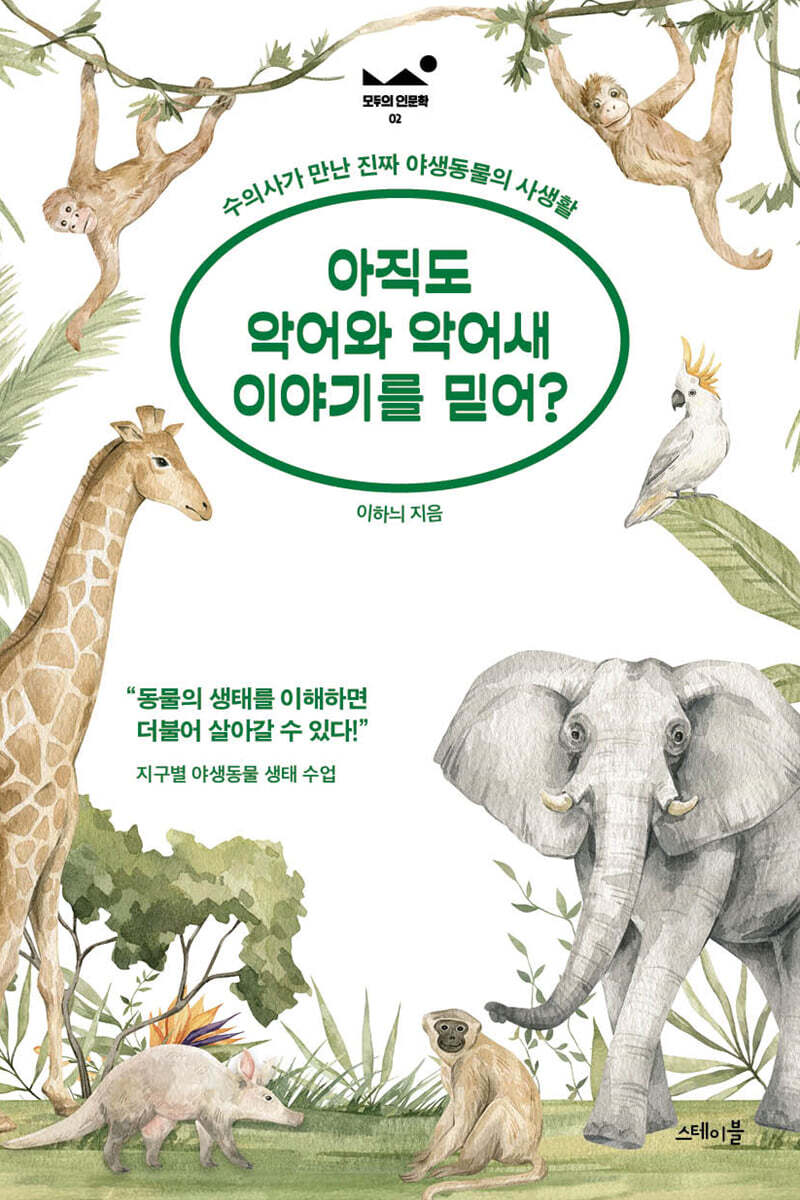
Do you still believe the story of the crocodile and the crocodile bird?
 |
Description
Book Introduction
If you understand the ecology of animals
We can live together!
A veterinarian's lesson on wildlife from around the world
The more you know, the more fascinating the habits and mysteries of wild animals become!
23 Biology Stories from the Perspectives of Coexistence, Love, and Social Life
When giving examples of animals living together, the relationship between crocodiles and alligators is often mentioned.
The story goes that the crocodile bird enters the crocodile's mouth, removes debris stuck in its teeth, and uses it as food, so the crocodile's teeth become clean.
It sounds like a fascinating and touching anecdote, but unfortunately it is not true.
The official name of the crocodile bird is the Egyptian plover.
They mainly live along rivers in North Africa and eat the fruits and seeds of plants.
We do not eat meat caught in the teeth of a carnivore, a crocodile.
In the case of crocodiles, more than 3,000 teeth fall out and grow back in their lifetime, and they grow so densely that debris does not get stuck easily.
That means there's no need for a crocodile to remove debris from between your teeth.
In fact, in the wild, it is difficult to observe a crocodile bird entering the mouth of a crocodile.
So why did this misunderstanding arise? In the 5th century BC, the ancient Greek historian Herodotus, while traveling, recorded a scene he happened to witness, which has long since become common knowledge.
As such, it is not easy to properly understand the ecology of wild animals because it is difficult to directly confirm it.
"Do You Still Believe the Story of the Crocodile and the Crocodile Bird?" is a book filled with vivid and fascinating facts about the author, a veterinarian, who has observed various wild animals while protecting them.
The animals he meets each have unique ecological characteristics, but they help each other like people, show outstanding maternal love, and even shower each other with gifts to show their love.
They also take advantage of others, harass specific individuals, fight with their spouses, and live a silent social life within the given roles.
Through this book, readers will be able to naturally learn about the preciousness of life and environmental protection, along with accurate knowledge about the ecology of wild animals.
We can live together!
A veterinarian's lesson on wildlife from around the world
The more you know, the more fascinating the habits and mysteries of wild animals become!
23 Biology Stories from the Perspectives of Coexistence, Love, and Social Life
When giving examples of animals living together, the relationship between crocodiles and alligators is often mentioned.
The story goes that the crocodile bird enters the crocodile's mouth, removes debris stuck in its teeth, and uses it as food, so the crocodile's teeth become clean.
It sounds like a fascinating and touching anecdote, but unfortunately it is not true.
The official name of the crocodile bird is the Egyptian plover.
They mainly live along rivers in North Africa and eat the fruits and seeds of plants.
We do not eat meat caught in the teeth of a carnivore, a crocodile.
In the case of crocodiles, more than 3,000 teeth fall out and grow back in their lifetime, and they grow so densely that debris does not get stuck easily.
That means there's no need for a crocodile to remove debris from between your teeth.
In fact, in the wild, it is difficult to observe a crocodile bird entering the mouth of a crocodile.
So why did this misunderstanding arise? In the 5th century BC, the ancient Greek historian Herodotus, while traveling, recorded a scene he happened to witness, which has long since become common knowledge.
As such, it is not easy to properly understand the ecology of wild animals because it is difficult to directly confirm it.
"Do You Still Believe the Story of the Crocodile and the Crocodile Bird?" is a book filled with vivid and fascinating facts about the author, a veterinarian, who has observed various wild animals while protecting them.
The animals he meets each have unique ecological characteristics, but they help each other like people, show outstanding maternal love, and even shower each other with gifts to show their love.
They also take advantage of others, harass specific individuals, fight with their spouses, and live a silent social life within the given roles.
Through this book, readers will be able to naturally learn about the preciousness of life and environmental protection, along with accurate knowledge about the ecology of wild animals.
- You can preview some of the book's contents.
Preview
index
Entering_Beyond Misunderstanding: The True Life of Wild Animals
Chapter 1: Symbiosis: Animals Living Together, Helping Each Other
1 We are stronger together: Malmijal and Clownfish
2 The Aunt Who Saved Her Nephew from Drowning: Kokiri's Co-Parenting
3 The world's largest sociable rodent: the capybara
4 The best hunters who move with team play: Orca
5 Sometimes defense is the best offense: Herbivores that travel in groups
[Question Book 1] When did livestock begin to coexist with humans? : The symbiotic relationship between humans and livestock
[Question Book 2] Why does illegal poaching occur? : No demand, no supply.
Chapter 2: Love: Animals that cherish and care for each other
1. Even first-time mothers find parenting difficult: The birth story of Euni, the spotted seal.
2 Are there any animals whose fathers are the primary caregivers? : Shaman
3. Loving and Fighting Hard: A Chimpanzee Couple
What's different about animals raised by humans? : Chimpanzee siblings
5 Will you like me if I give you a gift? : Male Hornbill
[Question Book 3] What Happens to Animals Who Have Lost Their Homes?: After Habitat Destruction
[Question Book 4] How Will Global Warming Affect Animals? : What We Can Do
Chapter 3 Social Life: Animals that Live in Communities and Maintain Order
1. A mantle given only to high-ranking males: Mantled baboon
2 Follow the Queen Who Fights the Best: Meerkat
Who would win in a fight between the three kings of beasts? Lion vs. Tiger
4 Bullying exists in animal societies too: baboons and Barbary sheep
5 You're Too Hot to Get Close to: Spiny Animals
6 The Secret of Immortality: The Naked Mole Rat
7 Born with a silver spoon in my mouth, eating well and living well: Hyena
[Question Book 5] How Plastic Is Ruining the Earth: Our Future, Traded for Convenience
[Question Book 6] How can I protect the wildlife around me? : Learning to live together
Chapter 1: Symbiosis: Animals Living Together, Helping Each Other
1 We are stronger together: Malmijal and Clownfish
2 The Aunt Who Saved Her Nephew from Drowning: Kokiri's Co-Parenting
3 The world's largest sociable rodent: the capybara
4 The best hunters who move with team play: Orca
5 Sometimes defense is the best offense: Herbivores that travel in groups
[Question Book 1] When did livestock begin to coexist with humans? : The symbiotic relationship between humans and livestock
[Question Book 2] Why does illegal poaching occur? : No demand, no supply.
Chapter 2: Love: Animals that cherish and care for each other
1. Even first-time mothers find parenting difficult: The birth story of Euni, the spotted seal.
2 Are there any animals whose fathers are the primary caregivers? : Shaman
3. Loving and Fighting Hard: A Chimpanzee Couple
What's different about animals raised by humans? : Chimpanzee siblings
5 Will you like me if I give you a gift? : Male Hornbill
[Question Book 3] What Happens to Animals Who Have Lost Their Homes?: After Habitat Destruction
[Question Book 4] How Will Global Warming Affect Animals? : What We Can Do
Chapter 3 Social Life: Animals that Live in Communities and Maintain Order
1. A mantle given only to high-ranking males: Mantled baboon
2 Follow the Queen Who Fights the Best: Meerkat
Who would win in a fight between the three kings of beasts? Lion vs. Tiger
4 Bullying exists in animal societies too: baboons and Barbary sheep
5 You're Too Hot to Get Close to: Spiny Animals
6 The Secret of Immortality: The Naked Mole Rat
7 Born with a silver spoon in my mouth, eating well and living well: Hyena
[Question Book 5] How Plastic Is Ruining the Earth: Our Future, Traded for Convenience
[Question Book 6] How can I protect the wildlife around me? : Learning to live together
Detailed image

Into the book
Orcas, which have a black back and white markings on their chest and around their eyes, are intelligent with an IQ of around 90.
They hunt together by cooperating with each other based on their superior intelligence.
Killer whales pass on their hunting skills to their offspring, friends, and relatives.
Experience passed down through generations accumulated and gradually developed hunting skills.
For example, orcas in Alaska have learned to steal fish tangled in long human fishing lines, and local orcas have inherited this skill and can now eat most of the fish tangled in the lines.
---From "The Best Hunter Moves Through Teamwork: Orca"
Giraffes are particularly popular with other herbivores.
Herbivores are divided into browsers, which eat leaves, and grazers, which eat grass.
Browser animals include elephants, giraffes, and deer, while grazer animals include rhinoceroses, buffalo, and antelope.
The long-necked giraffe is very large, standing 4.8 to 5.5 meters tall.
Because giraffes eat leaves from tall trees, their diet rarely overlaps with that of herbivores that graze on grass, and they can quickly detect predators approaching from a distance.
Herbivores graze next to giraffes, and when the giraffe detects an enemy approaching from afar and runs away, they adopt a strategy of running away together.
---From "Sometimes Defense is the Best Offense: Herbivores That Travel in Groups"
In the case of chickens, they are raised in narrow spaces about the size of a sheet of A4 paper, stacked five stories high.
Chickens raised in captivity have their beaks cut off as soon as they are born, out of concern that they might attack other chickens and thus lose their marketability.
Chicks are sexed by a sexer a few days after they are born.
If a male is identified as not capable of laying eggs at this time, its lifespan will be shortened.
If you are destined to become meat, you will only grow for 28 days, which is less than a month.
This is because the shipping age for chickens to be sent to the slaughterhouse is 28 to 35 days after birth.
The longer the meat is raised, the tougher it becomes and the higher the price, so it is sent for slaughter as quickly as possible.
---From "When did livestock start living with humans?: The symbiotic relationship between humans and livestock"
Chimpanzees live in groups of 20 to 150 and have a clear hierarchy.
It is a patriarchal society where the male is the leader, and members form a hierarchy centered around the leader.
As they live, they develop rich facial expressions like humans.
While other animals have a limited range of facial expressions, chimpanzees have a variety of expressions, including pursed lips, smiling, and tightly closing their mouths.
When communicating, use rich facial expressions and greet with a variety of vocalizations.
Intimacy is primarily expressed through 'grooming'.
Grooming is a habit common to other monkeys besides chimpanzees.
They groom each other's fur, removing fleas and other parasites, and keeping it neatly organized.
Chimpanzees spend a lot of time grooming themselves to form friendly relationships with family members and other group members.
---From "Love passionately and fight passionately: The chimpanzee couple"
One day, while I was cleaning the cage of a male hornbill.
The hornbill didn't avoid me, but instead brought me a stone with its beak, so I thought, 'What an interesting bird.'
But if you look closely, you'll see that they're taking turns giving stones to the female volunteers.
It turns out that the male southern ground hornbill has a habit of courting the female by giving her a nice stone.
The male hornbill loved a human, not a member of its own species.
After becoming aware of this feeling, I was troubled by the question, 'How should I accept it?'
---From "Will You Like Me If I Give You a Gift?: Male Hornbill"
The naked mole rat is also known as an immortal animal.
It is also helpful in research to prevent cancer in humans as it is resistant to cancer and aging.
The naked mole rat's lifespan is about 30 years.
That's 10 times longer than a mouse of similar size, which lives about three years.
In human terms, it is equivalent to having a lifespan of 800 years.
Even more interesting is the mortality rate of naked mole rats.
Humans begin to age at age 30, and the mortality rate doubles after age 30.
However, naked mole rats do not show any change in mortality rate as they age.
Because naked mole rat cells do not develop cancer.
They hunt together by cooperating with each other based on their superior intelligence.
Killer whales pass on their hunting skills to their offspring, friends, and relatives.
Experience passed down through generations accumulated and gradually developed hunting skills.
For example, orcas in Alaska have learned to steal fish tangled in long human fishing lines, and local orcas have inherited this skill and can now eat most of the fish tangled in the lines.
---From "The Best Hunter Moves Through Teamwork: Orca"
Giraffes are particularly popular with other herbivores.
Herbivores are divided into browsers, which eat leaves, and grazers, which eat grass.
Browser animals include elephants, giraffes, and deer, while grazer animals include rhinoceroses, buffalo, and antelope.
The long-necked giraffe is very large, standing 4.8 to 5.5 meters tall.
Because giraffes eat leaves from tall trees, their diet rarely overlaps with that of herbivores that graze on grass, and they can quickly detect predators approaching from a distance.
Herbivores graze next to giraffes, and when the giraffe detects an enemy approaching from afar and runs away, they adopt a strategy of running away together.
---From "Sometimes Defense is the Best Offense: Herbivores That Travel in Groups"
In the case of chickens, they are raised in narrow spaces about the size of a sheet of A4 paper, stacked five stories high.
Chickens raised in captivity have their beaks cut off as soon as they are born, out of concern that they might attack other chickens and thus lose their marketability.
Chicks are sexed by a sexer a few days after they are born.
If a male is identified as not capable of laying eggs at this time, its lifespan will be shortened.
If you are destined to become meat, you will only grow for 28 days, which is less than a month.
This is because the shipping age for chickens to be sent to the slaughterhouse is 28 to 35 days after birth.
The longer the meat is raised, the tougher it becomes and the higher the price, so it is sent for slaughter as quickly as possible.
---From "When did livestock start living with humans?: The symbiotic relationship between humans and livestock"
Chimpanzees live in groups of 20 to 150 and have a clear hierarchy.
It is a patriarchal society where the male is the leader, and members form a hierarchy centered around the leader.
As they live, they develop rich facial expressions like humans.
While other animals have a limited range of facial expressions, chimpanzees have a variety of expressions, including pursed lips, smiling, and tightly closing their mouths.
When communicating, use rich facial expressions and greet with a variety of vocalizations.
Intimacy is primarily expressed through 'grooming'.
Grooming is a habit common to other monkeys besides chimpanzees.
They groom each other's fur, removing fleas and other parasites, and keeping it neatly organized.
Chimpanzees spend a lot of time grooming themselves to form friendly relationships with family members and other group members.
---From "Love passionately and fight passionately: The chimpanzee couple"
One day, while I was cleaning the cage of a male hornbill.
The hornbill didn't avoid me, but instead brought me a stone with its beak, so I thought, 'What an interesting bird.'
But if you look closely, you'll see that they're taking turns giving stones to the female volunteers.
It turns out that the male southern ground hornbill has a habit of courting the female by giving her a nice stone.
The male hornbill loved a human, not a member of its own species.
After becoming aware of this feeling, I was troubled by the question, 'How should I accept it?'
---From "Will You Like Me If I Give You a Gift?: Male Hornbill"
The naked mole rat is also known as an immortal animal.
It is also helpful in research to prevent cancer in humans as it is resistant to cancer and aging.
The naked mole rat's lifespan is about 30 years.
That's 10 times longer than a mouse of similar size, which lives about three years.
In human terms, it is equivalent to having a lifespan of 800 years.
Even more interesting is the mortality rate of naked mole rats.
Humans begin to age at age 30, and the mortality rate doubles after age 30.
However, naked mole rats do not show any change in mortality rate as they age.
Because naked mole rat cells do not develop cancer.
---From "The Secret of Immortality: The Naked Mole Rat"
Publisher's Review
“Life is precious even to those who cannot speak.
“Just as people want happiness and fear pain, so do they.” _Dalai Lama
In Chapter 1, “Symbiosis,” we learn about wild animals that help each other and live together.
Clownfish, also known as the main character in the animated film Finding Nemo, live near sea anemones.
Although sea anemones may look like plants because they live attached to reefs, they are actually animals with mouths and use tentacles to move.
Fish that chase the clownfish are stung by the anemone's tentacles and become food, and the clownfish are protected by the anemone colony and also have foreign substances caught between the anemone's tentacles removed.
Clownfish may live their entire lives with a particular anemone they prefer, and their appearance, such as the size and pattern, may change depending on the type of anemone they live with.
In addition, it features elephants' communal parenting with their mothers and aunts, the capybara, which is the most popular animal and fits in everywhere, the killer whale, which is the best hunter and moves as a team, and herbivores that move in groups for defense.
Chapter 2, “Love,” examines the “relationships” between wild animals that care for and cherish each other.
It is full of stories that only the author, a veterinarian who works closely with wild animals in the field, can experience.
A hornbill with a large beak and a horn on top that resembles a rhinoceros.
It is an endangered species that is being poached due to the popularity of processed products made with its uniquely shaped beak.
They are monogamous and mate for life. The female enters a tree cavity, makes a nest with feathers, and lays eggs. The male then fills the hole with mud.
To protect the family from natural enemies such as snakes.
When the male brings food, the female devotes herself to raising the young.
Therefore, if a person catches one male hornbill, more than three hornbills will die.
When the author was volunteering at the Mohoro Wildlife Rescue Center in Africa, he observed a solitary male hornbill following female volunteers around, offering them rocks or plucking their hair like feathers.
This is a funny story about the courtship of a male hornbill, who, unable to find a female due to the threat of extinction, shows his affection for humans.
In addition, it contains the story of the birth of the spotted seal 'Euni', Shaman, whose father is the primary caregiver, a chimpanzee couple who love and fight passionately, and the story of artificial captivity that follows people more than its own kind.
Chapter 3, ‘Social Life’, introduces animals that live in groups while maintaining order.
It talks about the capes that only grow abundantly on high-ranking male Hamadryas baboons, the meerkats that make the most fighting females the leaders, the Barbary sheep and baboons that are victims of bullying, the porcupines and hedgehogs that cannot get close to their families because of their thorns, the naked mole rat that even suppresses reproduction based on social class, and the hyenas that have an easy life if they are born with a silver spoon in their mouths.
Additionally, the book features columns in the form of a "Questioning Book" that provide essential questions and answers for living with wild animals on Earth.
"When did livestock begin to coexist with humans? Why does illegal poaching occur? What happens to animals that have lost their habitats? How does global warming affect animals? How does plastic destroy the planet? How can I protect the wildlife around me?" Through these questions, readers will gain a more mature perspective on coexistence with wildlife.
“Just as people want happiness and fear pain, so do they.” _Dalai Lama
In Chapter 1, “Symbiosis,” we learn about wild animals that help each other and live together.
Clownfish, also known as the main character in the animated film Finding Nemo, live near sea anemones.
Although sea anemones may look like plants because they live attached to reefs, they are actually animals with mouths and use tentacles to move.
Fish that chase the clownfish are stung by the anemone's tentacles and become food, and the clownfish are protected by the anemone colony and also have foreign substances caught between the anemone's tentacles removed.
Clownfish may live their entire lives with a particular anemone they prefer, and their appearance, such as the size and pattern, may change depending on the type of anemone they live with.
In addition, it features elephants' communal parenting with their mothers and aunts, the capybara, which is the most popular animal and fits in everywhere, the killer whale, which is the best hunter and moves as a team, and herbivores that move in groups for defense.
Chapter 2, “Love,” examines the “relationships” between wild animals that care for and cherish each other.
It is full of stories that only the author, a veterinarian who works closely with wild animals in the field, can experience.
A hornbill with a large beak and a horn on top that resembles a rhinoceros.
It is an endangered species that is being poached due to the popularity of processed products made with its uniquely shaped beak.
They are monogamous and mate for life. The female enters a tree cavity, makes a nest with feathers, and lays eggs. The male then fills the hole with mud.
To protect the family from natural enemies such as snakes.
When the male brings food, the female devotes herself to raising the young.
Therefore, if a person catches one male hornbill, more than three hornbills will die.
When the author was volunteering at the Mohoro Wildlife Rescue Center in Africa, he observed a solitary male hornbill following female volunteers around, offering them rocks or plucking their hair like feathers.
This is a funny story about the courtship of a male hornbill, who, unable to find a female due to the threat of extinction, shows his affection for humans.
In addition, it contains the story of the birth of the spotted seal 'Euni', Shaman, whose father is the primary caregiver, a chimpanzee couple who love and fight passionately, and the story of artificial captivity that follows people more than its own kind.
Chapter 3, ‘Social Life’, introduces animals that live in groups while maintaining order.
It talks about the capes that only grow abundantly on high-ranking male Hamadryas baboons, the meerkats that make the most fighting females the leaders, the Barbary sheep and baboons that are victims of bullying, the porcupines and hedgehogs that cannot get close to their families because of their thorns, the naked mole rat that even suppresses reproduction based on social class, and the hyenas that have an easy life if they are born with a silver spoon in their mouths.
Additionally, the book features columns in the form of a "Questioning Book" that provide essential questions and answers for living with wild animals on Earth.
"When did livestock begin to coexist with humans? Why does illegal poaching occur? What happens to animals that have lost their habitats? How does global warming affect animals? How does plastic destroy the planet? How can I protect the wildlife around me?" Through these questions, readers will gain a more mature perspective on coexistence with wildlife.
GOODS SPECIFICS
- Date of issue: May 14, 2024
- Page count, weight, size: 184 pages | 304g | 140*210*10mm
- ISBN13: 9791193476031
- ISBN10: 1193476038
You may also like
카테고리
korean


korean

![GQ KOREA Mark (Monthly): December [2025]](http://librairie.coreenne.fr/cdn/shop/files/8ef265dbbfbf186523ed75ba7319009d.jpg?v=1765340328&width=3840)


