

Things you can only get from books even now
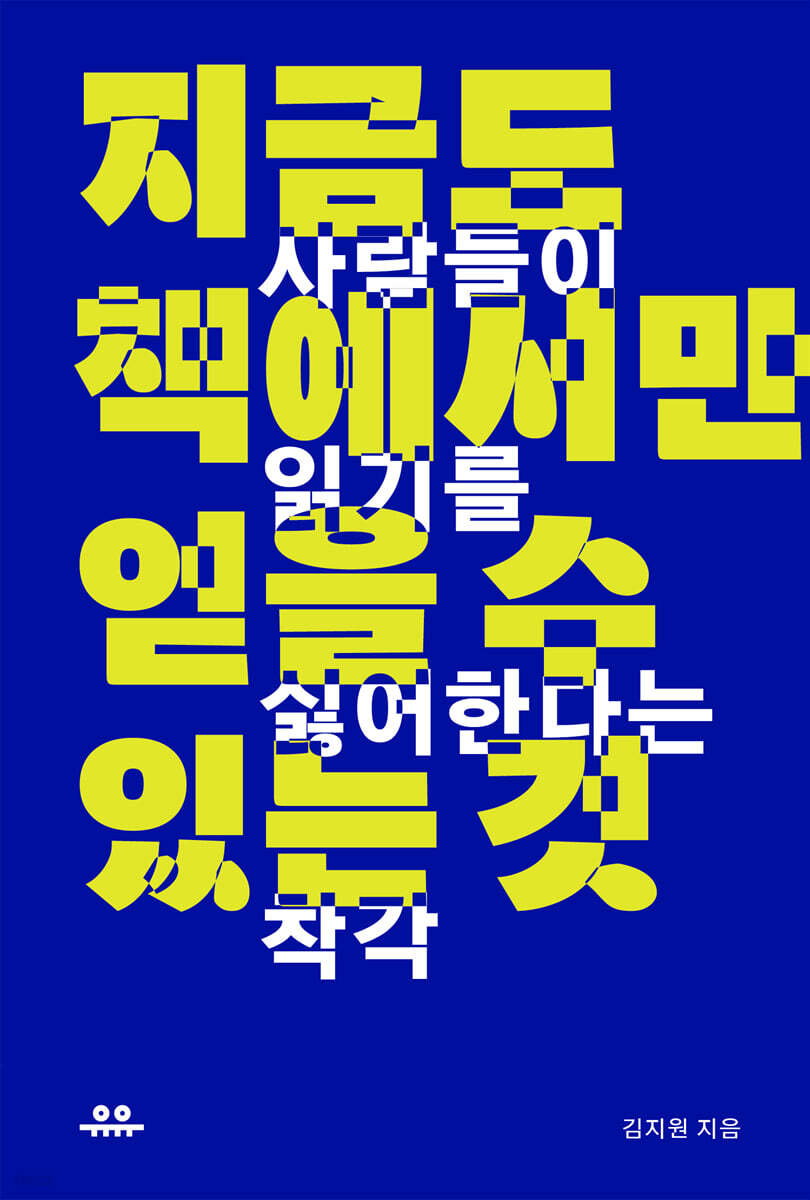 |
Description
Book Introduction
- A word from MD
- They say the number of readers has decreased.
They say videos are replacing books.
Is this true? Kim Ji-won, publisher of the humanities newsletter "Inspia," preaches the virtues of books.
You can find valuable information faster in books than in videos with unclear sources and a plethora of fake news.
And it's even fun.
- Son Min-gyu, humanities PD
A literacy crisis? The problem isn't literacy.
As the number of people reading books decreases, people too easily say, “People these days don’t like to read,” but statistics show that the time spent reading has not decreased compared to the past, nor has the amount of reading decreased.
So why has an 'enjoyable reading experience' become so distant and difficult?
Jiwon Kim, publisher of the book-based humanities newsletter 'Inspia,' sets out to find the answer to that question.
How do we read today? Why aren't we reading with pleasure? What constitutes "good" writing that is enjoyable to read? Where can "good" writing be found? After much thought, he found the answer: books.
Knowledge that is reliable and can be read with clear sources and authors.
An ark of valuable texts.
Because books are a tool that provides a reading experience without the distraction of advertisements or the intervention of algorithms.
How should we use and read such books in the future?
This book offers a fun and new path for those who read endlessly but gradually become tired of reading, and those who want to read more properly by finding books that answer their everyday questions.
As the number of people reading books decreases, people too easily say, “People these days don’t like to read,” but statistics show that the time spent reading has not decreased compared to the past, nor has the amount of reading decreased.
So why has an 'enjoyable reading experience' become so distant and difficult?
Jiwon Kim, publisher of the book-based humanities newsletter 'Inspia,' sets out to find the answer to that question.
How do we read today? Why aren't we reading with pleasure? What constitutes "good" writing that is enjoyable to read? Where can "good" writing be found? After much thought, he found the answer: books.
Knowledge that is reliable and can be read with clear sources and authors.
An ark of valuable texts.
Because books are a tool that provides a reading experience without the distraction of advertisements or the intervention of algorithms.
How should we use and read such books in the future?
This book offers a fun and new path for those who read endlessly but gradually become tired of reading, and those who want to read more properly by finding books that answer their everyday questions.
- You can preview some of the book's contents.
Preview
index
Introduction - An Era of the Lost Joy of Reading
Ⅰ In search of the lost enjoyable reading experience
1 People still look for 'good writing'
2. A pleasure to read, a worthwhile read, a readable text
3 The problem isn't literacy.
Ⅱ Book is [ ].
4 Books are a counter to algorithms
5 Books have information indicating their origin.
Book 6 is an ark of valuable texts.
7 Books are tools that help you experience a variety of reading experiences.
8 Books are a guide to reliable knowledge.
9 Books are texts with prefaces
Ⅲ Reading as a Tool
10. The 3-No Reading Method: Reading without burden, without focus, and without a plan
11 Ways to Find a 'Good' Book: Finding Books That Answer Everyday Questions
12 Interview Reading Techniques: Reading Like a Conversation
13 Note-taking Methods that Connect Reading and Writing: From Reading Journals to Book Reviews
14 Books as an Opportunity: Books are Nets for Fishing Thoughts
Outgoing Words - A World of Joyful Communication and Hospitality Opened by Reading
main
References
Ⅰ In search of the lost enjoyable reading experience
1 People still look for 'good writing'
2. A pleasure to read, a worthwhile read, a readable text
3 The problem isn't literacy.
Ⅱ Book is [ ].
4 Books are a counter to algorithms
5 Books have information indicating their origin.
Book 6 is an ark of valuable texts.
7 Books are tools that help you experience a variety of reading experiences.
8 Books are a guide to reliable knowledge.
9 Books are texts with prefaces
Ⅲ Reading as a Tool
10. The 3-No Reading Method: Reading without burden, without focus, and without a plan
11 Ways to Find a 'Good' Book: Finding Books That Answer Everyday Questions
12 Interview Reading Techniques: Reading Like a Conversation
13 Note-taking Methods that Connect Reading and Writing: From Reading Journals to Book Reviews
14 Books as an Opportunity: Books are Nets for Fishing Thoughts
Outgoing Words - A World of Joyful Communication and Hospitality Opened by Reading
main
References
Detailed image
Publisher's Review
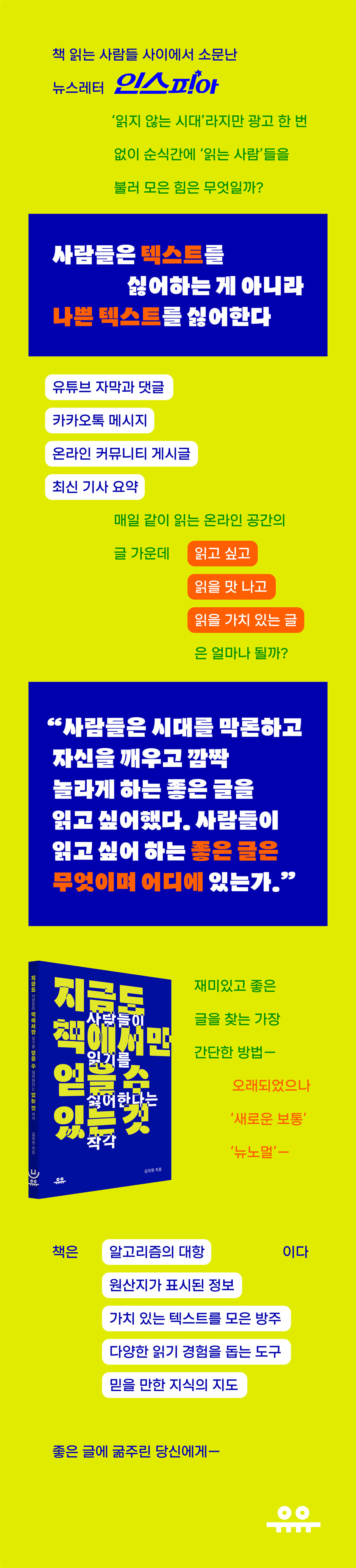
In the midst of the text flood era, I am looking for articles that are readable, worth reading, and fun to read.
People call this a “literacy crisis.”
The number of people reading is decreasing, and the number of people who read but do not understand is increasing.
We focus on vocabulary, concentration, and thinking skills, and on ways to improve literacy.
But is it really a literacy issue that people these days don't read well? Is it solely the fault of readers? Has the amount of time and volume of reading truly decreased compared to the past? "What You Can Still Gain from Books" begins with these questions.
The author tells us:
These days, people don't hate reading.
What people hate are boring articles, articles without value, articles with no sources and unreliable content that have been copied and pasted from somewhere, and such articles have not been welcomed regardless of the era.
But now most of our reading experiences take place online.
The online world is full of distractions that can make reading enjoyable and informative.
Context-free articles presented before your eyes by algorithms whose principles are unknown, so-called clickbait articles with provocative titles designed to attract clicks, unpleasant advertisements that inevitably appear between readings, statistics without sources, and baseless claims.
As the saying goes, “poverty in the midst of plenty,” the amount of text produced is increasing, but finding something worth reading is becoming increasingly difficult.
The author says that in an age where text is literally flooding in, the easiest way to find writing that is “readable (readability), worth reading (usefulness), and fun to read (enjoyment)” is to pick up a book.
Because books are at least reliable sources and author-identified, they offer a reading experience free from the distractions of advertising and algorithms.
Even if you need the information right away, it's much more economical to go to the library and find the right book to read than to endlessly search through useless texts.
That's why we still read books.
This is why I still recommend books to people who say that time is money and that they should save time to read books.
Books aren't just "must-reads," they're "the best problem-solving tools."
The author launched the book-based newsletter "Inspia" in 2021 to share the "fun of reading" and the "fun of thinking a little differently," and has published over 100 emails to date.
Regardless of whether it is new or old, we cover topics such as hate, labor, environment, AI, and media by combining at least two and as many as four books per volume.
Filled with "serious, long-form writing," this newsletter quickly attracted over 5,000 subscribers through word-of-mouth, without a single ad, and many passages introduced in the newsletter were rediscovered and re-evaluated by other readers.
What makes the author's reading style so persuasive is that, above all, he does not define books as "unconditionally good" or "must-read."
I chose the book not for the purpose of reading itself, but as the best tool to properly understand the issues we face in our daily lives and society, such as election law reform, no-kids zones, currency swaps, and Bitcoin.
For a generation criticized for its lack of literacy, books may not even have a chance to be properly recognized for their value.
Because it was common for reading obligations to be imposed before each person realized that books were a good medium.
As a member of that generation, the author had no choice but to redefine how to identify and utilize the "books I really need right now," and the newsletter he published was the result, bringing together "people who were hungry for good writing."
This book is divided into three parts.
After analyzing the current text ecosystem, where the "pleasant reading experience" has disappeared, and discussing why books can be a "new" alternative in this era, we introduce practical reading methods for placing and utilizing such books in the right places.
I recommend this book to anyone who is reading endlessly but is growing weary of reading because they can't find "good writing," anyone who wants to dig deep into the "literacy debate" to find a fundamental solution, anyone who is struggling with reading fatigue and wondering what books to read and how to read them, and anyone who wants to read more effectively and find books that answer their everyday questions.
People call this a “literacy crisis.”
The number of people reading is decreasing, and the number of people who read but do not understand is increasing.
We focus on vocabulary, concentration, and thinking skills, and on ways to improve literacy.
But is it really a literacy issue that people these days don't read well? Is it solely the fault of readers? Has the amount of time and volume of reading truly decreased compared to the past? "What You Can Still Gain from Books" begins with these questions.
The author tells us:
These days, people don't hate reading.
What people hate are boring articles, articles without value, articles with no sources and unreliable content that have been copied and pasted from somewhere, and such articles have not been welcomed regardless of the era.
But now most of our reading experiences take place online.
The online world is full of distractions that can make reading enjoyable and informative.
Context-free articles presented before your eyes by algorithms whose principles are unknown, so-called clickbait articles with provocative titles designed to attract clicks, unpleasant advertisements that inevitably appear between readings, statistics without sources, and baseless claims.
As the saying goes, “poverty in the midst of plenty,” the amount of text produced is increasing, but finding something worth reading is becoming increasingly difficult.
The author says that in an age where text is literally flooding in, the easiest way to find writing that is “readable (readability), worth reading (usefulness), and fun to read (enjoyment)” is to pick up a book.
Because books are at least reliable sources and author-identified, they offer a reading experience free from the distractions of advertising and algorithms.
Even if you need the information right away, it's much more economical to go to the library and find the right book to read than to endlessly search through useless texts.
That's why we still read books.
This is why I still recommend books to people who say that time is money and that they should save time to read books.
Books aren't just "must-reads," they're "the best problem-solving tools."
The author launched the book-based newsletter "Inspia" in 2021 to share the "fun of reading" and the "fun of thinking a little differently," and has published over 100 emails to date.
Regardless of whether it is new or old, we cover topics such as hate, labor, environment, AI, and media by combining at least two and as many as four books per volume.
Filled with "serious, long-form writing," this newsletter quickly attracted over 5,000 subscribers through word-of-mouth, without a single ad, and many passages introduced in the newsletter were rediscovered and re-evaluated by other readers.
What makes the author's reading style so persuasive is that, above all, he does not define books as "unconditionally good" or "must-read."
I chose the book not for the purpose of reading itself, but as the best tool to properly understand the issues we face in our daily lives and society, such as election law reform, no-kids zones, currency swaps, and Bitcoin.
For a generation criticized for its lack of literacy, books may not even have a chance to be properly recognized for their value.
Because it was common for reading obligations to be imposed before each person realized that books were a good medium.
As a member of that generation, the author had no choice but to redefine how to identify and utilize the "books I really need right now," and the newsletter he published was the result, bringing together "people who were hungry for good writing."
This book is divided into three parts.
After analyzing the current text ecosystem, where the "pleasant reading experience" has disappeared, and discussing why books can be a "new" alternative in this era, we introduce practical reading methods for placing and utilizing such books in the right places.
I recommend this book to anyone who is reading endlessly but is growing weary of reading because they can't find "good writing," anyone who wants to dig deep into the "literacy debate" to find a fundamental solution, anyone who is struggling with reading fatigue and wondering what books to read and how to read them, and anyone who wants to read more effectively and find books that answer their everyday questions.
GOODS SPECIFICS
- Date of issue: March 4, 2024
- Page count, weight, size: 198 pages | 127*188*10mm
- ISBN13: 9791167700841
You may also like
카테고리
korean


korean

![GQ KOREA Mark (Monthly): December [2025]](http://librairie.coreenne.fr/cdn/shop/files/8ef265dbbfbf186523ed75ba7319009d.jpg?v=1765340328&width=3840)


