

The stain spread and became a movie.
 |
Description
Book Introduction
Film critic Song Kyung-won's confession about the films he has cherished. “When a person like this says he loves something, he really loves it. “His 15-year-long work has been completed.” - Literary critic Shin Hyeong-cheol This is the first collection of reviews by Song Kyung-won, a film critic and editor-in-chief of Cine21. Generally, film critics start out as film journalists. Song Kyung-won, a rare example, debuted as a film critic and then became a film journalist. Perhaps that is why he is a critic who places more importance on illuminating our lives and memories that become scenes in films than on elevating the utility and meaning of films to a grand discourse. So he pours his heart and soul into films that capture fading memories, films that represent his past mistakes, films that allow him to compare other people's lives with his own. The twenty-eight essays included in this book are a compilation of Song Kyung-won's critical writings over the past fifteen years, selected from among his writings that condense his perspectives and worldview. Many cinephiles who heard the news of the publication of Song Kyung-won's first collection of criticism exclaimed, "Finally!" If you follow the 15-year trajectory of film critic Song Kyung-won in a single book, you will feel a deep affection for film spread within you. |
- You can preview some of the book's contents.
Preview
index
prolog
What it means to 'write' a movie 5
Chapter 1 Somehow unforgettable
“I don’t want to wake up here forever” 17
Always here, now, we are together 27
There is a movie that becomes the beginning of reason 39
48 Until Coincidence Becomes a Story
The stain spread and became a movie 61
The only thing that doesn't change is that everything changes. 73
Nostalgia for Movies 83
Some cracks are welcome 96
Chapter 2 Clear yet blurry
111 in the place where the movie disappeared
“The New World Will Save the Old World” 124
Although the frame may be part of the painting, 138
Lost in the narrative and wandering aimlessly 151
The desire to be persuaded 164
Recalling Memories You've Never Experienced 177
Cinema is not a magic name 189
The Good Game of Lies and Self-Deception 199
Not ready yet 212
Chapter 3 Looking back there
Hayao Miyazaki's Third Retirement Announcement 225
The feeling was there 235
Stop being awed and remember 248
Somewhere between Neverland and Wonderland 260
Reflections on 'The Best Movie' 273
Hearts that persevered and arrived at today 288
Recorder 297: Transforming Moments into Eternity
My Place in Other People's Stories 306
A fantasy world drawn with dots, lines, and planes 314
Epilogue
When a past movie speaks to me 326
On Film, Love, and Its Fate 340
Detailed image

Into the book
Perhaps writing about film is a task of chasing a mirage that is forever elusive.
If, despite all the anticipated setbacks and failures, the desire to keep writing just won't go away, then you must write.
You have to check the stain in your heart in some way.
--- p.8
The reason why a movie must be a movie is not in the realm of reason and rationality.
The life of a film filled with useless things resists and endures the passage of time only through confessions of taste.
Don Quixote, having heard the cruel truth from Sancho, says:
That the truth is being killed by facts.
Even so, or perhaps because of that, the confessions of those who try to protect their own truth, their own tastes, and what they believe and love (which are not like other people's business) are more beautiful the more reckless, dangerous, and stubborn they are.
--- p.23
Even the seemingly insignificant events that one person experiences are, in fact, the alternative history that movies have loved.
The film becomes part of the world through the power of the cameras that prove that the incident was there.
--- p.47
Sicario doesn't pretend to represent reality by making the screen transparent.
Instead, Denis Villeneuve intersperses distinctive shots between smooth edits, pushing the audience away from the screen and placing them in designated positions.
We are still unable to do anything and can only witness what is happening.
--- p.107
Unlike films that collide and realistically reveal social structural contradictions, “Minari” is a film wrapped in good intentions, and is filled with romantic imagination between scenes.
However, this is different from the illusion that conceals the structure.
If I had to explain it, it would be closer to filling in the blanks based on each person's experience.
--- p.255
If the towering, mountain-like famous quotes were a sight to behold, something I had to climb, the wonderful moments in the comics were like gentle friends who came to me and patted me on the shoulder.
When the esoteric truths point to the stars above the clouds, comics lower the threshold, sit down next to them, and tell them a story.
--- p.307
There are many definitions of animation, but I believe that it is essentially the work of giving life to abstract sensations through movement and motion.
If film prints images of reality like a print, animation directly depicts sensations and emotions.
--- p.321
Publisher's Review
Song Kyung-won's 15-year conversation with film
“All that time was my movie.”
Song Kyung-won does not believe that reviews change the meaning of a film or that films change the world.
But I know there are movies that get infinitely closer to reality.
While "The Murder of a Boy in Goryeong-ga" recreates history, it also confesses that the film is by no means reality.
Some films make the events that happened there into a part of the world, proving that they were there.
The Murder of a Boy in a High-Rise House is based on a true story that occurred in Taiwan in 1961, a time of political turmoil between indigenous people and immigrants.
No matter how much a story is based on facts and history, it cannot be said to be true.
"The Murder of a Boy in Goryeong-ga" acknowledges that the film cannot reveal the truth, and only acknowledges that "my historical roots" exist there through the limited light of the screen and the movement of the camera.
The author, who rewatched this film in theaters when it was first released in Korea in 2017, realized that his perspective on the past had changed.
Movies don't change me.
My changed appearance is only revealed through the movie.
Likewise, movies don't change the world.
We can only see the changing world through movies.
So, for Song Kyung-won, movies are a kind of coordinate.
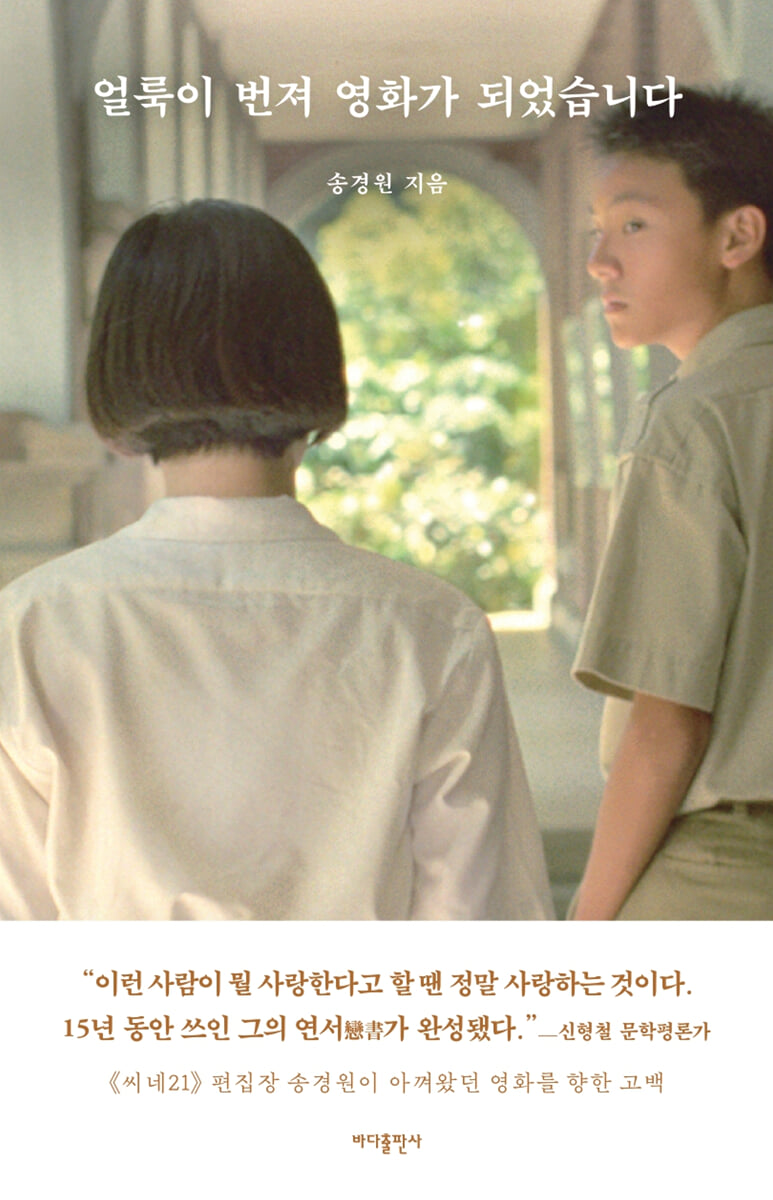
The fact that the cover of this book is a scene from "The Murder of a Boy in Goryeong-ga" is also an expression of the author's will to see how he himself has changed over time.
He continues to create the present by attempting to converse with past films.
To complete this book, the author rewrote the two epilogues, “Josee, the Tiger and the Fish” and “Eternal Sunshine of the Spotless Mind,” and listened to “what the past movies were saying to him.”
As he has persistently mentioned, films provide an opportunity to look at the scenes we pass by in our daily lives in an unfamiliar way.
The unfamiliar world here is the self in the past, the breakup of a relationship that could not be resolved at the time, and the absence of emotions.
When a scene in a movie feels like our own, the movie connects us to things that have passed, and we can call the meaning of the conflict and reconciliation that we realized belatedly 'fate'.
Song Kyung-won also confesses that 'writing' a movie was his 'destiny' as he completed the last chapter of this book.
“If movies speak truth to us, it is not in the movies.
“The truth blossoms somewhere between the film and me, in different forms each time.” (p. 12)
When the characters walk out of the theater
Another critique that well summarizes Song Kyung-won's perspective is "Boyhood."
Boyhood is a film that connects 15-minute cuts shot every year for 12 years.
The 12 years of the characters in the movie and my 12 years passed in the same way.
We too have experienced the same childhood, growing pains, and environmental changes they experienced.
It's a common story that everyone experiences, but Song Kyung-won is confident that this film will become a classic because it is so common.
It seems natural to follow director Linklater, who has created cinematic reality in his own way by carefully considering editing and connections that reduce the gap between film time and real time.
This is because Boyhood, by recognizing the film's time until the very end, "creates a huge space of communication where each person can evoke their own reality" in order to "communicate with the audience outside the film without being confined to the narrative."
It is also a sympathy for a life full of chance, unconsciousness, and uncertainty, and a sense of kinship from having grown up together in such a world.
This is why, just like our daily lives that continue even after we leave the theater, the characters' time seems to continue to flow behind the screen.
With the screen between us, the movie tries to resemble reality, and we try to resemble the movie, listening to each other's stories.
This impossible yet beautiful attempt at dialogue is what made the story last so long outside the theater.
“The moment the lights in the theater come on, you become one of those elements.” (p. 38)
Movies are where tastes converge.
Song Kyung-won is always sincere in his critiques of games, dramas, and animations, in addition to movies.
Although he writes based on literature and film, he is already known as a 'geek', as evidenced by his confession that "most of the sentences that shook me were encountered in comic books."
Even if it's a movie I don't want to see, I'm a film journalist born with the destiny to watch it all the way through and write about it in order to connect with readers whose tastes I don't know, but there are bound to be movies I want to see and write about.
The first sentence written by the author for the first film introduced in this book, “The French Dispatch,” seems to describe the author’s current location rather than his impressions of the film.
“The media, the times, and life are changing.
I feel like I'm at the end of my rope.
“You can resist and disappear, or you can adapt and survive.” Cine21, which holds the title of Korea’s only film magazine, is also anxious in today’s world where concerns about the crisis facing theaters are growing due to the normalization of YouTube and OTT.
Still, he emphasizes that there is a place for film lovers to lean on.
The author says of the book's final chapter, "Marona the Fantasy," that it is a film that "doesn't particularly require criticism or analysis."
Although he makes a living as a film critic and writer, he closes the book by confessing his love for films that touch our emotions and tastes.
He seems to feel relieved only when he reaches out in some way to where his heart is.
He serialized a column titled “Song Kyung-won’s Deoktong Thought” in Cine21, and served as a judge for the Seoul International Animation Film Festival, supporting individual tastes and willingly entering that world.
And fortunately, I was welcomed by many readers, and we met through a connection called taste.
The fact that the book includes the drama "Pachinko," the game "The Last of Us Part 2," the anime "Let's Decorate the Promised Flower on the Morning of Farewell," and the comic book "March Comes in Like a Lion" shows how wide the author's scope of activity is and how much he loves people with different tastes and personal stories.
In his recommendation, critic Shin Hyeong-cheol said this about critic Song Kyung-won:
“He is rather gentle, but that is because he speaks humbly, not because he lacks assertiveness.” This is Song Kyung-won’s attitude toward movies, his support for tastes, and, furthermore, his way of supporting each individual’s life.
Somehow, the appearances of Arthur (Bill Murray), the editor-in-chief of The French Dispatch, and Song Kyung-won, the editor-in-chief of Cine21, overlap.
GOODS SPECIFICS
- Date of issue: May 24, 2024
- Page count, weight, size: 352 pages | 456g | 138*214*20mm
- ISBN13: 9791166892486
- ISBN10: 1166892484
You may also like
카테고리
korean


korean


