

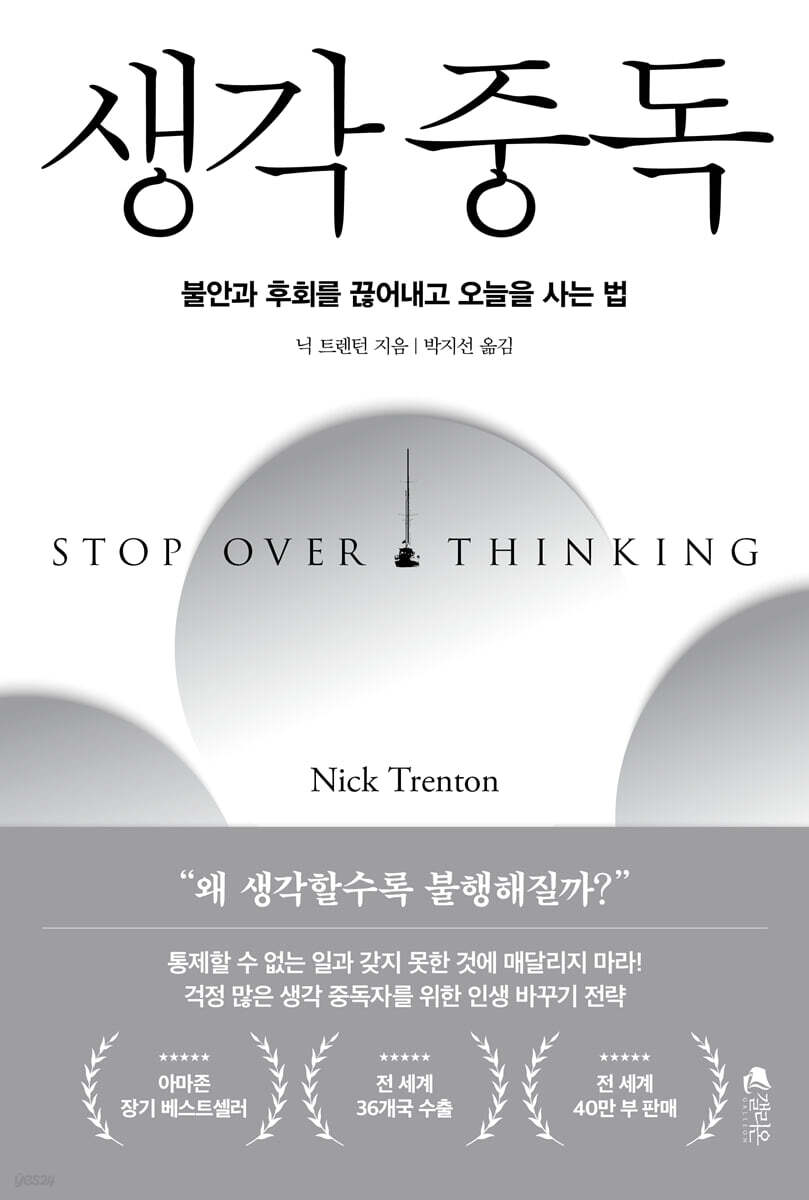
Thought addiction
 |
Description
Book Introduction
- A word from MD
-
My misfortune is due to my thoughtsA bestseller in the United States through word of mouth alone, published independently.
Modern people are trapped in a dilemma where they become unhappy no matter how busy they live.
The author diagnoses that it is because we think too much.
This book provides effective ways to reduce your thoughts, based on the latest research and your own experience.
March 15, 2024. Humanities PD Son Min-gyu
“A book that started as an independent publication and captivated hundreds of thousands of readers through word of mouth alone!”
* Amazon long-term bestseller, copyright exported to 36 countries *
* 400,000 copies sold worldwide, 9,800 cumulative Amazon reviews *
* YouTube [Brain Rich People] Strongly recommended by Dr. Heo Gyu-hyung, a psychiatrist *
* Self-development YouTube channel [Moving Water] Strongly recommended by Lee Dong-soo *
“Why do I become more unhappy the more I think about it?”
I have too many regrets and worries
23 Strategies to Save the Lives of Thought Addicts
The globally popular novel 『Thought Addiction』, which was first published as an independent publication and rose to the top of Amazon's comprehensive bestseller list through word of mouth and explosive support from readers, has finally been published in Korea after being exported to 36 countries.
The author defines "overthinking" as a problematic epidemic in modern society that slowly destroys our lives without us even realizing it, and urges us to recognize its severity and break free from its toxicity by immediately changing our thinking patterns.
People who reminisce about the past and have endless regrets, people who worry about even the smallest things, people who are overwhelmed by the amount of work they have to do and end up procrastinating, people who are afraid that their every word will harm a relationship…
They are all people trapped in a 'prison of thoughts'.
People trapped here suffer from anxiety, develop negative thought patterns that lead them to misperceive reality, and ultimately lead to extreme self-denial.
You can't even get out when you want.
Why on earth would I walk into a maze like this?
The answer is simple.
This is because we have not been able to properly manage stress, which is the default in modern society.
Drawing on numerous academic papers and scientific evidence, "Thought Addiction" reveals why modern people so easily fall into the prison of their thoughts. It also introduces various ways to break this cycle of overthinking, using psychological tools discovered in the latest research.
The specific examples presented in this book help us understand how certain thoughts gradually increase our anxiety.
Above all, this book will help us regain our lost focus on life by changing our 'thoughts about thoughts.'
* Amazon long-term bestseller, copyright exported to 36 countries *
* 400,000 copies sold worldwide, 9,800 cumulative Amazon reviews *
* YouTube [Brain Rich People] Strongly recommended by Dr. Heo Gyu-hyung, a psychiatrist *
* Self-development YouTube channel [Moving Water] Strongly recommended by Lee Dong-soo *
“Why do I become more unhappy the more I think about it?”
I have too many regrets and worries
23 Strategies to Save the Lives of Thought Addicts
The globally popular novel 『Thought Addiction』, which was first published as an independent publication and rose to the top of Amazon's comprehensive bestseller list through word of mouth and explosive support from readers, has finally been published in Korea after being exported to 36 countries.
The author defines "overthinking" as a problematic epidemic in modern society that slowly destroys our lives without us even realizing it, and urges us to recognize its severity and break free from its toxicity by immediately changing our thinking patterns.
People who reminisce about the past and have endless regrets, people who worry about even the smallest things, people who are overwhelmed by the amount of work they have to do and end up procrastinating, people who are afraid that their every word will harm a relationship…
They are all people trapped in a 'prison of thoughts'.
People trapped here suffer from anxiety, develop negative thought patterns that lead them to misperceive reality, and ultimately lead to extreme self-denial.
You can't even get out when you want.
Why on earth would I walk into a maze like this?
The answer is simple.
This is because we have not been able to properly manage stress, which is the default in modern society.
Drawing on numerous academic papers and scientific evidence, "Thought Addiction" reveals why modern people so easily fall into the prison of their thoughts. It also introduces various ways to break this cycle of overthinking, using psychological tools discovered in the latest research.
The specific examples presented in this book help us understand how certain thoughts gradually increase our anxiety.
Above all, this book will help us regain our lost focus on life by changing our 'thoughts about thoughts.'
- You can preview some of the book's contents.
Preview
index
Recommendation
Special Preface to the Korean Edition
Chapter 1.
Stop Overthinking_The Problem That's Plaguing You Most
What makes your mind noisy and painful
Anxiety, did it come from within me?
Stress, does it come from the environment?
The world around us
Overthinking ruins us
Chapter 2.
Letting Go of Stress - Will You Be Controlled or Will You Control?
Floating a Lifeboat in a Storm: The 4A Stress Management Techniques
Adding Resilience to Emotional Outbursts: A Stress Diary
Breaking Out of the Anxiety Vortex: The 5-4-3-2-1 Grounding Technique
'I' and the Problem Are Different: Narrative Therapy and Externalization
Chapter 3.
Escape from Anxiety_If you leave it alone, it will consume you.
How to Stop Wasting Time on Stress
Recovering lost time
Increase productivity through time allocation
Chapter 4.
The Art of the Mind: Training Yourself to Control Your Mind
Consciously Immersing Yourself in Your Sensations: Autogenic Relaxation Training
Controlling Your Runaway Brain: Guided Imagery and Visualization Techniques
Using the cheat code called "Relaxation": Progressive Muscle Relaxation
Blocking the Anxiety Surge: Postponing Worries
Chapter 5.
The Art of Thinking: Never Let Yourself Become Anxious
We see different worlds
How to Erase My Anxious World
Reframe Self-Talk with Cognitive Behavioral Therapy
Chapter 6.
How to Live Today: Survival Strategies for Not Wasting Your Life
Attitude 1: Focus on what you can control, not what you can't.
Attitude 2: Focus on what you can do, not what you can't do.
Attitude 3: Focus on what you have, not what you don't have.
Attitude 4: Focus on the present, not the past or future.
Attitude 5: Focus on what you need, not what you want.
Don't let anxiety take the wheel of your life.
Get rid of that annoying, nonstop chatterbox friend, Rumination.
How to Stop Your Brain from Racing Thoughts
Special Preface to the Korean Edition
Chapter 1.
Stop Overthinking_The Problem That's Plaguing You Most
What makes your mind noisy and painful
Anxiety, did it come from within me?
Stress, does it come from the environment?
The world around us
Overthinking ruins us
Chapter 2.
Letting Go of Stress - Will You Be Controlled or Will You Control?
Floating a Lifeboat in a Storm: The 4A Stress Management Techniques
Adding Resilience to Emotional Outbursts: A Stress Diary
Breaking Out of the Anxiety Vortex: The 5-4-3-2-1 Grounding Technique
'I' and the Problem Are Different: Narrative Therapy and Externalization
Chapter 3.
Escape from Anxiety_If you leave it alone, it will consume you.
How to Stop Wasting Time on Stress
Recovering lost time
Increase productivity through time allocation
Chapter 4.
The Art of the Mind: Training Yourself to Control Your Mind
Consciously Immersing Yourself in Your Sensations: Autogenic Relaxation Training
Controlling Your Runaway Brain: Guided Imagery and Visualization Techniques
Using the cheat code called "Relaxation": Progressive Muscle Relaxation
Blocking the Anxiety Surge: Postponing Worries
Chapter 5.
The Art of Thinking: Never Let Yourself Become Anxious
We see different worlds
How to Erase My Anxious World
Reframe Self-Talk with Cognitive Behavioral Therapy
Chapter 6.
How to Live Today: Survival Strategies for Not Wasting Your Life
Attitude 1: Focus on what you can control, not what you can't.
Attitude 2: Focus on what you can do, not what you can't do.
Attitude 3: Focus on what you have, not what you don't have.
Attitude 4: Focus on the present, not the past or future.
Attitude 5: Focus on what you need, not what you want.
Don't let anxiety take the wheel of your life.
Get rid of that annoying, nonstop chatterbox friend, Rumination.
How to Stop Your Brain from Racing Thoughts
Detailed image

Into the book
We live in a world overloaded with stimulation, with extreme tension and over-thinking.
Thinking too much overloads our natural thought processes, and when we think too much, our thought processes become out of our control.
The result is suffering.
The endless contemplation of life and self torments us.
Once you start, it's hard to stop and can lead to self-destructive results.
Our brains are designed to help us solve problems and understand situations more clearly, but when we overthink, they do the opposite.
Worry, anxiety, stress, rumination, obsession… whatever you call it, thinking too much is not only unpleasant, it’s unhelpful in every way.
--- p.21
Besides genes, there are other factors that trigger anxiety in us.
Most of us fall into the trap of thinking that we have solved a problem by overthinking it.
Just as James, concerned about his health, deluded himself into thinking he was getting to the root of the problem by constantly digging into various causes and solutions.
But in reality, overthinking often leads to no conclusion.
People who think too much only get stuck in a framework of analyzing and reconsidering various possibilities.
No matter how much you scratch an itchy spot, it only feels refreshing for a moment and the itch never goes away.
--- p.31
Even in the same situation, people's evaluations are very different, and experiences depend on the evaluation, not the situation.
Depending on how you evaluate yourself in life, your stress may end up getting worse.
For example, if you are someone who feels that control is external to you—that is, if you don't feel in control of your life but rather that it is influenced by luck, chance, and other people—you will likely experience new situations as threats rather than exciting challenges.
Once they perceive a threat, they become anxious and act as if they were actually threatened.
--- p.38
The best skill a person who thinks too much can have is to distinguish between awareness and anxiety.
Awareness is neutral, comfortable and calm.
Anxiety, on the other hand, involves emotions and we often get caught up in those emotions.
People who think too much often become anxious even in situations that simply require awareness.
--- p.54
Stress avoidance cannot be said to be running away from obligations or denying the real problem.
It's simply a process of learning to say "no" to unnecessary and harmful stress.
We can always reject situations and people that place too much demand on ourselves and our resources.
If something in your life is taking up all your time, you have the right to refuse it.
--- p.58
If you think about it, it's surprising how many people prioritize stress in their lives.
We often spend time on things that make us feel bad, anxious, or depressed, while recovery and reflection are often relegated to the bottom of our to-do list or not even considered.
Do you remember when you last intentionally prioritized rest and relaxation? Like most people, you probably always prioritize hard work, then spend whatever scraps of time and energy you have left over on the rest.
This is no different from Suzy's situation, where she is struggling to fit meditation into her schedule for the sake of her mental health and then finds it overwhelming.
--- p.91
Having a clear and concise list of tasks to be completed can actually help you focus your attention, which in turn can help you feel calmer and more in control.
This isn't just a feeling, it's a reality! With less to think about, you'll be less likely to overthink, and overall, you'll feel less stressed and confused.
To achieve this, you must execute consistently.
You need to understand your workflow and make sure that work doesn't pile up.
When a new issue arises that requires attention, you must jump in immediately and decide how to respond as quickly as possible.
Is following a link sent by a friend a priority right now? Is that email from your bank important? I just found out I'm out of milk. What's the quickest way to deal with it?
--- p.104
Allocating time allows you to quickly switch between tasks and avoid multitasking.
Schedule yourself to do only one task at a time and focus on that task.
By planning ahead, you can always prioritize your tasks without wasting time and energy deciding what to do.
We want to do 'deep work' by fully immersing ourselves in what we are doing rather than paying shallow attention to many things at once.
This deep immersion in your work not only makes you more efficient (getting more done in the same amount of time), but it also makes you much less stressed.
Therefore, you can achieve more satisfying work performance with less mental and emotional effort.
--- p.123
Our brains work at an incredibly fast pace, imagining scenes that have nothing to do with reality and causing anxiety.
No matter how much we try to induce visual sensations, the body is bound to be slower than the brain.
However, if you train your senses to be sensitive in these situations, you can accurately perceive the current environment through your physical senses, rather than the anxiety in your head.
Visualization shifts the gears of your brain, slowing it down and helping you better control your runaway brain.
--- p.140
People often and easily assume that their ideas are completely correct.
Isn't it funny? We usually don't question the thoughts that cross our minds.
But if we look closely at our thoughts, it's easy to see the distortions, inaccuracies, and false narratives that keep us trapped in patterns of overthinking and stress.
Whether it's through old habits and customs, trauma, or beliefs taught to us, various narratives become deeply ingrained in our minds, convincing us that our thoughts are not interpretations of reality, but reality itself.
--- p.183
Focusing on what I can't do is like pushing a rock that can't be moved.
No matter how much you push, the stone won't budge.
Only you will lose energy.
A stone that doesn't move can't be pushed.
That's true! But why waste energy focusing on things you can't change? If you could focus your efforts elsewhere, you could achieve real change. Why waste your efforts?
--- p.207
Focusing on what you have allows you to view every situation positively and healthily.
What resources do I have? What's going well? What do I have to be grateful for? With this mindset, you can find solutions and new opportunities.
Conversely, if you focus on what you have lost, what you lack, or what is wrong, you will only see that.
If we focus only on these things, we will completely miss the solution that will free us from our unhappiness.
--- p.212
We feel compassion for the emotion of fear, and we know that it is real and painful, even if we don't fall into it deeply.
But again, while it's perfectly acceptable to get in the car with fear or anxiety, you shouldn't let those emotions take the wheel and dictate the direction of your life!
--- p.223
Let's channel that anxious energy into something that will help us improve the situation, or at least accept it.
Then you can reconnect with the world and escape the endless hurricane that blows through your head and keeps you spinning in place.
We've already talked about the ability to tolerate pain, but simply learning to shift your attention at the right moment can go a long way toward building mental resilience.
Thinking too much overloads our natural thought processes, and when we think too much, our thought processes become out of our control.
The result is suffering.
The endless contemplation of life and self torments us.
Once you start, it's hard to stop and can lead to self-destructive results.
Our brains are designed to help us solve problems and understand situations more clearly, but when we overthink, they do the opposite.
Worry, anxiety, stress, rumination, obsession… whatever you call it, thinking too much is not only unpleasant, it’s unhelpful in every way.
--- p.21
Besides genes, there are other factors that trigger anxiety in us.
Most of us fall into the trap of thinking that we have solved a problem by overthinking it.
Just as James, concerned about his health, deluded himself into thinking he was getting to the root of the problem by constantly digging into various causes and solutions.
But in reality, overthinking often leads to no conclusion.
People who think too much only get stuck in a framework of analyzing and reconsidering various possibilities.
No matter how much you scratch an itchy spot, it only feels refreshing for a moment and the itch never goes away.
--- p.31
Even in the same situation, people's evaluations are very different, and experiences depend on the evaluation, not the situation.
Depending on how you evaluate yourself in life, your stress may end up getting worse.
For example, if you are someone who feels that control is external to you—that is, if you don't feel in control of your life but rather that it is influenced by luck, chance, and other people—you will likely experience new situations as threats rather than exciting challenges.
Once they perceive a threat, they become anxious and act as if they were actually threatened.
--- p.38
The best skill a person who thinks too much can have is to distinguish between awareness and anxiety.
Awareness is neutral, comfortable and calm.
Anxiety, on the other hand, involves emotions and we often get caught up in those emotions.
People who think too much often become anxious even in situations that simply require awareness.
--- p.54
Stress avoidance cannot be said to be running away from obligations or denying the real problem.
It's simply a process of learning to say "no" to unnecessary and harmful stress.
We can always reject situations and people that place too much demand on ourselves and our resources.
If something in your life is taking up all your time, you have the right to refuse it.
--- p.58
If you think about it, it's surprising how many people prioritize stress in their lives.
We often spend time on things that make us feel bad, anxious, or depressed, while recovery and reflection are often relegated to the bottom of our to-do list or not even considered.
Do you remember when you last intentionally prioritized rest and relaxation? Like most people, you probably always prioritize hard work, then spend whatever scraps of time and energy you have left over on the rest.
This is no different from Suzy's situation, where she is struggling to fit meditation into her schedule for the sake of her mental health and then finds it overwhelming.
--- p.91
Having a clear and concise list of tasks to be completed can actually help you focus your attention, which in turn can help you feel calmer and more in control.
This isn't just a feeling, it's a reality! With less to think about, you'll be less likely to overthink, and overall, you'll feel less stressed and confused.
To achieve this, you must execute consistently.
You need to understand your workflow and make sure that work doesn't pile up.
When a new issue arises that requires attention, you must jump in immediately and decide how to respond as quickly as possible.
Is following a link sent by a friend a priority right now? Is that email from your bank important? I just found out I'm out of milk. What's the quickest way to deal with it?
--- p.104
Allocating time allows you to quickly switch between tasks and avoid multitasking.
Schedule yourself to do only one task at a time and focus on that task.
By planning ahead, you can always prioritize your tasks without wasting time and energy deciding what to do.
We want to do 'deep work' by fully immersing ourselves in what we are doing rather than paying shallow attention to many things at once.
This deep immersion in your work not only makes you more efficient (getting more done in the same amount of time), but it also makes you much less stressed.
Therefore, you can achieve more satisfying work performance with less mental and emotional effort.
--- p.123
Our brains work at an incredibly fast pace, imagining scenes that have nothing to do with reality and causing anxiety.
No matter how much we try to induce visual sensations, the body is bound to be slower than the brain.
However, if you train your senses to be sensitive in these situations, you can accurately perceive the current environment through your physical senses, rather than the anxiety in your head.
Visualization shifts the gears of your brain, slowing it down and helping you better control your runaway brain.
--- p.140
People often and easily assume that their ideas are completely correct.
Isn't it funny? We usually don't question the thoughts that cross our minds.
But if we look closely at our thoughts, it's easy to see the distortions, inaccuracies, and false narratives that keep us trapped in patterns of overthinking and stress.
Whether it's through old habits and customs, trauma, or beliefs taught to us, various narratives become deeply ingrained in our minds, convincing us that our thoughts are not interpretations of reality, but reality itself.
--- p.183
Focusing on what I can't do is like pushing a rock that can't be moved.
No matter how much you push, the stone won't budge.
Only you will lose energy.
A stone that doesn't move can't be pushed.
That's true! But why waste energy focusing on things you can't change? If you could focus your efforts elsewhere, you could achieve real change. Why waste your efforts?
--- p.207
Focusing on what you have allows you to view every situation positively and healthily.
What resources do I have? What's going well? What do I have to be grateful for? With this mindset, you can find solutions and new opportunities.
Conversely, if you focus on what you have lost, what you lack, or what is wrong, you will only see that.
If we focus only on these things, we will completely miss the solution that will free us from our unhappiness.
--- p.212
We feel compassion for the emotion of fear, and we know that it is real and painful, even if we don't fall into it deeply.
But again, while it's perfectly acceptable to get in the car with fear or anxiety, you shouldn't let those emotions take the wheel and dictate the direction of your life!
--- p.223
Let's channel that anxious energy into something that will help us improve the situation, or at least accept it.
Then you can reconnect with the world and escape the endless hurricane that blows through your head and keeps you spinning in place.
We've already talked about the ability to tolerate pain, but simply learning to shift your attention at the right moment can go a long way toward building mental resilience.
--- p.231
Publisher's Review
“Why do we overthink and suffer?”
I keep falling into anxiety
It's because of the illusion that it's being solved.
There was someone who was concerned about a minor health problem.
As I was researching information, I became anxious about the possibility of something happening.
“No, maybe I’m just thinking too much.” I decided not to think about it anymore… but now I’m starting to feel stressed about thinking too much about my health.
I was worried that I might need counseling or have a panic disorder, and ended up recalling a completely unrelated past incident.
All this suffering, which ended with 'Why am I always like this!', began with a single dot I found on my shoulder!
If you think too much, you will get confused.
Your thoughts become more and more entangled, you become more stressed than necessary, and you end up in self-denial and self-criticism.
At this time, the brain plays an opposing role in understanding the situation.
It's just increasing the size of your thoughts while under the illusion that you're solving something.
This vicious cycle of feeling down, feeling anxious, and suffering from negative thoughts is the result of 'overthinking'.
Overthinking, which has emerged as a hot topic in modern society where people have lost their ability to concentrate, is not easy to escape.
Where does excessive thinking come from? Genetics and the environment we grew up in are among the causes, but a major contributing factor is a habitually negative outlook on the world, which leads to underlying anxiety.
Thinking too much can lead to the misconception that the problem is being resolved.
This book focuses on how to break down that misconception and manage stress so that anxiety doesn't invade your daily life.
It helps you change your negative perspectives through practical, concrete examples and gives you a sense of control over your life.
Eventually, you will find a way to regain your well-being and happiness without falling into anxiety.
.
“How does overthinking ruin me?”
Relationships that keep getting tangled, frequent mistakes at work, and a lack of focus…
We must find a way to save ourselves!
There is nothing wrong with questioning something, asking yourself fundamental questions, and then thinking about the answers.
But excessive thinking is different.
We constantly replay past events, regret them, and spend our energy worrying about future events that haven't happened yet.
It is natural that people who are obsessed with overthinking have difficulty with interpersonal relationships and are less efficient at work.
It not only ruins your mind but also your daily life and has a negative impact on your overall life.
The author found his own solutions to the problems we face and included them in his first book, Overthinking.
This book, which quickly became an Amazon bestseller and received explosive interest from readers around the world, teaches you how to save your life using the 4A stress management method, externalization, and cognitive behavioral therapy, which have been proven through various research papers.
In addition, it helps you solve everyday problems step by step through time management techniques that allow you to work efficiently and environmental management techniques that are suitable for you.
Whether you want to relax and distance yourself from your problems, break down big, scary tasks into smaller, easier ones, or simply let go of the feeling of being overwhelmed by a thousand swirling worries, you can always use the solutions in this book.
“Don’t let anxiety take the wheel of your life.”
Don't get hung up on things you can't control or things you don't have.
How to live today
When you overthink, you overthink problems and underestimate your problem-solving abilities.
They see even a small pile of dirt as a huge mountain, convince themselves that there is nothing they can do, and rage inside over things they cannot control.
On the other hand, calm people find their way through disasters by believing in their own abilities and resilience.
It's about focusing your thoughts on the values you truly desire and limiting stress so that anxiety doesn't invade your life.
Ultimately, the core changes this book proposes are choosing actions that benefit you and instilling in your life an attitude that allows you to deal resiliently with adversity.
[Attitude 1] Focus on what you can control, not what you can't control.
[Attitude 2] Focus on what you can do, not what you can't do.
[Attitude 3] Focus on what you have, not what you don't have.
[Attitude 4] Focus on the present, not the past or future.
[Attitude 5] Focus on what you need, not what you want.
People who adopt this attitude toward life are more flexible, focused, and resilient.
Even though we live with the fear and anxiety that are so inseparable from our lives, we don't let those emotions take over the steering wheel of our lives.
As you become familiar with the various methods and attitudes toward life suggested by the author, you will find yourself saying these words to the thoughts that bother you:
"Are there any new stories? Are there any practical, fresh ideas I can put into practice right now? If not, then I'll just leave."
“I’m busy right now.” (Page 234)
I keep falling into anxiety
It's because of the illusion that it's being solved.
There was someone who was concerned about a minor health problem.
As I was researching information, I became anxious about the possibility of something happening.
“No, maybe I’m just thinking too much.” I decided not to think about it anymore… but now I’m starting to feel stressed about thinking too much about my health.
I was worried that I might need counseling or have a panic disorder, and ended up recalling a completely unrelated past incident.
All this suffering, which ended with 'Why am I always like this!', began with a single dot I found on my shoulder!
If you think too much, you will get confused.
Your thoughts become more and more entangled, you become more stressed than necessary, and you end up in self-denial and self-criticism.
At this time, the brain plays an opposing role in understanding the situation.
It's just increasing the size of your thoughts while under the illusion that you're solving something.
This vicious cycle of feeling down, feeling anxious, and suffering from negative thoughts is the result of 'overthinking'.
Overthinking, which has emerged as a hot topic in modern society where people have lost their ability to concentrate, is not easy to escape.
Where does excessive thinking come from? Genetics and the environment we grew up in are among the causes, but a major contributing factor is a habitually negative outlook on the world, which leads to underlying anxiety.
Thinking too much can lead to the misconception that the problem is being resolved.
This book focuses on how to break down that misconception and manage stress so that anxiety doesn't invade your daily life.
It helps you change your negative perspectives through practical, concrete examples and gives you a sense of control over your life.
Eventually, you will find a way to regain your well-being and happiness without falling into anxiety.
.
“How does overthinking ruin me?”
Relationships that keep getting tangled, frequent mistakes at work, and a lack of focus…
We must find a way to save ourselves!
There is nothing wrong with questioning something, asking yourself fundamental questions, and then thinking about the answers.
But excessive thinking is different.
We constantly replay past events, regret them, and spend our energy worrying about future events that haven't happened yet.
It is natural that people who are obsessed with overthinking have difficulty with interpersonal relationships and are less efficient at work.
It not only ruins your mind but also your daily life and has a negative impact on your overall life.
The author found his own solutions to the problems we face and included them in his first book, Overthinking.
This book, which quickly became an Amazon bestseller and received explosive interest from readers around the world, teaches you how to save your life using the 4A stress management method, externalization, and cognitive behavioral therapy, which have been proven through various research papers.
In addition, it helps you solve everyday problems step by step through time management techniques that allow you to work efficiently and environmental management techniques that are suitable for you.
Whether you want to relax and distance yourself from your problems, break down big, scary tasks into smaller, easier ones, or simply let go of the feeling of being overwhelmed by a thousand swirling worries, you can always use the solutions in this book.
“Don’t let anxiety take the wheel of your life.”
Don't get hung up on things you can't control or things you don't have.
How to live today
When you overthink, you overthink problems and underestimate your problem-solving abilities.
They see even a small pile of dirt as a huge mountain, convince themselves that there is nothing they can do, and rage inside over things they cannot control.
On the other hand, calm people find their way through disasters by believing in their own abilities and resilience.
It's about focusing your thoughts on the values you truly desire and limiting stress so that anxiety doesn't invade your life.
Ultimately, the core changes this book proposes are choosing actions that benefit you and instilling in your life an attitude that allows you to deal resiliently with adversity.
[Attitude 1] Focus on what you can control, not what you can't control.
[Attitude 2] Focus on what you can do, not what you can't do.
[Attitude 3] Focus on what you have, not what you don't have.
[Attitude 4] Focus on the present, not the past or future.
[Attitude 5] Focus on what you need, not what you want.
People who adopt this attitude toward life are more flexible, focused, and resilient.
Even though we live with the fear and anxiety that are so inseparable from our lives, we don't let those emotions take over the steering wheel of our lives.
As you become familiar with the various methods and attitudes toward life suggested by the author, you will find yourself saying these words to the thoughts that bother you:
"Are there any new stories? Are there any practical, fresh ideas I can put into practice right now? If not, then I'll just leave."
“I’m busy right now.” (Page 234)
GOODS SPECIFICS
- Date of issue: February 29, 2024
- Page count, weight, size: 248 pages | 506g | 145*215*20mm
- ISBN13: 9788901280486
- ISBN10: 8901280485
You may also like
카테고리
korean


korean

![GQ KOREA Mark (Monthly): December [2025]](http://librairie.coreenne.fr/cdn/shop/files/8ef265dbbfbf186523ed75ba7319009d.jpg?v=1765340328&width=3840)


