

Universe in a Box
 |
Description
Book Introduction
“A new cosmology that is attracting attention in the scientific community today!”
A wondrous world of simulation unfolding within a square screen.
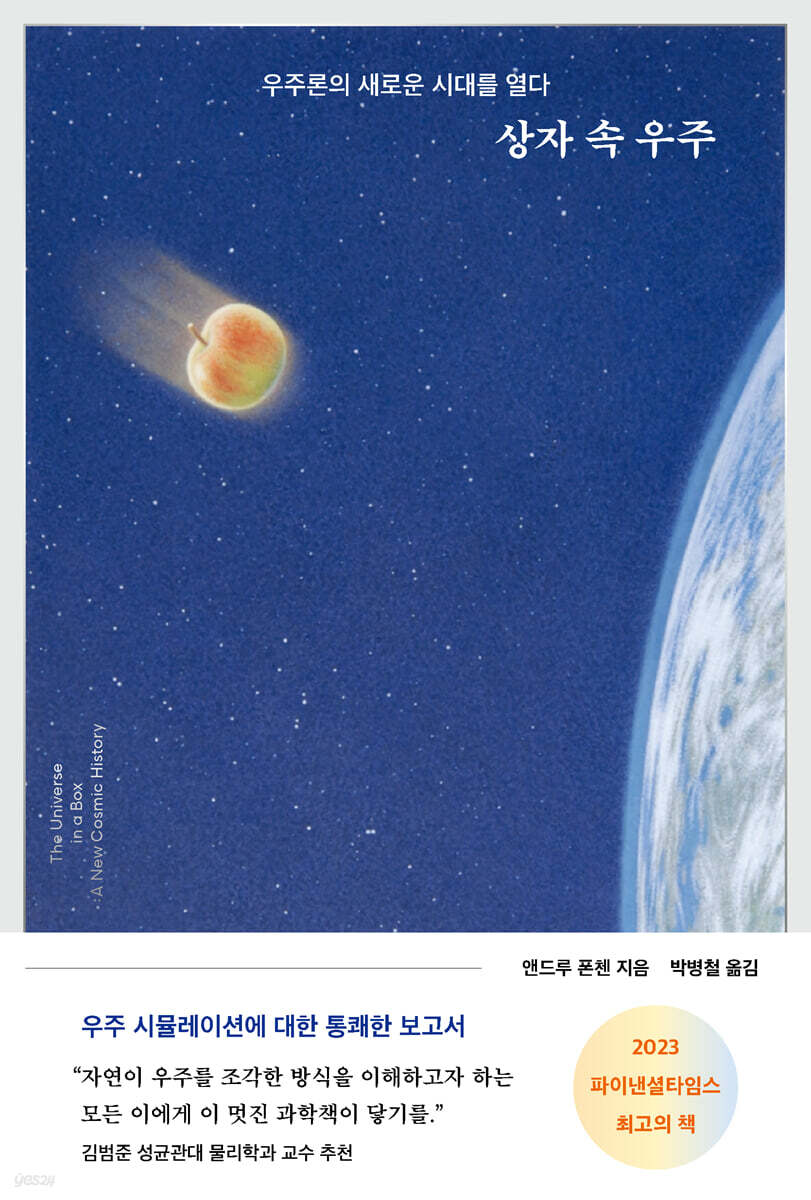
The science textbook "The Universe in a Box", which deals with space simulations, introduces the first computer simulation study of the universe.
As we all know, simulation is a technology that implements a virtual world.
As a discipline that studies the universe, which cannot be seen or touched, while elements whose existence cannot be felt determine the fate of the universe, a new type of physics that has emerged to bridge the gap between theory and experiment is 'cosmological simulation' using computers.
If you create a miniature universe inside your computer, give it a set of rules, and press the run button, a space laboratory opens on a small, square screen, and at that moment, the secrets of the universe unfold before your eyes.
At first glance, you might think this:
“The behavior of small particles is described by quantum mechanics, and the movements of large celestial bodies were theorized by Newton and Einstein, so isn’t space simulation simply a process of confirming existing theories?” Andrew Pontzen, a professor of cosmology at University College London and a simulation expert, emphasizes that space simulation is a guide that leads the way for theories to proceed, and “a comprehensive art of the scientific world that goes beyond the realm of physics and mixes computation, science, and human creativity.”
Overcoming the limitations of computers, defining individual elements as concisely as possible, and reflecting details that were not considered to achieve the best results, ultimately, a vision for the universe awaits.
This book is a popular science book that clearly explains the principles and meaning of the somewhat unfamiliar field of space simulation and provides specific guidance on how simulation is actually being used to solve the mysteries of the universe.
Upon publication, it received high expectations from experts in various fields, including astronomer Martin Rees, quantum physicist Jim Al-Khalili, and mathematician Hannah Fry, and was recognized for its prominence, including being selected as one of the Financial Times' Best Books of 2023, and was praised by leading media outlets such as Time, New Scientist, the Wall Street Journal, and Publisher's Weekly.
As Jim Al-Khalili puts it, “In this age where computers have become laboratories,” and with technological advancements reaching a peak, including expectations for quantum computers, this book is essential for our society.
A wondrous world of simulation unfolding within a square screen.
The science textbook "The Universe in a Box", which deals with space simulations, introduces the first computer simulation study of the universe.
As we all know, simulation is a technology that implements a virtual world.
As a discipline that studies the universe, which cannot be seen or touched, while elements whose existence cannot be felt determine the fate of the universe, a new type of physics that has emerged to bridge the gap between theory and experiment is 'cosmological simulation' using computers.
If you create a miniature universe inside your computer, give it a set of rules, and press the run button, a space laboratory opens on a small, square screen, and at that moment, the secrets of the universe unfold before your eyes.
At first glance, you might think this:
“The behavior of small particles is described by quantum mechanics, and the movements of large celestial bodies were theorized by Newton and Einstein, so isn’t space simulation simply a process of confirming existing theories?” Andrew Pontzen, a professor of cosmology at University College London and a simulation expert, emphasizes that space simulation is a guide that leads the way for theories to proceed, and “a comprehensive art of the scientific world that goes beyond the realm of physics and mixes computation, science, and human creativity.”
Overcoming the limitations of computers, defining individual elements as concisely as possible, and reflecting details that were not considered to achieve the best results, ultimately, a vision for the universe awaits.
This book is a popular science book that clearly explains the principles and meaning of the somewhat unfamiliar field of space simulation and provides specific guidance on how simulation is actually being used to solve the mysteries of the universe.
Upon publication, it received high expectations from experts in various fields, including astronomer Martin Rees, quantum physicist Jim Al-Khalili, and mathematician Hannah Fry, and was recognized for its prominence, including being selected as one of the Financial Times' Best Books of 2023, and was praised by leading media outlets such as Time, New Scientist, the Wall Street Journal, and Publisher's Weekly.
As Jim Al-Khalili puts it, “In this age where computers have become laboratories,” and with technological advancements reaching a peak, including expectations for quantum computers, this book is essential for our society.
- You can preview some of the book's contents.
Preview
index
introduction
Chapter 1 Weather and Climate
Chapter 2: Dark Matter, Dark Energy, and the Cosmic Web
Chapter 3: Galaxies and Subgrids
Chapter 4 Black Holes
Chapter 5: Quantum Mechanics and the Origin of the Universe
Chapter 6 Accident Simulation
Chapter 7: Simulation, Science, and Reality
Acknowledgments│Translator's Note│Notes│Index
Chapter 1 Weather and Climate
Chapter 2: Dark Matter, Dark Energy, and the Cosmic Web
Chapter 3: Galaxies and Subgrids
Chapter 4 Black Holes
Chapter 5: Quantum Mechanics and the Origin of the Universe
Chapter 6 Accident Simulation
Chapter 7: Simulation, Science, and Reality
Acknowledgments│Translator's Note│Notes│Index
Detailed image

Into the book
To put the universe on a computer, you have to be bold.
In fact, this task is inherently difficult.
It is never easy to understand the complex interplay of countless microscopic factors that lead to an overall outcome.
If even one very minor variable is entered incorrectly, it is very likely that completely wrong results will be produced.
The key to simulation is to design the program so that individual elements are defined as precisely as possible and the side effects caused by lack of information are minimized.
--- p.13
As far as we know, there are no boundaries in space.
People often think of an expanding universe as a “bigger bubble,” but that’s not really an appropriate metaphor.
The universe we see is already filled with a cosmic web of galaxies, yet the distances between galaxies are increasing.
This situation is never easy to visualize, and it is a problem we always run into when simulating the universe.
How can we reproduce a universe without boundaries on a finite computer?
--- p.99
After learning the inside story of the simulation, I was overcome with great disappointment.
Because the computers were too weak to run the simulations that astrophysicists wanted.
Even when simulating a single galaxy, the computer would crash if the basic laws of physics were not simplified as much as possible.
In particular, simulating the life of a star requires a regrettable looseness in core principles.
--- p.114
In fact, quantum phenomena determine the form and give meaning to the entire universe.
According to modern cosmology, everything in the universe—the cosmic web, dark matter halos, galaxies, black holes, planets, life, and you and I—came into existence thanks to primordial quantum uncertainty.
What appears solid to our eyes is only one aspect of a universe that exists secretly and ambiguously at all scales.
This is the last piece of the physics puzzle that must somehow be reflected in the simulation.
--- p.184~185
The true purpose of simulation is to systematically integrate scientific knowledge, insights, and collaboration among scientists.
Creating and running simulations and comparing them with observational data requires expertise in a wide range of fields, including fluid dynamics, the life cycle of stars and black holes, quantum mechanics, optics, and artificial intelligence.
However, most scientists find it difficult to delve into just one of these fields.
In other words, the point is that finishing a simulation is never something you can do alone.
--- p.294~295
The most interesting results from simulations are not the virtual worlds they create.
That world is just a shadow that roughly reflects reality, and is as bleak as a weather forecast.
What's really interesting is the collaboration between people who connect different scientific ideas and produce results.
Code is a series of instructions given to a computer, but it is also a collective expression that evolves on its own, like a living organism, on a canvas that collects people's diverse ideas about the universe.
In fact, this task is inherently difficult.
It is never easy to understand the complex interplay of countless microscopic factors that lead to an overall outcome.
If even one very minor variable is entered incorrectly, it is very likely that completely wrong results will be produced.
The key to simulation is to design the program so that individual elements are defined as precisely as possible and the side effects caused by lack of information are minimized.
--- p.13
As far as we know, there are no boundaries in space.
People often think of an expanding universe as a “bigger bubble,” but that’s not really an appropriate metaphor.
The universe we see is already filled with a cosmic web of galaxies, yet the distances between galaxies are increasing.
This situation is never easy to visualize, and it is a problem we always run into when simulating the universe.
How can we reproduce a universe without boundaries on a finite computer?
--- p.99
After learning the inside story of the simulation, I was overcome with great disappointment.
Because the computers were too weak to run the simulations that astrophysicists wanted.
Even when simulating a single galaxy, the computer would crash if the basic laws of physics were not simplified as much as possible.
In particular, simulating the life of a star requires a regrettable looseness in core principles.
--- p.114
In fact, quantum phenomena determine the form and give meaning to the entire universe.
According to modern cosmology, everything in the universe—the cosmic web, dark matter halos, galaxies, black holes, planets, life, and you and I—came into existence thanks to primordial quantum uncertainty.
What appears solid to our eyes is only one aspect of a universe that exists secretly and ambiguously at all scales.
This is the last piece of the physics puzzle that must somehow be reflected in the simulation.
--- p.184~185
The true purpose of simulation is to systematically integrate scientific knowledge, insights, and collaboration among scientists.
Creating and running simulations and comparing them with observational data requires expertise in a wide range of fields, including fluid dynamics, the life cycle of stars and black holes, quantum mechanics, optics, and artificial intelligence.
However, most scientists find it difficult to delve into just one of these fields.
In other words, the point is that finishing a simulation is never something you can do alone.
--- p.294~295
The most interesting results from simulations are not the virtual worlds they create.
That world is just a shadow that roughly reflects reality, and is as bleak as a weather forecast.
What's really interesting is the collaboration between people who connect different scientific ideas and produce results.
Code is a series of instructions given to a computer, but it is also a collective expression that evolves on its own, like a living organism, on a canvas that collects people's diverse ideas about the universe.
--- p.296
Publisher's Review
As revealed by virtual space sculptor Andrew Pontzen,
The limitless potential of space simulation research
To understand space simulation, we must first understand exactly what a simulation is.
Simulation is “a technology that predicts the results that would appear in real situations by modeling a specific phenomenon or event on a computer and performing it virtually.”
Simulations are closely related to our daily lives, including flight simulations, atmospheric simulations such as weather forecasts, computer games, special effects, and financial planning.
Among them, simulation research targeting space is what Andrew Pontzen, the author of this book, is doing.
It's easy to think of the difference between a single ant and a colony of ants.
Ants are fragile creatures that seem incapable of doing anything alone, but when they gather in groups, they display amazing collective behavior, such as smoothing rough roads, building large bridges, and finding food.
The universe is similar.
While the behavior of individual particles can be explained by existing physics theories, it is difficult to clearly explain the process by which they come together to form clouds of gas and dust, and then stars and galaxies.
What we know today is that "billions of years ago, clouds of gas coalesced under their own gravity to form stars", a result of sophisticated simulations.
The purpose of space simulation research is not to find the profound providence of the universe, but to understand the collective principles and relationships of matter such as particles, stars, and gas clouds in the universe.
This book, which presents a shortcut to space simulation research that astrophysicists have been relentlessly pursuing for the past 50 years, while also clearly identifying its limitations, will become a textbook in the field of space simulation.
Chapter 1 begins with a weather forecast, which is closely related to real life, to help you understand simulation.
Chapters 2 through 5 cover dark matter, dark energy, black holes, galaxies, and quantum mechanics, which are the unsolved mysteries of the universe, and examine the role of simulations in uncovering the origins of the universe.
Chapter 6 looks ahead to the future of technological advancements directly linked to simulation, such as artificial intelligence and machine learning, which are becoming important research tools in various fields, including cosmology.
Chapter 7 concludes by introducing the simulation hypothesis, that is, the debate over whether the world we live in is a simulation.
From dark matter to quantum mechanics, a computer-based space lab that travels the vastness of space.
In the 19th century, American meteorologist Cleveland Abbey and Scottish physicists Louis Fry Richardson and Dorothy Richardson recognized the importance of simulation even before computers existed, and proposed a series of calculation methods that emphasized the importance of 'initial conditions' and 'rules'.
Since the advent of computers, many scientists have made efforts to make simulations like today possible based on the theories of that time, including Charles Babbage, the first computer developer; Ada Lovelace, the world's first computer programmer; John von Neumann, a mathematician who emphasized the importance of weather forecasting more than anyone else; and Grace Hopper, who first created the coding we use today.
Another reason this book is so fascinating is that it unfolds the history of science through a lens of individual figures, and it is especially fascinating because it details the achievements of female scientists who have often gone unrecognized in the scientific community.
Thus, simulations that began in the late 19th century for weather forecasting have advanced to the level of handling astronomical scales thanks to the advancement of computer technology, and their scope has expanded to include space.
Chapters 2 through 5 are devoted to exploring key elements of cosmological research, including dark matter, dark energy, galaxies, black holes, and quantum mechanics.
In particular, it covers in detail the research achievements made by scientists on dark matter, dark energy, galaxies, black holes, and quantum mechanics, while presenting concrete results learned through simulation studies.
Among them, dark matter and dark energy are topics that always appear in cosmology research.
In the 1980s and 1990s, astronomers made the greatest contribution to proving the existence of dark matter and dark energy through observational data through simulations, and it was also around this time that they began to systematically classify the components of the universe using computer-operated astronomical telescopes.
The Higgs boson, discovered in 2012 at CERN (European Organization for Nuclear Research), was discovered more than half a century after its existence was theoretically predicted, along with the discovery of Neptune and the discovery of neutrinos. Its identity was discovered because a collision simulation was conducted in advance.
Just as the discovery of the Higgs boson left a great mark, we can look forward to the simulation results that will be achieved when the identities of dark matter and dark energy are revealed.
Asking about the future of cosmology
Simulation as a bridge between theory and experiment
In the final chapter, the author introduces an interesting hypothesis.
“What if the world we live in is itself a giant simulation?” As the movie [The Matrix] shows, the idea that reality is a simulation has been a staple of science fiction films and books since the 1950s, when computers began to emerge as a topic of public interest.
But it's not just science fiction writers who are interested in the simulation hypothesis.
Prominent scientists, including quantum physicist Seth Lloyd, physicist Brian Greene, evolutionary biologist Richard Dawkins, and astronomer Neil Tyson, take the simulation hypothesis seriously.
The author takes a negative view of the simulation hypothesis, citing realistic reasons such as the limitations of digital and quantum computers, and provides specific proof of why the hypothesis is incorrect. However, it is an issue worth considering from the perspective of looking ahead to the future of science.
As Andrew Pontzen also emphasizes throughout the book, simulations have clear limitations.
Simulations cannot solve all the problems that theoretical physics cannot solve today.
However, if simulations can provide answers to astronomical phenomena that are difficult to calculate directly and experiment on in a short period of time, then the simulations themselves serve as a “bridge between theory and experiment.”
The true achievement of simulation is understanding how complex phenomena emerge from simple rules coded into the simulation.
The author says that the true meaning of simulation research is “collaboration among people who connect diverse scientific ideas and produce results.”
Space simulation research is a field of study with infinite possibilities, comparable to a newborn baby.
With the advancement of cutting-edge technology, simulation research, which will usher in a new era of cosmology, will play a crucial role in uncovering the secrets of the universe that have yet to be discovered.
The limitless potential of space simulation research
To understand space simulation, we must first understand exactly what a simulation is.
Simulation is “a technology that predicts the results that would appear in real situations by modeling a specific phenomenon or event on a computer and performing it virtually.”
Simulations are closely related to our daily lives, including flight simulations, atmospheric simulations such as weather forecasts, computer games, special effects, and financial planning.
Among them, simulation research targeting space is what Andrew Pontzen, the author of this book, is doing.
It's easy to think of the difference between a single ant and a colony of ants.
Ants are fragile creatures that seem incapable of doing anything alone, but when they gather in groups, they display amazing collective behavior, such as smoothing rough roads, building large bridges, and finding food.
The universe is similar.
While the behavior of individual particles can be explained by existing physics theories, it is difficult to clearly explain the process by which they come together to form clouds of gas and dust, and then stars and galaxies.
What we know today is that "billions of years ago, clouds of gas coalesced under their own gravity to form stars", a result of sophisticated simulations.
The purpose of space simulation research is not to find the profound providence of the universe, but to understand the collective principles and relationships of matter such as particles, stars, and gas clouds in the universe.
This book, which presents a shortcut to space simulation research that astrophysicists have been relentlessly pursuing for the past 50 years, while also clearly identifying its limitations, will become a textbook in the field of space simulation.
Chapter 1 begins with a weather forecast, which is closely related to real life, to help you understand simulation.
Chapters 2 through 5 cover dark matter, dark energy, black holes, galaxies, and quantum mechanics, which are the unsolved mysteries of the universe, and examine the role of simulations in uncovering the origins of the universe.
Chapter 6 looks ahead to the future of technological advancements directly linked to simulation, such as artificial intelligence and machine learning, which are becoming important research tools in various fields, including cosmology.
Chapter 7 concludes by introducing the simulation hypothesis, that is, the debate over whether the world we live in is a simulation.
From dark matter to quantum mechanics, a computer-based space lab that travels the vastness of space.
In the 19th century, American meteorologist Cleveland Abbey and Scottish physicists Louis Fry Richardson and Dorothy Richardson recognized the importance of simulation even before computers existed, and proposed a series of calculation methods that emphasized the importance of 'initial conditions' and 'rules'.
Since the advent of computers, many scientists have made efforts to make simulations like today possible based on the theories of that time, including Charles Babbage, the first computer developer; Ada Lovelace, the world's first computer programmer; John von Neumann, a mathematician who emphasized the importance of weather forecasting more than anyone else; and Grace Hopper, who first created the coding we use today.
Another reason this book is so fascinating is that it unfolds the history of science through a lens of individual figures, and it is especially fascinating because it details the achievements of female scientists who have often gone unrecognized in the scientific community.
Thus, simulations that began in the late 19th century for weather forecasting have advanced to the level of handling astronomical scales thanks to the advancement of computer technology, and their scope has expanded to include space.
Chapters 2 through 5 are devoted to exploring key elements of cosmological research, including dark matter, dark energy, galaxies, black holes, and quantum mechanics.
In particular, it covers in detail the research achievements made by scientists on dark matter, dark energy, galaxies, black holes, and quantum mechanics, while presenting concrete results learned through simulation studies.
Among them, dark matter and dark energy are topics that always appear in cosmology research.
In the 1980s and 1990s, astronomers made the greatest contribution to proving the existence of dark matter and dark energy through observational data through simulations, and it was also around this time that they began to systematically classify the components of the universe using computer-operated astronomical telescopes.
The Higgs boson, discovered in 2012 at CERN (European Organization for Nuclear Research), was discovered more than half a century after its existence was theoretically predicted, along with the discovery of Neptune and the discovery of neutrinos. Its identity was discovered because a collision simulation was conducted in advance.
Just as the discovery of the Higgs boson left a great mark, we can look forward to the simulation results that will be achieved when the identities of dark matter and dark energy are revealed.
Asking about the future of cosmology
Simulation as a bridge between theory and experiment
In the final chapter, the author introduces an interesting hypothesis.
“What if the world we live in is itself a giant simulation?” As the movie [The Matrix] shows, the idea that reality is a simulation has been a staple of science fiction films and books since the 1950s, when computers began to emerge as a topic of public interest.
But it's not just science fiction writers who are interested in the simulation hypothesis.
Prominent scientists, including quantum physicist Seth Lloyd, physicist Brian Greene, evolutionary biologist Richard Dawkins, and astronomer Neil Tyson, take the simulation hypothesis seriously.
The author takes a negative view of the simulation hypothesis, citing realistic reasons such as the limitations of digital and quantum computers, and provides specific proof of why the hypothesis is incorrect. However, it is an issue worth considering from the perspective of looking ahead to the future of science.
As Andrew Pontzen also emphasizes throughout the book, simulations have clear limitations.
Simulations cannot solve all the problems that theoretical physics cannot solve today.
However, if simulations can provide answers to astronomical phenomena that are difficult to calculate directly and experiment on in a short period of time, then the simulations themselves serve as a “bridge between theory and experiment.”
The true achievement of simulation is understanding how complex phenomena emerge from simple rules coded into the simulation.
The author says that the true meaning of simulation research is “collaboration among people who connect diverse scientific ideas and produce results.”
Space simulation research is a field of study with infinite possibilities, comparable to a newborn baby.
With the advancement of cutting-edge technology, simulation research, which will usher in a new era of cosmology, will play a crucial role in uncovering the secrets of the universe that have yet to be discovered.
GOODS SPECIFICS
- Date of issue: March 22, 2024
- Page count, weight, size: 332 pages | 420g | 142*210*20mm
- ISBN13: 9788925575339
- ISBN10: 8925575337
You may also like
카테고리
korean


korean

![GQ KOREA Mark (Monthly): December [2025]](http://librairie.coreenne.fr/cdn/shop/files/8ef265dbbfbf186523ed75ba7319009d.jpg?v=1765340328&width=3840)


