

Can time be turned back?
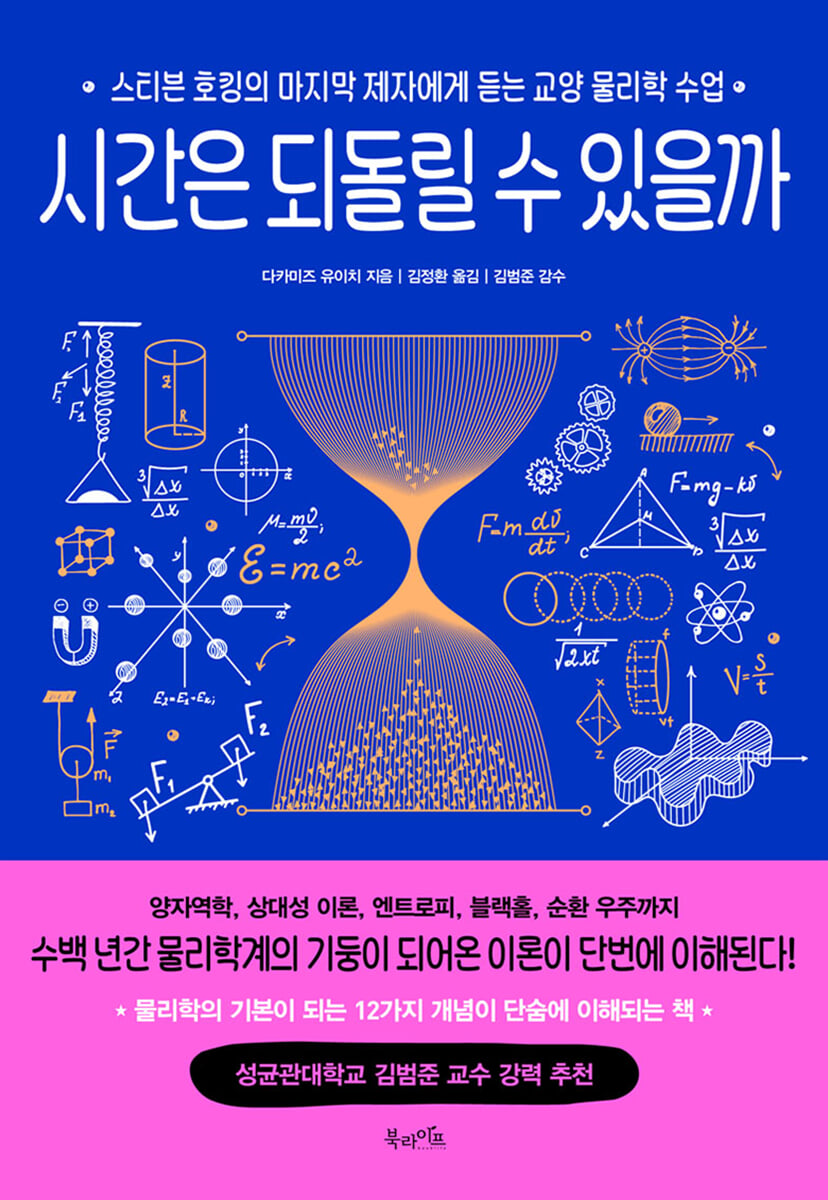 |
Description
Book Introduction
The moment you open the book, a world opens up where time flows backwards!
A fascinating story about the physics of time, from quantum to cosmic, that starts easily and gets you hooked in no time.
The S and N poles of a magnet, the male and female of living things, and even the action and reaction of force.
Most of nature is symmetrical, so why does time flow in only one direction? If there's symmetry in time, shouldn't there also be a flow from the future to the past? Stephen Hawking's last disciple answers this ultimate question that has rocked centuries of scientific history!
The author is a physicist who studied under the genius physicist Stephen Hawking while conducting research at the University of Cambridge in England.
As a disciple of Hawking, he boldly explores the possibility of time reversal with the quirky and delightful thought, "It's fun to turn back time!"
What determines the direction and speed of time? Does future memory actually exist? From the causality of time, dating back to Einstein's time, to the quantization of time suggesting the possibility of time reversal, to the cyclical universe of contraction and expansion, this author presents fascinating research findings currently at the forefront of science, with the author's ingenious imagination.
The story of time is a topic that can be easily approached by teenagers who find science textbooks difficult, liberal arts students who lack the basics, and even those reading a general science textbook for the first time.
This book explains the core concepts of physics that the general public should know as general knowledge, woven into the story of time.
By following the author's guide through the arrow of time, you will quickly understand twelve fundamental concepts of physics, including quantum mechanics, relativity, entropy, black holes, and the cyclical universe.
A fascinating story about the physics of time, from quantum to cosmic, that starts easily and gets you hooked in no time.
The S and N poles of a magnet, the male and female of living things, and even the action and reaction of force.
Most of nature is symmetrical, so why does time flow in only one direction? If there's symmetry in time, shouldn't there also be a flow from the future to the past? Stephen Hawking's last disciple answers this ultimate question that has rocked centuries of scientific history!
The author is a physicist who studied under the genius physicist Stephen Hawking while conducting research at the University of Cambridge in England.
As a disciple of Hawking, he boldly explores the possibility of time reversal with the quirky and delightful thought, "It's fun to turn back time!"
What determines the direction and speed of time? Does future memory actually exist? From the causality of time, dating back to Einstein's time, to the quantization of time suggesting the possibility of time reversal, to the cyclical universe of contraction and expansion, this author presents fascinating research findings currently at the forefront of science, with the author's ingenious imagination.
The story of time is a topic that can be easily approached by teenagers who find science textbooks difficult, liberal arts students who lack the basics, and even those reading a general science textbook for the first time.
This book explains the core concepts of physics that the general public should know as general knowledge, woven into the story of time.
By following the author's guide through the arrow of time, you will quickly understand twelve fundamental concepts of physics, including quantum mechanics, relativity, entropy, black holes, and the cyclical universe.
- You can preview some of the book's contents.
Preview
index
prolog
Chapter 1: Humanity Aware of Time
What Einstein and Stephen Hawking Have in Common
It all started with a calendar
How were the days of the week created?
What on earth is time?
There are many concepts of time.
Chapter 2: Unraveling the Truth About Time
Direction: The arrow of time is irreversible.
Dimensionality: Why is time one-dimensional?
Size: Not constant
Time is annoying?
Time is hidden in equations
The equation does not distinguish the direction of time.
Is it possible for the falling motion to go in the opposite direction?
Could there be a world where time flows backwards?
What is the law of increasing entropy?
Chapter 3 Relativity and Time
Special relativity, which made light a dictator
How slow does time slow down for superheroes?
General relativity, which states that gravity distorts space-time
What if you get sucked into a black hole?
Could we use the theory of relativity to live longer?
To what extent does causality determine the future?
Cone of Light and Arrow of Time
Chapter 4: The Relationship Between Quantum Mechanics and Time
The basic particles are quarks and electrons.
How are elements created?
Where do we come from?
Tunneling effect of elementary particles
Uncertainty principle of elementary particles
The future can only be predicted by probability.
Can causality be broken?
The bizarre nature of quantum mechanics ① Energy exists in discrete quantities.
The Bizarre Nature of Quantum Mechanics ② The Observer Determines the State
Is time also made of particles?
Chapter 5: The Battle with Entropy
Challenges toward a Perpetual Motion
The Birth of Entropy
Boltzmann's great achievements
The goblin created by Maxwell
Between the micro and macro worlds
The Second Law of Thermodynamics: Defeating the Goblin
The goblin has been resurrected!
Does time run backwards in the quantum world?
Chapter 6: Is Time Really One-Dimensional?
In ancient China, time and space were known.
The equation that can explain everything in the universe
What if time was two-dimensional?
Why is space three-dimensional?
A world with many dimensions is unstable.
Chapter 7: Quantum Gravity and Time
There are only four forces in nature.
Gravity, nature's most unusual force
The earnest wish of physicists around the world
What is string theory?
What is loop quantum gravity theory?
Which of the two theories is correct?
Time has disappeared!
Time is born from ignorance
What is the answer to the 'Achilles and the Tortoise' problem?
Chapter 8: The Possibility of a Circular Universe
From string to curtain
Was the Big Bang a collision of brains?
Genesis of an Inflationary Universe
Do we have no choice but to rely on God?
The emergence of a cyclical universe
What would happen if the universe contracted?
The current universe is the 50th universe?
The Crisis and Resurrection of the Circular Universe
Chapter 9: In Search of a Time Without Beginning
The universe must be quiet
Spaceport, you bastard!
The Mystery of Vacuum Energy
The cyclical universe revived by Phantom
Hawking's Imaginary Time Universe 235
How does imaginary time eliminate singularities? 238
Memories from Cambridge University 240
A mathematician who hears the answers God gives?
Chapter 10: The Time of Life, the Time of Man
Does the entropy of a star decrease?
Does the entropy of living things decrease?
Are stars living things?
Another arrow of time embedded in life
Time as Perception
Is the continuity of time also an illusion?
People obsessed with memories of the future
Chapter 11: Who Saw the Universe?
Two scenarios
The retrograde motion of time implied by Feynman diagrams
Do tachyons travel back in time?
Another scenario for a condensed universe
Time reversal created by a black hole
The Universe's Greatest Mystery: The Anthropic Principle
The key to solving the mystery lies in the reversal of time?
Epilogue
Search
Chapter 1: Humanity Aware of Time
What Einstein and Stephen Hawking Have in Common
It all started with a calendar
How were the days of the week created?
What on earth is time?
There are many concepts of time.
Chapter 2: Unraveling the Truth About Time
Direction: The arrow of time is irreversible.
Dimensionality: Why is time one-dimensional?
Size: Not constant
Time is annoying?
Time is hidden in equations
The equation does not distinguish the direction of time.
Is it possible for the falling motion to go in the opposite direction?
Could there be a world where time flows backwards?
What is the law of increasing entropy?
Chapter 3 Relativity and Time
Special relativity, which made light a dictator
How slow does time slow down for superheroes?
General relativity, which states that gravity distorts space-time
What if you get sucked into a black hole?
Could we use the theory of relativity to live longer?
To what extent does causality determine the future?
Cone of Light and Arrow of Time
Chapter 4: The Relationship Between Quantum Mechanics and Time
The basic particles are quarks and electrons.
How are elements created?
Where do we come from?
Tunneling effect of elementary particles
Uncertainty principle of elementary particles
The future can only be predicted by probability.
Can causality be broken?
The bizarre nature of quantum mechanics ① Energy exists in discrete quantities.
The Bizarre Nature of Quantum Mechanics ② The Observer Determines the State
Is time also made of particles?
Chapter 5: The Battle with Entropy
Challenges toward a Perpetual Motion
The Birth of Entropy
Boltzmann's great achievements
The goblin created by Maxwell
Between the micro and macro worlds
The Second Law of Thermodynamics: Defeating the Goblin
The goblin has been resurrected!
Does time run backwards in the quantum world?
Chapter 6: Is Time Really One-Dimensional?
In ancient China, time and space were known.
The equation that can explain everything in the universe
What if time was two-dimensional?
Why is space three-dimensional?
A world with many dimensions is unstable.
Chapter 7: Quantum Gravity and Time
There are only four forces in nature.
Gravity, nature's most unusual force
The earnest wish of physicists around the world
What is string theory?
What is loop quantum gravity theory?
Which of the two theories is correct?
Time has disappeared!
Time is born from ignorance
What is the answer to the 'Achilles and the Tortoise' problem?
Chapter 8: The Possibility of a Circular Universe
From string to curtain
Was the Big Bang a collision of brains?
Genesis of an Inflationary Universe
Do we have no choice but to rely on God?
The emergence of a cyclical universe
What would happen if the universe contracted?
The current universe is the 50th universe?
The Crisis and Resurrection of the Circular Universe
Chapter 9: In Search of a Time Without Beginning
The universe must be quiet
Spaceport, you bastard!
The Mystery of Vacuum Energy
The cyclical universe revived by Phantom
Hawking's Imaginary Time Universe 235
How does imaginary time eliminate singularities? 238
Memories from Cambridge University 240
A mathematician who hears the answers God gives?
Chapter 10: The Time of Life, the Time of Man
Does the entropy of a star decrease?
Does the entropy of living things decrease?
Are stars living things?
Another arrow of time embedded in life
Time as Perception
Is the continuity of time also an illusion?
People obsessed with memories of the future
Chapter 11: Who Saw the Universe?
Two scenarios
The retrograde motion of time implied by Feynman diagrams
Do tachyons travel back in time?
Another scenario for a condensed universe
Time reversal created by a black hole
The Universe's Greatest Mystery: The Anthropic Principle
The key to solving the mystery lies in the reversal of time?
Epilogue
Search
Detailed image

Into the book
Deep within our minds, there exists a flow of time in which events in the past lead to the present, and the present creates a future that has not yet been determined.
The saying, “what goes around comes around” also came from here.
What if, on the contrary, there were a flow of time from the future to the present, and from the present to the past?
Amazingly, this phenomenon is actually happening at the forefront of science.
---From the "Prologue"
Many people seem to think that going into space without gravity will increase your lifespan, but in reality, time passes quickly in a state of zero gravity, so it can be said that aging becomes easier.
It has been reported that not only physically but also biologically, space is more prone to physical weakness than on Earth.
For creatures that have evolved within the gravity of the planet Earth, ‘living’ can also be said to be ‘the activity of resisting the burden of gravity.’
So, I think that if you do nothing in space, where there is no gravity, your muscles will weaken and your vitality will gradually decline.
It may be that some degree of stress or burden is necessary in life.
---From Chapter 3, Relativity and Time
Turning to the quantum world can provide some answers to the fundamental question, "Where did we come from?"
The elements that make up our bodies were born from stars, and became diverse as the stars died.
It is often said that dying is like 'becoming a star in the sky', but if a star heard this, it might want to correct it by saying, "It's the opposite, it's the opposite!"
“You came into existence because we died!”
---From “Chapter 4: The Relationship Between Quantum Mechanics and Time”
“It has been revealed that in the quantum world, the lost order can be restored.
In the quantum world, motions that violate the second law of thermodynamics are possible.” Most laws of physics do not distinguish between the future and the past.
However, the second law of thermodynamics can only flow in one direction, from order to disorder, and this is absolutely impossible to violate in our daily lives, which are groups of atoms that satisfy Avogadro's number, as history has proven so far.
Time reversal cannot occur.
However, in the quantum world, where the movements of each individual particle are observed, time can also run backwards.
---From "Chapter 5: The Battle with Entropy, the Nemesis"
What if time were two-dimensional? In our world, time, which is linear, moves along a flat surface.
You can also draw a circle and return to your original position.
So we can easily go back to the past and our challenge will simply end.
And for humans living in one-dimensional time, one dream that is difficult to achieve comes true.
Yes, that's right.
It's a time machine.
Some people believe that if modern people time warp to the past, the past will be changed and the future will be rewritten in a different form.
On the one hand, some people believe that even if a time warp occurs, the events that person causes will be incorporated into the past so that they match the context, so history will not change, and therefore the future will not change either.
I think the latter is more correct physically.
---From Chapter 6: Is Time Really One-Dimensional?
There is an interesting study.
In a cyclical universe that repeats contraction and expansion, entropy accumulates with each cycle, and in the next cycle, the entropy of the entire universe increases by that amount.
Based on this, Japanese physicist Hikaru Kawai calculated that the current universe is in its 50th cycle.
If that's the case, then the decision you're about to make after much deliberation may actually have already been made in the 49th universe.
What if every action you take, every moment of emotion or discovery you make is actually something you have already experienced… .
The saying, “what goes around comes around” also came from here.
What if, on the contrary, there were a flow of time from the future to the present, and from the present to the past?
Amazingly, this phenomenon is actually happening at the forefront of science.
---From the "Prologue"
Many people seem to think that going into space without gravity will increase your lifespan, but in reality, time passes quickly in a state of zero gravity, so it can be said that aging becomes easier.
It has been reported that not only physically but also biologically, space is more prone to physical weakness than on Earth.
For creatures that have evolved within the gravity of the planet Earth, ‘living’ can also be said to be ‘the activity of resisting the burden of gravity.’
So, I think that if you do nothing in space, where there is no gravity, your muscles will weaken and your vitality will gradually decline.
It may be that some degree of stress or burden is necessary in life.
---From Chapter 3, Relativity and Time
Turning to the quantum world can provide some answers to the fundamental question, "Where did we come from?"
The elements that make up our bodies were born from stars, and became diverse as the stars died.
It is often said that dying is like 'becoming a star in the sky', but if a star heard this, it might want to correct it by saying, "It's the opposite, it's the opposite!"
“You came into existence because we died!”
---From “Chapter 4: The Relationship Between Quantum Mechanics and Time”
“It has been revealed that in the quantum world, the lost order can be restored.
In the quantum world, motions that violate the second law of thermodynamics are possible.” Most laws of physics do not distinguish between the future and the past.
However, the second law of thermodynamics can only flow in one direction, from order to disorder, and this is absolutely impossible to violate in our daily lives, which are groups of atoms that satisfy Avogadro's number, as history has proven so far.
Time reversal cannot occur.
However, in the quantum world, where the movements of each individual particle are observed, time can also run backwards.
---From "Chapter 5: The Battle with Entropy, the Nemesis"
What if time were two-dimensional? In our world, time, which is linear, moves along a flat surface.
You can also draw a circle and return to your original position.
So we can easily go back to the past and our challenge will simply end.
And for humans living in one-dimensional time, one dream that is difficult to achieve comes true.
Yes, that's right.
It's a time machine.
Some people believe that if modern people time warp to the past, the past will be changed and the future will be rewritten in a different form.
On the one hand, some people believe that even if a time warp occurs, the events that person causes will be incorporated into the past so that they match the context, so history will not change, and therefore the future will not change either.
I think the latter is more correct physically.
---From Chapter 6: Is Time Really One-Dimensional?
There is an interesting study.
In a cyclical universe that repeats contraction and expansion, entropy accumulates with each cycle, and in the next cycle, the entropy of the entire universe increases by that amount.
Based on this, Japanese physicist Hikaru Kawai calculated that the current universe is in its 50th cycle.
If that's the case, then the decision you're about to make after much deliberation may actually have already been made in the 49th universe.
What if every action you take, every moment of emotion or discovery you make is actually something you have already experienced… .
---From "Chapter 8: The Possibility of a Circular Universe"
Publisher's Review
The last disciple of the genius physicist Stephen Hawking,
The Physics of Time from a Quantum Gravity Theorist
“How was the universe created?” Stephen Hawking pondered this question until the day he died.
Hawking, who created new theories with curiosity and ingenious ideas as vast as the universe.
The author is the last student to have received Hawking's teachings while conducting research at the University of Cambridge in England.
He is one of the outstanding physicists produced by Hawking and is receiving attention in the field of quantum gravity theory research.
As a disciple of Hawking, who never lost his sense of humor, the author boldly presents novel and entertaining thoughts on time based on the latest research findings.
From fundamental questions like 'Where does time begin?' and 'Where do we come from?' to outrageous imaginations like 'Future memories may exist?' and 'If time were two-dimensional, a time machine would be possible,' it pours out without hesitation.
He also tells his memories of Cambridge University with his mentor Stephen Hawking in a calm and witty manner.
From physical time to the birth of the universe
Everything about time that everyone knows but no one knows
In nature, there is symmetry that seeks to maintain balance without imbalance.
Many of the things we find beautiful have bilateral symmetry.
But why does time exist in only one direction? The author questions the asymmetry of time and explores the possibility of time's reversal in terms of direction, dimensionality, and size.
Why does time flow only in one direction, from past to future? Space is three-dimensional, so why is time one-dimensional? Can time expand or contract? This book provides clear, scientific explanations of commonly accepted ideas about time, drawing on major physics theories such as quantum mechanics, relativity, and entropy.
The book focuses on quantum mechanics and its opposing law of increasing entropy to explore the possibility of "can time be turned back?"
From the perspective of the law of increasing entropy, all substances in nature have only one property of going from order to disorder, so time cannot run backwards.
On the other hand, if we assume that time is composed of elementary particles from a quantum mechanical perspective, the movement of the elementary particles is in an uncertain state, so the direction and speed of time cannot be determined.
In other words, time reversal is possible.
The clash between the two theories is quite troubling, and even now it is not clear which one is correct.
The author continues a fierce battle of wits about time, which is invisible and whose existence cannot be determined, until the very last moment of closing the book.
The author also sketches a scenario for the birth of the universe based on the latest research.
If the universe has been cyclically contracting and expanding without a beginning, which universe is the current one? If we are the 50th universe, isn't what we're experiencing now something we've already experienced in the 49th universe? From a cyclical universe perspective, the author speculates that traces and memories of previous universes might be preserved somewhere in the universe.
Quantum mechanics, relativity, entropy, black holes, and cyclic universes
A book that makes difficult physics concepts easy to understand
Although many books and lectures have explained time using physics, it has been difficult for the general public to understand.
This book explains the core concepts of physics that the general public should know as general knowledge in an easy and fun way, weaving them into the story of time, "Can time be turned back?"
Theories that have been pillars of physics for hundreds of years are naturally incorporated into the story, which unfolds in a fun and engaging way, covering memory, lifespan, prediction, cause and effect, and even the birth of the universe.
As you immerse yourself in the author's time-reversing world and follow your curiosity, you will quickly understand twelve fundamental concepts of physics, including quantum mechanics, relativity, entropy, black holes, and the cyclical universe.
It is a good introductory book for those who are just starting to take an interest in general science, and it is enough for existing science book readers to firmly establish the framework of physics in their minds.
The Physics of Time from a Quantum Gravity Theorist
“How was the universe created?” Stephen Hawking pondered this question until the day he died.
Hawking, who created new theories with curiosity and ingenious ideas as vast as the universe.
The author is the last student to have received Hawking's teachings while conducting research at the University of Cambridge in England.
He is one of the outstanding physicists produced by Hawking and is receiving attention in the field of quantum gravity theory research.
As a disciple of Hawking, who never lost his sense of humor, the author boldly presents novel and entertaining thoughts on time based on the latest research findings.
From fundamental questions like 'Where does time begin?' and 'Where do we come from?' to outrageous imaginations like 'Future memories may exist?' and 'If time were two-dimensional, a time machine would be possible,' it pours out without hesitation.
He also tells his memories of Cambridge University with his mentor Stephen Hawking in a calm and witty manner.
From physical time to the birth of the universe
Everything about time that everyone knows but no one knows
In nature, there is symmetry that seeks to maintain balance without imbalance.
Many of the things we find beautiful have bilateral symmetry.
But why does time exist in only one direction? The author questions the asymmetry of time and explores the possibility of time's reversal in terms of direction, dimensionality, and size.
Why does time flow only in one direction, from past to future? Space is three-dimensional, so why is time one-dimensional? Can time expand or contract? This book provides clear, scientific explanations of commonly accepted ideas about time, drawing on major physics theories such as quantum mechanics, relativity, and entropy.
The book focuses on quantum mechanics and its opposing law of increasing entropy to explore the possibility of "can time be turned back?"
From the perspective of the law of increasing entropy, all substances in nature have only one property of going from order to disorder, so time cannot run backwards.
On the other hand, if we assume that time is composed of elementary particles from a quantum mechanical perspective, the movement of the elementary particles is in an uncertain state, so the direction and speed of time cannot be determined.
In other words, time reversal is possible.
The clash between the two theories is quite troubling, and even now it is not clear which one is correct.
The author continues a fierce battle of wits about time, which is invisible and whose existence cannot be determined, until the very last moment of closing the book.
The author also sketches a scenario for the birth of the universe based on the latest research.
If the universe has been cyclically contracting and expanding without a beginning, which universe is the current one? If we are the 50th universe, isn't what we're experiencing now something we've already experienced in the 49th universe? From a cyclical universe perspective, the author speculates that traces and memories of previous universes might be preserved somewhere in the universe.
Quantum mechanics, relativity, entropy, black holes, and cyclic universes
A book that makes difficult physics concepts easy to understand
Although many books and lectures have explained time using physics, it has been difficult for the general public to understand.
This book explains the core concepts of physics that the general public should know as general knowledge in an easy and fun way, weaving them into the story of time, "Can time be turned back?"
Theories that have been pillars of physics for hundreds of years are naturally incorporated into the story, which unfolds in a fun and engaging way, covering memory, lifespan, prediction, cause and effect, and even the birth of the universe.
As you immerse yourself in the author's time-reversing world and follow your curiosity, you will quickly understand twelve fundamental concepts of physics, including quantum mechanics, relativity, entropy, black holes, and the cyclical universe.
It is a good introductory book for those who are just starting to take an interest in general science, and it is enough for existing science book readers to firmly establish the framework of physics in their minds.
GOODS SPECIFICS
- Date of issue: March 26, 2024
- Page count, weight, size: 304 pages | 480g | 145*210*20mm
- ISBN13: 9791191013610
- ISBN10: 1191013618
You may also like
카테고리
korean


korean

![GQ KOREA Mark (Monthly): December [2025]](http://librairie.coreenne.fr/cdn/shop/files/8ef265dbbfbf186523ed75ba7319009d.jpg?v=1765340328&width=3840)


