

Power Hour
 |
Description
Book Introduction
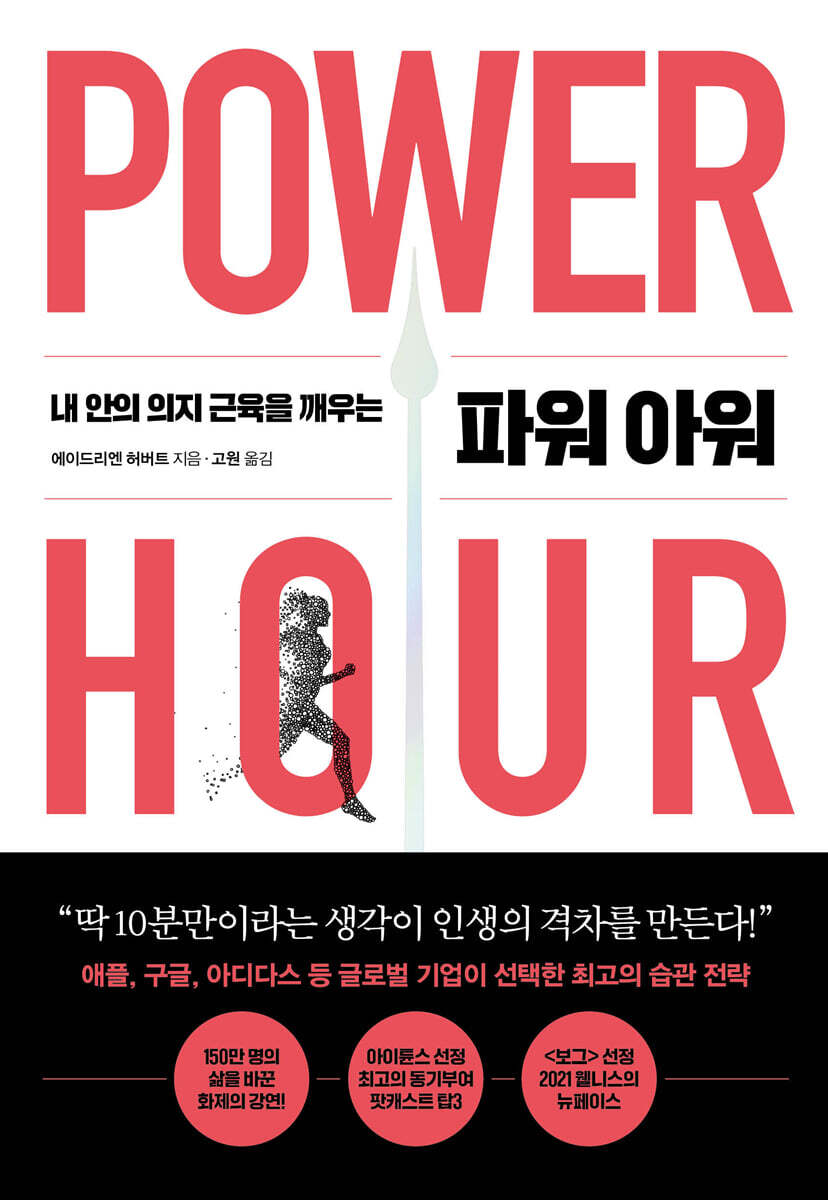
“Just 10 minutes of thinking can make a difference in your life!” The best habit strategies chosen by global companies like Apple, Google, and Adidas. A sensational lecture that changed 1.5 million lives! iTunes' top 3 self-improvement podcasts. [Vogue] Selected as the New Faces of Wellness in 2021 This book helps you discover the hidden "power hour"—a time when you can focus solely on yourself without being disturbed by the world—and by repeatedly taking small actions during this time, you can change little by little every day, overcome lethargy, and find direction in life. The author talks about the importance of habits in the first hour of the day, and says that the power of Power Hour can help you develop a growth mindset that empowers you to make your own choices and take action. Plus, it offers easy, practical ways to create your own "powerful" habits—useful habits that produce long-term results. |
- You can preview some of the book's contents.
Preview
index
Prologue What if you could reclaim one hour from your day?
Chapter 1: Finding Happy Movement: Moving Where You Want to Go
Movement for those who find exercise difficult
How do I wake up every morning?
Reimagine your day with your own moves
If you move, it will definitely come true
Chapter 2: A Mindset Shift: Expand Your Realm Through Learning
Find your own learning method
How to become a person who gets things done
Change your questions and change your life.
To those who believe it is too late
Change from where you are right now
Chapter 3: Building Powerful Habits: Choose Your Habits Before They Choose You
Pause for a moment before the easy choice.
Build strong habits by training your willpower muscles.
Words become habits, and habits become words.
3 Steps to Creating Useful Habits
Chapter 4? Time to Reclaim the Power of Sleep: If You Take Life Seriously, Be Serious About Sleep, Too
If you want to be successful, sleep well.
Monitor and manage my sleep
'Go to bed an hour earlier' rather than 'Wake up an hour earlier'
Three Techniques for the Best Sleep
Before you sleep, sleep your mind first.
Chapter 5? Time to Connect with People: What Kind of People Are in My Life?
What group do I belong to?
Build a board of directors for me
Find, meet, connect
Chapter 6? Time to Add Passion to Your Purpose: Are My Actions Aligned with My Dreams?
When you hit the jackpot
What I do every day makes me who I am.
What is most important to me right now?
The sweetness of doing nothing
What comes first, money or passion?
Some Ways to Overcome Fear
Chapter 7: Creating Power Hours: Miracles Blossom While the World Sleeps
Can the 'first hour of the day' really change your life?
How to Develop Deep Work Skills
Hold, touch, and feel your goal.
Three Ways to Use Power Hour
Epilogue: A Time to Love My Life More
Chapter 1: Finding Happy Movement: Moving Where You Want to Go
Movement for those who find exercise difficult
How do I wake up every morning?
Reimagine your day with your own moves
If you move, it will definitely come true
Chapter 2: A Mindset Shift: Expand Your Realm Through Learning
Find your own learning method
How to become a person who gets things done
Change your questions and change your life.
To those who believe it is too late
Change from where you are right now
Chapter 3: Building Powerful Habits: Choose Your Habits Before They Choose You
Pause for a moment before the easy choice.
Build strong habits by training your willpower muscles.
Words become habits, and habits become words.
3 Steps to Creating Useful Habits
Chapter 4? Time to Reclaim the Power of Sleep: If You Take Life Seriously, Be Serious About Sleep, Too
If you want to be successful, sleep well.
Monitor and manage my sleep
'Go to bed an hour earlier' rather than 'Wake up an hour earlier'
Three Techniques for the Best Sleep
Before you sleep, sleep your mind first.
Chapter 5? Time to Connect with People: What Kind of People Are in My Life?
What group do I belong to?
Build a board of directors for me
Find, meet, connect
Chapter 6? Time to Add Passion to Your Purpose: Are My Actions Aligned with My Dreams?
When you hit the jackpot
What I do every day makes me who I am.
What is most important to me right now?
The sweetness of doing nothing
What comes first, money or passion?
Some Ways to Overcome Fear
Chapter 7: Creating Power Hours: Miracles Blossom While the World Sleeps
Can the 'first hour of the day' really change your life?
How to Develop Deep Work Skills
Hold, touch, and feel your goal.
Three Ways to Use Power Hour
Epilogue: A Time to Love My Life More
Detailed image
Into the book
“Exercise is good.
I know it's good, but I'm not really the type to exercise."
I've heard this so many times.
The reason I still insist on using the word 'movement' instead of 'exercise' is because of people like that, people who are either physically weak or absolutely disgusted by exercise.
The same goes for people who say they want to exercise but don't have time.
If the word exercise feels like too high of a barrier to entry, let's start with movement, the smallest unit of exercise.
--- p.37
The important thing is to figure out what movements make you feel good.
If you've always viewed exercise as something that requires effort or something you don't want to do, I encourage you to incorporate even five minutes of movement into the first hour of your day.
I hope you can imagine the benefits your body and mind will receive from the moment you include exercise in your morning routine.
If you want to feel more energy and vitality, you obviously need to move more.
If you want to improve the quality of your sleep, you need to move more.
If you want to boost your self-esteem and confidence, try putting your promises to yourself into action.
--- p.48
I once shared a test on my podcast called "Six Questions to Ask Before 6 O'Clock."
The method is simple.
The moment you wake up in the morning and your Power Hour begins, write down the answers to these six simple questions:
1.
What kind of energy will I live with today?
2.
Who can I learn from today?
3.
Who can I help today?
4.
What do I need to do today to get one step closer to where I want to be in a year?
5.
What are you most looking forward to today?
6.
What are you most grateful for today?
--- p.
70
Our brains are complex organs that respond rapidly to changes in stimuli, environment, lifestyle, and diet, and they adapt and change continuously by creating new connections and pathways as a result of new experiences.
This brain ability is called 'neuroplasticity'.
Neuroplasticity exists from cradle to grave, and radical improvements in cognitive function—learning, thinking, perceiving, and remembering—are possible even in older adults.
Now, would you still say, "It's too late?" People tend to be reluctant to change what they're used to, what's been around for a long time.
Especially, they don't try to change their minds.
Let's take a moment here to change that mindset of 'I won't change my mind'.
It's okay to change your mind.
Changing your mind is not a failure.
--- p.75
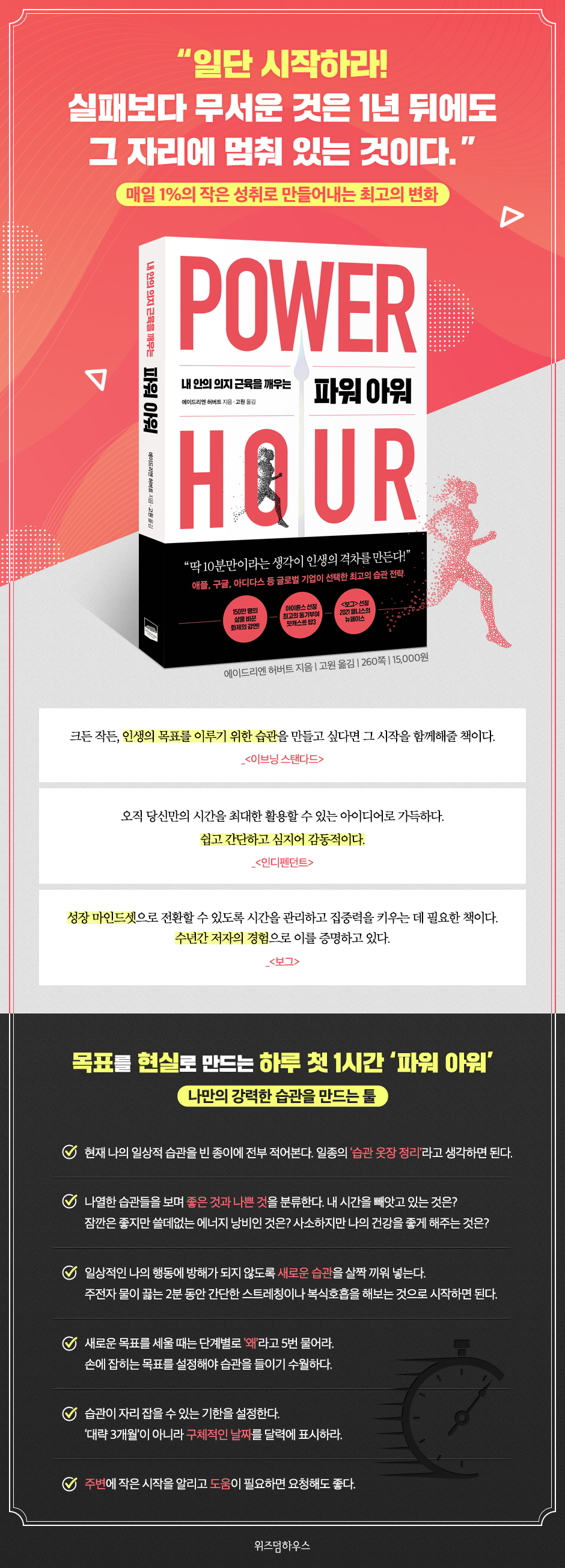
First, write down all the habits you have.
List your usual habits on a blank piece of paper or notebook.
It's like organizing your habit closet.
Classify each hour and write it down, but be sure to record everything honestly.
No one else will read and evaluate this but you.
No, let's not even judge ourselves.
You don't have to be perfect right now, and you don't have to be productive every moment.
Simply taking stock of how you habitually spend your time is valuable in itself.
--- p.
113
Let's create a time and space where we can focus solely on ourselves without being distracted by anything else.
Scientist and author Cal Newport argues that modern people are increasingly losing the ability to do deep work.
Deep work refers to the ability to focus on difficult and challenging tasks for a long time.
He says.
(…) So, wouldn’t doing more than one thing at a time save more time? Not at all, it would actually be less efficient.
Numerous studies have shown that multitasking reduces cognitive function and productivity by up to 40%.
Every time you switch from one task to another, it takes your brain that much longer to refocus.
--- p.239
Most people tend to finish tasks within the allotted time, even if they can be completed quickly.
So, whatever your goal, I recommend setting a deadline and being as specific as possible.
About 6 months? That's too vague.
Let's mark the date in red on the calendar.
You'll prioritize a task only when you feel a concrete pressure to do so, so figure out exactly how many months, weeks, and days it will take before you start.
If you have a habit of putting things off until the last minute, set a "false deadline" a week earlier than the actual due date.
Adjust everything to that deadline and literally convince yourself that this false deadline is a fixed date.
I know it's good, but I'm not really the type to exercise."
I've heard this so many times.
The reason I still insist on using the word 'movement' instead of 'exercise' is because of people like that, people who are either physically weak or absolutely disgusted by exercise.
The same goes for people who say they want to exercise but don't have time.
If the word exercise feels like too high of a barrier to entry, let's start with movement, the smallest unit of exercise.
--- p.37
The important thing is to figure out what movements make you feel good.
If you've always viewed exercise as something that requires effort or something you don't want to do, I encourage you to incorporate even five minutes of movement into the first hour of your day.
I hope you can imagine the benefits your body and mind will receive from the moment you include exercise in your morning routine.
If you want to feel more energy and vitality, you obviously need to move more.
If you want to improve the quality of your sleep, you need to move more.
If you want to boost your self-esteem and confidence, try putting your promises to yourself into action.
--- p.48
I once shared a test on my podcast called "Six Questions to Ask Before 6 O'Clock."
The method is simple.
The moment you wake up in the morning and your Power Hour begins, write down the answers to these six simple questions:
1.
What kind of energy will I live with today?
2.
Who can I learn from today?
3.
Who can I help today?
4.
What do I need to do today to get one step closer to where I want to be in a year?
5.
What are you most looking forward to today?
6.
What are you most grateful for today?
--- p.
70
Our brains are complex organs that respond rapidly to changes in stimuli, environment, lifestyle, and diet, and they adapt and change continuously by creating new connections and pathways as a result of new experiences.
This brain ability is called 'neuroplasticity'.
Neuroplasticity exists from cradle to grave, and radical improvements in cognitive function—learning, thinking, perceiving, and remembering—are possible even in older adults.
Now, would you still say, "It's too late?" People tend to be reluctant to change what they're used to, what's been around for a long time.
Especially, they don't try to change their minds.
Let's take a moment here to change that mindset of 'I won't change my mind'.
It's okay to change your mind.
Changing your mind is not a failure.
--- p.75
First, write down all the habits you have.
List your usual habits on a blank piece of paper or notebook.
It's like organizing your habit closet.
Classify each hour and write it down, but be sure to record everything honestly.
No one else will read and evaluate this but you.
No, let's not even judge ourselves.
You don't have to be perfect right now, and you don't have to be productive every moment.
Simply taking stock of how you habitually spend your time is valuable in itself.
--- p.
113
Let's create a time and space where we can focus solely on ourselves without being distracted by anything else.
Scientist and author Cal Newport argues that modern people are increasingly losing the ability to do deep work.
Deep work refers to the ability to focus on difficult and challenging tasks for a long time.
He says.
(…) So, wouldn’t doing more than one thing at a time save more time? Not at all, it would actually be less efficient.
Numerous studies have shown that multitasking reduces cognitive function and productivity by up to 40%.
Every time you switch from one task to another, it takes your brain that much longer to refocus.
--- p.239
Most people tend to finish tasks within the allotted time, even if they can be completed quickly.
So, whatever your goal, I recommend setting a deadline and being as specific as possible.
About 6 months? That's too vague.
Let's mark the date in red on the calendar.
You'll prioritize a task only when you feel a concrete pressure to do so, so figure out exactly how many months, weeks, and days it will take before you start.
If you have a habit of putting things off until the last minute, set a "false deadline" a week earlier than the actual due date.
Adjust everything to that deadline and literally convince yourself that this false deadline is a fixed date.
--- p.245
Publisher's Review
Are you lying down today holding your phone and thinking, 'Just 10 minutes'?
A powerful habit booster that will kick off the blanket and lead you to the life you want!
At the start of a new year, many people make ambitious plans for exercise, diet, study, and the Miracle Morning and write them down in their diaries.
With the belief that this time we will definitely succeed.
But you probably know better than anyone that you've been making decisions and giving up for quite some time.
"Power Hour" is a book that helps people who find it difficult to take action with motivation alone develop their "willpower muscles."
Author Adrienne Herbert is a renowned British self-help speaker and wellness expert, and host of the eponymous podcast 'Power Hour'.
The podcast 'Power Hour' is a popular content that has resonated with millions of people to the point that it was selected as one of the 'Top 3 Motivational Contents' by iTunes in 2019. This book was published based on the daily habits and routines of successful people I met there over the years, and what I learned along the way.
This book also contains 'easy and absolutely actionable' strategic tips for those who want to make big and small changes in their lives, such as scientific methods for creating new habits, developing a growth mindset, and building confidence through world-class lectures and workshops at global companies such as Google, Apple, Adidas, Berkley, and Virgin Sports.
The book begins with the author's personal experience, which led to the creation of 'Power Hour'.
When he was about to fall into the abyss of life after losing his second child, whom he had worked hard to get, he received an offer to run a marathon as an Adidas global ambassador. He was wondering what he could do to balance work and childcare, and he decided to start with a simple thought: just wake up an hour earlier.
What miracles did that one hour of "power hour"—the one that came with waking up early—bring about? To cut to the chase, it transformed everything imaginable, from interpersonal relationships to careers.
In the hour he regained, he read more, listened to podcasts, took online courses, stretched for marathon training, meditated, journaled, and even reached millions of people through his eponymous podcast, "The Power Hour."
The greatest change is made by achieving 1% of small achievements every day.
Power Hour: A time to focus on your life's purpose and love yourself.
Having worked with leaders across various industries for years, the author has focused primarily on their daily habits and routines, and has discovered that the mysterious force that gets them out of bed every morning is their "power hour."
Power Hour doesn't mean you have to be productive every hour or wake up early every time.
It's just about making the most of the 'first hour of the day'.
It's a mindset where you wake up in the morning and do something of your choice for an hour, reclaiming time and ability solely for yourself from the repetitiveness of each day.
The book consists of a total of 7 chapters.
Chapter 1 talks about 'exercise', the first strategy for developing the power hour habit.
Here, we use the expression 'movement' because the grandiose word 'exercise' only increases the barrier to entry.
Movement includes high-intensity exercises like running and working out, but it also suggests things that can be done easily and instinctively in everyday life, such as 5 minutes of stretching, walking a dog, and humming to music.
Chapter 2 talks about learning that can help you break the 'fixed mindset' that limits you and move toward a 'growth mindset'.
Chapter 3 teaches you how to create powerful habits that will keep your newly established mindset from wavering.
These are practical tips to help you incorporate the 'useful habits' that people find most difficult into your daily life without any resistance.
Chapters 4 through 6 teach you how to redirect your energy to where you want it by refocusing your sleep, relationships, and goal setting. Chapter 7 delves deeper into Chapter 5 by providing habit strategy tools to create your own "power hour."
Life can get bumpy at any time.
You might end up on a side road or you might end up in a tailspin.
But at times like these, you need to be clear about your purpose in life and what you're passionate about, and then everything else will fall into place.
If you're afraid of starting, constantly failing, or feeling lethargic because your life is stagnant, Power Hour can help you experience miraculous changes.
A powerful habit booster that will kick off the blanket and lead you to the life you want!
At the start of a new year, many people make ambitious plans for exercise, diet, study, and the Miracle Morning and write them down in their diaries.
With the belief that this time we will definitely succeed.
But you probably know better than anyone that you've been making decisions and giving up for quite some time.
"Power Hour" is a book that helps people who find it difficult to take action with motivation alone develop their "willpower muscles."
Author Adrienne Herbert is a renowned British self-help speaker and wellness expert, and host of the eponymous podcast 'Power Hour'.
The podcast 'Power Hour' is a popular content that has resonated with millions of people to the point that it was selected as one of the 'Top 3 Motivational Contents' by iTunes in 2019. This book was published based on the daily habits and routines of successful people I met there over the years, and what I learned along the way.
This book also contains 'easy and absolutely actionable' strategic tips for those who want to make big and small changes in their lives, such as scientific methods for creating new habits, developing a growth mindset, and building confidence through world-class lectures and workshops at global companies such as Google, Apple, Adidas, Berkley, and Virgin Sports.
The book begins with the author's personal experience, which led to the creation of 'Power Hour'.
When he was about to fall into the abyss of life after losing his second child, whom he had worked hard to get, he received an offer to run a marathon as an Adidas global ambassador. He was wondering what he could do to balance work and childcare, and he decided to start with a simple thought: just wake up an hour earlier.
What miracles did that one hour of "power hour"—the one that came with waking up early—bring about? To cut to the chase, it transformed everything imaginable, from interpersonal relationships to careers.
In the hour he regained, he read more, listened to podcasts, took online courses, stretched for marathon training, meditated, journaled, and even reached millions of people through his eponymous podcast, "The Power Hour."
The greatest change is made by achieving 1% of small achievements every day.
Power Hour: A time to focus on your life's purpose and love yourself.
Having worked with leaders across various industries for years, the author has focused primarily on their daily habits and routines, and has discovered that the mysterious force that gets them out of bed every morning is their "power hour."
Power Hour doesn't mean you have to be productive every hour or wake up early every time.
It's just about making the most of the 'first hour of the day'.
It's a mindset where you wake up in the morning and do something of your choice for an hour, reclaiming time and ability solely for yourself from the repetitiveness of each day.
The book consists of a total of 7 chapters.
Chapter 1 talks about 'exercise', the first strategy for developing the power hour habit.
Here, we use the expression 'movement' because the grandiose word 'exercise' only increases the barrier to entry.
Movement includes high-intensity exercises like running and working out, but it also suggests things that can be done easily and instinctively in everyday life, such as 5 minutes of stretching, walking a dog, and humming to music.
Chapter 2 talks about learning that can help you break the 'fixed mindset' that limits you and move toward a 'growth mindset'.
Chapter 3 teaches you how to create powerful habits that will keep your newly established mindset from wavering.
These are practical tips to help you incorporate the 'useful habits' that people find most difficult into your daily life without any resistance.
Chapters 4 through 6 teach you how to redirect your energy to where you want it by refocusing your sleep, relationships, and goal setting. Chapter 7 delves deeper into Chapter 5 by providing habit strategy tools to create your own "power hour."
Life can get bumpy at any time.
You might end up on a side road or you might end up in a tailspin.
But at times like these, you need to be clear about your purpose in life and what you're passionate about, and then everything else will fall into place.
If you're afraid of starting, constantly failing, or feeling lethargic because your life is stagnant, Power Hour can help you experience miraculous changes.
GOODS SPECIFICS
- Date of issue: January 14, 2022
- Page count, weight, size: 260 pages | 420g | 145*210*15mm
- ISBN13: 9791168121188
- ISBN10: 1168121183
You may also like
카테고리
korean


korean

![ELLE 엘르 스페셜 에디션 A형 : 12월 [2025]](http://librairie.coreenne.fr/cdn/shop/files/b8e27a3de6c9538896439686c6b0e8fb.jpg?v=1766436872&width=3840)


