

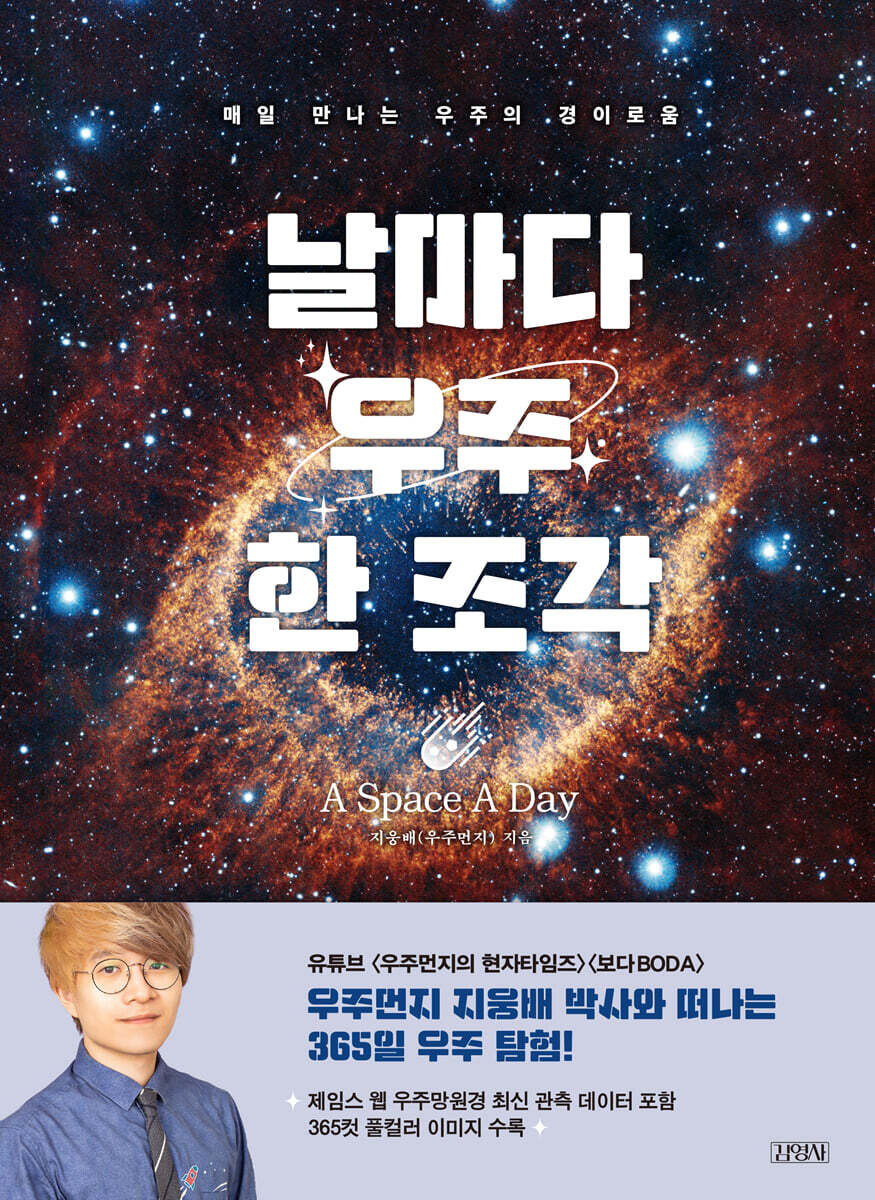
A piece of the universe every day
 |
Description
Book Introduction
YouTube "Space Dust's Sage Times" and "BODA"
Leaving with Dr. Jiwoong Bae, the space dust
365 days of space exploration!
If you want to spend a special year looking into the infinite universe one piece at a time, this is the book for you.
From the solar system to stars, nebulae, small celestial bodies, and galaxies, this book features 365 wondrous space photos, each accompanied by an exciting space story told by science communicator Dr. Ji Woong-bae, aka "Space Dust."
From galaxies of various shapes to colorful nebulae spreading across space and celestial bodies of each solar system, in addition to James Webb, photos sent back by other probes such as the Hubble Space Telescope, Voyager, and Perseverance were selected and compiled into 365 full-color images.
Accompanied by stunning photographs, it features in-depth explanations that add intellectual enjoyment to some days, hilarious humor from a space geek, and elegant sentences selected from literature and film, covering every day of the twelve months.
Readers are free to turn to any page.
Let's enjoy the joy of discovering something new about the vast universe every day.
Leaving with Dr. Jiwoong Bae, the space dust
365 days of space exploration!
If you want to spend a special year looking into the infinite universe one piece at a time, this is the book for you.
From the solar system to stars, nebulae, small celestial bodies, and galaxies, this book features 365 wondrous space photos, each accompanied by an exciting space story told by science communicator Dr. Ji Woong-bae, aka "Space Dust."
From galaxies of various shapes to colorful nebulae spreading across space and celestial bodies of each solar system, in addition to James Webb, photos sent back by other probes such as the Hubble Space Telescope, Voyager, and Perseverance were selected and compiled into 365 full-color images.
Accompanied by stunning photographs, it features in-depth explanations that add intellectual enjoyment to some days, hilarious humor from a space geek, and elegant sentences selected from literature and film, covering every day of the twelve months.
Readers are free to turn to any page.
Let's enjoy the joy of discovering something new about the vast universe every day.
- You can preview some of the book's contents.
Preview
index
preface
january
february
March
april
May
June
July
August
September
october
November
december
Glossary
Source of the illustration
Search
january
february
March
april
May
June
July
August
September
october
November
december
Glossary
Source of the illustration
Search
Detailed image

Into the book
“A question mark-shaped object was discovered near the bottom center of the photo.
Do you see the question mark shape? Unlike common constellations that only seem plausible with the mind's eye, this question mark is crystal clear to anyone who sees it.
It's as if the universe has placed a question mark on us, asking, "What do you see?"
Some mischievous astronomers even joke that the question mark box from the game Super Mario Bros. has been discovered in real space.
So what exactly is this massive cosmic question mark? Many astronomers speculate that the hooked shape of the question mark and the dot beneath it are separate celestial objects at completely different distances.
The hook shape is the overlapping of two colliding galaxies at a relatively close distance, while the dot below it may be a galaxy at the edge of the universe, much further away.
“It was quite by chance that two completely unrelated scenes happened to overlap in the same direction, creating this unique landscape.”
--- p.26~27
“February 14, 1990 was probably the most romantic Valentine’s Day in human history.
On this day, Voyager 1 looked at Earth from a distance of 6 billion kilometers while floating in space.
The Earth seen from there appeared to be nothing more than a tiny speck, a single pixel in the photo.
By chance, the afterimage of sunlight that spread across the camera lens passed over the Earth, creating an even more mysterious image, as if the Earth were lying on a long strip.
If you were born before February 14, 1990, you are unknowingly posing on Earth in this photo.
Carl Sagan nicknamed Earth "Pale Blue Dot" after seeing what it looked like in the photo.
Astronomers even divide humanity into before and after this photo was taken.
“The generation that grew up looking at the pale blue dot photo of Earth taken by Voyager is called the post-Voyager generation.”
--- p.63
“Every time I see a colorful and beautiful photograph of the universe, one question comes to mind:
Would space really look equally dazzling if we went out into space and saw it with our own eyes? Unfortunately, that's not the case.
This is because there are fundamentally significant differences in how human eyes, telescopes, and cameras see the world.
Our eyes cannot store light, but cameras can capture it.
Even the faintest light can be seen brighter if you give it a long exposure time.
The same goes for cameras mounted on telescopes that observe space.
Also, while the human eye can only see a very narrow range of wavelengths, visible light, telescopes detect a wide variety of light, including infrared, ultraviolet, and radio waves, in addition to visible light.
However, astronomers complete the picture by artificially adding various colors to make this light information more visually visible.”
--- p.199
“Small pebbles are imitating Einstein’s magic.
This photo shows how much the asteroids in our solar system can confuse astronomers.
The Hubble Space Telescope has been targeted at a massive galaxy cluster about 4 billion light-years away.
This is to take gravitational lens images of the light from background galaxies distorted as they pass around a massive galaxy cluster.
But this photo shows the trajectories of asteroids that passed through space much closer to us.
Curiously, the circular trails left by the asteroids are remarkably similar to the circular gravitational lensing images taken around galaxy clusters.
However, asteroids do not stay in one place but change their location quickly.
So, by observing the same area more times and synthesizing multiple images together, we can completely erase any traces of the asteroid.
“June 30th of every year is Asteroid Day.”
--- p.218
“The Curiosity rover has become a little prince standing alone on a small planet.
This small planet is Mars.
In fact, Mars is much smaller than Earth.
Of course, it is not so small that it is difficult for a single exploration rover to stand on it, as shown in the photo.
Curiosity collected the sample on August 5, 2015, its 1,065th day on Mars, by drilling a 1.6-centimeter-diameter hole into the rugged terrain beneath Mars' Mount Sharp.
It is called 'Buckskin', meaning deer skin, because of its rough surface.
After drilling a hole here, Curiosity took a fun selfie to commemorate the moment.
He took 92 photos by extending the MAHLI, a hand lens imager at the end of his robotic arm, and turning it slightly, literally taking selfies with a selfie stick.
Afterwards, all these photos were collected to create a circular panorama.
“Because the horizon of the surrounding Martian landscape has been artificially rounded, Mars feels much smaller than it actually is.”
--- p.260
“James Webb also captured the Pillars of Creation using a mid-infrared device that can see the longer wavelengths of mid-infrared.
Compared to the photo taken with a near-infrared camera (see p. 1), many of the stars that brightly filled the photo appear to have been erased.
Most bright stars shine brightly in the ultraviolet and visible ranges.
On the other hand, it emits almost no light in the mid-infrared wavelengths.
So most of the stars in this picture are gone.
Instead, we can see more clearly the low-temperature dust clouds that have been lukewarmed by starlight.
It feels like a ghost's blue fingers are slowly flowing. NASA released this photo specifically for Halloween.”
--- p.364
“Luke Skywalker, the protagonist of Star Wars, lives in a place where two suns set on the horizon.
There is actually a world where there are two suns rising and setting above our heads, not just one.
Not far away in the constellation Centaurus lies Proxima Centauri b, a pair of massive stars orbiting each other, and an exoplanet has been discovered orbiting it.
The small dot in the lower right corner of the photo is an exoplanet.
When the sun sets on this planet with two suns, two shadows will be cast.
Perhaps Star Wars was not simply a science fiction film based on the director's imagination, but a historical drama that secretly recorded the forgotten history of the universe."
Do you see the question mark shape? Unlike common constellations that only seem plausible with the mind's eye, this question mark is crystal clear to anyone who sees it.
It's as if the universe has placed a question mark on us, asking, "What do you see?"
Some mischievous astronomers even joke that the question mark box from the game Super Mario Bros. has been discovered in real space.
So what exactly is this massive cosmic question mark? Many astronomers speculate that the hooked shape of the question mark and the dot beneath it are separate celestial objects at completely different distances.
The hook shape is the overlapping of two colliding galaxies at a relatively close distance, while the dot below it may be a galaxy at the edge of the universe, much further away.
“It was quite by chance that two completely unrelated scenes happened to overlap in the same direction, creating this unique landscape.”
--- p.26~27
“February 14, 1990 was probably the most romantic Valentine’s Day in human history.
On this day, Voyager 1 looked at Earth from a distance of 6 billion kilometers while floating in space.
The Earth seen from there appeared to be nothing more than a tiny speck, a single pixel in the photo.
By chance, the afterimage of sunlight that spread across the camera lens passed over the Earth, creating an even more mysterious image, as if the Earth were lying on a long strip.
If you were born before February 14, 1990, you are unknowingly posing on Earth in this photo.
Carl Sagan nicknamed Earth "Pale Blue Dot" after seeing what it looked like in the photo.
Astronomers even divide humanity into before and after this photo was taken.
“The generation that grew up looking at the pale blue dot photo of Earth taken by Voyager is called the post-Voyager generation.”
--- p.63
“Every time I see a colorful and beautiful photograph of the universe, one question comes to mind:
Would space really look equally dazzling if we went out into space and saw it with our own eyes? Unfortunately, that's not the case.
This is because there are fundamentally significant differences in how human eyes, telescopes, and cameras see the world.
Our eyes cannot store light, but cameras can capture it.
Even the faintest light can be seen brighter if you give it a long exposure time.
The same goes for cameras mounted on telescopes that observe space.
Also, while the human eye can only see a very narrow range of wavelengths, visible light, telescopes detect a wide variety of light, including infrared, ultraviolet, and radio waves, in addition to visible light.
However, astronomers complete the picture by artificially adding various colors to make this light information more visually visible.”
--- p.199
“Small pebbles are imitating Einstein’s magic.
This photo shows how much the asteroids in our solar system can confuse astronomers.
The Hubble Space Telescope has been targeted at a massive galaxy cluster about 4 billion light-years away.
This is to take gravitational lens images of the light from background galaxies distorted as they pass around a massive galaxy cluster.
But this photo shows the trajectories of asteroids that passed through space much closer to us.
Curiously, the circular trails left by the asteroids are remarkably similar to the circular gravitational lensing images taken around galaxy clusters.
However, asteroids do not stay in one place but change their location quickly.
So, by observing the same area more times and synthesizing multiple images together, we can completely erase any traces of the asteroid.
“June 30th of every year is Asteroid Day.”
--- p.218
“The Curiosity rover has become a little prince standing alone on a small planet.
This small planet is Mars.
In fact, Mars is much smaller than Earth.
Of course, it is not so small that it is difficult for a single exploration rover to stand on it, as shown in the photo.
Curiosity collected the sample on August 5, 2015, its 1,065th day on Mars, by drilling a 1.6-centimeter-diameter hole into the rugged terrain beneath Mars' Mount Sharp.
It is called 'Buckskin', meaning deer skin, because of its rough surface.
After drilling a hole here, Curiosity took a fun selfie to commemorate the moment.
He took 92 photos by extending the MAHLI, a hand lens imager at the end of his robotic arm, and turning it slightly, literally taking selfies with a selfie stick.
Afterwards, all these photos were collected to create a circular panorama.
“Because the horizon of the surrounding Martian landscape has been artificially rounded, Mars feels much smaller than it actually is.”
--- p.260
“James Webb also captured the Pillars of Creation using a mid-infrared device that can see the longer wavelengths of mid-infrared.
Compared to the photo taken with a near-infrared camera (see p. 1), many of the stars that brightly filled the photo appear to have been erased.
Most bright stars shine brightly in the ultraviolet and visible ranges.
On the other hand, it emits almost no light in the mid-infrared wavelengths.
So most of the stars in this picture are gone.
Instead, we can see more clearly the low-temperature dust clouds that have been lukewarmed by starlight.
It feels like a ghost's blue fingers are slowly flowing. NASA released this photo specifically for Halloween.”
--- p.364
“Luke Skywalker, the protagonist of Star Wars, lives in a place where two suns set on the horizon.
There is actually a world where there are two suns rising and setting above our heads, not just one.
Not far away in the constellation Centaurus lies Proxima Centauri b, a pair of massive stars orbiting each other, and an exoplanet has been discovered orbiting it.
The small dot in the lower right corner of the photo is an exoplanet.
When the sun sets on this planet with two suns, two shadows will be cast.
Perhaps Star Wars was not simply a science fiction film based on the director's imagination, but a historical drama that secretly recorded the forgotten history of the universe."
--- p.423
Publisher's Review
YouTube "Space Dust's Sage Times" and "BODA"
Leaving with Dr. Jiwoong Bae, the space dust
365 days of space exploration!
“By the time I closed the last page of the book
You will gain the eyes of an astronomer!”
★ Includes the latest observation data from the James Webb Space Telescope
Includes 365 full-color images ★
Following the Hubble, Spitzer, and Kepler space telescopes, the James Webb Space Telescope, with its unparalleled resolution, has made the cosmic landscapes available to humanity even more diverse.
Just as there are docents to help us appreciate art more deeply, space photography also needs space guides to properly teach us how to appreciate it.
If you want to spend a special year looking into the infinite universe one piece at a time, this is the book for you.
《A Piece of the Universe Every Day》 contains 365 wondrous photographs of the universe, from the solar system to stars, nebulae, small celestial bodies, and galaxies, along with an exciting space story told by science communicator Dr. Ji Woong-bae, also known as 'Space Dust'.
Dr. Jiwoong Bae is a young science communicator who runs the YouTube channel “Space Dust Sage Times.”
Recently, he has appeared as a regular panelist on the YouTube channel BODA, which has 1.76 million subscribers, and has gained public love by explaining astronomy knowledge that can be considered difficult in an easy and fun way. He is a scientist who loves space more than anyone else.
There seems to be no one better suited to the role of docent, guiding us through the mysterious and beautiful universe.
In this book, the author has compiled 365 full-color images, including photos sent back by James Webb, the Hubble Space Telescope, Voyager, Perseverance, and other probes, from the majestic process of star birth and death to the colorful appearances of galaxies, nebulae, and each celestial body in the solar system.
Accompanied by stunning photographs, it features in-depth explanations that add intellectual enjoyment to some days, hilarious humor from a space geek, and elegant sentences selected from literature and film, covering every day of the twelve months.
Readers are free to turn to any page.
Let's enjoy the joy of discovering something new about the vast universe every day.
The fastest domestic publication
Includes the latest images from the James Webb Space Telescope.
Another attraction of this book is that it allows you to see amazing photos from the James Webb Space Telescope, the largest and most powerful observation instrument ever developed to explore the first stars and galaxies in the universe.
The book contains most of the observation images released by the James Webb Space Telescope from July 2022 to the most recent January 2024.
In July 2022, data from the James Webb Space Telescope were released for the first time, heralding the beginning of a new universe never before seen by humanity.
Many were moved by the five magnificent and beautiful photographs that captured over 10 billion years in a single angle.
The James Webb Space Telescope uses infrared technology to observe the universe farther and deeper, enough to discern individual stars in dust clouds and dwarf galaxies.
Thanks to James Webb, humanity's knowledge of the scale and history of the universe has expanded by leaps and bounds.
The author devotes about a third of this book (112 images in total) to images related to James Webb, introducing key discoveries captured in photographs and the latest news from the world of astronomy.
The latest discoveries captured by the James Webb Space Telescope, which are reported in the media as soon as the images are released, are perhaps the fastest to be published in Korea, with Dr. Ji Woong-bae's clear and lucid explanations.
From the deepest field images of the universe ever seen, to the smallest brown dwarf ever discovered that is redefining the boundary between stars and planets, to the high concentration of carbon dioxide ice detected on the surface of Europa, to the 40 or so Jupiter-sized rogue planets roaming the Orion Nebula, readers will have a special experience peeking into the secrets hidden in every corner of the universe.
The author also covers the James Webb Space Telescope itself, explaining not only its launch process and performance, but also how it takes pictures, how it works, and its future possibilities, helping readers easily understand how far James Webb and modern astronomy have come.
Towards a farther, deeper universe
A space guide brimming with science and romance
“How sad it is to live without being able to enjoy such a beautiful and magnificent universe spread out above our heads” (p. 7).
Dr. Jiwoong Bae is a passionate space enthusiast.
I go wherever space stories are discussed and share my knowledge of astronomy with the public.
Through his YouTube channel, he interviews NASA researchers and analyzes Nature papers to determine their authenticity, creating high-quality, fact-based content that expertly delivers the latest news from the world of astronomy.
But what he wants to convey is not all scientific knowledge about the universe.
Rather, what he really wants to convey is the emotion and wonder he felt while looking out at the universe.
The book adds a touch of romance to its awe-inspiring space photography by quoting passages from literature and film.
The photo of the brightly shining globular cluster M54 is accompanied by Alphonse Daudet's "Star" (page 234), and the photo of the galaxy Arp 142, which looks like a penguin floating in the dark night sky, is accompanied by a line from the movie "Mr. Popper's Penguins" (page 141), which fully enhances the feeling of space.
Additionally, each celestial body reminiscent of the lightsaber and character Han Solo from the science fiction movie Star Wars is introduced, and thanks to these diverse and interesting materials, the fun of turning the pages is doubled.
Even though the explanations are in-depth, there is a lot of wit and humor that makes you giggle as you read.
For example, the photo of a galaxy in the shape of the letter T (page 184) brings to mind the MBTI generation's catchphrase (“The universe speaks to me.
(Are you T?) The photo of Saturn and Titan overlapping (page 37) is amusing with the witty and witty sentence, “Someone ate all the Titan Tanghulu and left only one.”
There are also pages dedicated to special occasions.
On December 25th, we will tell the story of the Christmas Nebula, which is reminiscent of a Christmas tree, and on June 30th, we will tell the story of an asteroid, which is Asteroid Day.
On July 16th, a photo of the historic moment when humans first set foot on the lunar surface was published, and on February 14th, a photo of Earth called the "Pale Blue Dot" taken by Voyager 1 and released on Valentine's Day, 1990 was published.
We also introduce some interesting tips that most people don't know about.
If you type 'Dart Mission' in the Google search bar, you can see a fun scene where a dart spaceship flies in from the left of the search bar and collides with it, tilting the entire screen. In addition, it introduces that you can find your own constellation in the night sky viewed in other wavelengths, such as 'gamma-ray constellations', in addition to the 88 visible-light constellations designated by astronomers.
I hope that through this book, readers will be able to view the universe in a more familiar and wonderful way.
As you accumulate knowledge about the universe, one piece at a time, as the author hopes, “by the time you turn the last page, you will have the eyes of an astronomer.”
Leaving with Dr. Jiwoong Bae, the space dust
365 days of space exploration!
“By the time I closed the last page of the book
You will gain the eyes of an astronomer!”
★ Includes the latest observation data from the James Webb Space Telescope
Includes 365 full-color images ★
Following the Hubble, Spitzer, and Kepler space telescopes, the James Webb Space Telescope, with its unparalleled resolution, has made the cosmic landscapes available to humanity even more diverse.
Just as there are docents to help us appreciate art more deeply, space photography also needs space guides to properly teach us how to appreciate it.
If you want to spend a special year looking into the infinite universe one piece at a time, this is the book for you.
《A Piece of the Universe Every Day》 contains 365 wondrous photographs of the universe, from the solar system to stars, nebulae, small celestial bodies, and galaxies, along with an exciting space story told by science communicator Dr. Ji Woong-bae, also known as 'Space Dust'.
Dr. Jiwoong Bae is a young science communicator who runs the YouTube channel “Space Dust Sage Times.”
Recently, he has appeared as a regular panelist on the YouTube channel BODA, which has 1.76 million subscribers, and has gained public love by explaining astronomy knowledge that can be considered difficult in an easy and fun way. He is a scientist who loves space more than anyone else.
There seems to be no one better suited to the role of docent, guiding us through the mysterious and beautiful universe.
In this book, the author has compiled 365 full-color images, including photos sent back by James Webb, the Hubble Space Telescope, Voyager, Perseverance, and other probes, from the majestic process of star birth and death to the colorful appearances of galaxies, nebulae, and each celestial body in the solar system.
Accompanied by stunning photographs, it features in-depth explanations that add intellectual enjoyment to some days, hilarious humor from a space geek, and elegant sentences selected from literature and film, covering every day of the twelve months.
Readers are free to turn to any page.
Let's enjoy the joy of discovering something new about the vast universe every day.
The fastest domestic publication
Includes the latest images from the James Webb Space Telescope.
Another attraction of this book is that it allows you to see amazing photos from the James Webb Space Telescope, the largest and most powerful observation instrument ever developed to explore the first stars and galaxies in the universe.
The book contains most of the observation images released by the James Webb Space Telescope from July 2022 to the most recent January 2024.
In July 2022, data from the James Webb Space Telescope were released for the first time, heralding the beginning of a new universe never before seen by humanity.
Many were moved by the five magnificent and beautiful photographs that captured over 10 billion years in a single angle.
The James Webb Space Telescope uses infrared technology to observe the universe farther and deeper, enough to discern individual stars in dust clouds and dwarf galaxies.
Thanks to James Webb, humanity's knowledge of the scale and history of the universe has expanded by leaps and bounds.
The author devotes about a third of this book (112 images in total) to images related to James Webb, introducing key discoveries captured in photographs and the latest news from the world of astronomy.
The latest discoveries captured by the James Webb Space Telescope, which are reported in the media as soon as the images are released, are perhaps the fastest to be published in Korea, with Dr. Ji Woong-bae's clear and lucid explanations.
From the deepest field images of the universe ever seen, to the smallest brown dwarf ever discovered that is redefining the boundary between stars and planets, to the high concentration of carbon dioxide ice detected on the surface of Europa, to the 40 or so Jupiter-sized rogue planets roaming the Orion Nebula, readers will have a special experience peeking into the secrets hidden in every corner of the universe.
The author also covers the James Webb Space Telescope itself, explaining not only its launch process and performance, but also how it takes pictures, how it works, and its future possibilities, helping readers easily understand how far James Webb and modern astronomy have come.
Towards a farther, deeper universe
A space guide brimming with science and romance
“How sad it is to live without being able to enjoy such a beautiful and magnificent universe spread out above our heads” (p. 7).
Dr. Jiwoong Bae is a passionate space enthusiast.
I go wherever space stories are discussed and share my knowledge of astronomy with the public.
Through his YouTube channel, he interviews NASA researchers and analyzes Nature papers to determine their authenticity, creating high-quality, fact-based content that expertly delivers the latest news from the world of astronomy.
But what he wants to convey is not all scientific knowledge about the universe.
Rather, what he really wants to convey is the emotion and wonder he felt while looking out at the universe.
The book adds a touch of romance to its awe-inspiring space photography by quoting passages from literature and film.
The photo of the brightly shining globular cluster M54 is accompanied by Alphonse Daudet's "Star" (page 234), and the photo of the galaxy Arp 142, which looks like a penguin floating in the dark night sky, is accompanied by a line from the movie "Mr. Popper's Penguins" (page 141), which fully enhances the feeling of space.
Additionally, each celestial body reminiscent of the lightsaber and character Han Solo from the science fiction movie Star Wars is introduced, and thanks to these diverse and interesting materials, the fun of turning the pages is doubled.
Even though the explanations are in-depth, there is a lot of wit and humor that makes you giggle as you read.
For example, the photo of a galaxy in the shape of the letter T (page 184) brings to mind the MBTI generation's catchphrase (“The universe speaks to me.
(Are you T?) The photo of Saturn and Titan overlapping (page 37) is amusing with the witty and witty sentence, “Someone ate all the Titan Tanghulu and left only one.”
There are also pages dedicated to special occasions.
On December 25th, we will tell the story of the Christmas Nebula, which is reminiscent of a Christmas tree, and on June 30th, we will tell the story of an asteroid, which is Asteroid Day.
On July 16th, a photo of the historic moment when humans first set foot on the lunar surface was published, and on February 14th, a photo of Earth called the "Pale Blue Dot" taken by Voyager 1 and released on Valentine's Day, 1990 was published.
We also introduce some interesting tips that most people don't know about.
If you type 'Dart Mission' in the Google search bar, you can see a fun scene where a dart spaceship flies in from the left of the search bar and collides with it, tilting the entire screen. In addition, it introduces that you can find your own constellation in the night sky viewed in other wavelengths, such as 'gamma-ray constellations', in addition to the 88 visible-light constellations designated by astronomers.
I hope that through this book, readers will be able to view the universe in a more familiar and wonderful way.
As you accumulate knowledge about the universe, one piece at a time, as the author hopes, “by the time you turn the last page, you will have the eyes of an astronomer.”
GOODS SPECIFICS
- Date of issue: March 9, 2024
- Format: Hardcover book binding method guide
- Page count, weight, size: 452 pages | 1,254g | 170*235*30mm
- ISBN13: 9788934941378
- ISBN10: 8934941375
You may also like
카테고리
korean


korean

![GQ KOREA Mark (Monthly): December [2025]](http://librairie.coreenne.fr/cdn/shop/files/8ef265dbbfbf186523ed75ba7319009d.jpg?v=1765340328&width=3840)


