

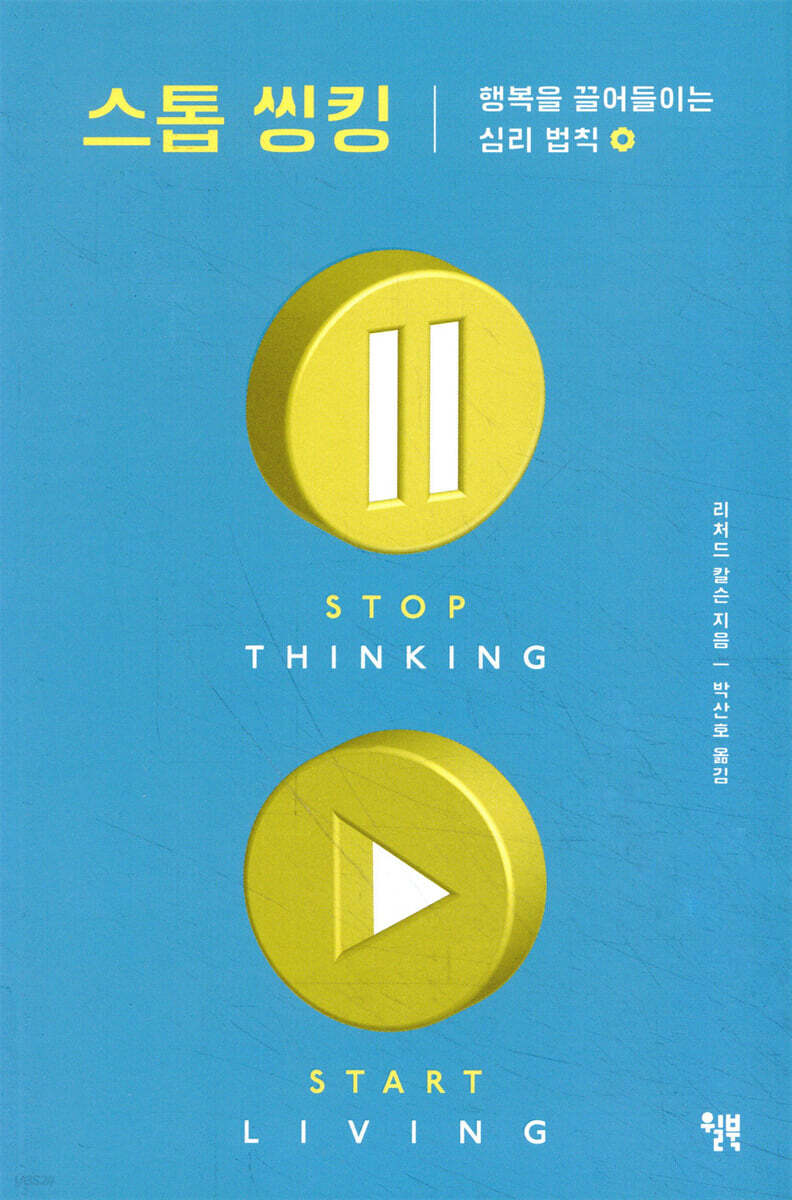
Stop thinking
 |
Description
Book Introduction
An early representative work by world-renowned pop psychologist Richard Carlson A book filled with Richard Carlson's most powerful advice for those trapped in the prison of their minds, mulling over their thoughts. The most effective message for us living in an age of overthinking is “Let’s stop thinking.” Dr. Oh Eun-young recently asked this question in a counseling program. “What is the purpose of counseling?” As concerns about mental health grow, how should we connect with someone's heart? It is fundamentally impossible to properly access another person's mind. So what was the answer to the question asking about the purpose of counseling? It is “the work of cultivating the mental strength to live on one’s own.” In other words, the ultimate goal of both counseling and parenting is to cultivate inner strength and become ‘independent.’ The fundamental goal of mind control is to go beyond simple comfort and cultivate the mental strength to live an independent life. "Stop Thinking" is an early representative work of Richard Carlson, a first-generation pop psychologist who captured the public's attention with the saying, "Don't sweat the small stuff." The messages in his books, which are considered the bible of mind control, were once considered a cultural phenomenon. This book contains records of his actual counseling sessions with clients, and his simple and clear prescriptions are noteworthy. He shows us how we torment our minds with our thoughts, and suggests a way of thinking that allows us to live a more proactive life by recognizing that we are the ones who turn the switch on our thoughts. 《Stop Thinking》 is a book that moves as if it were a single message. The purpose of this book also leads to one conclusion. The fact is that we have the “power to decide our own emotions.” In this age of overthinking, let's cultivate the 'inner strength' to determine our emotions rather than being overwhelmed by them. Then we can begin to live truly again. |
- You can preview some of the book's contents.
Preview
index
PART 1 Stop Thinking
1.
We live as we think
2.
How thoughts work in the mind
3.
Healthy mental functioning
4.
The art of letting go of thoughts
5.
wisdom
6.
Thoughts grow when you give them attention.
7.
thought system
8.
Points of Choice
9.
thinking habits
10.
The power of mood
PART 2: STARTING LIFE
11.
Live in the present, everything in your life will change.
12.
Choose the emotion that protects me
13.
Grief and loss
14.
Disease and Death
15.
I am in control of my life
16.
The Art of Optimism
17.
sense of happiness
18.
7 Psychological Laws for the Mind
Detailed image

Into the book
People who have never been depressed don't realize that thinking positively when depressed is as impossible as flying to the moon! Thinking positively happens naturally and effortlessly once you overcome depression.
Thinking positively is a natural consequence of knowing that your thoughts cannot harm you.
--- p.39
Happy people are deeply engaged in life itself.
Because you are so immersed in what you are doing at that moment, you don't stop and analyze your actions.
--- p.40
The wisest people throughout history have been those who have understood that while life is real, the problems it causes are illusions, mere creations of the mind.
--- p.81
The common notion that we need an ego to live as our true selves is not true.
Only when we reduce our need to prove our own worth can we truly recognize our own worth.
--- p.100
When you let go of your ego, you can see new alternatives that were previously invisible.
For example, if you let go of the idea that you are shy, you might discover that you actually want to connect with people.
One of my clients decided to do just that and planned her first party.
If you can just let go of some of your usual beliefs about what you like and what you don't like, you'll find yourself more willing to try new things, pick up new hobbies, start exercising, and eat at new restaurants.
When I let go of my ego, my possibilities expand.
--- p.101
When we are in a bad mood, filling our heads with negative thoughts is precisely why we suffer.
Such thoughts always greatly distort one's perspective on life.
--- p.137
Happy people know that the closer they get to their goal of living faithfully in the present moment each day, the more wonderful their lives will be.
Living in the present is not an empty theory, but a reality that happy people live in.
--- p.152
“Children are completely absorbed in whatever they are doing or who they are with at that moment.
“Because children live in the present, they absorb every experience they have completely, without missing a single thing.”
--- p.153
A faithful present will one day return to success.
This is the most honest technique for success.
--- p.
161
Focusing on the present means always doing your best, so as those moments accumulate, natural solutions will become a part of your life.
Instead of spending your life worrying about what might happen in the future, spend every moment constructively or enjoyably.
Each of those moments will add another piece to the puzzle.
Just as goals can only be achieved one step at a time, problems can only be solved by doing what you can, one thing at a time, every moment, every day.
--- p.161
You alone can decide which thoughts within you are worth focusing on and which ones should be left alone.
The heart is yours.
Thinking positively is a natural consequence of knowing that your thoughts cannot harm you.
--- p.39
Happy people are deeply engaged in life itself.
Because you are so immersed in what you are doing at that moment, you don't stop and analyze your actions.
--- p.40
The wisest people throughout history have been those who have understood that while life is real, the problems it causes are illusions, mere creations of the mind.
--- p.81
The common notion that we need an ego to live as our true selves is not true.
Only when we reduce our need to prove our own worth can we truly recognize our own worth.
--- p.100
When you let go of your ego, you can see new alternatives that were previously invisible.
For example, if you let go of the idea that you are shy, you might discover that you actually want to connect with people.
One of my clients decided to do just that and planned her first party.
If you can just let go of some of your usual beliefs about what you like and what you don't like, you'll find yourself more willing to try new things, pick up new hobbies, start exercising, and eat at new restaurants.
When I let go of my ego, my possibilities expand.
--- p.101
When we are in a bad mood, filling our heads with negative thoughts is precisely why we suffer.
Such thoughts always greatly distort one's perspective on life.
--- p.137
Happy people know that the closer they get to their goal of living faithfully in the present moment each day, the more wonderful their lives will be.
Living in the present is not an empty theory, but a reality that happy people live in.
--- p.152
“Children are completely absorbed in whatever they are doing or who they are with at that moment.
“Because children live in the present, they absorb every experience they have completely, without missing a single thing.”
--- p.153
A faithful present will one day return to success.
This is the most honest technique for success.
--- p.
161
Focusing on the present means always doing your best, so as those moments accumulate, natural solutions will become a part of your life.
Instead of spending your life worrying about what might happen in the future, spend every moment constructively or enjoyably.
Each of those moments will add another piece to the puzzle.
Just as goals can only be achieved one step at a time, problems can only be solved by doing what you can, one thing at a time, every moment, every day.
--- p.161
You alone can decide which thoughts within you are worth focusing on and which ones should be left alone.
The heart is yours.
--- p.243
Publisher's Review
A book containing Richard Carlson's fundamental philosophy, which began with his experience as a psychological counselor.
Popular psychologist and bestselling author Richard Carlson is better known for his saying, “Don’t sweat the small stuff,” but he also drew on his experience as a counseling psychologist to write a series of books that explore the psychological side of life.
This book is Richard Carlson's early masterpiece, and it contains the core of psychological health that he talks about in easy and accessible language.
When using traditional counseling techniques (typically psychoanalysis), the therapist was unable to guide the client in a better direction whenever he talked about negative memories and brought up memories from the past.
This is where Carlson's problem awareness begins.
“Why is it that when I look back on my past, my emotions are even more unstable and I can’t find stability?”
However, after realizing the very simple proposition that 'thoughts create emotions', his counseling direction completely changed, and progress was made in changing the hearts of his clients.
In other words, the fact that we made people aware of the fact that 'if you become the master of your thoughts, you can change your emotions' actually had results.
The book provides specific examples of how counseling can help people improve by stopping their thoughts.
Clients are often surprised to discover how much their negative thoughts, which often follow one another, distort their emotions.
It's no exaggeration to say that when we're in a whirlwind of emotions and overwhelmed by them, we have little control over what we say and what we think.
Even when asked the same question, the difference between when they were overwhelmed by emotion and when they were not was stark.
Rather than analyzing and talking to his clients about the causes of their unhappiness, Richard Carlson taught them that they were the ones creating the negative emotions, and how to stop those thoughts when they came and make choices that protected their minds.
All of the patients regained psychological stability.
This simple discovery has spread beyond counseling psychology to the realm of life, and he proposes 'stop thinking' as a groundbreaking way to 'start living.'
Negative thoughts can strike us without warning.
But if I realize that I am the one who moves that start button and that stop button, my life can completely change.
This proposition of 'stop thinking' that he proposes has influenced numerous psychological researchers and received support from readers.
It has also permeated our lives in many different forms since Richard Carlson, and remains a valid message, especially for those of us who need to know more and think more.
This feeling is not permanent, and I can change it.
When we are depressed, we are completely fooled by our mood.
I feel lethargic, don't want to do anything, and the world looks negative.
The emphasis is on 'being deceived'.
Feelings are not truth.
It's not eternal either.
Feelings are just a distortion of me and something I create.
If you keep in mind the basic premise of this book, that negative thoughts create negative feelings, then if you stop thinking, you can stop being fooled by negative feelings.
When you're in a bad mood, everything in the world seems negative.
The past brings regrets, reliving a conversation with someone you just met makes you feel worse, and thinking about what the future holds makes you anxious.
However, the author believes that healthy people have a different relationship with their thoughts.
They also have negative experiences, but they do not endlessly ruminate on those thoughts because they clearly recognize that it is they who think about those events and create negative emotions.
I know that I am fully capable of handling the negative emotions that thoughts create, and that I can change my mood by not thinking those thoughts.
'Stop thinking' is a feeling that happy people have acquired.
It's not that you're feeling bad right now because of someone's words or because of a bad choice you made in the past.
It's not the event that makes you feel that way.
The incident is in the past and your current feelings are created by your thoughts.
So, if you turn off your own thinking switch, you can stop feeling negative.
By remembering clearly that feelings are not permanent and that we can change them, we can escape the prison of our emotions.
Why “Stop Thinking” Now?
There is an abundance of information.
Especially when it comes to the mind, we are bombarded with an incalculable amount of information.
But we all feel that the more we think analytically and the deeper we get into our thoughts, the more complex our minds become.
In this age of information overload and overthinking, we seek temple stays, yoga or meditation, and quiet images or music to calm our minds.
"Stop Thinking" teaches us how to take control of our thinking and how to deal with the overwhelming thoughts as if they were just a passing river.
Fundamentally, self-awareness is the most important thing in this process.
If we recognize that it is we, not external events or the words of others, who create negative thoughts, and that these thoughts are creating a prison in our minds, we can allow the thoughts to flow away when they come.
A person who, after meeting someone, is lost in thought, mulling over their words and trying to figure out their intentions; a person who is so filled with regrets from the past that it is difficult to move forward; a person who cannot get things done because of anxiety about what will happen in the future.
Everyone suffers from mental problems due to 'overthinking'.
Richard Carlson, through numerous psychological counseling sessions, believes that the solution to mental problems lies in stopping thoughts, and he wrote this book to convey his most fundamental thoughts.
For a happy person, the tense of the mind is in the 'present'.
What is the nature of a depressed mind?
In short, the mind does not exist in the present.
They regret their past choices and suffer by ruminating on the words or memories of someone from the past.
At the same time, thoughts bring anxiety about the future.
I can't sleep because I'm worried about what will happen and what hasn't happened yet.
As a result, the mind is not fully present in the present.
When we are trapped in a chain of thought, the tense of life ceases to exist in the present.
If we can break this cycle of thinking, we can regain our sense of life.
So this simple psychological law called 'stop thinking' extends to the concept of happiness.
What exactly is happiness, a word that now seems like a cliché? Richard Carlson's definition of happiness is the most realistic of things.
The reason is that ‘happiness’ does not exist in the past or future, but ‘exists in the present.’
Happiness is not an ideal to be pursued, but rather a reality experienced by happy people.
Happiness is something very real.
Happiness is a perception I feel in my heart.
That's why what's important is where I place my mind's focus.
Happiness is something we can choose by taking control of our minds. It is not something that happens when we realize a perfect life, nor is it something that falls to us like luck someday.
This is the essence of happiness, according to Richard Carlson.
Happy people know that what they are looking for is a feeling of happiness, not a perfect life.
Happiness comes first, and a good life comes from happy feelings.
Popular psychologist and bestselling author Richard Carlson is better known for his saying, “Don’t sweat the small stuff,” but he also drew on his experience as a counseling psychologist to write a series of books that explore the psychological side of life.
This book is Richard Carlson's early masterpiece, and it contains the core of psychological health that he talks about in easy and accessible language.
When using traditional counseling techniques (typically psychoanalysis), the therapist was unable to guide the client in a better direction whenever he talked about negative memories and brought up memories from the past.
This is where Carlson's problem awareness begins.
“Why is it that when I look back on my past, my emotions are even more unstable and I can’t find stability?”
However, after realizing the very simple proposition that 'thoughts create emotions', his counseling direction completely changed, and progress was made in changing the hearts of his clients.
In other words, the fact that we made people aware of the fact that 'if you become the master of your thoughts, you can change your emotions' actually had results.
The book provides specific examples of how counseling can help people improve by stopping their thoughts.
Clients are often surprised to discover how much their negative thoughts, which often follow one another, distort their emotions.
It's no exaggeration to say that when we're in a whirlwind of emotions and overwhelmed by them, we have little control over what we say and what we think.
Even when asked the same question, the difference between when they were overwhelmed by emotion and when they were not was stark.
Rather than analyzing and talking to his clients about the causes of their unhappiness, Richard Carlson taught them that they were the ones creating the negative emotions, and how to stop those thoughts when they came and make choices that protected their minds.
All of the patients regained psychological stability.
This simple discovery has spread beyond counseling psychology to the realm of life, and he proposes 'stop thinking' as a groundbreaking way to 'start living.'
Negative thoughts can strike us without warning.
But if I realize that I am the one who moves that start button and that stop button, my life can completely change.
This proposition of 'stop thinking' that he proposes has influenced numerous psychological researchers and received support from readers.
It has also permeated our lives in many different forms since Richard Carlson, and remains a valid message, especially for those of us who need to know more and think more.
This feeling is not permanent, and I can change it.
When we are depressed, we are completely fooled by our mood.
I feel lethargic, don't want to do anything, and the world looks negative.
The emphasis is on 'being deceived'.
Feelings are not truth.
It's not eternal either.
Feelings are just a distortion of me and something I create.
If you keep in mind the basic premise of this book, that negative thoughts create negative feelings, then if you stop thinking, you can stop being fooled by negative feelings.
When you're in a bad mood, everything in the world seems negative.
The past brings regrets, reliving a conversation with someone you just met makes you feel worse, and thinking about what the future holds makes you anxious.
However, the author believes that healthy people have a different relationship with their thoughts.
They also have negative experiences, but they do not endlessly ruminate on those thoughts because they clearly recognize that it is they who think about those events and create negative emotions.
I know that I am fully capable of handling the negative emotions that thoughts create, and that I can change my mood by not thinking those thoughts.
'Stop thinking' is a feeling that happy people have acquired.
It's not that you're feeling bad right now because of someone's words or because of a bad choice you made in the past.
It's not the event that makes you feel that way.
The incident is in the past and your current feelings are created by your thoughts.
So, if you turn off your own thinking switch, you can stop feeling negative.
By remembering clearly that feelings are not permanent and that we can change them, we can escape the prison of our emotions.
Why “Stop Thinking” Now?
There is an abundance of information.
Especially when it comes to the mind, we are bombarded with an incalculable amount of information.
But we all feel that the more we think analytically and the deeper we get into our thoughts, the more complex our minds become.
In this age of information overload and overthinking, we seek temple stays, yoga or meditation, and quiet images or music to calm our minds.
"Stop Thinking" teaches us how to take control of our thinking and how to deal with the overwhelming thoughts as if they were just a passing river.
Fundamentally, self-awareness is the most important thing in this process.
If we recognize that it is we, not external events or the words of others, who create negative thoughts, and that these thoughts are creating a prison in our minds, we can allow the thoughts to flow away when they come.
A person who, after meeting someone, is lost in thought, mulling over their words and trying to figure out their intentions; a person who is so filled with regrets from the past that it is difficult to move forward; a person who cannot get things done because of anxiety about what will happen in the future.
Everyone suffers from mental problems due to 'overthinking'.
Richard Carlson, through numerous psychological counseling sessions, believes that the solution to mental problems lies in stopping thoughts, and he wrote this book to convey his most fundamental thoughts.
For a happy person, the tense of the mind is in the 'present'.
What is the nature of a depressed mind?
In short, the mind does not exist in the present.
They regret their past choices and suffer by ruminating on the words or memories of someone from the past.
At the same time, thoughts bring anxiety about the future.
I can't sleep because I'm worried about what will happen and what hasn't happened yet.
As a result, the mind is not fully present in the present.
When we are trapped in a chain of thought, the tense of life ceases to exist in the present.
If we can break this cycle of thinking, we can regain our sense of life.
So this simple psychological law called 'stop thinking' extends to the concept of happiness.
What exactly is happiness, a word that now seems like a cliché? Richard Carlson's definition of happiness is the most realistic of things.
The reason is that ‘happiness’ does not exist in the past or future, but ‘exists in the present.’
Happiness is not an ideal to be pursued, but rather a reality experienced by happy people.
Happiness is something very real.
Happiness is a perception I feel in my heart.
That's why what's important is where I place my mind's focus.
Happiness is something we can choose by taking control of our minds. It is not something that happens when we realize a perfect life, nor is it something that falls to us like luck someday.
This is the essence of happiness, according to Richard Carlson.
Happy people know that what they are looking for is a feeling of happiness, not a perfect life.
Happiness comes first, and a good life comes from happy feelings.
GOODS SPECIFICS
- Date of issue: January 10, 2022
- Page count, weight, size: 248 pages | 362g | 145*220*20mm
- ISBN13: 9791155814338
- ISBN10: 1155814339
You may also like
카테고리
korean


korean

![GQ KOREA Mark (Monthly): December [2025]](http://librairie.coreenne.fr/cdn/shop/files/8ef265dbbfbf186523ed75ba7319009d.jpg?v=1765340328&width=3840)


