

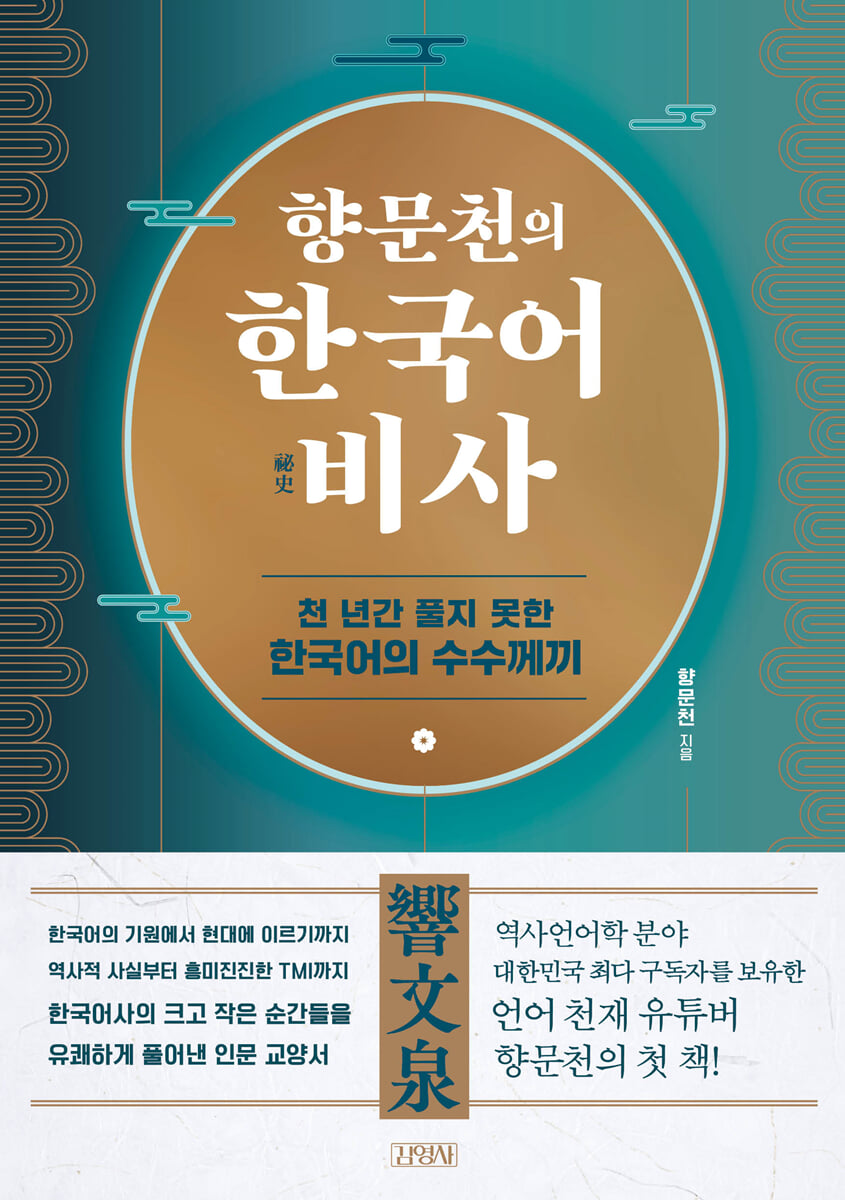
Hyangmuncheon's Korean Secret History
 |
Description
Book Introduction
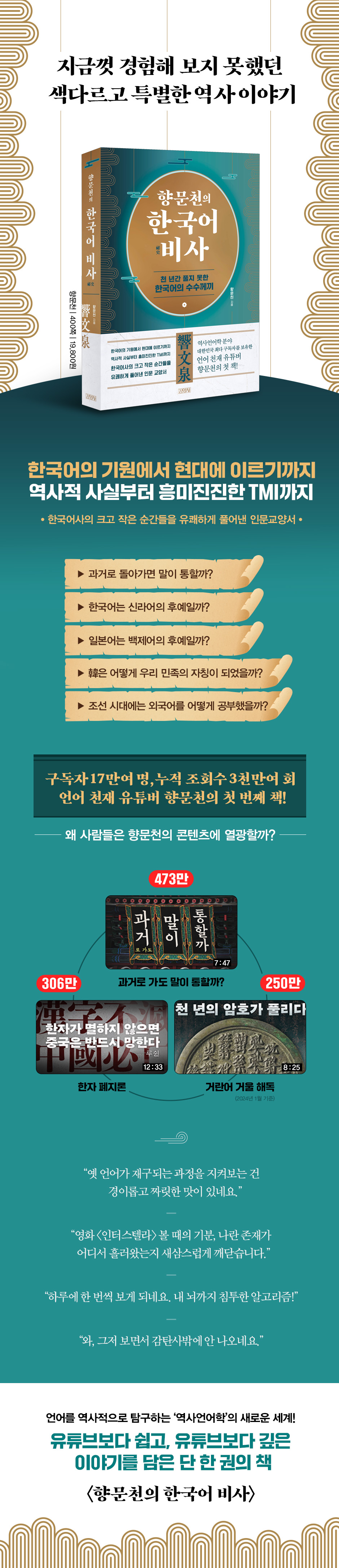
Korean history transcends time and borders If you trace the traces of changes in the Korean language, Amazing stories that were hidden unfold Hyang Moon-cheon, a linguistic genius YouTuber with the most subscribers in the field of historical linguistics in South Korea, shares the surprising history of the Korean language! "Is Korean a descendant of the Silla language?" "Is Japanese a descendant of the Baekje language?" "Would we be able to communicate if we went back in time?" "How did people study foreign languages during the Joseon Dynasty?" "How did Han become our people's self-name?" "What did foreigners call our country in the past?" "How were Western words translated in modern times?" From the origins of the Korean language to the modern era, from historical facts you might not have known to fascinating TMI, this humanities book humorously and candidly unravels the big and small moments in Korean history. It corrects misconceptions and misconceptions surrounding the origins and lineage of the Korean language, and traces how historical events and geopolitical factors have shaped the Korean language. Linguistic exchange, which occurs through the encounter between languages, influences each other in some way. This book traces each of these influences, examining the vivid history of contact and exchange between languages on the Korean Peninsula from ancient times to the modern era. It unfolds the changing status and position of the Korean language in East Asia, the multi-layered nature of Korean vocabulary, the various words that Korean has exported to other languages, and the history of the Korean people from the perspective of historical linguistics. |
- You can preview some of the book's contents.
Preview
index
Note
Glossary
vowel angle
Entering
Part 1.
Misunderstandings about the Korean language
1.
Is the Korean language a descendant of the Silla language?
2.
Is Japanese a descendant of Baekje?
3.
What is Old Korean?
4.
Category called Korean language family
Part 2.
The centrality of ancient Korean
1.
Smile and Meju
2.
Wild boar and salt shaker
3.
Korean Peninsula and Buddhist Culture
4.
Goguryeo and the continent
5.
Baekje literary tradition in Japan
6.
Japanese people from the continent
7.
Animal vocabulary through Yut Nori
8.
Words received by Korean
9.
Pre-modern foreign language education
Part 3.
The world of proper names
1.
The identity of the King of Isaji
2.
The true meaning of moving money
3.
Silla crossed the continent and the ocean
4.
Seoul and Shuri
5.
The self-proclaimed name of the Korean people
6.
Korea's Mystery
Part 4.
The turbulent modern era
1.
Dutch studies and translationism
2.
A flood of translations
3.
Literature and neologisms
4.
Linguistic remnants of Japanese colonial rule
5.
International Law and Chinese Translation
6.
Yan Fu's opposition to Japanese translations
7.
The birth of modern phonetic languages
8.
China has its own brand
9.
The Language of Chinese Cuisine
10.
Korea's first newspaper
11.
Modern English-Korean Dictionary and Translations
12.
Korean Sino-Korean words from before the Japanese colonial period
Going out
supplement
1.
List of Khitan characters
2.
Interpretation and basis of the "Dongje (Khitan Soja) Ming Wonhyeonggyeong"
3.
History of abbreviations in the Republic of Korea
main
References
Glossary
vowel angle
Entering
Part 1.
Misunderstandings about the Korean language
1.
Is the Korean language a descendant of the Silla language?
2.
Is Japanese a descendant of Baekje?
3.
What is Old Korean?
4.
Category called Korean language family
Part 2.
The centrality of ancient Korean
1.
Smile and Meju
2.
Wild boar and salt shaker
3.
Korean Peninsula and Buddhist Culture
4.
Goguryeo and the continent
5.
Baekje literary tradition in Japan
6.
Japanese people from the continent
7.
Animal vocabulary through Yut Nori
8.
Words received by Korean
9.
Pre-modern foreign language education
Part 3.
The world of proper names
1.
The identity of the King of Isaji
2.
The true meaning of moving money
3.
Silla crossed the continent and the ocean
4.
Seoul and Shuri
5.
The self-proclaimed name of the Korean people
6.
Korea's Mystery
Part 4.
The turbulent modern era
1.
Dutch studies and translationism
2.
A flood of translations
3.
Literature and neologisms
4.
Linguistic remnants of Japanese colonial rule
5.
International Law and Chinese Translation
6.
Yan Fu's opposition to Japanese translations
7.
The birth of modern phonetic languages
8.
China has its own brand
9.
The Language of Chinese Cuisine
10.
Korea's first newspaper
11.
Modern English-Korean Dictionary and Translations
12.
Korean Sino-Korean words from before the Japanese colonial period
Going out
supplement
1.
List of Khitan characters
2.
Interpretation and basis of the "Dongje (Khitan Soja) Ming Wonhyeonggyeong"
3.
History of abbreviations in the Republic of Korea
main
References
Detailed image
Into the book
Since Goryeo was a successor state to Goguryeo, not Silla, the roots of the Korean language established during the Goryeo period may possibly lie in the ‘Goguryeo language.’
In the famous negotiations between Goryeo and Liao, Seo Hee and So Son-nyeong sat facing each other from east to west and discussed territorial issues.
In this negotiation, Goryeo and Khitan each claimed to have inherited Goguryeo's legitimacy, and Goryeo claimed that it had inherited Goguryeo's national title and territory and therefore placed its capital in Pyongyang.
In this way, the Koryo people recognized themselves as the successors of Goguryeo.
--- p.34~35
The Goguryeo language exported many words to the Khitan and Jurchen languages, and they would have influenced each other.
However, this does not mean that ‘Goguryeo language’ becomes Khitan language or Jurchen language, or vice versa.
Therefore, it is very necessary to distinguish between kinship and affiliation, and to distinguish and understand native and loanwords.
It may sound obvious, but because we don't understand this, many misunderstandings about the origins and history of the Korean language have been perpetuated.
--- p.54
The Korean nominative particle '...ga' began to appear in Korean literature around the time of the Imjin War, so it is highly likely that it originated from Japanese.
It is surprising that grammatical elements that are used so frequently in modern Korean, such as the nominative particle, are not originally Korean elements.
Linguistic contact can occur not only through the exchange of material and human resources, but also in the form of war and invasion.
--- p.138
The foreign language education method of the missionary center did not have any secrets that dramatically differed from modern methods, such as starting study at a young age, repeatedly reviewing so as not to forget, memorizing textbooks written in written and spoken language, and then conversing with each other in the foreign language acquired in this way.
What was required for an interpreter to master a foreign language was learning ability and persistence.
--- p.154~155
Silla, which appears in Islamic literature, is mostly depicted as a utopian land rich in gold.
There may be complex reasons why Silla became a utopia in the Middle East, but there was an underlying myth in the Middle East that perceived paradise as a distant island in the east, originating from Dilmun, which was described in the Sumerian creation myth as the “place of the rising sun,” the “land of life,” and the “land of purity,” and known as the “land where salt water and fresh water meet.” Assilla, known as an island nation at the easternmost end, perfectly fit the conditions of this paradise.
--- p.178~179
'Love', which is an essential part of Western literature, has been a source of agony for modern Japanese translators.
(Omitted) There is controversy over its authenticity, but Futabatei, who was also a translator, is said to have translated the line “I love you” in the novel as “I don’t care if I die” after much thought.
There is a famous story that Natsume translated the same sentence as “The moon is beautiful.”
These translation difficulties were partly due to the fact that direct expressions like “I love you” were unnatural in the Eastern sensibilities of the time, but also because it was difficult to find a suitable word that perfectly matched the meaning of love.
--- p.234
Words that are unfamiliar to us initially come across as more official and more dignified.
This can also be seen in the difference in usage between “general” and “ordinary” in China and Japan. In Japanese, the word “ordinary” has been used colloquially since ancient times, so the use of the word “general” is more preferred in academic or public areas.
However, in China, “ordinary” has a colloquial nuance, so the Japanese “ordinary” is accepted and used in public areas.
--- p.249
These days, the meaning of 'subscription' has expanded to include subscribing to OTT services such as YouTube channels or Netflix, so the word 'guramja', which was used a century ago, may better fit the modern meaning.
In fact, if you look at the etymology of the word subscription, it means “to buy and read,” so the current “regular repurchase” is a result of the expansion of meaning.
In the famous negotiations between Goryeo and Liao, Seo Hee and So Son-nyeong sat facing each other from east to west and discussed territorial issues.
In this negotiation, Goryeo and Khitan each claimed to have inherited Goguryeo's legitimacy, and Goryeo claimed that it had inherited Goguryeo's national title and territory and therefore placed its capital in Pyongyang.
In this way, the Koryo people recognized themselves as the successors of Goguryeo.
--- p.34~35
The Goguryeo language exported many words to the Khitan and Jurchen languages, and they would have influenced each other.
However, this does not mean that ‘Goguryeo language’ becomes Khitan language or Jurchen language, or vice versa.
Therefore, it is very necessary to distinguish between kinship and affiliation, and to distinguish and understand native and loanwords.
It may sound obvious, but because we don't understand this, many misunderstandings about the origins and history of the Korean language have been perpetuated.
--- p.54
The Korean nominative particle '...ga' began to appear in Korean literature around the time of the Imjin War, so it is highly likely that it originated from Japanese.
It is surprising that grammatical elements that are used so frequently in modern Korean, such as the nominative particle, are not originally Korean elements.
Linguistic contact can occur not only through the exchange of material and human resources, but also in the form of war and invasion.
--- p.138
The foreign language education method of the missionary center did not have any secrets that dramatically differed from modern methods, such as starting study at a young age, repeatedly reviewing so as not to forget, memorizing textbooks written in written and spoken language, and then conversing with each other in the foreign language acquired in this way.
What was required for an interpreter to master a foreign language was learning ability and persistence.
--- p.154~155
Silla, which appears in Islamic literature, is mostly depicted as a utopian land rich in gold.
There may be complex reasons why Silla became a utopia in the Middle East, but there was an underlying myth in the Middle East that perceived paradise as a distant island in the east, originating from Dilmun, which was described in the Sumerian creation myth as the “place of the rising sun,” the “land of life,” and the “land of purity,” and known as the “land where salt water and fresh water meet.” Assilla, known as an island nation at the easternmost end, perfectly fit the conditions of this paradise.
--- p.178~179
'Love', which is an essential part of Western literature, has been a source of agony for modern Japanese translators.
(Omitted) There is controversy over its authenticity, but Futabatei, who was also a translator, is said to have translated the line “I love you” in the novel as “I don’t care if I die” after much thought.
There is a famous story that Natsume translated the same sentence as “The moon is beautiful.”
These translation difficulties were partly due to the fact that direct expressions like “I love you” were unnatural in the Eastern sensibilities of the time, but also because it was difficult to find a suitable word that perfectly matched the meaning of love.
--- p.234
Words that are unfamiliar to us initially come across as more official and more dignified.
This can also be seen in the difference in usage between “general” and “ordinary” in China and Japan. In Japanese, the word “ordinary” has been used colloquially since ancient times, so the use of the word “general” is more preferred in academic or public areas.
However, in China, “ordinary” has a colloquial nuance, so the Japanese “ordinary” is accepted and used in public areas.
--- p.249
These days, the meaning of 'subscription' has expanded to include subscribing to OTT services such as YouTube channels or Netflix, so the word 'guramja', which was used a century ago, may better fit the modern meaning.
In fact, if you look at the etymology of the word subscription, it means “to buy and read,” so the current “regular repurchase” is a result of the expansion of meaning.
--- p.301
Publisher's Review
A language genius YouTuber with the most subscribers in the field of historical linguistics in South Korea
The Hidden History of the Korean Language as Told by Hyangmuncheon
- Is the Korean language a descendant of the Silla language?
- Is Japanese a descendant of Baekje?
- If we go back in time, will we be able to communicate?
- How did people study foreign languages during the Joseon Dynasty?
- How did Han become the name of our people?
- What did foreigners call our country in the past?
- How were Western words translated in the modern era?
From the origins of the Korean language to modern times, from historical facts you may not have known to fascinating TMI, this humanities book humorously and candidly unfolds the major and minor moments of Korean history.
It corrects misconceptions and common sense surrounding the origins and lineage of the Korean language, and traces how historical events and geopolitical factors have shaped the Korean language.
Linguistic exchange, which occurs through the encounter between languages, influences each other in some way.
This book traces each of these influences, examining the vivid history of contact and exchange between languages on the Korean Peninsula from ancient times to the modern era.
It unfolds the changing status and position of the Korean language in East Asia, the multi-layered nature of Korean vocabulary, the various words that Korean has exported to other languages, and the history of the Korean people from the perspective of historical linguistics.
Every language has a history
Language contains traces of diverse existences and records of long lives.
Therefore, if we delve back into the past to find the origin of that word, we encounter another history.
Just as history exists amidst change and events, language is also always in the midst of inevitable change and has rational motivations.
This book focuses on language exchange among the numerous motivations for language change, and explores the history of the Korean language, which has continuously evolved from ancient times to the present.
The Korean language, which was used mainly on the Korean Peninsula, had many opportunities to come into direct contact with Han, Khitan, Mongolian, Jurchen, etc. above, and Wa below, and it is said that at one time there was active land and sea trade with the Western Regions.
In the process, the Korean language communicated with many languages and influenced each other in large and small ways.
It is similar to the fact that numerous Chinese characters, foreign words, and words derived from them have naturally permeated our daily lives.
However, the study of past languages, especially ancient languages, is difficult to escape from theoretical discussions because there are few written records left.
Of course, discussions in mainstream historical linguistics are established only on a solid foundation, but that doesn't mean there aren't many areas where absolute certainty can be established, making them more difficult to address than general history.
This is why books related to historical linguistics have remained academic research papers.
That's why this book is special.
This book is the first popular book in the field of historical linguistics, built on a solid foundation of numerous papers, books, various historical materials, and established academic theories, yet avoiding as much difficult terminology as possible and writing in an easily accessible manner for anyone with a basic understanding of history and linguistics.
As we trace the evolution of the Korean language based on historical facts, surprising stories that had been hidden for so long unfold.
A quick overview of the history of the Korean language
This book is divided into four parts.
Before delving into the history of the Korean language in earnest, Part 1 corrects unfounded common sense and misconceptions about the Korean language. Through a wealth of case studies and helpful commentary, it provides an opportunity to familiarize oneself with various concepts in historical linguistics that may be unfamiliar.
In Part 2, we examine the history of East Asia surrounding the Korean Peninsula through the phenomenon of ancient Korean being spread and transmitted to surrounding languages such as Wa, Khitan, Mongolian, Jurchen, and Manchu, and conversely, through elements of surrounding languages that remain in ancient Korean.
It also introduces how foreign language education was conducted to train interpreters during the Goryeo and Joseon Dynasties.
In Part 3, proper names such as personal and place names found in ancient literature are reconstructed based on various historical materials to correct misinterpretations, and various foreign documents are used to trace how the names of past countries such as Silla and Goryeo were transmitted to foreign countries and changed.
We will also examine how Han (Han) came to be established as a name representing our people.
Part 4 explains how the Korean language came to accept Western languages amidst the turbulent political climate of East Asia during the modernization period.
It also covers the efforts and influence of China and Japan, which adopted Western civilization faster than Korea, on translation, the first published Korean dictionary and newspaper, and the differences in Korean vocabulary used during the Enlightenment Period and today.
In addition, as an appendix, the basis for the interpretation of the "Dongje (Khitan Soja) Myeong Wonhyeonggyeong" that was not revealed in the video "Deciphering the Khitan Mirror at the National Museum of Korea" that caused a huge stir on the Hyangmuncheon YouTube channel in 2022 was included in detail, and the history of attempts to establish Chinese character abbreviations since the founding of the Republic of Korea, which was not well known to the world until then, was briefly presented.
The Korean language is still evolving
As a book that deals with the history of language exchange, this book features over a dozen different languages from the past.
Among them, there are some languages that are still used today, but there are also many languages that no longer survive and have become extinct.
In this way, languages have been constantly created and destroyed along with the rise and fall of nations and cultures.
Writing systems that failed to adapt to the changing times gradually disappeared, and new languages took their place. Among them, some languages with outstanding cultural capabilities or strong vitality spread to surrounding areas.
Sometimes political relationships, religious beliefs, and merchant interactions have fueled the spread of language.
The Korean language, which once faced the brink of extinction throughout its long and winding history, has endured with tenacious vitality to this day, and is now spreading throughout the world thanks to K-culture.
Isn't it time to look forward to the impact Korean will have on world languages and linguistic history?
As mentioned earlier, this book contains a mixture of modern Korean and the languages of various ethnic groups from the past, so the editing process faced several technical difficulties.
In particular, when East Asian characters that run from left to right and Central Asian characters that run from right to left are mixed within a single paragraph, the layout is likely to become distorted or the font broken.
However, we put our heart and soul into it until the very end, reflecting it correctly, with readers in mind who will experience the history of the Korean language in a new way. We also included all the illustrations in color to make it more vivid for readers.
If you want to develop a more special and advanced level of historical and linguistic knowledge, I highly recommend this book.
This book will satisfy anyone who wants to learn about the history of the Korean language and gain a deeper understanding.
The Hidden History of the Korean Language as Told by Hyangmuncheon
- Is the Korean language a descendant of the Silla language?
- Is Japanese a descendant of Baekje?
- If we go back in time, will we be able to communicate?
- How did people study foreign languages during the Joseon Dynasty?
- How did Han become the name of our people?
- What did foreigners call our country in the past?
- How were Western words translated in the modern era?
From the origins of the Korean language to modern times, from historical facts you may not have known to fascinating TMI, this humanities book humorously and candidly unfolds the major and minor moments of Korean history.
It corrects misconceptions and common sense surrounding the origins and lineage of the Korean language, and traces how historical events and geopolitical factors have shaped the Korean language.
Linguistic exchange, which occurs through the encounter between languages, influences each other in some way.
This book traces each of these influences, examining the vivid history of contact and exchange between languages on the Korean Peninsula from ancient times to the modern era.
It unfolds the changing status and position of the Korean language in East Asia, the multi-layered nature of Korean vocabulary, the various words that Korean has exported to other languages, and the history of the Korean people from the perspective of historical linguistics.
Every language has a history
Language contains traces of diverse existences and records of long lives.
Therefore, if we delve back into the past to find the origin of that word, we encounter another history.
Just as history exists amidst change and events, language is also always in the midst of inevitable change and has rational motivations.
This book focuses on language exchange among the numerous motivations for language change, and explores the history of the Korean language, which has continuously evolved from ancient times to the present.
The Korean language, which was used mainly on the Korean Peninsula, had many opportunities to come into direct contact with Han, Khitan, Mongolian, Jurchen, etc. above, and Wa below, and it is said that at one time there was active land and sea trade with the Western Regions.
In the process, the Korean language communicated with many languages and influenced each other in large and small ways.
It is similar to the fact that numerous Chinese characters, foreign words, and words derived from them have naturally permeated our daily lives.
However, the study of past languages, especially ancient languages, is difficult to escape from theoretical discussions because there are few written records left.
Of course, discussions in mainstream historical linguistics are established only on a solid foundation, but that doesn't mean there aren't many areas where absolute certainty can be established, making them more difficult to address than general history.
This is why books related to historical linguistics have remained academic research papers.
That's why this book is special.
This book is the first popular book in the field of historical linguistics, built on a solid foundation of numerous papers, books, various historical materials, and established academic theories, yet avoiding as much difficult terminology as possible and writing in an easily accessible manner for anyone with a basic understanding of history and linguistics.
As we trace the evolution of the Korean language based on historical facts, surprising stories that had been hidden for so long unfold.
A quick overview of the history of the Korean language
This book is divided into four parts.
Before delving into the history of the Korean language in earnest, Part 1 corrects unfounded common sense and misconceptions about the Korean language. Through a wealth of case studies and helpful commentary, it provides an opportunity to familiarize oneself with various concepts in historical linguistics that may be unfamiliar.
In Part 2, we examine the history of East Asia surrounding the Korean Peninsula through the phenomenon of ancient Korean being spread and transmitted to surrounding languages such as Wa, Khitan, Mongolian, Jurchen, and Manchu, and conversely, through elements of surrounding languages that remain in ancient Korean.
It also introduces how foreign language education was conducted to train interpreters during the Goryeo and Joseon Dynasties.
In Part 3, proper names such as personal and place names found in ancient literature are reconstructed based on various historical materials to correct misinterpretations, and various foreign documents are used to trace how the names of past countries such as Silla and Goryeo were transmitted to foreign countries and changed.
We will also examine how Han (Han) came to be established as a name representing our people.
Part 4 explains how the Korean language came to accept Western languages amidst the turbulent political climate of East Asia during the modernization period.
It also covers the efforts and influence of China and Japan, which adopted Western civilization faster than Korea, on translation, the first published Korean dictionary and newspaper, and the differences in Korean vocabulary used during the Enlightenment Period and today.
In addition, as an appendix, the basis for the interpretation of the "Dongje (Khitan Soja) Myeong Wonhyeonggyeong" that was not revealed in the video "Deciphering the Khitan Mirror at the National Museum of Korea" that caused a huge stir on the Hyangmuncheon YouTube channel in 2022 was included in detail, and the history of attempts to establish Chinese character abbreviations since the founding of the Republic of Korea, which was not well known to the world until then, was briefly presented.
The Korean language is still evolving
As a book that deals with the history of language exchange, this book features over a dozen different languages from the past.
Among them, there are some languages that are still used today, but there are also many languages that no longer survive and have become extinct.
In this way, languages have been constantly created and destroyed along with the rise and fall of nations and cultures.
Writing systems that failed to adapt to the changing times gradually disappeared, and new languages took their place. Among them, some languages with outstanding cultural capabilities or strong vitality spread to surrounding areas.
Sometimes political relationships, religious beliefs, and merchant interactions have fueled the spread of language.
The Korean language, which once faced the brink of extinction throughout its long and winding history, has endured with tenacious vitality to this day, and is now spreading throughout the world thanks to K-culture.
Isn't it time to look forward to the impact Korean will have on world languages and linguistic history?
As mentioned earlier, this book contains a mixture of modern Korean and the languages of various ethnic groups from the past, so the editing process faced several technical difficulties.
In particular, when East Asian characters that run from left to right and Central Asian characters that run from right to left are mixed within a single paragraph, the layout is likely to become distorted or the font broken.
However, we put our heart and soul into it until the very end, reflecting it correctly, with readers in mind who will experience the history of the Korean language in a new way. We also included all the illustrations in color to make it more vivid for readers.
If you want to develop a more special and advanced level of historical and linguistic knowledge, I highly recommend this book.
This book will satisfy anyone who wants to learn about the history of the Korean language and gain a deeper understanding.
GOODS SPECIFICS
- Date of issue: February 10, 2024
- Page count, weight, size: 400 pages | 590g | 148*210*30mm
- ISBN13: 9788934981015
- ISBN10: 8934981016
You may also like
카테고리
korean


korean

![ELLE 엘르 스페셜 에디션 A형 : 12월 [2025]](http://librairie.coreenne.fr/cdn/shop/files/b8e27a3de6c9538896439686c6b0e8fb.jpg?v=1766436872&width=3840)


