

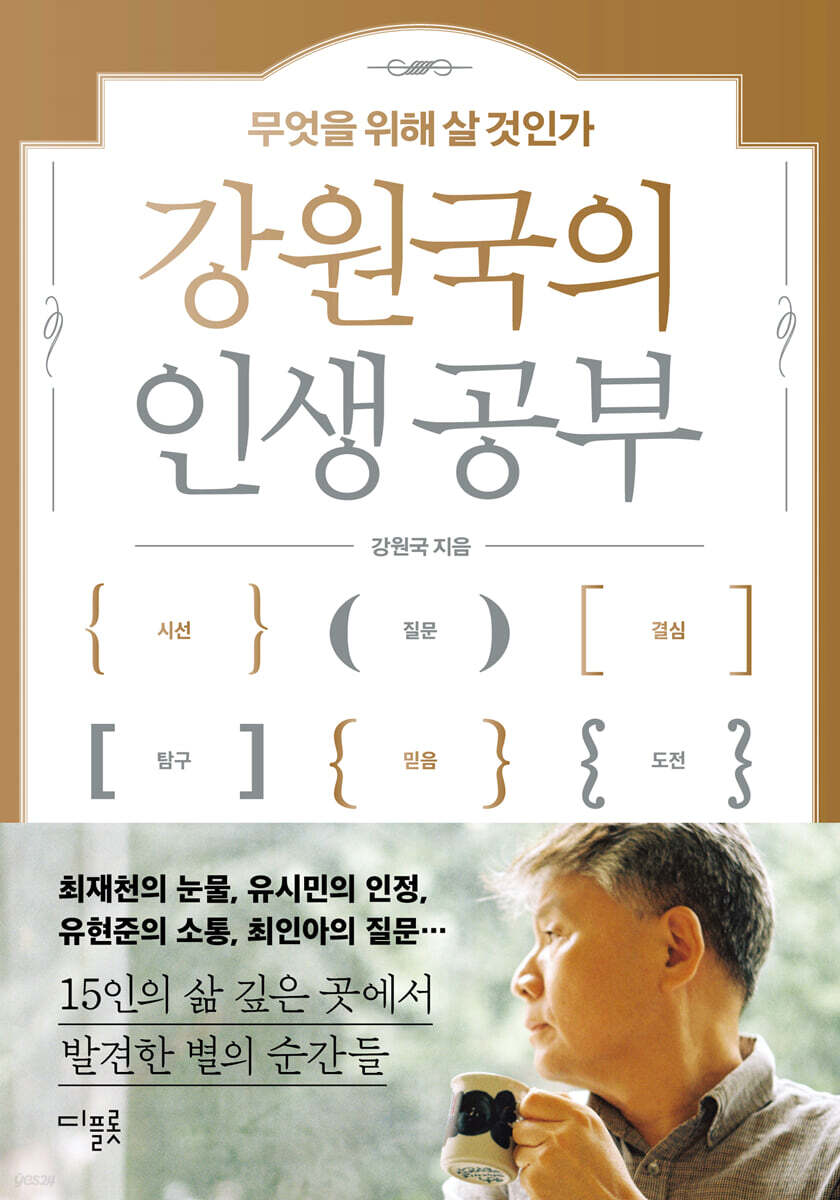
Kang Won-guk's life study
 |
Description
Book Introduction
- A word from MD
-
Learn from your great lifeWriter Kang Won-guk condenses the lives of 15 people whose names alone make one's heart flutter, including Na Tae-joo, No Brain, Park Mi-ok, Yoo Si-min, Yoo Hyun-joon, Lee Seul-ah, Choi Jae-cheon, and Choi In-ah.
How should we live and for what? This book provides answers, empowering us to overcome adversity and move forward.
January 16, 2024. Humanities PD Son Min-gyu
Choi Jae-cheon's tears, Yoo Si-min's challenge, Yoo Hyun-jun's lack, Choi In-ah's questions...
Kang Won-guk discovers "star moments" deep within the lives of 15 people.
“Now that I have finished writing this book, I have been free from my long-standing inferiority complex.
“Now I challenge failure.” (From “Epilogue”)
Kang Won-guk met with 15 people who have led change at the forefront of their time and sometimes embraced the pain of our lives, and learned about their intimate life histories and the wisdom to live by.
For over two years, Kang Won-guk has listened to the lives of 300 people who have emerged as beacons of hope in our society, and has captured the essence of the lives of 15 of them, leading figures in fields such as education, science, law, architecture, and literature, in this book.
Kang Won-guk believes that listening to the wisdom condensed throughout a person's life is the best form of study, and in this book, he has compiled the moments when conversation as study shined the brightest.
Kangwon-guk discovers a surprising commonality among them.
Almost everyone, without exception, has gone through times of adversity and used them as opportunities to overcome them and move on to their current lives.
What kind of unique life wisdom do those who have written their own drama of overcoming and regeneration have?
Kang Won-guk focuses on the moments when, even in times of despair, he never lost sight of what he was living for, what his life's direction was, rather than the success or failure of life, and explores how he forged his own path.
All 15 people have put their different life wisdoms into this book.
Kang Won-guk discovers "star moments" deep within the lives of 15 people.
“Now that I have finished writing this book, I have been free from my long-standing inferiority complex.
“Now I challenge failure.” (From “Epilogue”)
Kang Won-guk met with 15 people who have led change at the forefront of their time and sometimes embraced the pain of our lives, and learned about their intimate life histories and the wisdom to live by.
For over two years, Kang Won-guk has listened to the lives of 300 people who have emerged as beacons of hope in our society, and has captured the essence of the lives of 15 of them, leading figures in fields such as education, science, law, architecture, and literature, in this book.
Kang Won-guk believes that listening to the wisdom condensed throughout a person's life is the best form of study, and in this book, he has compiled the moments when conversation as study shined the brightest.
Kangwon-guk discovers a surprising commonality among them.
Almost everyone, without exception, has gone through times of adversity and used them as opportunities to overcome them and move on to their current lives.
What kind of unique life wisdom do those who have written their own drama of overcoming and regeneration have?
Kang Won-guk focuses on the moments when, even in times of despair, he never lost sight of what he was living for, what his life's direction was, rather than the success or failure of life, and explores how he forged his own path.
All 15 people have put their different life wisdoms into this book.
- You can preview some of the book's contents.
Preview
index
Beginning a Meeting - Learning from Your Life
Yoo Si-min: Admitting Ignorance Opens a New Perspective
Yoo Hyun-jun - A space for communication created by overcoming anxiety and deprivation
Jeong Ji-ah - The Gift of Liberation from a Warm Neighbor's Invasion
Pyo Chang-won - A free citizen dreaming of a just Sherlock Holmes
Isul-ah - A life of self-proclaimed authorship.
Choi Jae-cheon - Overcoming the emptiness of youth and entering a world of pure passion for exploration
Choi In-ah - A person who asks herself questions as if asking a loved one.
Paul Kim - The Power of Questions and Coaching That Turned Last Place into First Place
Park Jun-young - A life of regeneration and progress, a retrial for the weak is my destiny.
Kim Dong-sik - A storyteller from the periphery who delivers a powerful punch to the world.
Go Myeong-hwan - A passionate reader striving for a life with a beautiful ending
Ko Dong-jin: A Purpose-Driven Life That Created a Galaxy World Myth
Park Mi-ok - The Difference in Perspectives on Finding Oneself in Others' Lives
No Brain - Free-spirited runaways who set the stage ablaze
Na Tae-joo - I wrote to live, and I write to live.
Epilogue
Yoo Si-min: Admitting Ignorance Opens a New Perspective
Yoo Hyun-jun - A space for communication created by overcoming anxiety and deprivation
Jeong Ji-ah - The Gift of Liberation from a Warm Neighbor's Invasion
Pyo Chang-won - A free citizen dreaming of a just Sherlock Holmes
Isul-ah - A life of self-proclaimed authorship.
Choi Jae-cheon - Overcoming the emptiness of youth and entering a world of pure passion for exploration
Choi In-ah - A person who asks herself questions as if asking a loved one.
Paul Kim - The Power of Questions and Coaching That Turned Last Place into First Place
Park Jun-young - A life of regeneration and progress, a retrial for the weak is my destiny.
Kim Dong-sik - A storyteller from the periphery who delivers a powerful punch to the world.
Go Myeong-hwan - A passionate reader striving for a life with a beautiful ending
Ko Dong-jin: A Purpose-Driven Life That Created a Galaxy World Myth
Park Mi-ok - The Difference in Perspectives on Finding Oneself in Others' Lives
No Brain - Free-spirited runaways who set the stage ablaze
Na Tae-joo - I wrote to live, and I write to live.
Epilogue
Detailed image

Into the book
Feynman once called the humanists he met at a forum “arrogant fools.”
Just being stupid is okay, you can talk and help.
But what can we do about arrogant fools who believe they know something when they don't? That's what he said.
When I first read that passage, I thought, "That's too harsh," but after reading other science books, like Richard Dawkins' "The Selfish Gene" or Carl Sagan's "Cosmos," I realized I was really an idiot.
I was in that foolish range.
So, I thought, "This won't work. How much must scientists have laughed at our liberal arts students all these years?" and so from then on, I started reading science books in my spare time.
--- p.18~19, from “Yoo Si-min - A new perspective opens when you admit you don’t know”
[Kang Won-guk] You've been suppressing yourself, but when you encountered architecture, did you let out all those suppressed emotions?
[Hyunjun Yoo] I felt like I could breathe easier while doing architectural design.
I have a bit of a tolerance for it, but architectural design completely solved it.
Architectural design is about showing my ideas to other people.
But when people hear that, they applaud and praise it.
It's about having my existence acknowledged.
I want to do better.
I also started thinking about going to a place where the best people in the world are, seeing how I stack up, and competing against them.
Perhaps because I entered Harvard University with this mindset, I had a lot of fun studying there.
--- p.52, from “Yoo Hyun-jun - A space for communication created by overcoming anxiety and deficiency”
I learned exactly what kind of influence my father had on people.
Actually, my parents didn't have anything.
They are people who have no money and are branded as communists.
So who would want to be so attentive and take care of someone like that? My mother's abilities are slowly declining as she approaches ninety. Who would come to visit someone like that?
But the neighbors come by every time.
Please do your best to provide my mother with her favorite side dishes, warm clothes for her to wear, and even non-slip socks for her.
Even though I am her daughter, she takes care of everything that I cannot even pay attention to. (Omitted)
Gurye will be the same now as it was before I left.
But as I get older, I start to see things I didn't see before and learn things I didn't know before.
Sharing our hearts and living together doesn't necessarily mean that all of humanity's absolute loneliness or solitude will be resolved, but at least I don't think there will be any serious incidents in this life where people become broken or make extreme choices.
Because it comes and goes in and out of people's minds like this all the time.
--- p.71, from “Jeong Ji-ah - The Gift of Liberation Given by the Warm Invasion of Neighbors”
[Kang Won-guk] So, what should a writer do to write well?
[Lee Seul-ah] I would like to answer this by borrowing the words of Professor Kang Won-guk.
'Listening must come first.'
I think writing is the pinnacle of reading.
I think that if you continue to be a reader who reads a lot, you will eventually end up writing.
--- p.145, from “Isul-ah - A life of moving forward while planting the flag of being a writer on oneself”
I spent a week traveling around the country, searching streams with American professor George Edmonds.
Then I thought, maybe I should live like this grandfather.
So on the last day, when the professor bought me a beer at the Chosun Hotel where I was staying, I asked him.
How can I become like you?
Then I went to study abroad in the US for a long time.
While doing that, he taught me this and that, and I thought, "Ah, this is it."
So from that day on, I started preparing to study abroad.
--- p.156~157, from “Choi Jae-cheon - Overcoming the Emptiness of Youth and Entering the World of Pure Passion for Exploration”
I think that when I have concerns or questions, fermentation occurs.
So, at first, the question was A, but after a while, there comes a moment when you realize, 'The key wasn't A, it was B.'
So, at first, I was like, 'How much can I do this? How long can I hold out?' But as I went on, it changed to, 'Time is running out.'
Even if you don't have money now, you might get it in the future.
But time only gets shorter.
It's similar to living with only the balance in your bank account.
Even if you only spend ten thousand won, you end up saving it for important things.
So, with time running out, am I saving my time and using it wisely for what's important? I asked myself this question and looked in the mirror. My eyes seemed to dilate.
From then on, I started trying to use my time wisely.
--- p.219~220, from “Choi In-ah - A person who asks herself questions as if asking a loved one”
I like what Professor Shin Young-bok says.
There is a saying:
What I'm saying is that any evaluation of a person, or an evaluation of a person's life, should be based on how much of the contradictions and pain of the times in which that person lived are captured.
Through the cases I defend and will defend in the future, I hope to capture many of the contradictions and pains of our society.
Rather than just expressing pain, I want to tell a future-oriented story with warm affection.
Due to the limitations of my personal capabilities, the number of cases I can handle for retrial is small.
But I continue to give meaning to the events that I can.
When you give meaning to your work, you become passionate about it.
Then, you will have the desire to achieve good results.
--- p.239~240, from “Park Jun-young - A life that progresses through regeneration, a retrial for the weak is my destiny”
Author Kim Dong-sik still finds it surprising that he is a star author who receives tens of millions of won in royalties.
It seems like he still doesn't realize how popular he is.
If you listen to Kim Dong-sik's life story, you will understand why.
I wonder if it could be any more unfortunate than this.
Kim Dong-sik, who is thirty-eight years old this year, has lived in extreme poverty for thirty-one years of his life, and has never had a day when his hands were free of grease after dropping out of school in his first year of middle school.
But now I've become a writer who writes novels.
There are readers who wait for his novels and buy his books.
Requests to give lectures are pouring in from all over.
I was typing away at the keyboard, and my income was more than ten times that of my factory worker days.
From the writer Kim Dong-sik's perspective, each day is like a dream that disappears like smoke when he wakes up.
--- p.244, from “Kim Dong-sik - A storyteller from the outskirts who delivers a heavy punch to the world”
[Kangwon-guk] It's incredible that they even factored in global warming when opening a buckwheat noodle restaurant.
I'm also curious about how the law of the land, the chapter, and the law are applied.
[Goh Myeong-hwan] The earth is the tree and the location.
I checked the speed of cars and the walking speed of people on the road adjacent to where my store will be located.
For example, in the case of food stalls, the slower the pace of people walking, the better.
So the food stall is in the alley.
There are no food stalls along the street near Seolleung Station.
A good commercial district is one where people walk slowly.
There's so much to see that my pace slows down.
As I looked at the sign and the products on display, my pace slowed down.
--- p.276, from “Goh Myeong-hwan - A fierce reader striving for a life with a beautiful ending”
[Kang Won-guk] Our society is desperately thirsty for true leaders.
What kind of leader is a good leader, a leader we need?
[Go Dong-jin] First of all, when you become a middle manager, you must have the ability to cover for those below you when they seem unable to accomplish something.
If you continue to build up the ability to lead others like that, people will naturally follow you.
That's what it means to lead by example.
But if you just talk without taking the initiative, people will never follow suit.
I'll pretend to follow.
To rise to greater heights, leading by example is a fundamental asset, and humility and consideration must be added to it.
They say that if you humble yourself, others will follow, and if you show off, others will be suspicious.
This is a story told by a Chinese person during the Qing Dynasty, and I think it reflects one of the biggest problems in society today.
What you know exists in your memory, but you don't know if you really know it.
Memory can be faulty.
So people should be humble, considerate, and empathetic.
Then there is no reason for conflict to arise between people.
I don't see any reason for the relationship between seniors and juniors to become bad.
--- p.308, from “Go Dong-jin - A life driven by purpose that created the myth of the galaxy world”
In the morning, I ride my bike to work at the ‘Full Flower Literature Museum’.
If you keep going, you will pass by several elementary schools, and sometimes you will meet angels.
As I was passing by, the kids recognized me and said hello.
Say “hello” like an angel.
I ask the kid, wondering if he knows that I'm a poet and that I used to be a school principal.
If you ask me, “Do you know who I am?” I say, “I don’t know.”
I'm just saying hello to the neighborhood grandfather.
So I think.
'Ah, I met an angel again today.'
I met an angel who greeted me, so today, even if I'm angry, I should be less angry, and even if I'm sick, I should think happily. These are the thoughts that come to mind.
And if possible, I try to go at a leisurely pace.
If I ride my bike too fast, the angel might not be able to say hello to me.
Just being stupid is okay, you can talk and help.
But what can we do about arrogant fools who believe they know something when they don't? That's what he said.
When I first read that passage, I thought, "That's too harsh," but after reading other science books, like Richard Dawkins' "The Selfish Gene" or Carl Sagan's "Cosmos," I realized I was really an idiot.
I was in that foolish range.
So, I thought, "This won't work. How much must scientists have laughed at our liberal arts students all these years?" and so from then on, I started reading science books in my spare time.
--- p.18~19, from “Yoo Si-min - A new perspective opens when you admit you don’t know”
[Kang Won-guk] You've been suppressing yourself, but when you encountered architecture, did you let out all those suppressed emotions?
[Hyunjun Yoo] I felt like I could breathe easier while doing architectural design.
I have a bit of a tolerance for it, but architectural design completely solved it.
Architectural design is about showing my ideas to other people.
But when people hear that, they applaud and praise it.
It's about having my existence acknowledged.
I want to do better.
I also started thinking about going to a place where the best people in the world are, seeing how I stack up, and competing against them.
Perhaps because I entered Harvard University with this mindset, I had a lot of fun studying there.
--- p.52, from “Yoo Hyun-jun - A space for communication created by overcoming anxiety and deficiency”
I learned exactly what kind of influence my father had on people.
Actually, my parents didn't have anything.
They are people who have no money and are branded as communists.
So who would want to be so attentive and take care of someone like that? My mother's abilities are slowly declining as she approaches ninety. Who would come to visit someone like that?
But the neighbors come by every time.
Please do your best to provide my mother with her favorite side dishes, warm clothes for her to wear, and even non-slip socks for her.
Even though I am her daughter, she takes care of everything that I cannot even pay attention to. (Omitted)
Gurye will be the same now as it was before I left.
But as I get older, I start to see things I didn't see before and learn things I didn't know before.
Sharing our hearts and living together doesn't necessarily mean that all of humanity's absolute loneliness or solitude will be resolved, but at least I don't think there will be any serious incidents in this life where people become broken or make extreme choices.
Because it comes and goes in and out of people's minds like this all the time.
--- p.71, from “Jeong Ji-ah - The Gift of Liberation Given by the Warm Invasion of Neighbors”
[Kang Won-guk] So, what should a writer do to write well?
[Lee Seul-ah] I would like to answer this by borrowing the words of Professor Kang Won-guk.
'Listening must come first.'
I think writing is the pinnacle of reading.
I think that if you continue to be a reader who reads a lot, you will eventually end up writing.
--- p.145, from “Isul-ah - A life of moving forward while planting the flag of being a writer on oneself”
I spent a week traveling around the country, searching streams with American professor George Edmonds.
Then I thought, maybe I should live like this grandfather.
So on the last day, when the professor bought me a beer at the Chosun Hotel where I was staying, I asked him.
How can I become like you?
Then I went to study abroad in the US for a long time.
While doing that, he taught me this and that, and I thought, "Ah, this is it."
So from that day on, I started preparing to study abroad.
--- p.156~157, from “Choi Jae-cheon - Overcoming the Emptiness of Youth and Entering the World of Pure Passion for Exploration”
I think that when I have concerns or questions, fermentation occurs.
So, at first, the question was A, but after a while, there comes a moment when you realize, 'The key wasn't A, it was B.'
So, at first, I was like, 'How much can I do this? How long can I hold out?' But as I went on, it changed to, 'Time is running out.'
Even if you don't have money now, you might get it in the future.
But time only gets shorter.
It's similar to living with only the balance in your bank account.
Even if you only spend ten thousand won, you end up saving it for important things.
So, with time running out, am I saving my time and using it wisely for what's important? I asked myself this question and looked in the mirror. My eyes seemed to dilate.
From then on, I started trying to use my time wisely.
--- p.219~220, from “Choi In-ah - A person who asks herself questions as if asking a loved one”
I like what Professor Shin Young-bok says.
There is a saying:
What I'm saying is that any evaluation of a person, or an evaluation of a person's life, should be based on how much of the contradictions and pain of the times in which that person lived are captured.
Through the cases I defend and will defend in the future, I hope to capture many of the contradictions and pains of our society.
Rather than just expressing pain, I want to tell a future-oriented story with warm affection.
Due to the limitations of my personal capabilities, the number of cases I can handle for retrial is small.
But I continue to give meaning to the events that I can.
When you give meaning to your work, you become passionate about it.
Then, you will have the desire to achieve good results.
--- p.239~240, from “Park Jun-young - A life that progresses through regeneration, a retrial for the weak is my destiny”
Author Kim Dong-sik still finds it surprising that he is a star author who receives tens of millions of won in royalties.
It seems like he still doesn't realize how popular he is.
If you listen to Kim Dong-sik's life story, you will understand why.
I wonder if it could be any more unfortunate than this.
Kim Dong-sik, who is thirty-eight years old this year, has lived in extreme poverty for thirty-one years of his life, and has never had a day when his hands were free of grease after dropping out of school in his first year of middle school.
But now I've become a writer who writes novels.
There are readers who wait for his novels and buy his books.
Requests to give lectures are pouring in from all over.
I was typing away at the keyboard, and my income was more than ten times that of my factory worker days.
From the writer Kim Dong-sik's perspective, each day is like a dream that disappears like smoke when he wakes up.
--- p.244, from “Kim Dong-sik - A storyteller from the outskirts who delivers a heavy punch to the world”
[Kangwon-guk] It's incredible that they even factored in global warming when opening a buckwheat noodle restaurant.
I'm also curious about how the law of the land, the chapter, and the law are applied.
[Goh Myeong-hwan] The earth is the tree and the location.
I checked the speed of cars and the walking speed of people on the road adjacent to where my store will be located.
For example, in the case of food stalls, the slower the pace of people walking, the better.
So the food stall is in the alley.
There are no food stalls along the street near Seolleung Station.
A good commercial district is one where people walk slowly.
There's so much to see that my pace slows down.
As I looked at the sign and the products on display, my pace slowed down.
--- p.276, from “Goh Myeong-hwan - A fierce reader striving for a life with a beautiful ending”
[Kang Won-guk] Our society is desperately thirsty for true leaders.
What kind of leader is a good leader, a leader we need?
[Go Dong-jin] First of all, when you become a middle manager, you must have the ability to cover for those below you when they seem unable to accomplish something.
If you continue to build up the ability to lead others like that, people will naturally follow you.
That's what it means to lead by example.
But if you just talk without taking the initiative, people will never follow suit.
I'll pretend to follow.
To rise to greater heights, leading by example is a fundamental asset, and humility and consideration must be added to it.
They say that if you humble yourself, others will follow, and if you show off, others will be suspicious.
This is a story told by a Chinese person during the Qing Dynasty, and I think it reflects one of the biggest problems in society today.
What you know exists in your memory, but you don't know if you really know it.
Memory can be faulty.
So people should be humble, considerate, and empathetic.
Then there is no reason for conflict to arise between people.
I don't see any reason for the relationship between seniors and juniors to become bad.
--- p.308, from “Go Dong-jin - A life driven by purpose that created the myth of the galaxy world”
In the morning, I ride my bike to work at the ‘Full Flower Literature Museum’.
If you keep going, you will pass by several elementary schools, and sometimes you will meet angels.
As I was passing by, the kids recognized me and said hello.
Say “hello” like an angel.
I ask the kid, wondering if he knows that I'm a poet and that I used to be a school principal.
If you ask me, “Do you know who I am?” I say, “I don’t know.”
I'm just saying hello to the neighborhood grandfather.
So I think.
'Ah, I met an angel again today.'
I met an angel who greeted me, so today, even if I'm angry, I should be less angry, and even if I'm sick, I should think happily. These are the thoughts that come to mind.
And if possible, I try to go at a leisurely pace.
If I ride my bike too fast, the angel might not be able to say hello to me.
--- p.362~363, from “Na Tae-ju - Written to Live, Writes to Live”
Publisher's Review
Listening to the wisdom condensed throughout life,
That's the best study
After publishing his first book, "The President's Writing," which was chosen by 500,000 readers, Kang Won-guk has continued to publish best-selling books on writing and has given lectures and broadcasts.
When I was in charge of writing speeches for former Presidents Kim Dae-jung and Roh Moo-hyun, in order to write words and writings that moved the hearts of the people, I had to first and foremost study the lives and thoughts of the two presidents.
This ‘Kangwon-guk’s listening’ was not limited to writing.
I met people who have transformed our society and sometimes helped to heal the pain, and heard about their lives.
Rather than highlighting the greatness of their achievements, this book captures the life wisdom and life-changing moments of decision that led them to their current lives.
“I think that when I have concerns or questions, fermentation occurs.
At first, the question was A, but after a while, there comes a moment when you think, 'The key wasn't A, it was B.'
“So, at first, I was like, ‘How much longer can I do this? How long can I hold out?’ But as I went on, it changed to, ‘Time is running out.’” This is what CEO Choi In-ah, who became the first female vice president at Cheil Worldwide, then quit and opened a bookstore, the first of its kind, and is on a roll again.
He said that the most important thing in telling his story was 'questions', and he advises those who are worried about taking on a new challenge to 'ask yourself questions as if you were asking a loved one.'
We have developed the habit of always living as '乙' at work, so we consider ourselves as '乙' in our own lives as well. Just as we are curious about even the smallest details of our lover's inner thoughts, we should keep asking questions about our inner thoughts and treat the answers as thoughts of '甲'.
If CEO Choi In-ah led her second life to success through her own method of questioning, architect Professor Yoo Hyeon-jun was able to reach his current life because he faced his own deficiencies and anxieties and transformed them into a will to live a better life.
Professor Yoo Hyeon-jun finally opens his heart and sheds tears in response to Kang Won-guk's question that leads him to tell a story about his childhood. He calmly tells an anecdote about how he was shocked by the sight of his father overcome with sadness one night, and about the time when he was always pushed back by his older brother and was suppressed by an inferiority complex.
As the conversation continues and reaches his architectural philosophy of 'harmony', it naturally reveals how the emotions lurking in his heart have become the driving force of his life and the foundation of his architectural philosophy.
Not the greatness of the result
It makes you realize the greatness of life.
A special conversation with Kangwon National University!
Just as there is no single wisdom that applies equally to all lives, the 15 people in this book have each forged their own paths to where they are today.
The story of Choi Jae-cheon's childhood, in which the son of a dropout went to study abroad in the United States with his father's retirement money and cried on the plane; the study story of Yoo Si-min, a liberal arts student who got angry at Richard Feynman's remark that "humanists are arrogant fools" and started reading science books, only to admit that he was an idiot; and the life story of Park Mi-ok, who shattered the questioner's prejudice by answering, "I was busy being a detective, what kind of female detective am I?" when asked if she had any difficulties as the first female detective in Korea.
Kangwon-guk quietly admires the turning point in their lives.
By gently nagging them and making sarcastic remarks, you encourage them to reveal their deeper feelings.
What makes Kang Won-guk's interview special is not that it highlights the greatness of their achievements, but that it ultimately makes us realize the greatness of living.
Kang Won-guk confesses.
He said that he too was a person suffering from an inferiority complex.
I lamented my innate talent and temperament, and I envied those who did well without putting in any effort.
However, as I record the stories of our time that resonated deeply with each and every person, and as I gather their essence and publish this book, I realize this.
Even those who seem to have always been loved as shining beings have gone through times of suffering.
Neither of them did well from the beginning and had a humble beginning.
He acknowledged his situation and the difficulties he faced, but he did not kneel before them.
There is no one who has walked only on smooth roads.
And now that he has finished writing this book, Kang Won-guk confesses again.
I was reborn as a person who was willing to challenge failure.
There is no such thing as a natural human being.
He simply overcame the adversity given to him and turned it into a new possibility.
I sincerely hope that through this book, readers will encounter 'star moments' in their own lives that they have yet to discover.
That's the best study
After publishing his first book, "The President's Writing," which was chosen by 500,000 readers, Kang Won-guk has continued to publish best-selling books on writing and has given lectures and broadcasts.
When I was in charge of writing speeches for former Presidents Kim Dae-jung and Roh Moo-hyun, in order to write words and writings that moved the hearts of the people, I had to first and foremost study the lives and thoughts of the two presidents.
This ‘Kangwon-guk’s listening’ was not limited to writing.
I met people who have transformed our society and sometimes helped to heal the pain, and heard about their lives.
Rather than highlighting the greatness of their achievements, this book captures the life wisdom and life-changing moments of decision that led them to their current lives.
“I think that when I have concerns or questions, fermentation occurs.
At first, the question was A, but after a while, there comes a moment when you think, 'The key wasn't A, it was B.'
“So, at first, I was like, ‘How much longer can I do this? How long can I hold out?’ But as I went on, it changed to, ‘Time is running out.’” This is what CEO Choi In-ah, who became the first female vice president at Cheil Worldwide, then quit and opened a bookstore, the first of its kind, and is on a roll again.
He said that the most important thing in telling his story was 'questions', and he advises those who are worried about taking on a new challenge to 'ask yourself questions as if you were asking a loved one.'
We have developed the habit of always living as '乙' at work, so we consider ourselves as '乙' in our own lives as well. Just as we are curious about even the smallest details of our lover's inner thoughts, we should keep asking questions about our inner thoughts and treat the answers as thoughts of '甲'.
If CEO Choi In-ah led her second life to success through her own method of questioning, architect Professor Yoo Hyeon-jun was able to reach his current life because he faced his own deficiencies and anxieties and transformed them into a will to live a better life.
Professor Yoo Hyeon-jun finally opens his heart and sheds tears in response to Kang Won-guk's question that leads him to tell a story about his childhood. He calmly tells an anecdote about how he was shocked by the sight of his father overcome with sadness one night, and about the time when he was always pushed back by his older brother and was suppressed by an inferiority complex.
As the conversation continues and reaches his architectural philosophy of 'harmony', it naturally reveals how the emotions lurking in his heart have become the driving force of his life and the foundation of his architectural philosophy.
Not the greatness of the result
It makes you realize the greatness of life.
A special conversation with Kangwon National University!
Just as there is no single wisdom that applies equally to all lives, the 15 people in this book have each forged their own paths to where they are today.
The story of Choi Jae-cheon's childhood, in which the son of a dropout went to study abroad in the United States with his father's retirement money and cried on the plane; the study story of Yoo Si-min, a liberal arts student who got angry at Richard Feynman's remark that "humanists are arrogant fools" and started reading science books, only to admit that he was an idiot; and the life story of Park Mi-ok, who shattered the questioner's prejudice by answering, "I was busy being a detective, what kind of female detective am I?" when asked if she had any difficulties as the first female detective in Korea.
Kangwon-guk quietly admires the turning point in their lives.
By gently nagging them and making sarcastic remarks, you encourage them to reveal their deeper feelings.
What makes Kang Won-guk's interview special is not that it highlights the greatness of their achievements, but that it ultimately makes us realize the greatness of living.
Kang Won-guk confesses.
He said that he too was a person suffering from an inferiority complex.
I lamented my innate talent and temperament, and I envied those who did well without putting in any effort.
However, as I record the stories of our time that resonated deeply with each and every person, and as I gather their essence and publish this book, I realize this.
Even those who seem to have always been loved as shining beings have gone through times of suffering.
Neither of them did well from the beginning and had a humble beginning.
He acknowledged his situation and the difficulties he faced, but he did not kneel before them.
There is no one who has walked only on smooth roads.
And now that he has finished writing this book, Kang Won-guk confesses again.
I was reborn as a person who was willing to challenge failure.
There is no such thing as a natural human being.
He simply overcame the adversity given to him and turned it into a new possibility.
I sincerely hope that through this book, readers will encounter 'star moments' in their own lives that they have yet to discover.
GOODS SPECIFICS
- Date of issue: January 10, 2024
- Page count, weight, size: 368 pages | 538g | 140*200*22mm
- ISBN13: 9791193591017
- ISBN10: 1193591015
You may also like
카테고리
korean


korean

![ELLE 엘르 스페셜 에디션 A형 : 12월 [2025]](http://librairie.coreenne.fr/cdn/shop/files/b8e27a3de6c9538896439686c6b0e8fb.jpg?v=1766436872&width=3840)


