

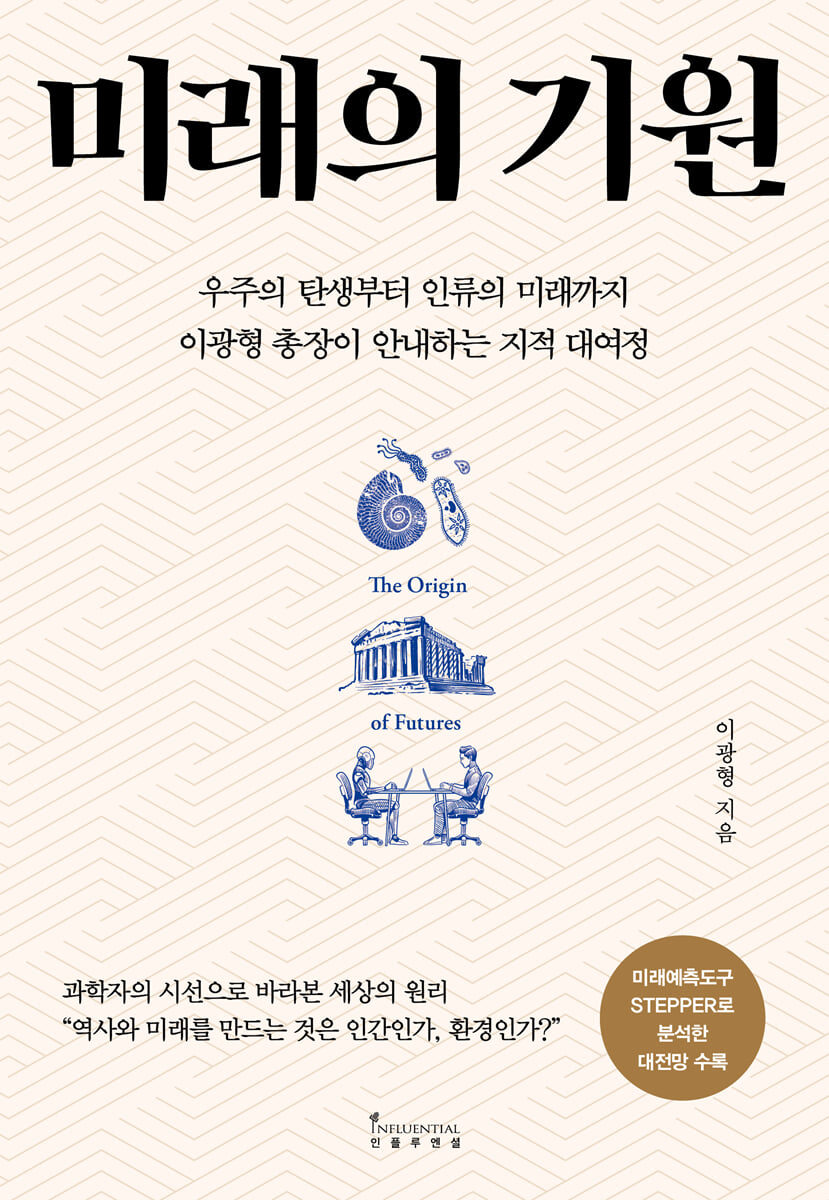
Origin of the Future
 |
Description
Book Introduction
- A word from MD
-
KAIST President Lee Kwang-hyung's intellectual journeyWhat is the future made of? President Lee Kwang-hyung, who has studied the future for decades, offers his answers.
By examining the causal relationships of history based on Big History, it talks about how the world works and the future of humanity.
From the Big Bang to Humanism 2.0, a futurist's perspective on the relationship between the environment and humanity invites readers on a precious journey of knowledge.
January 9, 2024. Natural Science PD Ahn Hyun-jae
President Lee Kwang-hyung, a leading futurologist in Korea
The history and future of the universe and humanity, written over a period of five years
An intellectual journey from the birth of the universe to the future of humanity, all in one volume.
Includes a comprehensive outlook analyzed using the future forecasting tool STEPPER.
What will the future be made of? With new technologies emerging daily and the unpredictable economic and international landscape, opinions are divided on what the future will look like.
KAIST President Lee Kwang-hyung, who has been studying the future for decades, found the answer in the big history that made humanity what it is today.
By examining the causal relationships of history, we can discover the principles by which the world operates, and through this, we can predict the future more specifically and accurately.
He says, “History is the study of the future,” and argues that understanding the principles of the flow of history opens one’s eyes to the future.
Unlike other history books that focus on human free will, 『Origin of the Future』 focuses on the natural and temporal environment, humanity's response to it, and the relationship between them.
From the physical changes in the universe and the Earth, the emergence of life and the evolution of humanity due to atmospheric fluctuations, the development of civilization alongside natural changes, and even today, when we face another turning point with the emergence of artificial intelligence, the power of the environment has always been at work at turning points in history that could be called great transformations. The meaning of human choices becomes clear when we examine them within the context of the environment and conditions.
He also claims that if we apply this principle to predict the future, we can clearly envision what the future that will unfold before us will look like.
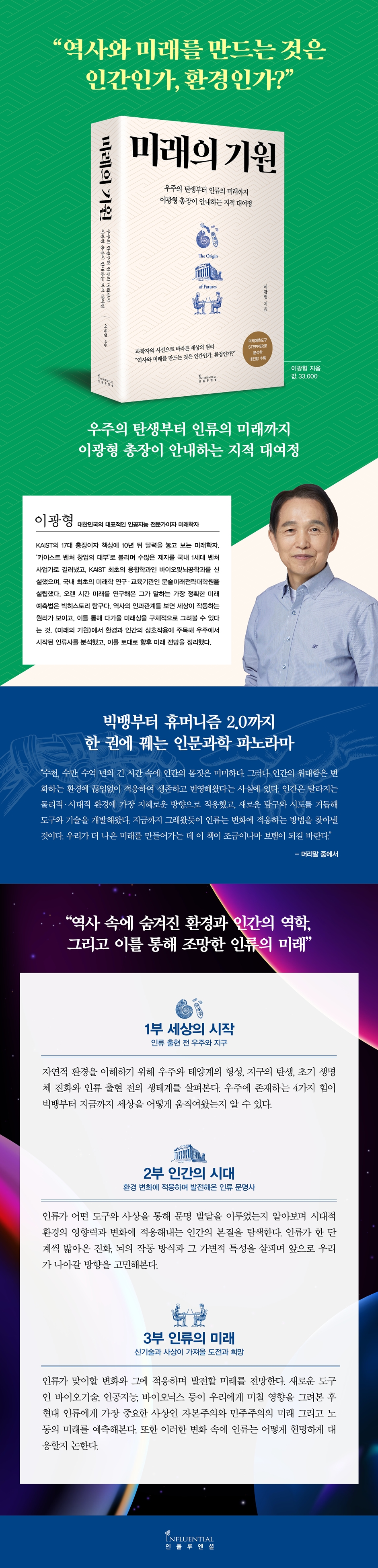
This book, which is composed of three parts, examines the origins of the universe and the watersheds of human history in the context of the environment in Parts 1 and 2. Then, in Part 3, it clearly explains what kind of future awaits us over the next 100 years based on these principles and how we should respond to it.
Through a panorama of history and the future that only a futurist can comprehend, readers will embark on a precious journey of knowledge that connects the past and the future, the environment and humanity.
The history and future of the universe and humanity, written over a period of five years
An intellectual journey from the birth of the universe to the future of humanity, all in one volume.
Includes a comprehensive outlook analyzed using the future forecasting tool STEPPER.
What will the future be made of? With new technologies emerging daily and the unpredictable economic and international landscape, opinions are divided on what the future will look like.
KAIST President Lee Kwang-hyung, who has been studying the future for decades, found the answer in the big history that made humanity what it is today.
By examining the causal relationships of history, we can discover the principles by which the world operates, and through this, we can predict the future more specifically and accurately.
He says, “History is the study of the future,” and argues that understanding the principles of the flow of history opens one’s eyes to the future.
Unlike other history books that focus on human free will, 『Origin of the Future』 focuses on the natural and temporal environment, humanity's response to it, and the relationship between them.
From the physical changes in the universe and the Earth, the emergence of life and the evolution of humanity due to atmospheric fluctuations, the development of civilization alongside natural changes, and even today, when we face another turning point with the emergence of artificial intelligence, the power of the environment has always been at work at turning points in history that could be called great transformations. The meaning of human choices becomes clear when we examine them within the context of the environment and conditions.
He also claims that if we apply this principle to predict the future, we can clearly envision what the future that will unfold before us will look like.
This book, which is composed of three parts, examines the origins of the universe and the watersheds of human history in the context of the environment in Parts 1 and 2. Then, in Part 3, it clearly explains what kind of future awaits us over the next 100 years based on these principles and how we should respond to it.
Through a panorama of history and the future that only a futurist can comprehend, readers will embark on a precious journey of knowledge that connects the past and the future, the environment and humanity.
- You can preview some of the book's contents.
Preview
index
Preface: The Future of Humanity: Originating in Space
Part 1: The Beginning of the World
Chapter 1: The Birth of the Universe
The origin of the universe, the Big Bang
Evidence of the Big Bang: Cosmic Microwave Background
The Birth of Matter and Power
From the birth of a star to its death
Elements created inside stars
Chapter 2: The Birth of the Solar System and Earth
The birth of the galaxy
dark matter, dark energy
The birth of the sun
The birth of the Earth
Preparation for conception of life
Chapter 3: The Emergence of Life
What is life
Prokaryotic and eukaryotic cells
DNA and RNA, which carry genetic information
Photosynthesis, the source of energy for life
Electrons that bind biomolecules
Chapter 4: The Emergence of Life and Mammals
Changes on Earth until the Big Bang
Animals' advance into land
Climate change and the emergence of dinosaurs
mass extinction event
The emergence of mammals and primates
Part 2: The Age of Man
Chapter 5: The Birth of Man
Apes and Australopithecus
The emergence of primitive humans
The emergence of Homo sapiens
Evolution and expansion of Homo sapiens
The beginning of ancient civilization
Chapter 6: The Human Brain and the Birth of Consciousness
Electrical signals in brain neurons and memory
Evolution and structure of the brain
Perception and consciousness of the brain
The Changing Brain and Reinforcement Learning
Social Intelligence and Values
Chapter 7: The Emergence of Thought and Religion
The emergence of civilization and thought
The emergence of Eastern thought
The emergence of Western Christian thought
The emergence of Greek philosophy
Rome and the Dark Ages
Chapter 8: Revolution in Modern Society
Scientific Revolution, a Shift in Worldview
Philosophical Revolution, the Restoration of Humanism
Citizens' Revolution, Freedom, Equality, and Human Rights
Industrial Revolution, Pioneering and Innovation
Medical Revolution: The War on Disease
Part 3: The Future of Humanity
Chapter 9: The Singularity Era, Tools of the 21st Century
The Interaction of Tools and Ideas
Stem cell technology that can clone life
The Beginning of Artificial Evolution: Genetic Technology
AI, a new intelligence that will change history
Bionics, the fusion of humans and computers
Chapter 10: The Future of Ideas and Institutions
The imperfect nature of human beings
sustainable democracy
The Future of Capitalism
The Future of Work
The key driving force behind history
Chapter 11: Challenges and Hopes for Humanity
The Human Body: Preparing for the Era of Humanism 2.0
Mind: The AI Era: Crisis and Opportunity
Society: What to Prepare for the Happiness of the Many
Environment: Energy Development for the Future of the Planet
Space: In Search of Another Planet
Appendix: The Future of Humanity Through STEPPER
References
Part 1: The Beginning of the World
Chapter 1: The Birth of the Universe
The origin of the universe, the Big Bang
Evidence of the Big Bang: Cosmic Microwave Background
The Birth of Matter and Power
From the birth of a star to its death
Elements created inside stars
Chapter 2: The Birth of the Solar System and Earth
The birth of the galaxy
dark matter, dark energy
The birth of the sun
The birth of the Earth
Preparation for conception of life
Chapter 3: The Emergence of Life
What is life
Prokaryotic and eukaryotic cells
DNA and RNA, which carry genetic information
Photosynthesis, the source of energy for life
Electrons that bind biomolecules
Chapter 4: The Emergence of Life and Mammals
Changes on Earth until the Big Bang
Animals' advance into land
Climate change and the emergence of dinosaurs
mass extinction event
The emergence of mammals and primates
Part 2: The Age of Man
Chapter 5: The Birth of Man
Apes and Australopithecus
The emergence of primitive humans
The emergence of Homo sapiens
Evolution and expansion of Homo sapiens
The beginning of ancient civilization
Chapter 6: The Human Brain and the Birth of Consciousness
Electrical signals in brain neurons and memory
Evolution and structure of the brain
Perception and consciousness of the brain
The Changing Brain and Reinforcement Learning
Social Intelligence and Values
Chapter 7: The Emergence of Thought and Religion
The emergence of civilization and thought
The emergence of Eastern thought
The emergence of Western Christian thought
The emergence of Greek philosophy
Rome and the Dark Ages
Chapter 8: Revolution in Modern Society
Scientific Revolution, a Shift in Worldview
Philosophical Revolution, the Restoration of Humanism
Citizens' Revolution, Freedom, Equality, and Human Rights
Industrial Revolution, Pioneering and Innovation
Medical Revolution: The War on Disease
Part 3: The Future of Humanity
Chapter 9: The Singularity Era, Tools of the 21st Century
The Interaction of Tools and Ideas
Stem cell technology that can clone life
The Beginning of Artificial Evolution: Genetic Technology
AI, a new intelligence that will change history
Bionics, the fusion of humans and computers
Chapter 10: The Future of Ideas and Institutions
The imperfect nature of human beings
sustainable democracy
The Future of Capitalism
The Future of Work
The key driving force behind history
Chapter 11: Challenges and Hopes for Humanity
The Human Body: Preparing for the Era of Humanism 2.0
Mind: The AI Era: Crisis and Opportunity
Society: What to Prepare for the Happiness of the Many
Environment: Energy Development for the Future of the Planet
Space: In Search of Another Planet
Appendix: The Future of Humanity Through STEPPER
References
Detailed image
Into the book
Even today, the vast universe and the era we live in are changing rapidly.
In the vastness of the universe and the unstoppable macroscopic flow, human gestures remain insignificant.
But as always, humanity will find ways to adapt to change.
We humans are already developing technologies that can alter the human body, influence our psyche, discover new energies, and stabilize ecosystems, including the climate, some of which are already on the verge of being put into use.
By adapting our ideas and systems to these environmental changes, we will create a new society.
I hope this book will help us understand our environment more clearly, respond more wisely, and create a better future.
--- p.8~9, from “Preface: The Future of Humanity Beginning in Space”
Electrons, which are subject to magnetic forces, are the most dynamic and changeable entities in the universe.
Atoms and molecules are created by electrons and electromagnetic forces, and all chemical elements have unique properties.
And almost all human activities, including the emergence of life on Earth, photosynthesis to create organic matter, neural signal transmission in living things, the development of memory and intelligence in the brain, the emergence of language, and modern civilization, utilize electrons.
As human history has been like this, humans will continue to pioneer the future based on these electronic activities.
--- p.38~39, from “Part 1, Chapter 1: The Birth of the Universe”
It is very important to note that the primitive atmosphere consisted mainly of carbon dioxide and water vapor.
This is because carbon dioxide and water vapor are gases that cause the greenhouse effect.
If there were no greenhouse gases like carbon dioxide and water vapor, all the enormous heat generated at that time would have escaped into space.
If that were the case, the Earth might have lost all its energy and would not have been able to sustain life as it does today.
A thick layer of clouds was formed by the water vapor and carbon dioxide of the primitive Earth, and a very important event occurred in which the water vapor in the air changed into water droplets.
--- p.84, from “Part 1, Chapter 2: The Birth of the Solar System and the Earth”
When their living environment changed, they had to move long distances to find new habitats.
Walking on two legs consumes less energy than walking on four legs, making it advantageous for long-distance travel.
Comparing the energy consumption of chimpanzees and humans while walking, humans' upright walking is much more energy efficient.
--- p.183, from “Part 2, Chapter 5: The Birth of Man”
The brain's basic structure is established by DNA, but the brain modifies its functions using new experiences and memories. This is because DNA cannot fully operate a living organism throughout its lifetime.
If DNA were to make all the decisions without the ability to change, the brain would be like an unintelligent robot, doing only what it was initially programmed to do.
Humans have evolved into beings capable of adapting to environmental changes and surviving.
Furthermore, it has the ability to change the environment to suit humans.
The ability to adapt to and change the environment in this way is human intelligence.
--- p.242, from “Part 2, Chapter 6: The Birth of the Human Brain and Consciousness”
In dense urban life, cooperative living was necessary to survive among people.
In this way, people who reflected on the long-term aspects of human life rather than short-term gains appeared in many places where early civilizations developed.
Today, we live within the framework of the lifestyle and ideas presented by these visionaries.
This happened about 2500 years ago.
It was a time of great turning point in human life.
The way of survival has changed from the law of the jungle to coexistence.
--- p.267, from “Part 2, Chapter 7: The Emergence of Thought and Religion”
Could gene-editing technology be applied to human embryos? A surprising event occurred in China in 2015.
Professor Huang Junjiu's research team at Chung-Ang University announced that they had successfully removed the gene involved in 'beta-thalassemia' from human embryos.
The researchers conducted experiments on 86 embryos obtained from an infertility clinic, and 48 hours after the procedure, 71 survived. After testing 54 genes, they confirmed that the anemia gene was deleted in 28 of them.
It has been proven that gene editing technology can work well on human embryos.
Although there was controversy over whether this experiment was ethically sound, Professor Jun Ji-woo was selected as one of the '10 People of Science' by the journal Nature.
--- p.399, from “Part 3, Chapter 9, The Singularity Era, Tools of the 21st Century”
I call this phenomenon of commodification that deviates from the basic purpose of goods ‘meta-commodification.’
It means that it has become a higher quality product than the original product.
The company was originally a production organization, but became an investment target.
The value of a company is created through the process of a few big players in finance buying and selling a company that has been built by the hard work of tens of thousands of people over a long period of time.
--- p.460, from “Part 3, Chapter 10: The Future of Thought and Institutions”
Therefore, in the future, our society needs Humanism 2.0 to establish a new order.
We must maintain the dignity of human beings, eliminate conflict with new humans, and redefine the role of humans.
Above all, we must maintain human-centered humanism.
We must not allow other beings who perform functional roles such as labor to take the initiative.
We must establish a new humanism that accepts new humans as equal members while maintaining the value of dignified human beings.
In the vastness of the universe and the unstoppable macroscopic flow, human gestures remain insignificant.
But as always, humanity will find ways to adapt to change.
We humans are already developing technologies that can alter the human body, influence our psyche, discover new energies, and stabilize ecosystems, including the climate, some of which are already on the verge of being put into use.
By adapting our ideas and systems to these environmental changes, we will create a new society.
I hope this book will help us understand our environment more clearly, respond more wisely, and create a better future.
--- p.8~9, from “Preface: The Future of Humanity Beginning in Space”
Electrons, which are subject to magnetic forces, are the most dynamic and changeable entities in the universe.
Atoms and molecules are created by electrons and electromagnetic forces, and all chemical elements have unique properties.
And almost all human activities, including the emergence of life on Earth, photosynthesis to create organic matter, neural signal transmission in living things, the development of memory and intelligence in the brain, the emergence of language, and modern civilization, utilize electrons.
As human history has been like this, humans will continue to pioneer the future based on these electronic activities.
--- p.38~39, from “Part 1, Chapter 1: The Birth of the Universe”
It is very important to note that the primitive atmosphere consisted mainly of carbon dioxide and water vapor.
This is because carbon dioxide and water vapor are gases that cause the greenhouse effect.
If there were no greenhouse gases like carbon dioxide and water vapor, all the enormous heat generated at that time would have escaped into space.
If that were the case, the Earth might have lost all its energy and would not have been able to sustain life as it does today.
A thick layer of clouds was formed by the water vapor and carbon dioxide of the primitive Earth, and a very important event occurred in which the water vapor in the air changed into water droplets.
--- p.84, from “Part 1, Chapter 2: The Birth of the Solar System and the Earth”
When their living environment changed, they had to move long distances to find new habitats.
Walking on two legs consumes less energy than walking on four legs, making it advantageous for long-distance travel.
Comparing the energy consumption of chimpanzees and humans while walking, humans' upright walking is much more energy efficient.
--- p.183, from “Part 2, Chapter 5: The Birth of Man”
The brain's basic structure is established by DNA, but the brain modifies its functions using new experiences and memories. This is because DNA cannot fully operate a living organism throughout its lifetime.
If DNA were to make all the decisions without the ability to change, the brain would be like an unintelligent robot, doing only what it was initially programmed to do.
Humans have evolved into beings capable of adapting to environmental changes and surviving.
Furthermore, it has the ability to change the environment to suit humans.
The ability to adapt to and change the environment in this way is human intelligence.
--- p.242, from “Part 2, Chapter 6: The Birth of the Human Brain and Consciousness”
In dense urban life, cooperative living was necessary to survive among people.
In this way, people who reflected on the long-term aspects of human life rather than short-term gains appeared in many places where early civilizations developed.
Today, we live within the framework of the lifestyle and ideas presented by these visionaries.
This happened about 2500 years ago.
It was a time of great turning point in human life.
The way of survival has changed from the law of the jungle to coexistence.
--- p.267, from “Part 2, Chapter 7: The Emergence of Thought and Religion”
Could gene-editing technology be applied to human embryos? A surprising event occurred in China in 2015.
Professor Huang Junjiu's research team at Chung-Ang University announced that they had successfully removed the gene involved in 'beta-thalassemia' from human embryos.
The researchers conducted experiments on 86 embryos obtained from an infertility clinic, and 48 hours after the procedure, 71 survived. After testing 54 genes, they confirmed that the anemia gene was deleted in 28 of them.
It has been proven that gene editing technology can work well on human embryos.
Although there was controversy over whether this experiment was ethically sound, Professor Jun Ji-woo was selected as one of the '10 People of Science' by the journal Nature.
--- p.399, from “Part 3, Chapter 9, The Singularity Era, Tools of the 21st Century”
I call this phenomenon of commodification that deviates from the basic purpose of goods ‘meta-commodification.’
It means that it has become a higher quality product than the original product.
The company was originally a production organization, but became an investment target.
The value of a company is created through the process of a few big players in finance buying and selling a company that has been built by the hard work of tens of thousands of people over a long period of time.
--- p.460, from “Part 3, Chapter 10: The Future of Thought and Institutions”
Therefore, in the future, our society needs Humanism 2.0 to establish a new order.
We must maintain the dignity of human beings, eliminate conflict with new humans, and redefine the role of humans.
Above all, we must maintain human-centered humanism.
We must not allow other beings who perform functional roles such as labor to take the initiative.
We must establish a new humanism that accepts new humans as equal members while maintaining the value of dignified human beings.
--- p.500, from “Chapter 11, Part 3: Challenges and Hopes for Humanity”
Publisher's Review
A Panorama of Humanities Connecting the Universe, Humanity, and the Future
From the Big Bang to Humanism 2.0 in One Volume
President Lee Kwang-hyung, the father of Korean futurology, has lived as a pioneer who views the world with a unique perspective and paves the way in uncharted territory.
In the 1990s, he nurtured many students into Korea's first-generation venture entrepreneurs, established KAIST's first interdisciplinary department in the 2000s, and established Korea's first futures studies research and education institution in the 2010s.
President Lee Kwang-hyung, who has lived his life as a future strategist, wrote this book in the hope that more people will have a future-oriented perspective.
Paradoxically, his future begins with the birth of the universe.
Because all the principles of the world necessary to know the future are revealed in history.
He focuses particularly on the process by which the environment and humans have interacted and changed, and explains that this same interaction will continue into the future.
A look into the properties of elements, the movement of electrons, the evolution of the Earth over 4.6 billion years, and the defining moments of life's evolution opens the door to understanding the environment that surrounds us.
Furthermore, by exploring the evolution and civilization history of humanity up to the present day and learning about the imperfect yet enterprising nature of humans, a more three-dimensional and comprehensive perspective on the future is formed.
If we confront the new technologies we now have, such as AI and stem cell therapy, or the major shifts in the ideologies that drive our society, such as capitalism and democracy, from this perspective, the future will appear new.
What is the relationship between the birth of stars and the new energy that the world is currently absorbed in? What is the connection between the extinction of dinosaurs and NASA's satellite experiments? Why should we recall the civil revolutions of the 17th and 18th centuries in the age of gene editing? These connections are becoming clear.
In this connection, we can glimpse the influence of the environment that will befall us and the direction in which humanity will move forward in response to it.
President Lee Kwang-hyung spent five long years writing this book, delving into the history of the universe and humanity to uncover the hints for the future he discovered there.
This book, which sheds new light on history and the future through the intellect of a futurist, will establish itself as an unprecedented science textbook.
Do humans create history through free will?
Or is history created as a result of human adaptation to the environment?
Based on the belief that if we want to talk about the future, we must first build a solid foundation, this book contains history, the future, the environment, and humanity.
This three-part look at the vast expanse of time, spanning the 13.8 billion years the universe has lived through and the 5 billion years yet to come that scientists have already predicted.
Part 1, 'The Beginning of the World', describes the universe and Earth before the emergence of mankind.
We look back at the birth and evolution of the universe, the sun, and the earth, and learn how the four forces of the universe, the dynamic energy of electrons, and changes in the Earth's temperature and atmosphere have influenced us from the Big Bang to the present.
Additionally, through the process of evolution of life from bacteria to reptiles and mammals, we learn about the essence of life and the importance of ecological change.
Part 2, 'The Age of Humans', covers the period from chimpanzees, the closest animals to humans, to the five major revolutions of modern times that shaped modern human society.
We learn about the importance of tools as we examine how the use of fire changed humanity and how telescopes and microscopes overturned our worldview.
We also learn why the ideas of the sages who emerged at the beginning of early civilizations are still relevant today, and how the major philosophies of ancient Greece and the Middle Ages influenced social culture, giving us a true sense of the influence of ideas.
By exploring how tools and ideas have shaped human history, we consider what tools and ideas will shape the future.
Finally, Part 3, "The Future of Humanity," builds on the understanding of the environment and human nature explored in Parts 1 and 2 to envision a concrete future. It discusses the changes new technologies like AI, gene editing, and BCI will bring to human society, as well as the future directions of capitalism and democracy. It also forecasts five challenges facing humanity: the cataclysmic shifts that will occur in the human body, mind, society, environment, and the cosmos.
While expressing hope that humanity will eventually adapt to the environmental changes that will come in the future, he also says that preparations are needed now to establish a new order, Humanism 2.0, that maintains humanistic peace.
The dynamics of the environment and humans hidden in history,
And the challenges humanity has faced through this
The book's conclusion includes a comprehensive outlook analyzed using the future forecasting tool STEPPER. Developed under the leadership of President Lee Kwang-hyung, STEPPER analyzes the future across seven frameworks: Society, Technology, Environment, Population, Politics, Economy, and Resources. It is being utilized to develop future strategies across various sectors of society.
Based on the contents of this book, President Lee Kwang-hyung presents the challenges humanity will face through STEPPER and solutions to address them.
As we live our busy lives, dealing with the daily challenges that pile up, grand narratives like the future of humanity tend to take a backseat.
However, we must remember that we are currently at a time of great transformation for humanity. AI will completely transform our lifestyles, and genetic engineering could create new bodies for humanity.
With the flood of information and the expansion of international politics, democracy is entering a new phase, and the power of capitalism is growing stronger by the day, threatening social harmony.
However, we should not turn away from this tremendous change out of fear, or stop our drive for development and evolution out of concern for the negative consequences of tools and ideas.
The change has already arrived.
It is our job to face this squarely, see through it, and lead humanity in a good direction.
We must ask ourselves:
We must never cease to ask ourselves what we can learn from the natural environment, which exerts overwhelming power over humanity, what weaknesses and greatness have been revealed in the course of human evolution and development, and what kind of future humanity dreams of together.
The answer to this may not come right away.
However, those who have asked such questions and delved into the origins of the future cannot have the same perspective on the world or attitude toward life as those who have not.
This book will be the beginning of that powerful question.
From the Big Bang to Humanism 2.0 in One Volume
President Lee Kwang-hyung, the father of Korean futurology, has lived as a pioneer who views the world with a unique perspective and paves the way in uncharted territory.
In the 1990s, he nurtured many students into Korea's first-generation venture entrepreneurs, established KAIST's first interdisciplinary department in the 2000s, and established Korea's first futures studies research and education institution in the 2010s.
President Lee Kwang-hyung, who has lived his life as a future strategist, wrote this book in the hope that more people will have a future-oriented perspective.
Paradoxically, his future begins with the birth of the universe.
Because all the principles of the world necessary to know the future are revealed in history.
He focuses particularly on the process by which the environment and humans have interacted and changed, and explains that this same interaction will continue into the future.
A look into the properties of elements, the movement of electrons, the evolution of the Earth over 4.6 billion years, and the defining moments of life's evolution opens the door to understanding the environment that surrounds us.
Furthermore, by exploring the evolution and civilization history of humanity up to the present day and learning about the imperfect yet enterprising nature of humans, a more three-dimensional and comprehensive perspective on the future is formed.
If we confront the new technologies we now have, such as AI and stem cell therapy, or the major shifts in the ideologies that drive our society, such as capitalism and democracy, from this perspective, the future will appear new.
What is the relationship between the birth of stars and the new energy that the world is currently absorbed in? What is the connection between the extinction of dinosaurs and NASA's satellite experiments? Why should we recall the civil revolutions of the 17th and 18th centuries in the age of gene editing? These connections are becoming clear.
In this connection, we can glimpse the influence of the environment that will befall us and the direction in which humanity will move forward in response to it.
President Lee Kwang-hyung spent five long years writing this book, delving into the history of the universe and humanity to uncover the hints for the future he discovered there.
This book, which sheds new light on history and the future through the intellect of a futurist, will establish itself as an unprecedented science textbook.
Do humans create history through free will?
Or is history created as a result of human adaptation to the environment?
Based on the belief that if we want to talk about the future, we must first build a solid foundation, this book contains history, the future, the environment, and humanity.
This three-part look at the vast expanse of time, spanning the 13.8 billion years the universe has lived through and the 5 billion years yet to come that scientists have already predicted.
Part 1, 'The Beginning of the World', describes the universe and Earth before the emergence of mankind.
We look back at the birth and evolution of the universe, the sun, and the earth, and learn how the four forces of the universe, the dynamic energy of electrons, and changes in the Earth's temperature and atmosphere have influenced us from the Big Bang to the present.
Additionally, through the process of evolution of life from bacteria to reptiles and mammals, we learn about the essence of life and the importance of ecological change.
Part 2, 'The Age of Humans', covers the period from chimpanzees, the closest animals to humans, to the five major revolutions of modern times that shaped modern human society.
We learn about the importance of tools as we examine how the use of fire changed humanity and how telescopes and microscopes overturned our worldview.
We also learn why the ideas of the sages who emerged at the beginning of early civilizations are still relevant today, and how the major philosophies of ancient Greece and the Middle Ages influenced social culture, giving us a true sense of the influence of ideas.
By exploring how tools and ideas have shaped human history, we consider what tools and ideas will shape the future.
Finally, Part 3, "The Future of Humanity," builds on the understanding of the environment and human nature explored in Parts 1 and 2 to envision a concrete future. It discusses the changes new technologies like AI, gene editing, and BCI will bring to human society, as well as the future directions of capitalism and democracy. It also forecasts five challenges facing humanity: the cataclysmic shifts that will occur in the human body, mind, society, environment, and the cosmos.
While expressing hope that humanity will eventually adapt to the environmental changes that will come in the future, he also says that preparations are needed now to establish a new order, Humanism 2.0, that maintains humanistic peace.
The dynamics of the environment and humans hidden in history,
And the challenges humanity has faced through this
The book's conclusion includes a comprehensive outlook analyzed using the future forecasting tool STEPPER. Developed under the leadership of President Lee Kwang-hyung, STEPPER analyzes the future across seven frameworks: Society, Technology, Environment, Population, Politics, Economy, and Resources. It is being utilized to develop future strategies across various sectors of society.
Based on the contents of this book, President Lee Kwang-hyung presents the challenges humanity will face through STEPPER and solutions to address them.
As we live our busy lives, dealing with the daily challenges that pile up, grand narratives like the future of humanity tend to take a backseat.
However, we must remember that we are currently at a time of great transformation for humanity. AI will completely transform our lifestyles, and genetic engineering could create new bodies for humanity.
With the flood of information and the expansion of international politics, democracy is entering a new phase, and the power of capitalism is growing stronger by the day, threatening social harmony.
However, we should not turn away from this tremendous change out of fear, or stop our drive for development and evolution out of concern for the negative consequences of tools and ideas.
The change has already arrived.
It is our job to face this squarely, see through it, and lead humanity in a good direction.
We must ask ourselves:
We must never cease to ask ourselves what we can learn from the natural environment, which exerts overwhelming power over humanity, what weaknesses and greatness have been revealed in the course of human evolution and development, and what kind of future humanity dreams of together.
The answer to this may not come right away.
However, those who have asked such questions and delved into the origins of the future cannot have the same perspective on the world or attitude toward life as those who have not.
This book will be the beginning of that powerful question.
GOODS SPECIFICS
- Date of issue: January 5, 2024
- Page count, weight, size: 556 pages | 958g | 153*220*35mm
- ISBN13: 9791168341593
- ISBN10: 1168341590
You may also like
카테고리
korean


korean

![GQ KOREA Mark (Monthly): December [2025]](http://librairie.coreenne.fr/cdn/shop/files/8ef265dbbfbf186523ed75ba7319009d.jpg?v=1765340328&width=3840)


