

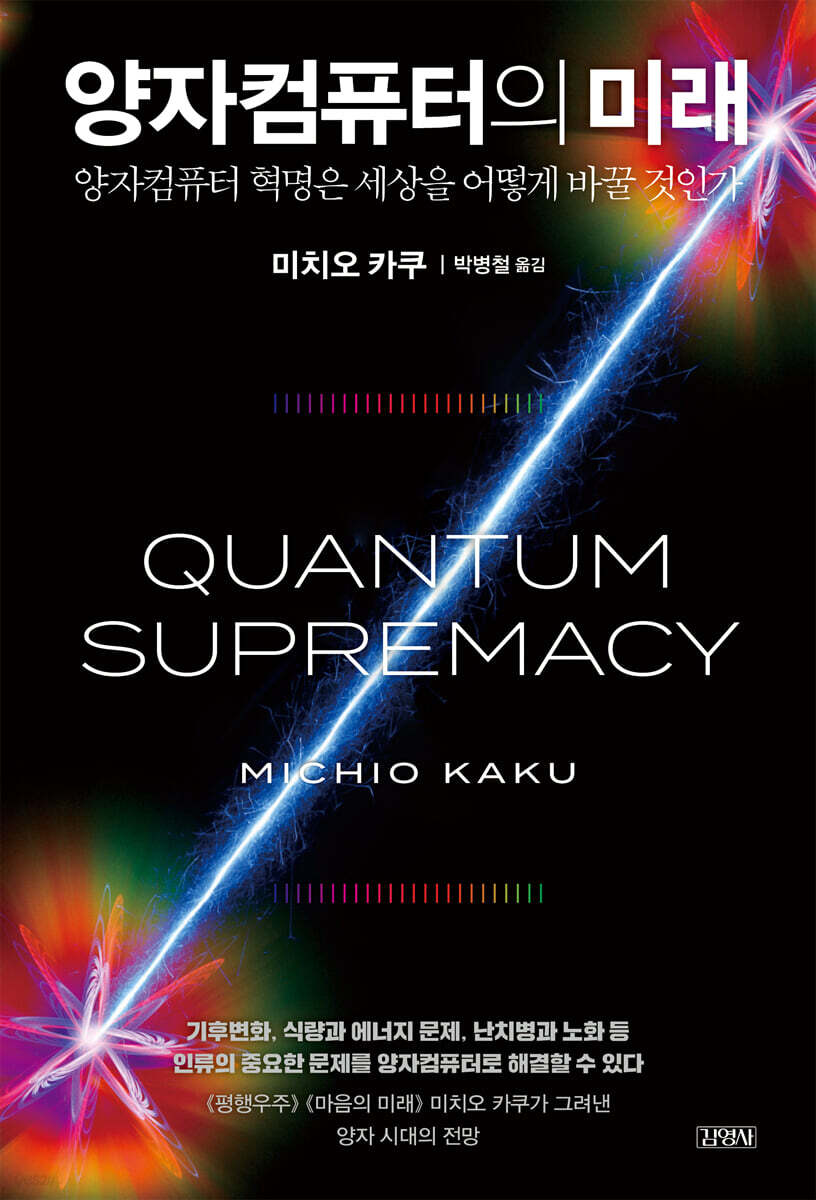
The Future of Quantum Computers
 |
Description
Book Introduction
- A word from MD
-
A new future created by quantum computersA new book by renowned theoretical physicist Michio Kaku.
We discuss the definition, history, and possibilities of the 'quantum computer,' the ultimate computer that will contribute to solving important problems for humanity.
The combination of 'computers', the practical foundation of modern civilization, and 'quantum mechanics', the core of modern physics, will mark the beginning of a new era, the quantum era.
December 22, 2023. Natural Science PD Ahn Hyun-jae
"Parallel Universes" and "The Future of the Mind": Michio Kaku's Vision of the Quantum Age
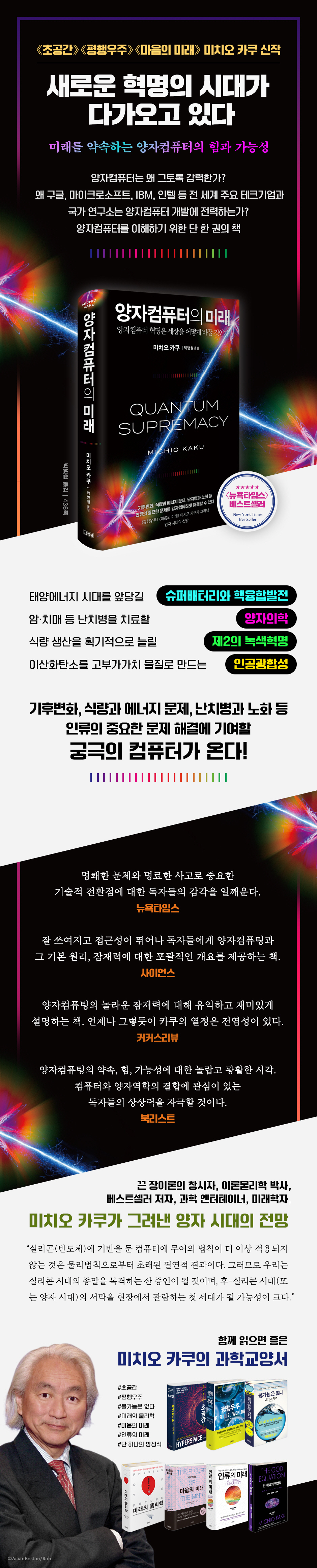
The power and potential of quantum computers that promise the future
Renowned theoretical physicist and international bestselling author Michio Kaku presents a captivating account of the history, principles, power, and potential of quantum computing in his signature, eloquent, and lucid style.
The author argues that quantum computers will play a crucial role in solving or overcoming global warming, food and energy problems, incurable diseases and aging, and ultimately in unlocking the secrets of life and the universe.
Based on this, it presents in clear and easy-to-understand language what research is currently being conducted in each field to solve problems, what limitations existing digital computers have, and what breakthroughs quantum computers will bring in these areas.
This book begins with the principles and history of 'computers', which can be said to be the practical foundation of modern civilization, and 'quantum mechanics', the core of modern physics, and then explains why 'quantum computers', which can be said to be the combination of the two, are so powerful, the nature of the development competition, and even the future shape of human society.
Explore the fantastic landscape of the quantum computer era with the faithful translation and annotations of Dr. Park Byeong-cheol, a science translator who has translated all of Michio Kaku's major works.
The power and potential of quantum computers that promise the future
Renowned theoretical physicist and international bestselling author Michio Kaku presents a captivating account of the history, principles, power, and potential of quantum computing in his signature, eloquent, and lucid style.
The author argues that quantum computers will play a crucial role in solving or overcoming global warming, food and energy problems, incurable diseases and aging, and ultimately in unlocking the secrets of life and the universe.
Based on this, it presents in clear and easy-to-understand language what research is currently being conducted in each field to solve problems, what limitations existing digital computers have, and what breakthroughs quantum computers will bring in these areas.
This book begins with the principles and history of 'computers', which can be said to be the practical foundation of modern civilization, and 'quantum mechanics', the core of modern physics, and then explains why 'quantum computers', which can be said to be the combination of the two, are so powerful, the nature of the development competition, and even the future shape of human society.
Explore the fantastic landscape of the quantum computer era with the faithful translation and annotations of Dr. Park Byeong-cheol, a science translator who has translated all of Michio Kaku's major works.
- You can preview some of the book's contents.
Preview
index
Part 1: The Rise of Quantum Computers
Chapter 1: The End of the Silicon Age
Chapter 2: The End of the Digital Age
Chapter 3: The Rising Quantum
Chapter 4: The Dawn of Quantum Computers
Chapter 5: Fierce Competition
Part 2: Quantum Computers and Society
Chapter 6: The Origin of Life
Chapter 7: Greening the Earth
Chapter 8: Feeding the Earth
Chapter 9: Supplying Energy to the Earth
Part 3: Quantum Medicine
Chapter 10 Quantum Health
Chapter 11: Genome Editing and Cancer Treatment
Chapter 12: Artificial Intelligence and Quantum Computers
Chapter 13 Eternal Life
Part 4: Modeling the World and the Universe
Chapter 14 Global Warming
Chapter 15: The Sun in a Bottle
Chapter 16: Space Simulation
Chapter 17: Daily Life in 2050
Epilogue: The Quantum Conundrum
Acknowledgements
Translator's Note
Huzhou
Further Reading
Search
Chapter 1: The End of the Silicon Age
Chapter 2: The End of the Digital Age
Chapter 3: The Rising Quantum
Chapter 4: The Dawn of Quantum Computers
Chapter 5: Fierce Competition
Part 2: Quantum Computers and Society
Chapter 6: The Origin of Life
Chapter 7: Greening the Earth
Chapter 8: Feeding the Earth
Chapter 9: Supplying Energy to the Earth
Part 3: Quantum Medicine
Chapter 10 Quantum Health
Chapter 11: Genome Editing and Cancer Treatment
Chapter 12: Artificial Intelligence and Quantum Computers
Chapter 13 Eternal Life
Part 4: Modeling the World and the Universe
Chapter 14 Global Warming
Chapter 15: The Sun in a Bottle
Chapter 16: Space Simulation
Chapter 17: Daily Life in 2050
Epilogue: The Quantum Conundrum
Acknowledgements
Translator's Note
Huzhou
Further Reading
Search
Detailed image
Into the book
We will be living witnesses to the end of the silicon era and likely the first generation to witness the dawn of the post-silicon era (or quantum era).
--- p.21
The problems that hold back quantum computers were anticipated from the time Feynman first proposed the basic concept.
For a quantum computer to function properly, the atoms that make up the qubits must be arranged so that they vibrate in the same mode simultaneously (this condition is called "coherence").
However, atoms are such small and sensitive objects that even the slightest impurity or disturbance from the outside causes the arrangement of atoms to immediately collapse into a state of decoherence, and calculations become a mess.
This is the biggest problem facing quantum computers.
Okay, let's ask the trillion dollar question here.
Can we control decoherence in quantum computers?
--- p.24~25
If two objects are in a coherent state (vibrating in the same pattern), they can remain in that state no matter how far apart they are.
Physicists today call this phenomenon "entanglement."
This is the core principle of quantum computers.
Entangled qubits can interact with each other even when they are far apart, which gives rise to powerful computational capabilities.
--- p.80
To understand the nature of the competition, it's important to remember that there isn't just one basic blueprint for a quantum computer, but many.
The working principle of a Turing machine is very general, so it can be applied to a variety of technologies.
That is, a digital computer that functions normally can be built using pipes and valves with flowing water instead of vacuum tubes or transistors.
What matters is the system that carries digital information made up of 0s and 1s and how to process this information.
Similarly, quantum computers can be designed in a variety of ways.
Any system that processes information by superimposing and entangling states of 0 and 1 can be a quantum computer.
Not only electrons and ions with spin up or down, but also polarized photons with spin clockwise or counterclockwise are suitable for quantum computers.
Because quantum mechanics applies to all matter and energy in the universe, there are thousands of ways to build a quantum computer.
A physicist sitting on his living room sofa on a lazy afternoon, imagining how to represent a superposition of 0 and 1, might come up with an entirely new quantum computer.
--- p.121~122
While we currently test hundreds of chemicals one by one to improve battery performance, quantum computers could make all these experiments much faster.
Of course, since it is conducted in a virtual space rather than an actual laboratory, costs are also greatly reduced.
Like simulations of photosynthesis or nitrogen fixation, 'virtual chemistry' conducted on quantum computers will significantly reduce the tedious trial and error that occurs in chemistry laboratories.
--- p.184
If you were to analyze the penicillin molecule using a conventional digital computer, you would have to be prepared to retire and hand over all your research to your students.
In fact, to do this task, you would need 1086 bits of computer memory.
But for quantum computers, this is just a routine calculation.
Developing new drugs and analyzing how drugs work at the molecular level may become the main tasks of quantum computers.
--- p.205
There are several ways to use quantum computers in the fight against cancer.
Liquid biopsies could be applied to detect cancer cells early, years before they form tumors. By analyzing biometric data transmitted daily from sensors attached to every citizen's bathroom, cancer cells could be identified or massive genome databases could be built.
If a cancer grows beyond a certain size, quantum computers could be used to modify the immune system to select and attack only specific cancer cells among hundreds of cancer types.
Gene therapy, immunotherapy, and the combination of quantum computers with CRISPR could enable immunotherapy without side effects by precisely cutting or pasting cancer genes.
Additionally, since most cancers are closely linked to a few genes, such as p53, it may be possible to block cancer at an early stage through gene therapy using quantum computers.
--- p.237
Quantum computers have enormous computational power, but they lack the ability to learn new knowledge from their mistakes.
However, if you equip a neural network on a quantum computer, the performance will improve with each iteration of the calculation, allowing you to solve problems more quickly and efficiently.
Similarly, artificial intelligence has the ability to learn from its mistakes, but its computational power is significantly limited when it comes to solving complex problems.
However, artificial intelligence, complemented by quantum computers, can easily solve the challenges that have held us back so far.
--- p.242~243
There is no systematic way to find materials that exhibit superconductivity.
All superconductors known to date were discovered by chance after scientists mixed things up and went through trial and error.
Therefore, if you want to test a new material, you have to start from scratch.
However, using a quantum computer, all of this process takes place in a virtual laboratory, significantly saving time and money.
Today, testing a single candidate substance requires years and millions of dollars, but if you leave the task to a quantum computer, testing could be completed in half an afternoon.
--- p.334
The Standard Model is a jumble of (1) 36 kinds of quarks and antiquarks, (2) 19 or more variables whose values are completely incomprehensible, (3) identical particles that exist across three generations, and (4) Yang-Mills particles, including gluons, W bosons, Z bosons, and Higgs bosons, all jumbled together.
It's a theory that no one would like except the mother who gave birth to the child.
It's like roughly taping together a groundhog, a platypus, and a whale and claiming they are "nature's elegant creations, the end product of millions of years of evolution."
--- p.361~362
The important thing here is that the laws of quantum mechanics that govern the universe can be stored in the form of code in a quantum Turing machine.
This is what it means to contain the universe in a quantum computer, and this is precisely the 'deep relationship between quantum computers and the universe' that I mentioned earlier.
Strictly speaking, the universe is not a quantum computer, but every phenomenon that occurs in the universe can be coded on a quantum computer.
--- p.21
The problems that hold back quantum computers were anticipated from the time Feynman first proposed the basic concept.
For a quantum computer to function properly, the atoms that make up the qubits must be arranged so that they vibrate in the same mode simultaneously (this condition is called "coherence").
However, atoms are such small and sensitive objects that even the slightest impurity or disturbance from the outside causes the arrangement of atoms to immediately collapse into a state of decoherence, and calculations become a mess.
This is the biggest problem facing quantum computers.
Okay, let's ask the trillion dollar question here.
Can we control decoherence in quantum computers?
--- p.24~25
If two objects are in a coherent state (vibrating in the same pattern), they can remain in that state no matter how far apart they are.
Physicists today call this phenomenon "entanglement."
This is the core principle of quantum computers.
Entangled qubits can interact with each other even when they are far apart, which gives rise to powerful computational capabilities.
--- p.80
To understand the nature of the competition, it's important to remember that there isn't just one basic blueprint for a quantum computer, but many.
The working principle of a Turing machine is very general, so it can be applied to a variety of technologies.
That is, a digital computer that functions normally can be built using pipes and valves with flowing water instead of vacuum tubes or transistors.
What matters is the system that carries digital information made up of 0s and 1s and how to process this information.
Similarly, quantum computers can be designed in a variety of ways.
Any system that processes information by superimposing and entangling states of 0 and 1 can be a quantum computer.
Not only electrons and ions with spin up or down, but also polarized photons with spin clockwise or counterclockwise are suitable for quantum computers.
Because quantum mechanics applies to all matter and energy in the universe, there are thousands of ways to build a quantum computer.
A physicist sitting on his living room sofa on a lazy afternoon, imagining how to represent a superposition of 0 and 1, might come up with an entirely new quantum computer.
--- p.121~122
While we currently test hundreds of chemicals one by one to improve battery performance, quantum computers could make all these experiments much faster.
Of course, since it is conducted in a virtual space rather than an actual laboratory, costs are also greatly reduced.
Like simulations of photosynthesis or nitrogen fixation, 'virtual chemistry' conducted on quantum computers will significantly reduce the tedious trial and error that occurs in chemistry laboratories.
--- p.184
If you were to analyze the penicillin molecule using a conventional digital computer, you would have to be prepared to retire and hand over all your research to your students.
In fact, to do this task, you would need 1086 bits of computer memory.
But for quantum computers, this is just a routine calculation.
Developing new drugs and analyzing how drugs work at the molecular level may become the main tasks of quantum computers.
--- p.205
There are several ways to use quantum computers in the fight against cancer.
Liquid biopsies could be applied to detect cancer cells early, years before they form tumors. By analyzing biometric data transmitted daily from sensors attached to every citizen's bathroom, cancer cells could be identified or massive genome databases could be built.
If a cancer grows beyond a certain size, quantum computers could be used to modify the immune system to select and attack only specific cancer cells among hundreds of cancer types.
Gene therapy, immunotherapy, and the combination of quantum computers with CRISPR could enable immunotherapy without side effects by precisely cutting or pasting cancer genes.
Additionally, since most cancers are closely linked to a few genes, such as p53, it may be possible to block cancer at an early stage through gene therapy using quantum computers.
--- p.237
Quantum computers have enormous computational power, but they lack the ability to learn new knowledge from their mistakes.
However, if you equip a neural network on a quantum computer, the performance will improve with each iteration of the calculation, allowing you to solve problems more quickly and efficiently.
Similarly, artificial intelligence has the ability to learn from its mistakes, but its computational power is significantly limited when it comes to solving complex problems.
However, artificial intelligence, complemented by quantum computers, can easily solve the challenges that have held us back so far.
--- p.242~243
There is no systematic way to find materials that exhibit superconductivity.
All superconductors known to date were discovered by chance after scientists mixed things up and went through trial and error.
Therefore, if you want to test a new material, you have to start from scratch.
However, using a quantum computer, all of this process takes place in a virtual laboratory, significantly saving time and money.
Today, testing a single candidate substance requires years and millions of dollars, but if you leave the task to a quantum computer, testing could be completed in half an afternoon.
--- p.334
The Standard Model is a jumble of (1) 36 kinds of quarks and antiquarks, (2) 19 or more variables whose values are completely incomprehensible, (3) identical particles that exist across three generations, and (4) Yang-Mills particles, including gluons, W bosons, Z bosons, and Higgs bosons, all jumbled together.
It's a theory that no one would like except the mother who gave birth to the child.
It's like roughly taping together a groundhog, a platypus, and a whale and claiming they are "nature's elegant creations, the end product of millions of years of evolution."
--- p.361~362
The important thing here is that the laws of quantum mechanics that govern the universe can be stored in the form of code in a quantum Turing machine.
This is what it means to contain the universe in a quantum computer, and this is precisely the 'deep relationship between quantum computers and the universe' that I mentioned earlier.
Strictly speaking, the universe is not a quantum computer, but every phenomenon that occurs in the universe can be coded on a quantum computer.
--- p.395
Publisher's Review
"A new era of revolution is approaching."
The power and potential of quantum computers that promise the future
"Parallel Universes" and "The Future of the Mind": Michio Kaku's Vision of the Quantum Age
News about quantum computers comes out almost every day.
This means that competition for investment and development is fierce.
South Korea also announced that it would invest 3 trillion won in public-private partnerships to foster quantum science and technology by 2035.
What are quantum computers, and how much more advanced are they than current digital computers that major global tech companies like Google, Microsoft, IBM, and Intel, as well as national research institutes, are focusing their efforts on their development? What makes quantum computers so powerful? Understanding the term "quantum computer" is difficult because the very words "quantum (mechanics)" and "computer" themselves are not trivial concepts.
Even though physicists say that "everything is quantum" and that our daily lives in modern civilization cannot function without computers, it is not easy to easily explain the concepts, principles, and history of "quantum" and "computers."
But is it possible to explain the concept and potential of a 'quantum computer' that combines the two in simple language?
“Translating complex scientific concepts into language that the general reader can understand is an art.
As Kirkus Review puts it, “Kaku, a professor of physics at the City University of New York, is one of the best experts on the subject.” Michio Kaku is a world-renowned theoretical physicist and a science entertainer who explains difficult scientific knowledge in an easy and interesting way on various TV programs.
He is also the author of bestsellers such as Hyperspace, Parallel Universes, and The One Equation, which make the difficult world of theoretical physics fun and roller coaster-like, and Nothing is Impossible, Physics of the Future, The Future of the Mind, and The Future of Humanity, which predict the future based on scientific facts.
The topic of Dr. Kaku's new book is 'quantum computers.'
"The Future of Quantum Computers" vividly depicts the power and potential of quantum computers, which will advance human civilization, in a light and clear style, from the basic concepts of quantum computers, their history and types, the fierce competition surrounding their development, the breakthroughs necessary for the transition to the quantum age, and finally, the fantastic future that will unfold.
Through the author's signature simple yet accurate explanations and analogies, readers will gain a thorough understanding of the fundamentals of quantum mechanics and computing, as well as the research currently being conducted in various scientific fields closely related to human life, such as physics, biology, and medicine, and how quantum computers can contribute.
The ultimate computer is coming!
The One Book to Understand Quantum Computers
In this book, Michio Kaku lists the following four areas in which quantum computers can surpass conventional digital computers.
1) Search ability.
The author says that the main advantage of quantum computers is 'finding a needle in a haystack'.
Quantum computers can extract key insights from vast and confusing data to derive important conclusions.
2) Optimization.
Quantum computers excel at calculating numerous variables to maximize or minimize specific elements of industry, such as waste, operational efficiency, revenue and costs, and manufacturing processes.
3) Simulation.
Complex or time-consuming experiments, such as weather forecasting or new drug development, can be replaced with virtual experiments using quantum computers.
To simulate the formation of a simple molecule like caffeine using a conventional digital computer would require 10^48 bits of information, which is about 10 percent of the total number of atoms that make up the Earth.
This is an impossible number even for the best digital computer, but it is a piece of cake for a quantum computer.
4) Integration with artificial intelligence.
When discussing future technologies, artificial intelligence is a constant topic. However, despite the theoretical foundation established in this field, progress has been stagnant due to the limitations of digital computers.
In particular, artificial intelligence has the ability to develop through mistakes, but its computational ability is somewhat lacking, and quantum computers have powerful computational abilities, but they do not have the ability to learn from mistakes, so they can complement each other's shortcomings.
The biggest difference between quantum computers and digital computers is the basic unit of computation.
While the basic unit of a digital computer is a binary 'bit' that is either 0 or 1, a quantum computer uses a 'qubit' as its basic unit, which can handle 0 and 1 'simultaneously' by utilizing the concept of 'superposition' in quantum mechanics.
This is precisely why quantum computers exhibit such powerful computational capabilities.
In addition to superposition, the author explains the bizarre properties of quantum theory that make quantum computers possible, such as entanglement, sum over paths, and tunneling, using anecdotes from famous scientists such as Einstein, Alan Turing, Richard Feynman, Max Planck, and Erwin Schrödinger, as well as easy-to-understand analogies such as a toy train with a compass, a rat in a maze, and a matchmaker who brings couples together.
If you follow Dr. Kaku's story without a second thought, you will be able to broaden your understanding of quantum computers, including not only 'quantum mechanics' and 'computing', but also what a 'quantum computer' is, and what the biggest obstacle holding back the development of quantum computers is (the atoms that make up a qubit must be arranged so that they vibrate in the same mode simultaneously, but if there is even the slightest external impurity or disturbance, the coherence state is broken).
From big tech companies to startups
A Fierce Competition: Types of Quantum Computers
So, what types of quantum computers are there, and what are the pros and cons of each design? The author asserts, "Any system that processes information through the superposition and entanglement of 0 and 1 states can be a quantum computer."
Accordingly, the basic design of quantum computers is also being developed in various ways, and Korea also attracted global attention by developing the world's first qubit using 'electron spin' through joint research in October 2023.
A brief overview of the types of quantum computers presented in this book is as follows.
1) Superconducting quantum computer: This can be said to be the current standard for quantum computers.
Google's Sycamore and IBM's Eagle and Osprey are examples. IBM also unveiled Condor, an 1,121-qubit quantum computer, in early December 2023.
The advantage is that it can use technology (integrated circuits) already developed in the digital computer industry, but the problem is that it is very difficult to maintain a superconducting state to perform quantum calculations.
2) Ion trap quantum computer: This is a quantum computer led by several companies including IonQ and Honeywell.
If you remove a few electrons from an electrically neutral atom, you get a positively charged ion (cation), which can be trapped in a trap created by electric and magnetic fields.
These trapped ions vibrate in the same mode like qubits in a coherent state, and when microwaves or lasers are irradiated on them, their spins flip, changing the state of the atom.
Unlike superconducting quantum computers, the coherence time is long and it operates normally even at non-extremely low temperatures, but there is the difficulty of having to finely adjust the electric and magnetic fields when adding qubits.
3) Optical quantum computer: This is a quantum computer that uses laser beams instead of electrons. The quantum computer 'Jiujiang' of the University of Science and Technology of China and the Canadian quantum computing company 'Xanadu' are famous.
Optical quantum computers exploit the property of light to vibrate in more than one direction (polarization).
Since photons have no charge, they are not affected by their surroundings as much as electrons, and they have the advantage of operating at room temperature. However, as the system becomes more complex, it becomes more difficult to create qubits, and it takes a lot of time to rearrange the components.
4) Silicon photonic quantum computer: A quantum computer currently under development by the American startup PsiQuantum, which utilizes the dual properties of silicon, a semiconductor.
Silicon can be processed into transistors to control the flow of electrons, and because it does not interact with certain infrared rays, it can be used as a medium for transmitting light.
This dual property can be exploited to create an entangled state between multiple photons.
PsiQuantum, whose valuation has soared to $3.1 billion in a short period of time, has declared that it will build a practical 1 million-qubit quantum computer by mid-century.
5) Topological quantum computer: Just as a donut shape is maintained unless artificially broken, a quantum computer can operate stably at room temperature as long as certain special topological conditions are maintained.
Physicists have long sought to find physical systems in which phase is preserved regardless of temperature.
In 2018, the Delft University of Technology in the Netherlands announced the discovery of a material with these properties, but later withdrew the paper after careful review.
However, since other substances are also being actively studied, it must be said that the possibility remains open.
6) D-Wave Quantum Computer: This is a quantum computer from D-Wave Systems, a company headquartered in Canada.
The data is optimized by controlling the electric and magnetic fields until the current flowing in the superconductor reaches the lowest energy state.
Because it shows the best performance in 'optimization' problems, its major buyers include Lockheed Martin, Volkswagen, Los Alamos National Laboratory, and NASA.
Climate change, food and energy issues, incurable diseases, and aging, etc.
Quantum computers will contribute to solving important problems for humanity.
The power of microprocessors, which enjoyed their heyday over the past several decades due to Moore's Law, which states that computer performance doubles every 18 months, is gradually weakening.
The performance of a computer is roughly proportional to the number of transistors on a microchip. However, if the spacing between transistors is made smaller to fit more transistors in the same area, electrons whose positions are uncertain due to Heisenberg's 'uncertainty principle' may short-circuit the circuit or generate excessive heat.
In other words, it is inevitable that there will come a day when Moore's Law no longer applies to digital computers.
The author says we will be “living witnesses to the end of the Silicon Age.”
A powerful tool that will replace the fading digital computer is the quantum computer, which will make a decisive contribution to solving important problems facing humanity, such as preventing global warming, solving food and energy problems, and finding cures for incurable diseases, by fully utilizing the quantum properties of atoms.
The author believes that quantum computers, with their immense computing power capable of simulating the entire universe, are the next-generation computers that will revolutionize our lives and, furthermore, play a significant role in unlocking the secrets of life and the universe.
The fact that global big tech companies, new startups, and governments around the world are investing enormous amounts of money in quantum computers is because the power and potential of quantum computers are so immense.
According to this book, quantum computers can also provide a breakthrough in carbon recycling technology that turns carbon dioxide, the main culprit of global warming, into high-value-added substances, or in implementing artificial photosynthesis (Chapter 7). They can also solve the food problem through a second green revolution by unraveling the biological process of fertilizer production (Chapter 8).
It will also make a crucial contribution to advancing the super battery revolution by efficiently and quickly performing millions of experiments (Chapter 9).
Furthermore, it is expected that by unraveling the secrets of 'protein folding', which is notoriously difficult, it will play a key role in developing treatments for incurable diseases such as Alzheimer's, motor neuron disease, and Parkinson's disease (Chapters 10-13).
It can also be of great help in preventing global warming by predicting the weather and developing alternative energy sources to reduce dependence on fossil fuels (Chapter 14), and it is also a strong candidate for realizing nuclear fusion power generation, which can produce clean energy indefinitely without radioactive waste (Chapter 15).
After exploring how quantum computers can be used to build a "theory of everything" that goes beyond the Standard Model (Chapter 16), the author weaves together all the material discussed so far to vividly and entertainingly depict the future of quantum science and technology and our daily lives in 2050 in a novel format (Chapter 17).
While Kaku warns of the dangers associated with quantum computers, such as their potential to undermine current cryptographic systems, he consistently maintains an optimistic and positive outlook on the future, stating that it is "just one of the side effects of all science and technology."
As you read the book, you cannot help but empathize with the wishes of the old scientist who truly hopes that technology will be used to benefit humanity.
In an interview with The Guardian after its publication, he said:
“The purpose of writing a book for the general public is to enable people to be properly informed about the future of technology and to make rational and wise decisions.
When technology becomes so complex that ordinary people cannot understand it, people without a moral compass will decide the direction of that technology, which is a big problem." Even at the age of approaching eighty, Michio Kaku's "The Future of Quantum Computers" is still full of passion, curiosity, and a positive attitude, and will guide readers into the quantum era realized by quantum science and technology.
With a clear style and clear thinking, it awakens readers' sense of important technological turning points.
_The New York Times
A well-written and accessible book that provides readers with a comprehensive overview of quantum computing, its fundamental principles, and its potential.
_Science
An informative and entertaining book that explains the incredible potential of quantum computing.
As always, Kaku's enthusiasm is contagious.
_Kirkus Review
A stunning and expansive look at the promise, power, and possibilities of quantum computing.
It will stimulate the imagination of readers interested in the combination of computers and quantum mechanics.
_Booklist
The power and potential of quantum computers that promise the future
"Parallel Universes" and "The Future of the Mind": Michio Kaku's Vision of the Quantum Age
News about quantum computers comes out almost every day.
This means that competition for investment and development is fierce.
South Korea also announced that it would invest 3 trillion won in public-private partnerships to foster quantum science and technology by 2035.
What are quantum computers, and how much more advanced are they than current digital computers that major global tech companies like Google, Microsoft, IBM, and Intel, as well as national research institutes, are focusing their efforts on their development? What makes quantum computers so powerful? Understanding the term "quantum computer" is difficult because the very words "quantum (mechanics)" and "computer" themselves are not trivial concepts.
Even though physicists say that "everything is quantum" and that our daily lives in modern civilization cannot function without computers, it is not easy to easily explain the concepts, principles, and history of "quantum" and "computers."
But is it possible to explain the concept and potential of a 'quantum computer' that combines the two in simple language?
“Translating complex scientific concepts into language that the general reader can understand is an art.
As Kirkus Review puts it, “Kaku, a professor of physics at the City University of New York, is one of the best experts on the subject.” Michio Kaku is a world-renowned theoretical physicist and a science entertainer who explains difficult scientific knowledge in an easy and interesting way on various TV programs.
He is also the author of bestsellers such as Hyperspace, Parallel Universes, and The One Equation, which make the difficult world of theoretical physics fun and roller coaster-like, and Nothing is Impossible, Physics of the Future, The Future of the Mind, and The Future of Humanity, which predict the future based on scientific facts.
The topic of Dr. Kaku's new book is 'quantum computers.'
"The Future of Quantum Computers" vividly depicts the power and potential of quantum computers, which will advance human civilization, in a light and clear style, from the basic concepts of quantum computers, their history and types, the fierce competition surrounding their development, the breakthroughs necessary for the transition to the quantum age, and finally, the fantastic future that will unfold.
Through the author's signature simple yet accurate explanations and analogies, readers will gain a thorough understanding of the fundamentals of quantum mechanics and computing, as well as the research currently being conducted in various scientific fields closely related to human life, such as physics, biology, and medicine, and how quantum computers can contribute.
The ultimate computer is coming!
The One Book to Understand Quantum Computers
In this book, Michio Kaku lists the following four areas in which quantum computers can surpass conventional digital computers.
1) Search ability.
The author says that the main advantage of quantum computers is 'finding a needle in a haystack'.
Quantum computers can extract key insights from vast and confusing data to derive important conclusions.
2) Optimization.
Quantum computers excel at calculating numerous variables to maximize or minimize specific elements of industry, such as waste, operational efficiency, revenue and costs, and manufacturing processes.
3) Simulation.
Complex or time-consuming experiments, such as weather forecasting or new drug development, can be replaced with virtual experiments using quantum computers.
To simulate the formation of a simple molecule like caffeine using a conventional digital computer would require 10^48 bits of information, which is about 10 percent of the total number of atoms that make up the Earth.
This is an impossible number even for the best digital computer, but it is a piece of cake for a quantum computer.
4) Integration with artificial intelligence.
When discussing future technologies, artificial intelligence is a constant topic. However, despite the theoretical foundation established in this field, progress has been stagnant due to the limitations of digital computers.
In particular, artificial intelligence has the ability to develop through mistakes, but its computational ability is somewhat lacking, and quantum computers have powerful computational abilities, but they do not have the ability to learn from mistakes, so they can complement each other's shortcomings.
The biggest difference between quantum computers and digital computers is the basic unit of computation.
While the basic unit of a digital computer is a binary 'bit' that is either 0 or 1, a quantum computer uses a 'qubit' as its basic unit, which can handle 0 and 1 'simultaneously' by utilizing the concept of 'superposition' in quantum mechanics.
This is precisely why quantum computers exhibit such powerful computational capabilities.
In addition to superposition, the author explains the bizarre properties of quantum theory that make quantum computers possible, such as entanglement, sum over paths, and tunneling, using anecdotes from famous scientists such as Einstein, Alan Turing, Richard Feynman, Max Planck, and Erwin Schrödinger, as well as easy-to-understand analogies such as a toy train with a compass, a rat in a maze, and a matchmaker who brings couples together.
If you follow Dr. Kaku's story without a second thought, you will be able to broaden your understanding of quantum computers, including not only 'quantum mechanics' and 'computing', but also what a 'quantum computer' is, and what the biggest obstacle holding back the development of quantum computers is (the atoms that make up a qubit must be arranged so that they vibrate in the same mode simultaneously, but if there is even the slightest external impurity or disturbance, the coherence state is broken).
From big tech companies to startups
A Fierce Competition: Types of Quantum Computers
So, what types of quantum computers are there, and what are the pros and cons of each design? The author asserts, "Any system that processes information through the superposition and entanglement of 0 and 1 states can be a quantum computer."
Accordingly, the basic design of quantum computers is also being developed in various ways, and Korea also attracted global attention by developing the world's first qubit using 'electron spin' through joint research in October 2023.
A brief overview of the types of quantum computers presented in this book is as follows.
1) Superconducting quantum computer: This can be said to be the current standard for quantum computers.
Google's Sycamore and IBM's Eagle and Osprey are examples. IBM also unveiled Condor, an 1,121-qubit quantum computer, in early December 2023.
The advantage is that it can use technology (integrated circuits) already developed in the digital computer industry, but the problem is that it is very difficult to maintain a superconducting state to perform quantum calculations.
2) Ion trap quantum computer: This is a quantum computer led by several companies including IonQ and Honeywell.
If you remove a few electrons from an electrically neutral atom, you get a positively charged ion (cation), which can be trapped in a trap created by electric and magnetic fields.
These trapped ions vibrate in the same mode like qubits in a coherent state, and when microwaves or lasers are irradiated on them, their spins flip, changing the state of the atom.
Unlike superconducting quantum computers, the coherence time is long and it operates normally even at non-extremely low temperatures, but there is the difficulty of having to finely adjust the electric and magnetic fields when adding qubits.
3) Optical quantum computer: This is a quantum computer that uses laser beams instead of electrons. The quantum computer 'Jiujiang' of the University of Science and Technology of China and the Canadian quantum computing company 'Xanadu' are famous.
Optical quantum computers exploit the property of light to vibrate in more than one direction (polarization).
Since photons have no charge, they are not affected by their surroundings as much as electrons, and they have the advantage of operating at room temperature. However, as the system becomes more complex, it becomes more difficult to create qubits, and it takes a lot of time to rearrange the components.
4) Silicon photonic quantum computer: A quantum computer currently under development by the American startup PsiQuantum, which utilizes the dual properties of silicon, a semiconductor.
Silicon can be processed into transistors to control the flow of electrons, and because it does not interact with certain infrared rays, it can be used as a medium for transmitting light.
This dual property can be exploited to create an entangled state between multiple photons.
PsiQuantum, whose valuation has soared to $3.1 billion in a short period of time, has declared that it will build a practical 1 million-qubit quantum computer by mid-century.
5) Topological quantum computer: Just as a donut shape is maintained unless artificially broken, a quantum computer can operate stably at room temperature as long as certain special topological conditions are maintained.
Physicists have long sought to find physical systems in which phase is preserved regardless of temperature.
In 2018, the Delft University of Technology in the Netherlands announced the discovery of a material with these properties, but later withdrew the paper after careful review.
However, since other substances are also being actively studied, it must be said that the possibility remains open.
6) D-Wave Quantum Computer: This is a quantum computer from D-Wave Systems, a company headquartered in Canada.
The data is optimized by controlling the electric and magnetic fields until the current flowing in the superconductor reaches the lowest energy state.
Because it shows the best performance in 'optimization' problems, its major buyers include Lockheed Martin, Volkswagen, Los Alamos National Laboratory, and NASA.
Climate change, food and energy issues, incurable diseases, and aging, etc.
Quantum computers will contribute to solving important problems for humanity.
The power of microprocessors, which enjoyed their heyday over the past several decades due to Moore's Law, which states that computer performance doubles every 18 months, is gradually weakening.
The performance of a computer is roughly proportional to the number of transistors on a microchip. However, if the spacing between transistors is made smaller to fit more transistors in the same area, electrons whose positions are uncertain due to Heisenberg's 'uncertainty principle' may short-circuit the circuit or generate excessive heat.
In other words, it is inevitable that there will come a day when Moore's Law no longer applies to digital computers.
The author says we will be “living witnesses to the end of the Silicon Age.”
A powerful tool that will replace the fading digital computer is the quantum computer, which will make a decisive contribution to solving important problems facing humanity, such as preventing global warming, solving food and energy problems, and finding cures for incurable diseases, by fully utilizing the quantum properties of atoms.
The author believes that quantum computers, with their immense computing power capable of simulating the entire universe, are the next-generation computers that will revolutionize our lives and, furthermore, play a significant role in unlocking the secrets of life and the universe.
The fact that global big tech companies, new startups, and governments around the world are investing enormous amounts of money in quantum computers is because the power and potential of quantum computers are so immense.
According to this book, quantum computers can also provide a breakthrough in carbon recycling technology that turns carbon dioxide, the main culprit of global warming, into high-value-added substances, or in implementing artificial photosynthesis (Chapter 7). They can also solve the food problem through a second green revolution by unraveling the biological process of fertilizer production (Chapter 8).
It will also make a crucial contribution to advancing the super battery revolution by efficiently and quickly performing millions of experiments (Chapter 9).
Furthermore, it is expected that by unraveling the secrets of 'protein folding', which is notoriously difficult, it will play a key role in developing treatments for incurable diseases such as Alzheimer's, motor neuron disease, and Parkinson's disease (Chapters 10-13).
It can also be of great help in preventing global warming by predicting the weather and developing alternative energy sources to reduce dependence on fossil fuels (Chapter 14), and it is also a strong candidate for realizing nuclear fusion power generation, which can produce clean energy indefinitely without radioactive waste (Chapter 15).
After exploring how quantum computers can be used to build a "theory of everything" that goes beyond the Standard Model (Chapter 16), the author weaves together all the material discussed so far to vividly and entertainingly depict the future of quantum science and technology and our daily lives in 2050 in a novel format (Chapter 17).
While Kaku warns of the dangers associated with quantum computers, such as their potential to undermine current cryptographic systems, he consistently maintains an optimistic and positive outlook on the future, stating that it is "just one of the side effects of all science and technology."
As you read the book, you cannot help but empathize with the wishes of the old scientist who truly hopes that technology will be used to benefit humanity.
In an interview with The Guardian after its publication, he said:
“The purpose of writing a book for the general public is to enable people to be properly informed about the future of technology and to make rational and wise decisions.
When technology becomes so complex that ordinary people cannot understand it, people without a moral compass will decide the direction of that technology, which is a big problem." Even at the age of approaching eighty, Michio Kaku's "The Future of Quantum Computers" is still full of passion, curiosity, and a positive attitude, and will guide readers into the quantum era realized by quantum science and technology.
With a clear style and clear thinking, it awakens readers' sense of important technological turning points.
_The New York Times
A well-written and accessible book that provides readers with a comprehensive overview of quantum computing, its fundamental principles, and its potential.
_Science
An informative and entertaining book that explains the incredible potential of quantum computing.
As always, Kaku's enthusiasm is contagious.
_Kirkus Review
A stunning and expansive look at the promise, power, and possibilities of quantum computing.
It will stimulate the imagination of readers interested in the combination of computers and quantum mechanics.
_Booklist
GOODS SPECIFICS
- Date of issue: December 11, 2023
- Format: Hardcover book binding method guide
- Page count, weight, size: 436 pages | 682g | 143*216*30mm
- ISBN13: 9788934955177
You may also like
카테고리
korean


korean

![GQ KOREA Mark (Monthly): December [2025]](http://librairie.coreenne.fr/cdn/shop/files/8ef265dbbfbf186523ed75ba7319009d.jpg?v=1765340328&width=3840)


