

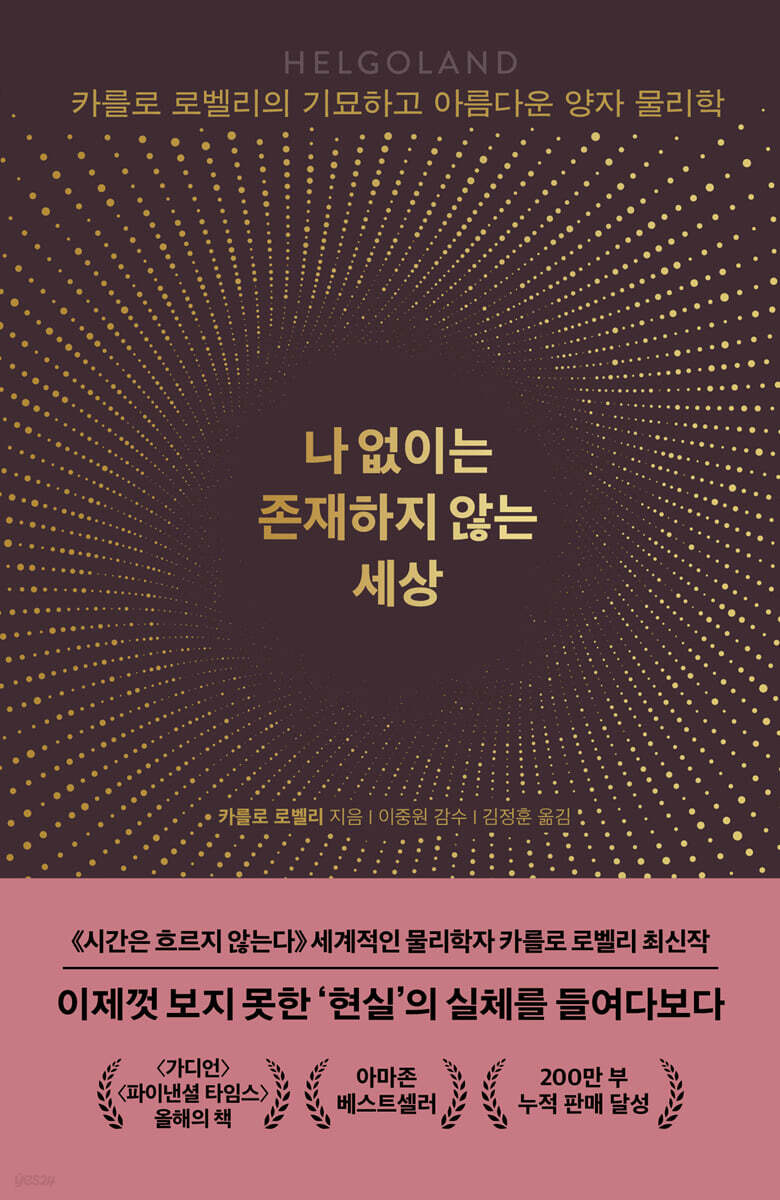
A world that doesn't exist without me
 |
Description
Book Introduction
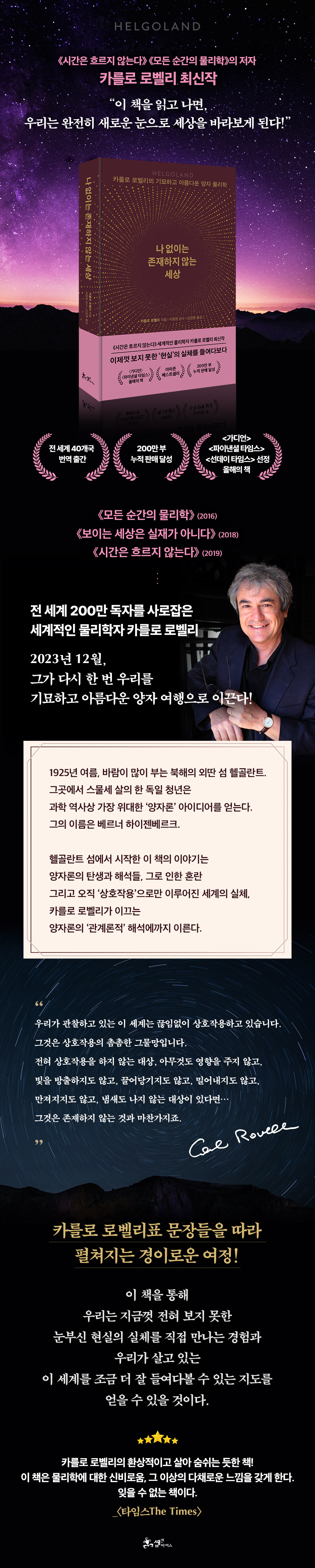
The latest work by Carlo Rovelli, author of "Time Does Not Pass" and "The Physics of Every Moment" “After reading this book, we will see the world with completely new eyes.” Published in 40 languages worldwide, with cumulative sales reaching 2 million copies. [Guardian] [Financial Times] [Sunday Times] Books of the Year The latest work by Carlo Rovelli, author of "Time Does Not Pass" and "The Physics of Every Moment" Take a peek into the dazzling reality of 'reality' you've never seen before! Another wondrous journey through physics, following Carlo Rovelli's signature lines. World-renowned physicist Carlo Rovelli's books, "The Physics of Every Moment," "Time Does Not Pass," and "The World as We See It Is Not Real," became bestsellers immediately after their publication and have been translated and published in 40 countries around the world. His books have sold over 2 million copies, an unprecedented record for a science book. And in December 2023, he will once again lead us into the strange and beautiful world of physics with his new book, The World That Would Not Exist Without Me. The book begins with the idea of 'quantum theory' discovered by a twenty-three-year-old German youth on the North Sea island of Heligoland. His name is Werner Heisenberg. The story, which begins on the island of Heligoland, covers the birth and interpretations of quantum theory, the resulting confusion, and the reality of the world consisting solely of 'interactions', the 'relational' interpretation of quantum theory. We think of this world in terms of material things, but in fact, this world we call 'reality' is a 'vast network of interacting entities'. The way an object interacts is the object itself. A boy throws a stone, the stone flies and moves the air, a tree makes oxygen from the sun, people breathe in oxygen, and people who breathe in oxygen see the stars… . This world is constantly interacting. If there is an object that does not interact at all, it is as good as not existing. Through the 'reality of the world' revealed by Carlo Rovelli's quantum theory, we experience as if we are directly touching the dazzling 'substance of reality' that we have never seen before. At the same time, it continues to question our preconceptions. If this world is made up solely of relationships, not material things, what is the fundamental reality of this world? Where should we anchor our concept of the world? How can my thoughts, subjectivity, values, beauty, and meaning exist? He explores these questions together, offering new perspectives on the world and a clear way to understand our place in the universe. This will colorfully reconstruct our worldview. |
- You can preview some of the book's contents.
Preview
index
Prologue: Facing the Dazzling Reality
I
Werner Heisenberg and 'Observation'
Erwin Schrödinger's probability
The particle nature of the world
II
Overlap
Multiverses, Hidden Variables, and Physical Collapse
Embrace uncertainty
III
There was a time when the world seemed simple.
How we influence each other
The thin and light quantum world
IV
tangle
A dance for three
Finite yet infinite information
V
Bogdanov and Lenin
Naturalism without substance: contextuality
Nagarjuna
VI
simple matter
What does meaning mean
The world seen from the inside
VII
A map that can show this world a little better
Reviewer's note
annotation
I
Werner Heisenberg and 'Observation'
Erwin Schrödinger's probability
The particle nature of the world
II
Overlap
Multiverses, Hidden Variables, and Physical Collapse
Embrace uncertainty
III
There was a time when the world seemed simple.
How we influence each other
The thin and light quantum world
IV
tangle
A dance for three
Finite yet infinite information
V
Bogdanov and Lenin
Naturalism without substance: contextuality
Nagarjuna
VI
simple matter
What does meaning mean
The world seen from the inside
VII
A map that can show this world a little better
Reviewer's note
annotation
Detailed image
Into the book
In the summer of 1925, a twenty-three-year-old German youth spends several days in anxious solitude on Heligoland, a remote island in the windswept North Sea, meaning "Holy Island."
And on that island, he got the idea to explain all the difficult facts and build 'quantum theory', the mathematical structure of quantum mechanics.
It was probably the greatest scientific revolution in history.
The young man's name was Werner Heisenberg.
The story of this book begins from there.
--- p.9
We think of this world in terms of objects, things, and entities (what scientific jargon calls the "physical world").
Photons, cats, stones, clocks, trees, boys, villages, rainbows, planets, clusters of galaxies, and so on… But these objects do not stand in lofty solitude.
Rather, they are just acting on each other.
If we are to understand nature, we must pay attention to these interactions, not to isolated objects.
The cat listens to the ticking of the clock.
A boy throws a stone, the stone flies through the air, hits another stone, moves that stone, and that stone falls and presses on the ground.
A tree gets energy from sunlight and creates oxygen, and the villagers breathe that oxygen and observe the stars.
And stars move through galaxies, drawn by the gravity of other stars.
The world we observe is constantly interacting.
It is a dense web of interactions.
--- p.97
Physical variables do not describe things, but rather how things appear to each other.
It is pointless to assign values to variables when no interaction is taking place.
A variable is something that has a relative value (such as the position or velocity of a particle) with respect to an object while interacting with that object.
The world is a network of these interactions.
When physical objects interact, relationships are established.
A stone hits another stone.
The sunlight touches my skin.
You, the reader, are reading this article.
--- p.105
The fragmented perspectives and diversified viewpoints, due to the fact that attributes are only relative, are reunited thanks to this consistency.
The grammar of quantum theory embodies this consistency, which forms the basis of intersubjectivity and supports the objectivity of our common worldview.
For all of us who converse with each other, the color of the butterfly's wings is always the same.
--- p.128
This magical kaleidoscope, filled with light, that we call the world and marvel at the fact that we exist within it.
The fragile veil we call 'mind' is merely a clumsy tool for exploring this infinite mystery.
We can cross the world without doubt, trusting the map in our hands.
You can live well enough like that.
You can just sit in silence, overwhelmed by the light and infinite beauty of the world.
You can sit patiently at your desk, light a candle, and open your laptop; you can go to the lab and argue with friends and enemies; you can seclude yourself on a sacred island and do calculations; you can climb a rocky mountain at dawn.
Or maybe you'll have a cup of tea, light a fire in the fireplace, and hit the keyboard again, trying to understand a few things a little better, or maybe you'll pick up an existing map and work on making it even better in some way.
Once again, let's think about nature.
--- p.141
It's hard to imagine that we humans could be made up of nothing but little pebbles bouncing off each other.
But if you look closely, even a single pebble is a vast world.
It's a galaxy of fiery quanta, where probabilities and interactions fluctuate.
On the other hand, what we call 'stones' are layers upon layers of meaning in our minds, brought about by our interactions with a galaxy of point-like, relative physical events.
'Simple matter' is scattered and becomes complex layers, suddenly appearing not so simple.
The gap between our faintly resolved mind and mere matter seems perhaps surmountable.
--- p.192-193
When we imagine the totality of things, we imagine that we are outside the universe and looking 'from there'.
But there is no 'outside' to the totality of things.
The perspective from the outside is a perspective that does not exist.
All descriptions of the world are made from within.
The world seen from the outside does not exist.
There are only partial and internal perspectives that reflect each other.
The world is a reflection of these perspectives.
Quantum physics shows that this phenomenon already occurs in inanimate objects.
A set of attributes related to the same object forms a perspective.
Without discarding all perspectives, one cannot reconstruct the totality of facts.
Since facts are only relative facts, we would end up in a world without facts.
--- p.213
When we take a relational perspective, we can escape the dualisms of subject/object, matter/mind, and the seemingly irreducible dualisms of reality/thought or brain/consciousness.
After elucidating the processes occurring within our bodies and their relationship to the external world, what else remains to be understood? These processes are a response to, and refinement of, the interconnectedness between our bodies and the external environment, which participate in them.
These processes traverse between the outside and the inside of our bodies (and between the inside and the outside).
Could the phenomenology of our consciousness be nothing more than the name we give to this process in a game of mirrors, where neurons mirror each other with the relevant information contained in the signals they transmit?
And on that island, he got the idea to explain all the difficult facts and build 'quantum theory', the mathematical structure of quantum mechanics.
It was probably the greatest scientific revolution in history.
The young man's name was Werner Heisenberg.
The story of this book begins from there.
--- p.9
We think of this world in terms of objects, things, and entities (what scientific jargon calls the "physical world").
Photons, cats, stones, clocks, trees, boys, villages, rainbows, planets, clusters of galaxies, and so on… But these objects do not stand in lofty solitude.
Rather, they are just acting on each other.
If we are to understand nature, we must pay attention to these interactions, not to isolated objects.
The cat listens to the ticking of the clock.
A boy throws a stone, the stone flies through the air, hits another stone, moves that stone, and that stone falls and presses on the ground.
A tree gets energy from sunlight and creates oxygen, and the villagers breathe that oxygen and observe the stars.
And stars move through galaxies, drawn by the gravity of other stars.
The world we observe is constantly interacting.
It is a dense web of interactions.
--- p.97
Physical variables do not describe things, but rather how things appear to each other.
It is pointless to assign values to variables when no interaction is taking place.
A variable is something that has a relative value (such as the position or velocity of a particle) with respect to an object while interacting with that object.
The world is a network of these interactions.
When physical objects interact, relationships are established.
A stone hits another stone.
The sunlight touches my skin.
You, the reader, are reading this article.
--- p.105
The fragmented perspectives and diversified viewpoints, due to the fact that attributes are only relative, are reunited thanks to this consistency.
The grammar of quantum theory embodies this consistency, which forms the basis of intersubjectivity and supports the objectivity of our common worldview.
For all of us who converse with each other, the color of the butterfly's wings is always the same.
--- p.128
This magical kaleidoscope, filled with light, that we call the world and marvel at the fact that we exist within it.
The fragile veil we call 'mind' is merely a clumsy tool for exploring this infinite mystery.
We can cross the world without doubt, trusting the map in our hands.
You can live well enough like that.
You can just sit in silence, overwhelmed by the light and infinite beauty of the world.
You can sit patiently at your desk, light a candle, and open your laptop; you can go to the lab and argue with friends and enemies; you can seclude yourself on a sacred island and do calculations; you can climb a rocky mountain at dawn.
Or maybe you'll have a cup of tea, light a fire in the fireplace, and hit the keyboard again, trying to understand a few things a little better, or maybe you'll pick up an existing map and work on making it even better in some way.
Once again, let's think about nature.
--- p.141
It's hard to imagine that we humans could be made up of nothing but little pebbles bouncing off each other.
But if you look closely, even a single pebble is a vast world.
It's a galaxy of fiery quanta, where probabilities and interactions fluctuate.
On the other hand, what we call 'stones' are layers upon layers of meaning in our minds, brought about by our interactions with a galaxy of point-like, relative physical events.
'Simple matter' is scattered and becomes complex layers, suddenly appearing not so simple.
The gap between our faintly resolved mind and mere matter seems perhaps surmountable.
--- p.192-193
When we imagine the totality of things, we imagine that we are outside the universe and looking 'from there'.
But there is no 'outside' to the totality of things.
The perspective from the outside is a perspective that does not exist.
All descriptions of the world are made from within.
The world seen from the outside does not exist.
There are only partial and internal perspectives that reflect each other.
The world is a reflection of these perspectives.
Quantum physics shows that this phenomenon already occurs in inanimate objects.
A set of attributes related to the same object forms a perspective.
Without discarding all perspectives, one cannot reconstruct the totality of facts.
Since facts are only relative facts, we would end up in a world without facts.
--- p.213
When we take a relational perspective, we can escape the dualisms of subject/object, matter/mind, and the seemingly irreducible dualisms of reality/thought or brain/consciousness.
After elucidating the processes occurring within our bodies and their relationship to the external world, what else remains to be understood? These processes are a response to, and refinement of, the interconnectedness between our bodies and the external environment, which participate in them.
These processes traverse between the outside and the inside of our bodies (and between the inside and the outside).
Could the phenomenology of our consciousness be nothing more than the name we give to this process in a game of mirrors, where neurons mirror each other with the relevant information contained in the signals they transmit?
--- p.220
Publisher's Review
“No one understands quantum mechanics.”
A mystery that has remained unsolved for over 100 years
Physicist Murray Gell-Mann said, “Quantum mechanics is a mysterious and baffling science that none of us really understands, but we all know how to use.”
Even Einstein, who pioneered the idea of quantum theory, and Richard Feynman, the great 20th century physicist, wrote, “Nobody understands quantum.”
Nobody understands quantum theory.
It forms the basis of modern technology, from the computers we use today to nuclear power plants, and engineers, astrophysicists, cosmologists, and biologists use this theory every day.
Even high school curricula include the foundations of this theory.
A hundred years after the birth of quantum theory, it remains an unsolved mystery.
In his new book, The World Would Not Exist Without Me, world-renowned theoretical physicist Carlo Rovelli seriously explores what this enigmatic quantum theory tells us about the "reality of the world" and what the real world depicted by quantum theory looks like.
Rovelli's quest begins with the ideas of the young Werner Heisenberg, who developed quantum theory on Heligoland, a harsh, windswept North Sea island.
The birth and interpretations of quantum theory, the resulting confusion, and the reality of the world he proposes as consisting solely of 'interactions', leading to the 'relational' interpretation of quantum theory.
The entire journey is astonishingly vast and expansive, a culmination of transversal thinking that seamlessly crosses the boundaries of science and philosophy.
It's real to you
Could there be something that is not like that for me?
What is the 'relational' interpretation that Carlo Rovelli explains in this book?
The core of quantum theory is that “quantum theory does not describe how quantum objects appear to us (or to any particular entity that does the ‘observation’).”
Quantum theory describes how any physical object appears to any other physical object.
In other words, it describes how physical objects act on other physical objects.
We think of this world in terms of objects, things, and entities (what scientific jargon calls the "physical world").
Photons, cats, stones, clocks, trees, boys, villages, rainbows, planets, clusters of galaxies, and so on… But these objects do not stand in lofty solitude.
Rather, they are just acting on each other.
If we are to understand nature, we must pay attention to these interactions, not to isolated objects.
The cat listens to the ticking of the clock.
A boy throws a stone, the stone flies through the air, hits another stone, moves that stone, and that stone falls and presses on the ground.
A tree gets energy from sunlight and creates oxygen, and the villagers breathe that oxygen and observe the stars.
And stars move through galaxies, drawn by the gravity of other stars.
The world we observe is constantly interacting.
It's interactive
It's a dragon's tight net.
_From the text
The object exists in itself as the way it interacts with the object.
An object that does not interact is as good as not existing.
That is, this world we call 'reality' or 'existence' is a vast network of interacting entities.
Objects reveal themselves to each other through interaction, and so do we.
Quantum theory, based on Carlo Rovelli's 'relational' interpretation, can be said to be a story about this 'network'.
This world is a dense web of constant interaction.
An object is not an independent entity with inherent properties from the beginning, but rather a relational entity whose related properties constantly arise through interaction with other objects.
The properties of an object do not exist within the object, but only in its interaction with other objects. It is a relationship between two objects in which properties can change as the objects of interaction change.
In short, this world is not a collection of objects with definite properties, but a network of relationships.
_From the text
This is the reality revealed by quantum theory, as described by Rovelli.
The world revealed in this way is a ‘thin world.’
The things in this world are not independent entities with fixed properties, but are beings that have properties and characteristics only in relation to other things, and only when they interact with each other.
A stone has no position of its own, but only with respect to other stones it collides with.
The sky does not have color in itself, but only has color for my eyes that look up at it.
The stars in the sky do not shine as independent entities, but are merely nodes in the network of interactions that make up the galaxy to which they belong.
The quantum world is therefore made up of more fluid, transient, and discrete events and interactions than conventional physics imagined.
In Rovelli's words, it is "a world as delicate, intricate, and fragile as Venetian lace."
Every interaction is an event.
It is these light and fleeting events that make up the world, not the heavy objects with absolute properties that philosophy posits.
“This is the best explanation of nature we have today,” adds Carlo Rovelli.
Rethinking the world
Not being afraid, that's the power of science.
In fact, this quantum theory of Rovelli's 'relational interpretation', which feels unfamiliar, confuses us.
But it opens up a new perspective for understanding the world we live in, a new picture of the reality of the world, or a conceptual framework for thinking about things.
It is possible to escape from dualisms such as subject-object, matter-spirit, reality-thought.
In this way, science empowers us with the power of rebellious and critical thinking, allowing us to revise the conceptual foundations we have lived with and to redesign the world we see from now on.
Sometimes it can be as small as learning a few new facts.
Sometimes it challenges our expectations, challenging the very conceptual grammar of how we think about the world.
At such times, we update our deepest worldview.
We find new maps for thinking about reality, maps that can show the world a little better.
This is quantum theory.
_From the text
In this book, he clearly demonstrates that 'scientific thinking is not made up of already obtained, certain facts.'
In quantum theory, we are not afraid to overturn the world order in order to find a more valid explanation, but we talk about the process of questioning everything again and turning everything upside down again.
“The power of science is not being afraid to rethink the world,” says Carlo Rovelli.
Just as Anaximander removed the fulcrum that held the Earth up and Copernicus lifted it into the sky and made it rotate, the picture of the world has been constantly redrawn in more effective forms.
Through this book, we will have the precious experience of letting go of things that seemed so natural to us and looking at the world in a new way.
With Carlo Rovelli, I truly realized the meaningful fun of physics and the infinite value of the quantum world.
Carlo Rovelli did the greatest thing to popularize physics.
Thanks to this, we live in a magical world where we no longer have to be daunted by science.
_〈Financial Times〉
A fantastic and vivid book by world-renowned physicist Carlo Rovelli!
This book leaves you with a strong sense of the mystery and richness of physics.
It's an unforgettable book.
_〈The Times〉
Carlo Rovelli has another elegant and wonderful book on time and quantum theory.
This book allows us to confront how little we know about the world and everything in it.
_〈Guardian〉
A spirit of deep thought and constant inquiry.
And a sentence that explains it as simply and beautifully as possible.
He has been a disappearing figure in the academic specialties of the past century, from Galileo to Darwin.
He is the only and unique scientist who continues the tradition of popular science writing.
_〈Observer〉
After reading him, you will see even the grains of sand between your toes with a whole new perspective.
_〈Irish Independent〉
A mystery that has remained unsolved for over 100 years
Physicist Murray Gell-Mann said, “Quantum mechanics is a mysterious and baffling science that none of us really understands, but we all know how to use.”
Even Einstein, who pioneered the idea of quantum theory, and Richard Feynman, the great 20th century physicist, wrote, “Nobody understands quantum.”
Nobody understands quantum theory.
It forms the basis of modern technology, from the computers we use today to nuclear power plants, and engineers, astrophysicists, cosmologists, and biologists use this theory every day.
Even high school curricula include the foundations of this theory.
A hundred years after the birth of quantum theory, it remains an unsolved mystery.
In his new book, The World Would Not Exist Without Me, world-renowned theoretical physicist Carlo Rovelli seriously explores what this enigmatic quantum theory tells us about the "reality of the world" and what the real world depicted by quantum theory looks like.
Rovelli's quest begins with the ideas of the young Werner Heisenberg, who developed quantum theory on Heligoland, a harsh, windswept North Sea island.
The birth and interpretations of quantum theory, the resulting confusion, and the reality of the world he proposes as consisting solely of 'interactions', leading to the 'relational' interpretation of quantum theory.
The entire journey is astonishingly vast and expansive, a culmination of transversal thinking that seamlessly crosses the boundaries of science and philosophy.
It's real to you
Could there be something that is not like that for me?
What is the 'relational' interpretation that Carlo Rovelli explains in this book?
The core of quantum theory is that “quantum theory does not describe how quantum objects appear to us (or to any particular entity that does the ‘observation’).”
Quantum theory describes how any physical object appears to any other physical object.
In other words, it describes how physical objects act on other physical objects.
We think of this world in terms of objects, things, and entities (what scientific jargon calls the "physical world").
Photons, cats, stones, clocks, trees, boys, villages, rainbows, planets, clusters of galaxies, and so on… But these objects do not stand in lofty solitude.
Rather, they are just acting on each other.
If we are to understand nature, we must pay attention to these interactions, not to isolated objects.
The cat listens to the ticking of the clock.
A boy throws a stone, the stone flies through the air, hits another stone, moves that stone, and that stone falls and presses on the ground.
A tree gets energy from sunlight and creates oxygen, and the villagers breathe that oxygen and observe the stars.
And stars move through galaxies, drawn by the gravity of other stars.
The world we observe is constantly interacting.
It's interactive
It's a dragon's tight net.
_From the text
The object exists in itself as the way it interacts with the object.
An object that does not interact is as good as not existing.
That is, this world we call 'reality' or 'existence' is a vast network of interacting entities.
Objects reveal themselves to each other through interaction, and so do we.
Quantum theory, based on Carlo Rovelli's 'relational' interpretation, can be said to be a story about this 'network'.
This world is a dense web of constant interaction.
An object is not an independent entity with inherent properties from the beginning, but rather a relational entity whose related properties constantly arise through interaction with other objects.
The properties of an object do not exist within the object, but only in its interaction with other objects. It is a relationship between two objects in which properties can change as the objects of interaction change.
In short, this world is not a collection of objects with definite properties, but a network of relationships.
_From the text
This is the reality revealed by quantum theory, as described by Rovelli.
The world revealed in this way is a ‘thin world.’
The things in this world are not independent entities with fixed properties, but are beings that have properties and characteristics only in relation to other things, and only when they interact with each other.
A stone has no position of its own, but only with respect to other stones it collides with.
The sky does not have color in itself, but only has color for my eyes that look up at it.
The stars in the sky do not shine as independent entities, but are merely nodes in the network of interactions that make up the galaxy to which they belong.
The quantum world is therefore made up of more fluid, transient, and discrete events and interactions than conventional physics imagined.
In Rovelli's words, it is "a world as delicate, intricate, and fragile as Venetian lace."
Every interaction is an event.
It is these light and fleeting events that make up the world, not the heavy objects with absolute properties that philosophy posits.
“This is the best explanation of nature we have today,” adds Carlo Rovelli.
Rethinking the world
Not being afraid, that's the power of science.
In fact, this quantum theory of Rovelli's 'relational interpretation', which feels unfamiliar, confuses us.
But it opens up a new perspective for understanding the world we live in, a new picture of the reality of the world, or a conceptual framework for thinking about things.
It is possible to escape from dualisms such as subject-object, matter-spirit, reality-thought.
In this way, science empowers us with the power of rebellious and critical thinking, allowing us to revise the conceptual foundations we have lived with and to redesign the world we see from now on.
Sometimes it can be as small as learning a few new facts.
Sometimes it challenges our expectations, challenging the very conceptual grammar of how we think about the world.
At such times, we update our deepest worldview.
We find new maps for thinking about reality, maps that can show the world a little better.
This is quantum theory.
_From the text
In this book, he clearly demonstrates that 'scientific thinking is not made up of already obtained, certain facts.'
In quantum theory, we are not afraid to overturn the world order in order to find a more valid explanation, but we talk about the process of questioning everything again and turning everything upside down again.
“The power of science is not being afraid to rethink the world,” says Carlo Rovelli.
Just as Anaximander removed the fulcrum that held the Earth up and Copernicus lifted it into the sky and made it rotate, the picture of the world has been constantly redrawn in more effective forms.
Through this book, we will have the precious experience of letting go of things that seemed so natural to us and looking at the world in a new way.
With Carlo Rovelli, I truly realized the meaningful fun of physics and the infinite value of the quantum world.
Carlo Rovelli did the greatest thing to popularize physics.
Thanks to this, we live in a magical world where we no longer have to be daunted by science.
_〈Financial Times〉
A fantastic and vivid book by world-renowned physicist Carlo Rovelli!
This book leaves you with a strong sense of the mystery and richness of physics.
It's an unforgettable book.
_〈The Times〉
Carlo Rovelli has another elegant and wonderful book on time and quantum theory.
This book allows us to confront how little we know about the world and everything in it.
_〈Guardian〉
A spirit of deep thought and constant inquiry.
And a sentence that explains it as simply and beautifully as possible.
He has been a disappearing figure in the academic specialties of the past century, from Galileo to Darwin.
He is the only and unique scientist who continues the tradition of popular science writing.
_〈Observer〉
After reading him, you will see even the grains of sand between your toes with a whole new perspective.
_〈Irish Independent〉
GOODS SPECIFICS
- Date of issue: December 1, 2023
- Format: Hardcover book binding method guide
- Page count, weight, size: 256 pages | 316g | 115*180*17mm
- ISBN13: 9791165348472
- ISBN10: 1165348470
You may also like
카테고리
korean


korean

![GQ KOREA Mark (Monthly): December [2025]](http://librairie.coreenne.fr/cdn/shop/files/8ef265dbbfbf186523ed75ba7319009d.jpg?v=1765340328&width=3840)


