

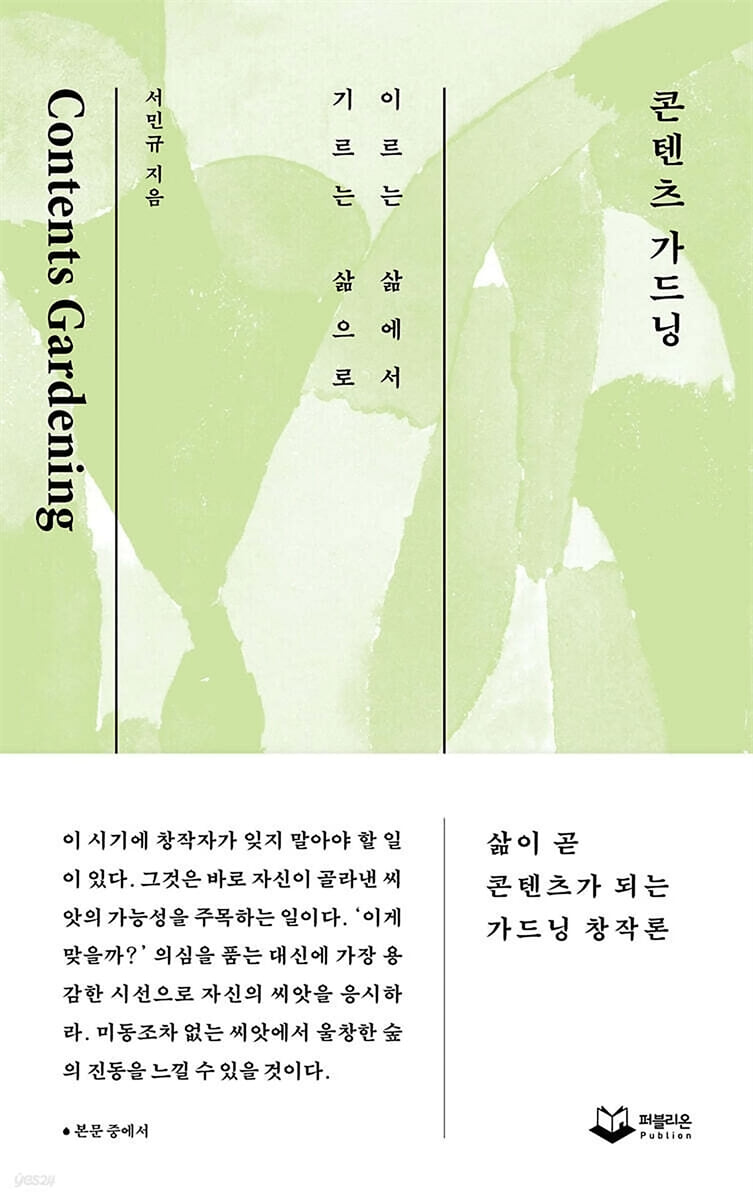
Content Gardening
 |
Description
Book Introduction
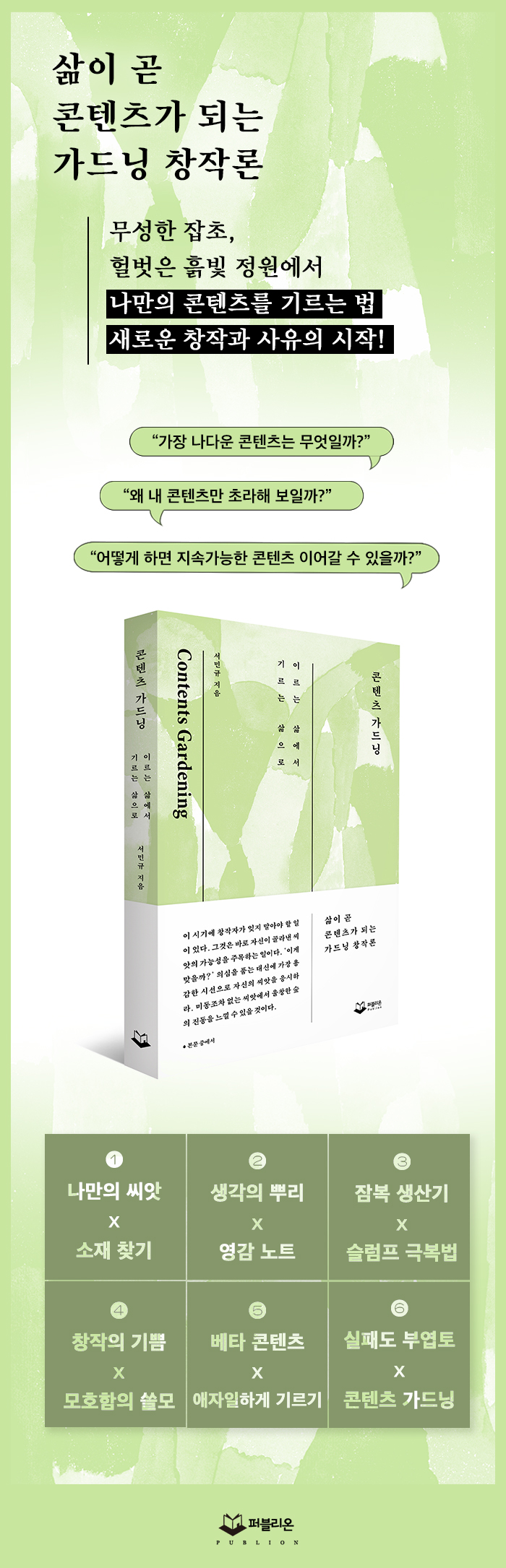
“Let the seeds of possibility sprout and take deep root.” Gardening Creation: How Life Becomes Content In the garden of lush weeds and bare earth The beginning of a new way of thinking, cultivating your own content! Content creation is no longer the domain of experts only. Many people are challenging themselves with their own content, such as publishing essay collections, filming vlogs, publishing webtoons, and building communities. But creation isn't easy for everyone. As the threshold for creation has lowered, the number of people losing their way has also increased. "What content is most like me?", "Why does my content always seem so shabby?", "How can I continue to create sustainable content?" This book suggests the path of gardening, rather than production, to novice creators with these concerns. ‘Content gardening’ is about moving away from the design mode that prioritizes competition and efficiency. Instead, I propose that we cultivate life and content simultaneously through adventure, enjoyment, sincerity, and self-sufficiency. The author, through his experience as a content coach and long-term reflection, has systematized a creative gardening theory in which life becomes content. It provides specific examples of how to discover and nurture your own original seeds, how to nurture their potential and make them bloom, and how to wisely overcome slumps through latent production, allowing anyone to cultivate their own content. |
- You can preview some of the book's contents.
Preview
index
prolog
Chapter 1.
Gardening: How to Grow Content
● Content Gardening
- Ponytails and their creation
- Gardening instead of design
● Planting seeds
- Leveling the soil
- Choosing seeds
● Rooting latent production period
- Nutrient and water cycle
- Rooting out content
- Things to do in the latent production period
● Grow by extending the stem
- Create tags
- Setting up a table of contents
● Raising children agilely
- Start with a small garden
- Planning, Departure, and Re-Exploration
- The Usefulness of Ambiguity
● Gardening tools
● Raising and growing
Chapter 2.
Garden, What Makes Good Content?
● Fences and gardens
- Containers and imagination
- A garden to enjoy together
- Grafting the story (?木)
● The idea that life becomes content
- Fertilizer, the humus of life
- Perspective and originality
● The beginning of unique content
- What I'm good at x What I like
- Planning becomes opportunity
- Roots of Thought and Inspiration Notes
● Invitation to my garden
- The clearer my universe is,
- Preparing for conversation
● Timing and naming
- Gardening time
- A name that everyone calls themselves
● Filling and emptying
Chapter 3.
Gardner, Who's Growing Content?
● Raiser
- Something that existed before the fruit
- Any seed
● When a plant dies just by touching it
- Overcoming perfectionism
- With smart diligence
- In the jungle of algorithms
- Not giving in to envy
● The Path to Becoming a Gardener
- Green fingers
- With admiration and trembling
● Developing the power to grow
- The usefulness of experience
- Creating through process
- Learn from your neighbor gardener
- In the face of the dilemma of choice
● Embrace more broadly
- Attitude toward failure
- About feedback
- The secret to growing the land
● A Day in the Life of a Gardner
- Sensual routine
- How to overcome a slump
- Something more difficult than evaluation
● Raising and raising
- In a world where the right answer has disappeared
- From a life that leads to a life that nurtures
Epilogue
References
Chapter 1.
Gardening: How to Grow Content
● Content Gardening
- Ponytails and their creation
- Gardening instead of design
● Planting seeds
- Leveling the soil
- Choosing seeds
● Rooting latent production period
- Nutrient and water cycle
- Rooting out content
- Things to do in the latent production period
● Grow by extending the stem
- Create tags
- Setting up a table of contents
● Raising children agilely
- Start with a small garden
- Planning, Departure, and Re-Exploration
- The Usefulness of Ambiguity
● Gardening tools
● Raising and growing
Chapter 2.
Garden, What Makes Good Content?
● Fences and gardens
- Containers and imagination
- A garden to enjoy together
- Grafting the story (?木)
● The idea that life becomes content
- Fertilizer, the humus of life
- Perspective and originality
● The beginning of unique content
- What I'm good at x What I like
- Planning becomes opportunity
- Roots of Thought and Inspiration Notes
● Invitation to my garden
- The clearer my universe is,
- Preparing for conversation
● Timing and naming
- Gardening time
- A name that everyone calls themselves
● Filling and emptying
Chapter 3.
Gardner, Who's Growing Content?
● Raiser
- Something that existed before the fruit
- Any seed
● When a plant dies just by touching it
- Overcoming perfectionism
- With smart diligence
- In the jungle of algorithms
- Not giving in to envy
● The Path to Becoming a Gardener
- Green fingers
- With admiration and trembling
● Developing the power to grow
- The usefulness of experience
- Creating through process
- Learn from your neighbor gardener
- In the face of the dilemma of choice
● Embrace more broadly
- Attitude toward failure
- About feedback
- The secret to growing the land
● A Day in the Life of a Gardner
- Sensual routine
- How to overcome a slump
- Something more difficult than evaluation
● Raising and raising
- In a world where the right answer has disappeared
- From a life that leads to a life that nurtures
Epilogue
References
Detailed image
Into the book
There is something that creators should not forget during this time.
It is a matter of noticing the potential of the seeds you have selected.
Instead of questioning, "Is this right?", look at your seed with the bravest eyes.
You will be able to feel the vibration of a dense forest from a seed that does not even move.
--- p.34
5 years on average.
Trees have a period of intensive rooting.
This is because the roots must spread deep and wide to grow in size and height later.
The roots spread out here and there and reach many waterways, making the tree resistant to drought.
As a result, the growth of trees going through the juvenile period cannot be seen well above ground.
It is the 'dormant growth period' of a tree growing towards the ground.
--- p.
41~42
Just like when using a navigation system, feel free to switch between 'planning', 'detouring', and 're-navigating'.
Keep your destination in mind and keep a broad direction, but if you take a wrong turn, just re-plan.
Countless departures and readjustments can sometimes be the driving force behind creation.
--- p.
68
Humus, considered the best fertilizer in gardening, comes from dead plants and animals.
Most of what is left behind by living things disappears into carbon dioxide, but a very small amount becomes 'humus' and plays a role in promoting new life.
The dead make way for the living.
Our 'ordinary lives' can also become material for content.
--- p.103
In a competitive world, it's easy to see others as competitors, but in the world of gardening, we see each other as collaborators.
We and they both take root in the same land, and each of us forms a large forest with our own unique characteristics.
And if there is cooperation between these two, it will become a garden that can be enjoyed by many more people, not just the parties involved.
--- p.166
Gardner's effectiveness depends on how flexibly he can respond to failure.
A competent gardener is not one who succeeds every time he tries, but one who learns from every failure.
That's why there are people who intentionally try to meet failure quickly.
They don't mind repeated mistakes and failures, but use them as assets and grow quickly.
--- p.201~202
We have a lineage.
You can find out when you do gardening.
The land I stand on has become fertile thanks to the creators who have passed through here before.
The fertile land was created through the accumulated efforts of people who had never met before.
It is a very moving thing to be able to plant my seeds in that land.
Having many good companions around me is the best way to fertilize my soil.
Cultivate each other with your colleagues.
When we grow together, we can go further.
--- p.208~209
We have many choices before us.
‘Content gardening’ may not be an option for everyone.
But as you shift your focus from a life of giving to a life of nurturing, you will realize that the answers you need are not outside of you, but within you.
Gardening is a process of cultivating a new self every day without reaching anywhere.
--- p.225
The destination was not in sight.
But I learned to exist as a process.
I focused on creating a complete process that I could enjoy.
In this way, the process gave birth to new processes, and they were connected to form a path that I could finally walk.
And I ended up going through a transit point called [content gardening] that I had never even imagined.
I have come to fully embrace the world of gardening, which exists only as a journey, by completing a life that requires reaching a destination.
--- p.227
A film director starts making a film only after the script is ready.
But life doesn't come with a finished script.
There is not even a rough draft, let alone a finished script.
It's closer to a creative work that starts right away without a script or rehearsal.
So, if we look at life only as an object of design or production, that method doesn't work well.
Life is not something to be created, but rather an object of creation, embracing uncertainty and ambiguity.
It is a matter of noticing the potential of the seeds you have selected.
Instead of questioning, "Is this right?", look at your seed with the bravest eyes.
You will be able to feel the vibration of a dense forest from a seed that does not even move.
--- p.34
5 years on average.
Trees have a period of intensive rooting.
This is because the roots must spread deep and wide to grow in size and height later.
The roots spread out here and there and reach many waterways, making the tree resistant to drought.
As a result, the growth of trees going through the juvenile period cannot be seen well above ground.
It is the 'dormant growth period' of a tree growing towards the ground.
--- p.
41~42
Just like when using a navigation system, feel free to switch between 'planning', 'detouring', and 're-navigating'.
Keep your destination in mind and keep a broad direction, but if you take a wrong turn, just re-plan.
Countless departures and readjustments can sometimes be the driving force behind creation.
--- p.
68
Humus, considered the best fertilizer in gardening, comes from dead plants and animals.
Most of what is left behind by living things disappears into carbon dioxide, but a very small amount becomes 'humus' and plays a role in promoting new life.
The dead make way for the living.
Our 'ordinary lives' can also become material for content.
--- p.103
In a competitive world, it's easy to see others as competitors, but in the world of gardening, we see each other as collaborators.
We and they both take root in the same land, and each of us forms a large forest with our own unique characteristics.
And if there is cooperation between these two, it will become a garden that can be enjoyed by many more people, not just the parties involved.
--- p.166
Gardner's effectiveness depends on how flexibly he can respond to failure.
A competent gardener is not one who succeeds every time he tries, but one who learns from every failure.
That's why there are people who intentionally try to meet failure quickly.
They don't mind repeated mistakes and failures, but use them as assets and grow quickly.
--- p.201~202
We have a lineage.
You can find out when you do gardening.
The land I stand on has become fertile thanks to the creators who have passed through here before.
The fertile land was created through the accumulated efforts of people who had never met before.
It is a very moving thing to be able to plant my seeds in that land.
Having many good companions around me is the best way to fertilize my soil.
Cultivate each other with your colleagues.
When we grow together, we can go further.
--- p.208~209
We have many choices before us.
‘Content gardening’ may not be an option for everyone.
But as you shift your focus from a life of giving to a life of nurturing, you will realize that the answers you need are not outside of you, but within you.
Gardening is a process of cultivating a new self every day without reaching anywhere.
--- p.225
The destination was not in sight.
But I learned to exist as a process.
I focused on creating a complete process that I could enjoy.
In this way, the process gave birth to new processes, and they were connected to form a path that I could finally walk.
And I ended up going through a transit point called [content gardening] that I had never even imagined.
I have come to fully embrace the world of gardening, which exists only as a journey, by completing a life that requires reaching a destination.
--- p.227
A film director starts making a film only after the script is ready.
But life doesn't come with a finished script.
There is not even a rough draft, let alone a finished script.
It's closer to a creative work that starts right away without a script or rehearsal.
So, if we look at life only as an object of design or production, that method doesn't work well.
Life is not something to be created, but rather an object of creation, embracing uncertainty and ambiguity.
--- p.230
Publisher's Review
“Even for Bongtail, creation is a series of coincidences?!”
Beyond the era of efficiency, competition and design
Into a world of adventure, enjoyment, and creation
Director Bong Joon-ho's [Parasite] consists of 161 scenes.
Of course, these scenes were not created and produced sequentially.
Director Bong Joon-ho had a vague idea of a story about a rich family and a poor family.
After that, I completed the script based on loose premonitions and disorganized notes.
In his words, “I organized it as I wrote.”
Even the ponytail just goes on without knowing the ending.
I don't know what or how it will be completed.
So maybe we call it creation rather than design.
The same goes for content gardening.
All we have is a bare, earthy garden, overgrown with weeds, and tiny seeds that may never sprout.
But believing in its potential and diligently nurturing it through daily labor is what makes a creator and a gardener.
The author, who is active as a content coach, examines 'creation (gardening) - creation (garden) - creator (gardener)' in this book.
Rather than rushing to get immediate results, it guides you through the process of finding your own unique answers by asking essential questions such as '1) How do you grow content? 2) What is good content? 3) Who grows content?'
Through this, readers will be able to gain the courage and wisdom to complete their own garden by looking at the various difficulties and concerns, small achievements and joys encountered in the creative process.
“A life of nurturing, not of giving.”
In an era where the correct answer has disappeared,
How Should Content Creation Change?
Through the book, the author emphasizes a 'life of nurturing' rather than a 'life of leading'.
What is the reason?
Because we live in a post-corona era where the right answers have disappeared.
A life where you reach your destination faster than anyone else is no longer meaningful.
Now, each individual must find his own path, one that no one else has taken.
What is needed at this time is none other than the ‘power to nurture.’
It takes patience, sincerity, adventure, and passion to affirm the potential of the small seed you hold and to make it sprout.
Raising a life is about creating value in the process, not the outcome.
That is why the author likens content creation to a large-scale 'gardening' and develops new thoughts and explorations.
The eternal gardener, said Karel Chapek.
“Every human being should have a garden, even if it is only the size of the palm of his hand.”
That little garden makes us dream and grow.
This book is a new creative theory for those who want to enrich their one and only life through gardening.
It was written for people who want to nurture their content and themselves as one unique original, not separate entities.
This is why I recommend this book to anyone who wants to make the time given to them more valuable and enriching.
Beyond the era of efficiency, competition and design
Into a world of adventure, enjoyment, and creation
Director Bong Joon-ho's [Parasite] consists of 161 scenes.
Of course, these scenes were not created and produced sequentially.
Director Bong Joon-ho had a vague idea of a story about a rich family and a poor family.
After that, I completed the script based on loose premonitions and disorganized notes.
In his words, “I organized it as I wrote.”
Even the ponytail just goes on without knowing the ending.
I don't know what or how it will be completed.
So maybe we call it creation rather than design.
The same goes for content gardening.
All we have is a bare, earthy garden, overgrown with weeds, and tiny seeds that may never sprout.
But believing in its potential and diligently nurturing it through daily labor is what makes a creator and a gardener.
The author, who is active as a content coach, examines 'creation (gardening) - creation (garden) - creator (gardener)' in this book.
Rather than rushing to get immediate results, it guides you through the process of finding your own unique answers by asking essential questions such as '1) How do you grow content? 2) What is good content? 3) Who grows content?'
Through this, readers will be able to gain the courage and wisdom to complete their own garden by looking at the various difficulties and concerns, small achievements and joys encountered in the creative process.
“A life of nurturing, not of giving.”
In an era where the correct answer has disappeared,
How Should Content Creation Change?
Through the book, the author emphasizes a 'life of nurturing' rather than a 'life of leading'.
What is the reason?
Because we live in a post-corona era where the right answers have disappeared.
A life where you reach your destination faster than anyone else is no longer meaningful.
Now, each individual must find his own path, one that no one else has taken.
What is needed at this time is none other than the ‘power to nurture.’
It takes patience, sincerity, adventure, and passion to affirm the potential of the small seed you hold and to make it sprout.
Raising a life is about creating value in the process, not the outcome.
That is why the author likens content creation to a large-scale 'gardening' and develops new thoughts and explorations.
The eternal gardener, said Karel Chapek.
“Every human being should have a garden, even if it is only the size of the palm of his hand.”
That little garden makes us dream and grow.
This book is a new creative theory for those who want to enrich their one and only life through gardening.
It was written for people who want to nurture their content and themselves as one unique original, not separate entities.
This is why I recommend this book to anyone who wants to make the time given to them more valuable and enriching.
GOODS SPECIFICS
- Publication date: June 18, 2021
- Page count, weight, size: 240 pages | 298g | 120*188*15mm
- ISBN13: 9791191587029
- ISBN10: 1191587029
You may also like
카테고리
korean


korean

![ELLE 엘르 스페셜 에디션 A형 : 12월 [2025]](http://librairie.coreenne.fr/cdn/shop/files/b8e27a3de6c9538896439686c6b0e8fb.jpg?v=1766436872&width=3840)


