

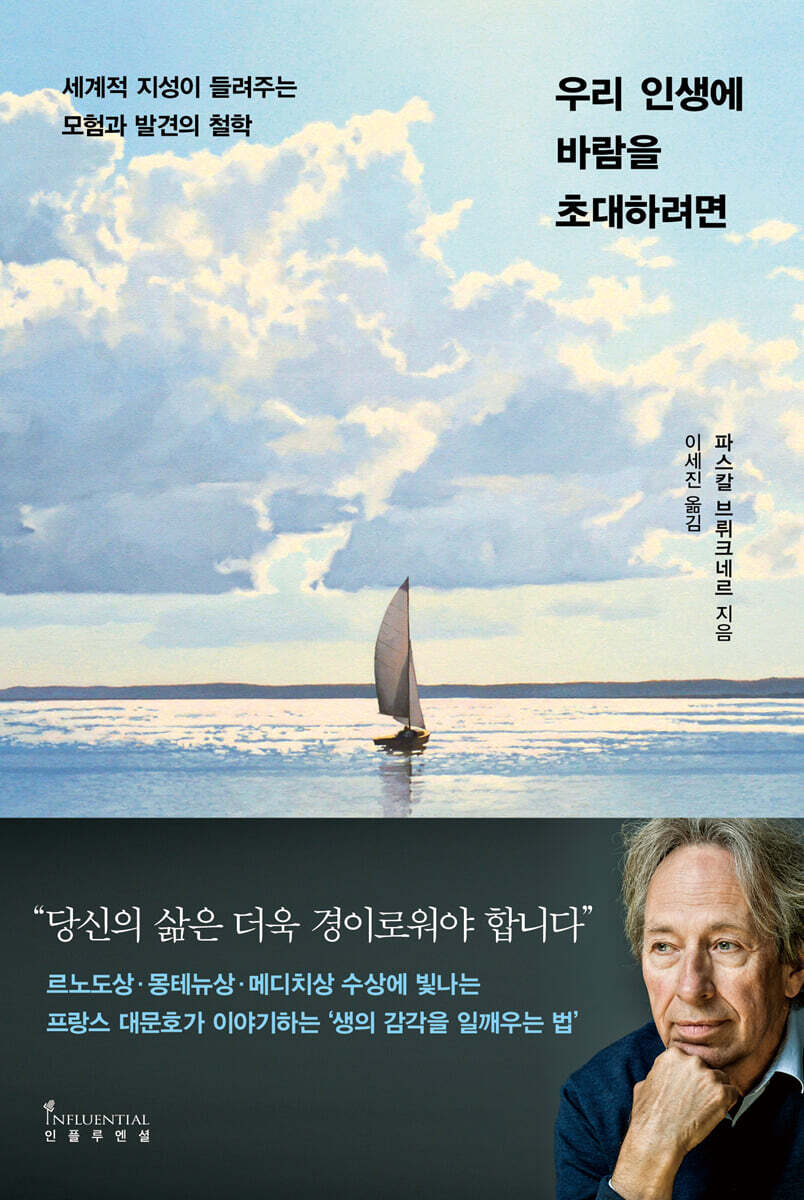
To invite the wind into our lives
 |
Description
Book Introduction
- A word from MD
-
Enjoy the wonderful worldA new work by Pascal Bruckner, winner of the Prix Médicis, Prix Renaudot, Prix Montaigne, and Prix Duménil.
It provides a prescription for the loneliness, lethargy, boredom, and depression of modern people who are absorbed in their smartphones.
Let's open the door and go outside.
Let's meet, adventure, and have fun in the real world.
Life is full of sacredness and wonder.
October 27, 2023. Humanities PD Son Min-gyu
Winner of the Prix Médicis, Prix Renaudot, Prix Montaigne, and Prix Duménil
A new work by world-renowned intellectual Pascal Brückner
A philosophy of adventure and discovery that speaks of new possibilities in an age of lethargy.
“Your life should be more wonderful.”
Why bother going outside when you can do most things from your bed—going to the movies, eating at a restaurant, working at the office? The small world in your hand makes life infinitely more comfortable, yet also less tedious.
Pascal Brückner's new work, "To Invite the Wind into Our Lives," aims to bring a breath of fresh air to your daily life, which has been stagnant these days, when the outside world is in turmoil due to abnormal weather, war, and pandemics, and apathy is rampant within.
Pascal Bruckner, a world-renowned French intellectual, has maintained a long-term position as a humanities bestseller by discussing a ‘new attitude toward aging’ in his previous work, ‘For Days Yet to Come.’
His insight, which unfolds elegant thoughts across various fields such as philosophy, history, literature, and art, is now directed towards the 'age of apathy'.
“What we really need is not wisdom, but a little madness, not a spiritual cure, but a thrilling intoxication.” As he says, this book is the starting point of a journey to recover true life.
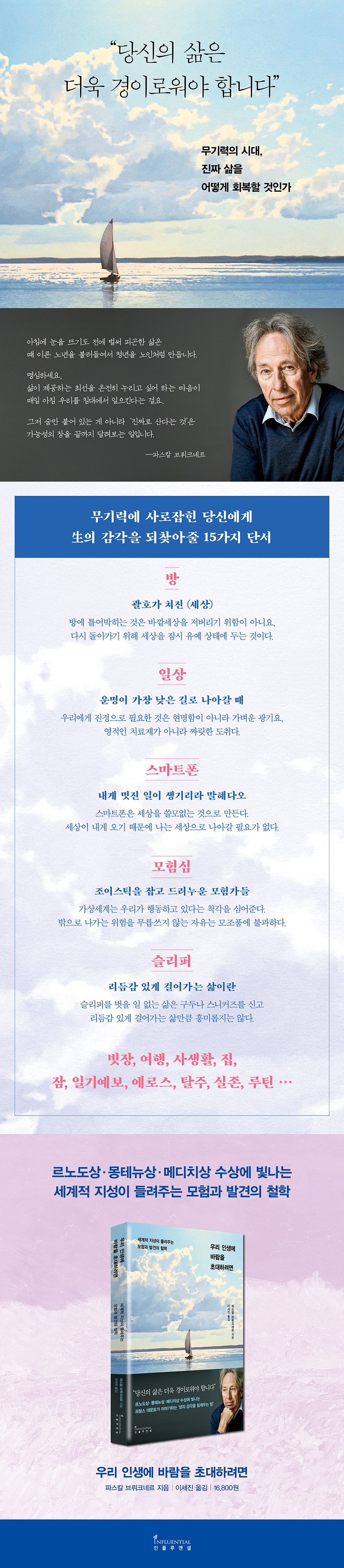
We try to regain our sense of life by following 15 clues including adventure, eros, privacy, daily life, existence, and escape.
I hope that the 'wind' that flows between inside and outside can bring you a new 'wind'.
A new work by world-renowned intellectual Pascal Brückner
A philosophy of adventure and discovery that speaks of new possibilities in an age of lethargy.
“Your life should be more wonderful.”
Why bother going outside when you can do most things from your bed—going to the movies, eating at a restaurant, working at the office? The small world in your hand makes life infinitely more comfortable, yet also less tedious.
Pascal Brückner's new work, "To Invite the Wind into Our Lives," aims to bring a breath of fresh air to your daily life, which has been stagnant these days, when the outside world is in turmoil due to abnormal weather, war, and pandemics, and apathy is rampant within.
Pascal Bruckner, a world-renowned French intellectual, has maintained a long-term position as a humanities bestseller by discussing a ‘new attitude toward aging’ in his previous work, ‘For Days Yet to Come.’
His insight, which unfolds elegant thoughts across various fields such as philosophy, history, literature, and art, is now directed towards the 'age of apathy'.
“What we really need is not wisdom, but a little madness, not a spiritual cure, but a thrilling intoxication.” As he says, this book is the starting point of a journey to recover true life.
We try to regain our sense of life by following 15 clues including adventure, eros, privacy, daily life, existence, and escape.
I hope that the 'wind' that flows between inside and outside can bring you a new 'wind'.
- You can preview some of the book's contents.
Preview
index
Preface to the Korean edition: May the doors of possibility be opened as much as possible.
Prologue: He never moves forward
Part 1: Is Life Still Wonderful?
Lock | The guard is in our heads
Travel | People who don't want to leave their rooms
Smartphone | Tell me something wonderful will happen to me
Daily Life|When Destiny Takes the Lowest Path
Private Life | I Was Not Mine
Room | (The world) with parentheses
Home | The Pains and Joys of a Chained Life
Sleep | Half of life spent in bed
Part 2 Your world is outside the door
Adventurers lying down with joysticks in hand
Slippers|A life of walking with rhythm
Weather Forecast | The Correlation Between Weather and Your Mind
Eros | The Age of the Decline of Sensuality
Escape | How to Travel My Room
Existence | 365 Days a Year, 365 Fates
Routine | If you get angry at even a grain of sand
Epilogue: The Game Isn't Over Yet
Translator's Note: With a heart of eternal wandering
To individuals who spend each day
Prologue: He never moves forward
Part 1: Is Life Still Wonderful?
Lock | The guard is in our heads
Travel | People who don't want to leave their rooms
Smartphone | Tell me something wonderful will happen to me
Daily Life|When Destiny Takes the Lowest Path
Private Life | I Was Not Mine
Room | (The world) with parentheses
Home | The Pains and Joys of a Chained Life
Sleep | Half of life spent in bed
Part 2 Your world is outside the door
Adventurers lying down with joysticks in hand
Slippers|A life of walking with rhythm
Weather Forecast | The Correlation Between Weather and Your Mind
Eros | The Age of the Decline of Sensuality
Escape | How to Travel My Room
Existence | 365 Days a Year, 365 Fates
Routine | If you get angry at even a grain of sand
Epilogue: The Game Isn't Over Yet
Translator's Note: With a heart of eternal wandering
To individuals who spend each day
Detailed image
Into the book
We must go outside to admire the beauty of the new day and to allow our bodies to take in the smells, sounds, and lights.
A screen is just a screen.
If you lock yourself in your house and live there, you are paying the price of deathly boredom for your safety.
A life like a low-altitude flight, unable to see far ahead, is a life of imprisonment, a life of slow speed.
It's a life that's already tiring before you even open your eyes in the morning.
That kind of mental dandyism is meticulously careful to ensure that nothing happens except the passage of time and the years.
Such a life invites premature old age and makes the young like old men.
--- p.7~8, from the preface to the Korean edition: “Let’s keep the doors of possibility open as much as possible”
We want our smartphones to trigger or herald some great event.
These tools allow us to stay connected to our loved ones, but they also make the wait more difficult to bear.
Why won't he call me? You might think there's something wrong with the device, the battery is dead, you're in a place where your phone won't work, or your phone was stolen, but reality is cruel.
That person just doesn't want to talk to you.
--- p.61, from “Smartphone|Tell me something wonderful will happen to me”
If I'm home alone and no one comes to visit, it's only a matter of time before my sacred place becomes a prison.
I bump into myself at every corner.
If there is no longer an “outside,” the “inside” loses its reason for existence.
It just becomes a closed place with no inside or outside.
The great light of the world, the unexpected beauty, should add meaning to life through its constant comings and goings, but it fails to do so.
--- p.117~118, from “Home | The Pain and Joy of Living Bound”
Baudelaire said this:
“Sleep and sleep again, that is my only wish now.
It is a cowardly and disgusting wish, but what can we do, since it is the truth?” Sleep is a regular act of descending into the abyss.
Death swallows up existence, but sleep, the small death, rebirths existence.
A person who becomes one with his bed and does not move is pursuing happiness very efficiently.
“We spend half our lives in bed and forget the sorrows of the other half,” said Xavier de Maistre in the 18th century.
--- p.127~128, from “Sleep | Half of Life Spent in Bed”
Can you imagine a hero, adventurer, or correspondent in slippers? A life without slippers isn't as exciting as a life striding along rhythmically in shoes or sneakers.
What if you happen to meet someone you've always admired—say, a great writer or actor—only to find them dressed shabbily and dragging their slippers? It's a painful experience, forced to face the mediocrity of the object of your admiration.
So I always end up repeating Hegel's famous words.
“There is no one who is a hero even to his own servants.
“It can’t be helped, not because the hero isn’t real, but because a servant is just a servant.”
--- p.168, from “Slippers | A life of walking with rhythm”
In most countries, weather forecasts are given by young female weathercasters who use facial expressions to indicate good or bad news.
A slightly frowning face foretells cloudy weather or rain.
If you smile brightly, a warm and clear day will come.
When the cold and heavy rain continue day after day, weathercasters become messengers of bad news and are unnecessarily hated.
In any situation, weather forecasting requires serious foresight and consideration.
For example, on snowy days, dress warmly, and if it rains, take an umbrella.
The old cheerful mood is no longer tolerated in weather forecasts.
Climate is war, and those who do not care about the climate are potential criminals.
Any forecast that isn't delivered in a serious tone seems irresponsible.
--- p.183, from “Weather Forecast | The Relationship Between Weather and the Mind”
The productive tension between inside and outside occurs when doors and shutters are slightly opened, allowing air to circulate on both sides (the same could be said of borders that separate nations to better connect them).
We must confront the anxieties that paralyze us with the grace to take risks.
It is not escape, but confronting adversity head-on that makes us strong.
Instead of dogmatism of closure or openness, we should pursue porosity, an appropriate gap between moderation and courage.
Because creative shocks occur in the meantime.
The taste of life always lies in the collision of various fields.
A screen is just a screen.
If you lock yourself in your house and live there, you are paying the price of deathly boredom for your safety.
A life like a low-altitude flight, unable to see far ahead, is a life of imprisonment, a life of slow speed.
It's a life that's already tiring before you even open your eyes in the morning.
That kind of mental dandyism is meticulously careful to ensure that nothing happens except the passage of time and the years.
Such a life invites premature old age and makes the young like old men.
--- p.7~8, from the preface to the Korean edition: “Let’s keep the doors of possibility open as much as possible”
We want our smartphones to trigger or herald some great event.
These tools allow us to stay connected to our loved ones, but they also make the wait more difficult to bear.
Why won't he call me? You might think there's something wrong with the device, the battery is dead, you're in a place where your phone won't work, or your phone was stolen, but reality is cruel.
That person just doesn't want to talk to you.
--- p.61, from “Smartphone|Tell me something wonderful will happen to me”
If I'm home alone and no one comes to visit, it's only a matter of time before my sacred place becomes a prison.
I bump into myself at every corner.
If there is no longer an “outside,” the “inside” loses its reason for existence.
It just becomes a closed place with no inside or outside.
The great light of the world, the unexpected beauty, should add meaning to life through its constant comings and goings, but it fails to do so.
--- p.117~118, from “Home | The Pain and Joy of Living Bound”
Baudelaire said this:
“Sleep and sleep again, that is my only wish now.
It is a cowardly and disgusting wish, but what can we do, since it is the truth?” Sleep is a regular act of descending into the abyss.
Death swallows up existence, but sleep, the small death, rebirths existence.
A person who becomes one with his bed and does not move is pursuing happiness very efficiently.
“We spend half our lives in bed and forget the sorrows of the other half,” said Xavier de Maistre in the 18th century.
--- p.127~128, from “Sleep | Half of Life Spent in Bed”
Can you imagine a hero, adventurer, or correspondent in slippers? A life without slippers isn't as exciting as a life striding along rhythmically in shoes or sneakers.
What if you happen to meet someone you've always admired—say, a great writer or actor—only to find them dressed shabbily and dragging their slippers? It's a painful experience, forced to face the mediocrity of the object of your admiration.
So I always end up repeating Hegel's famous words.
“There is no one who is a hero even to his own servants.
“It can’t be helped, not because the hero isn’t real, but because a servant is just a servant.”
--- p.168, from “Slippers | A life of walking with rhythm”
In most countries, weather forecasts are given by young female weathercasters who use facial expressions to indicate good or bad news.
A slightly frowning face foretells cloudy weather or rain.
If you smile brightly, a warm and clear day will come.
When the cold and heavy rain continue day after day, weathercasters become messengers of bad news and are unnecessarily hated.
In any situation, weather forecasting requires serious foresight and consideration.
For example, on snowy days, dress warmly, and if it rains, take an umbrella.
The old cheerful mood is no longer tolerated in weather forecasts.
Climate is war, and those who do not care about the climate are potential criminals.
Any forecast that isn't delivered in a serious tone seems irresponsible.
--- p.183, from “Weather Forecast | The Relationship Between Weather and the Mind”
The productive tension between inside and outside occurs when doors and shutters are slightly opened, allowing air to circulate on both sides (the same could be said of borders that separate nations to better connect them).
We must confront the anxieties that paralyze us with the grace to take risks.
It is not escape, but confronting adversity head-on that makes us strong.
Instead of dogmatism of closure or openness, we should pursue porosity, an appropriate gap between moderation and courage.
Because creative shocks occur in the meantime.
The taste of life always lies in the collision of various fields.
--- p.240, from “Epilogue | The Game Is Not Over Yet”
Publisher's Review
“How do we recover our true lives?”
- In an age of lethargy, a philosophy of adventure and discovery from world-renowned intellectuals.
Exhaustion and overwork, that is the life of modern people, said Nietzsche.
Do you ever feel like you're living a hectic, hectic life, but your overall life feels tedious? Pascal Bruckner, the French literary giant and winner of the Prix Renaudot and Prix Médicis, attributes it to apathy, adding:
“What threatens us now is not the virus but apathy, not the danger of disease but a deadly boredom.”
This book, “Inviting Wind into Our Lives,” interprets the apathy of our times from two major perspectives.
It is ‘isolation’ and ‘absence of real experience’.
As the barriers to privacy rise, individuals are isolated in their rooms, absorbed in smartphones and content, busy watching the wonderful things happening in the world on screen.
To borrow Hannah Arendt's words, it is a world filled with "the thick sadness of a private life that centers on nothing but oneself."
Individuals who are isolated from the outside world and locked within themselves cannot experience real life.
Instead of living a real life, we only experience brief mood swings, draining our energy and paralyzing ourselves with lethargy.
The author diagnoses that we live a life where we are “tired before we even open our eyes in the morning,” and says that we need to recover our “sense of life” to shake off lethargy and boredom.
“A house or a room can only function as a lung when it is open to the outside.
Only then can it expand and become more circulatory.
“If the doors and windows are tightly shut, the lungs will shrink and you will only breathe in the stale indoor air.” That is why ‘wind’ is needed.
The wind plays a role in expanding the field of possibility by moving between inside and outside, and the goal of this book is to breathe wind into the minds of modern people who are consumed by the inertia of everyday life by refreshing their thoughts.
You can't live a real life just by looking at a screen.
Now we need the experience of discovering life through real adventure.
“Humans are beings of light and exploration.”
- 15 clues to regain your sense of life, including privacy, sleep, slippers, and eros.
If we were to describe the history of modern humans in the future, we might be depicted as sitting, slumped over on a sofa or bed, instead of walking upright.
It is quite possible when you think about the modern person wasting away on a chair.
In the chapter “Slippers: A Life of Rhythm Walking,” the author points out that as we spend more time indoors wearing slippers and a gown, and the boundaries between indoor and outdoor clothing become blurred, the tension we originally had with the outside world has diminished.
“A life without taking off your slippers is not as interesting as a life with a rhythmic walk in shoes or sneakers,” is the reason the author argues for restoring the rhythm of life.
In "Weather Forecast: The Relationship Between Weather and the Mind," the author observes how the weather actually affects the human mind and how our minds have changed due to global warming.
Henri-Frédéric Amiel said, “Every landscape is a state of the soul.” In this age where daily weather forecasts have become like alarms, he says the human soul is also drifting off course and becoming unstable.
In "Eros: The Age of the Fall of Sensuality," the author explores the current situation in which the breath of others has become a source of fear.
They say that we are losing our intelligence for the wonders of sensuality.
“The new phenomenon of giving up sex is a sign of an allergy to others.
The real tragedy is when one day we stop loving and desiring.
“The opposite of libido is not abstinence, but the weariness of life.” In addition, he tries to regain a sense of life through a total of 15 clues, including a lock, travel, smartphone, existence, and routine.
“Your world is outside the door.”
- From Plato to Edward Hopper,
Philosophical, historical, and artistic reflections on seclusion and openness
“I would prefer not to.” These are the words of Bartleby, the main character in Bartleby, the Scrivener, written by Herman Melville, the famous author of Moby Dick.
Bartleby, with this peculiar negative affirmation that has long been remembered in the history of modern literature, planted the flag of apathy that went against the trend of the times.
Pascal Brückner superimposes the image of Bartleby, who stands still, defying the busy order of 19th-century Wall Street, onto the image of a helpless modern man trapped in an office.
If Bartleby were to come back to life in modern times, he would probably be a programmer working in an open office in a similar high-rise building.
The author, who is both a novelist and a philosopher, does not limit the anxiety, apathy, and boredom we harbor to the specific problems of the modern age.
As befitting an intellectual of the times, the diverse topics he brings out from a wide range of sources, including philosophy, history, and art, deepen the discussion.
Plato's 'Allegory of the Cave' was originally a fable criticizing the world of illusion, but today, with the introduction of modern equipment into the cave, its meaning has been reversed, as it has become a place of health and protection.
Edward Hopper's paintings, which depict urban landscapes as places of respite, also appear.
Through Hopper's paintings, we observe everyday life without suspense.
Pascal Brückner's story, based on a rich intellectual foundation ranging from philosophy to art, including Immanuel Kant, Louis XIV, Denis Diderot, the Flemish School, and Thomas Mann, elevates the level of thinking that allows us to view the world.
May you be able to invite wind into your life as you follow the vast wings of global intellect, freely transcending the universality of human history and the specificity of each era.
- In an age of lethargy, a philosophy of adventure and discovery from world-renowned intellectuals.
Exhaustion and overwork, that is the life of modern people, said Nietzsche.
Do you ever feel like you're living a hectic, hectic life, but your overall life feels tedious? Pascal Bruckner, the French literary giant and winner of the Prix Renaudot and Prix Médicis, attributes it to apathy, adding:
“What threatens us now is not the virus but apathy, not the danger of disease but a deadly boredom.”
This book, “Inviting Wind into Our Lives,” interprets the apathy of our times from two major perspectives.
It is ‘isolation’ and ‘absence of real experience’.
As the barriers to privacy rise, individuals are isolated in their rooms, absorbed in smartphones and content, busy watching the wonderful things happening in the world on screen.
To borrow Hannah Arendt's words, it is a world filled with "the thick sadness of a private life that centers on nothing but oneself."
Individuals who are isolated from the outside world and locked within themselves cannot experience real life.
Instead of living a real life, we only experience brief mood swings, draining our energy and paralyzing ourselves with lethargy.
The author diagnoses that we live a life where we are “tired before we even open our eyes in the morning,” and says that we need to recover our “sense of life” to shake off lethargy and boredom.
“A house or a room can only function as a lung when it is open to the outside.
Only then can it expand and become more circulatory.
“If the doors and windows are tightly shut, the lungs will shrink and you will only breathe in the stale indoor air.” That is why ‘wind’ is needed.
The wind plays a role in expanding the field of possibility by moving between inside and outside, and the goal of this book is to breathe wind into the minds of modern people who are consumed by the inertia of everyday life by refreshing their thoughts.
You can't live a real life just by looking at a screen.
Now we need the experience of discovering life through real adventure.
“Humans are beings of light and exploration.”
- 15 clues to regain your sense of life, including privacy, sleep, slippers, and eros.
If we were to describe the history of modern humans in the future, we might be depicted as sitting, slumped over on a sofa or bed, instead of walking upright.
It is quite possible when you think about the modern person wasting away on a chair.
In the chapter “Slippers: A Life of Rhythm Walking,” the author points out that as we spend more time indoors wearing slippers and a gown, and the boundaries between indoor and outdoor clothing become blurred, the tension we originally had with the outside world has diminished.
“A life without taking off your slippers is not as interesting as a life with a rhythmic walk in shoes or sneakers,” is the reason the author argues for restoring the rhythm of life.
In "Weather Forecast: The Relationship Between Weather and the Mind," the author observes how the weather actually affects the human mind and how our minds have changed due to global warming.
Henri-Frédéric Amiel said, “Every landscape is a state of the soul.” In this age where daily weather forecasts have become like alarms, he says the human soul is also drifting off course and becoming unstable.
In "Eros: The Age of the Fall of Sensuality," the author explores the current situation in which the breath of others has become a source of fear.
They say that we are losing our intelligence for the wonders of sensuality.
“The new phenomenon of giving up sex is a sign of an allergy to others.
The real tragedy is when one day we stop loving and desiring.
“The opposite of libido is not abstinence, but the weariness of life.” In addition, he tries to regain a sense of life through a total of 15 clues, including a lock, travel, smartphone, existence, and routine.
“Your world is outside the door.”
- From Plato to Edward Hopper,
Philosophical, historical, and artistic reflections on seclusion and openness
“I would prefer not to.” These are the words of Bartleby, the main character in Bartleby, the Scrivener, written by Herman Melville, the famous author of Moby Dick.
Bartleby, with this peculiar negative affirmation that has long been remembered in the history of modern literature, planted the flag of apathy that went against the trend of the times.
Pascal Brückner superimposes the image of Bartleby, who stands still, defying the busy order of 19th-century Wall Street, onto the image of a helpless modern man trapped in an office.
If Bartleby were to come back to life in modern times, he would probably be a programmer working in an open office in a similar high-rise building.
The author, who is both a novelist and a philosopher, does not limit the anxiety, apathy, and boredom we harbor to the specific problems of the modern age.
As befitting an intellectual of the times, the diverse topics he brings out from a wide range of sources, including philosophy, history, and art, deepen the discussion.
Plato's 'Allegory of the Cave' was originally a fable criticizing the world of illusion, but today, with the introduction of modern equipment into the cave, its meaning has been reversed, as it has become a place of health and protection.
Edward Hopper's paintings, which depict urban landscapes as places of respite, also appear.
Through Hopper's paintings, we observe everyday life without suspense.
Pascal Brückner's story, based on a rich intellectual foundation ranging from philosophy to art, including Immanuel Kant, Louis XIV, Denis Diderot, the Flemish School, and Thomas Mann, elevates the level of thinking that allows us to view the world.
May you be able to invite wind into your life as you follow the vast wings of global intellect, freely transcending the universality of human history and the specificity of each era.
GOODS SPECIFICS
- Date of issue: October 16, 2023
- Page count, weight, size: 252 pages | 334g | 126*188*15mm
- ISBN13: 9791168341364
- ISBN10: 1168341361
You may also like
카테고리
korean


korean

![ELLE 엘르 스페셜 에디션 A형 : 12월 [2025]](http://librairie.coreenne.fr/cdn/shop/files/b8e27a3de6c9538896439686c6b0e8fb.jpg?v=1766436872&width=3840)


