

Studying happiness
 |
Description
Book Introduction
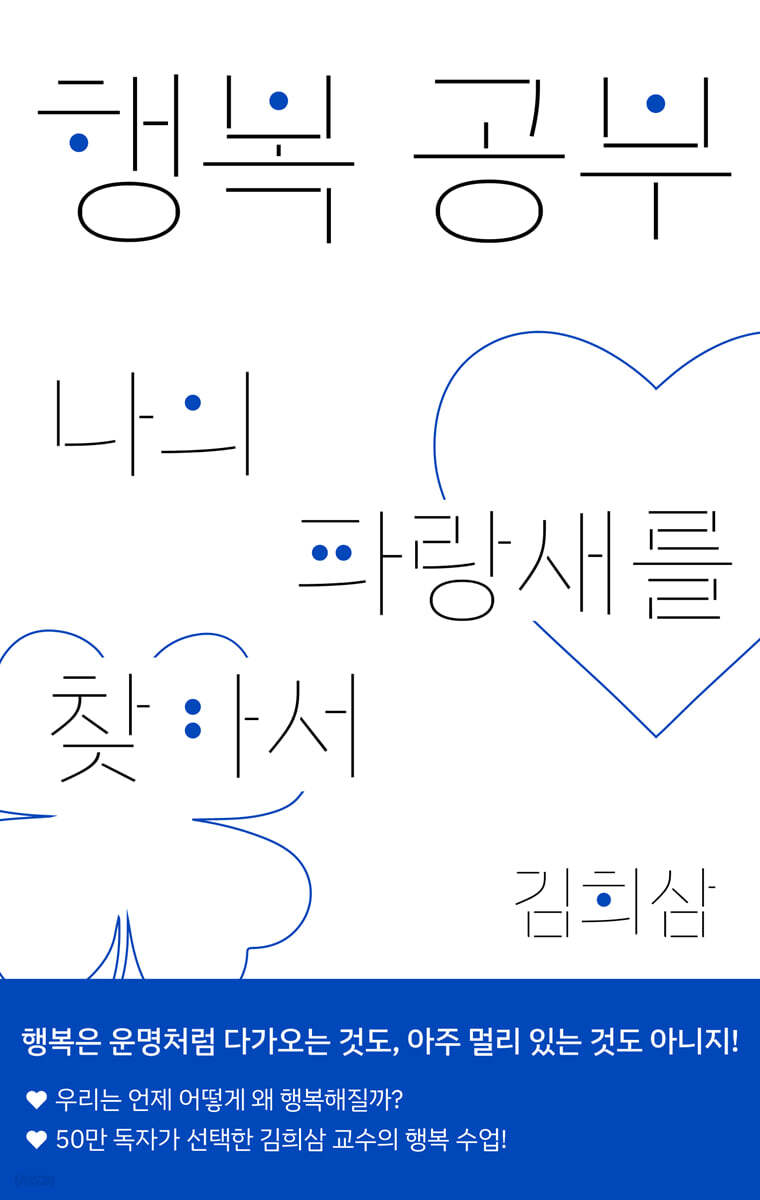
Everything about happiness! Professor Kim Hee-sam's Happiness Class, chosen by 500,000 readers The author, Professor Kim Hee-sam, is an economist who has studied happiness. The 'Happiness Class' he teaches at GIST (Gwangju Institute of Science and Technology) under the title 'Conditions of Happiness' has become so popular that it fills up within minutes of registration opening every semester. "Studying Happiness: Finding My Bluebird" has been published, compiling various studies and data from fields such as economics, psychology, cognitive science, sociology, and genetics related to happiness, and clearly organizing the message that "to become happy, you must understand and practice happiness." This book talks about how happiness is really important and that we need it just to survive. The method to become happy, and to become happy specifically, that an economist who values efficiency tells with simple stories is not only efficient but also accurate. |
- You can preview some of the book's contents.
Preview
index
prolog
Part 1: Preparing to Study Happiness
Chapter 1.
What is happiness?
― 'Warm Puppy'
Chapter 2.
How to measure happiness
― Happiness measured by the corners of the mouth
Chapter 3.
How happy do you think I am?
― My life curve
Part 2: Happiness Revealed by Science
Chapter 4.
The three major determinants of happiness
― The hamster wheel of punishment and pleasure
Chapter 5.
Genetic Lottery of Happiness
- My character strengths
Chapter 6.
Money and happiness
― Quotes about money
Part 3: Work and Happiness
Chapter 7.
Job preference and job satisfaction
―“I’m quitting today” - Decision utility and experiential utility
Chapter 8.
The meaning of work
- day
Chapter 9.
Choosing a career path
― The road not taken
Part 4: Human Relationships and Happiness
Chapter 10.
The Three Elements of Love and Happiness
― Shortest sentence, longest sentence
Chapter 11.
The secret to good human relationships
―The Power of Gratitude Visits
Chapter 12.
Moderately good parents, a happy family today too
― This is the kind of parent I want to be.
Part 5: I Increase My Happiness
Chapter 13.
Where am I these days
― Counseling Center
Chapter 14.
Even happiness is a habit
― Worry Management Center
Chapter 15.
Comparative Tendency and Happiness
― How to escape 'following others'
Chapter 16.
The Secret to Practicing Happiness
― Conditions for happy 'immersion'
Part 6: Growing Old Happily
Chapter 17.
Becoming a real adult
― Growth plates that don't close
Chapter 18.
The dance of life
― Death Questions
Epilogue
Americas
References
Part 1: Preparing to Study Happiness
Chapter 1.
What is happiness?
― 'Warm Puppy'
Chapter 2.
How to measure happiness
― Happiness measured by the corners of the mouth
Chapter 3.
How happy do you think I am?
― My life curve
Part 2: Happiness Revealed by Science
Chapter 4.
The three major determinants of happiness
― The hamster wheel of punishment and pleasure
Chapter 5.
Genetic Lottery of Happiness
- My character strengths
Chapter 6.
Money and happiness
― Quotes about money
Part 3: Work and Happiness
Chapter 7.
Job preference and job satisfaction
―“I’m quitting today” - Decision utility and experiential utility
Chapter 8.
The meaning of work
- day
Chapter 9.
Choosing a career path
― The road not taken
Part 4: Human Relationships and Happiness
Chapter 10.
The Three Elements of Love and Happiness
― Shortest sentence, longest sentence
Chapter 11.
The secret to good human relationships
―The Power of Gratitude Visits
Chapter 12.
Moderately good parents, a happy family today too
― This is the kind of parent I want to be.
Part 5: I Increase My Happiness
Chapter 13.
Where am I these days
― Counseling Center
Chapter 14.
Even happiness is a habit
― Worry Management Center
Chapter 15.
Comparative Tendency and Happiness
― How to escape 'following others'
Chapter 16.
The Secret to Practicing Happiness
― Conditions for happy 'immersion'
Part 6: Growing Old Happily
Chapter 17.
Becoming a real adult
― Growth plates that don't close
Chapter 18.
The dance of life
― Death Questions
Epilogue
Americas
References
Detailed image
Into the book
Good things are doubled when shared.
When you encounter different ideas, your thoughts become broader, and when you encounter similar ideas, your thoughts become deeper.
And it also helps you practice happiness.
This is especially true in practices related to human relationships, which have a significant impact on happiness.
--- p.64, Chapter 3.
From "How happy do you think I am?"
When something bad happens to people, they initially become pessimistic about their situation, but as they gradually adapt, they return to their original state.
While some people are inherently resilient, the constant emotional support and encouragement from those around them, including family, lovers, friends, and colleagues, also influences the speed and extent of recovery.
In this way, ‘relationships’ with people are important in many ways to happiness.
--- p.83, Chapter 4.
Among the “Three Major Determinants of Happiness”
Ed Diener, a psychologist who has studied happiness, said, “Happiness is determined not by the intensity of joy, but by the frequency of joy.” This is one of the conclusions he has reached through numerous psychological experiments.
Having too much money might increase the intensity of pleasure, such as buying a luxury yacht, but it can also cause you to lose many of the simple pleasures you enjoy in everyday life.
It's also important to remember that money doesn't just come in bulk.
Among the things you sacrifice to make more money are probably things that are important to your health, happiness, and life satisfaction, such as sleep, rest, exercise, regular meals, family, and friends.
The tipping point effect of income on happiness may also be due to the sacrifice of too many other elements of happiness in the pursuit of higher income.
--- p.121, Chapter 6.
From “Money and Happiness”
Also, the reason why love is important in human relationships is because it makes us recognize each other's existence.
My wife often tells me this.
“You don’t see me in your eyes.
“I see you in my eyes.” Every time he says that, his eyes are filled with wonder.
Love is recognizing someone's existence, respecting them for who they are, and making us understand them or try to understand them.
A being that existed but was not seen is now visible to my eyes.
--- p.203, Chapter 10.
From “The Three Elements of Love and Happiness”
Happy people don't have a lot of time or special abilities to take advantage of both present and future benefits.
Because they set their own goals and work hard towards them, they feel less pressure from comparing themselves to others or from the gaze of others.
Also, I don't miss out on the little pleasures and joys in everyday life.
--- p.258, Chapter 13.
From "Where am I these days"
Let's stop the habits that keep us away from happiness.
It might be difficult for someone who has been doing it out of habit, but still, bye bye.
To do that, you have to repeatedly think and act differently in similar situations than before.
So, I need to make new habits that will help me discover the happiness that is always close by.
Then your personality will change and your life will change.
--- p.283, Chapter 14.
From “Even happiness is a habit”
The ability to practice happiness is developed when you equip yourself with positive 'thoughts' based on 'knowledge' about happiness and consciously put them into 'action'.
The reason we need knowledge about happiness is to prevent us from thinking and acting in ways that are far from happiness.
As we saw in the previous section, ‘The Three Determinants of Happiness’, ‘voluntary action’ accounted for 40% of the determinants of sustained happiness.
When you encounter different ideas, your thoughts become broader, and when you encounter similar ideas, your thoughts become deeper.
And it also helps you practice happiness.
This is especially true in practices related to human relationships, which have a significant impact on happiness.
--- p.64, Chapter 3.
From "How happy do you think I am?"
When something bad happens to people, they initially become pessimistic about their situation, but as they gradually adapt, they return to their original state.
While some people are inherently resilient, the constant emotional support and encouragement from those around them, including family, lovers, friends, and colleagues, also influences the speed and extent of recovery.
In this way, ‘relationships’ with people are important in many ways to happiness.
--- p.83, Chapter 4.
Among the “Three Major Determinants of Happiness”
Ed Diener, a psychologist who has studied happiness, said, “Happiness is determined not by the intensity of joy, but by the frequency of joy.” This is one of the conclusions he has reached through numerous psychological experiments.
Having too much money might increase the intensity of pleasure, such as buying a luxury yacht, but it can also cause you to lose many of the simple pleasures you enjoy in everyday life.
It's also important to remember that money doesn't just come in bulk.
Among the things you sacrifice to make more money are probably things that are important to your health, happiness, and life satisfaction, such as sleep, rest, exercise, regular meals, family, and friends.
The tipping point effect of income on happiness may also be due to the sacrifice of too many other elements of happiness in the pursuit of higher income.
--- p.121, Chapter 6.
From “Money and Happiness”
Also, the reason why love is important in human relationships is because it makes us recognize each other's existence.
My wife often tells me this.
“You don’t see me in your eyes.
“I see you in my eyes.” Every time he says that, his eyes are filled with wonder.
Love is recognizing someone's existence, respecting them for who they are, and making us understand them or try to understand them.
A being that existed but was not seen is now visible to my eyes.
--- p.203, Chapter 10.
From “The Three Elements of Love and Happiness”
Happy people don't have a lot of time or special abilities to take advantage of both present and future benefits.
Because they set their own goals and work hard towards them, they feel less pressure from comparing themselves to others or from the gaze of others.
Also, I don't miss out on the little pleasures and joys in everyday life.
--- p.258, Chapter 13.
From "Where am I these days"
Let's stop the habits that keep us away from happiness.
It might be difficult for someone who has been doing it out of habit, but still, bye bye.
To do that, you have to repeatedly think and act differently in similar situations than before.
So, I need to make new habits that will help me discover the happiness that is always close by.
Then your personality will change and your life will change.
--- p.283, Chapter 14.
From “Even happiness is a habit”
The ability to practice happiness is developed when you equip yourself with positive 'thoughts' based on 'knowledge' about happiness and consciously put them into 'action'.
The reason we need knowledge about happiness is to prevent us from thinking and acting in ways that are far from happiness.
As we saw in the previous section, ‘The Three Determinants of Happiness’, ‘voluntary action’ accounted for 40% of the determinants of sustained happiness.
--- p.311, Chapter 16.
From “The Secret to Practicing Happiness”
From “The Secret to Practicing Happiness”
Publisher's Review
Guided by an economist
About precise and specific happiness
The author, Professor Kim Hee-sam, is an economist who has studied happiness.
The 'Happiness Class' he teaches at GIST (Gwangju Institute of Science and Technology) under the title 'Conditions of Happiness' has become so popular that it fills up within minutes of registration opening every semester.
"Studying Happiness" has been published, compiling research and various data from fields such as economics, psychology, cognitive science, sociology, and genetics related to happiness, and clearly organizing the message that "to become happy, one must understand and practice happiness."
How often do you think about "happiness"? How do you define it? Does the word "happiness" sound sentimental? Is happiness, to you, a goal to strive for, or a feeling you experience moment by moment? No matter how you answer these questions, no one can avoid "happiness."
When we are unhappy, we feel unhappy and try to move in a direction that will make us happy.
Perhaps happiness is our ultimate goal, because no one wants to remain in a state of unhappiness, like the pit of despair or the shackles of depression.
If you find yourself resisting this, comparing happiness to other values that you consider important will help you see which is a means and which is a higher-order value (for example, ask yourself whether you want to be happy in order to make a lot of money, or whether you want to make a lot of money in order to be happy).
So then, what exactly is happiness? Isn't it necessary to be happy?
This book says that happiness is really important and that happiness is necessary just to survive.
Humans are creatures who give up on life when their happiness is worn out and unhappiness takes its place.
In extreme situations where survival is threatened, survival may be the only purpose of life, but in the midst of ordinary, repetitive days, we hope to reach a state of comfort and satisfaction.
So how can we become happy? Or rather, what exactly is happiness? An economist who values efficiency offers simple, practical tips for achieving happiness. These tips, along with simple anecdotes, are not only efficient but also accurate.
How to become happy
Practicing how to become happy!
Despite the simple and clear proposition that “the way to cross a river is to cross the river” (p. 320), ironically, while we desperately desire happiness, we wait for it to come to us someday, for happiness to come to us like fate.
But to be happy, you must first know what happiness is, and then it is helpful to know how to become happy.
And most importantly, you must put the knowledge you have gained into practice.
《Study of Happiness》 is composed of six parts.
It provides useful information related to happiness, from personality and habits, money, work (career path), and human relationships (love, friendship, family) to life and death.
As you examine the research and experimental results and meaningful statistical data accumulated over many years, you will experience how the new facts you learn through this "Encyclopedia of Happiness" become closely related to your life and naturally bring about changes in your daily life.
Psychological research suggests that lasting happiness is influenced 50 percent by genes, 10 percent by environment, and 40 percent by voluntary actions.
The happiness we pursue is measurable and more concrete than we think.
"Studying Happiness" fills readers' backpacks with strength, allowing them to say goodbye to the days of sitting under a persimmon tree, waiting for the persimmons to fall, and embark on a journey toward happiness on their own.
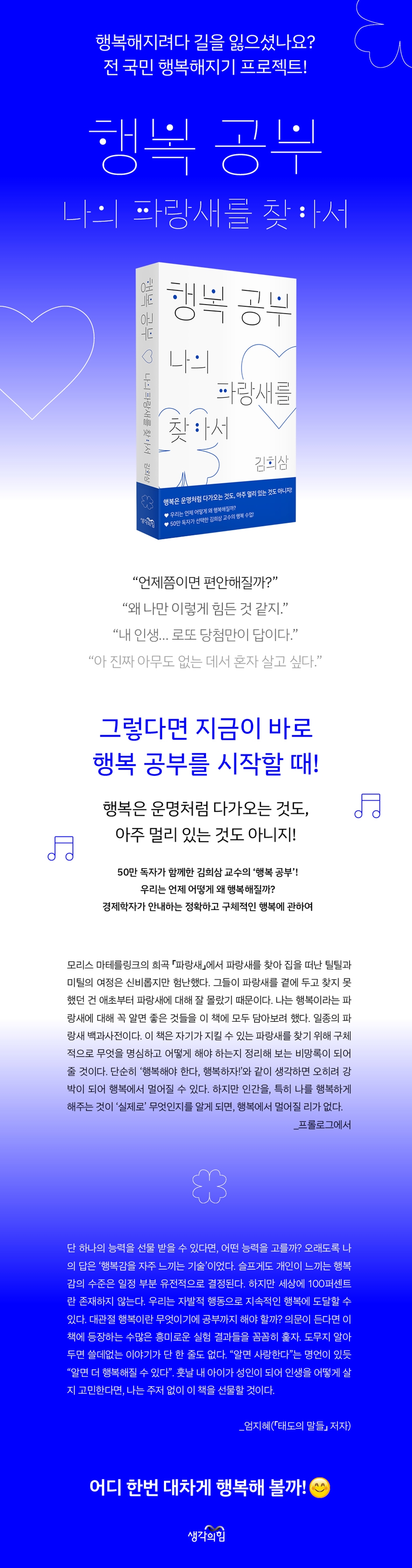
In Maurice Maeterlinck's play The Blue Bird, Tyltyl and Mytyl's journey to find the blue bird is mysterious but arduous.
The reason they couldn't find the bluebird while it was still there was because they didn't know much about bluebirds in the first place.
I tried to put everything you need to know about the bluebird of happiness into this book.
It's a kind of bluebird encyclopedia.
This book will serve as a memoir that outlines what to keep in mind and how to do it in order to find the bluebird you can protect.
If you simply think, 'I must be happy, let's be happy!', it can become an obsession and take you away from happiness.
But once I know what 'really' makes people, especially me, happy, I can't get away from it.
_From the prologue
About precise and specific happiness
The author, Professor Kim Hee-sam, is an economist who has studied happiness.
The 'Happiness Class' he teaches at GIST (Gwangju Institute of Science and Technology) under the title 'Conditions of Happiness' has become so popular that it fills up within minutes of registration opening every semester.
"Studying Happiness" has been published, compiling research and various data from fields such as economics, psychology, cognitive science, sociology, and genetics related to happiness, and clearly organizing the message that "to become happy, one must understand and practice happiness."
How often do you think about "happiness"? How do you define it? Does the word "happiness" sound sentimental? Is happiness, to you, a goal to strive for, or a feeling you experience moment by moment? No matter how you answer these questions, no one can avoid "happiness."
When we are unhappy, we feel unhappy and try to move in a direction that will make us happy.
Perhaps happiness is our ultimate goal, because no one wants to remain in a state of unhappiness, like the pit of despair or the shackles of depression.
If you find yourself resisting this, comparing happiness to other values that you consider important will help you see which is a means and which is a higher-order value (for example, ask yourself whether you want to be happy in order to make a lot of money, or whether you want to make a lot of money in order to be happy).
So then, what exactly is happiness? Isn't it necessary to be happy?
This book says that happiness is really important and that happiness is necessary just to survive.
Humans are creatures who give up on life when their happiness is worn out and unhappiness takes its place.
In extreme situations where survival is threatened, survival may be the only purpose of life, but in the midst of ordinary, repetitive days, we hope to reach a state of comfort and satisfaction.
So how can we become happy? Or rather, what exactly is happiness? An economist who values efficiency offers simple, practical tips for achieving happiness. These tips, along with simple anecdotes, are not only efficient but also accurate.
How to become happy
Practicing how to become happy!
Despite the simple and clear proposition that “the way to cross a river is to cross the river” (p. 320), ironically, while we desperately desire happiness, we wait for it to come to us someday, for happiness to come to us like fate.
But to be happy, you must first know what happiness is, and then it is helpful to know how to become happy.
And most importantly, you must put the knowledge you have gained into practice.
《Study of Happiness》 is composed of six parts.
It provides useful information related to happiness, from personality and habits, money, work (career path), and human relationships (love, friendship, family) to life and death.
As you examine the research and experimental results and meaningful statistical data accumulated over many years, you will experience how the new facts you learn through this "Encyclopedia of Happiness" become closely related to your life and naturally bring about changes in your daily life.
Psychological research suggests that lasting happiness is influenced 50 percent by genes, 10 percent by environment, and 40 percent by voluntary actions.
The happiness we pursue is measurable and more concrete than we think.
"Studying Happiness" fills readers' backpacks with strength, allowing them to say goodbye to the days of sitting under a persimmon tree, waiting for the persimmons to fall, and embark on a journey toward happiness on their own.
In Maurice Maeterlinck's play The Blue Bird, Tyltyl and Mytyl's journey to find the blue bird is mysterious but arduous.
The reason they couldn't find the bluebird while it was still there was because they didn't know much about bluebirds in the first place.
I tried to put everything you need to know about the bluebird of happiness into this book.
It's a kind of bluebird encyclopedia.
This book will serve as a memoir that outlines what to keep in mind and how to do it in order to find the bluebird you can protect.
If you simply think, 'I must be happy, let's be happy!', it can become an obsession and take you away from happiness.
But once I know what 'really' makes people, especially me, happy, I can't get away from it.
_From the prologue
GOODS SPECIFICS
- Date of issue: September 10, 2023
- Page count, weight, size: 384 pages | 450g | 130*205*23mm
- ISBN13: 9791193166192
- ISBN10: 1193166195
You may also like
카테고리
korean


korean

![ELLE 엘르 스페셜 에디션 A형 : 12월 [2025]](http://librairie.coreenne.fr/cdn/shop/files/b8e27a3de6c9538896439686c6b0e8fb.jpg?v=1766436872&width=3840)


