

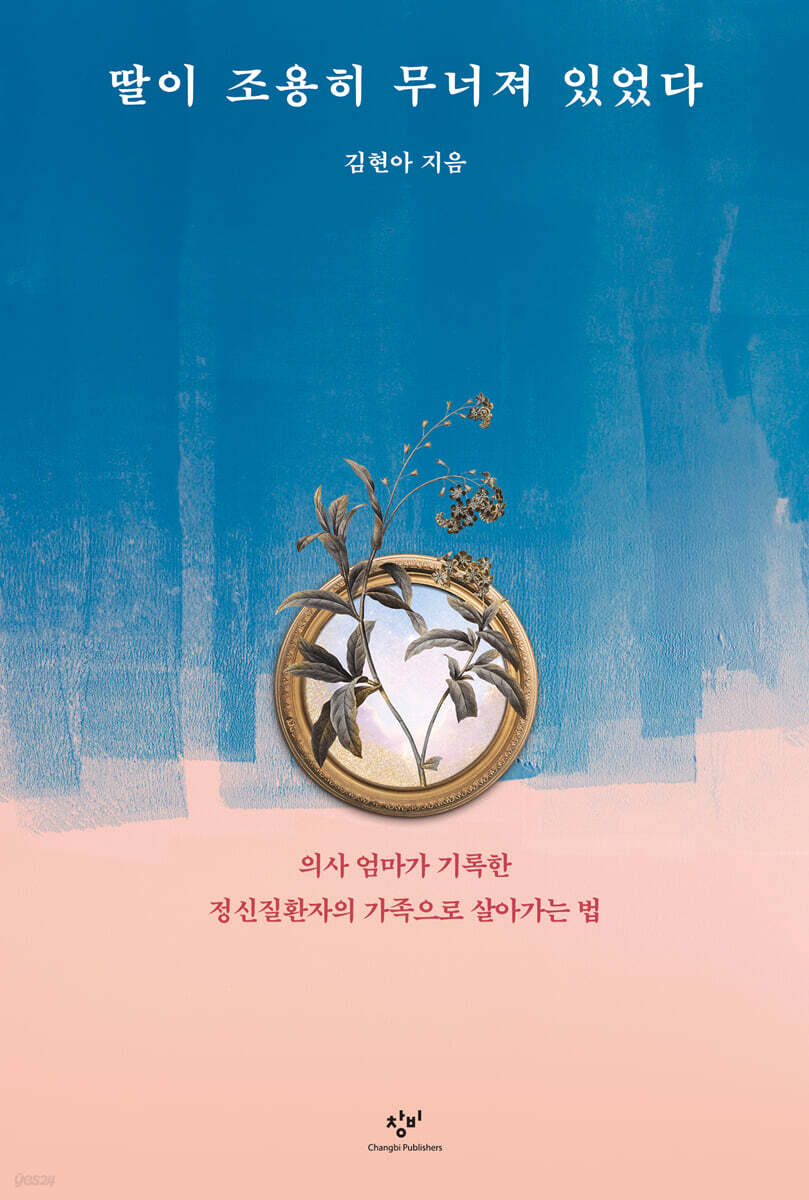
My daughter was quietly collapsing.
 |
Description
Book Introduction
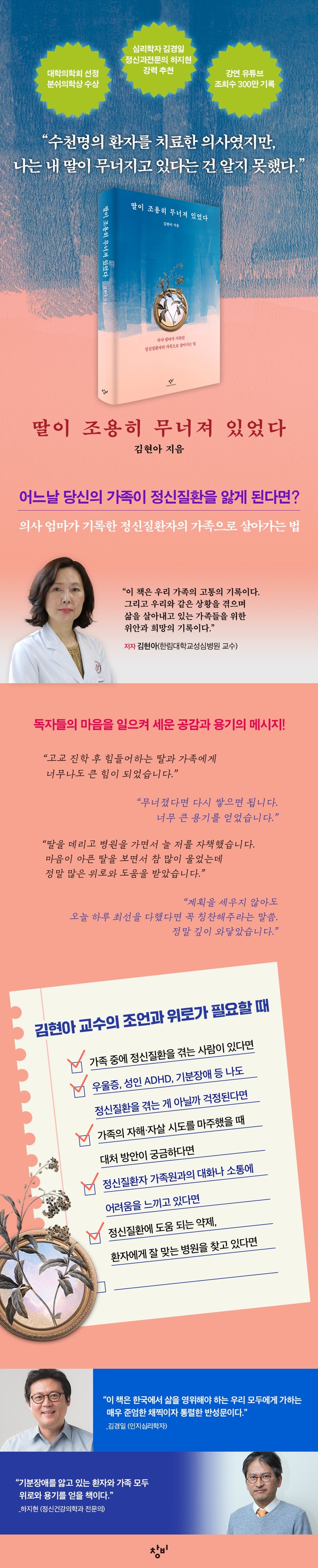
If your family member develops a mental illness One day, my dazzling daughter was diagnosed with bipolar disorder. Experienced comfort and vivid advice from a medical scientist who won the Bunsch Medical Award. What would you do if one day you discovered your family had attempted suicide? The author (Hyun-ah Kim, Rheumatologist, Hallym University Sacred Heart Hospital), a university hospital physician and author of books like "Learning to Die," has been actively researching and writing. She was confronted with the shocking truth that her daughter, whom she believed to be a cheerful and harmonious child growing up, had secretly been self-harming and suffering from bipolar disorder. "My Daughter Quietly Broke Down" is a record of the author's breathless journey as a mother and doctor caring for her mentally ill daughter and trying to live together as a family. I calmly reminisce about the past seven years of my struggle with mental illness, which I have endured with my daughter, as if I were swimming in the night sea where I could not see even an inch ahead, and offer empathy and comfort to those with mental illness, their families, and all those struggling with mental issues. In addition, by introducing numerous studies and records that were compiled to understand the daughter's pain, it broadens the social and scientific understanding of mental illness, and contains vivid advice based on actual experiences as a patient's family member, such as how to communicate with a family member suffering from mental illness, how to respond when faced with self-harm or suicide attempts, and what to keep in mind when choosing a hospital. I highly recommend this book to anyone with emotionally unstable family members, as well as anyone who wants to broaden their understanding of mental illness. |
- You can preview some of the book's contents.
Preview
index
The world falls apart as the book begins
First year with wife and optimism
Vincent / Nobody knew / Please save my child / Mental hospital / When I went to the ward / What kind of illness is it? / Is my child like this?
Second year dark clouds
Screams and Gunshots / What Did I Do to Get This Ill? / How Can I Stay Crazy? / The Massacre of Women Born in the 90s / Did the Stork Bring Me This? / A Wise Life After Hospital Discharge
Third year of life evaporation
Diseases of the Goddesses / The Mysterious and Mysterious Story of the Brain / One Way to Understand the Brain: Geography / Another Way to Understand the Brain: The Chemicals That Make Up the Mind / Why We Don't Know About Mental Illness / Brain Functions Taught by Sick People / Back to the Ward
Stormy night sea in the fourth year
Geniuses / Stormy Night Sea / The Worst Thing That Can Happen: Let's Talk About Suicide / The Right to Choose When to Say Goodbye to the World / I Don't Want to Die, But I Want to Harm Myself / Addiction or Treatment?
Fifth year: hug the bottle with all your might
Great Wounded Souls / Back Under My Roof / What Family Can Do / The Worst Things That Can Happen to Your Family / 30,000 Miles to the Hospital / How Should I Say It? / Is That Medicine Right for Me? / Borderline / To Make Life a Little Easier: Understanding the Many Symptoms / Please Give Me Electroshock Therapy
Sixth year back to life
Did the Great Man Have a Sickness? / Long Live Independence Again! / What I Gained from My Child's Illness / A Parent's Survival Guide
We All Have Mental Illness: A Neurodiversity-Based Worldview
I can't help you / The history of isolation, the history of cruelty / Psychiatry is ridiculous / There's no money to give you - you should just die / I want to live, I want to work / Why was Chris Rock smiling when he got slapped? / We are all mentally ill / Shameless, so shameless: A society that mass-produces mental illness
Conclusion
First year with wife and optimism
Vincent / Nobody knew / Please save my child / Mental hospital / When I went to the ward / What kind of illness is it? / Is my child like this?
Second year dark clouds
Screams and Gunshots / What Did I Do to Get This Ill? / How Can I Stay Crazy? / The Massacre of Women Born in the 90s / Did the Stork Bring Me This? / A Wise Life After Hospital Discharge
Third year of life evaporation
Diseases of the Goddesses / The Mysterious and Mysterious Story of the Brain / One Way to Understand the Brain: Geography / Another Way to Understand the Brain: The Chemicals That Make Up the Mind / Why We Don't Know About Mental Illness / Brain Functions Taught by Sick People / Back to the Ward
Stormy night sea in the fourth year
Geniuses / Stormy Night Sea / The Worst Thing That Can Happen: Let's Talk About Suicide / The Right to Choose When to Say Goodbye to the World / I Don't Want to Die, But I Want to Harm Myself / Addiction or Treatment?
Fifth year: hug the bottle with all your might
Great Wounded Souls / Back Under My Roof / What Family Can Do / The Worst Things That Can Happen to Your Family / 30,000 Miles to the Hospital / How Should I Say It? / Is That Medicine Right for Me? / Borderline / To Make Life a Little Easier: Understanding the Many Symptoms / Please Give Me Electroshock Therapy
Sixth year back to life
Did the Great Man Have a Sickness? / Long Live Independence Again! / What I Gained from My Child's Illness / A Parent's Survival Guide
We All Have Mental Illness: A Neurodiversity-Based Worldview
I can't help you / The history of isolation, the history of cruelty / Psychiatry is ridiculous / There's no money to give you - you should just die / I want to live, I want to work / Why was Chris Rock smiling when he got slapped? / We are all mentally ill / Shameless, so shameless: A society that mass-produces mental illness
Conclusion
Detailed image
Publisher's Review
My daughter's mental illness was confusing even to her doctor mother.
How to Live as a Family Member of a Mentally Ill Person: 7 Years of Experience and Know-How
The world has fallen apart.
The moment the author witnesses the countless knife marks on the wrists of his daughter, whom he believed had grown up with an abundance of love from her entire family, the world he had lived in is completely turned upside down.
After rushing to the psychiatric department and receiving counseling and examination, the diagnosis was bipolar disorder, commonly known as 'manic depression'.
It is a severe mental illness in which mania, which is characterized by excessive emotional excitement and heightened feelings, manifests as irritability, delusions, impulsivity, and excitement, and depression, which is characterized by anxiety, lethargy, despair, and pessimism. More than 25% of patients attempt suicide at least once in their lifetime, and the suicide rate of untreated patients is up to 30 times higher than that of the non-diseased.
The author does everything he can to save his daughter, including searching for the best hospital for her, admitting her to an intensive care unit, trying various treatments including medication and electroconvulsive therapy, and applying for disability registration so she can receive public assistance.
By personally researching and studying various research and statistical data and literature, I learned about the functions and operation of the brain, the organ that causes mental illness, and by checking the ingredients of the medications that patients take one by one and testing their effectiveness, I gained knowledge and experience related to mental illness every day.
After seven years of trying to understand what was going on in her daughter's head, the author decided to share her family's personal and painful experience publicly because, even with relatively easy access to medical expertise, coping with mental illness in her family was so difficult. She was struck by how hopelessly and profoundly different the situation must be for other families of mentally ill people.
We share the wealth of know-how we have gained through firsthand experience, including how to talk to family members who are suffering from mental illness, how to respond when witnessing a patient's self-harm or suicide attempt, what to consider when finding the right hospital and doctor, medications and treatments that have been effective for specific symptoms, life commandments to keep in mind as a family member who must make a living while caring for a patient, and a list of books that will help you understand mental illness.
Self-harm and suicide attempts are skyrocketing among people in their teens and twenties.
Mental illness still hidden by social stigma
Mental illness is considered a very high risk factor for suicide and self-harm attempts if not diagnosed and treated early.
The author identifies adolescents and women in their 20s as age groups particularly vulnerable to mental illness.
In the first half of 2020, when depression among women in their 20s surged amid the COVID-19 pandemic, the number of suicide deaths among women in their 20s increased by 43 percent compared to the previous year.
Emergency room visits by adolescents due to suicide and self-harm attempts also more than doubled between 2016 and 2020.
Despite the reality that patients are suffering from life-or-death agony, the problem of mental illness is not properly visible in Korea.
For example, in the United States, the prevalence of bipolar disorder is reported to be 1 to 2 percent on average, and 6.4 percent when the diagnostic range is expanded.
However, in our country, the prevalence of bipolar disorder was only 0.2 percent as of 2017.
This is a very low reported incidence compared to the prevalence in the United States, which means that there are many patients who are hidden and undiagnosed.
This stems from the immature attitude of our society, which still responds to mental illness issues with ignorance, stigma, and concealment.
When an incident occurs involving a person with mental illness, the objective fact that “the rate of criminals among those with severe mental illness (1.2%) is much lower than the rate of criminals among the general population (3.1%)” is ignored, and politicians continue to make absurd remarks day after day, saying that “patients with mental illness must be isolated immediately.”
They do not even attempt to address the fundamental issues, such as a competitive order that values only performance, the social stigma and prejudice that isolates people with mental illness and their families, and a system that fails to keep up with the reality of frontline medical care. Instead, they simply repeat the pre-modern idea that if a problem is not visible, it does not exist.
The author, through personally collected case studies, expert research, and statistical data from across the East and the West to understand the illness his daughter suffers from, clearly demonstrates that mental illness is an ordinary thing that has always accompanied us, but if left untreated and untreated, it can be a fatal threat to the patient's life and the peace of their family at any time.
Furthermore, we urge our society to stop being so eager to hide or conceal mental illness, but to face the potential problem head-on, raise it as a major social agenda, and engage in urgent discussion.
A society that mass-produces mental illness
In fact, we are all mentally ill.
The author emphasizes that mental illness and 'normality' cannot be clearly distinguished from the beginning, and that, in fact, the field of psychiatry has expanded the discussion to include the various layers and aspects of illness by giving the term 'spectrum' to the name of the illness.
Mental illnesses are diagnosed differently by different doctors even for the same patient, and diagnoses can change over time. There are many unknown areas that cannot be explained by modern medicine, such as the simultaneous manifestation of multiple illnesses and only some of them becoming latent.
Symptoms may be mild and do not interfere with daily life, or may even lead to more functional outcomes.
Recently, a neurodiversity movement has emerged that opposes the view that only certain ways of thinking, learning, and behaving are correct and that anything else is considered a disability.
The author points out that socially concealing mental illness, thereby isolating patients and forcing them into maladjustment and despair, will only worsen the problem at hand.
It is emphasized that we must acknowledge that anyone can experience mental health problems at any time, and that we must make mental illness visible so that patients can break free from the shackles of stigma and prejudice, actively discuss their illness and receive counseling from the early stages of their illness, and accept it as a natural part of life.
The author proposes that the first step toward change be to reframe the perception of “mental illness” as “brain disease.”
In fact, mental illness is caused by abnormalities in the circuitry between nerve cells in the brain.
The purpose is to avoid fostering the prejudice that the brain is a matter of will or determination, unlike other physical illnesses, as it is also a part of the body.
We suggest using the word "sick" instead of "crazy" and replacing vague and negative labels like "personality/personality disorder" with diagnostic labels.
Of course, the deep-rooted stigma won't disappear right away, but it will definitely help you understand the patient.
Big changes are always difficult.
But just as water drops gather to form a river that breaks through a rock, small changes can make the seemingly impossible possible.
This book will serve as a clear milestone on the path toward a world where both those suffering from mental illness and their families can embrace life with positivity and love.
How to Live as a Family Member of a Mentally Ill Person: 7 Years of Experience and Know-How
The world has fallen apart.
The moment the author witnesses the countless knife marks on the wrists of his daughter, whom he believed had grown up with an abundance of love from her entire family, the world he had lived in is completely turned upside down.
After rushing to the psychiatric department and receiving counseling and examination, the diagnosis was bipolar disorder, commonly known as 'manic depression'.
It is a severe mental illness in which mania, which is characterized by excessive emotional excitement and heightened feelings, manifests as irritability, delusions, impulsivity, and excitement, and depression, which is characterized by anxiety, lethargy, despair, and pessimism. More than 25% of patients attempt suicide at least once in their lifetime, and the suicide rate of untreated patients is up to 30 times higher than that of the non-diseased.
The author does everything he can to save his daughter, including searching for the best hospital for her, admitting her to an intensive care unit, trying various treatments including medication and electroconvulsive therapy, and applying for disability registration so she can receive public assistance.
By personally researching and studying various research and statistical data and literature, I learned about the functions and operation of the brain, the organ that causes mental illness, and by checking the ingredients of the medications that patients take one by one and testing their effectiveness, I gained knowledge and experience related to mental illness every day.
After seven years of trying to understand what was going on in her daughter's head, the author decided to share her family's personal and painful experience publicly because, even with relatively easy access to medical expertise, coping with mental illness in her family was so difficult. She was struck by how hopelessly and profoundly different the situation must be for other families of mentally ill people.
We share the wealth of know-how we have gained through firsthand experience, including how to talk to family members who are suffering from mental illness, how to respond when witnessing a patient's self-harm or suicide attempt, what to consider when finding the right hospital and doctor, medications and treatments that have been effective for specific symptoms, life commandments to keep in mind as a family member who must make a living while caring for a patient, and a list of books that will help you understand mental illness.
Self-harm and suicide attempts are skyrocketing among people in their teens and twenties.
Mental illness still hidden by social stigma
Mental illness is considered a very high risk factor for suicide and self-harm attempts if not diagnosed and treated early.
The author identifies adolescents and women in their 20s as age groups particularly vulnerable to mental illness.
In the first half of 2020, when depression among women in their 20s surged amid the COVID-19 pandemic, the number of suicide deaths among women in their 20s increased by 43 percent compared to the previous year.
Emergency room visits by adolescents due to suicide and self-harm attempts also more than doubled between 2016 and 2020.
Despite the reality that patients are suffering from life-or-death agony, the problem of mental illness is not properly visible in Korea.
For example, in the United States, the prevalence of bipolar disorder is reported to be 1 to 2 percent on average, and 6.4 percent when the diagnostic range is expanded.
However, in our country, the prevalence of bipolar disorder was only 0.2 percent as of 2017.
This is a very low reported incidence compared to the prevalence in the United States, which means that there are many patients who are hidden and undiagnosed.
This stems from the immature attitude of our society, which still responds to mental illness issues with ignorance, stigma, and concealment.
When an incident occurs involving a person with mental illness, the objective fact that “the rate of criminals among those with severe mental illness (1.2%) is much lower than the rate of criminals among the general population (3.1%)” is ignored, and politicians continue to make absurd remarks day after day, saying that “patients with mental illness must be isolated immediately.”
They do not even attempt to address the fundamental issues, such as a competitive order that values only performance, the social stigma and prejudice that isolates people with mental illness and their families, and a system that fails to keep up with the reality of frontline medical care. Instead, they simply repeat the pre-modern idea that if a problem is not visible, it does not exist.
The author, through personally collected case studies, expert research, and statistical data from across the East and the West to understand the illness his daughter suffers from, clearly demonstrates that mental illness is an ordinary thing that has always accompanied us, but if left untreated and untreated, it can be a fatal threat to the patient's life and the peace of their family at any time.
Furthermore, we urge our society to stop being so eager to hide or conceal mental illness, but to face the potential problem head-on, raise it as a major social agenda, and engage in urgent discussion.
A society that mass-produces mental illness
In fact, we are all mentally ill.
The author emphasizes that mental illness and 'normality' cannot be clearly distinguished from the beginning, and that, in fact, the field of psychiatry has expanded the discussion to include the various layers and aspects of illness by giving the term 'spectrum' to the name of the illness.
Mental illnesses are diagnosed differently by different doctors even for the same patient, and diagnoses can change over time. There are many unknown areas that cannot be explained by modern medicine, such as the simultaneous manifestation of multiple illnesses and only some of them becoming latent.
Symptoms may be mild and do not interfere with daily life, or may even lead to more functional outcomes.
Recently, a neurodiversity movement has emerged that opposes the view that only certain ways of thinking, learning, and behaving are correct and that anything else is considered a disability.
The author points out that socially concealing mental illness, thereby isolating patients and forcing them into maladjustment and despair, will only worsen the problem at hand.
It is emphasized that we must acknowledge that anyone can experience mental health problems at any time, and that we must make mental illness visible so that patients can break free from the shackles of stigma and prejudice, actively discuss their illness and receive counseling from the early stages of their illness, and accept it as a natural part of life.
The author proposes that the first step toward change be to reframe the perception of “mental illness” as “brain disease.”
In fact, mental illness is caused by abnormalities in the circuitry between nerve cells in the brain.
The purpose is to avoid fostering the prejudice that the brain is a matter of will or determination, unlike other physical illnesses, as it is also a part of the body.
We suggest using the word "sick" instead of "crazy" and replacing vague and negative labels like "personality/personality disorder" with diagnostic labels.
Of course, the deep-rooted stigma won't disappear right away, but it will definitely help you understand the patient.
Big changes are always difficult.
But just as water drops gather to form a river that breaks through a rock, small changes can make the seemingly impossible possible.
This book will serve as a clear milestone on the path toward a world where both those suffering from mental illness and their families can embrace life with positivity and love.
GOODS SPECIFICS
- Date of issue: September 1, 2023
- Page count, weight, size: 304 pages | 420g | 135*200*18mm
- ISBN13: 9788936479411
- ISBN10: 8936479415
You may also like
카테고리
korean


korean

![GQ KOREA Mark (Monthly): December [2025]](http://librairie.coreenne.fr/cdn/shop/files/8ef265dbbfbf186523ed75ba7319009d.jpg?v=1765340328&width=3840)


