

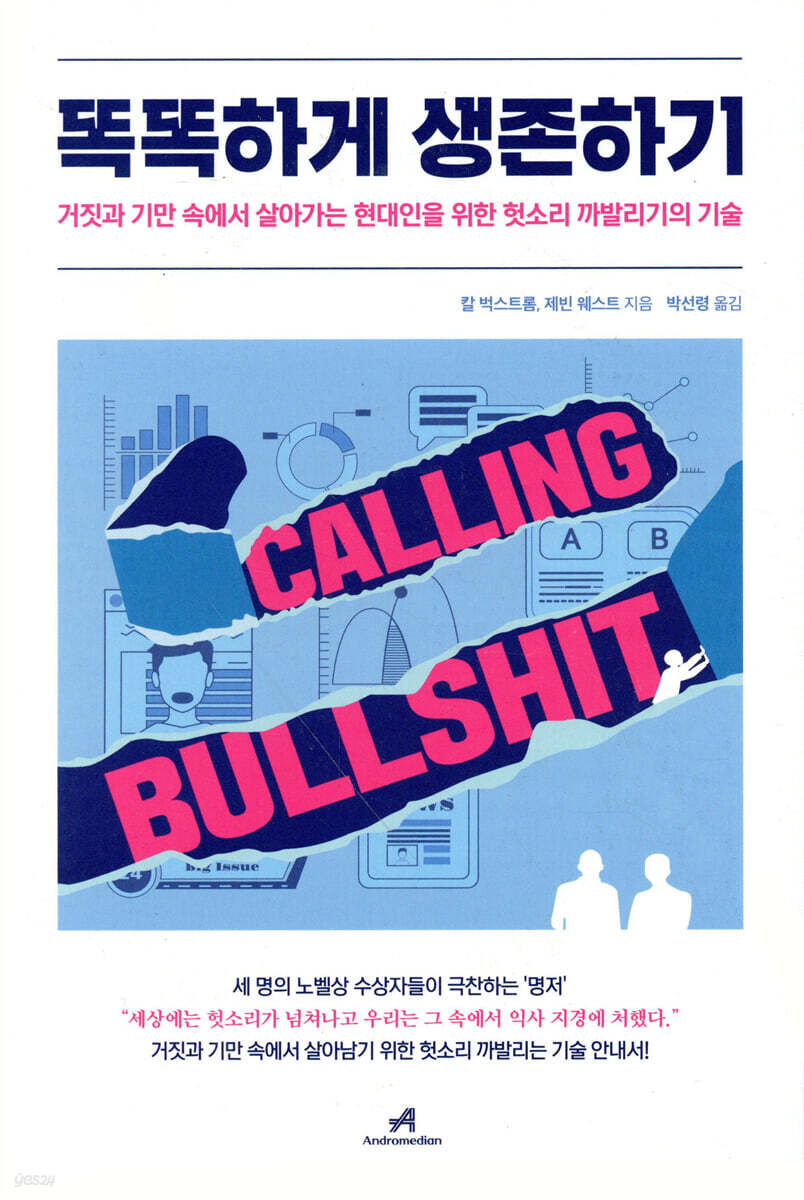
Survive smartly
 |
Description
Book Introduction
There is so much noise in the world today! The art of debunking nonsense for modern people living in lies and deception! The book begins with these words: “The world is full of nonsense and we are drowning in it.” We live in an age where there is so much noise. University of Washington Department of Biology Carl T. Berkstrom and Professor Jevin D. of the Graduate School of Information Through his class, "Bullshit Exposure," West has taught many students how to think and judge accurately without being swayed by bullshit. Thanks to today's dazzlingly developed information and communication technology, accessibility to information has increased dramatically, and the amount of information exchanged has increased dramatically. As a result, information overload has become severe along with the flood of information. The burden has become even greater because the amount of nonsense we have to filter out has also increased among the overwhelming amount of information. Clearly, technology has brought us many benefits, and we are living our lives enjoying those benefits. There is just more and more nonsense everywhere, and it is developing. To address the personal, political, and social problems that arise from this nonsense, individuals need to learn the art of "bullying." This book provides a method for understanding the nature of the overflowing nonsense and developing a mindset that can properly criticize it. The logical, simple, and clear techniques presented by the two authors in this book are easy for anyone to learn. Even people who don't know much about statistics! |
- You can preview some of the book's contents.
Preview
index
introduction
Chapter 1.
Nonsense all over the place
Chapter 2.
Media, Messages, and Misinformation
Chapter 3.
The essence of nonsense
Chapter 4.
causality
Chapter 5.
Numbers and bullshit
Chapter 6.
selection bias
Chapter 7.
Data visualization
Chapter 8.
Debunking the Nonsense in Big Data
Chapter 9.
Sensitivity of Science
Chapter 10.
Spotting nonsense
Chapter 11.
Refuting nonsense
Acknowledgements
References
Chapter 1.
Nonsense all over the place
Chapter 2.
Media, Messages, and Misinformation
Chapter 3.
The essence of nonsense
Chapter 4.
causality
Chapter 5.
Numbers and bullshit
Chapter 6.
selection bias
Chapter 7.
Data visualization
Chapter 8.
Debunking the Nonsense in Big Data
Chapter 9.
Sensitivity of Science
Chapter 10.
Spotting nonsense
Chapter 11.
Refuting nonsense
Acknowledgements
References
Detailed image
Publisher's Review
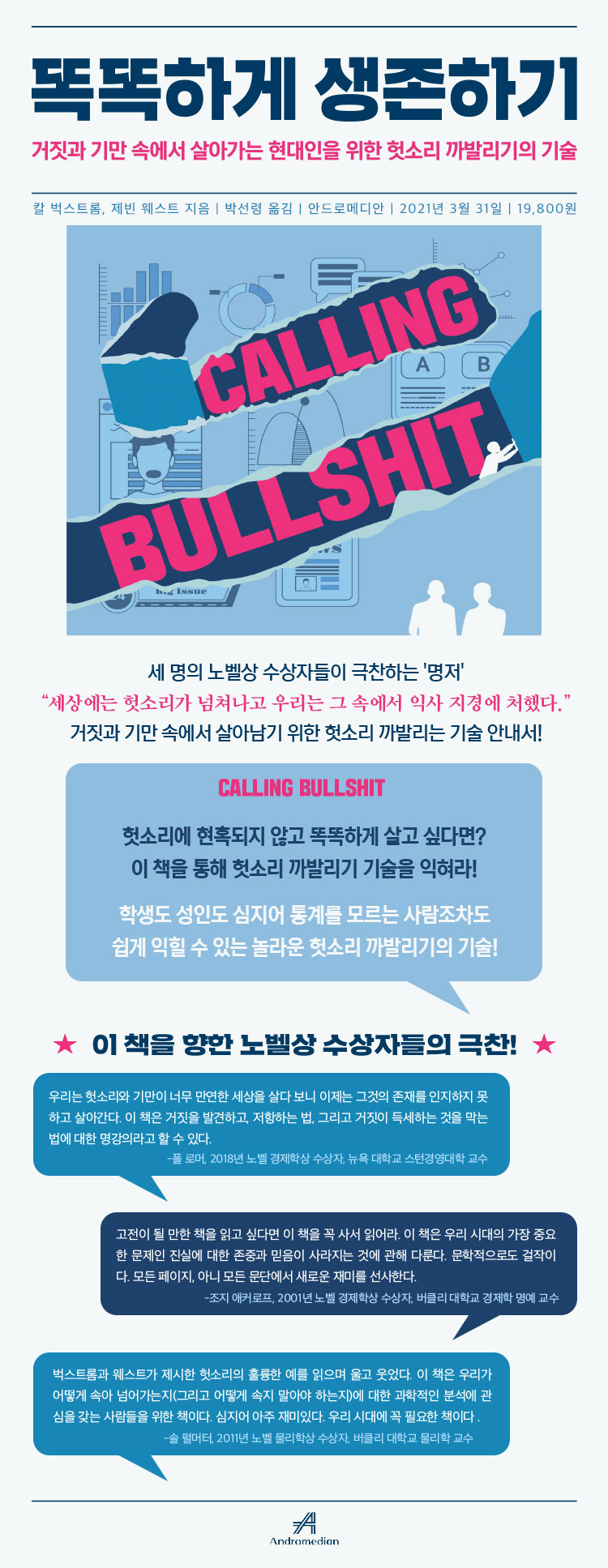
Nobel laureates Saul Perlmutter, George Akerlof, and Paul Romer
A book highly praised by Jordan Ellenberg, author of "How to Not Be Wrong"!
Politicians are not bound by facts.
Science is done through press releases.
Silicon Valley startups have elevated nonsense to an art form.
The world is becoming more and more complex and nonsense is increasing.
Even if you don't know statistics well or are not good at mathematical thinking,
A must-read if you want to know how to detect and avoid bullshit!
There is so much nonsense in the world.
In the information age, fake news and biased information are spreading more easily, and we have become accustomed to having easy access to such distorted information.
In today's world, there is so much noise that it is difficult to hear signals properly.
This means that even if the alarm sounds, we may not hear it and could be in danger.
In this day and age, people make wrong decisions because of the nonsense that is all over the world, and eventually end up in big trouble.
How can we survive smartly in this world?
University of Washington professors Carl Bergstrom and Jevin West teach bullshit detection as a way to survive smartly in the modern world.
The core of the nonsense-debunking technique presented by the two professors begins with uncovering the essence of 'nonsense'.
What is bullshit? The two professors define bullshit as language, statistics, data graphics, or other forms of explanation intended to persuade or impress an audience by distracting, overwhelming, or intimidating them, while blatantly disregarding truth, logical consistency, or the actual information being conveyed.
In other words, it can be said to mean anything that misleads people instead of telling them the truth.
What's even more unfortunate is that the methods of nonsense are constantly evolving.
This is because if you try to detect the nonsense by deliberately distorting quantitative figures, you may be intimidated.
Therefore, the two professors first explain the nature of nonsense and then present a methodology for exposing nonsense.
Nonsense creates unnecessary waste.
Political and social nonsense creates anxiety and uncertainty in our society.
Economically, there is a possibility that our economic resources will be invested in places that are flashy but lack substance.
It is highly likely that this will be a major obstacle to moving forward positively in the overall direction of the world we live in.
The debunking techniques presented in this book will be essential for all ages in exposing the nonsense that deceives and misleads us, and in creating a more positive world.
A book that deserves to be a classic.
Bergstrom and West empower readers with helpful information.
A guide to help you survive a dying democracy and a global pandemic.
- [ Wired ]
A book that combines witty commentary and serious scientific research on the epidemics that are polluting our world by misleading people about specific issues.
Bullshit weakens our ability to trust information.
This book is like a lecture containing statistical analysis of bullshit detection techniques.
- [ Kickers Review ]
High school and college students, and anyone with a sense of purpose who wants to consume news and social media discerningly in these strange times, should read this book.
- [ Forbes ]
A very useful guide to navigating a world filled with dubious claims based on fake data.
This book teaches even the average person how to spot bullshit, with clever anecdotes, reflections on online culture, and ancient philosophy.
Even people who don't know statistics!
- [The Economist]
A book highly praised by Jordan Ellenberg, author of "How to Not Be Wrong"!
Politicians are not bound by facts.
Science is done through press releases.
Silicon Valley startups have elevated nonsense to an art form.
The world is becoming more and more complex and nonsense is increasing.
Even if you don't know statistics well or are not good at mathematical thinking,
A must-read if you want to know how to detect and avoid bullshit!
There is so much nonsense in the world.
In the information age, fake news and biased information are spreading more easily, and we have become accustomed to having easy access to such distorted information.
In today's world, there is so much noise that it is difficult to hear signals properly.
This means that even if the alarm sounds, we may not hear it and could be in danger.
In this day and age, people make wrong decisions because of the nonsense that is all over the world, and eventually end up in big trouble.
How can we survive smartly in this world?
University of Washington professors Carl Bergstrom and Jevin West teach bullshit detection as a way to survive smartly in the modern world.
The core of the nonsense-debunking technique presented by the two professors begins with uncovering the essence of 'nonsense'.
What is bullshit? The two professors define bullshit as language, statistics, data graphics, or other forms of explanation intended to persuade or impress an audience by distracting, overwhelming, or intimidating them, while blatantly disregarding truth, logical consistency, or the actual information being conveyed.
In other words, it can be said to mean anything that misleads people instead of telling them the truth.
What's even more unfortunate is that the methods of nonsense are constantly evolving.
This is because if you try to detect the nonsense by deliberately distorting quantitative figures, you may be intimidated.
Therefore, the two professors first explain the nature of nonsense and then present a methodology for exposing nonsense.
Nonsense creates unnecessary waste.
Political and social nonsense creates anxiety and uncertainty in our society.
Economically, there is a possibility that our economic resources will be invested in places that are flashy but lack substance.
It is highly likely that this will be a major obstacle to moving forward positively in the overall direction of the world we live in.
The debunking techniques presented in this book will be essential for all ages in exposing the nonsense that deceives and misleads us, and in creating a more positive world.
A book that deserves to be a classic.
Bergstrom and West empower readers with helpful information.
A guide to help you survive a dying democracy and a global pandemic.
- [ Wired ]
A book that combines witty commentary and serious scientific research on the epidemics that are polluting our world by misleading people about specific issues.
Bullshit weakens our ability to trust information.
This book is like a lecture containing statistical analysis of bullshit detection techniques.
- [ Kickers Review ]
High school and college students, and anyone with a sense of purpose who wants to consume news and social media discerningly in these strange times, should read this book.
- [ Forbes ]
A very useful guide to navigating a world filled with dubious claims based on fake data.
This book teaches even the average person how to spot bullshit, with clever anecdotes, reflections on online culture, and ancient philosophy.
Even people who don't know statistics!
- [The Economist]
GOODS SPECIFICS
- Publication date: March 31, 2021
- Page count, weight, size: 484 pages | 696g | 152*225*24mm
- ISBN13: 9791135496851
- ISBN10: 1135496854
You may also like
카테고리
korean


korean

![GQ KOREA Mark (Monthly): December [2025]](http://librairie.coreenne.fr/cdn/shop/files/8ef265dbbfbf186523ed75ba7319009d.jpg?v=1765340328&width=3840)


