

Climate Book
 |
Description
Book Introduction
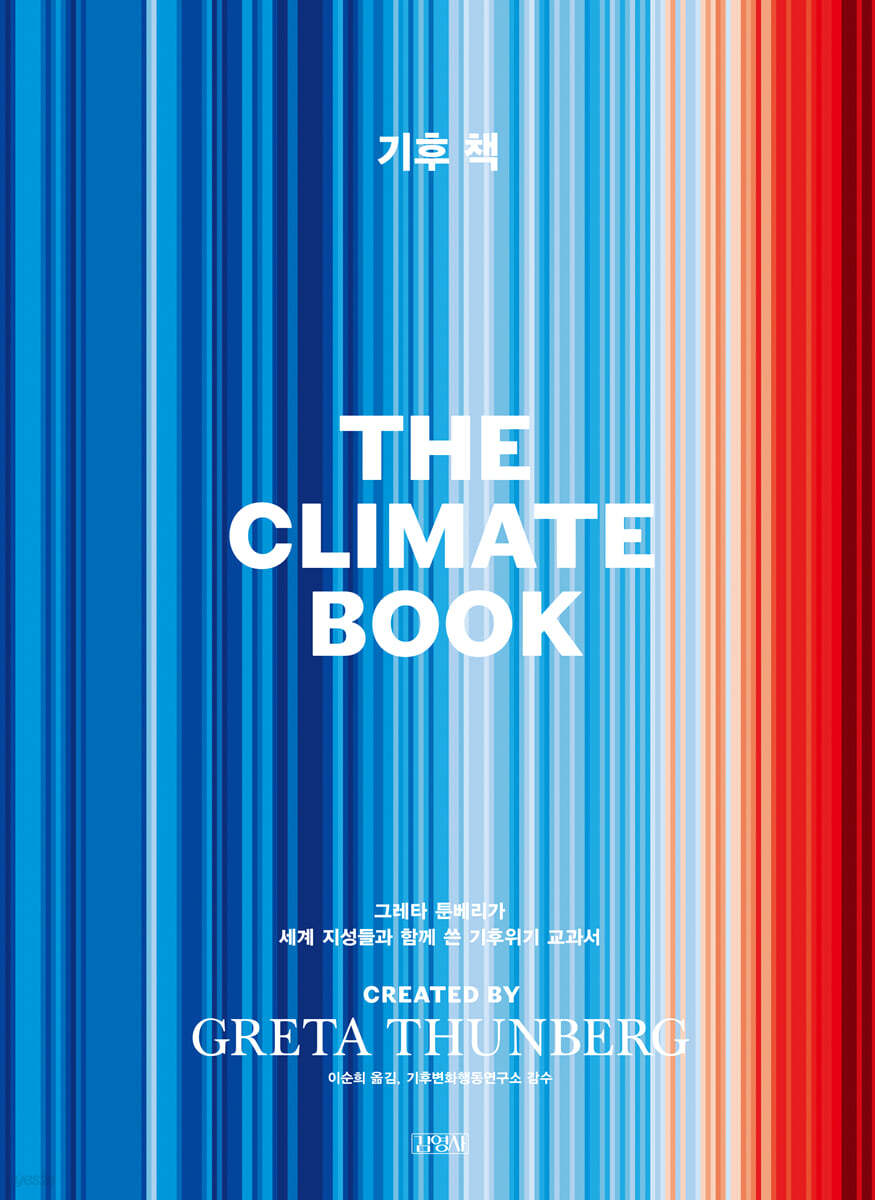
“Hope comes only when we tell the truth” [New York Times] Bestseller 2022 [The Times], [Financial Times], [Observer], [Nature] Book of the Year Greta Thunberg’s ambitious project that brought together the world’s best experts A definitive edition that compiles all topics related to climate change based on science with the participation of over 100 intellectuals including Thomas Piketty, Margaret Atwood, and Naomi Klein A climate book for everyone in the era of climate crisis Greta Thunberg, a Swedish climate activist who led the ‘School Strike for Climate’ at the age of sixteen and vented her anger at world leaders who were wasting time without clear solutions on the podium at the UN headquarters. Now twenty years old, he has reached readers all over the world with a heavy book. The title is 『The Climate Book』 without any modifiers. The cover is printed with Warming Stripes, which visualize the Earth's temperature rise year by year from the back cover to the front cover, and contains the names of a total of 104 contributors, including Thunberg. From melting ice sheets and relentless wildfires to species loss, fast fashion, plastic pollution, food crises and water depletion, carbon budgets and climate justice, this book compiles the problems and solutions facing humanity. The purpose was to record scientific facts that clearly show the current state of humanity and to inform the world that we still have the opportunity to change the future. This book is a scientific warning from intellectuals around the world, delivered to all of us living in the most heated era in history, and a fervent appeal that it is too early for humanity to give up hope. |
- You can preview some of the book's contents.
Preview
index
Part 1: How Climate Works
1.1 To solve a problem, you must first understand the problem clearly / Greta Thunberg
1.2 The History of Carbon Dioxide on Earth / Peter Brannan
1.3 The Impact of Humans on Evolution / Beth Shapiro
1.4 Civilization and Extinction / Elizabeth Colbert
1.5 Climate Science Is Impeccably Accurate / Greta Thunberg
1.6 The Discovery of Climate Change / Michael Oppenheimer
1.7 Why Didn't They Act? / Naomi Oreskes
1.8 Tipping Points and Feedback Loops / Johan Rockström
1.9 The Biggest Story in the World / Greta Thunberg
Part 2: How the Earth is Changing
2.1 Weather on Steroids / Greta Thunberg
2.2 Column / Katharine Hayhoe
2.3 Methane and Other Gases / Zig Hausfather
2.4 Air pollution and aerosols / Bjorn H.
three sets
2.5 Clouds / Paulo Seppi
2.6 Arctic Warming and the Jet Stream / Jennifer Francis
2.7 Dangerous Weather / Friederike Otto
2.8 The Snowball Starts Rolling / Greta Thunberg
2.9 Drought and Flood / Kate Marvel
2.10 Ice sheets, ice shelves, and glaciers / Ricarda Winkelmann
2.11 Ocean Warming and Sea Level Rise / Stefan Rahmstorf
2.12 Ocean Acidification and Marine Ecosystems / Hans-Otto Pörtner
2.13 Microplastics / Karin Kvale
2.14 Freshwater / Peter H.
Glick
2.15 The crisis is much closer to our daily lives than we think / Greta Thunberg
2.16 Wildfires / Joel Gergis
2.17 Amazon / Carlos Nobre, Julia Ariera, Natalia Nascimento
2.18 Boreal and Temperate Forests / Beverly Row
2.19 Terrestrial Biodiversity / Andy Purvis, Adriana de Palma
2.20 Insects / Dave Gulson
2.21 Nature's Calendar / Keith W.
Larson
2.22 Soil / Jennifer L.
Song
2.23 Permafrost / Jörjan Gustafsson
2.24 What happens when temperatures rise by 1.5 degrees, 2 degrees, and 4 degrees? / Tamzin Edwards
Part 3: What Impact Does Climate Change Have?
3.1 The World is in a Fever / Greta Thunberg
3.2 Health and Climate / Tedros Adhanom Ghebreyesus
3.3 Heat and Disease / Anna M.
Vicedo Cabrera
3.4 Air Pollution / Drew Shindell
3.5 Vector-Transmitted Infectious Diseases / Felipe J.
Colon Gonzalez
3.6 Antibiotic Resistance / John Brownstein, Derek McFadden, Sarah Magoff, Mauricio Santillana
3.7 Food and Nutrition / Samuel S.
Myers
3.8 We're Not All in the Same Boat / Greta Thunberg
How to survive at 3.9 degrees Celsius / Salimul Hook
3.10 Environmental Racism / Jacqueline Patterson
3.11 Climate Refugees / Abram Rustaton
3.12 Sea Level Rise and Small Islands / Michael Taylor
3.13 Sahel Rain / Hindu Umaru Ibrahim
3.14 Winter in Sapmi / Elin Anna Raba
3.15 Fight for the Forest / Sonia Gwajara
3.16 The Enormous Dilemma We Face / Greta Thunberg
3.17 Warming and Inequality / Solomon Xiang
3.18 Water Shortage / Oki Daikan
3.19 Climate Dispute / Marshall Burke
3.20 The Real Cost of Climate Change / Eugene Linden
Part 4: What Are We Doing?
4.1 To fix failure, you must first acknowledge it / Greta Thunberg
4.2 The New Negativity / Kevin Anderson
4.3 The Truth About Government Climate Goals / Alexandra Urisman Otto
4.4 We're going in the wrong direction / Greta Thunberg
4.5 The Persistent Dominance of Fossil Fuels / Bill McKibben
4.6 The Rise of Renewable Energy / Glen Peters
4.7 The Potential of the Forest / Karlheinz Erb, Simon Gingrich
4.8 The Reality of Geoengineering / Niklas Hellström, Jenny C.
Stevens, Isaac Stoddard
4.9 Carbon Removal Technologies / Rob Jackson
4.10 A fundamental shift in thinking is needed / Greta Thunberg
4.11 Human Fingerprints in the Ground / Alexander Pope
4.12 Food and Calorie Issues / Michael Clark
4.13 Designing a New Food System / Sonja Vermeulen
4.14 Industrial Sector Emissions / John Barrett and Alice Garvey
4.15 Technology as an Obstacle / Ketan Joshi
4.16 The Challenge of Transport / Alice Larkin
4.17 Is the Future Electric? / Jillian Annable, Christian Brand
4.18 Words and Actions Are Different / Greta Thunberg
The Harmful Effects of Consumerism / Annie Lowry
4.20 How to (Not) Buy Things / Mike Berners-Lee
4.21 A World Covered in Trash / Silpa Kaja
4.22 The Myth of Recycling / Nina Schrank
4.23 This is the final line / Greta Thunberg
4.24 Emissions and Growth / Nicholas Stern
4.25 Climate Justice / Sunita Narain
4.26 Degrowth / Jason Hickel
4.27 Awareness Gap / Amitabh Goshi
Part 5: What Should We Do Now?
5.1 The best escape route is to awaken ourselves / Greta Thunberg
5.2 Personal Action and Social Transformation / Stuart Capstick and Lorraine Whitmarsh
5.3 1.5 Degree Lifestyle / Kate Raworth
5.4 Overcoming Climate Indifference / Per Espen Stoknes
5.5 Changes in Eating Habits / Gidon Essence
5.6 Remember the Sea / Ayana Elizabeth Johnson
5.7 Back to Nature / George Monbiot, Rebecca Wrigley
5.8 Now we must do the impossible / Greta Thunberg
5.9 Practical Utopia / Margaret Atwood
5.10 People Power / Erica Chenoweth
5.11 Changing the Media Narrative / George Monbiot
5.12 Resisting the New Negativity / Michael E.
only
5.13 True Emergency Response / Seth Klein
Lessons from the May 14 Pandemic / David Wallace-Wells
5.15 Honesty, Solidarity, Authenticity, Climate Justice / Greta Thunberg
5.16 A Just Transition / Naomi Klein
5.17 The Meaning of Equity / Nikki Becker, Disha A.
Ravi, Hilda Flavia Nakabuye, Laura Veronica Muñoz, Ina Maria Sikongo, Aisha Sidika, and Mitch Jonel Tan
5.18 Women and the Climate Crisis / Wanjira Maathai
5.19 Decarbonization Requires Redistribution / Lucas Chancel, Thomas Piketty
5.20 Climate Compensation / Olufemi O.
Taiyo
5.21 Let's Set Our Relationship with the Land Right / Robin Wall Kimmerer
5.22 Hope is something we have to create / Greta Thunberg
What's next?
A word of recommendation from the editor
Illustration Credit
Search
1.1 To solve a problem, you must first understand the problem clearly / Greta Thunberg
1.2 The History of Carbon Dioxide on Earth / Peter Brannan
1.3 The Impact of Humans on Evolution / Beth Shapiro
1.4 Civilization and Extinction / Elizabeth Colbert
1.5 Climate Science Is Impeccably Accurate / Greta Thunberg
1.6 The Discovery of Climate Change / Michael Oppenheimer
1.7 Why Didn't They Act? / Naomi Oreskes
1.8 Tipping Points and Feedback Loops / Johan Rockström
1.9 The Biggest Story in the World / Greta Thunberg
Part 2: How the Earth is Changing
2.1 Weather on Steroids / Greta Thunberg
2.2 Column / Katharine Hayhoe
2.3 Methane and Other Gases / Zig Hausfather
2.4 Air pollution and aerosols / Bjorn H.
three sets
2.5 Clouds / Paulo Seppi
2.6 Arctic Warming and the Jet Stream / Jennifer Francis
2.7 Dangerous Weather / Friederike Otto
2.8 The Snowball Starts Rolling / Greta Thunberg
2.9 Drought and Flood / Kate Marvel
2.10 Ice sheets, ice shelves, and glaciers / Ricarda Winkelmann
2.11 Ocean Warming and Sea Level Rise / Stefan Rahmstorf
2.12 Ocean Acidification and Marine Ecosystems / Hans-Otto Pörtner
2.13 Microplastics / Karin Kvale
2.14 Freshwater / Peter H.
Glick
2.15 The crisis is much closer to our daily lives than we think / Greta Thunberg
2.16 Wildfires / Joel Gergis
2.17 Amazon / Carlos Nobre, Julia Ariera, Natalia Nascimento
2.18 Boreal and Temperate Forests / Beverly Row
2.19 Terrestrial Biodiversity / Andy Purvis, Adriana de Palma
2.20 Insects / Dave Gulson
2.21 Nature's Calendar / Keith W.
Larson
2.22 Soil / Jennifer L.
Song
2.23 Permafrost / Jörjan Gustafsson
2.24 What happens when temperatures rise by 1.5 degrees, 2 degrees, and 4 degrees? / Tamzin Edwards
Part 3: What Impact Does Climate Change Have?
3.1 The World is in a Fever / Greta Thunberg
3.2 Health and Climate / Tedros Adhanom Ghebreyesus
3.3 Heat and Disease / Anna M.
Vicedo Cabrera
3.4 Air Pollution / Drew Shindell
3.5 Vector-Transmitted Infectious Diseases / Felipe J.
Colon Gonzalez
3.6 Antibiotic Resistance / John Brownstein, Derek McFadden, Sarah Magoff, Mauricio Santillana
3.7 Food and Nutrition / Samuel S.
Myers
3.8 We're Not All in the Same Boat / Greta Thunberg
How to survive at 3.9 degrees Celsius / Salimul Hook
3.10 Environmental Racism / Jacqueline Patterson
3.11 Climate Refugees / Abram Rustaton
3.12 Sea Level Rise and Small Islands / Michael Taylor
3.13 Sahel Rain / Hindu Umaru Ibrahim
3.14 Winter in Sapmi / Elin Anna Raba
3.15 Fight for the Forest / Sonia Gwajara
3.16 The Enormous Dilemma We Face / Greta Thunberg
3.17 Warming and Inequality / Solomon Xiang
3.18 Water Shortage / Oki Daikan
3.19 Climate Dispute / Marshall Burke
3.20 The Real Cost of Climate Change / Eugene Linden
Part 4: What Are We Doing?
4.1 To fix failure, you must first acknowledge it / Greta Thunberg
4.2 The New Negativity / Kevin Anderson
4.3 The Truth About Government Climate Goals / Alexandra Urisman Otto
4.4 We're going in the wrong direction / Greta Thunberg
4.5 The Persistent Dominance of Fossil Fuels / Bill McKibben
4.6 The Rise of Renewable Energy / Glen Peters
4.7 The Potential of the Forest / Karlheinz Erb, Simon Gingrich
4.8 The Reality of Geoengineering / Niklas Hellström, Jenny C.
Stevens, Isaac Stoddard
4.9 Carbon Removal Technologies / Rob Jackson
4.10 A fundamental shift in thinking is needed / Greta Thunberg
4.11 Human Fingerprints in the Ground / Alexander Pope
4.12 Food and Calorie Issues / Michael Clark
4.13 Designing a New Food System / Sonja Vermeulen
4.14 Industrial Sector Emissions / John Barrett and Alice Garvey
4.15 Technology as an Obstacle / Ketan Joshi
4.16 The Challenge of Transport / Alice Larkin
4.17 Is the Future Electric? / Jillian Annable, Christian Brand
4.18 Words and Actions Are Different / Greta Thunberg
The Harmful Effects of Consumerism / Annie Lowry
4.20 How to (Not) Buy Things / Mike Berners-Lee
4.21 A World Covered in Trash / Silpa Kaja
4.22 The Myth of Recycling / Nina Schrank
4.23 This is the final line / Greta Thunberg
4.24 Emissions and Growth / Nicholas Stern
4.25 Climate Justice / Sunita Narain
4.26 Degrowth / Jason Hickel
4.27 Awareness Gap / Amitabh Goshi
Part 5: What Should We Do Now?
5.1 The best escape route is to awaken ourselves / Greta Thunberg
5.2 Personal Action and Social Transformation / Stuart Capstick and Lorraine Whitmarsh
5.3 1.5 Degree Lifestyle / Kate Raworth
5.4 Overcoming Climate Indifference / Per Espen Stoknes
5.5 Changes in Eating Habits / Gidon Essence
5.6 Remember the Sea / Ayana Elizabeth Johnson
5.7 Back to Nature / George Monbiot, Rebecca Wrigley
5.8 Now we must do the impossible / Greta Thunberg
5.9 Practical Utopia / Margaret Atwood
5.10 People Power / Erica Chenoweth
5.11 Changing the Media Narrative / George Monbiot
5.12 Resisting the New Negativity / Michael E.
only
5.13 True Emergency Response / Seth Klein
Lessons from the May 14 Pandemic / David Wallace-Wells
5.15 Honesty, Solidarity, Authenticity, Climate Justice / Greta Thunberg
5.16 A Just Transition / Naomi Klein
5.17 The Meaning of Equity / Nikki Becker, Disha A.
Ravi, Hilda Flavia Nakabuye, Laura Veronica Muñoz, Ina Maria Sikongo, Aisha Sidika, and Mitch Jonel Tan
5.18 Women and the Climate Crisis / Wanjira Maathai
5.19 Decarbonization Requires Redistribution / Lucas Chancel, Thomas Piketty
5.20 Climate Compensation / Olufemi O.
Taiyo
5.21 Let's Set Our Relationship with the Land Right / Robin Wall Kimmerer
5.22 Hope is something we have to create / Greta Thunberg
What's next?
A word of recommendation from the editor
Illustration Credit
Search
Detailed image

Into the book
We live in an age where giant greenwashing machines are at full power.
--- p.20
Most species on Earth today have survived multiple ice ages.
This means that the Earth survived a time when the temperature was lower than it is now.
However, it is not known whether these species will be able to survive as global temperatures rise further.
Going back millions of years, the Earth has never been hotter than it is now.
--- p.36
What makes carbon dioxide buildup in the atmosphere so problematic is that it can only be permanently removed by the oceans, which dissolve it very slowly over hundreds of years.
--- p.48
Methane stays in the atmosphere temporarily, but carbon dioxide stays forever.
--- p.81
Several recent extreme summer weather events, including the 2003 and 2018 European heatwaves that killed thousands, the 2010 Russian heatwave, the 2011 US South Central heatwave, and the 2018 East Asian heatwave, may have been caused by jet stream divergence.
--- p.96
If we hadn't burned fossil fuels, the number of people displaced by the storm surge accompanying Sandy would have been 70,000 fewer than the actual number of people displaced.
--- p.99
The poles are the most effective early warning system on Earth for indicating the progress of climate change.
This early warning system is sounding the alarm now.
--- p.108
Microplastics are very similar to the carbon dioxide emitted by humans.
They are similar in that they come from carbon-based fuels, are pollutants that persist for a long time and do not easily disappear, and are generated by almost all human activities.
--- p.120
Due to the impacts of global warming, wildfire seasons are already becoming more deadly and longer, and wildfires are occurring in areas where they never occurred before.
--- p.133
If insects disappear, our world will slowly come to a halt.
Without insects, this world would not turn.
--- p.151
The world's soils hold over 3 trillion tons of carbon.
This is about four times the amount of carbon in the atmosphere and in all the world's plants combined.
--- p.157
Compared to the numerous impacts heat has on human health, heat-related deaths are just the tip of the iceberg.
Heat has also been linked to increased hospitalizations for cardiovascular or respiratory conditions, premature births, and more.
--- p.182
Hope only comes when we tell the truth.
All the knowledge that science gives us as a basis for action is hope.
--- p.204
The United States has only 4 percent of the world's population, but it produces 25 percent of the cumulative greenhouse gas emissions that contribute to global climate change.
--- p.211
We need billions of climate activists.
We need civil disobedience movements, including non-violent and peaceful protests, strikes, boycotts, and marches that do not threaten anyone's safety.
--- p.234
Rising temperatures and extreme changes in precipitation have also been shown to increase the likelihood of communal conflicts, including gang violence, riots, and civil wars.
--- p.243
According to insurance giant Aon, the world suffered $1.8 trillion in damages from weather-related losses between 2000 and 2009, and that figure increased to $3 trillion between 2010 and 2019.
--- p.248
Even if all greenhouse gas emissions were eliminated, unless we change the way we produce and consume food, the global temperature will exceed the 1.5 degree target within a few decades and the 2 degree target soon after the turn of the century.
--- p.321
Taking the carbon footprint of the automobile manufacturing industry as an example, the territorial emissions accounting method attributes most of the emissions to developing countries that manufacture automobile parts, whereas the consumption-based emissions accounting method attributes most of the emissions to the final consumer countries where automobile demand is generated.
--- p.330
It is unclear which country should be responsible for emissions from international aviation and shipping.
But that total is equivalent to the carbon dioxide emissions of Japan, the world's fifth-largest greenhouse gas emitter.
--- p.345
The average American household has 300,000 items.
One in ten households rents a storage unit, and one in four people with a garage complain that it is so full they cannot park their car.
--- p.362
Rich countries can support their citizens' high standards of living with 'far less' energy and resources than they currently use.
The key is to reduce non-essential production and organize the economy around human welfare rather than capital accumulation.
This is degrowth.
--- p.397
In developed countries, global warming is primarily addressed from a technological, economic, and scientific perspective, whereas in developing countries, the same phenomenon is addressed from the perspective of a power and wealth gap resulting from geopolitical inequalities solidified during the colonial era.
--- p.402
Of the textile fibers currently produced, 12 percent are discarded or lost during the production process, 73 percent are landfilled or incinerated after use, and less than 1 percent are reused or recycled to become raw materials for new clothing.
Moreover, the fashion industry produces about 2 percent of global greenhouse gas emissions.
--- p.421
Renaturalization is not about returning Earth's ecosystems to a specific past state, but rather about leaving them to become as rich, diverse, dynamic, and healthy as possible.
--- p.444
According to a research team at Imperial College London, directing one-tenth of COVID-19 stimulus spending to decarbonization over the next five years could help meet the Paris Agreement goals and limit global warming to well below 2 degrees Celsius.
--- p.485
If "world-making" is necessary to achieve climate and racial justice, then justice is a design project.
Our goal is to fundamentally change an unfair world.
--- p.20
Most species on Earth today have survived multiple ice ages.
This means that the Earth survived a time when the temperature was lower than it is now.
However, it is not known whether these species will be able to survive as global temperatures rise further.
Going back millions of years, the Earth has never been hotter than it is now.
--- p.36
What makes carbon dioxide buildup in the atmosphere so problematic is that it can only be permanently removed by the oceans, which dissolve it very slowly over hundreds of years.
--- p.48
Methane stays in the atmosphere temporarily, but carbon dioxide stays forever.
--- p.81
Several recent extreme summer weather events, including the 2003 and 2018 European heatwaves that killed thousands, the 2010 Russian heatwave, the 2011 US South Central heatwave, and the 2018 East Asian heatwave, may have been caused by jet stream divergence.
--- p.96
If we hadn't burned fossil fuels, the number of people displaced by the storm surge accompanying Sandy would have been 70,000 fewer than the actual number of people displaced.
--- p.99
The poles are the most effective early warning system on Earth for indicating the progress of climate change.
This early warning system is sounding the alarm now.
--- p.108
Microplastics are very similar to the carbon dioxide emitted by humans.
They are similar in that they come from carbon-based fuels, are pollutants that persist for a long time and do not easily disappear, and are generated by almost all human activities.
--- p.120
Due to the impacts of global warming, wildfire seasons are already becoming more deadly and longer, and wildfires are occurring in areas where they never occurred before.
--- p.133
If insects disappear, our world will slowly come to a halt.
Without insects, this world would not turn.
--- p.151
The world's soils hold over 3 trillion tons of carbon.
This is about four times the amount of carbon in the atmosphere and in all the world's plants combined.
--- p.157
Compared to the numerous impacts heat has on human health, heat-related deaths are just the tip of the iceberg.
Heat has also been linked to increased hospitalizations for cardiovascular or respiratory conditions, premature births, and more.
--- p.182
Hope only comes when we tell the truth.
All the knowledge that science gives us as a basis for action is hope.
--- p.204
The United States has only 4 percent of the world's population, but it produces 25 percent of the cumulative greenhouse gas emissions that contribute to global climate change.
--- p.211
We need billions of climate activists.
We need civil disobedience movements, including non-violent and peaceful protests, strikes, boycotts, and marches that do not threaten anyone's safety.
--- p.234
Rising temperatures and extreme changes in precipitation have also been shown to increase the likelihood of communal conflicts, including gang violence, riots, and civil wars.
--- p.243
According to insurance giant Aon, the world suffered $1.8 trillion in damages from weather-related losses between 2000 and 2009, and that figure increased to $3 trillion between 2010 and 2019.
--- p.248
Even if all greenhouse gas emissions were eliminated, unless we change the way we produce and consume food, the global temperature will exceed the 1.5 degree target within a few decades and the 2 degree target soon after the turn of the century.
--- p.321
Taking the carbon footprint of the automobile manufacturing industry as an example, the territorial emissions accounting method attributes most of the emissions to developing countries that manufacture automobile parts, whereas the consumption-based emissions accounting method attributes most of the emissions to the final consumer countries where automobile demand is generated.
--- p.330
It is unclear which country should be responsible for emissions from international aviation and shipping.
But that total is equivalent to the carbon dioxide emissions of Japan, the world's fifth-largest greenhouse gas emitter.
--- p.345
The average American household has 300,000 items.
One in ten households rents a storage unit, and one in four people with a garage complain that it is so full they cannot park their car.
--- p.362
Rich countries can support their citizens' high standards of living with 'far less' energy and resources than they currently use.
The key is to reduce non-essential production and organize the economy around human welfare rather than capital accumulation.
This is degrowth.
--- p.397
In developed countries, global warming is primarily addressed from a technological, economic, and scientific perspective, whereas in developing countries, the same phenomenon is addressed from the perspective of a power and wealth gap resulting from geopolitical inequalities solidified during the colonial era.
--- p.402
Of the textile fibers currently produced, 12 percent are discarded or lost during the production process, 73 percent are landfilled or incinerated after use, and less than 1 percent are reused or recycled to become raw materials for new clothing.
Moreover, the fashion industry produces about 2 percent of global greenhouse gas emissions.
--- p.421
Renaturalization is not about returning Earth's ecosystems to a specific past state, but rather about leaving them to become as rich, diverse, dynamic, and healthy as possible.
--- p.444
According to a research team at Imperial College London, directing one-tenth of COVID-19 stimulus spending to decarbonization over the next five years could help meet the Paris Agreement goals and limit global warming to well below 2 degrees Celsius.
--- p.485
If "world-making" is necessary to achieve climate and racial justice, then justice is a design project.
Our goal is to fundamentally change an unfair world.
--- p.522
Publisher's Review
The Climate Book, first published in the UK in late 2022, attracted significant attention simply because it was planned by climate action icon Greta Thunberg.
It was selected as the book of the year by authoritative media outlets such as [The Times], [The Observer], and [Nature], and was published in the United States in February of the following year, where it quickly became a [New York Times] bestseller.
In particular, [The Times] selected this book as a must-read for our time, comparing it to Stephen Hawking's A Brief History of Time and Yuval Harari's Sapiens.
The background of the book's creation is also interesting.
Thunberg first conceived the idea for this book in 2021, when all outdoor activities were halted due to COVID-19.
The goal was clear and ambitious.
To create the most reliable, science-based guide to the global climate crisis.
It was to record scientific facts that clearly show the current state of humanity and to inform the world that we still have the opportunity to change the future.
And so the dream team was formed.
Leading experts in fields such as climatology, geophysics, oceanography, economics, health, history, and climate activism responded to Thunberg's call.
Scientists Drew Shindell and Michael Oppenheimer, who have been researching at the forefront of climate science; Bill McKibben and George Monbiot, who are famous for their outstanding writings on climate change; Margaret Atwood, a Booker Prize-winning author well-known in Korea; Robin Wall Kimmerer, a plant ecologist of Native American descent; Thomas Piketty, who rose to stardom with Capital in the Twenty-First Century; and world-renowned environmental activist Naomi Klein.
This combination would not have been possible without Thunberg.
Compendium of Climate Science
The Climate Book is a landmark publication that brings climate action to the forefront, but its breadth of subject matter surpasses that of existing climate-related books.
It encompasses the climate crisis stemming from our civilization, including capitalism, consumerism, colonialism, and climate justice, as well as the Earth's ecosystems, including the oceans, ice sheets, land, and atmosphere.
Using a variety of statistical data and cutting-edge research, the authors vividly convey the scale, speed, and impact of the current climate crisis.
The shocking graphs that appear throughout the book are particularly impressive.
For example, the 'Great Acceleration' graph (pp. 58-59) presented by Johan Rockström (Director of the Potsdam Institute for Climate Impact Research) shows at a glance the ripple effects of the Earth system and material civilization over the past 100 years since the full-scale use of fossil fuels.
Readers will see that virtually every indicator—greenhouse gas emissions, fertilizer consumption, water use, marine fisheries, population growth—is growing exponentially, far beyond what the planet can sustain.
This book consists of 84 chapters in 5 parts and is filled with interesting scientific knowledge.
Part 1, which explains how climate works in particular, covers the history of carbon dioxide, civilization and extinction, and anecdotes from the scientists who first recognized climate change (scientists warned the U.S. Senate 40 years ago that the "greenhouse effect" could not be ignored!).
The scientific explanation for the tipping point is particularly impressive: according to Rockström, “passing the tipping point is like pressing a kind of ‘go’ button.”
Because the Earth's biophysical systems are shifting to a completely new (irreversible) equilibrium (scientists consider the moment when this Pandora's box is opened to be a 1.5-degree rise).
Meanwhile, Part 2 comprehensively covers changes to the Earth caused by climate change, such as heat waves, wildfires, and floods.
In particular, the story of forest fires, which are increasing every year in Korea, is attracting attention.
According to Australian scientist Joel Gergis, global warming has “already made bushfire seasons more deadly and longer, and they are occurring in areas that have never seen fire before.” In 2019-2020, Australia saw megafires that burned 240,000 square kilometers, releasing more carbon dioxide in a single fire period than the entire country emits in a year.
The Real Cost of Climate Change
Part 3 addresses the issue of the 'real cost of climate change' charged to humanity in return for enjoying material civilization.
Scientific findings are revealing the precise threats climate change poses to human body, mind, and society, including heat, vector-borne infectious diseases, and food and nutritional issues.
Environmental epidemiologist Anna M.
According to Bichedo-Cabrera, “climate change is responsible for 37 percent of heat-related deaths between 1991 and 2018,” and beyond direct heatstroke, it can worsen acute illnesses like heart attacks and underlying conditions like chronic obstructive pulmonary disease.
Additionally, while a person born in 1960 will experience an average of four severe heat waves in their lifetime, a child born in 2020 will experience a whopping eighteen (the frequency of severe heat waves doubles for every 0.5 degree Celsius rise in global temperature).
The research of Marshall Burke (Department of Earth System Sciences, Stanford University) is also interesting.
Climate is correlated with violent crime, with higher temperatures leading to increased violent crime between individuals and greater group conflict.
Studies have also shown that more conflicts between civilians occur during El Niño events (see figure on page 244).
Meanwhile, there are also some surprising experimental results showing that atmospheric carbon dioxide concentrations lower the nutrients in crops.
Samuel S.
Myers (Harvard T.
According to a research team at the H. Chan School of Public Health, crops grown at 550 ppm of atmospheric carbon dioxide (the expected concentration in the mid-21st century) had significantly lower iron, zinc, and protein content, and some varieties of rice had significantly reduced levels of B vitamins, including folate and thiamine.
As the Earth's temperature rises in the future, humanity is likely to suffer from diseases caused by nutritional deficiencies.
It is a warning that the food crisis can cause problems not only in quantity but also in quality.
Climate change also portends significant socioeconomic costs.
According to journalist Eugene Linden, extreme temperatures could make parts of the Middle East, including Iran, Syria and Iraq, uninhabitable, worsening Europe's refugee crisis.
It is pointed out that this will significantly increase the geopolitical costs in climate disaster areas.
Meanwhile, on the economic front, a more serious crisis could arise.
According to major insurer Aon, the world suffered $1.8 trillion in damages from weather-related losses between 2000 and 2009, and the amount increased to $3 trillion between 2010 and 2019.
In 2021, Moody's Analytics estimated that reaching 2 degrees Celsius of warming would cost the global economy $69 trillion.
Linden warns that “our world will already be experiencing a climate-related global financial crisis long before we reach 2 degrees of warming.”
What should we do
Parts 4 and 5 address the futility of what we're doing to address the climate crisis and what we actually need to do.
A representative example is the effort to remove carbon from the atmosphere to prevent the climate crisis.
Carbon capture and storage (CCS) is recognized as a promising engineering method for removing carbon from industrial processes, led by Norway.
However, more than 100 of the 149 CCS projects worldwide have been abandoned or put on hold due to reasons such as construction costs and low profitability.
Meanwhile, the transition to renewable energy sources, such as solar energy, is too slow due to the social structure that is still based on fossil fuels and corporate lobbying.
So what should we do? Some of the authors in this book mention nature-based climate solutions.
By preserving the ecosystem, we strengthen and maintain nature's carbon absorption capacity.
Environmentalists George Monbiot and Rebecca Wrigley advocate "rewilding" (reviving ecosystems by relying on nature's resilience), while marine biologist Ayanna Elizabeth Johnson proposes farming seaweed and then sinking it in the deep sea (seaweed sequesters 200 million tonnes of carbon each year).
Of course, the best option is to minimize current carbon emissions.
As Stanford University geoscientist Rob Jackson puts it, “It costs less to keep greenhouse gases out of the atmosphere today than it does to remove them from the atmosphere tomorrow.” The cheap(?) greenhouse gases we emit today will have to be removed at great expense by future generations.
To prevent such moral irresponsibility, we must start by calculating carbon emissions correctly.
We don't have a large carbon budget, and even the calculation methods are flawed.
Journalist Alexandra Urisman Otto analyzed Sweden's "net zero emissions target by 2045" and found a significant discrepancy between the official figure of 50 million tonnes of greenhouse gases emitted each year and the actual figure of 150 million tonnes.
This is due to a loophole in the international climate accounting method (which excludes emissions from consumption, biomass combustion, international aviation and shipping), and experts say that if all countries rely on this calculation and act complacently, the carbon budget will soon run out, and the world will head straight for a catastrophic rise of 2.5 to 3 degrees Celsius.
These fictitious carbon budgets may be convenient for governments to fool citizens, but it is impossible to set any hopeful goals from them.
Towards a tipping point of hope
In early June 2023, massive wildfires in Canada turned New York's skies orange.
About a week later, in Sweden, two climate activists, a nurse and a nursing student, were arrested for putting their handprints on the protective window of the exhibition of Claude Monet's Garden at Giverny.
Climate change is now the hottest topic in the world, yet it's still consumed as gossip.
This is why Thunberg opens the book by defining our times in the first chapter as “the era in which the greenwashing machine is wielding its power.”
Greenwashing refers to corporate activities that improve the corporate image and promote sales by deceiving consumers into thinking that the company is eco-friendly when in fact it is not.
In Thunberg's eyes, our society, which fails to warn of the tipping point that will arrive in just 10 years, is itself a greenwashing machine.
And we hold accountable the politicians and media who waste time with empty promises, touting rosy engineering technologies, and whispering hopes (“Hope for whom? Hope for those who created this problem, or hope for those who suffer the consequences of this problem?”).
Thunberg's essays (18 in total), which appear interspersed with the authors' writings, are filled with anger and frustration at decades of repeated inaction and broken promises by political leaders.
But that anger leaps into change and action (Thunberg fills the back of the book with a list of things to do as individuals and as a society).
The world has known about climate change for a long time.
But half of all the carbon dioxide humans have emitted has occurred in the past 30 years.
Today, when the problem is so serious, those who will suffer the most from climate disaster are, paradoxically, those who are least responsible.
“Going vegetarian one day a week, buying carbon offsets when you fly to Thailand, or switching from a diesel SUV to an electric one” isn’t enough.
Maybe it's giving us the wrong signal that we're not in an emergency situation yet.
Everyone needs to be properly informed about the reality of the climate crisis and be able to tell the truth.
This book is a useful guide for those who want to delve deeper into the climate crisis and understand the big picture.
It's full of facts we're missing, problems we haven't thought about, and things we need to do.
Erica Chenoweth of Harvard University says in her chapter on “People Power” that “25 percent of dedicated people” change the world.
I look forward to the day when the spark of climate action ignited by Thunberg reaches 25 percent of the world's population, and I hope this book will be a source of hope for all those at the starting line of climate action.
Of course, that hope should not be the hope of a few, but of everyone.
Thunberg says.
“Hope is something we must create ourselves.
I am convinced that there is a societal tipping point where, when enough people decide to take action, things start to work out in our favor.” We are at a historic moment for humanity.
It was selected as the book of the year by authoritative media outlets such as [The Times], [The Observer], and [Nature], and was published in the United States in February of the following year, where it quickly became a [New York Times] bestseller.
In particular, [The Times] selected this book as a must-read for our time, comparing it to Stephen Hawking's A Brief History of Time and Yuval Harari's Sapiens.
The background of the book's creation is also interesting.
Thunberg first conceived the idea for this book in 2021, when all outdoor activities were halted due to COVID-19.
The goal was clear and ambitious.
To create the most reliable, science-based guide to the global climate crisis.
It was to record scientific facts that clearly show the current state of humanity and to inform the world that we still have the opportunity to change the future.
And so the dream team was formed.
Leading experts in fields such as climatology, geophysics, oceanography, economics, health, history, and climate activism responded to Thunberg's call.
Scientists Drew Shindell and Michael Oppenheimer, who have been researching at the forefront of climate science; Bill McKibben and George Monbiot, who are famous for their outstanding writings on climate change; Margaret Atwood, a Booker Prize-winning author well-known in Korea; Robin Wall Kimmerer, a plant ecologist of Native American descent; Thomas Piketty, who rose to stardom with Capital in the Twenty-First Century; and world-renowned environmental activist Naomi Klein.
This combination would not have been possible without Thunberg.
Compendium of Climate Science
The Climate Book is a landmark publication that brings climate action to the forefront, but its breadth of subject matter surpasses that of existing climate-related books.
It encompasses the climate crisis stemming from our civilization, including capitalism, consumerism, colonialism, and climate justice, as well as the Earth's ecosystems, including the oceans, ice sheets, land, and atmosphere.
Using a variety of statistical data and cutting-edge research, the authors vividly convey the scale, speed, and impact of the current climate crisis.
The shocking graphs that appear throughout the book are particularly impressive.
For example, the 'Great Acceleration' graph (pp. 58-59) presented by Johan Rockström (Director of the Potsdam Institute for Climate Impact Research) shows at a glance the ripple effects of the Earth system and material civilization over the past 100 years since the full-scale use of fossil fuels.
Readers will see that virtually every indicator—greenhouse gas emissions, fertilizer consumption, water use, marine fisheries, population growth—is growing exponentially, far beyond what the planet can sustain.
This book consists of 84 chapters in 5 parts and is filled with interesting scientific knowledge.
Part 1, which explains how climate works in particular, covers the history of carbon dioxide, civilization and extinction, and anecdotes from the scientists who first recognized climate change (scientists warned the U.S. Senate 40 years ago that the "greenhouse effect" could not be ignored!).
The scientific explanation for the tipping point is particularly impressive: according to Rockström, “passing the tipping point is like pressing a kind of ‘go’ button.”
Because the Earth's biophysical systems are shifting to a completely new (irreversible) equilibrium (scientists consider the moment when this Pandora's box is opened to be a 1.5-degree rise).
Meanwhile, Part 2 comprehensively covers changes to the Earth caused by climate change, such as heat waves, wildfires, and floods.
In particular, the story of forest fires, which are increasing every year in Korea, is attracting attention.
According to Australian scientist Joel Gergis, global warming has “already made bushfire seasons more deadly and longer, and they are occurring in areas that have never seen fire before.” In 2019-2020, Australia saw megafires that burned 240,000 square kilometers, releasing more carbon dioxide in a single fire period than the entire country emits in a year.
The Real Cost of Climate Change
Part 3 addresses the issue of the 'real cost of climate change' charged to humanity in return for enjoying material civilization.
Scientific findings are revealing the precise threats climate change poses to human body, mind, and society, including heat, vector-borne infectious diseases, and food and nutritional issues.
Environmental epidemiologist Anna M.
According to Bichedo-Cabrera, “climate change is responsible for 37 percent of heat-related deaths between 1991 and 2018,” and beyond direct heatstroke, it can worsen acute illnesses like heart attacks and underlying conditions like chronic obstructive pulmonary disease.
Additionally, while a person born in 1960 will experience an average of four severe heat waves in their lifetime, a child born in 2020 will experience a whopping eighteen (the frequency of severe heat waves doubles for every 0.5 degree Celsius rise in global temperature).
The research of Marshall Burke (Department of Earth System Sciences, Stanford University) is also interesting.
Climate is correlated with violent crime, with higher temperatures leading to increased violent crime between individuals and greater group conflict.
Studies have also shown that more conflicts between civilians occur during El Niño events (see figure on page 244).
Meanwhile, there are also some surprising experimental results showing that atmospheric carbon dioxide concentrations lower the nutrients in crops.
Samuel S.
Myers (Harvard T.
According to a research team at the H. Chan School of Public Health, crops grown at 550 ppm of atmospheric carbon dioxide (the expected concentration in the mid-21st century) had significantly lower iron, zinc, and protein content, and some varieties of rice had significantly reduced levels of B vitamins, including folate and thiamine.
As the Earth's temperature rises in the future, humanity is likely to suffer from diseases caused by nutritional deficiencies.
It is a warning that the food crisis can cause problems not only in quantity but also in quality.
Climate change also portends significant socioeconomic costs.
According to journalist Eugene Linden, extreme temperatures could make parts of the Middle East, including Iran, Syria and Iraq, uninhabitable, worsening Europe's refugee crisis.
It is pointed out that this will significantly increase the geopolitical costs in climate disaster areas.
Meanwhile, on the economic front, a more serious crisis could arise.
According to major insurer Aon, the world suffered $1.8 trillion in damages from weather-related losses between 2000 and 2009, and the amount increased to $3 trillion between 2010 and 2019.
In 2021, Moody's Analytics estimated that reaching 2 degrees Celsius of warming would cost the global economy $69 trillion.
Linden warns that “our world will already be experiencing a climate-related global financial crisis long before we reach 2 degrees of warming.”
What should we do
Parts 4 and 5 address the futility of what we're doing to address the climate crisis and what we actually need to do.
A representative example is the effort to remove carbon from the atmosphere to prevent the climate crisis.
Carbon capture and storage (CCS) is recognized as a promising engineering method for removing carbon from industrial processes, led by Norway.
However, more than 100 of the 149 CCS projects worldwide have been abandoned or put on hold due to reasons such as construction costs and low profitability.
Meanwhile, the transition to renewable energy sources, such as solar energy, is too slow due to the social structure that is still based on fossil fuels and corporate lobbying.
So what should we do? Some of the authors in this book mention nature-based climate solutions.
By preserving the ecosystem, we strengthen and maintain nature's carbon absorption capacity.
Environmentalists George Monbiot and Rebecca Wrigley advocate "rewilding" (reviving ecosystems by relying on nature's resilience), while marine biologist Ayanna Elizabeth Johnson proposes farming seaweed and then sinking it in the deep sea (seaweed sequesters 200 million tonnes of carbon each year).
Of course, the best option is to minimize current carbon emissions.
As Stanford University geoscientist Rob Jackson puts it, “It costs less to keep greenhouse gases out of the atmosphere today than it does to remove them from the atmosphere tomorrow.” The cheap(?) greenhouse gases we emit today will have to be removed at great expense by future generations.
To prevent such moral irresponsibility, we must start by calculating carbon emissions correctly.
We don't have a large carbon budget, and even the calculation methods are flawed.
Journalist Alexandra Urisman Otto analyzed Sweden's "net zero emissions target by 2045" and found a significant discrepancy between the official figure of 50 million tonnes of greenhouse gases emitted each year and the actual figure of 150 million tonnes.
This is due to a loophole in the international climate accounting method (which excludes emissions from consumption, biomass combustion, international aviation and shipping), and experts say that if all countries rely on this calculation and act complacently, the carbon budget will soon run out, and the world will head straight for a catastrophic rise of 2.5 to 3 degrees Celsius.
These fictitious carbon budgets may be convenient for governments to fool citizens, but it is impossible to set any hopeful goals from them.
Towards a tipping point of hope
In early June 2023, massive wildfires in Canada turned New York's skies orange.
About a week later, in Sweden, two climate activists, a nurse and a nursing student, were arrested for putting their handprints on the protective window of the exhibition of Claude Monet's Garden at Giverny.
Climate change is now the hottest topic in the world, yet it's still consumed as gossip.
This is why Thunberg opens the book by defining our times in the first chapter as “the era in which the greenwashing machine is wielding its power.”
Greenwashing refers to corporate activities that improve the corporate image and promote sales by deceiving consumers into thinking that the company is eco-friendly when in fact it is not.
In Thunberg's eyes, our society, which fails to warn of the tipping point that will arrive in just 10 years, is itself a greenwashing machine.
And we hold accountable the politicians and media who waste time with empty promises, touting rosy engineering technologies, and whispering hopes (“Hope for whom? Hope for those who created this problem, or hope for those who suffer the consequences of this problem?”).
Thunberg's essays (18 in total), which appear interspersed with the authors' writings, are filled with anger and frustration at decades of repeated inaction and broken promises by political leaders.
But that anger leaps into change and action (Thunberg fills the back of the book with a list of things to do as individuals and as a society).
The world has known about climate change for a long time.
But half of all the carbon dioxide humans have emitted has occurred in the past 30 years.
Today, when the problem is so serious, those who will suffer the most from climate disaster are, paradoxically, those who are least responsible.
“Going vegetarian one day a week, buying carbon offsets when you fly to Thailand, or switching from a diesel SUV to an electric one” isn’t enough.
Maybe it's giving us the wrong signal that we're not in an emergency situation yet.
Everyone needs to be properly informed about the reality of the climate crisis and be able to tell the truth.
This book is a useful guide for those who want to delve deeper into the climate crisis and understand the big picture.
It's full of facts we're missing, problems we haven't thought about, and things we need to do.
Erica Chenoweth of Harvard University says in her chapter on “People Power” that “25 percent of dedicated people” change the world.
I look forward to the day when the spark of climate action ignited by Thunberg reaches 25 percent of the world's population, and I hope this book will be a source of hope for all those at the starting line of climate action.
Of course, that hope should not be the hope of a few, but of everyone.
Thunberg says.
“Hope is something we must create ourselves.
I am convinced that there is a societal tipping point where, when enough people decide to take action, things start to work out in our favor.” We are at a historic moment for humanity.
GOODS SPECIFICS
- Date of issue: June 20, 2023
- Format: Hardcover book binding method guide
- Page count, weight, size: 568 pages | 1,186g | 172*240*35mm
- ISBN13: 9788934964100
- ISBN10: 8934964103
You may also like
카테고리
korean


korean

![GQ KOREA Mark (Monthly): December [2025]](http://librairie.coreenne.fr/cdn/shop/files/8ef265dbbfbf186523ed75ba7319009d.jpg?v=1765340328&width=3840)


