

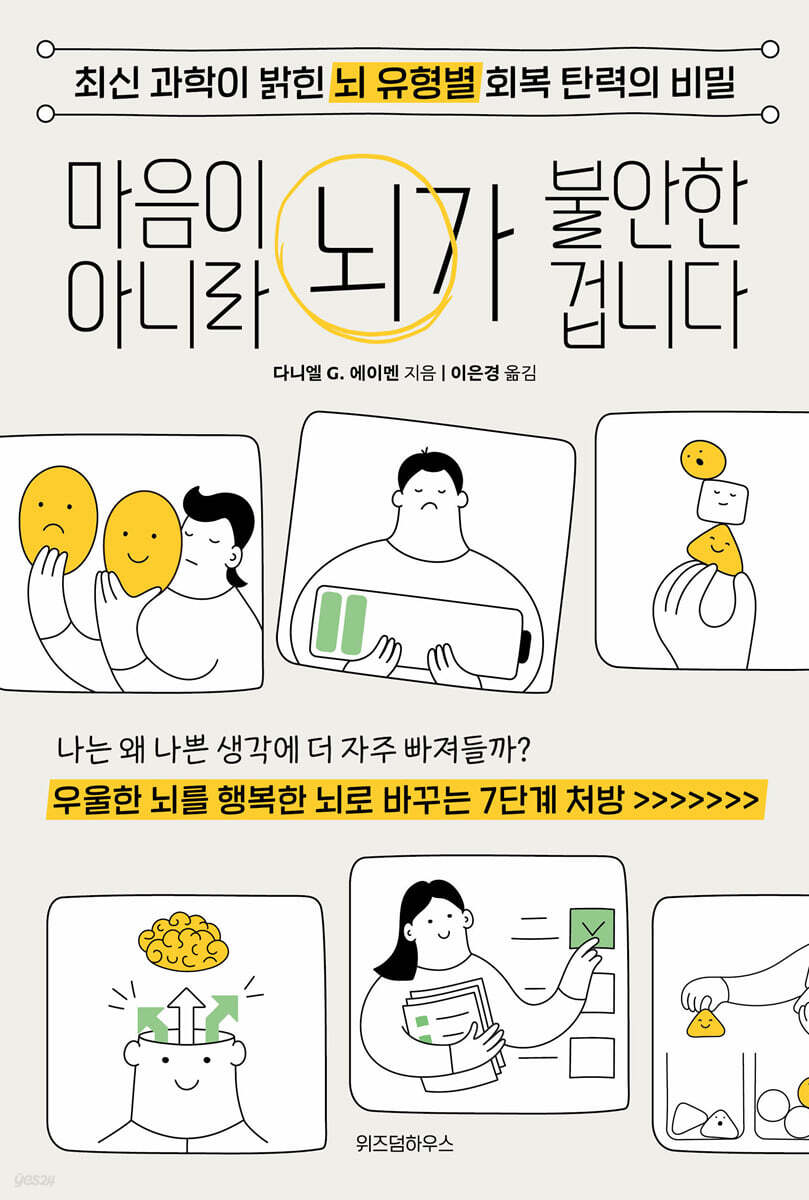
It's not the heart that's anxious, it's the brain.
 |
Description
Book Introduction
“Why do I have negative thoughts more often?”
A 7-Step Prescription for Transforming a Depressed Brain into a Happy Brain Daniel G., hailed as America's most popular psychiatrist. Amen has published a brain health guide for happiness. Dr. Amen, who studied brain scans of more than 225,000 people from 155 countries for over 30 years, discovered that there are separate brains that are "easily happy" and "easily unhappy." This book divides the human brain into five basic types (Balanced Brain, Improvisational Brain, Persistent Brain, Sensitive Brain, and Careful Brain) and eleven complex types, and provides detailed biological and psychological guidance on the vulnerabilities and characteristics of each type and how to maximize brain health. People often believe that achieving more than they already have will make them happy, but Dr. Amen has met countless people who have amassed the wealth and fame that the world envies, yet remain unhappy. And treating them and watching their changes convinced me that happiness comes from a healthy brain, not circumstances. Let's create a brain that becomes happier every day by following his excellent strategy proven by numerous treatment cases. By investing just 10 minutes a day, you can become 30% happier in just 30 days, regardless of your age, upbringing, education, genes, or current situation. |
- You can preview some of the book's contents.
Preview
index
Recommendation
Preface to the Korean edition.
Happiness is the way for us all
Introductory text.
Whatever your brain type, you can become happier in just 30 days.
Chapter 1.
We misunderstand happiness
11 Lies About Happiness
Happiness can be found in the brain
Am I the happy brain type?
Chapter 2.
5 Brain Types That Determine Happiness and Unhappiness
Type 1│Balanced Brain: Thoughtful and Honest Model Citizen
Type 2│Improvisational Brain: Dopamine-addicted, strong in challenge and vulnerable to boredom
Type 3│The Persistent Brain: Obsessive-compulsive, accustomed to rules, arguments, and criticism
Type 4│Sensitive Brain: Emotion-centered type, good at empathy and vulnerable to external stimuli
Type 5│Cautious Brain: Risk-Averse, Easily Overwhelmed by Anxiety
Chapter 3.
Lifestyle Habits: Break the Daily Patterns That Trigger Sadness
Smart people are happier
Let's provide nutrients that suit my brain type.
Food that brings happiness, food that brings unhappiness
Chapter 4.
Psychological Habits: Train Your Anxious Brain in 10 Minutes a Day
How to Hardwire Happiness into Your Nervous System
Positivity bias training to turn your mind towards the good side
Let's reset our reasons for being happy.
Chapter 5.
Relationship Habits: Humans Need Connection to Be Happy
RELATING: 8 Guidelines for Building Healthy Relationships
The value of happiness connected to the world
Outgoing Post Your happiness must be lasting
Preface to the Korean edition.
Happiness is the way for us all
Introductory text.
Whatever your brain type, you can become happier in just 30 days.
Chapter 1.
We misunderstand happiness
11 Lies About Happiness
Happiness can be found in the brain
Am I the happy brain type?
Chapter 2.
5 Brain Types That Determine Happiness and Unhappiness
Type 1│Balanced Brain: Thoughtful and Honest Model Citizen
Type 2│Improvisational Brain: Dopamine-addicted, strong in challenge and vulnerable to boredom
Type 3│The Persistent Brain: Obsessive-compulsive, accustomed to rules, arguments, and criticism
Type 4│Sensitive Brain: Emotion-centered type, good at empathy and vulnerable to external stimuli
Type 5│Cautious Brain: Risk-Averse, Easily Overwhelmed by Anxiety
Chapter 3.
Lifestyle Habits: Break the Daily Patterns That Trigger Sadness
Smart people are happier
Let's provide nutrients that suit my brain type.
Food that brings happiness, food that brings unhappiness
Chapter 4.
Psychological Habits: Train Your Anxious Brain in 10 Minutes a Day
How to Hardwire Happiness into Your Nervous System
Positivity bias training to turn your mind towards the good side
Let's reset our reasons for being happy.
Chapter 5.
Relationship Habits: Humans Need Connection to Be Happy
RELATING: 8 Guidelines for Building Healthy Relationships
The value of happiness connected to the world
Outgoing Post Your happiness must be lasting
Detailed image

Into the book
Contrary to popular belief, happiness is not exclusive to the rich, famous, lucky, or beautiful.
I've treated many people like this, and they are some of the most unfortunate people I know.
You don't have to win the genetic lottery to be happy, and you're not doomed to always be depressed just because life doesn't go your way.
By leveraging practical neuroscience and understanding the seven secrets to happiness no one's talking about, you can learn how to consistently generate positive emotions, regardless of your age, income, or circumstances.
---From "11 Lies About Happiness" on page 18, chapter 1
Fame also initially increases dopamine levels.
Because having many people see and recognize your achievements fulfills many basic human needs (achievement, attention, security, affection, etc.).
The more pleasure you get, the more you want, and over time, your pleasure center becomes damaged, leaving you feeling listless and depressed.
Over the course of my career, I have treated countless celebrities, from Olympic athletes, professional golfers, soccer players, hockey players, baseball players, and basketball players to Oscar-winning actors, Hall of Fame musicians, politicians, Pulitzer Prize-winning authors, and models.
The dopamine spike that comes with fame often leads to tolerance, and you need more and more dopamine to feel the same excitement as before.
This is why celebrities resort to drug abuse, infidelity, fast cars, and gambling just to feel comfortable.
Celebrities who are newlyweds are five times more likely to get divorced than the average person.
I pray for young people often.
“God, please don’t let young people become famous before their brains are fully developed.”
---From "Pages 103-104, Chapter 2: The Improvisational Brain: Dopamine-Addicted, Strong to Challenge, Weak to Boredom"
I'm not a sensitive person, but I've always been attracted to people with a sensitive brain type.
That's why I invited one of the pioneers in understanding sensitive people to join the podcast I host with my wife.
He was none other than Dr. Judith Orloff, author of Thriving as an Empath.
Dr. Olof diligently shares how to live well as a “sensitive empath,” saying, “They have beautiful and wonderful abilities, but at the same time, they have to learn self-care to cope with the challenges of living as a highly sensitive person.”
“The secret is not to become less sensitive or dull.
My mother, who was a doctor, always told me, 'Honey, just be a little more numb.
He said, 'You have to get stronger.'
That's not the right answer.
You have to broaden your senses, but you also have to learn how to center yourself.
You have to learn how to draw the line appropriately.
You have to learn to take care of yourself fiercely.
You also need to figure out how to make sure you have enough alone time.
Learn the signs of sensory overload so you can nip it in the bud before it explodes, drives you crazy and causes you to say things you'll regret.
---From "Pages 129-130, Chapter 2: The Sensitive Brain: Emotion-centered type that is good at empathy and vulnerable to external stimuli"
Food is a relationship.
Have you ever been in a bad relationship? I've been in a few, and it was painful.
Too many people have a bad relationship with food.
They like foods that are high in calories, cause obesity, promote diabetes, and cause inflammation.
Let's get smart.
Let's start a new routine where we only love food that rewards us.
If you bought a million-dollar racehorse, would you feed it junk food? Only a fool would do that.
You will want to maintain the value of your investment by feeding your pet a high-quality, nutritious diet.
Aren't you worth much more than that?
---From "Page 257, Chapter 3: Foods that Bring Happiness, Foods that Bring Unhappiness"
Most people don't realize that positive and negative thoughts trigger different chemicals in the brain.
When you think happy thoughts, have a bright idea, or feel a loving emotion, your brain releases happy chemicals like dopamine, serotonin, and calming endorphins.
When you think negative thoughts, your brain releases or reduces chemicals that make you feel angry, sad, or stressed.
When the stress hormones cortisol (the danger molecule) and adrenaline are released, and the feel-good neurotransmitters dopamine and serotonin decrease, the body's chemistry and brain focus change.
This makes people unhappy.
---From "Pages 320-321, Chapter 4: Positivity Bias Training to Turn Your Mind to a Good Side"
People with an impulsive brain type are easily distracted, so they can easily get carried away while having a conversation.
The persistent brain type cannot wait for the other person to say everything they think, and is more likely to try to judge right from wrong or to refute.
Careful people are often reluctant to ask for clarification because they are too eager to please others, are perfectionists, or are overly sensitive to criticism.
Because I don't want to give the impression that I don't understand properly.
People with sensitive brain types tend to get so caught up in their thoughts that they miss out on the verbal and nonverbal feedback that helps them connect with each other.
No matter what brain type you belong to, try to improve where you lack listening skills.
That would be much more helpful to your relationship.
I've treated many people like this, and they are some of the most unfortunate people I know.
You don't have to win the genetic lottery to be happy, and you're not doomed to always be depressed just because life doesn't go your way.
By leveraging practical neuroscience and understanding the seven secrets to happiness no one's talking about, you can learn how to consistently generate positive emotions, regardless of your age, income, or circumstances.
---From "11 Lies About Happiness" on page 18, chapter 1
Fame also initially increases dopamine levels.
Because having many people see and recognize your achievements fulfills many basic human needs (achievement, attention, security, affection, etc.).
The more pleasure you get, the more you want, and over time, your pleasure center becomes damaged, leaving you feeling listless and depressed.
Over the course of my career, I have treated countless celebrities, from Olympic athletes, professional golfers, soccer players, hockey players, baseball players, and basketball players to Oscar-winning actors, Hall of Fame musicians, politicians, Pulitzer Prize-winning authors, and models.
The dopamine spike that comes with fame often leads to tolerance, and you need more and more dopamine to feel the same excitement as before.
This is why celebrities resort to drug abuse, infidelity, fast cars, and gambling just to feel comfortable.
Celebrities who are newlyweds are five times more likely to get divorced than the average person.
I pray for young people often.
“God, please don’t let young people become famous before their brains are fully developed.”
---From "Pages 103-104, Chapter 2: The Improvisational Brain: Dopamine-Addicted, Strong to Challenge, Weak to Boredom"
I'm not a sensitive person, but I've always been attracted to people with a sensitive brain type.
That's why I invited one of the pioneers in understanding sensitive people to join the podcast I host with my wife.
He was none other than Dr. Judith Orloff, author of Thriving as an Empath.
Dr. Olof diligently shares how to live well as a “sensitive empath,” saying, “They have beautiful and wonderful abilities, but at the same time, they have to learn self-care to cope with the challenges of living as a highly sensitive person.”
“The secret is not to become less sensitive or dull.
My mother, who was a doctor, always told me, 'Honey, just be a little more numb.
He said, 'You have to get stronger.'
That's not the right answer.
You have to broaden your senses, but you also have to learn how to center yourself.
You have to learn how to draw the line appropriately.
You have to learn to take care of yourself fiercely.
You also need to figure out how to make sure you have enough alone time.
Learn the signs of sensory overload so you can nip it in the bud before it explodes, drives you crazy and causes you to say things you'll regret.
---From "Pages 129-130, Chapter 2: The Sensitive Brain: Emotion-centered type that is good at empathy and vulnerable to external stimuli"
Food is a relationship.
Have you ever been in a bad relationship? I've been in a few, and it was painful.
Too many people have a bad relationship with food.
They like foods that are high in calories, cause obesity, promote diabetes, and cause inflammation.
Let's get smart.
Let's start a new routine where we only love food that rewards us.
If you bought a million-dollar racehorse, would you feed it junk food? Only a fool would do that.
You will want to maintain the value of your investment by feeding your pet a high-quality, nutritious diet.
Aren't you worth much more than that?
---From "Page 257, Chapter 3: Foods that Bring Happiness, Foods that Bring Unhappiness"
Most people don't realize that positive and negative thoughts trigger different chemicals in the brain.
When you think happy thoughts, have a bright idea, or feel a loving emotion, your brain releases happy chemicals like dopamine, serotonin, and calming endorphins.
When you think negative thoughts, your brain releases or reduces chemicals that make you feel angry, sad, or stressed.
When the stress hormones cortisol (the danger molecule) and adrenaline are released, and the feel-good neurotransmitters dopamine and serotonin decrease, the body's chemistry and brain focus change.
This makes people unhappy.
---From "Pages 320-321, Chapter 4: Positivity Bias Training to Turn Your Mind to a Good Side"
People with an impulsive brain type are easily distracted, so they can easily get carried away while having a conversation.
The persistent brain type cannot wait for the other person to say everything they think, and is more likely to try to judge right from wrong or to refute.
Careful people are often reluctant to ask for clarification because they are too eager to please others, are perfectionists, or are overly sensitive to criticism.
Because I don't want to give the impression that I don't understand properly.
People with sensitive brain types tend to get so caught up in their thoughts that they miss out on the verbal and nonverbal feedback that helps them connect with each other.
No matter what brain type you belong to, try to improve where you lack listening skills.
That would be much more helpful to your relationship.
---From "Relating: 8 Guidelines for Creating Healthy Relationships" on page 362, Chapter 5
Publisher's Review
“Happiness isn’t out there, it’s in your brain.”
Analysis of brain scans of 225,000 people from 155 countries reveals
The most scientific and simple truth about happiness
The number of people complaining of depression and anxiety is rapidly increasing worldwide.
High unemployment, a shattered economy, and persistent social isolation have led to a sharp surge in new prescriptions for antidepressants, anti-anxiety medications, and sleep aids. According to OECD depression prevalence statistics by country, South Korea has the highest prevalence of depression since the COVID-19 pandemic.
In its wake, interest in meditation and mindfulness has grown, but many people complain that no matter how much they practice, it is not easy to control their mind.
Daniel G.
Amen advises these people to look into their 'brain' rather than their 'heart' first.
The brain is the organ that controls happiness.
A healthy brain makes us happier, healthier, wealthier, and more successful in everything we do, including our relationships and work, as a result of better decisions.
The quality of our decisions (our brain function) is the common denominator that determines our happiness and success in all areas of life.
_From the text
New York Times bestselling author and renowned neuroscientist Daniel G.
Dr. Amen has studied brain scans of more than 225,000 people from 155 countries, regardless of nationality, age, or gender, for over 30 years.
And we discovered five brain types that influence happiness (the balanced brain, the spontaneous brain, the persistent brain, the sensitive brain, and the cautious brain) and seven neuroscience secrets directly related to happiness.
This book, "It's Not Your Heart, It's Your Brain That's Anxious," compiles the research and treatment cases, offering practical strategies for optimizing happiness based on your brain type.
“How does the brain interfere with our happiness?”
We cannot change the circumstances that cause unhappiness,
The hormones that detect unhappiness can be controlled.
According to Dr. Amen's research, people experience significant differences in the scale and degree of happiness and unhappiness depending on their brain type, that is, how their brains function in the same situation.
That's why the world's overflowing advice on happiness doesn't consistently help everyone.
This book provides a brain type test developed by Dr. Amen after 30 years of research, and provides detailed guidance on the vulnerabilities and characteristics of each type, how to maximize brain health, and how to pursue small happiness in everyday life.
By understanding which stimuli each brain type is most susceptible to, which hormones involved in mood and emotion, work and learning ability are most active and which are lacking, and in what situations one becomes easily happy or sad, one can also discover why the painstaking efforts to become happy have only exhausted one.
Furthermore, by understanding the brain types of yourself and those close to you, you may be able to find solutions to recurring conflicts and communication problems.
We cannot control the external circumstances that make us unhappy.
But the brain can be changed at any time.
In fact, when Dr. Amen began his brain research at age 37, his brain was seriously aged for his age.
Afterwards, as a result of practicing brain-friendly eating and lifestyle habits, his brain became surprisingly healthy, and his quality of life naturally improved.
His method of restoring brain health, proven by numerous treatment cases, systematically guides you through both biological and psychological fields.
Dr. Amen is confident that by investing just 10 minutes a day, you can become 30% happier in just 30 days, regardless of your age, upbringing, education, genes, or current situation.
“Why should you be happy?”
If the more you struggle to be happy, the more exhausted you become
We need to re-establish our reasons for being happy.
Dr. Amen, who has been a psychiatrist for over 40 years, has confirmed that happiness is a universal goal for all people.
That's why we've been working with the belief that more people will find sustainable happiness in easier, faster, and simpler ways.
As part of this, we launched the '30-Day Happiness Challenge' program for people struggling in the aftermath of the 2001 pandemic, and confirmed a dramatic psychological change in the 32,000 people who participated in the project.
The biggest change for participants was that they became clear about what kind of happiness they wanted by accurately identifying their desires and vision.
The final condition for 'sustainable happiness' that Dr. Amen emphasizes is your own reason for being happy.
This book helps you discover what truly makes you happy, not the values or vague desires of those around you or society.
Why do you strive for happiness? If you can't clearly answer this question, I hope this book will help you rediscover the true value of your life.
“Once you discover what motivates you to be happy, you’re much more likely to be happy,” says Dr. Amen.
If you have a healthy brain, healthy psychological habits, and your own motivation for life, your happiness will be much richer and more solid.
Analysis of brain scans of 225,000 people from 155 countries reveals
The most scientific and simple truth about happiness
The number of people complaining of depression and anxiety is rapidly increasing worldwide.
High unemployment, a shattered economy, and persistent social isolation have led to a sharp surge in new prescriptions for antidepressants, anti-anxiety medications, and sleep aids. According to OECD depression prevalence statistics by country, South Korea has the highest prevalence of depression since the COVID-19 pandemic.
In its wake, interest in meditation and mindfulness has grown, but many people complain that no matter how much they practice, it is not easy to control their mind.
Daniel G.
Amen advises these people to look into their 'brain' rather than their 'heart' first.
The brain is the organ that controls happiness.
A healthy brain makes us happier, healthier, wealthier, and more successful in everything we do, including our relationships and work, as a result of better decisions.
The quality of our decisions (our brain function) is the common denominator that determines our happiness and success in all areas of life.
_From the text
New York Times bestselling author and renowned neuroscientist Daniel G.
Dr. Amen has studied brain scans of more than 225,000 people from 155 countries, regardless of nationality, age, or gender, for over 30 years.
And we discovered five brain types that influence happiness (the balanced brain, the spontaneous brain, the persistent brain, the sensitive brain, and the cautious brain) and seven neuroscience secrets directly related to happiness.
This book, "It's Not Your Heart, It's Your Brain That's Anxious," compiles the research and treatment cases, offering practical strategies for optimizing happiness based on your brain type.
“How does the brain interfere with our happiness?”
We cannot change the circumstances that cause unhappiness,
The hormones that detect unhappiness can be controlled.
According to Dr. Amen's research, people experience significant differences in the scale and degree of happiness and unhappiness depending on their brain type, that is, how their brains function in the same situation.
That's why the world's overflowing advice on happiness doesn't consistently help everyone.
This book provides a brain type test developed by Dr. Amen after 30 years of research, and provides detailed guidance on the vulnerabilities and characteristics of each type, how to maximize brain health, and how to pursue small happiness in everyday life.
By understanding which stimuli each brain type is most susceptible to, which hormones involved in mood and emotion, work and learning ability are most active and which are lacking, and in what situations one becomes easily happy or sad, one can also discover why the painstaking efforts to become happy have only exhausted one.
Furthermore, by understanding the brain types of yourself and those close to you, you may be able to find solutions to recurring conflicts and communication problems.
We cannot control the external circumstances that make us unhappy.
But the brain can be changed at any time.
In fact, when Dr. Amen began his brain research at age 37, his brain was seriously aged for his age.
Afterwards, as a result of practicing brain-friendly eating and lifestyle habits, his brain became surprisingly healthy, and his quality of life naturally improved.
His method of restoring brain health, proven by numerous treatment cases, systematically guides you through both biological and psychological fields.
Dr. Amen is confident that by investing just 10 minutes a day, you can become 30% happier in just 30 days, regardless of your age, upbringing, education, genes, or current situation.
“Why should you be happy?”
If the more you struggle to be happy, the more exhausted you become
We need to re-establish our reasons for being happy.
Dr. Amen, who has been a psychiatrist for over 40 years, has confirmed that happiness is a universal goal for all people.
That's why we've been working with the belief that more people will find sustainable happiness in easier, faster, and simpler ways.
As part of this, we launched the '30-Day Happiness Challenge' program for people struggling in the aftermath of the 2001 pandemic, and confirmed a dramatic psychological change in the 32,000 people who participated in the project.
The biggest change for participants was that they became clear about what kind of happiness they wanted by accurately identifying their desires and vision.
The final condition for 'sustainable happiness' that Dr. Amen emphasizes is your own reason for being happy.
This book helps you discover what truly makes you happy, not the values or vague desires of those around you or society.
Why do you strive for happiness? If you can't clearly answer this question, I hope this book will help you rediscover the true value of your life.
“Once you discover what motivates you to be happy, you’re much more likely to be happy,” says Dr. Amen.
If you have a healthy brain, healthy psychological habits, and your own motivation for life, your happiness will be much richer and more solid.
GOODS SPECIFICS
- Date of issue: July 26, 2023
- Page count, weight, size: 416 pages | 556g | 145*215*20mm
- ISBN13: 9791168126749
- ISBN10: 1168126746
You may also like
카테고리
korean


korean

![GQ KOREA Mark (Monthly): December [2025]](http://librairie.coreenne.fr/cdn/shop/files/8ef265dbbfbf186523ed75ba7319009d.jpg?v=1765340328&width=3840)


