

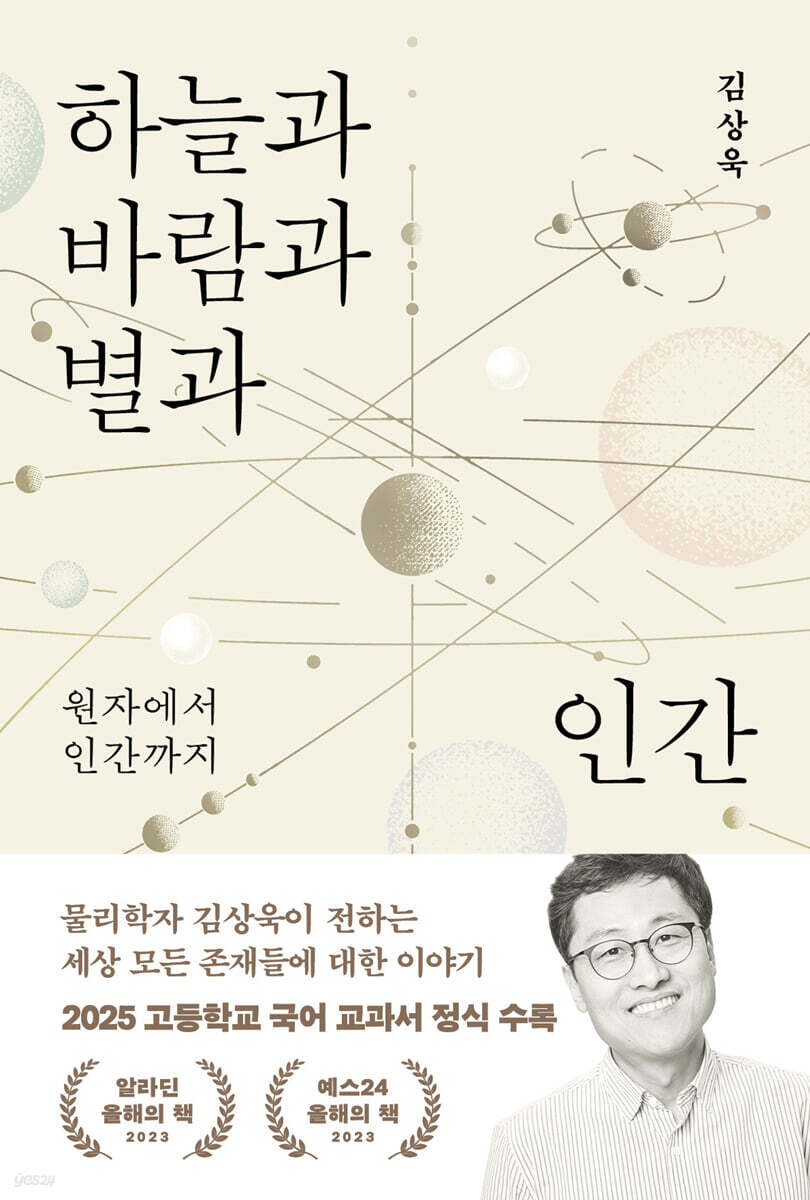
Sky, wind, stars, and humans
 |
Description
Book Introduction
|
Kim Sang-wook's first new book in five years
Kim Sang-wook, the affectionate physicist of "All-purpose Workbook," has returned with a new book after five years as a solo author. This time, we go beyond the boundaries of physics and talk about all beings in the world, from atoms to humans. The author begins with elementary particles and atoms, and progresses through the layers of existence one by one, exploring how matter, life, and even the universe and humanity are intertwined. He also shows how the universe, once perceived as cold, can be warm through the eyes of a physicist. This book offers a comprehensive look at the intellectual world of Kim Sang-wook, a boy whose curiosity to understand the world expanded from physics to chemistry, from chemistry to biology, and then back to the humanities. |
- You can preview some of the book's contents.
Preview
index
Introduction
Sky, wind, stars, and humans.
I wanted to understand everything that exists
How did one atom become everything?
Chapter 1: On the Nature of Things - The Secret of the Atoms That Make Up All Things
Chapter 2 My Name is Atom - Atom's Profile
Chapter 3: Three Ways Matter Is Made: How Atoms Become Everything
To a physicist, God is the greatest imagination humans have ever created to live together.
2 How the stars become us
Chapter 4: The Earth from a Physics Perspective - Most of the Things on Earth
Chapter 5: The Core, Stars, and the Source of Energy - In Search of the Source of Earth's Energy
Chapter 6: The Mystery of the Universe Created by Elementary Particles - Does the Smallest Connect to the Biggest?
To a physicist, death means: the universe is filled with death, and we live forever as atoms.
3 Life, a wondrous coincidence that blossomed in the universe
Chapter 7: Living Things Are Chemical Machines: The Chemistry of Life Through the Eyes of a Physicist
Chapter 8: Are Living Things Information-Processing Machines? ─ Why Do People Give Birth to People, and Cats Give Birth to Cats?
Chapter 9: The First Life and Evolution: A Miracle Created by Accumulated Change
Chapter 10: From Multicellular Organisms to Humans: The Grand History of Life on Earth
Love for a Physicist: A Universe of Inevitability and the Ultimate Coincidence
4 Beyond feeling to imagination
Chapter 11: How We Became Homo Sapiens: A Physicist's View of Homo Sapiens
Chapter 12: I exist, and I think too - What is information?
Chapter 13: Feelings and Imagination, What Makes Humans Special - From Feelings to Imagination and Culture
The text that appears
Part and whole
Sky, wind, stars, and humans.
I wanted to understand everything that exists
How did one atom become everything?
Chapter 1: On the Nature of Things - The Secret of the Atoms That Make Up All Things
Chapter 2 My Name is Atom - Atom's Profile
Chapter 3: Three Ways Matter Is Made: How Atoms Become Everything
To a physicist, God is the greatest imagination humans have ever created to live together.
2 How the stars become us
Chapter 4: The Earth from a Physics Perspective - Most of the Things on Earth
Chapter 5: The Core, Stars, and the Source of Energy - In Search of the Source of Earth's Energy
Chapter 6: The Mystery of the Universe Created by Elementary Particles - Does the Smallest Connect to the Biggest?
To a physicist, death means: the universe is filled with death, and we live forever as atoms.
3 Life, a wondrous coincidence that blossomed in the universe
Chapter 7: Living Things Are Chemical Machines: The Chemistry of Life Through the Eyes of a Physicist
Chapter 8: Are Living Things Information-Processing Machines? ─ Why Do People Give Birth to People, and Cats Give Birth to Cats?
Chapter 9: The First Life and Evolution: A Miracle Created by Accumulated Change
Chapter 10: From Multicellular Organisms to Humans: The Grand History of Life on Earth
Love for a Physicist: A Universe of Inevitability and the Ultimate Coincidence
4 Beyond feeling to imagination
Chapter 11: How We Became Homo Sapiens: A Physicist's View of Homo Sapiens
Chapter 12: I exist, and I think too - What is information?
Chapter 13: Feelings and Imagination, What Makes Humans Special - From Feelings to Imagination and Culture
The text that appears
Part and whole
Detailed image
.jpg)
Into the book
The 'collection' of atoms called 'I' will disappear with death, but the atoms that made me up will become part of another 'collection'.
In this way, we become part of the universe and become immortal.
---From “Chapter 1, On the Nature of Things, p. 48”
Everything in the world is made of atoms.
We can't reduce everything in the world to atoms, but atoms tell us why the world is the way it is.
---From "Chapter 2 My Name is Atomic, page 72"
Ultimately, we conclude that it is best to apply different rules depending on the level.
Many things are different.
---From "Chapter 3, Three Ways to Create Matter, p. 99"
When we die, we return to dust, to the Earth.
This is not a poetic expression, but a scientific fact.
In this way, all things are made of atoms.
---From "Chapter 4, The Earth from a Physics Perspective, p. 144"
The atomic nuclei that make up our bodies form the unchanging foundation of matter, but the atomic nuclei of stars split and combine to create the energy that moves the universe.
The energy created by the sacrifice of one nucleus drives the movement of matter created from another nucleus.
In this way, the universe is like one giant organism made up of atoms.
---From "Chapter 5: Nuclei, Stars, and the Source of Energy, p. 166"
Understanding atoms will change the very face of human civilization.
The fact that computers, TVs, plastics, smartphones, the Internet, fluorescent lights, synthetic fibers, antibiotics, satellites, and biotechnology, which did not exist in the 19th century, appeared in the 20th century is because humans understood atoms in the early 20th century.
---From "Chapter 6: The Mystery of the Universe Created by Elementary Particles, p. 190"
As we have seen, the process of creating energy through breathing is nothing more than a chain of chemical reactions.
We say that chemical reactions that occur sequentially like this are alive.
The atoms used in life are the same atoms used in non-living matter.
Life is a chemical machine made of atoms.
---From "Chapter 7: Living Things Are Chemical Machines, p. 228"
It is not widely known that physicists have made significant contributions to uncovering the central principles of biology.
On April 25, 1953, a paper on the structure of DNA was published in Nature.
In July of that year, Watson and Crick received a letter from a physicist named George Gamow.
Gamow proposed that the four bases that make up DNA could be viewed as a string of four bits, and that the code of life could be discovered using mathematics such as number theory and combinatorics.
---From "Chapter 8: Are Living Things Information Processing Machines?, p. 256"
If replication including errors exists, evolution is inevitable.
There is no intention or purpose here.
It's just a matter of saying that good things bring good results, and more brings more.
To physicists, evolution is just a given.
Great ideas are obvious once you know them.
---From "Chapter 9, The First Life Forms and Evolution, p. 268"
What's worse is that human activities are causing the Earth's average temperature to rise.
Such climate change is likely to disrupt ecosystems much more dramatically.
Of course, living things will adapt to new environments.
But when mass extinctions occur, the top predators always go extinct.
For reference, the top predator right now is humans.
---From "Chapter 10, From Multicellular Organisms to Humans, p. 304"
The story of the cognitive revolution and our ability to believe in fiction is of great interest to physicists.
Physics fundamentally tries to understand the world based on matter.
It means materialistic.
All physical quantities can be directly measured and quantitatively treated.
Comparing physical quantities like position, velocity, mass, energy, and charge to concepts like love, justice, and morality reveals how material they are.
Through the cognitive revolution, humans have created a fictional realm beyond the reach of physics.
Fiction is the foundation on which humans form society and build civilization.
---From "Chapter 11: How We Became Homo Sapiens, p. 330"
We still don't know what consciousness is, what thinking is.
But meaning is not necessary in the process of making consciousness and thought exist.
This is a surprising conclusion that information science has discovered.
In this way, we become part of the universe and become immortal.
---From “Chapter 1, On the Nature of Things, p. 48”
Everything in the world is made of atoms.
We can't reduce everything in the world to atoms, but atoms tell us why the world is the way it is.
---From "Chapter 2 My Name is Atomic, page 72"
Ultimately, we conclude that it is best to apply different rules depending on the level.
Many things are different.
---From "Chapter 3, Three Ways to Create Matter, p. 99"
When we die, we return to dust, to the Earth.
This is not a poetic expression, but a scientific fact.
In this way, all things are made of atoms.
---From "Chapter 4, The Earth from a Physics Perspective, p. 144"
The atomic nuclei that make up our bodies form the unchanging foundation of matter, but the atomic nuclei of stars split and combine to create the energy that moves the universe.
The energy created by the sacrifice of one nucleus drives the movement of matter created from another nucleus.
In this way, the universe is like one giant organism made up of atoms.
---From "Chapter 5: Nuclei, Stars, and the Source of Energy, p. 166"
Understanding atoms will change the very face of human civilization.
The fact that computers, TVs, plastics, smartphones, the Internet, fluorescent lights, synthetic fibers, antibiotics, satellites, and biotechnology, which did not exist in the 19th century, appeared in the 20th century is because humans understood atoms in the early 20th century.
---From "Chapter 6: The Mystery of the Universe Created by Elementary Particles, p. 190"
As we have seen, the process of creating energy through breathing is nothing more than a chain of chemical reactions.
We say that chemical reactions that occur sequentially like this are alive.
The atoms used in life are the same atoms used in non-living matter.
Life is a chemical machine made of atoms.
---From "Chapter 7: Living Things Are Chemical Machines, p. 228"
It is not widely known that physicists have made significant contributions to uncovering the central principles of biology.
On April 25, 1953, a paper on the structure of DNA was published in Nature.
In July of that year, Watson and Crick received a letter from a physicist named George Gamow.
Gamow proposed that the four bases that make up DNA could be viewed as a string of four bits, and that the code of life could be discovered using mathematics such as number theory and combinatorics.
---From "Chapter 8: Are Living Things Information Processing Machines?, p. 256"
If replication including errors exists, evolution is inevitable.
There is no intention or purpose here.
It's just a matter of saying that good things bring good results, and more brings more.
To physicists, evolution is just a given.
Great ideas are obvious once you know them.
---From "Chapter 9, The First Life Forms and Evolution, p. 268"
What's worse is that human activities are causing the Earth's average temperature to rise.
Such climate change is likely to disrupt ecosystems much more dramatically.
Of course, living things will adapt to new environments.
But when mass extinctions occur, the top predators always go extinct.
For reference, the top predator right now is humans.
---From "Chapter 10, From Multicellular Organisms to Humans, p. 304"
The story of the cognitive revolution and our ability to believe in fiction is of great interest to physicists.
Physics fundamentally tries to understand the world based on matter.
It means materialistic.
All physical quantities can be directly measured and quantitatively treated.
Comparing physical quantities like position, velocity, mass, energy, and charge to concepts like love, justice, and morality reveals how material they are.
Through the cognitive revolution, humans have created a fictional realm beyond the reach of physics.
Fiction is the foundation on which humans form society and build civilization.
---From "Chapter 11: How We Became Homo Sapiens, p. 330"
We still don't know what consciousness is, what thinking is.
But meaning is not necessary in the process of making consciousness and thought exist.
This is a surprising conclusion that information science has discovered.
---From "Chapter 12 I Exist, and I Think, Page 360"
Publisher's Review
Physicist Kim Sang-wook reports
Stories about all beings in the world
“This book is a journey of ups and downs, crossing boundaries to understand the world, and a guidebook for anyone who wants to know everything about the world.” ─ Kim Sang-wook
The sky, the wind, the stars, and humans,
The Universe and Humanity as Seen by Physicist Sangwook Kim
After five years of work, the affectionate physicist Kim Sang-wook returns to tell stories about all beings in the world through the language of science.
The title of this book, 'Sky, Wind, Stars, and Humans,' inspired by poet Yun Dong-ju's poetry collection, contains the author's desire to understand everything that exists.
The author says that the sky represents the universe and its laws, the wind represents time and space, and the stars represent matter and energy.
Adding humans to this, 'the sky, the wind, the stars, and humans' encompasses all the subjects that physicist Kim Sang-wook seeks to address in this book.
The author begins with atoms, moves from atoms to molecules, from molecules to matter, from matter to life, and from life to humans, climbing the layers of existence to meticulously depict the meaning of his usual saying, “Everything is made of atoms.”
I guide you through this daring journey from a physicist's perspective, but not with the imperialist attitude of physics that everything can be reduced to physics.
Rather, he says we need to go beyond physics to understand everything in the world.
Because as you ascend each level, new characteristics of existence emerge.
This is also why the whole cannot be the sum of its parts.
The author affirms the value of various beings that have blossomed in the inevitable universe and casts a warm gaze on all things that exist in the world.
From atoms to humans,
A feast of life and science in one volume
The author became a physicist because he wanted to understand the world, but after a long period of study, he came to the conclusion that understanding the world requires a variety of fields of study beyond physics.
Physics and the universe are not human, and are better understood without humans.
This means, conversely, that understanding humans requires a completely different approach than physics.
The author expands the boundaries from physics to chemistry, from chemistry to biology, and from biology to anthropology, telling readers what it means to understand the world from a physicist's perspective.
This book is a journey of a physicist who crossed boundaries to understand the world, and a guidebook for anyone who wants to know everything about the world.
The world seen by physicists seems to be filled only with the cold movements of atoms and molecules.
But the world that Kim Sang-wook draws in the language of science is not like that.
This book begins with the inhuman atom, but it offers a new perspective on the world and sometimes a comforting glimpse into its multifaceted relationship with the atom, the stars, the Earth, life, and us.
The author speaks of death from an atomic perspective:
“Death is not the destruction of atoms, but their rearrangement.
Even when I die, the atoms that make up my body scatter and become part of something else.
The saying, 'From dust we come and to dust we return' is not a beautiful metaphor, but a scientific fact.
"Thus, we exist eternally through atoms." Could there be a more elegant way to express death, humanity's most fundamental problem, in the language of science? As we follow Kim Sang-wook's web of existence, from atoms to humans, we discover that these expressions are not mere rhetoric, as if science dances within life.
New culture for a new era
With Kim Sang-wook, science becomes a form of culture.
Why can't science be a liberal art?
This is one of the issues the author is aware of and the main reason for actively communicating with the public.
The author emphasizes that science is no longer limited to experts; it is essential knowledge that all democratic citizens must know.
In an era where science and technology are driving social change, such as the impact of ChatGPT, scientific knowledge is essential for citizens to make sound judgments.
This book is an individual's effort to understand the world beyond its boundaries, and at the same time, it is a new liberal arts book proposed by physicist Kim Sang-wook for our time, as it synthesizes almost every point reached by modern science, including physics, chemistry, biology, brain science, and information science.
In addition to providing a friendly guide from a well-known author, 『Sky, Wind, Stars, and Humans』 can be said to be a science textbook for everyone living today, as it conveys almost all knowledge of modern science.
Stories about all beings in the world
“This book is a journey of ups and downs, crossing boundaries to understand the world, and a guidebook for anyone who wants to know everything about the world.” ─ Kim Sang-wook
The sky, the wind, the stars, and humans,
The Universe and Humanity as Seen by Physicist Sangwook Kim
After five years of work, the affectionate physicist Kim Sang-wook returns to tell stories about all beings in the world through the language of science.
The title of this book, 'Sky, Wind, Stars, and Humans,' inspired by poet Yun Dong-ju's poetry collection, contains the author's desire to understand everything that exists.
The author says that the sky represents the universe and its laws, the wind represents time and space, and the stars represent matter and energy.
Adding humans to this, 'the sky, the wind, the stars, and humans' encompasses all the subjects that physicist Kim Sang-wook seeks to address in this book.
The author begins with atoms, moves from atoms to molecules, from molecules to matter, from matter to life, and from life to humans, climbing the layers of existence to meticulously depict the meaning of his usual saying, “Everything is made of atoms.”
I guide you through this daring journey from a physicist's perspective, but not with the imperialist attitude of physics that everything can be reduced to physics.
Rather, he says we need to go beyond physics to understand everything in the world.
Because as you ascend each level, new characteristics of existence emerge.
This is also why the whole cannot be the sum of its parts.
The author affirms the value of various beings that have blossomed in the inevitable universe and casts a warm gaze on all things that exist in the world.
From atoms to humans,
A feast of life and science in one volume
The author became a physicist because he wanted to understand the world, but after a long period of study, he came to the conclusion that understanding the world requires a variety of fields of study beyond physics.
Physics and the universe are not human, and are better understood without humans.
This means, conversely, that understanding humans requires a completely different approach than physics.
The author expands the boundaries from physics to chemistry, from chemistry to biology, and from biology to anthropology, telling readers what it means to understand the world from a physicist's perspective.
This book is a journey of a physicist who crossed boundaries to understand the world, and a guidebook for anyone who wants to know everything about the world.
The world seen by physicists seems to be filled only with the cold movements of atoms and molecules.
But the world that Kim Sang-wook draws in the language of science is not like that.
This book begins with the inhuman atom, but it offers a new perspective on the world and sometimes a comforting glimpse into its multifaceted relationship with the atom, the stars, the Earth, life, and us.
The author speaks of death from an atomic perspective:
“Death is not the destruction of atoms, but their rearrangement.
Even when I die, the atoms that make up my body scatter and become part of something else.
The saying, 'From dust we come and to dust we return' is not a beautiful metaphor, but a scientific fact.
"Thus, we exist eternally through atoms." Could there be a more elegant way to express death, humanity's most fundamental problem, in the language of science? As we follow Kim Sang-wook's web of existence, from atoms to humans, we discover that these expressions are not mere rhetoric, as if science dances within life.
New culture for a new era
With Kim Sang-wook, science becomes a form of culture.
Why can't science be a liberal art?
This is one of the issues the author is aware of and the main reason for actively communicating with the public.
The author emphasizes that science is no longer limited to experts; it is essential knowledge that all democratic citizens must know.
In an era where science and technology are driving social change, such as the impact of ChatGPT, scientific knowledge is essential for citizens to make sound judgments.
This book is an individual's effort to understand the world beyond its boundaries, and at the same time, it is a new liberal arts book proposed by physicist Kim Sang-wook for our time, as it synthesizes almost every point reached by modern science, including physics, chemistry, biology, brain science, and information science.
In addition to providing a friendly guide from a well-known author, 『Sky, Wind, Stars, and Humans』 can be said to be a science textbook for everyone living today, as it conveys almost all knowledge of modern science.
GOODS SPECIFICS
- Date of issue: May 26, 2023
- Page count, weight, size: 404 pages | 644g | 152*225*26mm
- ISBN13: 9791166891496
- ISBN10: 1166891496
You may also like
카테고리
korean


korean

![GQ KOREA Mark (Monthly): December [2025]](http://librairie.coreenne.fr/cdn/shop/files/8ef265dbbfbf186523ed75ba7319009d.jpg?v=1765340328&width=3840)


