

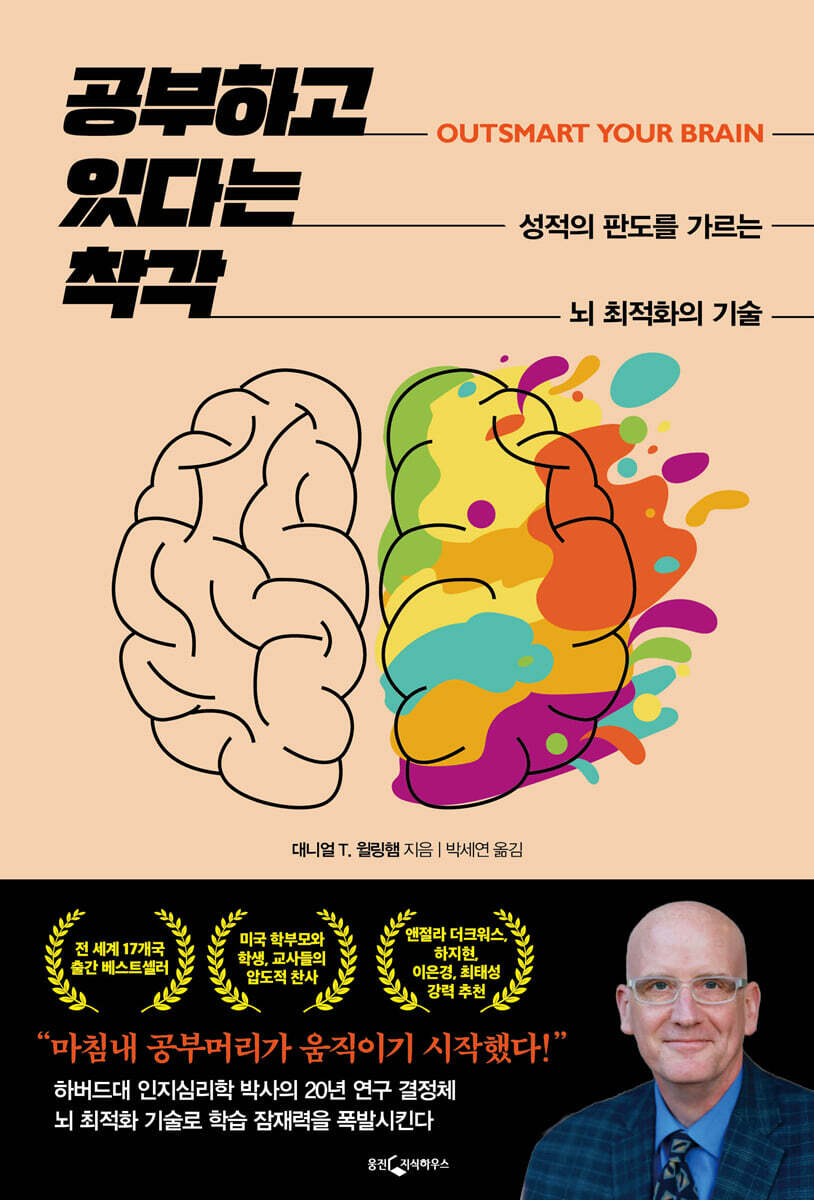
The illusion of studying
 |
Description
Book Introduction
“My brain is finally starting to work!”
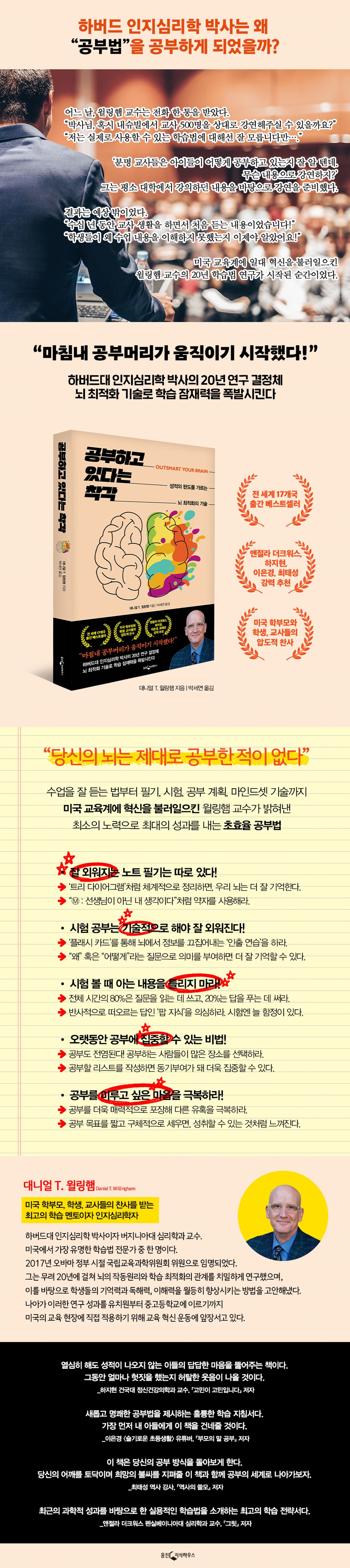
The culmination of 20 years of research by a Harvard cognitive psychology doctorate Unleash your learning potential with brain optimization technology. There is a person who is called “a leading figure in cognitive psychology research,” “America’s best learning mentor,” and “a neuroscientist who changed the paradigm of study methods.” Daniel T., a Ph.D. in cognitive psychology from Harvard University and a professor of psychology at the University of Virginia, Willingham revolutionized American education by establishing a "brain science study method" that anyone can apply to immediately improve their grades. Professor Willingham happened to give a lecture to 500 teachers, and it was then that he realized that his students were studying incorrectly, so he began researching study methods. "The Illusion of Studying" is a book that contains the results of his 20 years of research, and it identifies and addresses 14 of the biggest study concerns students have. Professor Willingham sharply analyzes the causes of anxiety from a neuroscientist's perspective and offers specific tips for overcoming them. This book, which contains brain optimization techniques and practical study methods from the world's leading learning authority, will serve as a solid study strategy guide for students unsure of their own study methods, parents who want to help their children improve their grades, teachers who want to effectively convey lesson content to students, and adults who want to achieve high achievement. |
- You can preview some of the book's contents.
Preview
index
Going Beyond the Brain's Commands That Interfere with Studying
Why Cognitive Psychologists Study 'Study'│Why We Need to Go Beyond the Brain│How to Use This Book
Chapter 1: Why can't I understand the class content?
Let's extract structure from class. Classes aren't just about 'listening.' Class materials can't replace written notes. Decide when to do reading assignments. Overcome the reluctance to ask questions.
To the teacher, repeat the lecture outline and check for student understanding.
Chapter 2 What and how should I write it down?
Study begins with preparation│Decide which is more important: understanding or taking notes│Write by hand rather than using a notebook│Check your notes on the spot│Don't follow popular note-taking methods│Use abbreviations to write more│Recording classes cannot replace taking notes
Teachers: _ Leave as much room as possible for students to take as many notes as possible.
Chapter 3: Grasp the Core of Experiential Activities and Practice
Why is active learning necessary? │ Decide what to focus on │ Overcome the 'curse of knowledge' │ Attend and participate unconditionally │ Check the lesson objectives when doing analogical activities │ How to extract lesson objectives from the script │ Choose, get feedback, and reflect on your own │ Experience and practice are different │ Plan in advance what to observe │ Don't forget to take notes during the experience │ Look at it from the teacher's perspective
Let's give the teacher the objectives of the activity class and break down the instructions.
Chapter 4: Note-taking Techniques to Engrave What You Learn into Your Brain
Organize well and remember well│Find connections between notes│Find logical loopholes in your notes│Note-taking is also a team sport│Ask your teacher specific questions to reinforce your notes│Decorating your notes is optional
Let the teacher realize that his note-taking is imperfect.
Chapter 5: There are separate strategies for reading difficult texts.
Don't underline while reading│Be sure to think about your purpose before reading│Skills for summarizing and taking notes while reading textbooks│Invest time in reading textbooks
To the teacher, if you want to read deeply, give appropriate assignments.
Chapter 6: Super-Efficient Test Study Methods to Boost Your Grades
Forget the usual memory techniques│Preparing to study is studying│Release your memories with a study guide│Don't look at ready-made materials│You remember better when you give meaning to them│Three memory techniques to memorize meaningless content│Improve the quality of your studies by using a study guide│Don't distrust your own study methods│Don't go to study empty-handed│Why cramming doesn't help│Compare cases to prepare for application problems│Set subgoals to prepare for variation problems
Teachers, let your students know in advance how to study.
Chapter 7: Last Things to Remember Before the Exam
You Think You Know, But You Actually Don't│What Does "Know" Mean│We Think We Know When We Reread│Take a Self-Test│Don't Check How Much You Know with Past Questions│Overstudy by 115%
Let teachers know what students need to know.
Chapter 8: How to Get Your Brain to Answer the Right Question When Taking a Test
Don't make mistakes when you already know them. Learn how to deal with test anxiety. Imagine the classroom as your own room. Develop answers from test questions. Keep reviewing your answers even after you've written them down. Be skeptical of the "pop knowledge" that comes to mind. Ask your teacher if you're unsure about a question. Don't overthink it. Develop a three-step plan when solving essay questions.
To the teacher: Don't give students problems that they can't solve.
Chapter 9: Be sure to look at the exam paper you messed up.
Categorize the reasons why you got it wrong│Five reasons why you get points deducted in essays│Don't be fooled by tricky questions│Acknowledge your good points too│Don't get frustrated and give up
To the teacher: Don't underestimate the struggles of frustrated students.
Chapter 10: Studying starts with making a study plan.
Don't skimp on sleep time│Set aside time to study in advance│Use a calendar│Make a 'Today's Study List'│Set long-term goals for your life│How to decide what career you want to pursue│Develop a long-term plan
To the teacher: Find out what students can do now rather than judging their goals.
Chapter 11: Don't be tempted to procrastinate.
Use habits instead of willpower│Make your goals short and specific│Package them so you want to study│Once you start studying, it's not so bad│Actively let people around you know│Eliminate excuses for procrastination│Turn tempting activities into rewards│Procrastinating once doesn't mean you've failed.
Break down the assignments into chunks and give your teacher regular updates on the schedule.
Chapter 12: Control Your Environment to Increase Your Focus
Choose where to study carefully│How to study more efficiently in the same place│Let go of the illusion that you can multitask│Re-evaluate whether you really need phone notifications│We want social media, but we don't enjoy it│Chewing gum has a short-term effect│How to combat chronic mind-wandering│Build immunity to mind-wandering│Plan your breaks too│If you feel limited, reorganize or move
Let teachers know that multitasking is not possible.
Chapter 13: A mindset that remains unshaken until the end
Being a top student in school doesn't necessarily mean you'll become a successful member of society. │Have a study buddy by your side. │Compare yourself to your past self, not others. │Seek advice from a variety of sources.
How to Inspire Confidence in Students by Teachers
Chapter 14: Managing Anxiety Well Leads to Studying Well
Manage Anxiety│Cope with Anxious Reactions│3-Step Mindfulness Method to Slow Down Anxiety│Don't Interpret Excitement as Anxiety│Soothe Anxiety and Stress with Mindfulness Meditation
To the teacher: Don't try to cure or resolve your student's anxiety.
A virtuous learning cycle that makes even the most unpleasant studies fun.
Acknowledgements
References
Why Cognitive Psychologists Study 'Study'│Why We Need to Go Beyond the Brain│How to Use This Book
Chapter 1: Why can't I understand the class content?
Let's extract structure from class. Classes aren't just about 'listening.' Class materials can't replace written notes. Decide when to do reading assignments. Overcome the reluctance to ask questions.
To the teacher, repeat the lecture outline and check for student understanding.
Chapter 2 What and how should I write it down?
Study begins with preparation│Decide which is more important: understanding or taking notes│Write by hand rather than using a notebook│Check your notes on the spot│Don't follow popular note-taking methods│Use abbreviations to write more│Recording classes cannot replace taking notes
Teachers: _ Leave as much room as possible for students to take as many notes as possible.
Chapter 3: Grasp the Core of Experiential Activities and Practice
Why is active learning necessary? │ Decide what to focus on │ Overcome the 'curse of knowledge' │ Attend and participate unconditionally │ Check the lesson objectives when doing analogical activities │ How to extract lesson objectives from the script │ Choose, get feedback, and reflect on your own │ Experience and practice are different │ Plan in advance what to observe │ Don't forget to take notes during the experience │ Look at it from the teacher's perspective
Let's give the teacher the objectives of the activity class and break down the instructions.
Chapter 4: Note-taking Techniques to Engrave What You Learn into Your Brain
Organize well and remember well│Find connections between notes│Find logical loopholes in your notes│Note-taking is also a team sport│Ask your teacher specific questions to reinforce your notes│Decorating your notes is optional
Let the teacher realize that his note-taking is imperfect.
Chapter 5: There are separate strategies for reading difficult texts.
Don't underline while reading│Be sure to think about your purpose before reading│Skills for summarizing and taking notes while reading textbooks│Invest time in reading textbooks
To the teacher, if you want to read deeply, give appropriate assignments.
Chapter 6: Super-Efficient Test Study Methods to Boost Your Grades
Forget the usual memory techniques│Preparing to study is studying│Release your memories with a study guide│Don't look at ready-made materials│You remember better when you give meaning to them│Three memory techniques to memorize meaningless content│Improve the quality of your studies by using a study guide│Don't distrust your own study methods│Don't go to study empty-handed│Why cramming doesn't help│Compare cases to prepare for application problems│Set subgoals to prepare for variation problems
Teachers, let your students know in advance how to study.
Chapter 7: Last Things to Remember Before the Exam
You Think You Know, But You Actually Don't│What Does "Know" Mean│We Think We Know When We Reread│Take a Self-Test│Don't Check How Much You Know with Past Questions│Overstudy by 115%
Let teachers know what students need to know.
Chapter 8: How to Get Your Brain to Answer the Right Question When Taking a Test
Don't make mistakes when you already know them. Learn how to deal with test anxiety. Imagine the classroom as your own room. Develop answers from test questions. Keep reviewing your answers even after you've written them down. Be skeptical of the "pop knowledge" that comes to mind. Ask your teacher if you're unsure about a question. Don't overthink it. Develop a three-step plan when solving essay questions.
To the teacher: Don't give students problems that they can't solve.
Chapter 9: Be sure to look at the exam paper you messed up.
Categorize the reasons why you got it wrong│Five reasons why you get points deducted in essays│Don't be fooled by tricky questions│Acknowledge your good points too│Don't get frustrated and give up
To the teacher: Don't underestimate the struggles of frustrated students.
Chapter 10: Studying starts with making a study plan.
Don't skimp on sleep time│Set aside time to study in advance│Use a calendar│Make a 'Today's Study List'│Set long-term goals for your life│How to decide what career you want to pursue│Develop a long-term plan
To the teacher: Find out what students can do now rather than judging their goals.
Chapter 11: Don't be tempted to procrastinate.
Use habits instead of willpower│Make your goals short and specific│Package them so you want to study│Once you start studying, it's not so bad│Actively let people around you know│Eliminate excuses for procrastination│Turn tempting activities into rewards│Procrastinating once doesn't mean you've failed.
Break down the assignments into chunks and give your teacher regular updates on the schedule.
Chapter 12: Control Your Environment to Increase Your Focus
Choose where to study carefully│How to study more efficiently in the same place│Let go of the illusion that you can multitask│Re-evaluate whether you really need phone notifications│We want social media, but we don't enjoy it│Chewing gum has a short-term effect│How to combat chronic mind-wandering│Build immunity to mind-wandering│Plan your breaks too│If you feel limited, reorganize or move
Let teachers know that multitasking is not possible.
Chapter 13: A mindset that remains unshaken until the end
Being a top student in school doesn't necessarily mean you'll become a successful member of society. │Have a study buddy by your side. │Compare yourself to your past self, not others. │Seek advice from a variety of sources.
How to Inspire Confidence in Students by Teachers
Chapter 14: Managing Anxiety Well Leads to Studying Well
Manage Anxiety│Cope with Anxious Reactions│3-Step Mindfulness Method to Slow Down Anxiety│Don't Interpret Excitement as Anxiety│Soothe Anxiety and Stress with Mindfulness Meditation
To the teacher: Don't try to cure or resolve your student's anxiety.
A virtuous learning cycle that makes even the most unpleasant studies fun.
Acknowledgements
References
Detailed image
Into the book
One day I got a call from someone I didn't know very well.
He asked me to come to Nashville and give a lecture on learning to 500 teachers.
I replied that I didn't know much about teaching methods that teachers could actually use.
But he said this.
“Of course we know that too.
Still, I think the teachers will find it interesting.” I said, embarrassed but proud, in the end.
“Okay.” … Omitted… But surprisingly, the lecture was a success.
Even though the introductory course on learning covered the material, the teachers were unaware of it.
Moreover, my story was received not as academic knowledge, but as a useful skill to be used in the classroom.
---「Pages 16-17, Introduction---From 「Beyond the Brain's Commands That Interfere with Studying」
In conclusion, the human brain evolved to understand speech.
In everyday conversation, we don't plan out what we're going to say for 50 minutes, so we just say whatever comes to mind and plan only one or two sentences at a time.
That's why I won't say something that can only be understood when connected to something I said 20 minutes ago.
On the other hand, lectures are planned and systematically organized, so students must be able to connect one concept to a concept the teacher mentioned 20 minutes ago, and when they miss that connection, they miss layers of meaning.
In this chapter, you will learn not only new terms and facts, but also some techniques to help you grasp the deeper meaning of the lesson.
---From "Pages 30-31, Chapter 1: Why Can't I Understand the Class Content?"
If you want to cram as much information into your notes as possible, the strategy is simple.
Write as quickly as possible, and don't worry too much about understanding it deeply and expressing it in your own words.
In other words, don't use words you don't understand.
…omitted… On the other hand, if you think you should focus more on understanding, you should still write quickly, but you should move away from using the teacher's exact expressions.
The easiest strategy is to understand what the teacher is saying and write down your own thoughts, not what the teacher said.
In the process, we can focus on meaning.
Plus, it saves time.
---From "Page 58, Chapter 2: What and How Should I Take Notes?"
We can remember meaningful stories much more easily than meaningless facts.
Movie plots are easy to remember because each scene is connected to the other scenes.
For example, Buzz Lightyear falling from the window in Toy Story brings to mind the scene where Buzz and Woody end up stranded on the road, which in turn brings to mind the scene where they board the Pizza Planet truck.
The connection continues like that.
On the other hand, randomly arranged numbers are difficult to remember.
Because each number is not connected to each other.
To take advantage of this property of memory, let's make our answers meaningful even if the question itself is meaningless.
For example, a study guide might contain questions like these:
If you're having trouble coming up with an answer (1817-1825) to the question, "When was the Era of Good Feelings in America?", try making sense of the question by asking "Why?" or "How?"
---From "Pages 165-166, Chapter 6: Super-Efficient Exam Study Methods to Raise Your Grades"
Everyone has probably had the experience of preparing thoroughly for an exam but getting a terrible result.
In such cases, people usually criticize the test, saying that it was wrong.
'I definitely knew what it was about.
But you might think, 'There must be something wrong with the test because I couldn't show what I know.'
However, the idea that 'I knew what it was about' is a subjective assessment.
Perhaps the same is true for simple tests, not midterms or finals administered by teachers.
Surprisingly, people can be delusional about what they know.
---From "Page 191, Chapter 7, Last Things to Keep in Mind Before the Exam"
When we wake up in the morning, we don't wonder if there's a more efficient way to make coffee.
And I don't even try brushing my teeth with my other hand, which is different from my usual hand.
That's because we live most of the time under autonomous navigation.
Do what you always do.
…omitted… I recommended setting aside a time each day to study (see tip 62).
Ideally, starting to study would become as much of a habit as brushing your teeth before bed.
When sitting down to study becomes a habit, the danger of procrastination disappears.
Because there is nothing to choose from.
---From "Don't be dragged around by the desire to put off studying" on pages 295-296, Chapter 11
You probably picked up your phone reflexively.
One strategy we can try here is to block out reflexive behaviors and consciously evaluate them.
Let's think about it for a moment.
Or maybe it would be better if you said it out loud.
"How important is that notification 'really'?" Or, if you wait until you're taking a break to check it, how likely are you to regret it and say, "Why did I keep studying? I should have listened to my instincts and checked my phone immediately?" If you find yourself reaching for your phone automatically and never having time to ask yourself these questions, disable automatic logins to ensure you always have a safe place to enter your ideas and passwords.
---From "Control the environment to increase concentration" on pages 331-332, Chapter 12
Feeling anxious is uncomfortable, but it is not dangerous.
…omitted… It may be very uncomfortable, but it is not a dangerous situation.
A few years ago I was inspired by a student.
He rarely showed any social anxiety, but whenever he spoke in class, his face would turn red from chest to neck.
And judging by his stuttering, it seemed like speaking in front of a lot of people made him very anxious.
Nevertheless, he continued speaking.
I was convinced that I was seeing the fruit of tremendous effort.
He asked me to come to Nashville and give a lecture on learning to 500 teachers.
I replied that I didn't know much about teaching methods that teachers could actually use.
But he said this.
“Of course we know that too.
Still, I think the teachers will find it interesting.” I said, embarrassed but proud, in the end.
“Okay.” … Omitted… But surprisingly, the lecture was a success.
Even though the introductory course on learning covered the material, the teachers were unaware of it.
Moreover, my story was received not as academic knowledge, but as a useful skill to be used in the classroom.
---「Pages 16-17, Introduction---From 「Beyond the Brain's Commands That Interfere with Studying」
In conclusion, the human brain evolved to understand speech.
In everyday conversation, we don't plan out what we're going to say for 50 minutes, so we just say whatever comes to mind and plan only one or two sentences at a time.
That's why I won't say something that can only be understood when connected to something I said 20 minutes ago.
On the other hand, lectures are planned and systematically organized, so students must be able to connect one concept to a concept the teacher mentioned 20 minutes ago, and when they miss that connection, they miss layers of meaning.
In this chapter, you will learn not only new terms and facts, but also some techniques to help you grasp the deeper meaning of the lesson.
---From "Pages 30-31, Chapter 1: Why Can't I Understand the Class Content?"
If you want to cram as much information into your notes as possible, the strategy is simple.
Write as quickly as possible, and don't worry too much about understanding it deeply and expressing it in your own words.
In other words, don't use words you don't understand.
…omitted… On the other hand, if you think you should focus more on understanding, you should still write quickly, but you should move away from using the teacher's exact expressions.
The easiest strategy is to understand what the teacher is saying and write down your own thoughts, not what the teacher said.
In the process, we can focus on meaning.
Plus, it saves time.
---From "Page 58, Chapter 2: What and How Should I Take Notes?"
We can remember meaningful stories much more easily than meaningless facts.
Movie plots are easy to remember because each scene is connected to the other scenes.
For example, Buzz Lightyear falling from the window in Toy Story brings to mind the scene where Buzz and Woody end up stranded on the road, which in turn brings to mind the scene where they board the Pizza Planet truck.
The connection continues like that.
On the other hand, randomly arranged numbers are difficult to remember.
Because each number is not connected to each other.
To take advantage of this property of memory, let's make our answers meaningful even if the question itself is meaningless.
For example, a study guide might contain questions like these:
If you're having trouble coming up with an answer (1817-1825) to the question, "When was the Era of Good Feelings in America?", try making sense of the question by asking "Why?" or "How?"
---From "Pages 165-166, Chapter 6: Super-Efficient Exam Study Methods to Raise Your Grades"
Everyone has probably had the experience of preparing thoroughly for an exam but getting a terrible result.
In such cases, people usually criticize the test, saying that it was wrong.
'I definitely knew what it was about.
But you might think, 'There must be something wrong with the test because I couldn't show what I know.'
However, the idea that 'I knew what it was about' is a subjective assessment.
Perhaps the same is true for simple tests, not midterms or finals administered by teachers.
Surprisingly, people can be delusional about what they know.
---From "Page 191, Chapter 7, Last Things to Keep in Mind Before the Exam"
When we wake up in the morning, we don't wonder if there's a more efficient way to make coffee.
And I don't even try brushing my teeth with my other hand, which is different from my usual hand.
That's because we live most of the time under autonomous navigation.
Do what you always do.
…omitted… I recommended setting aside a time each day to study (see tip 62).
Ideally, starting to study would become as much of a habit as brushing your teeth before bed.
When sitting down to study becomes a habit, the danger of procrastination disappears.
Because there is nothing to choose from.
---From "Don't be dragged around by the desire to put off studying" on pages 295-296, Chapter 11
You probably picked up your phone reflexively.
One strategy we can try here is to block out reflexive behaviors and consciously evaluate them.
Let's think about it for a moment.
Or maybe it would be better if you said it out loud.
"How important is that notification 'really'?" Or, if you wait until you're taking a break to check it, how likely are you to regret it and say, "Why did I keep studying? I should have listened to my instincts and checked my phone immediately?" If you find yourself reaching for your phone automatically and never having time to ask yourself these questions, disable automatic logins to ensure you always have a safe place to enter your ideas and passwords.
---From "Control the environment to increase concentration" on pages 331-332, Chapter 12
Feeling anxious is uncomfortable, but it is not dangerous.
…omitted… It may be very uncomfortable, but it is not a dangerous situation.
A few years ago I was inspired by a student.
He rarely showed any social anxiety, but whenever he spoke in class, his face would turn red from chest to neck.
And judging by his stuttering, it seemed like speaking in front of a lot of people made him very anxious.
Nevertheless, he continued speaking.
I was convinced that I was seeing the fruit of tremendous effort.
---From "You can study well only if you manage your anxiety well" on page 374, Chapter 14
Publisher's Review
Overwhelming praise from American parents, students, and teachers
Published in 17 countries worldwide, including the UK and Japan
『Worries are worries』 Ha Ji-hyeon, 『Studying Parents' Words』 Lee Eun-gyeong, 『The Usefulness of History』 Choi Tae-seong,
Highly recommended: Grit by Angela Duckworth and The Righteous Mind by Jonathan Haidt!
“Our biggest mistake is not learning how to study.”
─ Starting with a lecture to 500 teachers, the optimal learning strategy discovered after 20 years of research.
Many students, from elementary school to college, spend most of their time studying.
They think that 'studying for a long time is the way to get good grades', and they give up time for eating, sleeping, and spending time with family or friends to make more time for studying.
This reality is unfortunate, but it is even more frustrating that in most cases, even if you invest time and effort in studying, you do not get satisfactory results.
Students eventually conclude that they need to study longer and sit back down at their desks, giving up more time.
This vicious cycle of tragedy begins with studying the wrong way.
Students never learn 'how to study' throughout their school years.
Studying with your own inefficient and unproven methods takes a lot of time and the results are not good.
Professor Willingham, the person most sought after by American parents, presents the 'brain science study method' as a solution to the vicious cycle of learning through 'The Illusion of Studying'.
Professor Willingham, a researcher in psychological theory, had the opportunity to lecture on some of the contents of cognitive psychology in front of 500 teachers.
In a lecture that was expected to fail, the teachers were so enthusiastic that they realized what was wrong with the students' study methods.
Professor Willingham also realized through this lecture that many students were studying incorrectly, and for over 20 years, he met with students and teachers across the country, researching ways to apply cognitive psychology and neuroscience to study methods.
This book is the result of Professor Willingham's 20 years of research.
If you understand how the brain works and apply those principles to your studies, you can achieve great results in a short period of time.
The author identifies 14 student study concerns, such as “Why can’t I understand the class content?”, “What and how should I take notes?”, “How should I prepare for exams?”, and “Why can’t I concentrate for a long time?”, and suggests specific solutions so that students can immediately apply the “brain science study method.”
“The key is to understand and organize the class content.”
─ Only 18% of unorganized words are remembered, so systematic note-taking is necessary.
The 14 study concerns covered in this book can be broadly grouped into three categories.
The first is how to listen well in class and organize your thoughts, the second is how to prepare well for and take exams, and the last is how to make a study plan and put it into practice.
Most students mistakenly believe that they are doing well when they listen and take notes in class.
The classes are structured systematically.
But because our brains are developed to understand everyday conversations, we have a hard time understanding structured lessons.
Therefore, while attending class, we must constantly understand the outline of the class and organize the content well.
However, a 2007 survey of college students found that about half of them said, “My notes are messy and hard to understand.”
If this is the case for college students who are in the final stages of their education, it will be even more serious for elementary, middle, and high school students.
Our brains evolved to be interested in new things.
What is familiar is safe because it has not been a threat in the past, and does not require attention. (p. 113) Because of this, many students quickly tire of looking at notes taken in class and think, 'I already know this.
I think, 'Let's find something new.'
But these brain commands are an illusion.
We understand note-taking, but we don't know it.
To truly understand the content, you need to organize your notes systematically and imprint them in your brain.
Experiments have shown that humans remember only 18 percent of disorganized words, but 65 percent of logically organized words.
If you organize your notes systematically, your brain will naturally remember more.
"Students' test-taking strategies are all wrong."
─ 3 techniques to improve your memory by 10-15% and boost your grades with just 'retrieval practice'
Students' second concern is about exams.
This is the most important part for readers, as the ultimate goal of most students or studying adults is to take a test.
Professor Willingham breaks it down into chronological sections: how to study for a test, strategies for studying right before a test, techniques for finding answers while taking a test, and how to review completed test papers.
The author emphasizes that there are three ways to store more information in the brain.
One is ‘systematically organizing’ as mentioned above.
The second is ‘thinking about meaning.’
Our brain remembers better when we make connections between content and create meaning than when we simply memorize it.
Finally, when you're trying to retrieve information from memory, you'll remember it better if you test yourself before the exam.
This is called 'retrieval practice', and experiments show that retrieval practice can help you remember things 10 to 15 percent better.
So how do students actually study? According to a survey of college students, the most common study strategies they use are "skimming notes," "repeating textbooks," and "highlighting important information in notes."
But these strategies don't help at all.
Rereading notes or textbooks is easy to do, but it's difficult to find connections between them (p. 157). The most effective test-taking strategy is to create your own "study guide" in the form of questions and answers.
If you write a study guide, you can 'think about meaning' and 'organize systematically'.
Furthermore, by continuously self-testing before the exam with the study guide, you can even practice retrieval, thereby perfectly preparing for the exam.
“If you want to procrastinate, trick your brain by flipping your thinking.”
─ What the brain wants is an 'immediate desire', and it must be packaged as an act of wanting to study.
The final concern for students is the know-how to create and implement a study plan.
The author analyzes the causes of the biggest mental obstacles to studying—the desire to procrastinate, lack of concentration, self-esteem issues, and anxiety—and suggests solutions.
The emotion that most of these students feel is the 'desire to put off studying.'
People keep putting off studying because they want to feel better.
The more we dislike an unpleasant activity (doing homework) and the more attractive a pleasant activity (playing a game) seems, the more we tend to procrastinate.
From a psychological perspective, pleasure or pain in the present has a much stronger power than pleasure or pain in the future.
If you ask a diabetic, “Would you like to have cheesecake for dessert in a week?” they will most likely say firmly, “No, I have to watch my sugar intake.”
But if a cheesecake is right in front of you 'right now', it's hard to refuse.
Since the value of pleasure and pain varies over time, doing homework 'now' is more painful than doing it later.
Also, games played 'now' feel much more appealing than games played 'later'.
We need to reject the plans our brains create to satisfy immediate desires and use the principle of 'pleasure and pain' in reverse.
The best way is to make studying look attractive.
If you play a game instead of doing your homework now, consider giving up the good feeling you get when you finish your homework.
Let's also clearly distinguish whether we dislike the process (homework or studying) or the goal (the test). (p. 303) If we procrastinate on homework because we dislike the anxiety or nervousness that comes with testing, think to yourself, "I'm not taking a test right now; I'm just doing my homework."
By thinking about the dilemma from a new perspective, we can weaken the power of temptation.
"Brain science technology that maximizes your academic acumen."
─ 94 solutions based on brain science research results, including essential learning strategies for Korean students.
Study methods introduced through the media or books are based on the 'experiences of individuals who are very good at studying.'
Because of this, each person suggests a completely different study method, and it is difficult to be sure whether the claims are based on evidence.
For this reason, students and parents are unable to establish standards for what study methods to follow and continue to use incorrect study methods.
Professor Willingham, the author of this book, has been researching American brain science and cognitive psychology for 20 years, incorporating them into his study methods.
The author has come up with a credible solution by referencing his own research results and other studies.
In addition, this book introduces 94 detailed study methods that can be used immediately in daily life, so anyone with just this book can establish an unwavering standard for studying.
This book explains in detail the 'test study methods' that are especially essential for Korean students.
It contains techniques that Korean students can perfectly apply, such as easy memorization methods, how to utilize past exam questions, how to avoid mistakes when taking tests, and how to self-test.
I hope that this book, which contains solutions to students' study concerns and essential study skills, will help students achieve results that exceed their study efforts.
A book that will help you see if you really know!
- [Washington Post]
A Brain User's Manual for Students
- [Forbes]
Published in 17 countries worldwide, including the UK and Japan
『Worries are worries』 Ha Ji-hyeon, 『Studying Parents' Words』 Lee Eun-gyeong, 『The Usefulness of History』 Choi Tae-seong,
Highly recommended: Grit by Angela Duckworth and The Righteous Mind by Jonathan Haidt!
“Our biggest mistake is not learning how to study.”
─ Starting with a lecture to 500 teachers, the optimal learning strategy discovered after 20 years of research.
Many students, from elementary school to college, spend most of their time studying.
They think that 'studying for a long time is the way to get good grades', and they give up time for eating, sleeping, and spending time with family or friends to make more time for studying.
This reality is unfortunate, but it is even more frustrating that in most cases, even if you invest time and effort in studying, you do not get satisfactory results.
Students eventually conclude that they need to study longer and sit back down at their desks, giving up more time.
This vicious cycle of tragedy begins with studying the wrong way.
Students never learn 'how to study' throughout their school years.
Studying with your own inefficient and unproven methods takes a lot of time and the results are not good.
Professor Willingham, the person most sought after by American parents, presents the 'brain science study method' as a solution to the vicious cycle of learning through 'The Illusion of Studying'.
Professor Willingham, a researcher in psychological theory, had the opportunity to lecture on some of the contents of cognitive psychology in front of 500 teachers.
In a lecture that was expected to fail, the teachers were so enthusiastic that they realized what was wrong with the students' study methods.
Professor Willingham also realized through this lecture that many students were studying incorrectly, and for over 20 years, he met with students and teachers across the country, researching ways to apply cognitive psychology and neuroscience to study methods.
This book is the result of Professor Willingham's 20 years of research.
If you understand how the brain works and apply those principles to your studies, you can achieve great results in a short period of time.
The author identifies 14 student study concerns, such as “Why can’t I understand the class content?”, “What and how should I take notes?”, “How should I prepare for exams?”, and “Why can’t I concentrate for a long time?”, and suggests specific solutions so that students can immediately apply the “brain science study method.”
“The key is to understand and organize the class content.”
─ Only 18% of unorganized words are remembered, so systematic note-taking is necessary.
The 14 study concerns covered in this book can be broadly grouped into three categories.
The first is how to listen well in class and organize your thoughts, the second is how to prepare well for and take exams, and the last is how to make a study plan and put it into practice.
Most students mistakenly believe that they are doing well when they listen and take notes in class.
The classes are structured systematically.
But because our brains are developed to understand everyday conversations, we have a hard time understanding structured lessons.
Therefore, while attending class, we must constantly understand the outline of the class and organize the content well.
However, a 2007 survey of college students found that about half of them said, “My notes are messy and hard to understand.”
If this is the case for college students who are in the final stages of their education, it will be even more serious for elementary, middle, and high school students.
Our brains evolved to be interested in new things.
What is familiar is safe because it has not been a threat in the past, and does not require attention. (p. 113) Because of this, many students quickly tire of looking at notes taken in class and think, 'I already know this.
I think, 'Let's find something new.'
But these brain commands are an illusion.
We understand note-taking, but we don't know it.
To truly understand the content, you need to organize your notes systematically and imprint them in your brain.
Experiments have shown that humans remember only 18 percent of disorganized words, but 65 percent of logically organized words.
If you organize your notes systematically, your brain will naturally remember more.
"Students' test-taking strategies are all wrong."
─ 3 techniques to improve your memory by 10-15% and boost your grades with just 'retrieval practice'
Students' second concern is about exams.
This is the most important part for readers, as the ultimate goal of most students or studying adults is to take a test.
Professor Willingham breaks it down into chronological sections: how to study for a test, strategies for studying right before a test, techniques for finding answers while taking a test, and how to review completed test papers.
The author emphasizes that there are three ways to store more information in the brain.
One is ‘systematically organizing’ as mentioned above.
The second is ‘thinking about meaning.’
Our brain remembers better when we make connections between content and create meaning than when we simply memorize it.
Finally, when you're trying to retrieve information from memory, you'll remember it better if you test yourself before the exam.
This is called 'retrieval practice', and experiments show that retrieval practice can help you remember things 10 to 15 percent better.
So how do students actually study? According to a survey of college students, the most common study strategies they use are "skimming notes," "repeating textbooks," and "highlighting important information in notes."
But these strategies don't help at all.
Rereading notes or textbooks is easy to do, but it's difficult to find connections between them (p. 157). The most effective test-taking strategy is to create your own "study guide" in the form of questions and answers.
If you write a study guide, you can 'think about meaning' and 'organize systematically'.
Furthermore, by continuously self-testing before the exam with the study guide, you can even practice retrieval, thereby perfectly preparing for the exam.
“If you want to procrastinate, trick your brain by flipping your thinking.”
─ What the brain wants is an 'immediate desire', and it must be packaged as an act of wanting to study.
The final concern for students is the know-how to create and implement a study plan.
The author analyzes the causes of the biggest mental obstacles to studying—the desire to procrastinate, lack of concentration, self-esteem issues, and anxiety—and suggests solutions.
The emotion that most of these students feel is the 'desire to put off studying.'
People keep putting off studying because they want to feel better.
The more we dislike an unpleasant activity (doing homework) and the more attractive a pleasant activity (playing a game) seems, the more we tend to procrastinate.
From a psychological perspective, pleasure or pain in the present has a much stronger power than pleasure or pain in the future.
If you ask a diabetic, “Would you like to have cheesecake for dessert in a week?” they will most likely say firmly, “No, I have to watch my sugar intake.”
But if a cheesecake is right in front of you 'right now', it's hard to refuse.
Since the value of pleasure and pain varies over time, doing homework 'now' is more painful than doing it later.
Also, games played 'now' feel much more appealing than games played 'later'.
We need to reject the plans our brains create to satisfy immediate desires and use the principle of 'pleasure and pain' in reverse.
The best way is to make studying look attractive.
If you play a game instead of doing your homework now, consider giving up the good feeling you get when you finish your homework.
Let's also clearly distinguish whether we dislike the process (homework or studying) or the goal (the test). (p. 303) If we procrastinate on homework because we dislike the anxiety or nervousness that comes with testing, think to yourself, "I'm not taking a test right now; I'm just doing my homework."
By thinking about the dilemma from a new perspective, we can weaken the power of temptation.
"Brain science technology that maximizes your academic acumen."
─ 94 solutions based on brain science research results, including essential learning strategies for Korean students.
Study methods introduced through the media or books are based on the 'experiences of individuals who are very good at studying.'
Because of this, each person suggests a completely different study method, and it is difficult to be sure whether the claims are based on evidence.
For this reason, students and parents are unable to establish standards for what study methods to follow and continue to use incorrect study methods.
Professor Willingham, the author of this book, has been researching American brain science and cognitive psychology for 20 years, incorporating them into his study methods.
The author has come up with a credible solution by referencing his own research results and other studies.
In addition, this book introduces 94 detailed study methods that can be used immediately in daily life, so anyone with just this book can establish an unwavering standard for studying.
This book explains in detail the 'test study methods' that are especially essential for Korean students.
It contains techniques that Korean students can perfectly apply, such as easy memorization methods, how to utilize past exam questions, how to avoid mistakes when taking tests, and how to self-test.
I hope that this book, which contains solutions to students' study concerns and essential study skills, will help students achieve results that exceed their study efforts.
A book that will help you see if you really know!
- [Washington Post]
A Brain User's Manual for Students
- [Forbes]
GOODS SPECIFICS
- Date of issue: July 17, 2023
- Page count, weight, size: 408 pages | 608g | 152*224*20mm
- ISBN13: 9788901273587
- ISBN10: 8901273586
You may also like
카테고리
korean


korean

![ELLE 엘르 스페셜 에디션 A형 : 12월 [2025]](http://librairie.coreenne.fr/cdn/shop/files/b8e27a3de6c9538896439686c6b0e8fb.jpg?v=1766436872&width=3840)


