

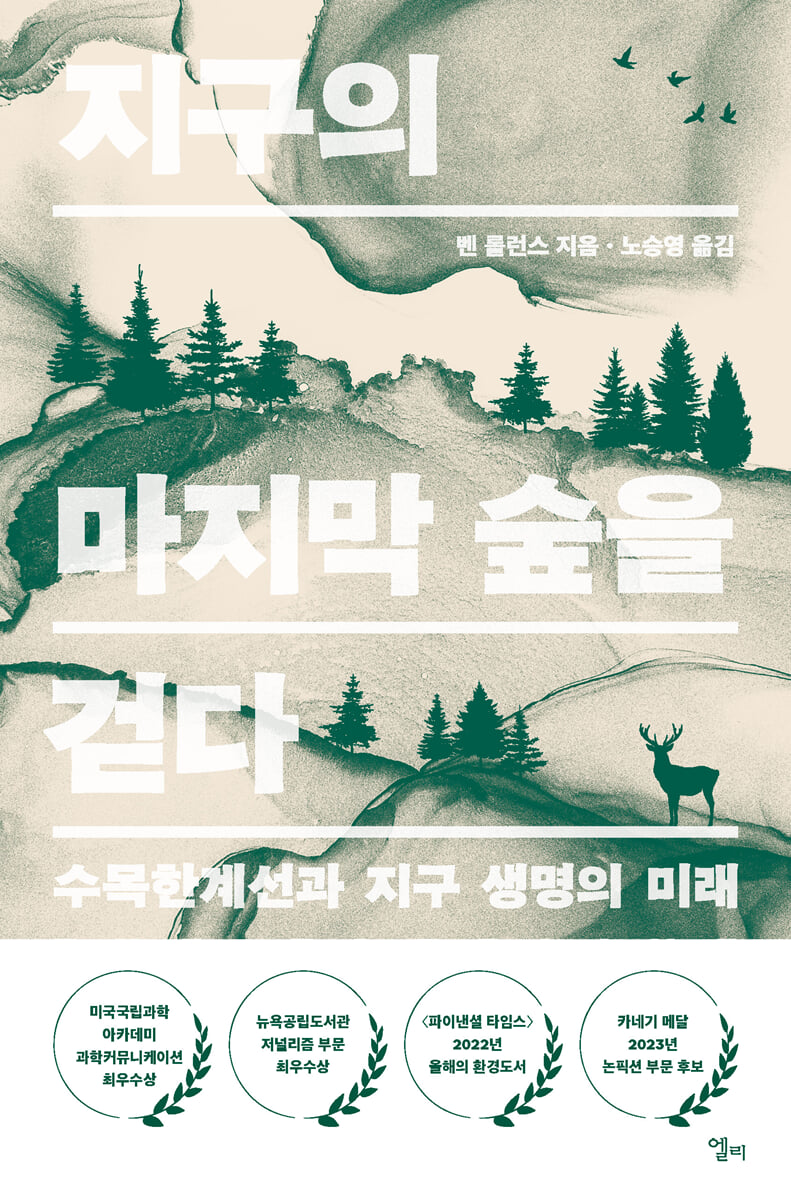
Walking through Earth's last forest
 |
Description
Book Introduction
A four-year journey through the northern forests along the timberline About our past, present, and future as we live in the Anthropocene A four-year journey to six northern regions (Scotland, Norway, Siberia, Alaska, Canada, and Greenland) to study climate change and the tree line in the northernmost forest, the boreal forest, the "true lungs of the Earth." This is a non-fiction book on earth science, environment, and ecology. We meet scientists who study trees, animals, climate, and permafrost, and talk to those who have lived and worked in the Arctic since before the impact of Western capitalism and colonialism, and examine our past, present, and future as we live in the Anthropocene. Rather than highlighting the necessity of responding to climate change, "Walking Through the Last Forest on Earth" documents the contradictory natural phenomena caused by climate change (the expansion of forest areas) and the resulting consequences (accelerated global warming and the rapid increase in methane gas emissions stored in permafrost). In response, the 'difficult' options of killing deer and cutting down trees are also discussed. Beyond the simple and simplistic identification that humans have destroyed nature or that we are victims of climate change, it emphasizes that humans are living beings that have co-evolved with the forest, just as “forests, like any other living thing, are a symbiotic system and a dynamic process, not a collection of objects or separate beings.” Furthermore, it presents the key to finding alternatives and imagining the future through the history of people living at the tree line, who have experienced the reality of a changing environment longer than anyone else. |
- You can preview some of the book's contents.
Preview
index
map
preface
1.
Zombie Forest
2.
Chasing reindeer
3.
Sleeping Bear
4.
borderline
5.
Forest of the Sea
6.
Last Tango with Ice
Conclusion: Thinking Like a Forest
Tree Description
Translator's Note: The end of the forest is the end of the world.
main
preface
1.
Zombie Forest
2.
Chasing reindeer
3.
Sleeping Bear
4.
borderline
5.
Forest of the Sea
6.
Last Tango with Ice
Conclusion: Thinking Like a Forest
Tree Description
Translator's Note: The end of the forest is the end of the world.
main
Detailed image

Into the book
Now that humanity has disrupted the planetary systems of oceans, forests, winds, and currents, upsetting the gaseous balance of water and air that gave birth to us in the first place, the comfort offered by attention is questionable.
What the tree offers is no longer comfort, but a warning.
--- p.14
The empire crosses the line.
Imperialism, capitalism, and white supremacy share a common, twisted philosophy.
It regards any restriction on the freedom of some human actions as an infringement on the principle of freedom itself.
The co-evolutionary dynamics of the forest are quite the opposite.
--- p.15
If you time-lapse the Earth over geologic time, you can see ice sheets advancing and retreating in rhythmic patterns, and vast green forests rising and falling toward the North Pole, taking a kind of breath.
But now the Earth is hyperventilating.
A green ribbon moves unnaturally fast, crowning the Earth with a laurel wreath of needles and broadleaf, turning the white North Pole green.
Now the tree line moves northward by hundreds of meters per year, rather than by tens of centimeters per century.
The trees are moving.
This can't go on like this.
This ominous phenomenon has a tremendous impact on all life on Earth.
--- p.18
This isn't just a story about trees running north, breathing in carbon dioxide.
It's a story of the Earth shaking, of the ecosystem struggling to restore balance in response to massive change.
Every year, forests as large as countries are destroyed by fire, insects and humans, and precious tundra is encroached upon by trees (considered invasive species).
Forests are evolving and emerging in places where they shouldn't be, causing confusion among animals and humans who rely on the forest's stability as a basis for their survival strategies.
--- pp.18~19
It is not the Amazon rainforest, but the boreal forest that is the true lungs of the Earth.
Covering one-fifth of the Earth's surface and containing one-third of all trees, the boreal forest is the second largest biome after the oceans.
Earth's systems, such as the water and oxygen cycles, atmospheric circulation, the albedo effect, ocean currents, and polar winds, are shaped and changed by the position of the tree line and the activity of forests.
--- p.20
I learned that we know very little about how the activities of these systems will change under the influence of warming.
We know the world is getting dangerously hotter, but we don't yet know what this means for us or for other creatures in the forest.
As forests warm, they are losing their ability to absorb and store carbon dioxide.
Although boreal forests are the planet's largest source of oxygen, their abundance of trees does not necessarily mean they sequester more carbon from the atmosphere.
Trees invade the tundra and accelerate the thawing of permafrost, which, when melted, releases greenhouse gases trapped within, accelerating global warming to levels that surpass all scientific predictions.
Several contradictory phenomena are occurring at once now.
--- pp.20~21
At first glance, having more trees might seem like a good thing.
But the tundra turning green is directly linked to global warming.
This is because downy birch improves soil quality through microbial activity and raises ground temperature, melting permafrost and releasing methane.
Methane is a greenhouse gas 85 times more potent than carbon dioxide in terms of warming potential, but has a shorter-term impact.
--- pp.91~92
The land was not plunged into silence.
We just don't listen anymore.
--- p.99
While the Sami are currently bearing the brunt of climate change, in time those living in hotter regions and coastal cities will face even more severe problems due to floods and heat waves.
The refugee crisis in the Arctic is expected to worsen as people flee south due to crop failures and extreme temperatures.
--- p.123
In defining ecosystems and habitats, the timberline has shaped the possibilities of human existence and, by extension, has defined the conditions of human culture.
Our place has always been at the edge of the forest and we have a relationship with the forest.
--- p.145
As permafrost on the ocean floor melts and releases methane hydrate, oil and gas companies are cheering and climate scientists are horrified.
--- pp.177~178
Nikita and Sergei have no interest in saving the forest.
All they care about is permafrost.
As strange as it may sound, cutting down trees seems to be the best way to slow the thaw and perhaps even save some of the taiga.
--- p.207
All we know is that forests, like all life, are a symbiotic system and a dynamic process, not a collection of objects or separate entities.
--- p.240
The unnatural has become natural, the apocalypse has become routine, an annual event, relegated to mere background.
This may be one of the emerging realities of climate breakdown.
Mourning is a luxury.
The urgent demands of everyday life do not allow for such rest or detachment.
There is always something to do.
--- p.261
For Ellen, the end of culture means the end of the world.
The end is made up of countless small tragedies.
As each species, language, or custom dies out, it is not the cries of protest but the silent tears that signal it.
--- p.376
If we look back at the long history of our co-evolution with forests, humanity's separation from nature was a blink of an eye.
The story of human existence on Earth is longer and broader than the history of capitalism, and, most importantly, its ending has yet to be written.
--- pp.401~402
What I learned from the ruins and refugee camps of Congo, Sudan, Uganda, and Somalia is that hope does not breed struggle, but struggle breeds hope.
Hope is not an inert precious metal lying idle, waiting to be discovered.
It is something that must be created and redefined every day in light of changing circumstances.
The lesson here is that despair is the first step toward recovery.
Acknowledging past harm can empower us to change.
The elders of Poplar River transformed the suffering of colonial rule into the creation of North America's largest protected forest, while Thomas MacDonnell reversed centuries of foraging patterns for sheep and deer and began restoring Scotland's great forests.
--- p.404
A revolution begins with a walk through the forest.
How could we possibly forget the names of the living beings who produce oxygen and purify air and water? As a co-evolving species, we must restore our essential entanglements with other life forms to survive the coming cataclysm.
We all need to relearn how to think like a forest.
--- p.406
Unlike ownership, use carries responsibility.
Those who are irresponsible can only consume and destroy, but cannot cultivate, preserve, or share.
It may sound ridiculous, but we live to throw away.
It seems clear that humanity owns the Earth.
We have successfully defeated all living things that have threatened the Earth, whether they are giant animals, bacteria, or viruses.
But are we really using the Earth responsibly? The trees would certainly say no.
I wish there were still trees left to say no.
What the tree offers is no longer comfort, but a warning.
--- p.14
The empire crosses the line.
Imperialism, capitalism, and white supremacy share a common, twisted philosophy.
It regards any restriction on the freedom of some human actions as an infringement on the principle of freedom itself.
The co-evolutionary dynamics of the forest are quite the opposite.
--- p.15
If you time-lapse the Earth over geologic time, you can see ice sheets advancing and retreating in rhythmic patterns, and vast green forests rising and falling toward the North Pole, taking a kind of breath.
But now the Earth is hyperventilating.
A green ribbon moves unnaturally fast, crowning the Earth with a laurel wreath of needles and broadleaf, turning the white North Pole green.
Now the tree line moves northward by hundreds of meters per year, rather than by tens of centimeters per century.
The trees are moving.
This can't go on like this.
This ominous phenomenon has a tremendous impact on all life on Earth.
--- p.18
This isn't just a story about trees running north, breathing in carbon dioxide.
It's a story of the Earth shaking, of the ecosystem struggling to restore balance in response to massive change.
Every year, forests as large as countries are destroyed by fire, insects and humans, and precious tundra is encroached upon by trees (considered invasive species).
Forests are evolving and emerging in places where they shouldn't be, causing confusion among animals and humans who rely on the forest's stability as a basis for their survival strategies.
--- pp.18~19
It is not the Amazon rainforest, but the boreal forest that is the true lungs of the Earth.
Covering one-fifth of the Earth's surface and containing one-third of all trees, the boreal forest is the second largest biome after the oceans.
Earth's systems, such as the water and oxygen cycles, atmospheric circulation, the albedo effect, ocean currents, and polar winds, are shaped and changed by the position of the tree line and the activity of forests.
--- p.20
I learned that we know very little about how the activities of these systems will change under the influence of warming.
We know the world is getting dangerously hotter, but we don't yet know what this means for us or for other creatures in the forest.
As forests warm, they are losing their ability to absorb and store carbon dioxide.
Although boreal forests are the planet's largest source of oxygen, their abundance of trees does not necessarily mean they sequester more carbon from the atmosphere.
Trees invade the tundra and accelerate the thawing of permafrost, which, when melted, releases greenhouse gases trapped within, accelerating global warming to levels that surpass all scientific predictions.
Several contradictory phenomena are occurring at once now.
--- pp.20~21
At first glance, having more trees might seem like a good thing.
But the tundra turning green is directly linked to global warming.
This is because downy birch improves soil quality through microbial activity and raises ground temperature, melting permafrost and releasing methane.
Methane is a greenhouse gas 85 times more potent than carbon dioxide in terms of warming potential, but has a shorter-term impact.
--- pp.91~92
The land was not plunged into silence.
We just don't listen anymore.
--- p.99
While the Sami are currently bearing the brunt of climate change, in time those living in hotter regions and coastal cities will face even more severe problems due to floods and heat waves.
The refugee crisis in the Arctic is expected to worsen as people flee south due to crop failures and extreme temperatures.
--- p.123
In defining ecosystems and habitats, the timberline has shaped the possibilities of human existence and, by extension, has defined the conditions of human culture.
Our place has always been at the edge of the forest and we have a relationship with the forest.
--- p.145
As permafrost on the ocean floor melts and releases methane hydrate, oil and gas companies are cheering and climate scientists are horrified.
--- pp.177~178
Nikita and Sergei have no interest in saving the forest.
All they care about is permafrost.
As strange as it may sound, cutting down trees seems to be the best way to slow the thaw and perhaps even save some of the taiga.
--- p.207
All we know is that forests, like all life, are a symbiotic system and a dynamic process, not a collection of objects or separate entities.
--- p.240
The unnatural has become natural, the apocalypse has become routine, an annual event, relegated to mere background.
This may be one of the emerging realities of climate breakdown.
Mourning is a luxury.
The urgent demands of everyday life do not allow for such rest or detachment.
There is always something to do.
--- p.261
For Ellen, the end of culture means the end of the world.
The end is made up of countless small tragedies.
As each species, language, or custom dies out, it is not the cries of protest but the silent tears that signal it.
--- p.376
If we look back at the long history of our co-evolution with forests, humanity's separation from nature was a blink of an eye.
The story of human existence on Earth is longer and broader than the history of capitalism, and, most importantly, its ending has yet to be written.
--- pp.401~402
What I learned from the ruins and refugee camps of Congo, Sudan, Uganda, and Somalia is that hope does not breed struggle, but struggle breeds hope.
Hope is not an inert precious metal lying idle, waiting to be discovered.
It is something that must be created and redefined every day in light of changing circumstances.
The lesson here is that despair is the first step toward recovery.
Acknowledging past harm can empower us to change.
The elders of Poplar River transformed the suffering of colonial rule into the creation of North America's largest protected forest, while Thomas MacDonnell reversed centuries of foraging patterns for sheep and deer and began restoring Scotland's great forests.
--- p.404
A revolution begins with a walk through the forest.
How could we possibly forget the names of the living beings who produce oxygen and purify air and water? As a co-evolving species, we must restore our essential entanglements with other life forms to survive the coming cataclysm.
We all need to relearn how to think like a forest.
--- p.406
Unlike ownership, use carries responsibility.
Those who are irresponsible can only consume and destroy, but cannot cultivate, preserve, or share.
It may sound ridiculous, but we live to throw away.
It seems clear that humanity owns the Earth.
We have successfully defeated all living things that have threatened the Earth, whether they are giant animals, bacteria, or viruses.
But are we really using the Earth responsibly? The trees would certainly say no.
I wish there were still trees left to say no.
--- pp.446~447
Publisher's Review
A four-year journey through the northern forests along the timberline
About our past, present, and future as we live in the Anthropocene
The timber line refers to the extreme line where trees can survive in high mountains and polar regions.
Ben Rollens, author of "Walking Through Earth's Last Forest: The Timberline and the Future of Life on Earth," visits Scotland, Norway, Siberia, Alaska, Canada, and Greenland to find the "boreal forest," the northernmost treeline on Earth.
There, we meet scientists studying vegetation, animals, climate, and permafrost, and visit indigenous communities such as the Sami, Dolgan, and First Nations who have lived in the Arctic since before the influence of Western capitalism and colonialism, and look into their lifestyles to examine our past, present, and future as we live in the Anthropocene.
The most important and striking thing this book reveals is that, contrary to our expectations, forests are expanding in the northern part of the planet.
The image of the burning Amazon rainforest, a representative example of the consequences of climate change and global warming, is not the only urgent reality that demands our attention.
The white North Pole is turning green.
The tree line is advancing northward by hundreds of meters each year, not by tens of centimeters every hundred years.
Covering one-fifth of the Earth's surface and home to one-third of all trees on Earth, the boreal forest is the second-largest biome after the oceans.
It is not the Amazon rainforest, but the boreal forest that is the 'real lungs of the Earth.'
Should we be happy or sad if such forests are flourishing and the treeline is expanding? The author's central argument is that we cannot simply be complacent about the prosperity of trees.
As the Earth warms and glaciers melt, there is more ground for trees to take root, which in turn increases microbial activity, accelerating global warming and glacial melting.
Furthermore, if global warming accelerates and permafrost melts, releasing stored methane gas, it will have an uncontrollable impact on the Earth.
“What the tree offers is no longer comfort, but a warning.”
Complex and 'difficult' choices to address climate change
Sometimes you have to cut down trees and cull animals.
By visiting forests in six countries and studying the six keystone tree species that make up each forest—Siberian pine, downy birch, daur larch, spruce, balsam poplar, and Greenland rowan—the author discusses the difficult choices of killing animals and cutting down trees to counter the uncontrolled expansion of the timberline.
On a visit to Scotland, the author encounters a solitary 'grandmother pine' in a fenced-in reserve.
The reason the old pine tree stands alone is because deer, which feed on the pine trunks and leaves, thrive in this forest where top predators such as wolves are absent.
Even though the pine tree has sprouted abundantly, deer eat the young trees before they grow fully.
That is why it is necessary to 'artificially' reduce the deer population to a level where the trees can regenerate.
The author also depicts the reality that trees must be cut down to restore the ecosystem and increase the population of Norwegian reindeer.
As climate change causes temperatures to rise, the ground thaws and freezes repeatedly, forming an ice crust on the surface, making it difficult for reindeer to access lichen, their main food source.
Along with climate change (or perhaps due to population growth), the main factor that increases the temperature of the ground is the downy birch.
As more downy birch trees take root in the Norwegian tundra, microbial activity in the soil increases, accelerating the rise in ground temperature.
Greening tundra might sound like good news in the age of rising carbon, but if the rate of global warming is not controlled, permafrost will melt, rapidly releasing the methane it holds (which is 85 times more potent as a warming agent than carbon).
Reindeer feed on birch trees, including lichens, but there is no 'natural' way to stop the trees from flourishing now that the ecosystem is out of balance.
That's why the option to cut down the tree is presented.
Furthermore, forests are not simply independent spaces that are limited to a certain country or region and that form and operate an ecosystem only within that region.
Forests produce rain and generate wind through photosynthesis and evapotranspiration of trees, influencing atmospheric circulation around the globe.
The Amazon rainforest and the West African monsoon, the spruce forests of Alaska and northern Canada and the breadbasket of the American Midwest, the Russian taiga and the wheat fields of Ukraine are all linked by this 'teleconnection'.
The forest is also connected to the sea.
Phytoplankton, the base of the marine food chain, require iron, an essential catalyst for photosynthesis.
Iron is created when forest leaves decompose, combines with humic acid, and flows down rivers to the sea.
The iron provided by trees forms the foundation of the marine food chain.
Because forests are so closely connected to other life forms and systems that make up the Earth, climate change always requires complex responses.
The global entanglement of life on Earth, rooted in forests
“Reading the relationship between humans and their habitats more positively,
“Here lies the key to imagining a different future.”
After a four-year journey that took him through the forests of six countries along the northern timberline, the author returns to Wales, England, where he lives with his family.
Clear-cutting work is in full swing in the nearby forest.
It is a mixed forest where various tree species, including the core species of the northern boreal forest, such as pine, birch, larch, and spruce, coexist, and countless healthy trees are being cut down under the pretext of “reforestation of old natural forests.”
In today's core values of 'capital' and 'ownership', strong wood is a great asset.
As human desires are endlessly subsumed by capitalism (and colonialism, which still persists in various forms), the author does not stray too far from either hope or despair.
It emphasizes that there is a third story that is neither the blind and unrealistic hope that humanity will always find a solution by advocating for 'net zero' and green growth, nor the cynical despair based on indifference that there is no other way and the only answer is human extinction.
This is the story of people who view and use their homes in a way that is different from the Western way of thinking and affluent lifestyle that is the starting point of the unique economic model of the modern era called capitalism.
During the four years the author has been studying climate change and the treeline, he has visited not only scientists but also indigenous communities that have long inhabited the Arctic, such as the Sami, Dolgan, and First Nations, to gain insight into their lifestyles and views of nature.
The obvious reality that humans have always coexisted and coevolved with other living beings, including the fact that “humans depend on natural processes.”
The author proposes 'strategic ecology' (and 'human-assisted migration', in which humans participate in the adaptation and movement of other species) as a countermeasure, based on the ancient wisdom that the entire Earth is fundamentally and factually intertwined.
We study the impacts of climate change, which vary across forests and ecosystems, predict the outcomes, and propose different approaches (such as cutting down trees in some forests and planting trees in others).
While not a unified and easy solution, it emphasizes that “hope does not breed struggle, but struggle breeds hope,” and that hope is “something that must be crafted and redefined every day in light of changing circumstances.”
“Ben Rollins has created one of the most ambitious, brilliant, and inspiring works of science, storytelling, and personal dedication, and he succeeds on all fronts.”
- [National Academy of Sciences]
“A clear and perspective-changing book.
A beautiful portrait that evokes contemplation of the natural world.
“A must-read for anyone seeking to better understand our changing planet.”
- [Spectator]
“Ben Rollans brings the natural world before us in lyrical, nuanced prose, delivering a timely and urgent message with fluidity.”
- [Kirkus]
About our past, present, and future as we live in the Anthropocene
The timber line refers to the extreme line where trees can survive in high mountains and polar regions.
Ben Rollens, author of "Walking Through Earth's Last Forest: The Timberline and the Future of Life on Earth," visits Scotland, Norway, Siberia, Alaska, Canada, and Greenland to find the "boreal forest," the northernmost treeline on Earth.
There, we meet scientists studying vegetation, animals, climate, and permafrost, and visit indigenous communities such as the Sami, Dolgan, and First Nations who have lived in the Arctic since before the influence of Western capitalism and colonialism, and look into their lifestyles to examine our past, present, and future as we live in the Anthropocene.
The most important and striking thing this book reveals is that, contrary to our expectations, forests are expanding in the northern part of the planet.
The image of the burning Amazon rainforest, a representative example of the consequences of climate change and global warming, is not the only urgent reality that demands our attention.
The white North Pole is turning green.
The tree line is advancing northward by hundreds of meters each year, not by tens of centimeters every hundred years.
Covering one-fifth of the Earth's surface and home to one-third of all trees on Earth, the boreal forest is the second-largest biome after the oceans.
It is not the Amazon rainforest, but the boreal forest that is the 'real lungs of the Earth.'
Should we be happy or sad if such forests are flourishing and the treeline is expanding? The author's central argument is that we cannot simply be complacent about the prosperity of trees.
As the Earth warms and glaciers melt, there is more ground for trees to take root, which in turn increases microbial activity, accelerating global warming and glacial melting.
Furthermore, if global warming accelerates and permafrost melts, releasing stored methane gas, it will have an uncontrollable impact on the Earth.
“What the tree offers is no longer comfort, but a warning.”
Complex and 'difficult' choices to address climate change
Sometimes you have to cut down trees and cull animals.
By visiting forests in six countries and studying the six keystone tree species that make up each forest—Siberian pine, downy birch, daur larch, spruce, balsam poplar, and Greenland rowan—the author discusses the difficult choices of killing animals and cutting down trees to counter the uncontrolled expansion of the timberline.
On a visit to Scotland, the author encounters a solitary 'grandmother pine' in a fenced-in reserve.
The reason the old pine tree stands alone is because deer, which feed on the pine trunks and leaves, thrive in this forest where top predators such as wolves are absent.
Even though the pine tree has sprouted abundantly, deer eat the young trees before they grow fully.
That is why it is necessary to 'artificially' reduce the deer population to a level where the trees can regenerate.
The author also depicts the reality that trees must be cut down to restore the ecosystem and increase the population of Norwegian reindeer.
As climate change causes temperatures to rise, the ground thaws and freezes repeatedly, forming an ice crust on the surface, making it difficult for reindeer to access lichen, their main food source.
Along with climate change (or perhaps due to population growth), the main factor that increases the temperature of the ground is the downy birch.
As more downy birch trees take root in the Norwegian tundra, microbial activity in the soil increases, accelerating the rise in ground temperature.
Greening tundra might sound like good news in the age of rising carbon, but if the rate of global warming is not controlled, permafrost will melt, rapidly releasing the methane it holds (which is 85 times more potent as a warming agent than carbon).
Reindeer feed on birch trees, including lichens, but there is no 'natural' way to stop the trees from flourishing now that the ecosystem is out of balance.
That's why the option to cut down the tree is presented.
Furthermore, forests are not simply independent spaces that are limited to a certain country or region and that form and operate an ecosystem only within that region.
Forests produce rain and generate wind through photosynthesis and evapotranspiration of trees, influencing atmospheric circulation around the globe.
The Amazon rainforest and the West African monsoon, the spruce forests of Alaska and northern Canada and the breadbasket of the American Midwest, the Russian taiga and the wheat fields of Ukraine are all linked by this 'teleconnection'.
The forest is also connected to the sea.
Phytoplankton, the base of the marine food chain, require iron, an essential catalyst for photosynthesis.
Iron is created when forest leaves decompose, combines with humic acid, and flows down rivers to the sea.
The iron provided by trees forms the foundation of the marine food chain.
Because forests are so closely connected to other life forms and systems that make up the Earth, climate change always requires complex responses.
The global entanglement of life on Earth, rooted in forests
“Reading the relationship between humans and their habitats more positively,
“Here lies the key to imagining a different future.”
After a four-year journey that took him through the forests of six countries along the northern timberline, the author returns to Wales, England, where he lives with his family.
Clear-cutting work is in full swing in the nearby forest.
It is a mixed forest where various tree species, including the core species of the northern boreal forest, such as pine, birch, larch, and spruce, coexist, and countless healthy trees are being cut down under the pretext of “reforestation of old natural forests.”
In today's core values of 'capital' and 'ownership', strong wood is a great asset.
As human desires are endlessly subsumed by capitalism (and colonialism, which still persists in various forms), the author does not stray too far from either hope or despair.
It emphasizes that there is a third story that is neither the blind and unrealistic hope that humanity will always find a solution by advocating for 'net zero' and green growth, nor the cynical despair based on indifference that there is no other way and the only answer is human extinction.
This is the story of people who view and use their homes in a way that is different from the Western way of thinking and affluent lifestyle that is the starting point of the unique economic model of the modern era called capitalism.
During the four years the author has been studying climate change and the treeline, he has visited not only scientists but also indigenous communities that have long inhabited the Arctic, such as the Sami, Dolgan, and First Nations, to gain insight into their lifestyles and views of nature.
The obvious reality that humans have always coexisted and coevolved with other living beings, including the fact that “humans depend on natural processes.”
The author proposes 'strategic ecology' (and 'human-assisted migration', in which humans participate in the adaptation and movement of other species) as a countermeasure, based on the ancient wisdom that the entire Earth is fundamentally and factually intertwined.
We study the impacts of climate change, which vary across forests and ecosystems, predict the outcomes, and propose different approaches (such as cutting down trees in some forests and planting trees in others).
While not a unified and easy solution, it emphasizes that “hope does not breed struggle, but struggle breeds hope,” and that hope is “something that must be crafted and redefined every day in light of changing circumstances.”
“Ben Rollins has created one of the most ambitious, brilliant, and inspiring works of science, storytelling, and personal dedication, and he succeeds on all fronts.”
- [National Academy of Sciences]
“A clear and perspective-changing book.
A beautiful portrait that evokes contemplation of the natural world.
“A must-read for anyone seeking to better understand our changing planet.”
- [Spectator]
“Ben Rollans brings the natural world before us in lyrical, nuanced prose, delivering a timely and urgent message with fluidity.”
- [Kirkus]
GOODS SPECIFICS
- Date of issue: June 16, 2023
- Page count, weight, size: 456 pages | 506g | 145*220*23mm
- ISBN13: 9791191247350
- ISBN10: 119124735X
You may also like
카테고리
korean


korean

![GQ KOREA Mark (Monthly): December [2025]](http://librairie.coreenne.fr/cdn/shop/files/8ef265dbbfbf186523ed75ba7319009d.jpg?v=1765340328&width=3840)


