

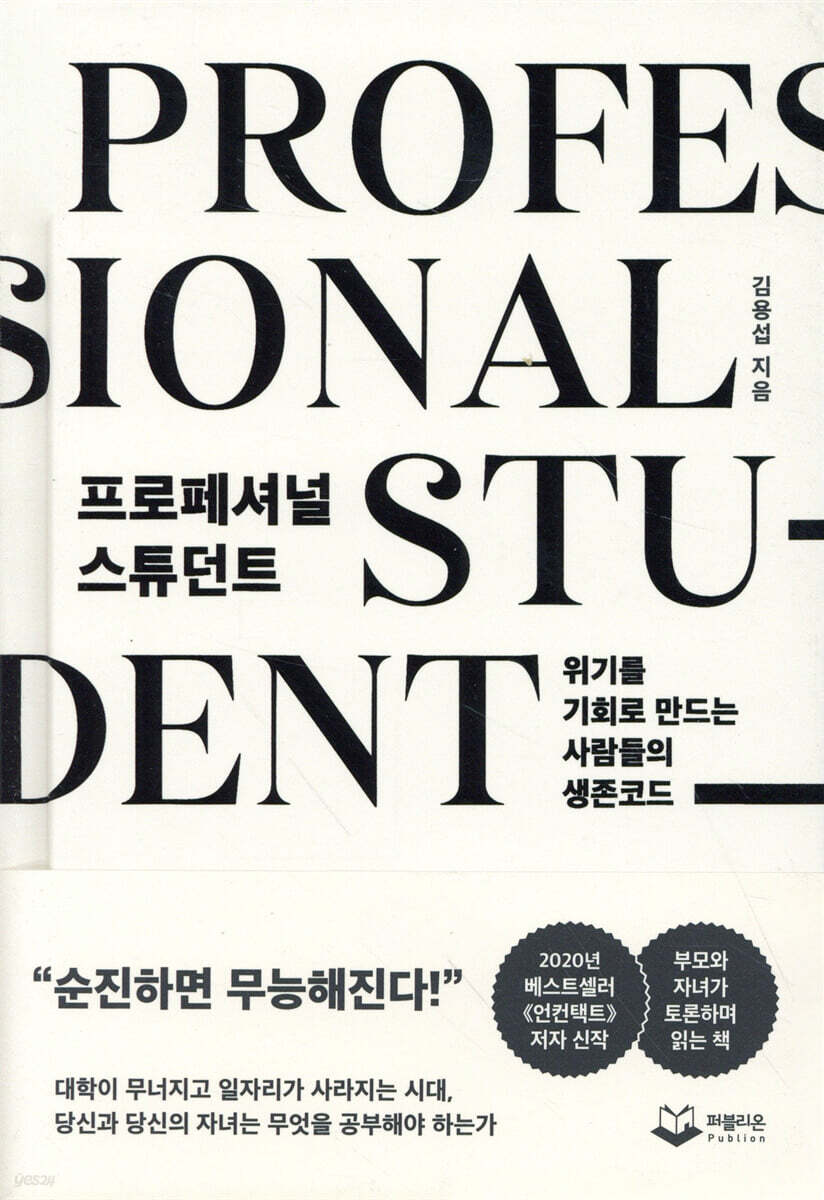
Professional Student
 |
Description
Book Introduction
People who survive in uncertain times, Why We Should Become 'Professional Students' Following the 2020 bestseller, 『Uncontact』 Trend analyst Kim Yong-seop's poignant and painful survival prescription! Don't get me wrong. The essence of the crisis is not a pandemic. The world that will be revealed after the pandemic ends and the curtain of Corona is lifted is the 'real crisis'. Work is automated and jobs are disappearing. Many companies will collapse and the economic landscape will change. 2020 is not the year of the pandemic. Future generations will remember last year as a turning point in the robotics industry's rapid growth. Change is accelerating and crises are becoming routine. This is why missing the reality of the future makes you incompetent. Ultimately, those who survive in the future are those who constantly study, adapt to crises, and evolve over and over again. In an era where you can freely take classes from prestigious universities around the world from the comfort of your own home, MOOCs, micro-colleges, ultra-learning, and Google with Google—real-world learning that breaks the mold—are creating today's innovators. With global companies no longer requiring degrees, the growing obsoletion of college, and the shortening half-life of knowledge, what should we (and your children) study? Following "Uncontact," Kim Yong-seop, Korea's leading trend analyst, presents his second topic of discussion! "Professional Student" will serve as a fierce survival guide for those forging their own path in an era of massive creative destruction. “Understand the reality of change and turn crisis into opportunity!” |
- You can preview some of the book's contents.
Preview
index
Prologue We instinctively seek out 'study'
Part 1.
The real crisis begins! Only the strong survive.
Do you believe that the crisis will be over when the pandemic ends?
The world has been brought forward by about 5 years!
Is it a good thing that the future comes quickly?
People of the future will remember 2020/2021 differently.
Who is the real power?
Professional Students Survive
Part 2.
What does college mean to a professional student?
College: Right Then, Wrong Now
Universities fail in the order in which cherry blossoms bloom?
Why did we ignore Alvin Toffler's words?
What should students learn for the future?
If there is no discussion, it is not education.
Discover classes from prestigious universities around the world on MOOC.
Take on ultrarunning
How much of what you studied for the entrance exam will you use in your lifetime?
Is it really necessary to go to college?
Which major would be advantageous to choose?
Micro colleges instead of four-year universities
Part 3.
What is a job or workplace for a professional student?
How do you work now?
Is RPA (Robotic Process Automation) Putting Your Job at Risk?
Automation and remote outsourcing: The future has already begun.
We are a sports team, not a family.
If you can do it, whether it's two jobs or three jobs, definitely do it!
Are you an elephant or a flea?
Only those who can move survive
Reskilling, upskilling
Professional Students: The New Ideal Employee for Companies
How long can I work?
What jobs will children have in the future?
You're not fighting robots, you're fighting unoriginals.
Become a professional student and start a business!
Part 4.
What is real study for professional students?
You need unlearning now
In the future, only the study of nurturing leaders remains.
Home education has become more important than public or private education.
Study Community: Do you have friends to study with?
Will studying change when the singularity approaches?
Studying Technology: This is the era where technology becomes common sense!
Studying Money: If you don't know about money, all your studies will be in vain!
Trend Study: Being Sensitive to Change is Essential
Studying Art: Money Isn't the Only Thing That Determines the Value of Life!
Survival Skills Study: You must survive in any situation!
Epilogue: Selfish, Calculating, yet Inclusive Studying is Needed
References
Part 1.
The real crisis begins! Only the strong survive.
Do you believe that the crisis will be over when the pandemic ends?
The world has been brought forward by about 5 years!
Is it a good thing that the future comes quickly?
People of the future will remember 2020/2021 differently.
Who is the real power?
Professional Students Survive
Part 2.
What does college mean to a professional student?
College: Right Then, Wrong Now
Universities fail in the order in which cherry blossoms bloom?
Why did we ignore Alvin Toffler's words?
What should students learn for the future?
If there is no discussion, it is not education.
Discover classes from prestigious universities around the world on MOOC.
Take on ultrarunning
How much of what you studied for the entrance exam will you use in your lifetime?
Is it really necessary to go to college?
Which major would be advantageous to choose?
Micro colleges instead of four-year universities
Part 3.
What is a job or workplace for a professional student?
How do you work now?
Is RPA (Robotic Process Automation) Putting Your Job at Risk?
Automation and remote outsourcing: The future has already begun.
We are a sports team, not a family.
If you can do it, whether it's two jobs or three jobs, definitely do it!
Are you an elephant or a flea?
Only those who can move survive
Reskilling, upskilling
Professional Students: The New Ideal Employee for Companies
How long can I work?
What jobs will children have in the future?
You're not fighting robots, you're fighting unoriginals.
Become a professional student and start a business!
Part 4.
What is real study for professional students?
You need unlearning now
In the future, only the study of nurturing leaders remains.
Home education has become more important than public or private education.
Study Community: Do you have friends to study with?
Will studying change when the singularity approaches?
Studying Technology: This is the era where technology becomes common sense!
Studying Money: If you don't know about money, all your studies will be in vain!
Trend Study: Being Sensitive to Change is Essential
Studying Art: Money Isn't the Only Thing That Determines the Value of Life!
Survival Skills Study: You must survive in any situation!
Epilogue: Selfish, Calculating, yet Inclusive Studying is Needed
References
Into the book
Do you believe that the crisis will end when the COVID-19 pandemic ends? Do you believe the world will be a better place as if nothing happened? That kind of thinking is naive.
In reality, the opposite will be true.
After the pandemic, a real crisis, bigger and more serious, begins.
While many may have considered the pandemic itself a crisis, the real crisis lies in the acceleration of change brought about by the pandemic, the economic crisis it has wrought, and the ongoing events that will follow.
The pandemic has accelerated the rise of robotics, artificial intelligence, autonomous driving, and automation, impacting your job and the jobs your children will have in the future. --- p.8
But it is businesses, not workers, that will adopt robots, artificial intelligence, and automation.
Martin Ford, a futurist who is known for his research on robots and artificial intelligence, said in his book Rise of the Robots (2015) that “if a technology that can reduce human resources is available, it is almost always tempting for rational entrepreneurs to do so,” and that an era in which robots equipped with artificial intelligence compete with humans for jobs is inevitable.
--- p.32
To become a professional student, you must be honest with yourself.
Each person's desired results and goals as a professional student may vary.
At least being honest with yourself will give you a clearer idea of what you want and what you want to focus on studying.
You should choose a study that will truly benefit you and that you can immerse yourself in, rather than a study that is just for show to others.
--- p.55
In July 2020, when domestic fintech company TOSS hired developers, it did not consider college degrees.
Toss, which had been hiring developers on a rolling basis, has now started hiring developers with less than three years of experience, including new hires. The company has eliminated the document evaluation process and requires all applicants to take an online coding test as their first step.
Here, we conducted a task-based screening for those who passed.
It was tested by presenting actual development work as a task.
During this process, we conducted technical interviews with successful applicants, during which they submitted free-form application forms.
This is a different method from the one used by companies that have been hiring college graduates in the past, which involved document screening and written exams in the first round.
Since the documents are submitted last, not first, it seems that the ability itself is evaluated first.
--- pp.
68-69
POSTECH (Pohang University of Science and Technology) Graduate School of Convergence Studies will open a master's and doctoral program in social data science starting in the first semester of 2021.
This major is supported by POSCO and SK Hynix, which provide full tuition and educational resources. If you are selected for the SK Hynix track, you are guaranteed a job at SK Hynix immediately after completing your degree.
The reason companies invest is to secure the talent they need.
--- p.89
Minerva Schools, which opened in 2014, is a regular university without a campus or classrooms.
Traditional universities have long built large, offline campuses and numerous buildings, capitalized on real estate value, operated sports teams, and actively pursued profitable businesses and investments.
As a result, the question of whether universities exist strictly for the sake of students or whether students exist for the sake of the university's business was inevitably raised.
For universities to focus on education, an online, non-face-to-face model may be an alternative.
These are the issues that Ben Nelson, founder and CEO of the Minerva Project, revealed as the issues he had in mind when creating Minerva Schools.
This sense of problem is spreading to existing universities.
--- p.98
If you are currently working, ask yourself some cool questions.
What are the chances that your job will be replaced by a robot? If your job involves simple, repetitive tasks that don't require creative solutions or manuals, if you can handle them independently without the need for assistance from others, if you're comfortable working in tight spaces, and if your job doesn't require negotiation skills, you should be a little anxious about the future.
If something can be solved by an algorithm or created by a program, we must accept a future where jobs will disappear.
--- pp.154-155
Rather than evaluating the answers to the questions, we also evaluate the questions themselves.
The answer can be found through search, but the question is a problem.
People who admit they don't know what they don't know and ask questions about what they are curious about can achieve more than those who don't.
If you want to find an answer, you must first find a question, and if you find a good question, you will get a better answer.
Ultimately, questions become the beginning of creation.
--- p.256
It is important to note that coding is not a functional vocational training program that turns you into a programmer, but rather that any profession can maximize its value and expertise through coding.
Artificial intelligence and computing technology are constantly evolving, but how much of a loss would it be if we failed to fully utilize and enjoy them? Just as the goal of learning English isn't simply to converse with English speakers, but to achieve practical results through those conversations, whether it's making friends or conducting business, and the core goal is to achieve high status and opportunities along the way, the same goes for coding.
Knowing the alphabet and being able to have simple conversations doesn't mean you can do business in an English-speaking country and become an expert.
Coding should also be understood in that way.
--- p.279
Studying trends and the future is not a subject to be memorized, but an experimental subject.
It is most important to understand the background and direction, and then apply that to your own situation and interpret it.
To this end, it is necessary to observe and analyze a wide spectrum when interpreting trend issues.
Put yourself at the center of all interpretations.
The reason we study is not for others, but for ourselves.
So, no matter what trend or future issue, think about how you will apply it to yourself and respond to it.
--- p.298
Ultimately, raising inclusive leaders should be the primary goal of parents raising their children today.
Inclusive learning is necessary not only for children but also for today's working people.
The era of the lone wolf is over. The era of trampling on others to achieve success is over.
We live in an age where every word and action is revealed in its entirety, and past mistakes can have fatal consequences.
In the future, people with bad character will not be able to become talented people or leaders.
This is not because people have become kinder and more just, but because times have evolved.
Diversity and inclusion are not optional, they are essential.
--- p.319
The third goal is to study to understand yourself.
If you don't know, no one will.
What your child is good at, what he or she wants to do, what you are good at and what your goals are—no one else can know.
Rather than spending money on asking others for advice, you should invest time, effort, and money to find the answer yourself.
Let's use at least half of the private education costs we spent on college entrance exams over the 12 years of elementary, middle, and high school as opportunity costs for diverse experiences to find out what we truly like.
This is the best education and gift you can give your children.
And even if you are already an adult, it is not too late.
It's never too late to learn about yourself.
In reality, the opposite will be true.
After the pandemic, a real crisis, bigger and more serious, begins.
While many may have considered the pandemic itself a crisis, the real crisis lies in the acceleration of change brought about by the pandemic, the economic crisis it has wrought, and the ongoing events that will follow.
The pandemic has accelerated the rise of robotics, artificial intelligence, autonomous driving, and automation, impacting your job and the jobs your children will have in the future. --- p.8
But it is businesses, not workers, that will adopt robots, artificial intelligence, and automation.
Martin Ford, a futurist who is known for his research on robots and artificial intelligence, said in his book Rise of the Robots (2015) that “if a technology that can reduce human resources is available, it is almost always tempting for rational entrepreneurs to do so,” and that an era in which robots equipped with artificial intelligence compete with humans for jobs is inevitable.
--- p.32
To become a professional student, you must be honest with yourself.
Each person's desired results and goals as a professional student may vary.
At least being honest with yourself will give you a clearer idea of what you want and what you want to focus on studying.
You should choose a study that will truly benefit you and that you can immerse yourself in, rather than a study that is just for show to others.
--- p.55
In July 2020, when domestic fintech company TOSS hired developers, it did not consider college degrees.
Toss, which had been hiring developers on a rolling basis, has now started hiring developers with less than three years of experience, including new hires. The company has eliminated the document evaluation process and requires all applicants to take an online coding test as their first step.
Here, we conducted a task-based screening for those who passed.
It was tested by presenting actual development work as a task.
During this process, we conducted technical interviews with successful applicants, during which they submitted free-form application forms.
This is a different method from the one used by companies that have been hiring college graduates in the past, which involved document screening and written exams in the first round.
Since the documents are submitted last, not first, it seems that the ability itself is evaluated first.
--- pp.
68-69
POSTECH (Pohang University of Science and Technology) Graduate School of Convergence Studies will open a master's and doctoral program in social data science starting in the first semester of 2021.
This major is supported by POSCO and SK Hynix, which provide full tuition and educational resources. If you are selected for the SK Hynix track, you are guaranteed a job at SK Hynix immediately after completing your degree.
The reason companies invest is to secure the talent they need.
--- p.89
Minerva Schools, which opened in 2014, is a regular university without a campus or classrooms.
Traditional universities have long built large, offline campuses and numerous buildings, capitalized on real estate value, operated sports teams, and actively pursued profitable businesses and investments.
As a result, the question of whether universities exist strictly for the sake of students or whether students exist for the sake of the university's business was inevitably raised.
For universities to focus on education, an online, non-face-to-face model may be an alternative.
These are the issues that Ben Nelson, founder and CEO of the Minerva Project, revealed as the issues he had in mind when creating Minerva Schools.
This sense of problem is spreading to existing universities.
--- p.98
If you are currently working, ask yourself some cool questions.
What are the chances that your job will be replaced by a robot? If your job involves simple, repetitive tasks that don't require creative solutions or manuals, if you can handle them independently without the need for assistance from others, if you're comfortable working in tight spaces, and if your job doesn't require negotiation skills, you should be a little anxious about the future.
If something can be solved by an algorithm or created by a program, we must accept a future where jobs will disappear.
--- pp.154-155
Rather than evaluating the answers to the questions, we also evaluate the questions themselves.
The answer can be found through search, but the question is a problem.
People who admit they don't know what they don't know and ask questions about what they are curious about can achieve more than those who don't.
If you want to find an answer, you must first find a question, and if you find a good question, you will get a better answer.
Ultimately, questions become the beginning of creation.
--- p.256
It is important to note that coding is not a functional vocational training program that turns you into a programmer, but rather that any profession can maximize its value and expertise through coding.
Artificial intelligence and computing technology are constantly evolving, but how much of a loss would it be if we failed to fully utilize and enjoy them? Just as the goal of learning English isn't simply to converse with English speakers, but to achieve practical results through those conversations, whether it's making friends or conducting business, and the core goal is to achieve high status and opportunities along the way, the same goes for coding.
Knowing the alphabet and being able to have simple conversations doesn't mean you can do business in an English-speaking country and become an expert.
Coding should also be understood in that way.
--- p.279
Studying trends and the future is not a subject to be memorized, but an experimental subject.
It is most important to understand the background and direction, and then apply that to your own situation and interpret it.
To this end, it is necessary to observe and analyze a wide spectrum when interpreting trend issues.
Put yourself at the center of all interpretations.
The reason we study is not for others, but for ourselves.
So, no matter what trend or future issue, think about how you will apply it to yourself and respond to it.
--- p.298
Ultimately, raising inclusive leaders should be the primary goal of parents raising their children today.
Inclusive learning is necessary not only for children but also for today's working people.
The era of the lone wolf is over. The era of trampling on others to achieve success is over.
We live in an age where every word and action is revealed in its entirety, and past mistakes can have fatal consequences.
In the future, people with bad character will not be able to become talented people or leaders.
This is not because people have become kinder and more just, but because times have evolved.
Diversity and inclusion are not optional, they are essential.
--- p.319
The third goal is to study to understand yourself.
If you don't know, no one will.
What your child is good at, what he or she wants to do, what you are good at and what your goals are—no one else can know.
Rather than spending money on asking others for advice, you should invest time, effort, and money to find the answer yourself.
Let's use at least half of the private education costs we spent on college entrance exams over the 12 years of elementary, middle, and high school as opportunity costs for diverse experiences to find out what we truly like.
This is the best education and gift you can give your children.
And even if you are already an adult, it is not too late.
It's never too late to learn about yourself.
--- p.322
Publisher's Review
If you are naive, you become incompetent!
Identify the 'real crisis' after the pandemic.
For those who endured the worst year of 2020 due to COVID-19, 2021 will be a year of hope as vaccines become available.
When the pandemic ends, the world will regain stability, the economy will revitalize, and global exchanges will resume.
However, the author's analysis is that even in this situation, the number of individuals who are excluded and ignored is much greater.
The replacement of jobs by robots, artificial intelligence, and automation was a long-anticipated trend, but the pace has accelerated, and it has become too fast.
This will be a 'bigger and more serious crisis' for individuals than a pandemic.
COVID-19 has taught us that people pose the greatest risk.
To eliminate the risk of infection, companies are accelerating the automation of factories, logistics, and office tasks.
The author, a trend analyst, vividly and concretely demonstrates how quickly and closely these changes are altering our daily lives.
Then, painfully realizing that these changes in the world can never be advantageous to the weaker individuals, he proposes the path of a "professional student" who can gain insight into the conditions of the times in which we live and become truly capable.
Professional students are completely free from the inertia they have had until now.
You can't beat a robot by studying for competition or passing an exam.
To develop unique content that can survive any crisis, you must choose a study that truly benefits you and allows you to immerse yourself, rather than one that's meant to be shown off to others.
You also need to be able to update the learning you have gained over and over again.
Futurist Jason Schenker summed up this future with these words:
“The beneficiaries of the future will be (omitted) those who go beyond lifelong education and become ‘professional students.’”
Why are universities collapsing? How will the schools of the future be different?
"Professional Student," a great book for parents and children to read together, begins with discussion.
Whenever the author gives lectures on trends and future prospects at companies or government agencies, the questions inevitably turn to 'children's education.'
The question is, ‘The world is changing so quickly, so how can we educate children?’
They say the so-called "singularity" is approaching for humanity. How should I prepare my children?
For parents these days, there is no question more urgent and pressing than this.
The half-life of knowledge is shortening, and the validity of jobs is also shortening.
This is why it is essential to continue learning new things.
So, it is natural that the current university model, which requires students to study for four years, feels like a limitation.
Even companies no longer seem to consider degrees important.
The author harshly criticizes the educational culture and business practices that Korean society has pursued thus far for their inability to thrive in a changing world. He then offers a candid analysis and proposals on the type of talent that will be required in the future, along with the role of parents and the function of schools.
It also provides a concrete guide by introducing alternative learning methods that will become commonplace in the future, such as MOOCs, micro-colleges, ultra-learning, and reskilling.
Above all, in a society where we will live alongside robots, the core abilities are creativity, communication, critical thinking, and collaboration.
What is needed for this is to start a conversation with my child about 'what he or she wants to learn and what kind of person he or she wants to become.'
This book is a great one for parents and children to read together.
By reading together and continuing discussions, both parents and children will be able to naturally embark on the path of becoming a 'professional student.'
The moment you recognize change, the moment you sense the future
We instinctively seek out 'study'.
Perhaps we are already sensing these changes.
Everything has changed.
There's no going back to the way things were.
Many people feel that way.
But there's not much to grasp about what to do and what's needed right now.
That's why it's scary and frustrating.
This book vividly shows the latest economic and social trends, the flow of change, and the reality of crises for these people, like a VR experience.
At the same time, readers will be able to encounter specific types of studies they should begin immediately while reading the book.
When a crisis arises, we instinctively seek out study.
A crisis prepared for is never dangerous.
You can overcome anything and even use it as an opportunity to leap forward.
So, times of crisis are a great opportunity for those with real talent to grow.
In that sense, professional students are the most important trend issue of our time and a challenge we all face.
I hope this book will serve as a good guide for everyone who dreams of becoming a 'professional student.'
Identify the 'real crisis' after the pandemic.
For those who endured the worst year of 2020 due to COVID-19, 2021 will be a year of hope as vaccines become available.
When the pandemic ends, the world will regain stability, the economy will revitalize, and global exchanges will resume.
However, the author's analysis is that even in this situation, the number of individuals who are excluded and ignored is much greater.
The replacement of jobs by robots, artificial intelligence, and automation was a long-anticipated trend, but the pace has accelerated, and it has become too fast.
This will be a 'bigger and more serious crisis' for individuals than a pandemic.
COVID-19 has taught us that people pose the greatest risk.
To eliminate the risk of infection, companies are accelerating the automation of factories, logistics, and office tasks.
The author, a trend analyst, vividly and concretely demonstrates how quickly and closely these changes are altering our daily lives.
Then, painfully realizing that these changes in the world can never be advantageous to the weaker individuals, he proposes the path of a "professional student" who can gain insight into the conditions of the times in which we live and become truly capable.
Professional students are completely free from the inertia they have had until now.
You can't beat a robot by studying for competition or passing an exam.
To develop unique content that can survive any crisis, you must choose a study that truly benefits you and allows you to immerse yourself, rather than one that's meant to be shown off to others.
You also need to be able to update the learning you have gained over and over again.
Futurist Jason Schenker summed up this future with these words:
“The beneficiaries of the future will be (omitted) those who go beyond lifelong education and become ‘professional students.’”
Why are universities collapsing? How will the schools of the future be different?
"Professional Student," a great book for parents and children to read together, begins with discussion.
Whenever the author gives lectures on trends and future prospects at companies or government agencies, the questions inevitably turn to 'children's education.'
The question is, ‘The world is changing so quickly, so how can we educate children?’
They say the so-called "singularity" is approaching for humanity. How should I prepare my children?
For parents these days, there is no question more urgent and pressing than this.
The half-life of knowledge is shortening, and the validity of jobs is also shortening.
This is why it is essential to continue learning new things.
So, it is natural that the current university model, which requires students to study for four years, feels like a limitation.
Even companies no longer seem to consider degrees important.
The author harshly criticizes the educational culture and business practices that Korean society has pursued thus far for their inability to thrive in a changing world. He then offers a candid analysis and proposals on the type of talent that will be required in the future, along with the role of parents and the function of schools.
It also provides a concrete guide by introducing alternative learning methods that will become commonplace in the future, such as MOOCs, micro-colleges, ultra-learning, and reskilling.
Above all, in a society where we will live alongside robots, the core abilities are creativity, communication, critical thinking, and collaboration.
What is needed for this is to start a conversation with my child about 'what he or she wants to learn and what kind of person he or she wants to become.'
This book is a great one for parents and children to read together.
By reading together and continuing discussions, both parents and children will be able to naturally embark on the path of becoming a 'professional student.'
The moment you recognize change, the moment you sense the future
We instinctively seek out 'study'.
Perhaps we are already sensing these changes.
Everything has changed.
There's no going back to the way things were.
Many people feel that way.
But there's not much to grasp about what to do and what's needed right now.
That's why it's scary and frustrating.
This book vividly shows the latest economic and social trends, the flow of change, and the reality of crises for these people, like a VR experience.
At the same time, readers will be able to encounter specific types of studies they should begin immediately while reading the book.
When a crisis arises, we instinctively seek out study.
A crisis prepared for is never dangerous.
You can overcome anything and even use it as an opportunity to leap forward.
So, times of crisis are a great opportunity for those with real talent to grow.
In that sense, professional students are the most important trend issue of our time and a challenge we all face.
I hope this book will serve as a good guide for everyone who dreams of becoming a 'professional student.'
GOODS SPECIFICS
- Publication date: February 18, 2021
- Format: Hardcover book binding method guide
- Page count, weight, size: 336 pages | 490g | 128*188*30mm
- ISBN13: 9791197016875
- ISBN10: 1197016872
You may also like
카테고리
korean


korean

![GQ KOREA Mark (Monthly): December [2025]](http://librairie.coreenne.fr/cdn/shop/files/8ef265dbbfbf186523ed75ba7319009d.jpg?v=1765340328&width=3840)


