

 |
Book Introduction
- A word from MD
-
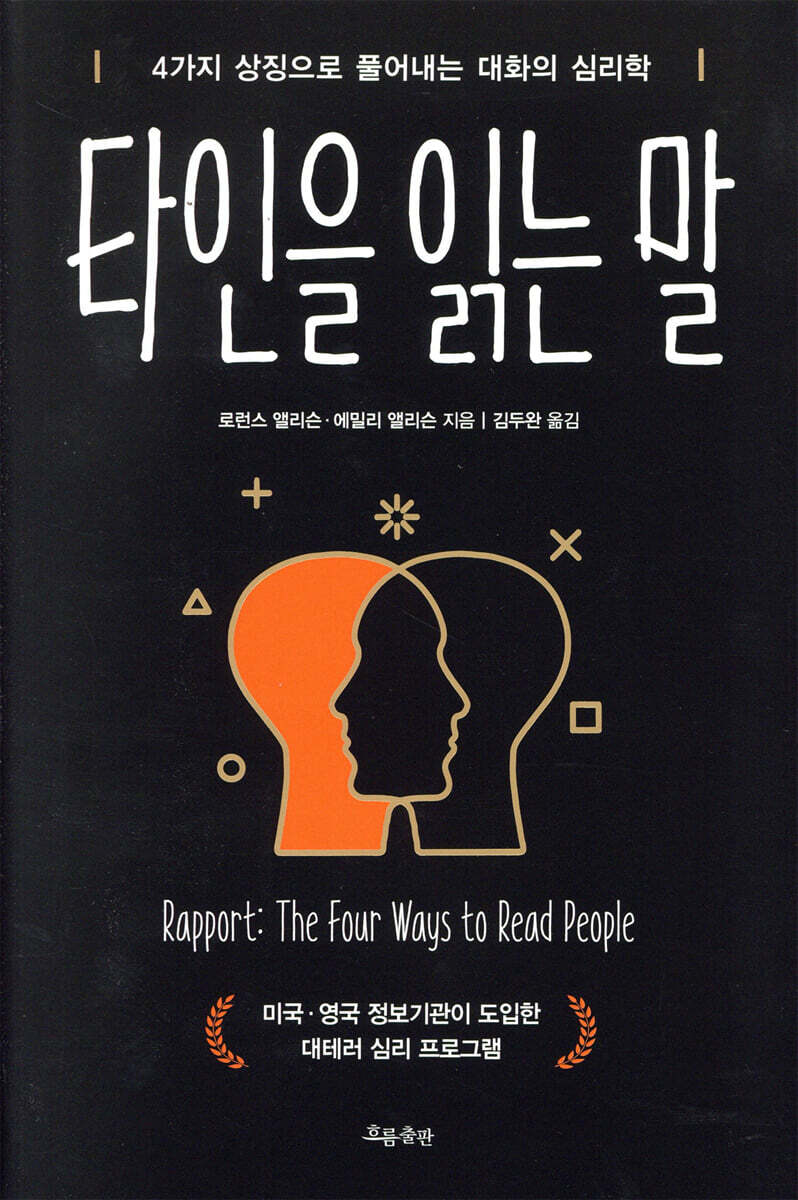
What kind of animal am I communicating like?"Learning counter-terrorism psychological strategies taught me how to be a good father." A psychological communication method developed by a couple of criminal psychologists at the request of a U.S. intelligence agency.
This has been published in a book so that it can be applied to everyday life.
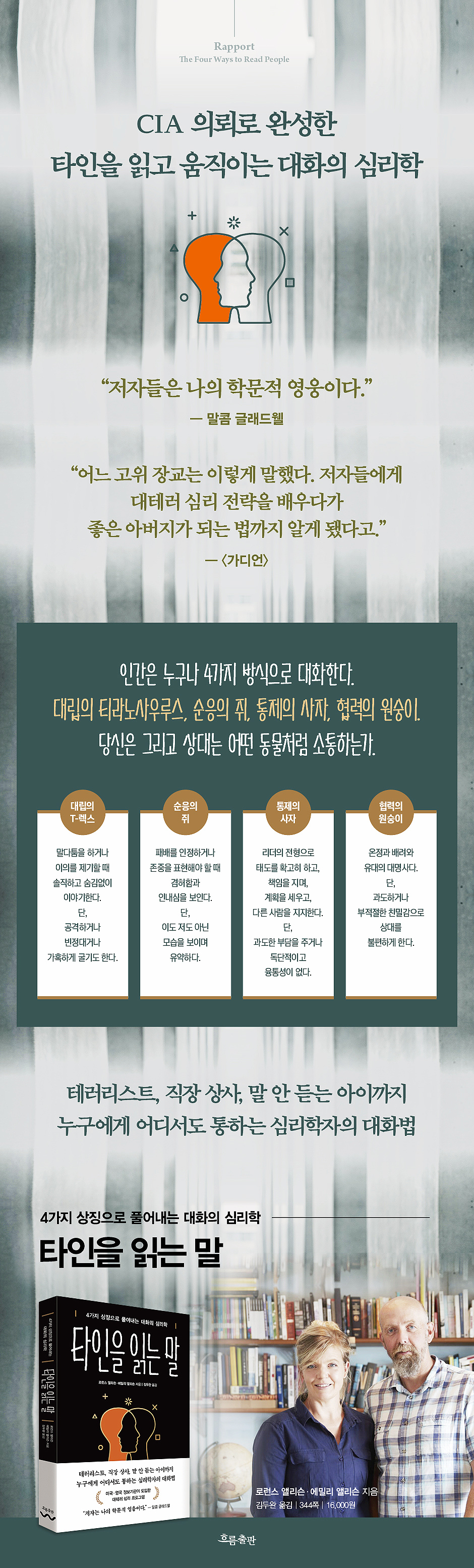
All humans communicate like these four animals: Tyrannosaurus, rat, lion, and monkey.
What kind of animals do we speak like? What's hidden in our words?January 29, 2021. Self-Development PD Park Jeong-yoon
“Authors are my academic heroes.” - Malcolm Gladwell
“A senior officer said this:
“I learned counter-terrorism psychological strategies from the authors and even learned how to be a good father.” - The Guardian
In 2004, a video of US soldiers abusing Iraqi prisoners of war was released to the public, causing a huge stir.
The U.S. intelligence agency commissioned the Allisons, two of Britain's leading criminal psychologists with over 20 years of experience in family and adolescent therapy, to evaluate existing counter-terrorism interrogation strategies and develop new approaches.
The Allisons conducted more than 2,000 hours of interviews with intelligence agents, prosecutors, police, terrorist suspects, and criminal suspects around the world.
Research has shown that, contrary to popular belief, pressure, persuasion, and torture are rarely effective in persuading others or obtaining information.
On the other hand, the more I empathized with the other person, guaranteed their autonomy, and spoke directly about what I wanted, the more the other person opened their heart.
We also discovered that everyone, from terrorists to bosses to teenagers, communicates in four communication styles: confrontation, following, control, and cooperation.
Based on these research results, the authors completed the Animal Circle, which organizes communication types using the HEAR (Honesty, Empathy, Autonomy, Reflection) conversation principles and four animal symbols.
The psychological dialogue method developed by the authors is currently used as an interrogation strategy by intelligence agencies, police, and prosecutors in the United States and the United Kingdom, and is also used as an important methodology in psychological counseling and treatment for parents and adolescents.
《Reading Others》 is a popular psychology book that organizes the authors' conversation methods so that anyone can easily apply them in their daily lives.
- You can preview some of the book's contents.
Preview
index
Introduction People who talk but don't communicate
Part 1: Words that Move the Heart: HEAR Conversation Principles
Chapter 1 The more desperate you are, the more cautious you are. The more curious you are, the more honest you are.
“I wish you were a murderer!”
“I’m concentrating on what you’re saying!”
Listen carefully and ask honestly.
Chapter 2: Principles of Disarming Dialogue
The first principle of conversation: Why do we talk?
HEAR Conversation Principles: Honesty, Empathy, Autonomy, and Reflection
Even honesty requires strategy.
You don't have to be friends to sympathize.
Persuasion is not coercion.
Revival, finding hidden meaning
Chapter 3: The answer lies in the other person's words.
Avoid the temptation to teach
How to ask questions that lead a conversation
Reconstruction technology, SONAR
Part 2: How to Read Others with Four Symbols_Animal Circle
Chapter 4: Everyone Has Their Own Symbol
Four Animals, Four Ways of Communication
Good animals, bad animals
What kind of animal am I
Find my symbol
Chapter 5: Tyrannosaurus: I Attack, Therefore I Am
Threats are the worst of the worst
How to speak confidently without hurting others
Tyrannosaurus in the workplace
“I say what I have to say and live it.”
Chapter 6: To Be Humble or Cowardly, That Is the Question
In the end, the rat wins
The Power of Humility That Moved Terrorists
The Bad Rat's Delusion
A good rat makes the best leader
Chapter 7 Lion, Lead or Take the Neck
Problem Solver, Lion
Lead but do not rule
Who is the lion in our house?
Chapter 8: Monkeys, If You Want to Go Far, Go Together
The embodiment of teamwork, the monkey
The 3-Step Conversation Method of an Attractive Person
Monkey in the Workplace
Distinguish between intimacy and obsession
Chapter 9: Using the Animal Circle
To freely use the four animal types
Fit or twist
Role-playing exercises
Conclusion: The Rapport Revolution
Huzhou
Detailed image
Into the book
And we live our lives forming and maintaining rapport with people every day without even realizing it.
From chatting about the weather with strangers to engaging in complex interactions with close friends, all of this is about establishing and maintaining rapport.
But most people don't know the key elements or formula for building rapport.
Rather, the way one builds rapport is often seen as a matter of innate personality.
Something like, “That guy is really sociable.”
Can we learn to build rapport regardless of our innate personality? Based on my research as a psychologist, I'd say it's possible.
Understanding the elements that create rapport and mastering the formula can help you make all your relationships more positive.
--- Introduction (pp. 11-12)
Have you ever avoided confrontation by not speaking up, only to find yourself making things worse? You need to have the strength to speak up and assert yourself when necessary.
Instead of being cruel, quarrelsome, or malicious, you should be straightforward.
Let's not try to gloss over what the real issue is.
Whether you're telling your spouse you're lacking time together, expressing concerns about your child's drinking and smoking directly to yourself, or telling yourself that your parent's health and mobility have deteriorated, it doesn't matter what the situation is.
These are all difficult conversations, but being honest about what you want to discuss can build trust and lead to real change.
Be courageous and straightforward.
And then finish it off like ripping off a band-aid.
--- Chapter 2: Principles of Dialogue That Disarms the Opponent (pp. 70)
“I feel like I’m in a terrible state these days.
I know I've gained weight and my clothes don't fit anymore! It's so depressing.
Jillian did that diet program right and now she looks great.
“Don’t you think she’s cool? I bet you’re attracted to her, right?”
Don't answer the last question.
It's a trap! If you say no, your spouse will likely think you're lying.
If you answer yes, you'll probably end up sleeping on the couch that night.
Instead, let's try writing a review.
What is your spouse really saying in this conversation? Does she really want a yes or no answer about whether she's attracted to her best friend? Even if she thinks she is, she probably isn't.
So, what should we say to avoid an argument? Let's review what's underlying the story we heard.
--- Chapter 3.
Review (pp. 129-130)
Humans tend to develop behavior patterns that are most comfortable for them and apply them in most interpersonal relationships.
This is an instinctive choice.
But to mature, you need to step out of your comfort zone and try different ways of communicating, even ways that may be uncomfortable, awkward, or even make you sweat.
'This is my way.
If you decide that the other person will have to deal with it on their own, you are limiting your ability to achieve the best results in your relationships.
The more you expand your technology, the more benefits you gain.
Interpersonal flexibility is also related to emotional intelligence and empathy.
Research shows that people who are good communicators are more flexible than those who are not.
--- Chapter 9: Using the Animal Circle (pp. 304-305)
Improving rapport with others isn't just good for them.
It is also the path to your own happiness, health, and satisfaction.
Rapport is the key to improving interactions with others, growing closer to those we care about, fostering camaraderie in our communities, and fostering greater understanding and reducing conflict in the international community we live in.
Rapport not only makes your life better, it makes the world a better place.
It's definitely worth the effort.
Publisher's Review
Psychological conversation techniques to read and move the other person
“Authors are my academic heroes.” - Malcolm Gladwell
In 2004, a video of US soldiers abusing Iraqi prisoners of war was released to the public, causing a huge stir.
In particular, the photos of Private Charles Graner and Private Lynndie England, who were in a romantic relationship, pretending to shoot naked prisoners in the lower body or dragging them around with a rope around their necks were shocking as they showed the ruthlessness of counter-terrorism operations.
But Lindy England, who was sentenced to three years in prison for the incident, said she did not regret the abuse she inflicted on the prisoners, saying it was her way of managing terrorists.
This shows how much high-intensity psychological techniques (mental and physical pressure and torture) have been tolerated by various intelligence agencies, including the US military.
To address this issue, US President Barack Obama launched the High-Value Detainee Interrogation Group (HIG) in 2009.
The organization, which studies best-practice newspaper strategies and serves as a repository for case studies, is comprised of officials from U.S. government agencies such as the FBI, CIA, Department of Defense, Department of Homeland Security, and the National Security Council.
In 2012, HIG asked Professor Laurence Allison, a psychology professor at the University of Liverpool, and Dr. Emily Allison to work with HIG to research effective strategies for obtaining testimony, information, and evidence from terrorism suspects.
Why would a U.S. intelligence agency ask a British couple of psychologists to research persuasion techniques that could replace torture?
The Allisons are some of the world's top criminal psychologists and profilers, having analyzed over 400 terrorist and violent crime cases.
He was responsible for the psychoanalysis and treatment of victims of the Burnsfield fire, the largest fire disaster in European history, the London bombings, and the tsunami disaster.
They have provided psychological counseling, particularly in hundreds of serious cases involving murder, rape, child sexual exploitation, and terrorism, and have attracted attention for adopting a 'rapport strategy' instead of the traditional 'separation and isolation' method.
Conversational methods that pressure and persuade others are ineffective.
The Allisons' research was aimed at finding "alternatives to torture." HIG wanted to test whether the methods they had been using up to that point—mental and physical coercion and torture—were actually effective, using interviews with criminal suspects.
The study found that the 'high-intensity newspaper technique' was not effective at all.
Even using these methods, criminal suspects often provide distorted information, or the information obtained is often worthless.
But, if you give a terrorist suspect a cup of warm tea and a biscuit, will they open up easily? It won't work either.
There are situations where you need to take the initiative and get a confession, and there are times when you need to get life-or-death information.
In this situation, it is natural to have a strong urge to use 'any means' to achieve one's goal.
For these reasons, the counterterrorism psychological model the authors presented to HIG had to be legally compliant, ethical, scientifically supported, and demonstrably effective.
To provide an alternative, the authors were granted access to a dataset of police and intelligence interviews with convicted terrorists from around the world.
Additionally, they spent over 2,000 hours collaborating with intelligence agencies, prosecutors, and police from various countries to find alternatives and implement their rapport strategies on the ground.
As a result, the authors' methodology was found to function remarkably well even in the antagonistic relationship between terrorists and psychological investigators.
The Allisons' rapport strategy is currently used by counter-terrorism agencies and special police units in the United States and the United Kingdom, and is also a key treatment in over 80 schools, dozens of juvenile delinquency teams, and numerous other social welfare organizations in the UK.
Every human being communicates in four ways.
What kind of animal do you and your partner communicate like?
“A senior officer said this:
“I learned counter-terrorism psychological strategies from the authors and even learned how to be a good father.” - The Guardian
"Reading Others" is a popular psychology book written by the Allisons, in which their theories are organized so that anyone can easily apply them to everyday life, whether with friends, lovers, family, or work.
The authors say in this book that successful interpersonal relationships depend on how you build rapport.
We live our lives forming and maintaining rapport with people every day without even realizing it.
From chatting about the weather with strangers to engaging in complex interactions with close friends, all of this is part of rapport building, which establishes and sustains relationships.
However, people often view the way they build rapport as a matter of innate personality.
Something like, “That guy is really sociable.”
Can we learn to build rapport regardless of our innate personality? The authors say it's definitely possible.
Understanding the elements that create rapport and figuring out the formula can help you make all your relationships more positive.
This book proposes two specific methodologies for rapport strategy in two parts.
Part 1 introduces the HEAR principles, the four fundamental principles of rapport strategy: Honesty, Empathy, Autonomy, and Reflection. The HEAR principles are a conversational method that enhances communication skills with others and increases opportunities to achieve desired outcomes.
In particular, 'review' is a simple but powerful way to read the other person's inner thoughts that they are not even aware of by asking simple questions, and thereby take the initiative in the conversation and solve the problem.
Part 2 introduces the 'Animal Circle'.
Each person has their own individuality, and through this, they build relationships in their own way of communicating.
For example, some people are born leaders or enjoy conflict, while others are born managers or prefer to stay back.
In this way, each person has a safety zone in their interpersonal relationships.
It is difficult to step out of your comfort zone and engage in interactions that you find relatively challenging.
It is human nature to try to avoid social situations that make us feel awkward.
However, the authors argue that effective conversation is possible in any situation if you understand your own and the other person's communication style and can utilize it appropriately.
The 'Animal Circle' is a diagram that represents the four main human communication styles (confrontation, compliance, control, and cooperation) by assigning them to animals that symbolize them.
To summarize, it is as follows:
- Tyrannosaurus (conflict.
To become adept at handling conflict, you must eliminate aggressive, insulting, and harsh communication styles from your repertoire.
A good debater is assertive, honest, and direct.
But they also attack others, are harsh, and are sarcastic.
It is easy to cross the line, so maximum self-control is required.
- Rats (compliant.
To protect yourself while handing over control to others, you must learn not to appear weak, to step back, to listen, to be patient, and to be willing to accept advice.
A good follower is humble, but not weak.
- Lion (control.
To be a leader, you must be able to lead responsibly and effectively.
However, it should be noted that control can become excessive, arbitrary, or old-fashioned.
A good leader leads from the front by supporting others, establishing clear and solid plans, and eliciting commitment and confidence from others.
- Monkey (cooperation.
Friend) To master teamwork, you must be careful of excessive or inappropriate socializing.
Good friends use warmth, conversation, and consideration to build attachments with others.
The book introduces a simple questionnaire to help you discover your dominant communication style and how to understand the communication styles of others.
Additionally, it provides various examples of the characteristics of each symbol's conversation style, things to watch out for, and areas for improvement.
Rapport strategy isn't about getting 100 percent of the answers you want or seeing through how much someone is lying.
Unlike spy movies, there is no technology or drug in this world that can guarantee a confession.
However, the conversational methods introduced by the authors in this book will significantly increase the opportunities to obtain useful information from the other person's communication.
Rapport strategies are also useful in everyday life.
The book introduces various real-life cases, including those related to teenagers, couples, work, and lovers, and rapport strategies for each case.
You may also like
카테고리

korean

![ELLE 엘르 스페셜 에디션 A형 : 12월 [2025]](http://librairie.coreenne.fr/cdn/shop/files/b8e27a3de6c9538896439686c6b0e8fb.jpg?v=1766436872&width=3840)


