

Four Seasons Memory Book
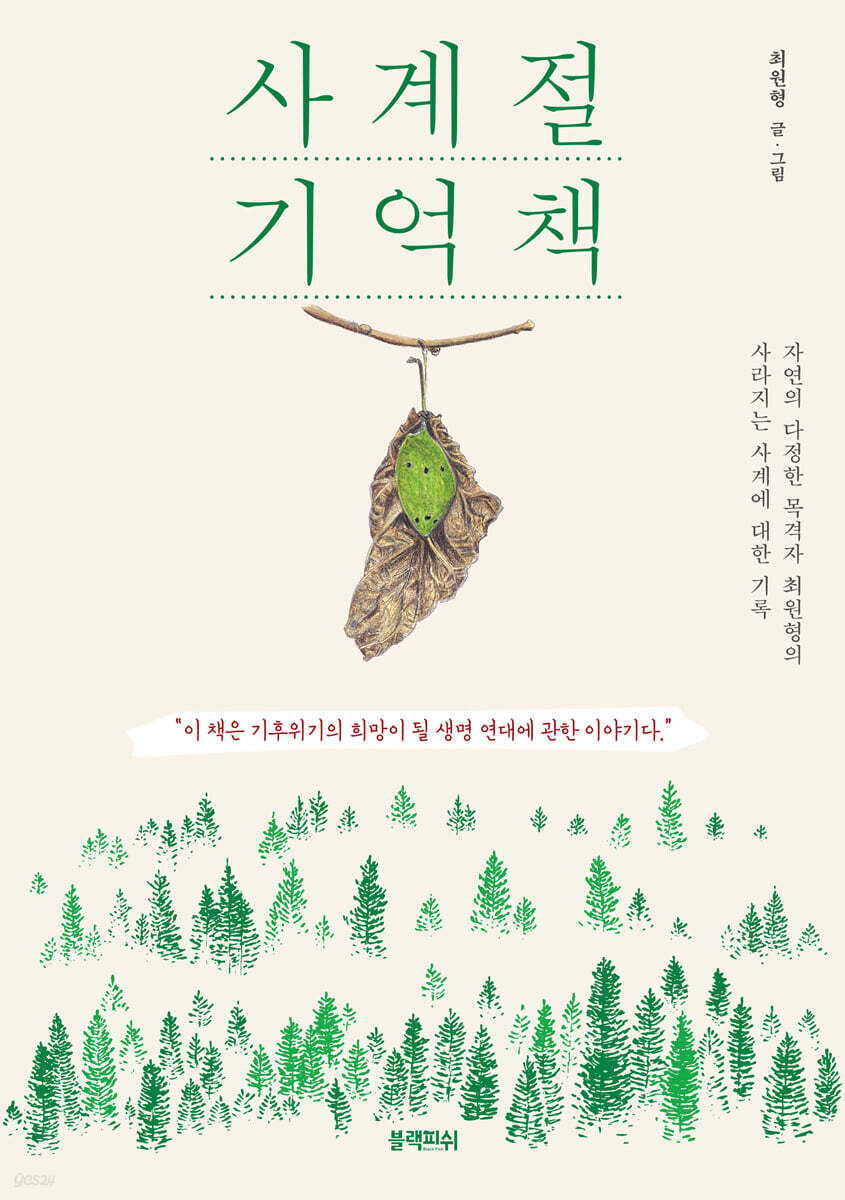 |
Description
Book Introduction
- A word from MD
-
Records of the Disappearing Four SeasonsThe four seasons are disappearing.
Climate change and overdevelopment are causing the scent of acacia trees in spring and cicadas in midsummer to disappear.
To remember the disappearing lives, Choi Won-hyung, a 'kind witness of nature', recorded them.
In the age of climate crisis, the encounter between living beings in organic relationships offers the harmless solace of nature.
June 9, 2023. Natural Science PD Ahn Hyun-jae
“This book is a story about life solidarity, a hope for the climate crisis.”
Choi Won-hyung, a loving witness of nature
A record written and drawn every day to remember and protect
Recommended by News Penguin CEO Kim Ki-jung and Hankyoreh Climate Change Team reporter Nam Jong-young
There are memorable scenes in each season, like frogs in spring and cicadas in midsummer.
However, due to climate change, excessive development, and reckless consumption, the representatives of the seasons are disappearing without us even realizing it.
Could it be that the last generation to know spring and fall is not far off?
"The Four Seasons Memory Book" is a daily record written and drawn by Wonhyung Choi, an ecology, environment, and energy expert and "a loving witness of nature," to remember the fading seasons and disappearing beings.
The author, who has traveled through mountains and seas, rivers and streams, tidal flats and wetlands, and met countless lives, presents their vibrant stories, along with over 100 detailed drawings.
The vivid nature unfolds as if it were right before your eyes, with not only the neighboring flora and fauna that you may have passed by without noticing, but also unfamiliar creatures that you may not easily encounter, such as the black-faced crane in Suncheon Bay, the Suwon tree frog in Paju's Gongneungcheon, and the long-tailed tit in Jeju's Saryeoni Forest.
Meanwhile, the author also focuses on natural creatures that are suffering or disappearing due to human greed, such as the spoon-billed sandpiper, of which only about 700 survive on Earth; the dung beetle that went extinct with the development of the meat industry; the southern right whale 'Bibongi' that was released into the sea off Jeju after living in an aquarium; the rhinoceros that has become virtually functionally extinct due to poaching; and the zebra 'Sero' that escaped from the zoo and roamed the roads.
The more we get to know the great and small creatures in nature, the more we believe we will be able to cherish them with a deeper sense of connection.
In an age where we hear so much about climate crisis and extinction crisis, the author publishes this book with the sole determination to remember and protect.
Choi Won-hyung, a loving witness of nature
A record written and drawn every day to remember and protect
Recommended by News Penguin CEO Kim Ki-jung and Hankyoreh Climate Change Team reporter Nam Jong-young
There are memorable scenes in each season, like frogs in spring and cicadas in midsummer.
However, due to climate change, excessive development, and reckless consumption, the representatives of the seasons are disappearing without us even realizing it.
Could it be that the last generation to know spring and fall is not far off?
"The Four Seasons Memory Book" is a daily record written and drawn by Wonhyung Choi, an ecology, environment, and energy expert and "a loving witness of nature," to remember the fading seasons and disappearing beings.
The author, who has traveled through mountains and seas, rivers and streams, tidal flats and wetlands, and met countless lives, presents their vibrant stories, along with over 100 detailed drawings.
The vivid nature unfolds as if it were right before your eyes, with not only the neighboring flora and fauna that you may have passed by without noticing, but also unfamiliar creatures that you may not easily encounter, such as the black-faced crane in Suncheon Bay, the Suwon tree frog in Paju's Gongneungcheon, and the long-tailed tit in Jeju's Saryeoni Forest.
Meanwhile, the author also focuses on natural creatures that are suffering or disappearing due to human greed, such as the spoon-billed sandpiper, of which only about 700 survive on Earth; the dung beetle that went extinct with the development of the meat industry; the southern right whale 'Bibongi' that was released into the sea off Jeju after living in an aquarium; the rhinoceros that has become virtually functionally extinct due to poaching; and the zebra 'Sero' that escaped from the zoo and roamed the roads.
The more we get to know the great and small creatures in nature, the more we believe we will be able to cherish them with a deeper sense of connection.
In an age where we hear so much about climate crisis and extinction crisis, the author publishes this book with the sole determination to remember and protect.
- You can preview some of the book's contents.
Preview
index
Introduction
Winter with the beginning of spring
Birds are skilled architects_ Gaebye
Suncheon, a city that removed power lines for birds_ Black-faced Cranes
A bird that eats apples so artistically_ A woodpecker
The Korean Peninsula's top predator_ The wildcat
The Life of Wild-Released Aquarium Whales_ Southern Right Whales
I see a swallow, spring
Why do swallows cross the sea to our country in spring?_ Swallows
"So where should we live?" The story of the frog and the roadkill_ Suwon tree frog
For a variety of choices toward a safe world_ March 11, the anniversary of the Fukushima accident (2011)
Dandelion, a strong and flexible grass
Ingredients with the face of the producer_ Spinach
The grass that has the fate of not being able to survive unless it is stepped on_ Plantain
A small but important creature that carries pollen_ Bumblebee
Birds also suffer from housing shortages_ Papillon
Cherry trees, a refuge in the city
Buen Vivir, a life where humans and nature coexist in harmony_ April 22nd, Earth Day
A hotel for birds that have become outcasts_ Acacia tree
Recycling Woodpecker Nests_ Donggobi
Human Civilization, Climate Issues, and Fair Trade Stories_ World Fair Trade Day, the second Saturday of May
A continental traveler who flies 12,000 km nonstop_ The Great Godwit
Summer when the daffodils bloom
The season when birds leave the nest and become independent_ Sparrows
A Thankful Plant That Cools Down a City Heatwave: Clematis
The sorrow of losing a country_ The lost country's sorrow_
A useful window to communicate with the outside world_ A temporary station
Can you tell the difference between beneficial and harmful insects? _ Saw-legged ant-waisted stink bug
Moidae, forming a small ecosystem_ Kamajung
A fateful encounter, not a coincidence, while traveling in Jeju_ Long-tailed tit
The identity inside the hole of a half-eaten green pepper_ Tobacco moth larva
What humans did to obtain feathers, a product of evolution_ Live plucking
Narrowing skies, urban high-rise buildings_ June 17th, World Day to Combat Desertification
A migratory bird bathing in a water bowl_ a magpie
Autumn with beautiful persimmon tree leaves
Who makes the oak forest? _ Squirrel
Insects, the most abundant animal species on Earth_ Spotted beetle
The generous tree that bears magpie rice_ Persimmon tree
Seed Keepers_ Beans
The now-extinct relationship between dung beetles and carnivores_ Dung beetles
A farmer who tills the land silently_ Earthworm
Seed strategies for spreading and blooming_ Heterogeneous grass
Saemangeum Reclamation Project, New Airport Development, and the Death of the Tidal Flats_ Jomdoyo
Rhinoceros, an unfortunate species facing extinction due to poaching
Winter in solidarity with wild life
Connecting with Wild Life_ Birdfeeder
Marine Debris and Why I Plog_ The Dinghy
Migratory birds that sit without moving_ Blackbirds
Bird hunting is natural_ falcon
About animal instincts and coexistence_ Cat
Concluding remarks
People who helped
References
Winter with the beginning of spring
Birds are skilled architects_ Gaebye
Suncheon, a city that removed power lines for birds_ Black-faced Cranes
A bird that eats apples so artistically_ A woodpecker
The Korean Peninsula's top predator_ The wildcat
The Life of Wild-Released Aquarium Whales_ Southern Right Whales
I see a swallow, spring
Why do swallows cross the sea to our country in spring?_ Swallows
"So where should we live?" The story of the frog and the roadkill_ Suwon tree frog
For a variety of choices toward a safe world_ March 11, the anniversary of the Fukushima accident (2011)
Dandelion, a strong and flexible grass
Ingredients with the face of the producer_ Spinach
The grass that has the fate of not being able to survive unless it is stepped on_ Plantain
A small but important creature that carries pollen_ Bumblebee
Birds also suffer from housing shortages_ Papillon
Cherry trees, a refuge in the city
Buen Vivir, a life where humans and nature coexist in harmony_ April 22nd, Earth Day
A hotel for birds that have become outcasts_ Acacia tree
Recycling Woodpecker Nests_ Donggobi
Human Civilization, Climate Issues, and Fair Trade Stories_ World Fair Trade Day, the second Saturday of May
A continental traveler who flies 12,000 km nonstop_ The Great Godwit
Summer when the daffodils bloom
The season when birds leave the nest and become independent_ Sparrows
A Thankful Plant That Cools Down a City Heatwave: Clematis
The sorrow of losing a country_ The lost country's sorrow_
A useful window to communicate with the outside world_ A temporary station
Can you tell the difference between beneficial and harmful insects? _ Saw-legged ant-waisted stink bug
Moidae, forming a small ecosystem_ Kamajung
A fateful encounter, not a coincidence, while traveling in Jeju_ Long-tailed tit
The identity inside the hole of a half-eaten green pepper_ Tobacco moth larva
What humans did to obtain feathers, a product of evolution_ Live plucking
Narrowing skies, urban high-rise buildings_ June 17th, World Day to Combat Desertification
A migratory bird bathing in a water bowl_ a magpie
Autumn with beautiful persimmon tree leaves
Who makes the oak forest? _ Squirrel
Insects, the most abundant animal species on Earth_ Spotted beetle
The generous tree that bears magpie rice_ Persimmon tree
Seed Keepers_ Beans
The now-extinct relationship between dung beetles and carnivores_ Dung beetles
A farmer who tills the land silently_ Earthworm
Seed strategies for spreading and blooming_ Heterogeneous grass
Saemangeum Reclamation Project, New Airport Development, and the Death of the Tidal Flats_ Jomdoyo
Rhinoceros, an unfortunate species facing extinction due to poaching
Winter in solidarity with wild life
Connecting with Wild Life_ Birdfeeder
Marine Debris and Why I Plog_ The Dinghy
Migratory birds that sit without moving_ Blackbirds
Bird hunting is natural_ falcon
About animal instincts and coexistence_ Cat
Concluding remarks
People who helped
References
Detailed image
.jpg)
Into the book
I often went for a walk along the roadside where small birds like grouse, red-headed grouse, and sparrows would often come and go.
One winter day, while looking into the bush, I happened to find a nest shaped like a rice bowl, hidden from view by the thick foliage.
The first thing that came to mind was how anxiously the bird must have been weaving its nest and raising its chicks, hearing the sound of people coming and going.
The skill with which the dry grass was tightly woven around the tree trunk was amazing.
People say that humans are superior because they can use tools, but as time goes by, we are losing the use of our hands, and when we see birds making such wonderful nests with just their beaks, we can't help but say that the standards of superiority are flexible depending on the criteria.
---From "Birds are skilled architects_ Gaebye"
Power lines spoil the scenery.
In addition, large birds such as black-crowned cranes and eagles can get their wings injured by getting caught in power lines.
Birds with injured wings, which are essential for survival, will eventually be eliminated, so power lines are bound to be a threat to birds.
Suncheon City was the first region to remove these power lines for the sake of birds.
In April 2009, Suncheon City began landscape farming by removing utility poles from farmland around Suncheon Bay and planting rice in the shape of a black-faced crane in the fields.
Farming requires electricity, so farmers would not have readily agreed to having their utility poles pulled out.
When even Korea Electric Power Corporation refused to remove the utility poles, people who wanted to protect Suncheon City and Suncheon Bay came up with a concrete plan and began persuading them.
This 59-hectare field, now devoid of utility poles, has become a migratory bird sanctuary.
There, rice harvested through eco-friendly farming methods without the use of pesticides or herbicides is provided as food for black-faced spoonbills.
We have secured a wetland for birds to rest in, so that not only black-faced spoonbills but also any other birds that visit can come and rest.
Suncheon citizens installed light-blocking fences and vehicle barriers to provide sleeping and feeding areas for the birds so they can spend the winter comfortably.
---From "Suncheon, a city that removed power lines for the birds_ Black-faced Cranes"
The snail knows exactly how to survive without being trampled and completely crushed.
Small white flowers bloom on the flower stalks and black seeds are formed, but it is difficult to tell them apart without a magnifying glass even when lying face down on the ground.
These seeds contain a jelly-like substance that swells and becomes adhesive when exposed to water.
Due to these characteristics of the seeds, plantains live on the road, spreading their territory far and wide by getting stuck on the soles of the shoes of passing travelers, on the wheels of carriages, and in the 21st century, on the tires of automobiles.
Knowing that each and every shape of the plant contains traces of evolutionary efforts to spread its offspring, I think the name "plantain" is a very fitting name for the plant.
---From "The Grass That Embraces the Fate of Not Being Trampled on: The Plantain"
Animals like squirrels and chipmunks collect acorns as they begin to fall and hide them in places they can remember.
It is good for the oak trees to store food to eat throughout the winter and prepare for winter, and the animals that take acorns and hide them in the ground do this.
Even if an acorn that falls under a tree sprouts, it is difficult for other trees to grow properly under a large tree, so it is advantageous for the acorn to fall as far away as possible to spread its offspring.
(syncopation)
It is impossible for animals to remember all the acorns they have hidden, so the acorns that survive being forgotten are buried at an appropriate depth, where they take root and sprout, eventually becoming large oak trees.
And the squirrels and the squirrels are rewarded for their efforts by burying acorns in the fall.
---From "Who Makes the Oak Forest?_ Squirrel"
Autumn is a season when you stand up and see the fields of cosmos and chrysanthemums in full bloom, and when you lower your posture, you can see the tall flowers in the gaps between them, and it is a good time to encounter seeds of various shapes.
Among the wild flowers, there is a grass with the odd name of 'Ijil' that does not go well with the pretty flowers.
The herb Ijilpul is used in oriental medicine as a laxative to treat dysentery.
Since it was a time when medicine was not developed, practical information would have been more important than a pretty name.
The place that bloomed with pink flowers all summer turns into a beautiful pod containing seeds in the fall.
As the seeds ripen and the pod bursts, the seeds inside are thrown out.
The seeds, which have not completely bounced off and are still attached to the pod, look like a gorgeous chandelier to me.
It looks pretty with chandeliers placed here and there in the grass.
The force of the opening of the pods causing the seeds to bounce far away is also a strategy for plants to spread their offspring.
(syncopation)
We tend to focus mainly on the splendor of flowers, but there is much to see even when we look at the places where flowers have withered.
The wisteria tree, which provides cool shade all summer long and also presents beautiful flowers, is a legume plant that produces clusters of pods that resemble bean pods in the fall.
Observing the twisting and opening of the dried seed pods is a fascinating demonstration of the plant's efforts to disperse its seeds far and wide.
Maple and pine trees attach wings to their seeds and carry them on the wind, while burdock and thistles even hitch a ride on animals to spread their seeds far and wide.
One winter day, while looking into the bush, I happened to find a nest shaped like a rice bowl, hidden from view by the thick foliage.
The first thing that came to mind was how anxiously the bird must have been weaving its nest and raising its chicks, hearing the sound of people coming and going.
The skill with which the dry grass was tightly woven around the tree trunk was amazing.
People say that humans are superior because they can use tools, but as time goes by, we are losing the use of our hands, and when we see birds making such wonderful nests with just their beaks, we can't help but say that the standards of superiority are flexible depending on the criteria.
---From "Birds are skilled architects_ Gaebye"
Power lines spoil the scenery.
In addition, large birds such as black-crowned cranes and eagles can get their wings injured by getting caught in power lines.
Birds with injured wings, which are essential for survival, will eventually be eliminated, so power lines are bound to be a threat to birds.
Suncheon City was the first region to remove these power lines for the sake of birds.
In April 2009, Suncheon City began landscape farming by removing utility poles from farmland around Suncheon Bay and planting rice in the shape of a black-faced crane in the fields.
Farming requires electricity, so farmers would not have readily agreed to having their utility poles pulled out.
When even Korea Electric Power Corporation refused to remove the utility poles, people who wanted to protect Suncheon City and Suncheon Bay came up with a concrete plan and began persuading them.
This 59-hectare field, now devoid of utility poles, has become a migratory bird sanctuary.
There, rice harvested through eco-friendly farming methods without the use of pesticides or herbicides is provided as food for black-faced spoonbills.
We have secured a wetland for birds to rest in, so that not only black-faced spoonbills but also any other birds that visit can come and rest.
Suncheon citizens installed light-blocking fences and vehicle barriers to provide sleeping and feeding areas for the birds so they can spend the winter comfortably.
---From "Suncheon, a city that removed power lines for the birds_ Black-faced Cranes"
The snail knows exactly how to survive without being trampled and completely crushed.
Small white flowers bloom on the flower stalks and black seeds are formed, but it is difficult to tell them apart without a magnifying glass even when lying face down on the ground.
These seeds contain a jelly-like substance that swells and becomes adhesive when exposed to water.
Due to these characteristics of the seeds, plantains live on the road, spreading their territory far and wide by getting stuck on the soles of the shoes of passing travelers, on the wheels of carriages, and in the 21st century, on the tires of automobiles.
Knowing that each and every shape of the plant contains traces of evolutionary efforts to spread its offspring, I think the name "plantain" is a very fitting name for the plant.
---From "The Grass That Embraces the Fate of Not Being Trampled on: The Plantain"
Animals like squirrels and chipmunks collect acorns as they begin to fall and hide them in places they can remember.
It is good for the oak trees to store food to eat throughout the winter and prepare for winter, and the animals that take acorns and hide them in the ground do this.
Even if an acorn that falls under a tree sprouts, it is difficult for other trees to grow properly under a large tree, so it is advantageous for the acorn to fall as far away as possible to spread its offspring.
(syncopation)
It is impossible for animals to remember all the acorns they have hidden, so the acorns that survive being forgotten are buried at an appropriate depth, where they take root and sprout, eventually becoming large oak trees.
And the squirrels and the squirrels are rewarded for their efforts by burying acorns in the fall.
---From "Who Makes the Oak Forest?_ Squirrel"
Autumn is a season when you stand up and see the fields of cosmos and chrysanthemums in full bloom, and when you lower your posture, you can see the tall flowers in the gaps between them, and it is a good time to encounter seeds of various shapes.
Among the wild flowers, there is a grass with the odd name of 'Ijil' that does not go well with the pretty flowers.
The herb Ijilpul is used in oriental medicine as a laxative to treat dysentery.
Since it was a time when medicine was not developed, practical information would have been more important than a pretty name.
The place that bloomed with pink flowers all summer turns into a beautiful pod containing seeds in the fall.
As the seeds ripen and the pod bursts, the seeds inside are thrown out.
The seeds, which have not completely bounced off and are still attached to the pod, look like a gorgeous chandelier to me.
It looks pretty with chandeliers placed here and there in the grass.
The force of the opening of the pods causing the seeds to bounce far away is also a strategy for plants to spread their offspring.
(syncopation)
We tend to focus mainly on the splendor of flowers, but there is much to see even when we look at the places where flowers have withered.
The wisteria tree, which provides cool shade all summer long and also presents beautiful flowers, is a legume plant that produces clusters of pods that resemble bean pods in the fall.
Observing the twisting and opening of the dried seed pods is a fascinating demonstration of the plant's efforts to disperse its seeds far and wide.
Maple and pine trees attach wings to their seeds and carry them on the wind, while burdock and thistles even hitch a ride on animals to spread their seeds far and wide.
---From "Strategies of Seeds to Spread Widely and Bloom_ Heterogeneous Grass"
Publisher's Review
“Record, remember, connect the heart.”
Wonhyung Choi, a loving witness of nature, watches the fading season,
A book of life written to remember and protect the vanishing existence.
《Four Seasons Memory Book》 is a record written and drawn every day by Choi Won-hyung, a 'kind witness of nature', to remember the fading seasons and disappearing beings.
As an expert in ecology, environment, and energy, the author, who has published numerous books including “Learning the Earth Environment through Calendars” and “There is No Ethical Consumption,” is a highly beloved author in the field. This time, he has published his first nature essay along with over 100 detailed illustrations never before seen in any other book.
From flowers and trees to plants called weeds, from familiar mammals and birds to unfamiliar insects and amphibians.
The beautiful nature that I had not been aware of before unfolds vividly as if it were right before my eyes.
Meanwhile, the author also focuses on natural creatures that are suffering or disappearing due to human greed, such as the spoon-billed sandpiper, of which only about 700 survive on Earth; the dung beetle that went extinct with the development of the meat industry; the southern right whale 'Bibongi' that was released into the sea off Jeju after living in an aquarium; the rhinoceros that has become virtually functionally extinct due to poaching; and the zebra 'Sero' that escaped from the zoo and roamed the roads.
The more we get to know the great and small creatures in nature, the more we believe we will be able to cherish them with a deeper sense of connection.
In an age where we hear so much about climate crisis and extinction crisis, the author publishes this book with the sole determination to remember and protect.
“Encounter nature in every moment of your daily life.”
Nature's harmless comfort, nurtured between life and life
From the moment he shared an apple with a magpie that had come to Moidae, to the moment he pulled a tobacco budworm larva out of a green pepper hole, to the moment he discovered an earthworm in a flowerpot he was repotting, nature is present in every moment the author touches with his fingertips and toes.
The author meticulously observes and records with a warm gaze the lives of each being, which may be different in size but have the same weight, whether in the forest or in the city.
《The Four Seasons Memory Book》 is a memoir by an urban forest naturalist for modern people who can tell the breeds of dogs and cats but do not know the name of the bird that sang on the street tree today.
“Even if the city is a concrete forest, it is not difficult to find life, such as grass and birds, permeating every corner (p. 73),” says the author, who travels to mountains, seas, rivers, streams, tidal flats, and wetlands and tells the stories of the countless lives he has met there.
Black-faced spoonbill in Suncheon Bay, Suwon tree frog in Gongneungcheon, Paju, long-tailed tit in Saryeoni Forest, Jeju…
It is a sight that can only be encountered by those who are ready to fully embrace nature.
The meeting of life and life forms that live in an organic relationship, relying on each other without invading each other's territory.
The sight of beings quietly fulfilling their duties in their place and the author watching them with warm eyes provides a very 'harmless' comfort of nature that cannot be obtained in the artificial world.
“Learn from nature every day.”
From grasses evolved to be trampled, to birds skilled at building nests.
Into the wisdom and enlightenment that nature offers
“Birds evolved by changing their bodies to be able to fly.
To lose weight, they sacrifice their teeth, hollow out their bones, and sometimes even minimize their internal organs when traveling long distances.
“We learn from watching birds that there are things we can only gain by emptying and letting go (p. 197).”
Nature itself is a treasure trove of learning.
Wherever you look, you can glimpse the overflowing mystery of life and evolution, and gain insight into the world.
The author conveys the wisdom of nature that we, city dwellers, may have been unaware of through fascinating stories and vivid illustrations.
From plantains that evolved to disperse their seeds widely even when stepped on by the road, to perennials that spend the winter with their leaves spread out like small cushions to avoid the bitter wind, to earthworms, called "silent farmers who till the soil," to birds, the world's most efficient architects who build their own nests using all sorts of materials, you can encounter the colorful stories of various living species.
Through plants and animals that adapt and live in harmony with nature in their own ways, we can also consider the path forward for humankind.
“We have a duty to share the Earth with other life forms.”
On Life Solidarity, a Hope for the Climate Crisis
Until now, mankind has caused numerous problems, including environmental destruction, through indiscriminate development.
Reclamation projects have led to the death of the tidal flat ecosystem, and roads that have entered the habitat are killing frogs on their way to lay eggs.
Due to the development of the meat industry, dung beetles have long since disappeared from our land.
It is time to move beyond reflection on the past and prepare for the future.
In that sense, “The Four Seasons Memories” is a book that goes beyond simply praising the beauty of nature and instead seeks out the direction in which humanity should move forward.
The book tells the story of the Vavilov Institute, which protected seeds sent from all over the world despite being under siege for 900 days during the German invasion of the Soviet Union during World War II, and the story of Suncheon City, which became a vast sanctuary for migratory birds by removing power lines that threatened their lives.
It is a prime example of how a never-give-up mindset can create a better tomorrow.
In addition, various efforts by Earth's community members that will become hope for the future are introduced, such as the 'Frog Ladder' for frogs living in concrete drains, the 'Acorn Guardians' that aim to return acorns to animals living in the forest, and the 'Bird Feeder' for birds that have difficulty obtaining food in the winter.
The author says that since the apartment he lives in is a space that has been built by pushing out wild animal habitats, “gathering food for the birds is my duty and is like paying for the space.”
In this book, he also focuses on solidarity between life and life itself as a hope for the climate crisis.
I hope that each and every person's good deeds for the Earth will come together to sustain tomorrow.
Wonhyung Choi, a loving witness of nature, watches the fading season,
A book of life written to remember and protect the vanishing existence.
《Four Seasons Memory Book》 is a record written and drawn every day by Choi Won-hyung, a 'kind witness of nature', to remember the fading seasons and disappearing beings.
As an expert in ecology, environment, and energy, the author, who has published numerous books including “Learning the Earth Environment through Calendars” and “There is No Ethical Consumption,” is a highly beloved author in the field. This time, he has published his first nature essay along with over 100 detailed illustrations never before seen in any other book.
From flowers and trees to plants called weeds, from familiar mammals and birds to unfamiliar insects and amphibians.
The beautiful nature that I had not been aware of before unfolds vividly as if it were right before my eyes.
Meanwhile, the author also focuses on natural creatures that are suffering or disappearing due to human greed, such as the spoon-billed sandpiper, of which only about 700 survive on Earth; the dung beetle that went extinct with the development of the meat industry; the southern right whale 'Bibongi' that was released into the sea off Jeju after living in an aquarium; the rhinoceros that has become virtually functionally extinct due to poaching; and the zebra 'Sero' that escaped from the zoo and roamed the roads.
The more we get to know the great and small creatures in nature, the more we believe we will be able to cherish them with a deeper sense of connection.
In an age where we hear so much about climate crisis and extinction crisis, the author publishes this book with the sole determination to remember and protect.
“Encounter nature in every moment of your daily life.”
Nature's harmless comfort, nurtured between life and life
From the moment he shared an apple with a magpie that had come to Moidae, to the moment he pulled a tobacco budworm larva out of a green pepper hole, to the moment he discovered an earthworm in a flowerpot he was repotting, nature is present in every moment the author touches with his fingertips and toes.
The author meticulously observes and records with a warm gaze the lives of each being, which may be different in size but have the same weight, whether in the forest or in the city.
《The Four Seasons Memory Book》 is a memoir by an urban forest naturalist for modern people who can tell the breeds of dogs and cats but do not know the name of the bird that sang on the street tree today.
“Even if the city is a concrete forest, it is not difficult to find life, such as grass and birds, permeating every corner (p. 73),” says the author, who travels to mountains, seas, rivers, streams, tidal flats, and wetlands and tells the stories of the countless lives he has met there.
Black-faced spoonbill in Suncheon Bay, Suwon tree frog in Gongneungcheon, Paju, long-tailed tit in Saryeoni Forest, Jeju…
It is a sight that can only be encountered by those who are ready to fully embrace nature.
The meeting of life and life forms that live in an organic relationship, relying on each other without invading each other's territory.
The sight of beings quietly fulfilling their duties in their place and the author watching them with warm eyes provides a very 'harmless' comfort of nature that cannot be obtained in the artificial world.
“Learn from nature every day.”
From grasses evolved to be trampled, to birds skilled at building nests.
Into the wisdom and enlightenment that nature offers
“Birds evolved by changing their bodies to be able to fly.
To lose weight, they sacrifice their teeth, hollow out their bones, and sometimes even minimize their internal organs when traveling long distances.
“We learn from watching birds that there are things we can only gain by emptying and letting go (p. 197).”
Nature itself is a treasure trove of learning.
Wherever you look, you can glimpse the overflowing mystery of life and evolution, and gain insight into the world.
The author conveys the wisdom of nature that we, city dwellers, may have been unaware of through fascinating stories and vivid illustrations.
From plantains that evolved to disperse their seeds widely even when stepped on by the road, to perennials that spend the winter with their leaves spread out like small cushions to avoid the bitter wind, to earthworms, called "silent farmers who till the soil," to birds, the world's most efficient architects who build their own nests using all sorts of materials, you can encounter the colorful stories of various living species.
Through plants and animals that adapt and live in harmony with nature in their own ways, we can also consider the path forward for humankind.
“We have a duty to share the Earth with other life forms.”
On Life Solidarity, a Hope for the Climate Crisis
Until now, mankind has caused numerous problems, including environmental destruction, through indiscriminate development.
Reclamation projects have led to the death of the tidal flat ecosystem, and roads that have entered the habitat are killing frogs on their way to lay eggs.
Due to the development of the meat industry, dung beetles have long since disappeared from our land.
It is time to move beyond reflection on the past and prepare for the future.
In that sense, “The Four Seasons Memories” is a book that goes beyond simply praising the beauty of nature and instead seeks out the direction in which humanity should move forward.
The book tells the story of the Vavilov Institute, which protected seeds sent from all over the world despite being under siege for 900 days during the German invasion of the Soviet Union during World War II, and the story of Suncheon City, which became a vast sanctuary for migratory birds by removing power lines that threatened their lives.
It is a prime example of how a never-give-up mindset can create a better tomorrow.
In addition, various efforts by Earth's community members that will become hope for the future are introduced, such as the 'Frog Ladder' for frogs living in concrete drains, the 'Acorn Guardians' that aim to return acorns to animals living in the forest, and the 'Bird Feeder' for birds that have difficulty obtaining food in the winter.
The author says that since the apartment he lives in is a space that has been built by pushing out wild animal habitats, “gathering food for the birds is my duty and is like paying for the space.”
In this book, he also focuses on solidarity between life and life itself as a hope for the climate crisis.
I hope that each and every person's good deeds for the Earth will come together to sustain tomorrow.
GOODS SPECIFICS
- Date of issue: May 25, 2023
- Page count, weight, size: 320 pages | 510g | 148*210*20mm
- ISBN13: 9788968334320
- ISBN10: 8968334323
You may also like
카테고리
korean


korean

![GQ KOREA Mark (Monthly): December [2025]](http://librairie.coreenne.fr/cdn/shop/files/8ef265dbbfbf186523ed75ba7319009d.jpg?v=1765340328&width=3840)


