

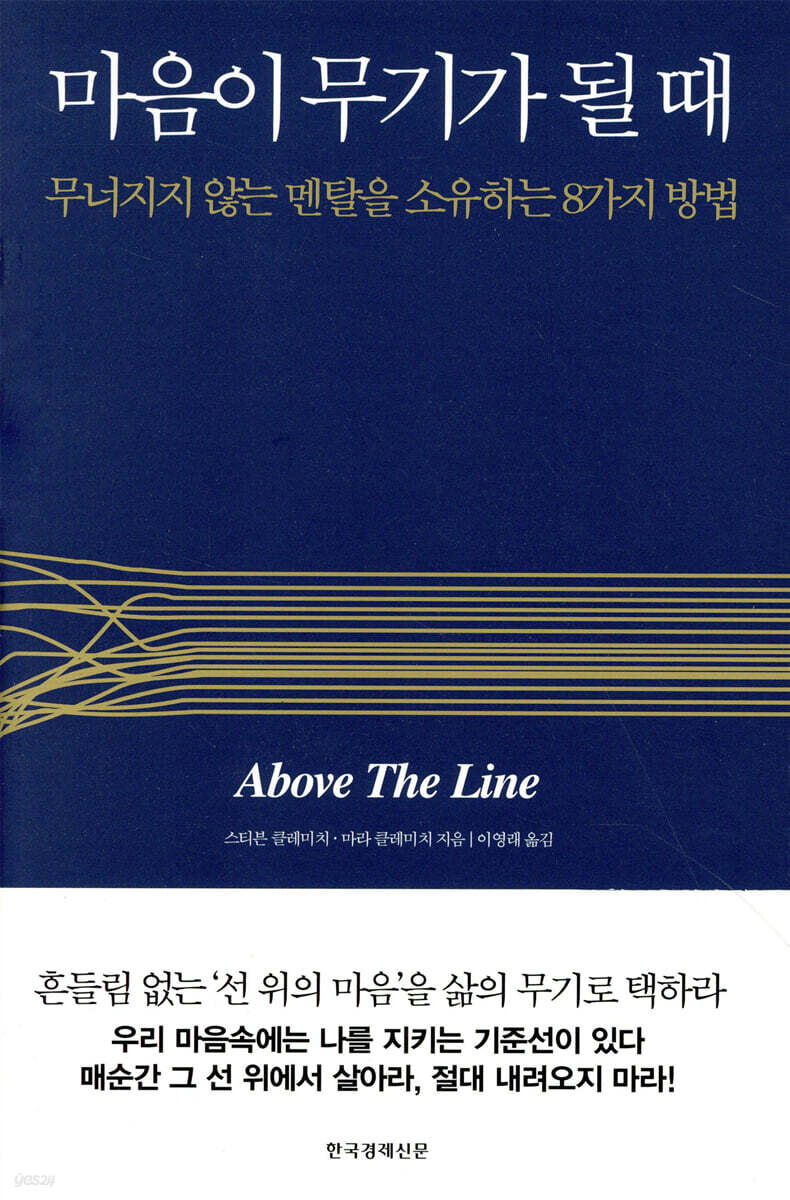
When the mind becomes a weapon
 |
Description
Book Introduction
“What makes someone with an unwavering mentality different?” The 'line of mind' that holds the center of life 8 Secret Actions That Turn Your Mind into a Weapon The saying, 'It's all in the mind' is a wisdom that has been passed down for a long time. But in reality, it is not easy to control your mind at every moment and draw out the power of positivity. Most of us live our lives driven by our own minds. But what if we could understand the elements that make up our minds and the principles that determine our actions? Once we objectively understand how the mind works, we can choose better thoughts and actions in any situation, and ultimately live each day as our "best selves." People with strong mentality are those who know that principle. In "When the Mind Becomes a Weapon," the authors, who have coached organizations of various nationalities and cultures for 30 years, uncover universal principles of the mind based on brain science and neuropsychology and introduce eight behavioral types that strengthen the mentality accordingly. The principles of the mind that govern human life in common, transcending language, religion, culture, beliefs, and worldview, are simple yet fundamental. Deep within our hearts there is a line. This line divides the mind into 'above the line' and 'below the line'. If you choose 'above the line', you will be at your best, driven by humility and love. If you choose 'below the line', you will be at your worst, driven by pride and fear. That is, when we slip below the line of our heart, we become defensive and negative, and we fail at work and in our relationships. Therefore, we must always 'live on the line.' And this book teaches us how to cultivate a strong mentality that allows us to choose a mind above the line at every moment. After identifying which principles of mind you currently operate by, I encourage you to live your best self every day by strengthening the eight actions of the mind above the line: authenticity, transformation, trust, and achievement (the four actions of humility), connection, encouragement, development, and compassion (the four actions of love). |
- You can preview some of the book's contents.
Preview
index
Recommended Article | Meet Your Best Self Through a Mind Revolution
Introduction | The Four Minds That Form the Principles of Life
-There is a line in our hearts.
-The heart above the line and the heart below the line are both mine
-The mind on the line that becomes the weapon of life
-Look into my heart
Part 1: The Secret Hidden in Our Hearts
Chapter 1 | The Four Minds Determine Everything
-The problem is always the mind.
-Mind Below the Line: Fear and Pride
-Heart on the Line: Humility and Love
Chapter 2 | Why Do I Repeat This Behavior?
-My true feelings hidden behind my actions
-My own thought patterns that I have created
-The frame of mind created by the brain
-Thought patterns speak volumes about a person.
- Break out of the mold you were stuck in
Chapter 3 | Why My Heart Keeps Going Below the Line
-In fact, negative thinking patterns are normal.
-There are gems in the mud, potential in adversity.
-Using wounds as fuel to climb the line
-The power to choose to think differently
-How to break out of the thinking pattern below the line
Chapter 4 | What Type of Mind Am I?: Understanding Your Mind Through 16 Behavioral Types
-8 Actions That Arouse the Mind Above the Line
-8 Actions That Your Mind Arouses Below the Line
-Me now vs. Me I want to be
-From bottom to top, from inside to outside
Chapter 5 | What Types of Minds Do Others Have?: The Shape of Our Minds as Seen Through the Mind Type Analysis Index
-Our actions when we are trapped in our minds below the line
-The truth that you and I are not that different
-The magic of compassion for others
Part 2: How the Mind Becomes a Weapon
Chapter 6 | A 3-Step Strategy to Stay on Top
-Step 1.
Look in the mirror
Step 2. SBTB: Stop, Breathe, Think, Act
-Step 3.
Designing the mind
-Remember that humility is stronger than fear, and love is stronger than pride.
-Grow together with others
-Record and analyze my behavior patterns.
Chapter 7 | Knowing Who I Am: Actions That Turn the Mind into a Weapon ① Authenticity ② Transformation
-How to meet your most honest self
-1.
Check your behavior below the line you habitually choose.
-2.
Overcome cynicism and competitiveness.
-3.
Check out the changes you want to make in yourself
-4.
Establish a set of values that serve as a benchmark
-5.
We need a 'truth teller'
-6.
Expose your vulnerability
Chapter 8 | Knowing Where I'm Going: Actions That Turn the Mind into a Weapon ③ Trust ④ Achievement
-How to gain a clear sense of purpose
-1.
Don't give up on finding your way
-2.
Distinguish between achievement and struggle
-3.
Be cold to time, but generous to people.
Chapter 9 | Connecting with Others: Actions That Turn the Mind into a Weapon ⑤ Connection ⑥ Encouragement
-The joy of connecting with others
-Don't get into relationships just to get recognition.
-The moment when connection and encouragement shine
-Encouragement doesn't take long.
-If you want to improve the way you relate to others
Chapter 10 | Growing with Others: Actions That Turn the Mind into a Weapon ⑦ Development ⑧ Compassion
Coaching that helps both you and your partner grow together
-How to help people grow honestly and wisely
-Sometimes letting go is what helps you grow.
-The power not to judge others rashly
-Together we sail on the line
-The courage to even share tears
Chapter 11 | A Leader Who Leads with His Heart
Leadership that drives a culture above the line
A healthy organizational culture fosters growth.
-Action is culture
-How did they lead the organization with their hearts?
Five Ways to Transform Your Organization
Conclusion | Life on the Line
-Leave only your heart above the line as a weapon.
-Training, training again
-Even when the seasons of the heart change, without wavering
-Crossing the line with conviction
-Live with your heart, walk on the line
Acknowledgements
supplement
Introduction | The Four Minds That Form the Principles of Life
-There is a line in our hearts.
-The heart above the line and the heart below the line are both mine
-The mind on the line that becomes the weapon of life
-Look into my heart
Part 1: The Secret Hidden in Our Hearts
Chapter 1 | The Four Minds Determine Everything
-The problem is always the mind.
-Mind Below the Line: Fear and Pride
-Heart on the Line: Humility and Love
Chapter 2 | Why Do I Repeat This Behavior?
-My true feelings hidden behind my actions
-My own thought patterns that I have created
-The frame of mind created by the brain
-Thought patterns speak volumes about a person.
- Break out of the mold you were stuck in
Chapter 3 | Why My Heart Keeps Going Below the Line
-In fact, negative thinking patterns are normal.
-There are gems in the mud, potential in adversity.
-Using wounds as fuel to climb the line
-The power to choose to think differently
-How to break out of the thinking pattern below the line
Chapter 4 | What Type of Mind Am I?: Understanding Your Mind Through 16 Behavioral Types
-8 Actions That Arouse the Mind Above the Line
-8 Actions That Your Mind Arouses Below the Line
-Me now vs. Me I want to be
-From bottom to top, from inside to outside
Chapter 5 | What Types of Minds Do Others Have?: The Shape of Our Minds as Seen Through the Mind Type Analysis Index
-Our actions when we are trapped in our minds below the line
-The truth that you and I are not that different
-The magic of compassion for others
Part 2: How the Mind Becomes a Weapon
Chapter 6 | A 3-Step Strategy to Stay on Top
-Step 1.
Look in the mirror
Step 2. SBTB: Stop, Breathe, Think, Act
-Step 3.
Designing the mind
-Remember that humility is stronger than fear, and love is stronger than pride.
-Grow together with others
-Record and analyze my behavior patterns.
Chapter 7 | Knowing Who I Am: Actions That Turn the Mind into a Weapon ① Authenticity ② Transformation
-How to meet your most honest self
-1.
Check your behavior below the line you habitually choose.
-2.
Overcome cynicism and competitiveness.
-3.
Check out the changes you want to make in yourself
-4.
Establish a set of values that serve as a benchmark
-5.
We need a 'truth teller'
-6.
Expose your vulnerability
Chapter 8 | Knowing Where I'm Going: Actions That Turn the Mind into a Weapon ③ Trust ④ Achievement
-How to gain a clear sense of purpose
-1.
Don't give up on finding your way
-2.
Distinguish between achievement and struggle
-3.
Be cold to time, but generous to people.
Chapter 9 | Connecting with Others: Actions That Turn the Mind into a Weapon ⑤ Connection ⑥ Encouragement
-The joy of connecting with others
-Don't get into relationships just to get recognition.
-The moment when connection and encouragement shine
-Encouragement doesn't take long.
-If you want to improve the way you relate to others
Chapter 10 | Growing with Others: Actions That Turn the Mind into a Weapon ⑦ Development ⑧ Compassion
Coaching that helps both you and your partner grow together
-How to help people grow honestly and wisely
-Sometimes letting go is what helps you grow.
-The power not to judge others rashly
-Together we sail on the line
-The courage to even share tears
Chapter 11 | A Leader Who Leads with His Heart
Leadership that drives a culture above the line
A healthy organizational culture fosters growth.
-Action is culture
-How did they lead the organization with their hearts?
Five Ways to Transform Your Organization
Conclusion | Life on the Line
-Leave only your heart above the line as a weapon.
-Training, training again
-Even when the seasons of the heart change, without wavering
-Crossing the line with conviction
-Live with your heart, walk on the line
Acknowledgements
supplement
Detailed image

Into the book
Stephen had the great fortune of being selected as a torchbearer to carry the Olympic flame to the Olympic Stadium where Catherine Freeman would light the cauldron on the opening day.
It was an honor that ordinary people do not often experience, to be present at a place that confirms the solidarity of all mankind.
On that day, the hearts of mankind were in balance and harmony.
But as people dispersed and returned to their daily lives, that sense of high spirits and unity was easily lost.
How quickly the patient and polite demeanor devolved into impatient and complaining in the chaos and hustle of trying to find a way back to the car and escape the traffic jam.
We were cheering and applauding the Olympics and the unity of humanity, but the very next moment, we were all frustrated and yelling at the traffic jam, desperate to get out of here.
In both situations, our minds were initially happy with the experience and then became dissatisfied.
Deep in your heart there is a line.
It's a very thin line.
It's so thin that in most cases you don't even notice it's there.
But the way we live our lives is balanced along this line.
Our minds (what we call character) are quick to shift from one side of good to the other.
--- From "The Four Minds That Form the Principles of Life"
Most people face moments like this every day.
And then I think.
'Why did I say that?', 'If only I had...' We nag our children and spouses over small issues.
Blaming your teammates in front of others.
Agree to a deadline even though you know it's difficult to achieve.
Fortunately, we also turn our best intentions into reality every day.
There are times when I wish I could take back my words or make different choices.
In that short time, we can become more collaborative, focused, honest, patient, and dedicated.
The mind can shift very quickly from selfish to altruistic, from critical to compassionate, from motivated to depressed, from constructive to destructive, from doubtful to confident.
It can go from effective to ineffective in just one minute.
--- From "Chapter 1: The Four Minds Determine Everything"
Eva's 10-year-old son, Sam, was angry.
“Mom, I can’t afford a hotel!” Sam said, waving his hand in front of the Monopoly board between them.
There were still three spaces left before the horse could return to the starting space (where he would receive a salary of $200 if he passed this space - translator).
“You have entered my land.
“I have to pay,” she replied.
“Can you give it to me next time?”
Eva was annoyed by the question.
“This is a game, Sam.
“I’m trying to win.”
“Just this once.
“I’ll definitely give it to you next time.”
“I said no! You have to pay now.”
Eva flinched at his sharp voice, a voice that was not only filled with discontent but even anger.
It wouldn't have been strange if Sam had cried or gotten up and run into the room.
My heart sank.
'Why? Why did I just do that?'
She had unconsciously reverted to her working mindset.
And he felt that his 10-year-old son was interfering with his victory.
Why would she act so competitively toward her son, to the point of venting her frustrations and arguing, even though she genuinely wanted him to have a pleasant evening? Why couldn't she anticipate the consequences and stop herself before it was too late?
Why do we do that?
--- From Chapter 2, “Why Do I Repeat This Behavior?”
The thing that both of us encounter the most resistance to is the idea that competition is an ineffective behavior below the line.
People say competition is a good thing.
Of course, we also believe that healthy competition helps us achieve our goals.
But unhealthy, pride-driven competitive behavior is different from winning above the line, striving to be our best.
Competitive behavior is not about winning through dignity, respect, honor, or honesty.
It's about defeating others, winning at any cost, and feeling like you're a person of value.
Think of all the inspiring stories you've heard in the world of professional sports.
Compare the stories of those who achieved victory or accepted defeat with dignity through honesty and integrity to those who ruined their careers and reputations through cheating, drug use, and match-fixing.
That difference is the key to achievements that come from humility and achievements that come from pride.
--- From "Chapter 4: What Type of Heart Am I"
Tomorrow, next week, next month… .
There's probably already something on your schedule that's causing stress in your life.
It could be a meeting with your boss about a project that isn't going as planned, a difficult performance meeting with your team members, or a conversation with a guest who has been staying too long and is becoming a nuisance.
Whatever it is, something about the situation will trigger you, and your brain will pull out one of those old frames it's been pulling out for years in similar situations.
You know this.
As is often the case, things will not end well.
We prepare agendas, slides, and reports for meetings.
Take the time to perfect your vacation plans and talk about them at your next gathering.
And yet, we rarely think about designing our character (attitude, thoughts, and actions).
Even though I know it might be stimulating.
Character design keeps you on track and feeling good about interactions, especially difficult ones.
The method is simple.
It only takes five steps.
If you invest just five minutes into this activity, you can alleviate the situation below the line before it even starts.
It was an honor that ordinary people do not often experience, to be present at a place that confirms the solidarity of all mankind.
On that day, the hearts of mankind were in balance and harmony.
But as people dispersed and returned to their daily lives, that sense of high spirits and unity was easily lost.
How quickly the patient and polite demeanor devolved into impatient and complaining in the chaos and hustle of trying to find a way back to the car and escape the traffic jam.
We were cheering and applauding the Olympics and the unity of humanity, but the very next moment, we were all frustrated and yelling at the traffic jam, desperate to get out of here.
In both situations, our minds were initially happy with the experience and then became dissatisfied.
Deep in your heart there is a line.
It's a very thin line.
It's so thin that in most cases you don't even notice it's there.
But the way we live our lives is balanced along this line.
Our minds (what we call character) are quick to shift from one side of good to the other.
--- From "The Four Minds That Form the Principles of Life"
Most people face moments like this every day.
And then I think.
'Why did I say that?', 'If only I had...' We nag our children and spouses over small issues.
Blaming your teammates in front of others.
Agree to a deadline even though you know it's difficult to achieve.
Fortunately, we also turn our best intentions into reality every day.
There are times when I wish I could take back my words or make different choices.
In that short time, we can become more collaborative, focused, honest, patient, and dedicated.
The mind can shift very quickly from selfish to altruistic, from critical to compassionate, from motivated to depressed, from constructive to destructive, from doubtful to confident.
It can go from effective to ineffective in just one minute.
--- From "Chapter 1: The Four Minds Determine Everything"
Eva's 10-year-old son, Sam, was angry.
“Mom, I can’t afford a hotel!” Sam said, waving his hand in front of the Monopoly board between them.
There were still three spaces left before the horse could return to the starting space (where he would receive a salary of $200 if he passed this space - translator).
“You have entered my land.
“I have to pay,” she replied.
“Can you give it to me next time?”
Eva was annoyed by the question.
“This is a game, Sam.
“I’m trying to win.”
“Just this once.
“I’ll definitely give it to you next time.”
“I said no! You have to pay now.”
Eva flinched at his sharp voice, a voice that was not only filled with discontent but even anger.
It wouldn't have been strange if Sam had cried or gotten up and run into the room.
My heart sank.
'Why? Why did I just do that?'
She had unconsciously reverted to her working mindset.
And he felt that his 10-year-old son was interfering with his victory.
Why would she act so competitively toward her son, to the point of venting her frustrations and arguing, even though she genuinely wanted him to have a pleasant evening? Why couldn't she anticipate the consequences and stop herself before it was too late?
Why do we do that?
--- From Chapter 2, “Why Do I Repeat This Behavior?”
The thing that both of us encounter the most resistance to is the idea that competition is an ineffective behavior below the line.
People say competition is a good thing.
Of course, we also believe that healthy competition helps us achieve our goals.
But unhealthy, pride-driven competitive behavior is different from winning above the line, striving to be our best.
Competitive behavior is not about winning through dignity, respect, honor, or honesty.
It's about defeating others, winning at any cost, and feeling like you're a person of value.
Think of all the inspiring stories you've heard in the world of professional sports.
Compare the stories of those who achieved victory or accepted defeat with dignity through honesty and integrity to those who ruined their careers and reputations through cheating, drug use, and match-fixing.
That difference is the key to achievements that come from humility and achievements that come from pride.
--- From "Chapter 4: What Type of Heart Am I"
Tomorrow, next week, next month… .
There's probably already something on your schedule that's causing stress in your life.
It could be a meeting with your boss about a project that isn't going as planned, a difficult performance meeting with your team members, or a conversation with a guest who has been staying too long and is becoming a nuisance.
Whatever it is, something about the situation will trigger you, and your brain will pull out one of those old frames it's been pulling out for years in similar situations.
You know this.
As is often the case, things will not end well.
We prepare agendas, slides, and reports for meetings.
Take the time to perfect your vacation plans and talk about them at your next gathering.
And yet, we rarely think about designing our character (attitude, thoughts, and actions).
Even though I know it might be stimulating.
Character design keeps you on track and feeling good about interactions, especially difficult ones.
The method is simple.
It only takes five steps.
If you invest just five minutes into this activity, you can alleviate the situation below the line before it even starts.
--- From "Chapter 6: 3-Step Strategy to Stay on the Line"
Publisher's Review
“Why do I keep acting like this? Even though I don’t want to?”
If you understand how your mind works and its behavioral patterns, you can change your life!
How to Have an Unwavering Mental Ability in Any Situation
Words that I say without realizing it and then regret, actions that I commit without realizing it and then regret…
In our daily lives, we often say or do negative things to our family, lovers, colleagues, and subordinates in an instant, only to regret it later.
Why do we keep repeating these behaviors when we could have responded more gently and positively? Why are our "mental" systems so easily swayed by external circumstances, regardless of our will?
The Clemiches, who have been coaching organizations of various nationalities and cultures for 30 years, explain the reason as 'the goodness of the heart' and 'behavioral patterns.'
In this book, "When the Mind Becomes a Weapon," the authors reveal that it is ultimately the mind that determines our actions, and therefore, by understanding the components and operating principles of the mind, we can maintain mental strength and choose the best course of action in any situation.
And it suggests eight behavioral patterns that will strengthen your mentality and encourage you to maintain the best state of mind every day.
It is a theory that summarizes the universal wisdom of humanity that “everything depends on the mind” into a practically applicable theory through brain science and neuropsychology.
There is a line in our hearts
Arm yourself with the "mind above the line" that becomes the standard for life.
The principles of the mind analyzed by the authors are very simple yet fundamental.
There is a line in our hearts.
This line divides the human mind into two areas, 'above the line' and 'below the line', and it is so thin that we unconsciously cross over and under the line every moment.
Above the line is full of humility and love.
Using the 'mind above the line' can bring out the most mature, best version of ourselves within us.
Below the line lies fear and pride.
When I am ruled by the 'mind below the line', I become defensive, negative, and my worst self appears.
The best and the worst of me are within me, and I can change my actions and my life depending on what kind of mind I choose.
It is also a message of universal truth that transcends language, religion, culture, beliefs, and worldviews.
What we have to do is clear.
Always choose to live with a mind above the line and live as your best self.
But we often go below the line.
This is because, since childhood, we have been dominated by two minds below the line: fear and pride.
And those experiences are stored in our brains, creating certain thought patterns, which then lead to certain behavioral patterns.
This is why we keep repeating behaviors we don't want to do.
Now, which mind will you choose?
Building a "Steel Mentality" by Designing and Implementing It Yourself
So how can we stop this behavioral pattern? First, the authors developed a "Mind Type Analysis Index" that allows us to check which mindset we primarily use.
We structured our minds into quadrants, placing humility and love in the second and first quadrants, which correspond to the line, and pride and fear in the third and fourth quadrants, which correspond to the line.
After answering 75 questions about your mind type, you will receive a personalized mind type analysis report with the numbers for each quadrant expressed in a graph.
Only when we understand which element of our mind we use most—humility, love, pride, or fear—can we truly understand our own behavior.
Next, we will teach you a three-step strategy for consciously choosing a mind above the line.
Through a three-step strategy of 'Looking in the Mirror - SBTB - Designing the Mind', we will teach you the secret to choosing the mind above the line anytime, anywhere.
In fact, those with a strong mentality are those who have already mastered this technique.
Even when things get confusing or upsetting, they "stay put." They always have the power to calmly make choices that benefit both themselves and the other person.
This is a strength that comes from honest humility to oneself and a loving heart that wishes for the growth of others.
Finally, the authors recommend continuously strengthening your mentality by practicing eight behaviors that foster humility and love—the kind that are born from a heart above good.
It delves into the four acts of humility—authenticity, transformation, trust, and achievement—and the four acts of love—connection, encouragement, development, and compassion—and analyzes how these acts help us grow ourselves and, by extension, others.
Growth gives you a mentality that is unbreakable, a mind that always becomes a weapon to protect yourself.
In this way, we can get one step closer to becoming the person we want to be.
If you understand how your mind works and its behavioral patterns, you can change your life!
How to Have an Unwavering Mental Ability in Any Situation
Words that I say without realizing it and then regret, actions that I commit without realizing it and then regret…
In our daily lives, we often say or do negative things to our family, lovers, colleagues, and subordinates in an instant, only to regret it later.
Why do we keep repeating these behaviors when we could have responded more gently and positively? Why are our "mental" systems so easily swayed by external circumstances, regardless of our will?
The Clemiches, who have been coaching organizations of various nationalities and cultures for 30 years, explain the reason as 'the goodness of the heart' and 'behavioral patterns.'
In this book, "When the Mind Becomes a Weapon," the authors reveal that it is ultimately the mind that determines our actions, and therefore, by understanding the components and operating principles of the mind, we can maintain mental strength and choose the best course of action in any situation.
And it suggests eight behavioral patterns that will strengthen your mentality and encourage you to maintain the best state of mind every day.
It is a theory that summarizes the universal wisdom of humanity that “everything depends on the mind” into a practically applicable theory through brain science and neuropsychology.
There is a line in our hearts
Arm yourself with the "mind above the line" that becomes the standard for life.
The principles of the mind analyzed by the authors are very simple yet fundamental.
There is a line in our hearts.
This line divides the human mind into two areas, 'above the line' and 'below the line', and it is so thin that we unconsciously cross over and under the line every moment.
Above the line is full of humility and love.
Using the 'mind above the line' can bring out the most mature, best version of ourselves within us.
Below the line lies fear and pride.
When I am ruled by the 'mind below the line', I become defensive, negative, and my worst self appears.
The best and the worst of me are within me, and I can change my actions and my life depending on what kind of mind I choose.
It is also a message of universal truth that transcends language, religion, culture, beliefs, and worldviews.
What we have to do is clear.
Always choose to live with a mind above the line and live as your best self.
But we often go below the line.
This is because, since childhood, we have been dominated by two minds below the line: fear and pride.
And those experiences are stored in our brains, creating certain thought patterns, which then lead to certain behavioral patterns.
This is why we keep repeating behaviors we don't want to do.
Now, which mind will you choose?
Building a "Steel Mentality" by Designing and Implementing It Yourself
So how can we stop this behavioral pattern? First, the authors developed a "Mind Type Analysis Index" that allows us to check which mindset we primarily use.
We structured our minds into quadrants, placing humility and love in the second and first quadrants, which correspond to the line, and pride and fear in the third and fourth quadrants, which correspond to the line.
After answering 75 questions about your mind type, you will receive a personalized mind type analysis report with the numbers for each quadrant expressed in a graph.
Only when we understand which element of our mind we use most—humility, love, pride, or fear—can we truly understand our own behavior.
Next, we will teach you a three-step strategy for consciously choosing a mind above the line.
Through a three-step strategy of 'Looking in the Mirror - SBTB - Designing the Mind', we will teach you the secret to choosing the mind above the line anytime, anywhere.
In fact, those with a strong mentality are those who have already mastered this technique.
Even when things get confusing or upsetting, they "stay put." They always have the power to calmly make choices that benefit both themselves and the other person.
This is a strength that comes from honest humility to oneself and a loving heart that wishes for the growth of others.
Finally, the authors recommend continuously strengthening your mentality by practicing eight behaviors that foster humility and love—the kind that are born from a heart above good.
It delves into the four acts of humility—authenticity, transformation, trust, and achievement—and the four acts of love—connection, encouragement, development, and compassion—and analyzes how these acts help us grow ourselves and, by extension, others.
Growth gives you a mentality that is unbreakable, a mind that always becomes a weapon to protect yourself.
In this way, we can get one step closer to becoming the person we want to be.
GOODS SPECIFICS
- Publication date: December 10, 2020
- Page count, weight, size: 368 pages | 630g | 147*225*30mm
- ISBN13: 9788947546645
- ISBN10: 894754664X
You may also like
카테고리
korean


korean

![GQ KOREA Mark (Monthly): December [2025]](http://librairie.coreenne.fr/cdn/shop/files/8ef265dbbfbf186523ed75ba7319009d.jpg?v=1765340328&width=3840)


