

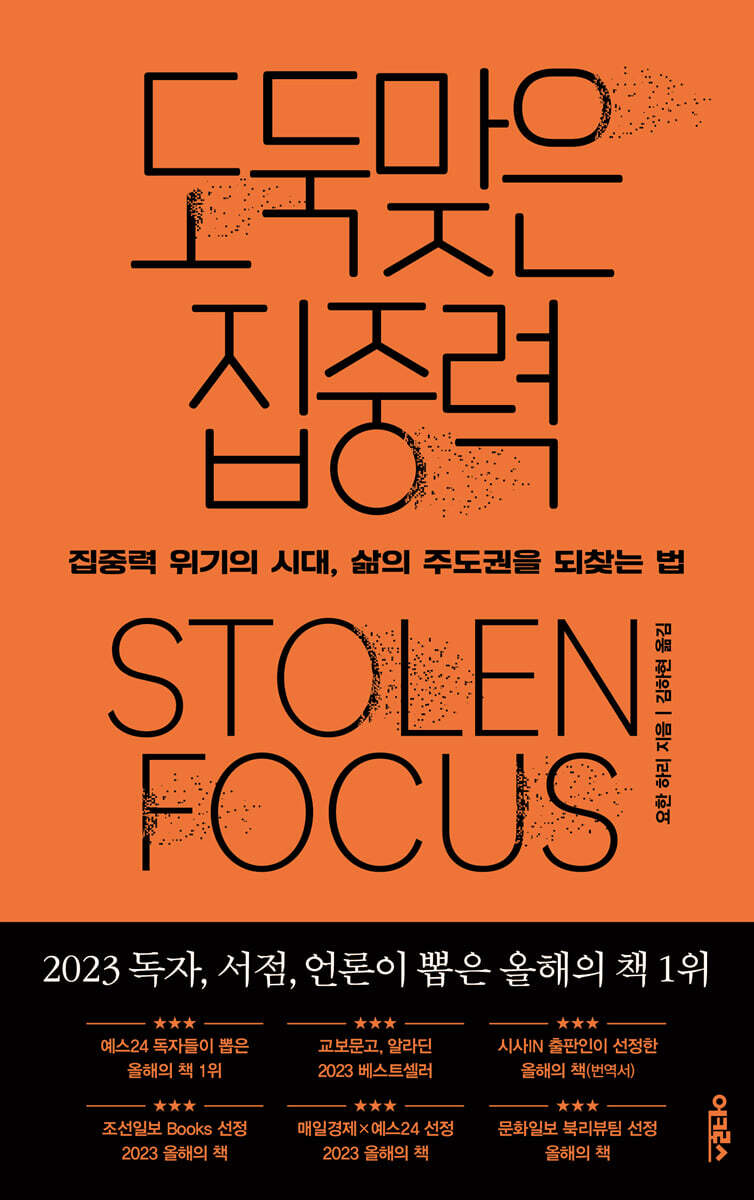
Stolen concentration
 |
Description
Book Introduction
- A word from MD
-
Why can't we concentrate?Mindfulness is trendy, but there's no research showing that it improves modern people's concentration.
The reality is the opposite.
Smartphones are blamed as the culprit, but will simply changing your phone usage habits be enough to solve the problem? We need to examine the underlying structures that contribute to this lack of focus: multitasking, excessive work hours and reduced sleep, diet, and big tech companies.
May 4, 2023. Humanities PD Son Min-gyu
★ #1 Book of the Year, chosen by readers, bookstores, and the press
★ Books recommended by Seungyeon Cho, Hyunjun Yoo, and Gyul Kim
All over the world, our ability to focus is collapsing.
American teenagers can't focus on one thing for more than 65 seconds.
The average attention span of office workers is just three minutes.
New York Times bestselling author and journalist Johan Hari embarked on an epic journey to meet leading scientists and experts from around the world to find out why this phenomenon is happening.
And in the meantime, we've discovered that we've been wrong about this topic.
We often think of inability to focus and distraction as a personal failure to exercise self-control when using digital devices like smartphones.
But that's not the case.
The author explains that the concentration problems we are currently experiencing are similar to the rising obesity rates in modern society.
Just as our food supply system and lifestyle changes, centered around junk food, have contributed to the rise in obesity rates, the widespread rise in attention deficit disorder is a pandemic created by our modern social systems.
Along the way, the author travels from a Silicon Valley dissident who discovered a trick to hijack human attention, to a vet who diagnosed a dog with ADHD, to a Rio favela suffering from a severe attention crisis, to a New Zealand company that found a surprising way to restore its workers' focus.
And we find that this widespread attention crisis is driven by 12 factors, including sleep deprivation, the breakdown of reading, and the manipulation and exploitation of our attention by tech companies.
★ Books recommended by Seungyeon Cho, Hyunjun Yoo, and Gyul Kim
All over the world, our ability to focus is collapsing.
American teenagers can't focus on one thing for more than 65 seconds.
The average attention span of office workers is just three minutes.
New York Times bestselling author and journalist Johan Hari embarked on an epic journey to meet leading scientists and experts from around the world to find out why this phenomenon is happening.
And in the meantime, we've discovered that we've been wrong about this topic.
We often think of inability to focus and distraction as a personal failure to exercise self-control when using digital devices like smartphones.
But that's not the case.
The author explains that the concentration problems we are currently experiencing are similar to the rising obesity rates in modern society.
Just as our food supply system and lifestyle changes, centered around junk food, have contributed to the rise in obesity rates, the widespread rise in attention deficit disorder is a pandemic created by our modern social systems.
Along the way, the author travels from a Silicon Valley dissident who discovered a trick to hijack human attention, to a vet who diagnosed a dog with ADHD, to a Rio favela suffering from a severe attention crisis, to a New Zealand company that found a surprising way to restore its workers' focus.
And we find that this widespread attention crisis is driven by 12 factors, including sleep deprivation, the breakdown of reading, and the manipulation and exploitation of our attention by tech companies.
- You can preview some of the book's contents.
Preview
index
prolog
What's Really Happening to Our Focus
What Concentration Problems and Rising Obesity Rates Have in Common: We May Lose the Ability to Think Deeply
Chapter 1: Too Fast, Too Frequent Multitasking - Focus is a Limited Resource
Information overload, shortening attention span │ What happens to concentration when you slow down │ The trap of multitasking │ The brain that can't filter out unnecessary information
Chapter 2: The Damage of Immersion - Skinner's Pigeon and Mihaly's Painter: What Do You Want to Be?
Technology applied to billions of users │ The forgotten pleasure of immersion │ What will we look back on at the end of our lives?
Chapter 3: A Sleepless Society - When sleep quality declines, the world becomes more murky in every way.
The first thing that disappears when you stay awake is the feeling of a hangover. People who are asleep don't access Amazon.
Chapter 4: The Age of the Novel's Passion - What Happens When Your Ability to Read Long Texts Fails
The Screen's Edge | How We See the World on Social Media | The Long-Term Effects of Reading Novels
Chapter 5: What New Research on Mind Wandering Tells Us - The Benefits of Letting Our Minds Wander
What Happens to Our Brains When We Mind-Drift │ Again, Failing to Mind-Drift
Chapter 6: Tech Companies Track and Control Us - Destroying Our Attention Is Their Business Model
The World's Greatest Magician's Story │ "Millionaire Maker" │ How to Capture the Attention of 2 Billion People │ Time Lost in Infinite Scrolling
Chapter 7: Fueling Distraction - How a Distracted Society Is at Risk
When tech companies give something away for free │ Whose interests is technology designed for │ A little more blame, a little less understanding │ We don't know much about algorithms │ What happens when group focus is broken │ Real threats and non-existent threats
Chapter 8: Small, Shallow Solutions - Why "The Problem Is Inside You" Is Wrong
Just press the "Do Not Disturb" button and everything will be solved? │ Then let them eat cake │ People on the other side of the screen who are breaking our self-control
Chapter 9: Witnessing a Radical Solution for the First Time - Why Did Zuckerberg Ignore Scientists' Research?
The Approach Zuckerberg Hates │ Technology for Humans
Chapter 10: Stress and Chronic Arousal - Why Our Ability to Resist Distractions Is Significantly Reduced
In the face of danger, our brains focus on just one thing: What the Finnish basic income experiment tells us.
Chapter 11: Places that directly challenge the logic of our society - How would a four-day workweek affect concentration?
Is this possible? │ The Right to Disconnect
Chapter 12: The Cheap and Bad Diet - Foods That Are Destroying Your Waist, Heart, and Focus
The brain is built through food intake │ MRI photos of a child flown in from Mexico
Chapter 13: Misdiagnosis of ADHD - What's Really Happening to Our Children While We Blame Genes
Your Son's Behavior Is Not Your Fault │ Animals Diagnosed with Psychiatric Drugs │ What Life Factors Lead to ADHD │ Children's Brains Are Most Vulnerable to Drugs │ Flaws in Twin Studies
Chapter 14: Children Who Are Physically and Psychologically Locked Up - Children Play, Roam, Ask Questions, and Become Competent
An idea that has never existed in human history │ What we take away from children │ The Adventures of Huckleberry Finn │ “Life begins the moment you step out of your comfort zone” │ Children have desires
Epilogue
Concentration rebellion
Three Types of Focus | How the Pandemic Changed Our Focus | Exercises to Reclaim Focus | How Economic Growth Works | Why Focus is So Urgent for Humanity Now
What's Really Happening to Our Focus
What Concentration Problems and Rising Obesity Rates Have in Common: We May Lose the Ability to Think Deeply
Chapter 1: Too Fast, Too Frequent Multitasking - Focus is a Limited Resource
Information overload, shortening attention span │ What happens to concentration when you slow down │ The trap of multitasking │ The brain that can't filter out unnecessary information
Chapter 2: The Damage of Immersion - Skinner's Pigeon and Mihaly's Painter: What Do You Want to Be?
Technology applied to billions of users │ The forgotten pleasure of immersion │ What will we look back on at the end of our lives?
Chapter 3: A Sleepless Society - When sleep quality declines, the world becomes more murky in every way.
The first thing that disappears when you stay awake is the feeling of a hangover. People who are asleep don't access Amazon.
Chapter 4: The Age of the Novel's Passion - What Happens When Your Ability to Read Long Texts Fails
The Screen's Edge | How We See the World on Social Media | The Long-Term Effects of Reading Novels
Chapter 5: What New Research on Mind Wandering Tells Us - The Benefits of Letting Our Minds Wander
What Happens to Our Brains When We Mind-Drift │ Again, Failing to Mind-Drift
Chapter 6: Tech Companies Track and Control Us - Destroying Our Attention Is Their Business Model
The World's Greatest Magician's Story │ "Millionaire Maker" │ How to Capture the Attention of 2 Billion People │ Time Lost in Infinite Scrolling
Chapter 7: Fueling Distraction - How a Distracted Society Is at Risk
When tech companies give something away for free │ Whose interests is technology designed for │ A little more blame, a little less understanding │ We don't know much about algorithms │ What happens when group focus is broken │ Real threats and non-existent threats
Chapter 8: Small, Shallow Solutions - Why "The Problem Is Inside You" Is Wrong
Just press the "Do Not Disturb" button and everything will be solved? │ Then let them eat cake │ People on the other side of the screen who are breaking our self-control
Chapter 9: Witnessing a Radical Solution for the First Time - Why Did Zuckerberg Ignore Scientists' Research?
The Approach Zuckerberg Hates │ Technology for Humans
Chapter 10: Stress and Chronic Arousal - Why Our Ability to Resist Distractions Is Significantly Reduced
In the face of danger, our brains focus on just one thing: What the Finnish basic income experiment tells us.
Chapter 11: Places that directly challenge the logic of our society - How would a four-day workweek affect concentration?
Is this possible? │ The Right to Disconnect
Chapter 12: The Cheap and Bad Diet - Foods That Are Destroying Your Waist, Heart, and Focus
The brain is built through food intake │ MRI photos of a child flown in from Mexico
Chapter 13: Misdiagnosis of ADHD - What's Really Happening to Our Children While We Blame Genes
Your Son's Behavior Is Not Your Fault │ Animals Diagnosed with Psychiatric Drugs │ What Life Factors Lead to ADHD │ Children's Brains Are Most Vulnerable to Drugs │ Flaws in Twin Studies
Chapter 14: Children Who Are Physically and Psychologically Locked Up - Children Play, Roam, Ask Questions, and Become Competent
An idea that has never existed in human history │ What we take away from children │ The Adventures of Huckleberry Finn │ “Life begins the moment you step out of your comfort zone” │ Children have desires
Epilogue
Concentration rebellion
Three Types of Focus | How the Pandemic Changed Our Focus | Exercises to Reclaim Focus | How Economic Growth Works | Why Focus is So Urgent for Humanity Now
Detailed image
.jpg)
Into the book
He said it might be helpful to compare the rise in concentration problems to the rise in obesity rates.
Obesity was very rare 50 years ago, but today it is an epidemic in the Western world.
It's not that we suddenly became greedy or indulgent.
Joel said.
“Obesity is not a medical epidemic.
It's a social epidemic.
For example, people are getting fat because the quality of the food they eat is poor.” Our lifestyles have changed dramatically (food supply chains have changed, cities have been built that make it harder to walk or cycle), and these environmental changes have led to changes in our bodies.
Joel said a similar shift may be happening with our ability to focus.
---From "Pages 21-22, Prologue"
What scientists have found is that when people think they are doing multiple things at once, they are actually “juggling” (as Earl describes it).
“I’m switching between this and that.
They don't even realize they're doing it.
The brain blocks that fact, so the conscious mind has a very smooth experience.
But in reality, you're resetting your brain moment by moment as you move between tasks.
“There is a price to pay for that.”
---「Page 60, Chapter 1.
From "Too fast speed, too frequent multitasking"
He discovered that sleep is a surprisingly active process.
When we sleep, our brain and body undergo a variety of activities that are essential for proper functioning and concentration.
One of the things that happens in our bodies while we sleep is that our brain clears out the junk that has accumulated during the day.
(…)“There is a limit to the energy available to the brain.
And the brain seems to have no choice but to choose between two different functional states: staying conscious while awake, or purifying while asleep.” (…) If the brain fails to undergo this necessary purification, it will become increasingly toxin-laden, making it increasingly difficult to concentrate.
---「Pages 111-112, Chapter 3.
From "The Society That Can't Sleep"
Before I met the two scientists, I thought mind-wandering (something I did so much, so happily, in Provincetown) was the opposite of focused attention, and for that reason, I felt guilty about it.
But that was a wrong idea.
In fact, mind-wandering is another form of, and a necessary form of, concentration.
Nathan said it takes “a certain amount of energy” to narrow our attention to one thing with a single spotlight, and when that spotlight is turned off, “we still have that energy.”
It's just about being able to "allocate more energy" to different ways of thinking.
“So, attention doesn’t necessarily decrease,” it just “shifts” to other important forms of thinking.
---Page 149, Chapter 5.
From “What New Research on Mind-Wandering Tells Us”
As time went on, Tristan became increasingly shocked by the way tech giants like Google were casually consuming the attention span of a billion people.
One day he must have heard an engineer say something excitedly.
“What if my phone rang every time I got an email?” Everyone would have shuddered.
And then a few weeks later, cell phones around the world started buzzing in pockets, and more and more people were checking their Gmail more than ever before.
---Page 175, Chapter 6.
Among the tech companies that track and control us
Nadine believed she had discovered a key truth about focus.
The truth is, to be able to pay attention normally, you must feel safe.
To focus, you have to be able to turn off the part of your mind that searches your field of vision for bears, lions, or any modern-day danger, and lose yourself in a single, safe subject.
---「Page 276, Chapter 10.
From “Stress and Chronic Arousal”
“If you put shampoo in your car engine, you won’t be surprised when it breaks down.” Yet, across the West, we are putting substances into our bodies every day that are “far removed from anything that has ever been used as fuel for humans.”
Dale said that maintaining focus is a physical process, and for this process to occur, our bodies must be able to do certain things.
Therefore, if you are harming your body (by not giving it the nutrients it needs or by flooding it with pollutants), your concentration will also be affected.
---「Page 311, Chapter 12.
Among the "cheap and poor diets"
In much of the West, politicians have radically changed school systems to prioritize testing more.
Almost everything outside of exams, including play, music, and relaxation, is steadily being pushed out.
There has never been a golden age when most schools were progressive, but the school system is shifting toward a narrow vision of efficiency.
In 2002, George W.
Bush signed the No Child Left Behind Act, which led to an increase in standardized testing across the country.
Over the next four years, the number of children diagnosed with severe attention problems increased by 22 percent.
Obesity was very rare 50 years ago, but today it is an epidemic in the Western world.
It's not that we suddenly became greedy or indulgent.
Joel said.
“Obesity is not a medical epidemic.
It's a social epidemic.
For example, people are getting fat because the quality of the food they eat is poor.” Our lifestyles have changed dramatically (food supply chains have changed, cities have been built that make it harder to walk or cycle), and these environmental changes have led to changes in our bodies.
Joel said a similar shift may be happening with our ability to focus.
---From "Pages 21-22, Prologue"
What scientists have found is that when people think they are doing multiple things at once, they are actually “juggling” (as Earl describes it).
“I’m switching between this and that.
They don't even realize they're doing it.
The brain blocks that fact, so the conscious mind has a very smooth experience.
But in reality, you're resetting your brain moment by moment as you move between tasks.
“There is a price to pay for that.”
---「Page 60, Chapter 1.
From "Too fast speed, too frequent multitasking"
He discovered that sleep is a surprisingly active process.
When we sleep, our brain and body undergo a variety of activities that are essential for proper functioning and concentration.
One of the things that happens in our bodies while we sleep is that our brain clears out the junk that has accumulated during the day.
(…)“There is a limit to the energy available to the brain.
And the brain seems to have no choice but to choose between two different functional states: staying conscious while awake, or purifying while asleep.” (…) If the brain fails to undergo this necessary purification, it will become increasingly toxin-laden, making it increasingly difficult to concentrate.
---「Pages 111-112, Chapter 3.
From "The Society That Can't Sleep"
Before I met the two scientists, I thought mind-wandering (something I did so much, so happily, in Provincetown) was the opposite of focused attention, and for that reason, I felt guilty about it.
But that was a wrong idea.
In fact, mind-wandering is another form of, and a necessary form of, concentration.
Nathan said it takes “a certain amount of energy” to narrow our attention to one thing with a single spotlight, and when that spotlight is turned off, “we still have that energy.”
It's just about being able to "allocate more energy" to different ways of thinking.
“So, attention doesn’t necessarily decrease,” it just “shifts” to other important forms of thinking.
---Page 149, Chapter 5.
From “What New Research on Mind-Wandering Tells Us”
As time went on, Tristan became increasingly shocked by the way tech giants like Google were casually consuming the attention span of a billion people.
One day he must have heard an engineer say something excitedly.
“What if my phone rang every time I got an email?” Everyone would have shuddered.
And then a few weeks later, cell phones around the world started buzzing in pockets, and more and more people were checking their Gmail more than ever before.
---Page 175, Chapter 6.
Among the tech companies that track and control us
Nadine believed she had discovered a key truth about focus.
The truth is, to be able to pay attention normally, you must feel safe.
To focus, you have to be able to turn off the part of your mind that searches your field of vision for bears, lions, or any modern-day danger, and lose yourself in a single, safe subject.
---「Page 276, Chapter 10.
From “Stress and Chronic Arousal”
“If you put shampoo in your car engine, you won’t be surprised when it breaks down.” Yet, across the West, we are putting substances into our bodies every day that are “far removed from anything that has ever been used as fuel for humans.”
Dale said that maintaining focus is a physical process, and for this process to occur, our bodies must be able to do certain things.
Therefore, if you are harming your body (by not giving it the nutrients it needs or by flooding it with pollutants), your concentration will also be affected.
---「Page 311, Chapter 12.
Among the "cheap and poor diets"
In much of the West, politicians have radically changed school systems to prioritize testing more.
Almost everything outside of exams, including play, music, and relaxation, is steadily being pushed out.
There has never been a golden age when most schools were progressive, but the school system is shifting toward a narrow vision of efficiency.
In 2002, George W.
Bush signed the No Child Left Behind Act, which led to an increase in standardized testing across the country.
Over the next four years, the number of children diagnosed with severe attention problems increased by 22 percent.
---Page 396, Chapter 14.
Among the “children who are physically and psychologically imprisoned”
Among the “children who are physically and psychologically imprisoned”
Publisher's Review
How Are We Being Stealing Our Focus Without Even Realizing It?
30,000 Miles of Flight, Interviews with 250 Experts
A comprehensive exploration begins with the New York Times bestselling author.
All over the world, our ability to focus is collapsing.
American teenagers can't focus on one thing for more than 65 seconds.
The average attention span of office workers is just three minutes.
New York Times bestselling author and journalist Johan Hari embarked on an epic journey to meet leading scientists and experts from around the world to find out why this phenomenon is happening.
And in the meantime, we discovered that we were wrong about this topic.
We often think of inability to focus and distraction as a personal failure to exercise self-control when using digital devices like smartphones.
But that's not the case.
The author explains that the concentration problems we are currently experiencing are similar to the rising obesity rates in modern society.
Just as our food supply system and lifestyle changes, centered around junk food, have contributed to the rise in obesity rates, the widespread rise in attention deficit disorder is a pandemic created by our modern social systems.
Along the way, the author travels from a Silicon Valley dissident who discovered a trick to hijack human attention, to a vet who diagnosed a dog with ADHD, to a Rio favela suffering from a severe attention crisis, to a New Zealand company that found a surprising way to restore its workers' focus.
And we find that this widespread attention crisis is driven by 12 factors, including sleep deprivation, the breakdown of reading, and the manipulation and exploitation of our attention by tech companies.
From frequent multitasking to insufficient sleep
How Too Many and Too Little Factors Steal Our Focus
The author explains the causes that take away our focus by categorizing them into two broad categories: 'too much' and 'too little'.
Excessive multitasking, chronic stress and hyper-arousal, and the all-encompassing surveillance and manipulation of tech companies.
These include insufficient sleep, shortened novel reading experiences, immersive experiences, and lack of nutritious food.
People frequently multitask by opening multiple windows at the same time and switching between them to get the work done.
But is this really effective? Our brains constantly reset during frequent multitasking.
By the time you think about going back to what you were doing, your concentration and work speed have already decreased significantly.
The stress and arousal that are prevalent in modern people also take away concentration.
Let's assume a situation where bear attacks occur frequently.
An angry bear attacks a villager three times a week.
In situations where there is an obvious danger, such as a bear, the brain enters a state of 'hyperarousal', constantly looking for danger factors.
“Hyperarousal is essentially like looking for a bear wherever you go.
Our focus is on clues to potential danger.
“Instead of feeling what’s happening, or taking the lessons you need to learn, or doing the things you need to do,” he says, “this image is reminiscent of modern society, which puts us in a state of stress and arousal everywhere.
Unlike some factors that are problematic because they are too numerous, there are also factors that are problematic because they are too few.
While we sleep, a kind of 'cleaning' takes place in our brain.
The cerebrospinal fluid diligently performs a process called 'brainwashing' to clean out the toxic proteins that have accumulated in the brain during the day.
But when you sleep less, these functions decline and you continue to feel “hangover.”
What about food? "We're craving sugar and carbohydrate-laden snacks to keep us focused for short, sharp bursts," they say.
However, when we consume such cheap and poor carbohydrate foods, our bodies experience a 'roller coaster' phenomenon where blood sugar levels spike and then drop sharply.
It would be like putting rocket fuel into a BMW Mini.
In addition to this, the book comprehensively exposes the reality of concentration being stolen, including the surprising ways in which concentration is stolen, such as incorrect ADHD diagnoses, impaired immersion, and failure to manage mind-wandering, as well as the shocking causes that steal our concentration without us even knowing it.
The attention crisis is a 'social epidemic'
Beyond blaming individuals, launch a powerful counterattack against the system.
If people are losing focus so widely, without even realizing it, can we truly view the current attention crisis as merely a personal problem? We've lived in a culture that indoctrinates us to blame individuals first and foremost for focusing.
But this is “like reading a diet book to lose weight,” the author explains, calling the current attention crisis a massive “social epidemic.”
The specific elements of society's dysfunction make it extremely difficult for us to focus deeply and for long periods of time.
The author argues that to address this social epidemic, we must seek social solutions as well as individual efforts.
I suggest that we compare the current attention crisis to the climate crisis.
Even as we choke on smoke from devastating wildfires and face countless clear warning signs, our failure to act has left us facing an unprecedented catastrophe: the climate crisis.
The author warns that if the problem of concentration is left untreated, it could lead to an uncontrollable crisis for society as a whole.
“As the world’s attention spans burn out, we are being told to blame ourselves and change our habits.” In this way, “Stolen Attention” overturns the conventional wisdom of existing books that blame individuals for attention problems, leading us to expand the solution to a societal level that matches the scale of the problem.
Warnings from global experts on the front lines of attention deficit problems
“We may lose the ability to think deeply.”
To re-evaluate the problem of concentration and devise solutions that transcend the individual, the author embarks on a wide-ranging expedition spanning 30,000 miles across countries and sectors.
We interview experts at the forefront of attention issues, including neuroscientists, social scientists, philosophers, and psychologists, and we relentlessly pursue scientific clues and compelling evidence about why we lose focus.
Based on this thorough and extensive research, the author finally derives one fact.
“Over the past several decades, various factors that have been robbing us of our focus have been intensifying, sometimes dramatically.”
The author doesn't stop at simply overturning our misconceptions about concentration; he warns that if we continue on this path, we may ultimately "lose the ability to think deeply," forcing us to confront the undeniable reality of where the modern-day attention crisis is taking us.
A Bold Counterargument to the Attention Crisis
Presenting a new solution to refocus
The author, who has developed a compelling story about how we lose focus, suggests “three big, bold” goals as a way to regain it.
We need to ban surveillance capitalism, introduce a four-day workweek, and give children back their free childhood.
These methods may seem like vague and unattainable alternatives to us today.
But to overcome the “crisis of the human species”—the crisis of attention—we need an organized solution that can stand up to the massive system.
The author says that "Exercises to Regain Focus" will provide a solid foundation for winning the fierce battle against concentration, and emphasizes that if we are determined to fight, the battle is more winnable than we think.
“I realized that we now have to make a choice.
Do we value concentration? Is the ability to think deeply important to us? Do we want our children to develop concentration? If so, we must fight to regain it.
As one politician once said, “If you don’t fight, you don’t get it.” “Stolen Focus” demands a rethinking of the way we view the problem of concentration and presents a bold counterargument to the system.
By reading this book, we will gain a clear answer to how our concentration has been stolen, and only then will we be able to focus again.
30,000 Miles of Flight, Interviews with 250 Experts
A comprehensive exploration begins with the New York Times bestselling author.
All over the world, our ability to focus is collapsing.
American teenagers can't focus on one thing for more than 65 seconds.
The average attention span of office workers is just three minutes.
New York Times bestselling author and journalist Johan Hari embarked on an epic journey to meet leading scientists and experts from around the world to find out why this phenomenon is happening.
And in the meantime, we discovered that we were wrong about this topic.
We often think of inability to focus and distraction as a personal failure to exercise self-control when using digital devices like smartphones.
But that's not the case.
The author explains that the concentration problems we are currently experiencing are similar to the rising obesity rates in modern society.
Just as our food supply system and lifestyle changes, centered around junk food, have contributed to the rise in obesity rates, the widespread rise in attention deficit disorder is a pandemic created by our modern social systems.
Along the way, the author travels from a Silicon Valley dissident who discovered a trick to hijack human attention, to a vet who diagnosed a dog with ADHD, to a Rio favela suffering from a severe attention crisis, to a New Zealand company that found a surprising way to restore its workers' focus.
And we find that this widespread attention crisis is driven by 12 factors, including sleep deprivation, the breakdown of reading, and the manipulation and exploitation of our attention by tech companies.
From frequent multitasking to insufficient sleep
How Too Many and Too Little Factors Steal Our Focus
The author explains the causes that take away our focus by categorizing them into two broad categories: 'too much' and 'too little'.
Excessive multitasking, chronic stress and hyper-arousal, and the all-encompassing surveillance and manipulation of tech companies.
These include insufficient sleep, shortened novel reading experiences, immersive experiences, and lack of nutritious food.
People frequently multitask by opening multiple windows at the same time and switching between them to get the work done.
But is this really effective? Our brains constantly reset during frequent multitasking.
By the time you think about going back to what you were doing, your concentration and work speed have already decreased significantly.
The stress and arousal that are prevalent in modern people also take away concentration.
Let's assume a situation where bear attacks occur frequently.
An angry bear attacks a villager three times a week.
In situations where there is an obvious danger, such as a bear, the brain enters a state of 'hyperarousal', constantly looking for danger factors.
“Hyperarousal is essentially like looking for a bear wherever you go.
Our focus is on clues to potential danger.
“Instead of feeling what’s happening, or taking the lessons you need to learn, or doing the things you need to do,” he says, “this image is reminiscent of modern society, which puts us in a state of stress and arousal everywhere.
Unlike some factors that are problematic because they are too numerous, there are also factors that are problematic because they are too few.
While we sleep, a kind of 'cleaning' takes place in our brain.
The cerebrospinal fluid diligently performs a process called 'brainwashing' to clean out the toxic proteins that have accumulated in the brain during the day.
But when you sleep less, these functions decline and you continue to feel “hangover.”
What about food? "We're craving sugar and carbohydrate-laden snacks to keep us focused for short, sharp bursts," they say.
However, when we consume such cheap and poor carbohydrate foods, our bodies experience a 'roller coaster' phenomenon where blood sugar levels spike and then drop sharply.
It would be like putting rocket fuel into a BMW Mini.
In addition to this, the book comprehensively exposes the reality of concentration being stolen, including the surprising ways in which concentration is stolen, such as incorrect ADHD diagnoses, impaired immersion, and failure to manage mind-wandering, as well as the shocking causes that steal our concentration without us even knowing it.
The attention crisis is a 'social epidemic'
Beyond blaming individuals, launch a powerful counterattack against the system.
If people are losing focus so widely, without even realizing it, can we truly view the current attention crisis as merely a personal problem? We've lived in a culture that indoctrinates us to blame individuals first and foremost for focusing.
But this is “like reading a diet book to lose weight,” the author explains, calling the current attention crisis a massive “social epidemic.”
The specific elements of society's dysfunction make it extremely difficult for us to focus deeply and for long periods of time.
The author argues that to address this social epidemic, we must seek social solutions as well as individual efforts.
I suggest that we compare the current attention crisis to the climate crisis.
Even as we choke on smoke from devastating wildfires and face countless clear warning signs, our failure to act has left us facing an unprecedented catastrophe: the climate crisis.
The author warns that if the problem of concentration is left untreated, it could lead to an uncontrollable crisis for society as a whole.
“As the world’s attention spans burn out, we are being told to blame ourselves and change our habits.” In this way, “Stolen Attention” overturns the conventional wisdom of existing books that blame individuals for attention problems, leading us to expand the solution to a societal level that matches the scale of the problem.
Warnings from global experts on the front lines of attention deficit problems
“We may lose the ability to think deeply.”
To re-evaluate the problem of concentration and devise solutions that transcend the individual, the author embarks on a wide-ranging expedition spanning 30,000 miles across countries and sectors.
We interview experts at the forefront of attention issues, including neuroscientists, social scientists, philosophers, and psychologists, and we relentlessly pursue scientific clues and compelling evidence about why we lose focus.
Based on this thorough and extensive research, the author finally derives one fact.
“Over the past several decades, various factors that have been robbing us of our focus have been intensifying, sometimes dramatically.”
The author doesn't stop at simply overturning our misconceptions about concentration; he warns that if we continue on this path, we may ultimately "lose the ability to think deeply," forcing us to confront the undeniable reality of where the modern-day attention crisis is taking us.
A Bold Counterargument to the Attention Crisis
Presenting a new solution to refocus
The author, who has developed a compelling story about how we lose focus, suggests “three big, bold” goals as a way to regain it.
We need to ban surveillance capitalism, introduce a four-day workweek, and give children back their free childhood.
These methods may seem like vague and unattainable alternatives to us today.
But to overcome the “crisis of the human species”—the crisis of attention—we need an organized solution that can stand up to the massive system.
The author says that "Exercises to Regain Focus" will provide a solid foundation for winning the fierce battle against concentration, and emphasizes that if we are determined to fight, the battle is more winnable than we think.
“I realized that we now have to make a choice.
Do we value concentration? Is the ability to think deeply important to us? Do we want our children to develop concentration? If so, we must fight to regain it.
As one politician once said, “If you don’t fight, you don’t get it.” “Stolen Focus” demands a rethinking of the way we view the problem of concentration and presents a bold counterargument to the system.
By reading this book, we will gain a clear answer to how our concentration has been stolen, and only then will we be able to focus again.
GOODS SPECIFICS
- Date of issue: June 28, 2024
- Page count, weight, size: 464 pages | 574g | 135*215*23mm
- ISBN13: 9791167740984
You may also like
카테고리
korean


korean

![ELLE 엘르 스페셜 에디션 A형 : 12월 [2025]](http://librairie.coreenne.fr/cdn/shop/files/b8e27a3de6c9538896439686c6b0e8fb.jpg?v=1766436872&width=3840)


