

Debater
 |
Description
Book Introduction
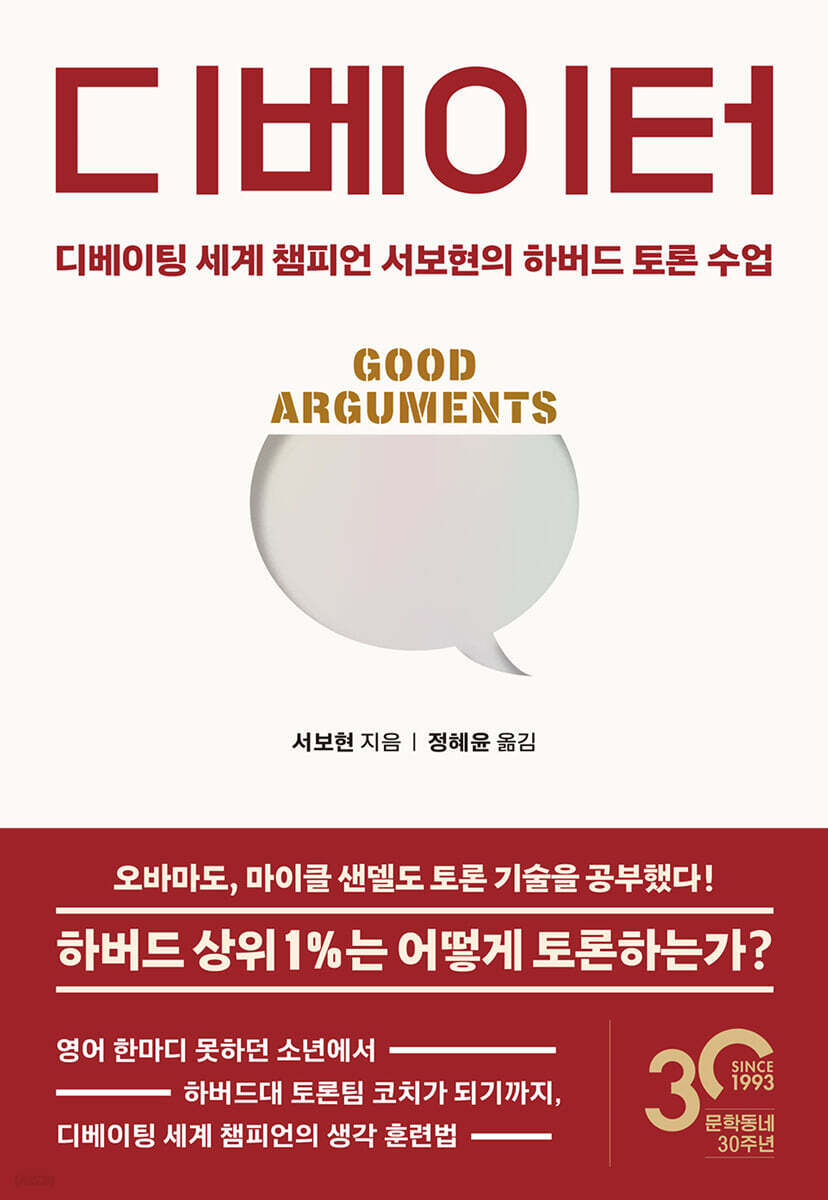
Even Obama and Michael Sandel studied debate techniques! How do Harvard's top 1% debate? World-defeating debating champion and the first Korean to coach the Harvard University debate team Learning Logical Thinking and Rational Speaking Skills from Seo Bo-hyeon Includes a special preface for Korean readers A must-read book, highly recommended by former World Bank President Kim Yong, Harvard Law School Professor Seok Ji-young, Blackstone founder Stephen Schwarzman, Organica Chairman Hong Jeong-wook, and Wharton School professor Adam Grant! Every time we watch a confirmation hearing or current affairs debate, we feel a sense of extreme fatigue. Because empty arguments, threats, and intimidation between the camps are rampant. Even the arguments on social media that occur almost every day often end up just riding an emotional escalator between the two parties. It's the same in everyday life. While we may envision a dignified, intelligent, and rational discussion, we often choose to remain silent, either because we assume that expressing our opinions in an agitated environment will be of little use, or because we dislike confronting conflict. Perhaps because of this, despite the fact that spaces for communication where people can express their opinions and hear the stories of others have become more diverse and numerous than ever before, the phenomenon of extreme opinions remaining and being overrepresented is intensifying. In these times of extreme confrontation and seething anger, the art of speaking—listening to others' opinions and expressing one's own complete thoughts—is becoming more important than ever. Author Seo Bo-hyun, the first Korean to win two World Debate Championships and a former coach for the world's best debate team, Harvard University, preaches the power and potential of debate with a voice more persuasive than anyone else in "Debater." The story of how the child of an Australian immigrant who couldn't speak a word of English became the world's best debater through debate training and built an "outstanding" career is a dense coming-of-age story in itself and an impeccable textbook of the humanities. This book could only have been written by author Seo Bo-hyeon, who has studied and found methods for good debate through fierce debates with world-class debaters. |
- You can preview some of the book's contents.
Preview
index
To Korean readers
To begin with and better oppose
Part 1: Five Skills for Debating
Chapter 1: Thesis: What to Fight About
Chapter 2: Argumentation: How to Persuade
Chapter 3: Counterargument: 'Good Opposition' Leads to 'Good Debate'
Chapter 4: The Art of Investigation: The Weapon or Strategy of Emotion
Chapter 5: Silence: The Art of Dissent
Applying the Skills of Debate Part 2 to Life
Chapter 6 Self-Defense: How to Deal with Rude People Easily
Chapter 7: Education: Learning to Win and Lose Gracefully
Chapter 8: Relationships: How to Fight 'Well' with People Close to You
Chapter 9: Technology: What AI Can Never Do
How does the discussion spread in conclusion?
Acknowledgements
main
To begin with and better oppose
Part 1: Five Skills for Debating
Chapter 1: Thesis: What to Fight About
Chapter 2: Argumentation: How to Persuade
Chapter 3: Counterargument: 'Good Opposition' Leads to 'Good Debate'
Chapter 4: The Art of Investigation: The Weapon or Strategy of Emotion
Chapter 5: Silence: The Art of Dissent
Applying the Skills of Debate Part 2 to Life
Chapter 6 Self-Defense: How to Deal with Rude People Easily
Chapter 7: Education: Learning to Win and Lose Gracefully
Chapter 8: Relationships: How to Fight 'Well' with People Close to You
Chapter 9: Technology: What AI Can Never Do
How does the discussion spread in conclusion?
Acknowledgements
main
Detailed image

Into the book
“A debate is a structured argument in which two teams compete for the hearts and minds of an audience.
“It’s a kind of battle of wits.”
--- p.20
Although very few people participate in debates, we all argue in some way almost every day.
Because we differ not only about the right direction things should go, but also about the current situation itself, simply recognizing something can spark conflict.
Through argument, we persuade others, find solutions, test our beliefs, and build self-esteem.
Everyone knows that while it is important to win arguments for our personal, professional, and political interests, it is also important to win them the right way.
--- p.24
To be well opposed has many meanings.
It includes getting your way, reducing conflict, and maintaining good relationships with others.
--- p.25
In a liberal democracy, good debate is not only something society must do, but something it must pursue.
--- p.28
The discussion gave me a clearer view of a small corner of the world.
Lying in bed, I wondered where the discussion would illuminate next.
--- p.48
If you don't believe you can change someone's mind or that people will act in good faith, you're likely to want to draw the boundaries of discussion to suit your own tastes.
--- p.71
“Belief alone doesn’t move people,” he said with a shrug.
“People move people.”
--- p.200
It meant that we had to create something new.
A speaking style that holds people's hands still instead of pulling them away.
--- pp.201~202
The goal was not to eliminate all arguments, but to eliminate bad ones so we could focus on the most worthwhile ones.
Living in a world with so much to oppose, we have had to choose our battles carefully.
--- p.247
When we encounter fighters in our daily lives, there is only one thing we want: to return to the form of discussion.
--- p.287
Myth tells us that the opposite of bad opposition is not agreement, but good opposition.
--- p.300
The new idea was a synthesis of two ideas.
It was both, yet neither.
--- p.330
When our views face genuine opposition, we have not only the option of asserting them more forcefully or abandoning them altogether, but also of reconsidering and finding a third way.
Another aspect of debate as an educational tool is:
If we can keep the conversation going without giving up, debate teaches us how to constantly learn from each other.
--- p.331
I was relieved to find that our most superior human ability, communion with other human beings, remains uniquely ours.
“It’s a kind of battle of wits.”
--- p.20
Although very few people participate in debates, we all argue in some way almost every day.
Because we differ not only about the right direction things should go, but also about the current situation itself, simply recognizing something can spark conflict.
Through argument, we persuade others, find solutions, test our beliefs, and build self-esteem.
Everyone knows that while it is important to win arguments for our personal, professional, and political interests, it is also important to win them the right way.
--- p.24
To be well opposed has many meanings.
It includes getting your way, reducing conflict, and maintaining good relationships with others.
--- p.25
In a liberal democracy, good debate is not only something society must do, but something it must pursue.
--- p.28
The discussion gave me a clearer view of a small corner of the world.
Lying in bed, I wondered where the discussion would illuminate next.
--- p.48
If you don't believe you can change someone's mind or that people will act in good faith, you're likely to want to draw the boundaries of discussion to suit your own tastes.
--- p.71
“Belief alone doesn’t move people,” he said with a shrug.
“People move people.”
--- p.200
It meant that we had to create something new.
A speaking style that holds people's hands still instead of pulling them away.
--- pp.201~202
The goal was not to eliminate all arguments, but to eliminate bad ones so we could focus on the most worthwhile ones.
Living in a world with so much to oppose, we have had to choose our battles carefully.
--- p.247
When we encounter fighters in our daily lives, there is only one thing we want: to return to the form of discussion.
--- p.287
Myth tells us that the opposite of bad opposition is not agreement, but good opposition.
--- p.300
The new idea was a synthesis of two ideas.
It was both, yet neither.
--- p.330
When our views face genuine opposition, we have not only the option of asserting them more forcefully or abandoning them altogether, but also of reconsidering and finding a third way.
Another aspect of debate as an educational tool is:
If we can keep the conversation going without giving up, debate teaches us how to constantly learn from each other.
--- p.331
I was relieved to find that our most superior human ability, communion with other human beings, remains uniquely ours.
--- p.391
Publisher's Review
From a boy who couldn't speak a word of English to becoming the first Korean to coach the Harvard debate team,
Shining milestones reached through the world of debate
The author, who left Korea at the age of eight and immigrated to Australia with his family, encountered language and cultural barriers and often became the butt of teasing from mischievous children.
Every time I clashed with my peers, I felt miserable because I couldn't express my thoughts clearly.
Sometimes I tried to respond in my own way, appealing to emotions and sometimes rushing in to fight, but as the situation kept getting worse instead of better, I gradually grew tired of it.
Eventually, they end up avoiding conflict and remaining silent, without getting involved in any arguments.
Then, when he was about to enter the fifth grade, something happened that changed his life completely.
Joining the school debate team, I discovered a magical world where I could clearly express my opposing views without any arguments or discord.
In the discussion room, no one interrupted the other person when they were speaking, and no one showed any violent behavior.
I felt free to wander freely (since I hadn't decided whether to support or oppose) and to delve into the dark corners of controversial issues (since I hadn't decided the topic).
Page 39
As I began to receive debate training, my thirst for healthy communication gradually subsided.
And a curiosity and passion I had never felt before welled up in me.
“I felt like I had found a life raft that would not only save me but also lead me to a brighter future if I just held on to it” (p. 30), and from then on, he began to explore the world of debate without hesitation.
After competing in regional debate competitions, he qualified to represent Australia in the World Student Debating Championships (WSDC), where he won first place and became the first Korean to be named Best Speaker.
He then entered Harvard University early and was selected as one of the top 1% of Harvard's "Junior 24" with a full scholarship for four years, and participated in the World University Debating Championship (WUDC) and won again.
He is currently a member of Phi Beta Kappa, the most prestigious honors fraternity in the United States, and is pursuing a doctorate at Harvard Law School while interacting with world-class scholars.
Discussion as an effective humanities education tool that leads to broader and deeper learning.
: We need a 'good debate' now.
The author says that the debate took him into a wider world, into places he had only vaguely dreamed of belonging to.
Discussion is an essential element of his learning journey.
To engage in debate, one must be thoroughly familiar with a vast amount of information on a wide range of fields, including domestic and international politics, history, science, and culture, and must have a deep enough understanding of the subject to be able to immediately express one's own opinion.
Discussion is an effective educational tool because it naturally fosters a genuine desire for knowledge and motivates learning.
Moreover, it is not limited to the pursuit of knowledge, but also involves the practice of thinking and speaking logically, so it is also a means to complete the knowledge as one's own.
His vivid experience in preparing for a debate, from identifying the topic to arguing methods and utilizing rhetorical techniques, provides practical knowledge to readers who value rational thinking and communication, and allows them to reflect on the fundamentals of debate.
Contrary to popular belief, debate, being an activity with others, fosters empathy and a willingness to listen to others.
To oppose well, you must listen well.
Debate has helped me understand opinions different from mine and has thus revealed hidden parts of the world.
As we continued to compete, we would discuss the Olympics one week and tax reform the next, pretending to be people who held strong opinions on these topics.
We traveled the world on trains of thought without ever stepping outside our own homes.
Page 60
The Art of Dissent: A Better Life, Better Relationships, and True Democracy
: Losing doesn't mean you're wrong, and winning doesn't mean you're right.
In a debate competition, everyone is guaranteed equal time and fair judgment.
No matter how absurd the other party's claims are, you must respond to them.
When given a position for or against a topic, the rule of debate is that you must represent the given position regardless of your own original beliefs.
In doing so, we find ourselves thinking from a different perspective than our actual beliefs, and sometimes being persuaded by the other side's position, and discover truths and answers that we would never have found on our own.
In a debate, the winner and loser are determined by one criterion: "Which side is more persuasive?"
Losing a debate doesn't mean your opinion is wrong or incorrect, and winning doesn't necessarily mean your opinion is right.
However, the clear victory or defeat in a debate reminds us of the valuable truth that 'how you say something' is more important than 'what you say.'
It reminds us again that we need to think hard about how to persuade others as much as we need to clearly express our own opinions.
When arguing, it is a good strategy to examine your argument from the other side's perspective.
This is because when you stand in the opposing position, there are aspects that look completely different, and you are forced to consider and examine all the multi-layered aspects of the issue.
Meanwhile, refuting the opponent's logic is also an essential element of a good argument.
This is not an act of ignoring the other person's opinion, but rather an act of being polite to the other person and respecting opinions that differ from your own.
Covering up and avoiding conflict stems from a cynical attitude that reconciliation will never happen and a lack of trust in others.
As citizens, we had a duty to dissent well—to resolve disputes through persuasion rather than violence, to deliberate on issues of common interest, to give those we opposed a reason and a chance to respond.
This obligation applies even more strongly to those who share our homes, workplaces, neighborhoods, and countries.
Avoiding discussion was also avoiding responsibility.
Page 299
Things AI can never do, things humans can do
Persuading others and listening to each other's stories
In 2019, the author attends the annual conference of tech company IBM.
There, they encounter Project Debater, an artificial intelligence system trained to debate with humans.
On this day, the robot debates with a highly skilled 'human' debater.
As the debate begins, Project Debaters demonstrate their formidable information gathering skills, solidifying their arguments with all sorts of research and figures.
He continues to present his argument in a gentle voice without being swayed by the other party's rebuttal.
Who was the winner?
The power of discussion lies, above all, in the magic that comes from the act of facing each other.
The willingness to listen to each other and reach out to each other is the key to changing the world.
Artificial intelligence can demonstrate information power that is not constrained by the limitations of human knowledge and can also present compelling arguments.
But if you want to move someone's heart, logical reasoning and countless facts alone aren't enough.
We need human connection, gentle empathy and compromise.
You must learn to see the world through the eyes and hearts of others.
So to speak, “persuasion is the use of words as weapons of love” (Jamaica Kincaid).
The experience of seeing the world through both your own eyes and the eyes of others is confusing, unsettling, and exhausting.
But this could not be said to be an explanation of love.
Page 358
A book that very well introduces the format, function, and types of debate competitions.
It's full of exciting historical scenes and practical advice.
"The Debater" inspires us by exploring the fact that arguments based on positive beliefs bring people together rather than divide them.
_Publisher's Weekly
A useful reflection on how to dissent effectively, especially in an age overflowing with harmful claims.
_Kirkus
Author Seo Bo-hyeon unfolds his experiences and observations during actual discussions, taking readers into an exciting and surprising world.
This book, which opens your eyes to a new world, provides a glimpse into the fascinating world of debate competitions and provides plenty of food for thought.
_Booklist
Shining milestones reached through the world of debate
The author, who left Korea at the age of eight and immigrated to Australia with his family, encountered language and cultural barriers and often became the butt of teasing from mischievous children.
Every time I clashed with my peers, I felt miserable because I couldn't express my thoughts clearly.
Sometimes I tried to respond in my own way, appealing to emotions and sometimes rushing in to fight, but as the situation kept getting worse instead of better, I gradually grew tired of it.
Eventually, they end up avoiding conflict and remaining silent, without getting involved in any arguments.
Then, when he was about to enter the fifth grade, something happened that changed his life completely.
Joining the school debate team, I discovered a magical world where I could clearly express my opposing views without any arguments or discord.
In the discussion room, no one interrupted the other person when they were speaking, and no one showed any violent behavior.
I felt free to wander freely (since I hadn't decided whether to support or oppose) and to delve into the dark corners of controversial issues (since I hadn't decided the topic).
Page 39
As I began to receive debate training, my thirst for healthy communication gradually subsided.
And a curiosity and passion I had never felt before welled up in me.
“I felt like I had found a life raft that would not only save me but also lead me to a brighter future if I just held on to it” (p. 30), and from then on, he began to explore the world of debate without hesitation.
After competing in regional debate competitions, he qualified to represent Australia in the World Student Debating Championships (WSDC), where he won first place and became the first Korean to be named Best Speaker.
He then entered Harvard University early and was selected as one of the top 1% of Harvard's "Junior 24" with a full scholarship for four years, and participated in the World University Debating Championship (WUDC) and won again.
He is currently a member of Phi Beta Kappa, the most prestigious honors fraternity in the United States, and is pursuing a doctorate at Harvard Law School while interacting with world-class scholars.
Discussion as an effective humanities education tool that leads to broader and deeper learning.
: We need a 'good debate' now.
The author says that the debate took him into a wider world, into places he had only vaguely dreamed of belonging to.
Discussion is an essential element of his learning journey.
To engage in debate, one must be thoroughly familiar with a vast amount of information on a wide range of fields, including domestic and international politics, history, science, and culture, and must have a deep enough understanding of the subject to be able to immediately express one's own opinion.
Discussion is an effective educational tool because it naturally fosters a genuine desire for knowledge and motivates learning.
Moreover, it is not limited to the pursuit of knowledge, but also involves the practice of thinking and speaking logically, so it is also a means to complete the knowledge as one's own.
His vivid experience in preparing for a debate, from identifying the topic to arguing methods and utilizing rhetorical techniques, provides practical knowledge to readers who value rational thinking and communication, and allows them to reflect on the fundamentals of debate.
Contrary to popular belief, debate, being an activity with others, fosters empathy and a willingness to listen to others.
To oppose well, you must listen well.
Debate has helped me understand opinions different from mine and has thus revealed hidden parts of the world.
As we continued to compete, we would discuss the Olympics one week and tax reform the next, pretending to be people who held strong opinions on these topics.
We traveled the world on trains of thought without ever stepping outside our own homes.
Page 60
The Art of Dissent: A Better Life, Better Relationships, and True Democracy
: Losing doesn't mean you're wrong, and winning doesn't mean you're right.
In a debate competition, everyone is guaranteed equal time and fair judgment.
No matter how absurd the other party's claims are, you must respond to them.
When given a position for or against a topic, the rule of debate is that you must represent the given position regardless of your own original beliefs.
In doing so, we find ourselves thinking from a different perspective than our actual beliefs, and sometimes being persuaded by the other side's position, and discover truths and answers that we would never have found on our own.
In a debate, the winner and loser are determined by one criterion: "Which side is more persuasive?"
Losing a debate doesn't mean your opinion is wrong or incorrect, and winning doesn't necessarily mean your opinion is right.
However, the clear victory or defeat in a debate reminds us of the valuable truth that 'how you say something' is more important than 'what you say.'
It reminds us again that we need to think hard about how to persuade others as much as we need to clearly express our own opinions.
When arguing, it is a good strategy to examine your argument from the other side's perspective.
This is because when you stand in the opposing position, there are aspects that look completely different, and you are forced to consider and examine all the multi-layered aspects of the issue.
Meanwhile, refuting the opponent's logic is also an essential element of a good argument.
This is not an act of ignoring the other person's opinion, but rather an act of being polite to the other person and respecting opinions that differ from your own.
Covering up and avoiding conflict stems from a cynical attitude that reconciliation will never happen and a lack of trust in others.
As citizens, we had a duty to dissent well—to resolve disputes through persuasion rather than violence, to deliberate on issues of common interest, to give those we opposed a reason and a chance to respond.
This obligation applies even more strongly to those who share our homes, workplaces, neighborhoods, and countries.
Avoiding discussion was also avoiding responsibility.
Page 299
Things AI can never do, things humans can do
Persuading others and listening to each other's stories
In 2019, the author attends the annual conference of tech company IBM.
There, they encounter Project Debater, an artificial intelligence system trained to debate with humans.
On this day, the robot debates with a highly skilled 'human' debater.
As the debate begins, Project Debaters demonstrate their formidable information gathering skills, solidifying their arguments with all sorts of research and figures.
He continues to present his argument in a gentle voice without being swayed by the other party's rebuttal.
Who was the winner?
The power of discussion lies, above all, in the magic that comes from the act of facing each other.
The willingness to listen to each other and reach out to each other is the key to changing the world.
Artificial intelligence can demonstrate information power that is not constrained by the limitations of human knowledge and can also present compelling arguments.
But if you want to move someone's heart, logical reasoning and countless facts alone aren't enough.
We need human connection, gentle empathy and compromise.
You must learn to see the world through the eyes and hearts of others.
So to speak, “persuasion is the use of words as weapons of love” (Jamaica Kincaid).
The experience of seeing the world through both your own eyes and the eyes of others is confusing, unsettling, and exhausting.
But this could not be said to be an explanation of love.
Page 358
A book that very well introduces the format, function, and types of debate competitions.
It's full of exciting historical scenes and practical advice.
"The Debater" inspires us by exploring the fact that arguments based on positive beliefs bring people together rather than divide them.
_Publisher's Weekly
A useful reflection on how to dissent effectively, especially in an age overflowing with harmful claims.
_Kirkus
Author Seo Bo-hyeon unfolds his experiences and observations during actual discussions, taking readers into an exciting and surprising world.
This book, which opens your eyes to a new world, provides a glimpse into the fascinating world of debate competitions and provides plenty of food for thought.
_Booklist
GOODS SPECIFICS
- Date of issue: April 14, 2023
- Page count, weight, size: 440 pages | 606g | 145*210*30mm
- ISBN13: 9788954691994
- ISBN10: 8954691994
You may also like
카테고리
korean


korean

![GQ KOREA Mark (Monthly): December [2025]](http://librairie.coreenne.fr/cdn/shop/files/8ef265dbbfbf186523ed75ba7319009d.jpg?v=1765340328&width=3840)


