

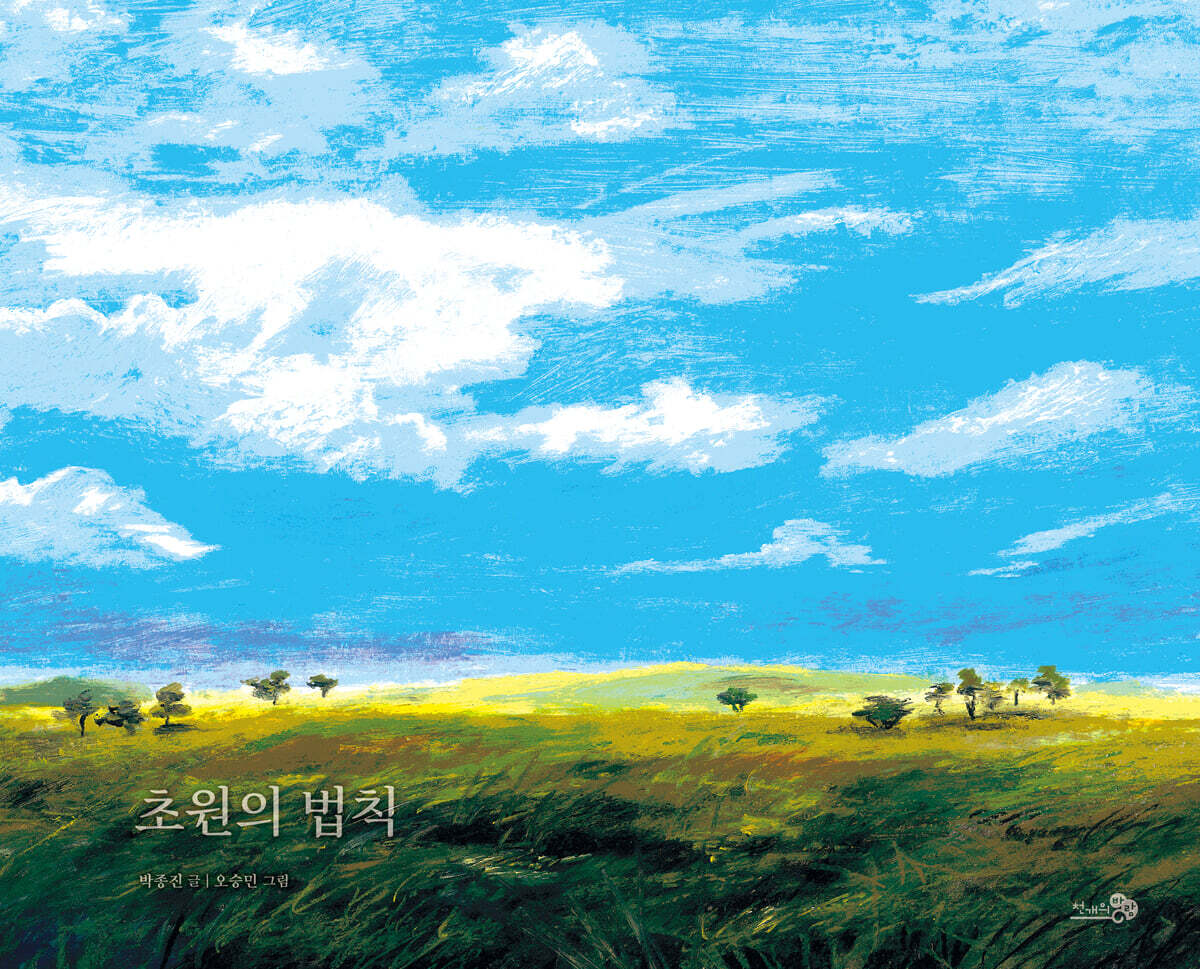
Law of the Prairie
 |
Description
Book Introduction
Wind Picture Book 139.
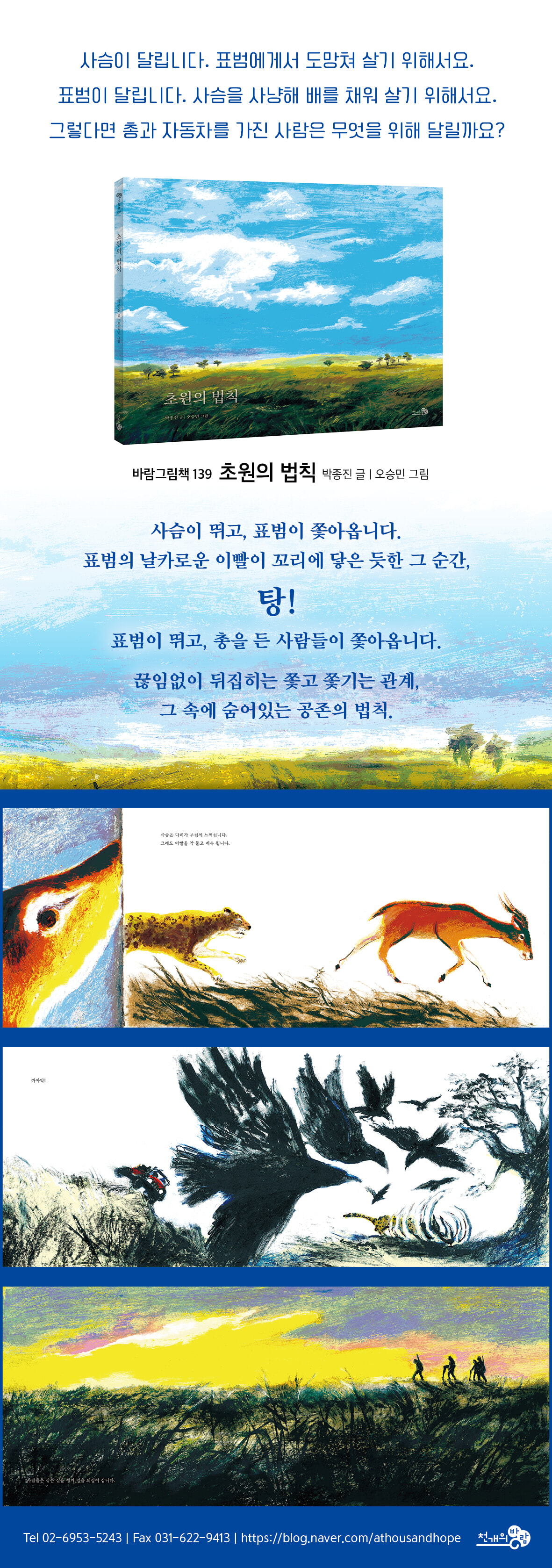
The deer is jumping.
To escape from the leopard and survive.
The leopard runs in pursuit.
To hunt deer and fill our stomachs to survive.
The moment the leopard's sharp teeth touched the tail, bang! The leopard jumped.
To escape from gunmen and survive.
This is a picture book that captures the constantly changing relationship of chasing and being chased, and the laws of coexistence hidden within it.
The deer is jumping.
To escape from the leopard and survive.
The leopard runs in pursuit.
To hunt deer and fill our stomachs to survive.
The moment the leopard's sharp teeth touched the tail, bang! The leopard jumped.
To escape from gunmen and survive.
This is a picture book that captures the constantly changing relationship of chasing and being chased, and the laws of coexistence hidden within it.
- You can preview some of the book's contents.
Preview
Detailed image
Publisher's Review
The preciousness of life that continues to walk
The life of animals living in the grasslands continues through ‘jumping.’
The deer runs to escape from the leopard.
The leopard runs to catch the deer.
On the other hand, many people today do not run themselves but rather use various means of transportation to get around.
This is the power of civilization that human society has built up.
The deer and leopard in "The Law of the Prairie" run using their own feet.
Meanwhile, people drive their cars and roam freely across the grasslands.
The car, which had been running wildly as if it had nothing to fear, flips over and is damaged by a rock, and people start to walk.
Eventually, they are caught by the reserve warden and arrested, but are taken away on another vehicle.
As if they will continue to live in the future.
This is the result of walking and walking until I was tired.
That's why the person at the front is smiling in relief at being alive even while being arrested.
The deer gritted its teeth and ran to avoid the leopard.
The leopard ran fiercely, changing directions to avoid the man with the gun.
People did not sit still and continued walking.
This shows that all life is about running and walking, and that it continues like that.
This is a picture book that makes you think about the preciousness of life by showing how not to give up even when things are difficult.
Two Directions for Humanity: Greed or Coexistence
But did the three animals running and trotting across the same grassland—the deer, the leopard, and the human—have the same purpose for running? While their reasons were different, the deer and the leopard ran desperately, driven by the same goal: survival.
But humans who have the benefits of civilization do not run to survive.
They ran for the fun and profit of poaching, the gain they made by taking another life.
It is natural to take other lives in order to survive by eating something, but humans are driven by greed.
They know that their own lives are precious, but they do not consider the lives of other animals precious.
People with tools like cars and guns roamed the prairies without hesitation.
Those who run for greed are captured and locked in bars by those who want to protect the grasslands and animals.
This scene clearly shows the theme that other lives should not be taken for fun and greed.
Both the poacher who hunts the leopard and the conservation area manager are people who enjoy the benefits of civilization.
But how they used the technology was different.
A poacher who runs without looking around, drunk on greed, to easily take other lives, and a ranger who looks around and runs with tools to protect other lives.
The Law of the Prairie subtly suggests the direction in which humans should take in life, including how they should use tools and how they should live in the future.
A harmony of concise text and powerful illustrations
"Law of the Prairie" captures your attention from the very first scene.
The simple sentence, "The deer is jumping," is combined with the shining eyes of the leopard that has captured the deer, creating a very powerful impression.
Artist Seungmin Oh, who drew the picture, completed the hand-drawn manuscript digitally.
I first worked on the nature and animals of the grassland with a rough and free feel to bring them to life.
To prevent the painting from looking like a scene from a documentary, we added clarity digitally, and boldly omitted the blue of the sky and grassland to emphasize the animals.
The scene where the poachers are arrested is based on blue and yellow, a color scheme similar to that of "Mr. Poet, Please Have Noodles," previously published by Cheon Gae-baram, but the atmosphere of the two books is completely different.
You can feel the artist's feelings when he painted the picture and what he wanted to express in this scene.
The writing is concise.
I tried to keep my emotions as low as possible, to the point where it was barely noticeable what I thought of animals and people.
Because the writing seems to present facts without mixing opinions, there are many interpretations of what the book is trying to say and what the title, "Law of the Prairie," means.
Does "The Law of the Grassland" reveal a world where everything is prey, preyed upon, and chased? Or does it remind us that even humans have a relationship of chase and being chased, and that we too are animals within nature, as represented by the grassland? Or does it imply that taking other life for pleasure or profit is wrong? Through concise, multifaceted text and illustrations that reveal the author's thoughts, discuss your own interpretation of the Law of the Grassland and delve deeper into the book.
Nuri Course 5.
Nature Exploration - Living with Nature
Curriculum 1st Grade Integrated 2-9.
Life is precious
3rd year, 1st semester, Ethics 6.
We respect life
3rd grade, 1st semester, Korean language 9.
What is the content?
5th grade, 2nd semester, Science 2.
Biology and Environment
The life of animals living in the grasslands continues through ‘jumping.’
The deer runs to escape from the leopard.
The leopard runs to catch the deer.
On the other hand, many people today do not run themselves but rather use various means of transportation to get around.
This is the power of civilization that human society has built up.
The deer and leopard in "The Law of the Prairie" run using their own feet.
Meanwhile, people drive their cars and roam freely across the grasslands.
The car, which had been running wildly as if it had nothing to fear, flips over and is damaged by a rock, and people start to walk.
Eventually, they are caught by the reserve warden and arrested, but are taken away on another vehicle.
As if they will continue to live in the future.
This is the result of walking and walking until I was tired.
That's why the person at the front is smiling in relief at being alive even while being arrested.
The deer gritted its teeth and ran to avoid the leopard.
The leopard ran fiercely, changing directions to avoid the man with the gun.
People did not sit still and continued walking.
This shows that all life is about running and walking, and that it continues like that.
This is a picture book that makes you think about the preciousness of life by showing how not to give up even when things are difficult.
Two Directions for Humanity: Greed or Coexistence
But did the three animals running and trotting across the same grassland—the deer, the leopard, and the human—have the same purpose for running? While their reasons were different, the deer and the leopard ran desperately, driven by the same goal: survival.
But humans who have the benefits of civilization do not run to survive.
They ran for the fun and profit of poaching, the gain they made by taking another life.
It is natural to take other lives in order to survive by eating something, but humans are driven by greed.
They know that their own lives are precious, but they do not consider the lives of other animals precious.
People with tools like cars and guns roamed the prairies without hesitation.
Those who run for greed are captured and locked in bars by those who want to protect the grasslands and animals.
This scene clearly shows the theme that other lives should not be taken for fun and greed.
Both the poacher who hunts the leopard and the conservation area manager are people who enjoy the benefits of civilization.
But how they used the technology was different.
A poacher who runs without looking around, drunk on greed, to easily take other lives, and a ranger who looks around and runs with tools to protect other lives.
The Law of the Prairie subtly suggests the direction in which humans should take in life, including how they should use tools and how they should live in the future.
A harmony of concise text and powerful illustrations
"Law of the Prairie" captures your attention from the very first scene.
The simple sentence, "The deer is jumping," is combined with the shining eyes of the leopard that has captured the deer, creating a very powerful impression.
Artist Seungmin Oh, who drew the picture, completed the hand-drawn manuscript digitally.
I first worked on the nature and animals of the grassland with a rough and free feel to bring them to life.
To prevent the painting from looking like a scene from a documentary, we added clarity digitally, and boldly omitted the blue of the sky and grassland to emphasize the animals.
The scene where the poachers are arrested is based on blue and yellow, a color scheme similar to that of "Mr. Poet, Please Have Noodles," previously published by Cheon Gae-baram, but the atmosphere of the two books is completely different.
You can feel the artist's feelings when he painted the picture and what he wanted to express in this scene.
The writing is concise.
I tried to keep my emotions as low as possible, to the point where it was barely noticeable what I thought of animals and people.
Because the writing seems to present facts without mixing opinions, there are many interpretations of what the book is trying to say and what the title, "Law of the Prairie," means.
Does "The Law of the Grassland" reveal a world where everything is prey, preyed upon, and chased? Or does it remind us that even humans have a relationship of chase and being chased, and that we too are animals within nature, as represented by the grassland? Or does it imply that taking other life for pleasure or profit is wrong? Through concise, multifaceted text and illustrations that reveal the author's thoughts, discuss your own interpretation of the Law of the Grassland and delve deeper into the book.
Nuri Course 5.
Nature Exploration - Living with Nature
Curriculum 1st Grade Integrated 2-9.
Life is precious
3rd year, 1st semester, Ethics 6.
We respect life
3rd grade, 1st semester, Korean language 9.
What is the content?
5th grade, 2nd semester, Science 2.
Biology and Environment
GOODS SPECIFICS
- Date of issue: May 15, 2023
- Format: Hardcover book binding method guide
- Page count, weight, size: 40 pages | 280*225*15mm
- ISBN13: 9791165734121
- ISBN10: 1165734125
- KC Certification: Certification Type: Conformity Confirmation
You may also like
카테고리
korean


korean

![GQ KOREA Mark (Monthly): December [2025]](http://librairie.coreenne.fr/cdn/shop/files/8ef265dbbfbf186523ed75ba7319009d.jpg?v=1765340328&width=3840)


