

A very dangerous science book
 |
Description
Book Introduction
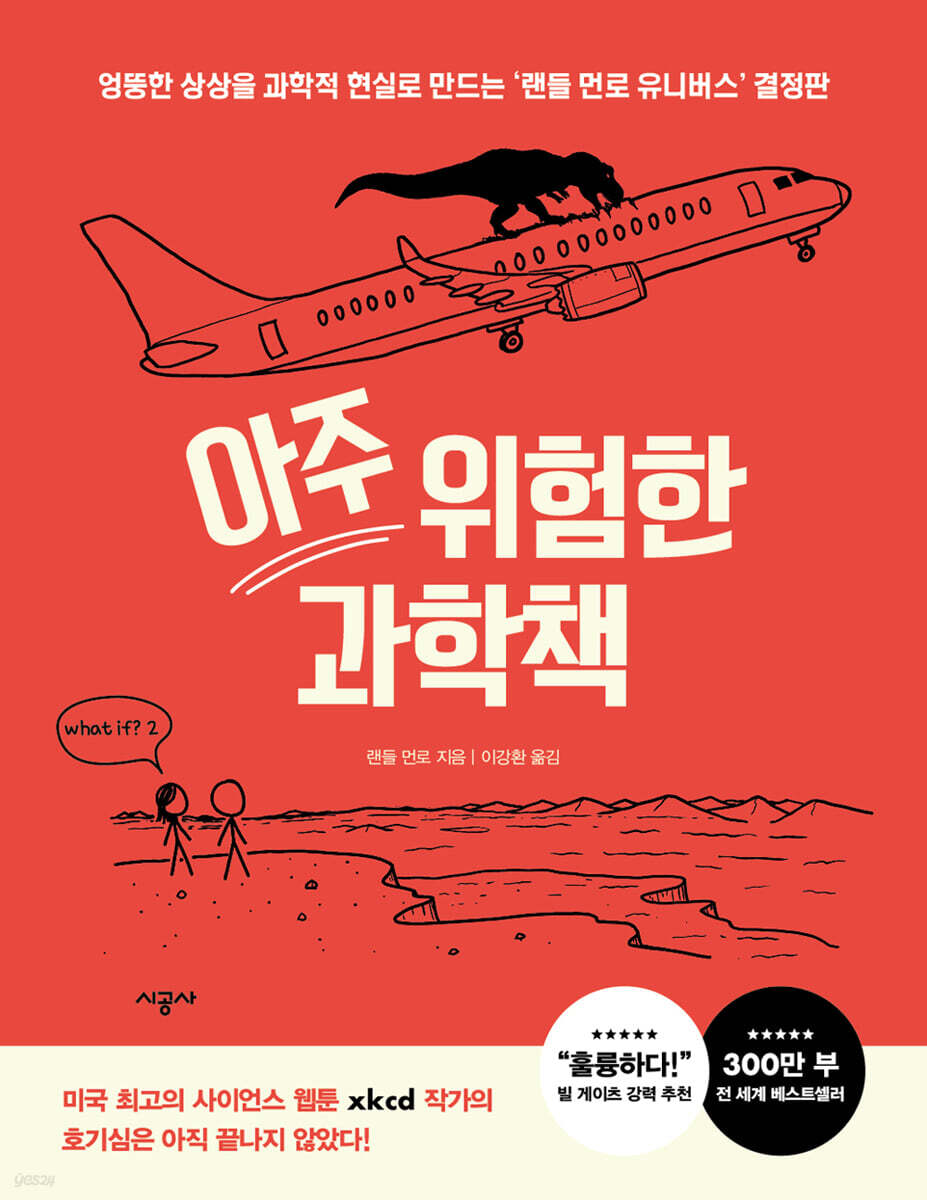
The million-selling 『Dangerous Science Book』 and 『More Dangerous Science Book』 The latest masterpiece has finally landed in Korea! “Science definitely becomes fun when you go through Randall Munroe.” - TIME The Randall Munroe series, which has captivated science nerds worldwide and sold over 3 million copies, is back and stronger than ever. The new book, "A Very Dangerous Science Book," became an Amazon bestseller immediately after its publication, and its rights have been exported to 19 countries, including Korea, reaching readers around the world. The questions that bombard Randall Munroe with are becoming increasingly dangerous and outlandish, but his tenacity for finding the most scientific answers to any question is also evolving. Everyone knows that the sun is incredibly hot. So what about the questions: What SPF should your sunscreen have when you visit the sun's surface, and how many layers should you apply to protect your skin? Or how big will a snowball roll from the top of Mount Everest, the world's highest mountain, until it reaches the bottom? Or how long would it take to fill a swimming pool with the saliva you inevitably spilled as a baby and now deliberately spit out as an adult? It doesn't really matter what the question is. What makes science so wonderful is that it provides tools to answer questions that seem unanswerable, and the very process of using scientific tools to find answers to those questions is meaningful. Consisting of about 60 questions and answers, "The Very Dangerous Science Book" is a book that clearly shows what "scientific thinking" is. If you want to get closer to science, meet Randall Munber. |
- You can preview some of the book's contents.
Preview
index
Entering
1.
If you filled the solar system with soup
2.
If you can hold on to the returning helicopter blades
3.
If you are next to an extremely cold object
4.
If you evaporate a lump of iron
5.
If you go to the end of the universe by car
6.
To ascend to the sky by hanging on a dove
Short Answers ①
7.
If you live with a Tyrannosaurus
8.
If you stand in front of an erupting geyser
9.
If you shoot a laser gun into space
10.
If we estimate the expansion period of the book
Strange and Worrisome Questions ①
11.
If you fill a church with bananas
12.
If you catch a fired bullet with your hand
13.
If we remove the mass of the Earth
14.
If you paint the entire Earth
15.
If Jupiter were the size of a house
16.
If our galaxy were on a beach
17.
To get to the highest point on the swing
18.
If you launch an airplane with a slingshot
Short Answers ②
19.
If a meteorite collides slowly with the Earth
20.
If planets were made of elements of the same name
21.
If a day were one second
22.
To build a billion-story building
23.
To avoid paying 2 undecimal dollars in compensation
24.
If we are to determine the ownership of stars
25.
To find out the whereabouts of the missing tires
26.
If we estimate the amount of dinosaurs contained in plastic,
Short Answers ③
27.
If you make a water column aquarium in the sea
28.
If you look at it with eyes the size of the Earth
29.
If you build Rome in a day
30.
If you reach the Mariana Trench by riding a glass tube built on the seabed,
31.
To fill a shoebox with the most expensive
32. If you are curious about the effects of magnetic fields around MRI
33.
If you are curious about the number of people you can call your ancestors
34.
To safely transport a flying bird into a moving car
35.
To win a car race without rules
Strange and Worrisome Questions ②
36.
If you make a smartphone with a vacuum tube
37.
If you stop the rain with a laser
38.
To eat the clouds alone
39.
If you're wondering how to delay the sunset
40.
If you make a lamp out of lava
41.
If we cooled the Earth with a refrigerator
42.
To increase blood alcohol level by drinking blood
43.
To make the Earth rotate faster
44.
If you're curious about the Spider vs. Sun showdown
45.
If you breathe a person through dead skin
46.
To make lightning by crushing candy
Short Answers ④
47.
If you heat your house with a toaster
48.
If you are curious about the proton Earth and electron Moon scenario,
49.
If you take out your eye and look with the other eye
50.
If Japan disappears
51.
If you light it with moonlight
Strange and Worrisome Questions ③
52.
If you fill a swimming pool with saliva
53.
If you ask about the growth limit of a snowball,
54.
If you could make Niagara Falls flow through a straw
55.
If time goes back to the past from the moment you walk
56.
If you fill the stomach with ammonia
57.
If we connect the Earth and the Moon with a fire escape pole,
Short Answers ⑤
58.
To cover the whole world with snow
59.
If every dog had five puppies every year
60.
If you stay in the sun for 1 nanosecond
61.
To block ultraviolet rays from the sun's surface with sunscreen
62.
If you want to touch the sun
63.
If it rains lemon drops and gum drops
Acknowledgements
References
Search
1.
If you filled the solar system with soup
2.
If you can hold on to the returning helicopter blades
3.
If you are next to an extremely cold object
4.
If you evaporate a lump of iron
5.
If you go to the end of the universe by car
6.
To ascend to the sky by hanging on a dove
Short Answers ①
7.
If you live with a Tyrannosaurus
8.
If you stand in front of an erupting geyser
9.
If you shoot a laser gun into space
10.
If we estimate the expansion period of the book
Strange and Worrisome Questions ①
11.
If you fill a church with bananas
12.
If you catch a fired bullet with your hand
13.
If we remove the mass of the Earth
14.
If you paint the entire Earth
15.
If Jupiter were the size of a house
16.
If our galaxy were on a beach
17.
To get to the highest point on the swing
18.
If you launch an airplane with a slingshot
Short Answers ②
19.
If a meteorite collides slowly with the Earth
20.
If planets were made of elements of the same name
21.
If a day were one second
22.
To build a billion-story building
23.
To avoid paying 2 undecimal dollars in compensation
24.
If we are to determine the ownership of stars
25.
To find out the whereabouts of the missing tires
26.
If we estimate the amount of dinosaurs contained in plastic,
Short Answers ③
27.
If you make a water column aquarium in the sea
28.
If you look at it with eyes the size of the Earth
29.
If you build Rome in a day
30.
If you reach the Mariana Trench by riding a glass tube built on the seabed,
31.
To fill a shoebox with the most expensive
32. If you are curious about the effects of magnetic fields around MRI
33.
If you are curious about the number of people you can call your ancestors
34.
To safely transport a flying bird into a moving car
35.
To win a car race without rules
Strange and Worrisome Questions ②
36.
If you make a smartphone with a vacuum tube
37.
If you stop the rain with a laser
38.
To eat the clouds alone
39.
If you're wondering how to delay the sunset
40.
If you make a lamp out of lava
41.
If we cooled the Earth with a refrigerator
42.
To increase blood alcohol level by drinking blood
43.
To make the Earth rotate faster
44.
If you're curious about the Spider vs. Sun showdown
45.
If you breathe a person through dead skin
46.
To make lightning by crushing candy
Short Answers ④
47.
If you heat your house with a toaster
48.
If you are curious about the proton Earth and electron Moon scenario,
49.
If you take out your eye and look with the other eye
50.
If Japan disappears
51.
If you light it with moonlight
Strange and Worrisome Questions ③
52.
If you fill a swimming pool with saliva
53.
If you ask about the growth limit of a snowball,
54.
If you could make Niagara Falls flow through a straw
55.
If time goes back to the past from the moment you walk
56.
If you fill the stomach with ammonia
57.
If we connect the Earth and the Moon with a fire escape pole,
Short Answers ⑤
58.
To cover the whole world with snow
59.
If every dog had five puppies every year
60.
If you stay in the sun for 1 nanosecond
61.
To block ultraviolet rays from the sun's surface with sunscreen
62.
If you want to touch the sun
63.
If it rains lemon drops and gum drops
Acknowledgements
References
Search
Detailed image

Into the book
Sometimes a question that seems simple turns out to be more difficult in unexpected ways.
Why does your hair actually stand on end when you rub a balloon? The common answer from science class is that negatively charged electrons move from your hair to the balloon, making your hair positively charged.
The hairs stand on end because the electrically charged hairs push against each other.
But why do electrons move from the hair to the balloon? Why not the other way around? That's a very good question.
Because nobody knows the answer.
Physicists have no plausible, general theory as to why some materials shed electrons from their surfaces when in contact, while others accept them.
This phenomenon, called triboelectricity, is a cutting-edge area of research.
The same science is used to answer serious questions and silly questions.
Frictional electricity explains how lightning is created in storms.
Counting the number of subatomic particles in living organisms is something physicists need to do when conducting radiation experiments.
Answering stupid questions can lead us into the realm of serious science.
--- pp.10~11
Q.
Would it be dangerous to be next to a large object that has a temperature of 0 Kelvin, or absolute zero?
A.
One of the great dangers of extremely cold substances is that they often do not want to remain extremely cold.
When liquid nitrogen or dry ice warms and turns into a gas, it expands greatly and can push all the air out of a room.
A single bucket of liquid nitrogen can be converted into enough nitrogen gas to fill a room.
If you breathe oxygen, this is bad news.
--- p.27
Q.
Is the universe hot or cold?
A.
According to the textbook definition of temperature, the universe is hot.
At least here in our solar system.
Molecules in space move individually very quickly.
Each has a lot of energy, and temperature is roughly defined as the average kinetic energy of the molecules.
But because there are so few molecules in space, even though each has a lot of energy, the total amount of thermal energy is small.
It means that you can't heat an object.
Space may be warm in theory, but in reality it feels cold.
Space is hot, but it's the hottest place you can freeze to death.
--- pp.119~120
Q.
What is the maximum height a person can swing a swing by simply swinging their legs? Is it possible to build a swing so high that a rider could launch into space if they timed their jump perfectly?
A.
There is a place with a very large swing.
At Moses Mabhida Stadium in Durban, South Africa, spectators can climb high up and ride on a 60-meter-long swing suspended from the stadium's structure.
But at that speed, air resistance is very strong.
When a person on a swing reaches the bottom, they have lost most of their momentum and cannot go up very far in the opposite direction.
Kicking doesn't help much.
Because the swing is so long, rowing it is virtually ineffective.
A giant swing might be fun, but it won't help you get into space.
Measurements taken by average people have shown that the ideal swing length to allow maximum height is between 3 and 4.5 meters.
It's exactly the length of a swing in a large playground.
Once again, the kids are the most accurate.
--- pp.105~107
Q.
If plastic is made from oil, and oil is made from dead dinosaurs, how much of a real dinosaur is in a plastic dinosaur?
A.
No matter where it comes from, only a very small percentage of the oil in your plastic dinosaur comes directly from the carcasses of real dinosaurs.
If the oil came from a Mesozoic oil field with a rich terrestrial supply, it could contain slightly more dinosaurs.
If it comes from pre-Mesozoic deposits trapped under the caprock, it probably doesn't contain any dinosaurs.
There's no way to know without painstakingly tracking every step of your particular toy's manufacturing process.
In a broad sense, all the water in the ocean was part of the dinosaurs at some point.
When this water is used for photosynthesis, the water molecules become part of the fats and hydrocarbons in the food chain.
But there's a lot more water in your body right now, in the form of water.
So, there's more dinosaurs in your body than in your plastic toys.
--- pp.163~164
Q.
If up to 80 percent of household dust is made up of dead skin, how much human skin will a person inhale in their lifetime?
A.
Good news: You can't breathe it in, and most dust isn't dead skin.
(…) Even if we figured out how to maximize the amount of floating skin dust, it wouldn't be enough to inhale a single person.
Even if we built a machine that pumped skin dust into a room and increased the density of skin dust to 10 milligrams per cubic meter (making the air dusty enough to exceed the dust exposure limit for coal miners), we would only inhale about 3 kilograms of skin cells over the average lifespan.
Why does your hair actually stand on end when you rub a balloon? The common answer from science class is that negatively charged electrons move from your hair to the balloon, making your hair positively charged.
The hairs stand on end because the electrically charged hairs push against each other.
But why do electrons move from the hair to the balloon? Why not the other way around? That's a very good question.
Because nobody knows the answer.
Physicists have no plausible, general theory as to why some materials shed electrons from their surfaces when in contact, while others accept them.
This phenomenon, called triboelectricity, is a cutting-edge area of research.
The same science is used to answer serious questions and silly questions.
Frictional electricity explains how lightning is created in storms.
Counting the number of subatomic particles in living organisms is something physicists need to do when conducting radiation experiments.
Answering stupid questions can lead us into the realm of serious science.
--- pp.10~11
Q.
Would it be dangerous to be next to a large object that has a temperature of 0 Kelvin, or absolute zero?
A.
One of the great dangers of extremely cold substances is that they often do not want to remain extremely cold.
When liquid nitrogen or dry ice warms and turns into a gas, it expands greatly and can push all the air out of a room.
A single bucket of liquid nitrogen can be converted into enough nitrogen gas to fill a room.
If you breathe oxygen, this is bad news.
--- p.27
Q.
Is the universe hot or cold?
A.
According to the textbook definition of temperature, the universe is hot.
At least here in our solar system.
Molecules in space move individually very quickly.
Each has a lot of energy, and temperature is roughly defined as the average kinetic energy of the molecules.
But because there are so few molecules in space, even though each has a lot of energy, the total amount of thermal energy is small.
It means that you can't heat an object.
Space may be warm in theory, but in reality it feels cold.
Space is hot, but it's the hottest place you can freeze to death.
--- pp.119~120
Q.
What is the maximum height a person can swing a swing by simply swinging their legs? Is it possible to build a swing so high that a rider could launch into space if they timed their jump perfectly?
A.
There is a place with a very large swing.
At Moses Mabhida Stadium in Durban, South Africa, spectators can climb high up and ride on a 60-meter-long swing suspended from the stadium's structure.
But at that speed, air resistance is very strong.
When a person on a swing reaches the bottom, they have lost most of their momentum and cannot go up very far in the opposite direction.
Kicking doesn't help much.
Because the swing is so long, rowing it is virtually ineffective.
A giant swing might be fun, but it won't help you get into space.
Measurements taken by average people have shown that the ideal swing length to allow maximum height is between 3 and 4.5 meters.
It's exactly the length of a swing in a large playground.
Once again, the kids are the most accurate.
--- pp.105~107
Q.
If plastic is made from oil, and oil is made from dead dinosaurs, how much of a real dinosaur is in a plastic dinosaur?
A.
No matter where it comes from, only a very small percentage of the oil in your plastic dinosaur comes directly from the carcasses of real dinosaurs.
If the oil came from a Mesozoic oil field with a rich terrestrial supply, it could contain slightly more dinosaurs.
If it comes from pre-Mesozoic deposits trapped under the caprock, it probably doesn't contain any dinosaurs.
There's no way to know without painstakingly tracking every step of your particular toy's manufacturing process.
In a broad sense, all the water in the ocean was part of the dinosaurs at some point.
When this water is used for photosynthesis, the water molecules become part of the fats and hydrocarbons in the food chain.
But there's a lot more water in your body right now, in the form of water.
So, there's more dinosaurs in your body than in your plastic toys.
--- pp.163~164
Q.
If up to 80 percent of household dust is made up of dead skin, how much human skin will a person inhale in their lifetime?
A.
Good news: You can't breathe it in, and most dust isn't dead skin.
(…) Even if we figured out how to maximize the amount of floating skin dust, it wouldn't be enough to inhale a single person.
Even if we built a machine that pumped skin dust into a room and increased the density of skin dust to 10 milligrams per cubic meter (making the air dusty enough to exceed the dust exposure limit for coal miners), we would only inhale about 3 kilograms of skin cells over the average lifespan.
--- p.258
Publisher's Review
The best science webtoon in the US, xkcd writer,
Randall Munroe's curiosity is not over yet!
Answering outrageous questions
The most bizarre and scientific answers in one place
The definitive edition of "The Dangerous Science Book," which became a genre by becoming a bestseller on Amazon and the New York Times for 30 consecutive weeks immediately after its publication, has been published.
The original title shared by both books is 'What if?', meaning 'What would happen if ~?'
Even if you just glance at the table of contents, you'll get a feel for it, but as the title suggests, all sorts of strange 'if's' appear.
Opening this book is the only way to get answers to the odd questions you never thought to ask.
You might even find solace in the fact that your curiosity isn't so outrageous, and that there are so many people in the world with more bizarre and dangerous imaginations.
As the number of people seeking out Randall Munroe from around the world continues to grow, their questions are becoming more and more bizarre.
Randall Munroe's approach is more outlandish than the questions themselves, offering answers that defy imagination and unfold in a captivating story.
Not to mention his signature (engineering nerd) humor, sometimes with 'fact violence', and sometimes with an inclusiveness that takes any question seriously, he does not disappoint his readers this time either.
"The Very Dangerous Science Book" is the Randall Munroe version of "Anything to Help You."
What if you wanted to lower the global temperature by opening all the refrigerator doors simultaneously? A brief explanation of thermodynamics would probably be in order.
Have you ever wondered if drinking a drunk person's blood could raise your blood alcohol level? What would happen if you built a billion-story building? What if raindrops were made of lemons and gum? What would happen if you painted all the land on Earth? What would happen if you shot a laser gun into space? Randall Munroe is a very kind author who can tell you anything you want.
(However, putting this into practice is not recommended, and you are responsible for the consequences.) If you want to travel to space by car or fill every church in the world with bananas, please refer to this scientific guide before taking action.
How to Bring Out Your Inner Child
Have fun and don't stop imagining!
Randall Munroe is a rare scientist and a wonderful storyteller who presents science with humor and clarity.
There are many charming points to be found in "The Very Dangerous Science Book," one of which is the absurd and comical footnotes.
If you're wondering, "Why are there footnotes to such obvious statements? Why are they talking to themselves in the footnotes?" please understand that this is Randall Munroe's comedic code.
This rather thick book is not filled solely with wit.
Among English-speaking readers who encountered the book before Korean readers, many said it was quite educational.
Parents and teachers are often among those who submit questions to the book, and the questions often originate from young children.
If you're wondering why kids can't stop reading Randall Munroe's books, just look for a moment when they've put the book down.
You will find that your interest in science from childhood is quickly rekindled.
Randall Munroe answers any question carefully.
We provide clear and easy-to-understand explanations, referencing the latest research and, where necessary, drawing on the help of experts in the field.
With a constant stream of funny and terrifying illustrations, it'll either make you laugh or send goosebumps down your arms.
We can learn a great deal simply by mapping out how the world works scientifically in unusual and extreme situations. While some might dismiss this work, consistently pursued by a NASA-trained, eccentric writer, as a waste of time, it's undoubtedly helpful to others.
If you have any questions you don't know where to ask, check out Randall Munroe's blog (https://xkcd.com/).
Because someday the answer to your question might be in "The Extremely Dangerous Book of Science" (which has not yet been published).
Ultimately, the message this book gives you is one.
Never stop asking 'what if'!
Even if it's a useless answer, isn't it fun to know? The book you're holding weighs roughly the same as two giant dolphins.
This information may not be of any use, but I hope you find it interesting.
- From 〈Entering〉
“A must-read for anyone with a curious mind!”
- [Website 'Popular Science']
"A sweet and salty combination of serious science and crazy whimsy."
- [Blog 'BoingBoingBoing']
“Fun Crazy Things”
- [Boston Globe]
“Astrophysics and chemistry have never been so clearly explained and consistently funny.”
- [Entertainment Weekly]
A Party for the Eyes, a Festival for the Brain
- [Scientific American]
“Consistently engaging and interesting!”
- [The Wall Street Journal]
“A book that proves our brain's ability to conjure up absurdly absurd imaginations.”
- [NPR]
Randall Munroe's curiosity is not over yet!
Answering outrageous questions
The most bizarre and scientific answers in one place
The definitive edition of "The Dangerous Science Book," which became a genre by becoming a bestseller on Amazon and the New York Times for 30 consecutive weeks immediately after its publication, has been published.
The original title shared by both books is 'What if?', meaning 'What would happen if ~?'
Even if you just glance at the table of contents, you'll get a feel for it, but as the title suggests, all sorts of strange 'if's' appear.
Opening this book is the only way to get answers to the odd questions you never thought to ask.
You might even find solace in the fact that your curiosity isn't so outrageous, and that there are so many people in the world with more bizarre and dangerous imaginations.
As the number of people seeking out Randall Munroe from around the world continues to grow, their questions are becoming more and more bizarre.
Randall Munroe's approach is more outlandish than the questions themselves, offering answers that defy imagination and unfold in a captivating story.
Not to mention his signature (engineering nerd) humor, sometimes with 'fact violence', and sometimes with an inclusiveness that takes any question seriously, he does not disappoint his readers this time either.
"The Very Dangerous Science Book" is the Randall Munroe version of "Anything to Help You."
What if you wanted to lower the global temperature by opening all the refrigerator doors simultaneously? A brief explanation of thermodynamics would probably be in order.
Have you ever wondered if drinking a drunk person's blood could raise your blood alcohol level? What would happen if you built a billion-story building? What if raindrops were made of lemons and gum? What would happen if you painted all the land on Earth? What would happen if you shot a laser gun into space? Randall Munroe is a very kind author who can tell you anything you want.
(However, putting this into practice is not recommended, and you are responsible for the consequences.) If you want to travel to space by car or fill every church in the world with bananas, please refer to this scientific guide before taking action.
How to Bring Out Your Inner Child
Have fun and don't stop imagining!
Randall Munroe is a rare scientist and a wonderful storyteller who presents science with humor and clarity.
There are many charming points to be found in "The Very Dangerous Science Book," one of which is the absurd and comical footnotes.
If you're wondering, "Why are there footnotes to such obvious statements? Why are they talking to themselves in the footnotes?" please understand that this is Randall Munroe's comedic code.
This rather thick book is not filled solely with wit.
Among English-speaking readers who encountered the book before Korean readers, many said it was quite educational.
Parents and teachers are often among those who submit questions to the book, and the questions often originate from young children.
If you're wondering why kids can't stop reading Randall Munroe's books, just look for a moment when they've put the book down.
You will find that your interest in science from childhood is quickly rekindled.
Randall Munroe answers any question carefully.
We provide clear and easy-to-understand explanations, referencing the latest research and, where necessary, drawing on the help of experts in the field.
With a constant stream of funny and terrifying illustrations, it'll either make you laugh or send goosebumps down your arms.
We can learn a great deal simply by mapping out how the world works scientifically in unusual and extreme situations. While some might dismiss this work, consistently pursued by a NASA-trained, eccentric writer, as a waste of time, it's undoubtedly helpful to others.
If you have any questions you don't know where to ask, check out Randall Munroe's blog (https://xkcd.com/).
Because someday the answer to your question might be in "The Extremely Dangerous Book of Science" (which has not yet been published).
Ultimately, the message this book gives you is one.
Never stop asking 'what if'!
Even if it's a useless answer, isn't it fun to know? The book you're holding weighs roughly the same as two giant dolphins.
This information may not be of any use, but I hope you find it interesting.
- From 〈Entering〉
“A must-read for anyone with a curious mind!”
- [Website 'Popular Science']
"A sweet and salty combination of serious science and crazy whimsy."
- [Blog 'BoingBoingBoing']
“Fun Crazy Things”
- [Boston Globe]
“Astrophysics and chemistry have never been so clearly explained and consistently funny.”
- [Entertainment Weekly]
A Party for the Eyes, a Festival for the Brain
- [Scientific American]
“Consistently engaging and interesting!”
- [The Wall Street Journal]
“A book that proves our brain's ability to conjure up absurdly absurd imaginations.”
- [NPR]
GOODS SPECIFICS
- Date of issue: April 27, 2023
- Format: Hardcover book binding method guide
- Page count, weight, size: 400 pages | 874g | 170*220*30mm
- ISBN13: 9791169257176
- ISBN10: 1169257178
You may also like
카테고리
korean


korean

![GQ KOREA Mark (Monthly): December [2025]](http://librairie.coreenne.fr/cdn/shop/files/8ef265dbbfbf186523ed75ba7319009d.jpg?v=1765340328&width=3840)


