

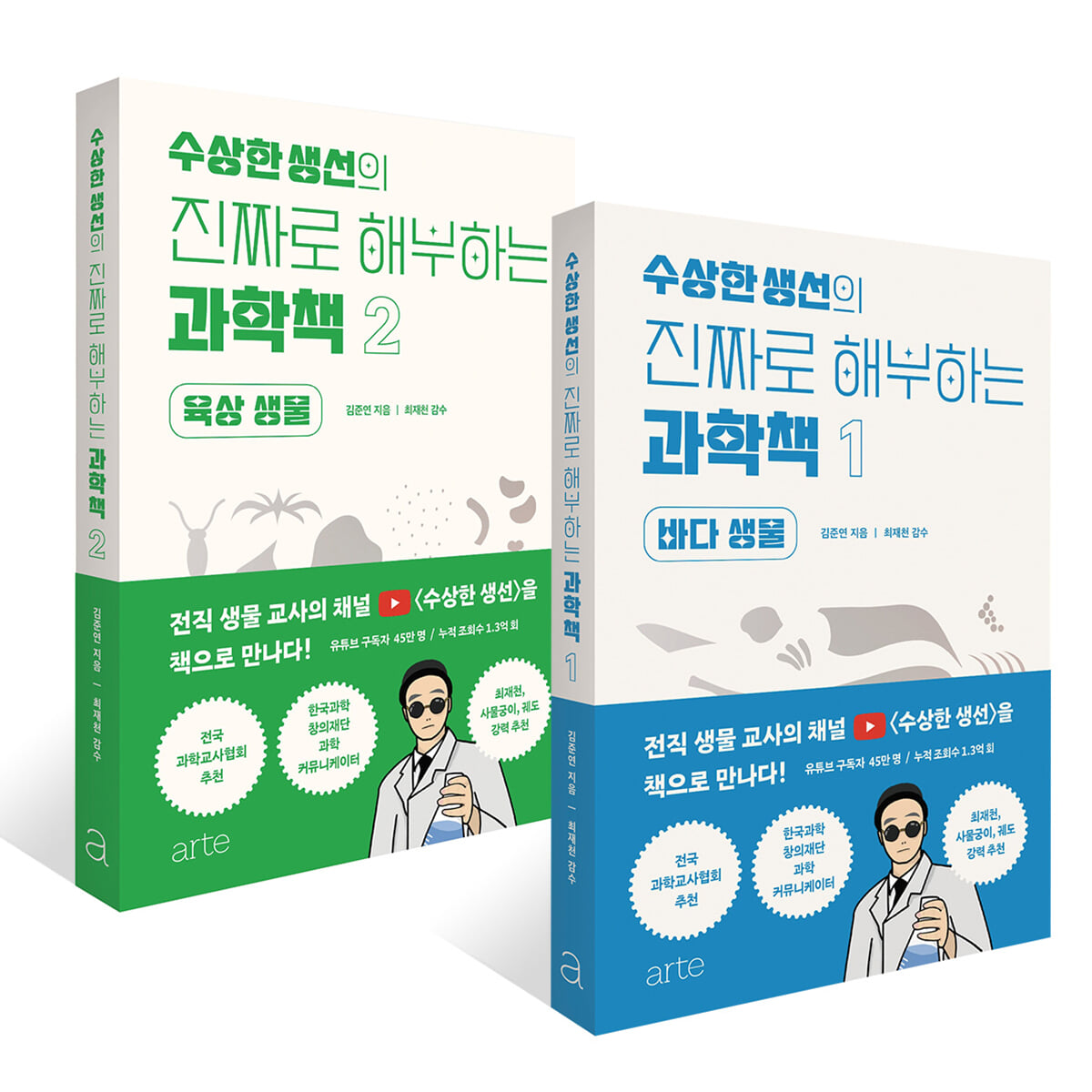
The Real Science of Dissecting Suspicious Fish, Volumes 1 and 2
 |
Description
Book Introduction
This product is a product made by YES24. (Individual returns are not possible.)
[Book] The Real Science of Dissecting Suspicious Fish: 1: Marine Life
Volume 1, 'Sea Life', introduces creatures belonging to the same taxonomic group in the order of vertebrate fish, echinoderms, arthropods, and mollusks, while Volume 2, 'Terrestrial Life', contains scientific explorations of the bodies of various animals and plants living on land.
[Book] The Real Science of Dissecting Suspicious Fish: 2 Terrestrial Life
Volume 1, 'Sea Life', introduces creatures belonging to the same taxonomic group in the order of vertebrate fish, echinoderms, arthropods, and mollusks, while Volume 2, 'Terrestrial Life', contains scientific explorations of the bodies of various animals and plants living on land.
[Book] The Real Science of Dissecting Suspicious Fish: 1: Marine Life
Volume 1, 'Sea Life', introduces creatures belonging to the same taxonomic group in the order of vertebrate fish, echinoderms, arthropods, and mollusks, while Volume 2, 'Terrestrial Life', contains scientific explorations of the bodies of various animals and plants living on land.
[Book] The Real Science of Dissecting Suspicious Fish: 2 Terrestrial Life
Volume 1, 'Sea Life', introduces creatures belonging to the same taxonomic group in the order of vertebrate fish, echinoderms, arthropods, and mollusks, while Volume 2, 'Terrestrial Life', contains scientific explorations of the bodies of various animals and plants living on land.
- You can preview some of the book's contents.
Preview
index
『The Real Science Book on Dissecting Suspicious Fish 1: Sea Creatures』
prolog
A message from a suspicious biology teacher
The fun of biology
Part 1
It's a fish
Aren't they all the same fish?
01.
Sharks | Different from the inside out, the ocean's top predators
02.
Anchovy | Anchovy poop isn't poop?!
03.
Halibut | The Secret of Halibut, a Sad Fish with Crowded Eyes
Part 2
With tentacle-like feet
Strange slow-moving animals
04.
Starfish | How do starfish eat large creatures?
05.
Sea urchin | Aristotle's lamp inside a sea urchin
06.
Sea Cucumber | A Winter Delicacy: The Secret to Its Crunchy Texture
Part 3
With a body and legs divided into segments
Secrets of Animals
07.
Shrimp | Where are the shrimp bones?
08.
Hongge | Crabs live by folding their bodies in half?!
09.
The Shellfish Hat | The Shocking Identity of a Creature Mistaken for a Shell for Hundreds of Years
10.
turtle hand | a creature resembling a turtle's hand
Part 4
To protect the soft body
Various strategies
11.
Oyster | Where do oyster shells come from?
12.
Scallop | The Secret of the Hundred-Eyed Scallop
13.
Oysters | Various creatures living in oysters
14.
Abalone | Abalone is a snail that lives in the sea.
15.
Military | Mysterious fossil-like creatures
Epilogue
Evidence for evolution revealed by taxonomy
The mystery of life
References
『The Real Science Book of Suspicious Fish Dissection 2: Terrestrial Life』
prolog
A message from a suspicious biology teacher
The fun of biology
Part 1
Transforming
The Mystery of Insects
01.
Mosquitoes │ Why do mosquitoes suck animal blood?
02.
Cabbage White Butterfly │ What happens inside the pupa?
03.
Cicada │ Which part of a cicada makes the loudest sound?
04.
Salt Strider │ How do salt striders walk on water?
Part 2
Hidden in fresh water
Amazing creatures
05.
Hydra │ A creature resembling a mythical monster
06.
Planaria │ The Secret of Planaria, Which Grows More The More You Cut It
07.
Helmet Shrimp │ Living Fossil, Helmet Shrimp
08.
Leech │ A peculiar pattern that appears at the site of a leech bite
Part 3
What we eat
Is there such a twist in fruit?
09.
Strawberry │ Aren't those things stuck on the outside of the strawberry seeds?
10.
Pineapple │ The Secret of the Pineapple, a Pine Cone-Shaped Fruit
11.
Apple │ The unique pattern that appears when you cut an apple crosswise
Part 4
The more I look at it, the more mysterious it becomes
Secrets of Plants
12.
Corn │ Is the number of corn silks the same as the number of corn kernels?
13.
Carnivorous Plants │ Why do carnivorous plants eat insects?
14.
Tangerine │ The curious pattern you see when you remove the stem of a tangerine
15.
Water hyacinth │ A plant beneficial only in Korea? The secrets of water hyacinth
Epilogue
As children, we all,
I was full of curiosity about other creatures.
References
prolog
A message from a suspicious biology teacher
The fun of biology
Part 1
It's a fish
Aren't they all the same fish?
01.
Sharks | Different from the inside out, the ocean's top predators
02.
Anchovy | Anchovy poop isn't poop?!
03.
Halibut | The Secret of Halibut, a Sad Fish with Crowded Eyes
Part 2
With tentacle-like feet
Strange slow-moving animals
04.
Starfish | How do starfish eat large creatures?
05.
Sea urchin | Aristotle's lamp inside a sea urchin
06.
Sea Cucumber | A Winter Delicacy: The Secret to Its Crunchy Texture
Part 3
With a body and legs divided into segments
Secrets of Animals
07.
Shrimp | Where are the shrimp bones?
08.
Hongge | Crabs live by folding their bodies in half?!
09.
The Shellfish Hat | The Shocking Identity of a Creature Mistaken for a Shell for Hundreds of Years
10.
turtle hand | a creature resembling a turtle's hand
Part 4
To protect the soft body
Various strategies
11.
Oyster | Where do oyster shells come from?
12.
Scallop | The Secret of the Hundred-Eyed Scallop
13.
Oysters | Various creatures living in oysters
14.
Abalone | Abalone is a snail that lives in the sea.
15.
Military | Mysterious fossil-like creatures
Epilogue
Evidence for evolution revealed by taxonomy
The mystery of life
References
『The Real Science Book of Suspicious Fish Dissection 2: Terrestrial Life』
prolog
A message from a suspicious biology teacher
The fun of biology
Part 1
Transforming
The Mystery of Insects
01.
Mosquitoes │ Why do mosquitoes suck animal blood?
02.
Cabbage White Butterfly │ What happens inside the pupa?
03.
Cicada │ Which part of a cicada makes the loudest sound?
04.
Salt Strider │ How do salt striders walk on water?
Part 2
Hidden in fresh water
Amazing creatures
05.
Hydra │ A creature resembling a mythical monster
06.
Planaria │ The Secret of Planaria, Which Grows More The More You Cut It
07.
Helmet Shrimp │ Living Fossil, Helmet Shrimp
08.
Leech │ A peculiar pattern that appears at the site of a leech bite
Part 3
What we eat
Is there such a twist in fruit?
09.
Strawberry │ Aren't those things stuck on the outside of the strawberry seeds?
10.
Pineapple │ The Secret of the Pineapple, a Pine Cone-Shaped Fruit
11.
Apple │ The unique pattern that appears when you cut an apple crosswise
Part 4
The more I look at it, the more mysterious it becomes
Secrets of Plants
12.
Corn │ Is the number of corn silks the same as the number of corn kernels?
13.
Carnivorous Plants │ Why do carnivorous plants eat insects?
14.
Tangerine │ The curious pattern you see when you remove the stem of a tangerine
15.
Water hyacinth │ A plant beneficial only in Korea? The secrets of water hyacinth
Epilogue
As children, we all,
I was full of curiosity about other creatures.
References
Into the book
『The Real Science Book on Dissecting Suspicious Fish 1: Sea Creatures』
Now, let's dissect a shark. If you cut open the shark's belly from the anus, you'll find it's full of internal organs.
The liver is the largest of the shark's internal organs.
Cartilaginous fish, to which sharks belong, do not have a swim bladder, an organ that provides buoyancy, unlike bony fish.
So, cartilaginous fish use their large livers instead of swim bladders to achieve buoyancy.
If you cut open a shark's liver and float it in water, you will see that it floats.
Because shark liver is rich in fat, it is lighter than water (has a low density), which allows it to function as a buoyancy aid in the body.
For this reason, sharks have very large livers.
---From "Page 23, Shark"
Inside the anchovy, you can also observe the anchovy's digestive tract, which extends from the esophagus through the stomach to the intestines.
Let's take a closer look at the anchovy's stomach. The stomach is surrounded by finger-like organs.
This part surrounding the stomach is the digestive organ of a fish called the pylorus.
The pylorus is a unique digestive organ found in fish that secretes digestive enzymes and absorbs nutrients at the border between the stomach and small intestine.
Here's a surprising fact.
By examining the digestive tract of an anchovy in detail, we can also find out what food the anchovy consumed before it died.
---From "Page 38, Anchovies"
Now, let's take a look inside the sea cucumber. If you cut open the inside of the sea cucumber, you'll see orange, thread-like structures.
This is known as the sea cucumber's roe and is widely used as food, but to be precise, it is the gonad part where the sea cucumber's reproductive cells are formed.
The orange ones are the female gonads (ovaries), and the milky ones are the male gonads (testes).
After removing the gonads, the sea cucumber's long digestive tract can be seen.
The digestive tract of sea cucumbers is long and winding, with the esophagus, stomach, and intestines extending from the mouth to the anus.
The digestive tract of this sea cucumber is also made into salted seafood and eaten, which is a food called 'Konowata'.
Konowata is known as one of Japan's three great delicacies, along with eel roe and sea urchin roe.
---From "Sea Cucumber" on pages 98-99
Among these, insects and shrimp have many similarities.
In fact, insects are taxonomically closer to crustaceans than to civets and spiders.
That's why, if you look closely at shrimp, you can see many parts that are similar to insects.
But we hate insects and love crustaceans.
Is it because crustaceans are delicious? This chapter will be quite interesting to read while considering the similarities between shrimp and insects.
So now let's start dissecting the shrimp.
From now on, we will take a closer look at the shrimp that we have been ignoring.
---From "Page 109, Shrimp"
But while shrimp and crayfish look quite similar, doesn't the crab's body structure seem completely different from that of shrimp and crayfish? There's a surprising twist here.
In fact, the crab's body has a structure quite similar to that of shrimp or crayfish, but surprisingly, the crab's body is folded in half.
Let's now observe the red crab and find out exactly what it means for it to be folded in half.
---From "Page 135, Hongge"
The gonads are located on the upper part of the clam's feet.
In bivalves, the intestine passes inside the gonads.
So if you cut off the foot and carefully cut open the gonad area, you can see the intestines running through it.
Lastly, when a foreign substance enters the body of a bivalve, it secretes calcium carbonate internally to protect the foreign substance and remove it.
The result of this defensive action is a beautiful pearl.
Beautiful pearls are created when bivalves try to protect their bodies from foreign substances.
Did you know that there are many interesting facts hidden in living things?
As we live, there are times when we face difficult trials.
But if you can endure such trials like an oyster embraces a foreign substance, it won't just remain as a scar, but will be reborn as a beautiful pearl!
---From "Page 181, Shellfish"
Unlike other clams (oysters, clams) that move little or very slowly, scallops are dynamic swimmers.
They swim by repeatedly opening and closing their two shells like castanets, and when the shells close, water is shot out through the gap at the back of the shell, providing propulsion and movement.
However, it is said that scallops' swimming consumes so much energy that once they start moving properly, they have to stay still for several hours afterwards.
To understand how a scallop's shell opens and closes, we need to look inside the scallop.
If you cut the scallop's scapula, it will split in half. This scapula is the adductor muscle, a bivalve muscle that we also looked at in clams.
---From "Page 188, Scallop"
Let's take a closer look at the inside of an oyster. The membrane attached to the shell is the mantle, which secretes the shell.
Mollusks with shells, such as abalone, conch, and clams, all secrete shells through a part called the mantle, and oysters are no exception.
If you remove the outer membrane of an oyster and look inside, you can see four layers of gills.
The reason gills take up so much space is because bivalves, to which oysters belong, use gills not only for breathing but also for feeding.
---From "Page 202, Oysters"
Abalone is a creature with many fascinating features.
Abalones move by creating waves with their muscular legs located on their abdomen, much like a snail moves.
At this time, the suction power (adhesion) of the abalone's feet is so strong that it is difficult to remove them by hand.
And the abalone has a pair of tentacles on its head.
There is also a pair of eyes located next to the antennae.
If you zoom in on the head, you can see the abalone's eyes in quite detail.
---From "Page 212, Overturning"
It's fascinating how countless creatures on Earth are grouped together according to specific criteria.
What's the point of classifying organisms by finding similarities between them? Surprisingly, taxonomy is the discipline that provides evidence for one of the most important theories in biology: the theory of evolution.
In the past, it was believed that species never changed because they were created by God.
However, the similarities between organisms discovered through taxonomy have become strong evidence of 'evolution', that organisms have a common ancestor and have differentiated into various species over a long period of time.
The closer organisms are taxonomically related, the more they have in common. Biologists analyze the evolutionary relationships of organisms through this classification and explain the origin of life in the form of a tree called a "phylogenetic tree."
I wanted to share this evolutionary flow with you by introducing various creatures through YouTube.
However, due to the nature of YouTube content, I always felt it was a shame that each video had to focus on only one creature.
So, in this book, we have grouped together creatures belonging to the same taxonomic group and organized them so that you can fully understand the meaning of taxonomy.
I hope that through this book, you can indirectly experience the mystery of life and discover the joy of biology.
Biology is so much fun, isn't it? Until you all discover the joy of living things! "Suspicious Fish" continues.
---From the "Epilogue"
『The Real Science Book of Suspicious Fish Dissection 2: Terrestrial Life』
If you look at the head of a mosquito, you will see a pair of compound eyes, a pair of antennae, a straw-shaped mouth (proboscis), and a pair of labial barbels on the upper part of the mouth.
Mosquitoes use their antennae and lower labial whiskers to detect smell, heat, and carbon dioxide to find food.
And the mosquito's mouth is a stinging mouth, which looks like a tube, but is actually a structure made up of several organs combined.
It is a combination of parts that pierce the skin, inject saliva, and suck blood.
---From "Page 22, Mosquito"
After the larva turns into a pupa, it spends about seven days without eating anything and focusing only on metamorphosis before emerging as a butterfly.
During this period, they constantly ate plant leaves as larvae to store energy.
The shocking fact is that in the early stages, most of the internal organs inside the pupa are dissolved and become almost liquid.
During the pupal stage, the insect's insides are sometimes described as turning into a 'protein soup'.
This is because, surprisingly, a mysterious phenomenon occurs inside the pupa, where most of the larval body melts away and the adult body is completely reconstituted.
---From "Page 35, Cabbage White Butterfly"
Recently, as environmental pollution has become more severe, the population of salt striders has decreased.
Since the oil in the legs plays a large role in the water strider's ability to float on water, in an environment with surfactants (soap water) that mix water and oil, the water strider loses its ability to float and drowns.
These days, there are more and more cases of oil spills, water pollution, and salt striders dying.
---From "Page 65, The Salt Struggler"
The main food source for hydras that live in freshwater is water fleas.
When we gave water fleas to the hydra, we could see it paralyzing the water fleas with its stingers and eating them.
We were also able to observe Hydra putting water fleas into its gastric cavity and secreting digestive enzymes to slowly digest them.
If you look at the picture, you can see that the water flea has become liquid inside the hydra's gastric cavity.
Isn't it amazing?
---From "Page 78, Hydra"
Many people are amazed by creatures with remarkable regenerative abilities, such as planarians, hydras, and starfish, but in fact, there are many creatures that have the ability to regenerate severed limbs.
There are cases where a severed body part is restored when a crustacean sheds its skin, a lizard's tail regenerates after being cut off, and an earthworm regenerates the remaining part of its body when part of its body is cut off.
---From "Page 95, Planaria"
The dormant eggs of the helmet shrimp are highly resistant to dryness, cold, and heat, and are said to be able to remain dormant for as long as 20 years.
It seems that this excellent survival strategy of the helmet shrimp has allowed them to survive so tenaciously from the Mesozoic era to the present.
So, people take advantage of the characteristics of these dormant eggs and make and sell dried shrimp eggs as breeding sets.
The breeding kit called 'Raising Triops' on the Internet uses these dormant eggs of the squid shrimp.
---From "Page 110, Shrimp in a Pitcher"
The shocking truth is that the little sesame-like parts on the outside of the strawberry are not strawberry seeds.
Amazingly, each of the parts we call seeds is actually a true strawberry fruit.
A fruit that resembles a strawberry is called an achene.
A berry is a type of fruit in which the seeds are surrounded by a thin, membranous pericarp.
---From "Strawberry" on page 136
Pineapple flowers bloom with 100 to 200 flowers centered on a single stem (flower stalk), and in the case of pineapples, these numerous flowers merge with the stem to form one large fruit.
So, if you look at a pineapple fruit, you can see that it is made up of hundreds of flowers joined together.
The polygonal shapes visible on the outside of a pineapple are all parts that were once separate flowers. If you look closely at these polygonal parts, you can find traces of what used to be a single flower.
Let's take a closer look at the polygonal shape.
---From "Page 149, Pineapple"
The fleshy part of the apple that we enjoy is not the part where the ovary is developed, unlike the fleshy part of fruits like peaches or persimmons.
The part that develops and forms the ovary of an apple is a completely unexpected part.
If you cut an apple lengthwise, you will see a border in the center.
The small part in the center of this apple is where the ovary develops, which corresponds to the flesh of other fruits (true fruits).
---From "Page 165, Apple"
Why do carnivorous plants eat insects? Because they need protein.
To be precise, we need the nitrogen component contained in proteins.
Most carnivorous plants live in poor environments where the soil is lacking in nitrogen or phosphorus.
Since plants cannot grow properly when they lack nitrogen or phosphorus, carnivorous plants evolved to obtain the missing nutrients by digesting insects in order to survive in poor soil.
So, carnivorous plants break down the proteins and nucleic acids of insects to obtain nitrogen and phosphorus, which are elements that are lacking in the soil.
---From "Carnivorous Plants" on pages 193-194
The number of tangerine slices varies from individual to individual, averaging ten to twelve, but if you compare the number of holes in the pattern after removing the calyx and the number of tangerine slices, you will see that they match exactly.
Check it out for yourself! What's the secret behind the pattern inside a tangerine's stem? The reason the circles in the stem's pattern correspond to the number of tangerine slices is related to the white, thread-like fibers inside the tangerine.
---From "Tangerine" on pages 212-213
If you too are curious about a certain creature, I hope you will experience satisfying your curiosity directly by observing and exploring the creature, as introduced in the book.
Knowing which taxonomic group an organism belongs to and focusing on observing its unique characteristics and related body parts can greatly deepen your understanding of that organism.
And in this process, we will be able to feel again the joy of exploration that we felt as children.
The theme of this book is creatures that we commonly see around us, such as mosquitoes, cicadas, and strawberries. After reading the book, you will have the mysterious experience of seeing things you never saw before, such as the antennae of a mosquito, the stinging mouth of a cicada, and the style of a strawberry.
As the saying goes, "You see as much as you know," the deeper your understanding of living things, the better your vision of them! I hope this book provides you with an opportunity to experience the wonders of life and discover how to enjoy scientific inquiry.
Science is fun! Why not observe something right now?
Now, let's dissect a shark. If you cut open the shark's belly from the anus, you'll find it's full of internal organs.
The liver is the largest of the shark's internal organs.
Cartilaginous fish, to which sharks belong, do not have a swim bladder, an organ that provides buoyancy, unlike bony fish.
So, cartilaginous fish use their large livers instead of swim bladders to achieve buoyancy.
If you cut open a shark's liver and float it in water, you will see that it floats.
Because shark liver is rich in fat, it is lighter than water (has a low density), which allows it to function as a buoyancy aid in the body.
For this reason, sharks have very large livers.
---From "Page 23, Shark"
Inside the anchovy, you can also observe the anchovy's digestive tract, which extends from the esophagus through the stomach to the intestines.
Let's take a closer look at the anchovy's stomach. The stomach is surrounded by finger-like organs.
This part surrounding the stomach is the digestive organ of a fish called the pylorus.
The pylorus is a unique digestive organ found in fish that secretes digestive enzymes and absorbs nutrients at the border between the stomach and small intestine.
Here's a surprising fact.
By examining the digestive tract of an anchovy in detail, we can also find out what food the anchovy consumed before it died.
---From "Page 38, Anchovies"
Now, let's take a look inside the sea cucumber. If you cut open the inside of the sea cucumber, you'll see orange, thread-like structures.
This is known as the sea cucumber's roe and is widely used as food, but to be precise, it is the gonad part where the sea cucumber's reproductive cells are formed.
The orange ones are the female gonads (ovaries), and the milky ones are the male gonads (testes).
After removing the gonads, the sea cucumber's long digestive tract can be seen.
The digestive tract of sea cucumbers is long and winding, with the esophagus, stomach, and intestines extending from the mouth to the anus.
The digestive tract of this sea cucumber is also made into salted seafood and eaten, which is a food called 'Konowata'.
Konowata is known as one of Japan's three great delicacies, along with eel roe and sea urchin roe.
---From "Sea Cucumber" on pages 98-99
Among these, insects and shrimp have many similarities.
In fact, insects are taxonomically closer to crustaceans than to civets and spiders.
That's why, if you look closely at shrimp, you can see many parts that are similar to insects.
But we hate insects and love crustaceans.
Is it because crustaceans are delicious? This chapter will be quite interesting to read while considering the similarities between shrimp and insects.
So now let's start dissecting the shrimp.
From now on, we will take a closer look at the shrimp that we have been ignoring.
---From "Page 109, Shrimp"
But while shrimp and crayfish look quite similar, doesn't the crab's body structure seem completely different from that of shrimp and crayfish? There's a surprising twist here.
In fact, the crab's body has a structure quite similar to that of shrimp or crayfish, but surprisingly, the crab's body is folded in half.
Let's now observe the red crab and find out exactly what it means for it to be folded in half.
---From "Page 135, Hongge"
The gonads are located on the upper part of the clam's feet.
In bivalves, the intestine passes inside the gonads.
So if you cut off the foot and carefully cut open the gonad area, you can see the intestines running through it.
Lastly, when a foreign substance enters the body of a bivalve, it secretes calcium carbonate internally to protect the foreign substance and remove it.
The result of this defensive action is a beautiful pearl.
Beautiful pearls are created when bivalves try to protect their bodies from foreign substances.
Did you know that there are many interesting facts hidden in living things?
As we live, there are times when we face difficult trials.
But if you can endure such trials like an oyster embraces a foreign substance, it won't just remain as a scar, but will be reborn as a beautiful pearl!
---From "Page 181, Shellfish"
Unlike other clams (oysters, clams) that move little or very slowly, scallops are dynamic swimmers.
They swim by repeatedly opening and closing their two shells like castanets, and when the shells close, water is shot out through the gap at the back of the shell, providing propulsion and movement.
However, it is said that scallops' swimming consumes so much energy that once they start moving properly, they have to stay still for several hours afterwards.
To understand how a scallop's shell opens and closes, we need to look inside the scallop.
If you cut the scallop's scapula, it will split in half. This scapula is the adductor muscle, a bivalve muscle that we also looked at in clams.
---From "Page 188, Scallop"
Let's take a closer look at the inside of an oyster. The membrane attached to the shell is the mantle, which secretes the shell.
Mollusks with shells, such as abalone, conch, and clams, all secrete shells through a part called the mantle, and oysters are no exception.
If you remove the outer membrane of an oyster and look inside, you can see four layers of gills.
The reason gills take up so much space is because bivalves, to which oysters belong, use gills not only for breathing but also for feeding.
---From "Page 202, Oysters"
Abalone is a creature with many fascinating features.
Abalones move by creating waves with their muscular legs located on their abdomen, much like a snail moves.
At this time, the suction power (adhesion) of the abalone's feet is so strong that it is difficult to remove them by hand.
And the abalone has a pair of tentacles on its head.
There is also a pair of eyes located next to the antennae.
If you zoom in on the head, you can see the abalone's eyes in quite detail.
---From "Page 212, Overturning"
It's fascinating how countless creatures on Earth are grouped together according to specific criteria.
What's the point of classifying organisms by finding similarities between them? Surprisingly, taxonomy is the discipline that provides evidence for one of the most important theories in biology: the theory of evolution.
In the past, it was believed that species never changed because they were created by God.
However, the similarities between organisms discovered through taxonomy have become strong evidence of 'evolution', that organisms have a common ancestor and have differentiated into various species over a long period of time.
The closer organisms are taxonomically related, the more they have in common. Biologists analyze the evolutionary relationships of organisms through this classification and explain the origin of life in the form of a tree called a "phylogenetic tree."
I wanted to share this evolutionary flow with you by introducing various creatures through YouTube.
However, due to the nature of YouTube content, I always felt it was a shame that each video had to focus on only one creature.
So, in this book, we have grouped together creatures belonging to the same taxonomic group and organized them so that you can fully understand the meaning of taxonomy.
I hope that through this book, you can indirectly experience the mystery of life and discover the joy of biology.
Biology is so much fun, isn't it? Until you all discover the joy of living things! "Suspicious Fish" continues.
---From the "Epilogue"
『The Real Science Book of Suspicious Fish Dissection 2: Terrestrial Life』
If you look at the head of a mosquito, you will see a pair of compound eyes, a pair of antennae, a straw-shaped mouth (proboscis), and a pair of labial barbels on the upper part of the mouth.
Mosquitoes use their antennae and lower labial whiskers to detect smell, heat, and carbon dioxide to find food.
And the mosquito's mouth is a stinging mouth, which looks like a tube, but is actually a structure made up of several organs combined.
It is a combination of parts that pierce the skin, inject saliva, and suck blood.
---From "Page 22, Mosquito"
After the larva turns into a pupa, it spends about seven days without eating anything and focusing only on metamorphosis before emerging as a butterfly.
During this period, they constantly ate plant leaves as larvae to store energy.
The shocking fact is that in the early stages, most of the internal organs inside the pupa are dissolved and become almost liquid.
During the pupal stage, the insect's insides are sometimes described as turning into a 'protein soup'.
This is because, surprisingly, a mysterious phenomenon occurs inside the pupa, where most of the larval body melts away and the adult body is completely reconstituted.
---From "Page 35, Cabbage White Butterfly"
Recently, as environmental pollution has become more severe, the population of salt striders has decreased.
Since the oil in the legs plays a large role in the water strider's ability to float on water, in an environment with surfactants (soap water) that mix water and oil, the water strider loses its ability to float and drowns.
These days, there are more and more cases of oil spills, water pollution, and salt striders dying.
---From "Page 65, The Salt Struggler"
The main food source for hydras that live in freshwater is water fleas.
When we gave water fleas to the hydra, we could see it paralyzing the water fleas with its stingers and eating them.
We were also able to observe Hydra putting water fleas into its gastric cavity and secreting digestive enzymes to slowly digest them.
If you look at the picture, you can see that the water flea has become liquid inside the hydra's gastric cavity.
Isn't it amazing?
---From "Page 78, Hydra"
Many people are amazed by creatures with remarkable regenerative abilities, such as planarians, hydras, and starfish, but in fact, there are many creatures that have the ability to regenerate severed limbs.
There are cases where a severed body part is restored when a crustacean sheds its skin, a lizard's tail regenerates after being cut off, and an earthworm regenerates the remaining part of its body when part of its body is cut off.
---From "Page 95, Planaria"
The dormant eggs of the helmet shrimp are highly resistant to dryness, cold, and heat, and are said to be able to remain dormant for as long as 20 years.
It seems that this excellent survival strategy of the helmet shrimp has allowed them to survive so tenaciously from the Mesozoic era to the present.
So, people take advantage of the characteristics of these dormant eggs and make and sell dried shrimp eggs as breeding sets.
The breeding kit called 'Raising Triops' on the Internet uses these dormant eggs of the squid shrimp.
---From "Page 110, Shrimp in a Pitcher"
The shocking truth is that the little sesame-like parts on the outside of the strawberry are not strawberry seeds.
Amazingly, each of the parts we call seeds is actually a true strawberry fruit.
A fruit that resembles a strawberry is called an achene.
A berry is a type of fruit in which the seeds are surrounded by a thin, membranous pericarp.
---From "Strawberry" on page 136
Pineapple flowers bloom with 100 to 200 flowers centered on a single stem (flower stalk), and in the case of pineapples, these numerous flowers merge with the stem to form one large fruit.
So, if you look at a pineapple fruit, you can see that it is made up of hundreds of flowers joined together.
The polygonal shapes visible on the outside of a pineapple are all parts that were once separate flowers. If you look closely at these polygonal parts, you can find traces of what used to be a single flower.
Let's take a closer look at the polygonal shape.
---From "Page 149, Pineapple"
The fleshy part of the apple that we enjoy is not the part where the ovary is developed, unlike the fleshy part of fruits like peaches or persimmons.
The part that develops and forms the ovary of an apple is a completely unexpected part.
If you cut an apple lengthwise, you will see a border in the center.
The small part in the center of this apple is where the ovary develops, which corresponds to the flesh of other fruits (true fruits).
---From "Page 165, Apple"
Why do carnivorous plants eat insects? Because they need protein.
To be precise, we need the nitrogen component contained in proteins.
Most carnivorous plants live in poor environments where the soil is lacking in nitrogen or phosphorus.
Since plants cannot grow properly when they lack nitrogen or phosphorus, carnivorous plants evolved to obtain the missing nutrients by digesting insects in order to survive in poor soil.
So, carnivorous plants break down the proteins and nucleic acids of insects to obtain nitrogen and phosphorus, which are elements that are lacking in the soil.
---From "Carnivorous Plants" on pages 193-194
The number of tangerine slices varies from individual to individual, averaging ten to twelve, but if you compare the number of holes in the pattern after removing the calyx and the number of tangerine slices, you will see that they match exactly.
Check it out for yourself! What's the secret behind the pattern inside a tangerine's stem? The reason the circles in the stem's pattern correspond to the number of tangerine slices is related to the white, thread-like fibers inside the tangerine.
---From "Tangerine" on pages 212-213
If you too are curious about a certain creature, I hope you will experience satisfying your curiosity directly by observing and exploring the creature, as introduced in the book.
Knowing which taxonomic group an organism belongs to and focusing on observing its unique characteristics and related body parts can greatly deepen your understanding of that organism.
And in this process, we will be able to feel again the joy of exploration that we felt as children.
The theme of this book is creatures that we commonly see around us, such as mosquitoes, cicadas, and strawberries. After reading the book, you will have the mysterious experience of seeing things you never saw before, such as the antennae of a mosquito, the stinging mouth of a cicada, and the style of a strawberry.
As the saying goes, "You see as much as you know," the deeper your understanding of living things, the better your vision of them! I hope this book provides you with an opportunity to experience the wonders of life and discover how to enjoy scientific inquiry.
Science is fun! Why not observe something right now?
---From the "Epilogue"
Publisher's Review
The mystery of creatures that have never been seen before
The life science story closest to our lives
“What a fresh and vivid science book!”
'Suspicious Fish' has gathered a large number of passionate fans with its unique identity of revealing various creatures through 'dissection'.
With 450,000 subscribers, the average number of views per episode is 850,000, which is twice the number of subscribers, which proves the usefulness of the content.
The materials provided by 'Suspicious Fish' occupy a unique position in the field of biology among science education contents, with elementary, middle, and high school teachers using the biological dissection videos as supplementary teaching materials, and graduate students majoring in biology using the content as reference for research.
The author is a science communicator affiliated with the Korea Foundation for the Advancement of Science and Creativity, where he advises on planning and developing science education content to enable students to experience science and technology in the classroom.
The knowledge gained through the process of dissecting each organ of a living organism is in itself valuable and useful biological data, but what made the content of 'Suspicious Fish' attract the public's attention is that it introduces 'the identity of a familiar organism' from a very new perspective.
That is why, as of April 2023, the content “What You Didn’t See in Anchovies” has recorded explosive views of 6.66 million, “What You Didn’t See in Crabs” has recorded 2.95 million, and “What’s Outside a Strawberry Isn’t a Seed” has recorded 2.36 million.
Also, the content that tells the story of how the identity of the creature we are familiar with is actually not 'it' but something else is fresh and shocking.
Since the identity of the 'thing' we enjoyed so much is often actually 'gonads', fans have created numerous gonad-related memes in the community, such as "Today, too, its identity was gonads", "Suspicious fish feels empty without gonads", and "No gonads today?" There is even a fan who actively uses the account 'Suspicious Gonads'.
This video introduces in a fun and informative way that the entrails of sea urchins, sea cucumber eggs, and abalone entrails, which we consider delicacies and eat deliciously, are actually reproductive organs. It also provides detailed knowledge, research processes, and historical data about biological organs that cannot be covered in depth in the video.
With suspicious fish
Anywhere becomes a laboratory!
If you read 『The Real Science Book of Suspicious Fish Dissection』, you will learn that 'exploration (dissection)' of living things is not something that can be done only in a laboratory, but can be done anywhere.
The author emphasizes that you can observe living things right now without any special preparation, and provides methods for exploring living things that can be easily encountered in everyday life.
The anchovy chapter recommends 'anchovy dissection experiments that can be done at home' and explains how to observe the swim bladder and otoliths in fish. The sea cucumber chapter explains the longitudinal muscles of sea cucumbers, explaining 'the reason for the crunchy texture of sea cucumbers.' The shrimp chapter explains 'the body structure that resembles insects,' exploring the exoskeleton and introducing the characteristics of arthropods.
Also, if you look closely at an abalone, you can see its tentacles and feet, which reveal that it is a 'sea snail (gastropod)', and the surprising fact that crabs look different from shrimp and crayfish with a body structure similar to theirs 'because their bodies are folded in half'.
In addition, we introduce interesting knowledge that can be learned with just a little interest in everyday life, such as the axe-shaped feet of clams (scallops), the 200 eyes of scallops, and the various creatures that live in oysters.
It also explores creatures that we don't easily come across, such as sharks, starfish, snails, turtles, and sea snails, and guides us into the world of unfamiliar, yet interesting and mysterious creatures.
A book of delightful living, breathing creatures
The Fun of Biology: A Former Biology Teacher's Guide
“It’s a bit fishy, but it’s so useful!”
The knowledge the author imparts by examining living things in detail and dissecting their organs is fresh, vivid, and enjoyable.
“Isn’t it amazing?” “Isn’t it fun?” “Isn’t it amazing?” are phrases that appear frequently, as the inner workings of wondrous creatures unfold raw and come alive throughout the book.
This kind of enjoyable knowledge was exactly what the author, a high school biology teacher, wanted to impart to his students.
This was possible because the book was written with the ambition of “making it possible for many people to experience the ‘fun of biology’ by actually observing and exploring the theory.”
If you're looking for a popular science book that, as Orbit recommends, "shows the raw, vivid nature of science without any editing or editing, and provides a thorough explanation filled with fascinating stories," this is the book for you.
Samulgung introduced this book by saying, “It is interesting to analyze living things to this extent.”
Choi Jae-cheon, Korea's leading biologist, recommends this book to everyone who finds life mysterious, and exclaims, "As I read the book, I wonder how much better a biologist I could have become if this person had been my biology teacher."
There is a saying, 'You see as much as you know.'
How about learning how to truly enjoy exploring biology through this book? You'll find your vision for seeing living things noticeably improved.
If you close this book and look at the creatures, shrimp will no longer be shrimp, and anchovies will no longer be anchovies.
So, shall we delve into the mysteries of creatures we've never seen before? Let's immerse ourselves in the mysterious allure of the "suspicious fish," which makes even what we see seem unfamiliar.
The life science story closest to our lives
“What a fresh and vivid science book!”
'Suspicious Fish' has gathered a large number of passionate fans with its unique identity of revealing various creatures through 'dissection'.
With 450,000 subscribers, the average number of views per episode is 850,000, which is twice the number of subscribers, which proves the usefulness of the content.
The materials provided by 'Suspicious Fish' occupy a unique position in the field of biology among science education contents, with elementary, middle, and high school teachers using the biological dissection videos as supplementary teaching materials, and graduate students majoring in biology using the content as reference for research.
The author is a science communicator affiliated with the Korea Foundation for the Advancement of Science and Creativity, where he advises on planning and developing science education content to enable students to experience science and technology in the classroom.
The knowledge gained through the process of dissecting each organ of a living organism is in itself valuable and useful biological data, but what made the content of 'Suspicious Fish' attract the public's attention is that it introduces 'the identity of a familiar organism' from a very new perspective.
That is why, as of April 2023, the content “What You Didn’t See in Anchovies” has recorded explosive views of 6.66 million, “What You Didn’t See in Crabs” has recorded 2.95 million, and “What’s Outside a Strawberry Isn’t a Seed” has recorded 2.36 million.
Also, the content that tells the story of how the identity of the creature we are familiar with is actually not 'it' but something else is fresh and shocking.
Since the identity of the 'thing' we enjoyed so much is often actually 'gonads', fans have created numerous gonad-related memes in the community, such as "Today, too, its identity was gonads", "Suspicious fish feels empty without gonads", and "No gonads today?" There is even a fan who actively uses the account 'Suspicious Gonads'.
This video introduces in a fun and informative way that the entrails of sea urchins, sea cucumber eggs, and abalone entrails, which we consider delicacies and eat deliciously, are actually reproductive organs. It also provides detailed knowledge, research processes, and historical data about biological organs that cannot be covered in depth in the video.
With suspicious fish
Anywhere becomes a laboratory!
If you read 『The Real Science Book of Suspicious Fish Dissection』, you will learn that 'exploration (dissection)' of living things is not something that can be done only in a laboratory, but can be done anywhere.
The author emphasizes that you can observe living things right now without any special preparation, and provides methods for exploring living things that can be easily encountered in everyday life.
The anchovy chapter recommends 'anchovy dissection experiments that can be done at home' and explains how to observe the swim bladder and otoliths in fish. The sea cucumber chapter explains the longitudinal muscles of sea cucumbers, explaining 'the reason for the crunchy texture of sea cucumbers.' The shrimp chapter explains 'the body structure that resembles insects,' exploring the exoskeleton and introducing the characteristics of arthropods.
Also, if you look closely at an abalone, you can see its tentacles and feet, which reveal that it is a 'sea snail (gastropod)', and the surprising fact that crabs look different from shrimp and crayfish with a body structure similar to theirs 'because their bodies are folded in half'.
In addition, we introduce interesting knowledge that can be learned with just a little interest in everyday life, such as the axe-shaped feet of clams (scallops), the 200 eyes of scallops, and the various creatures that live in oysters.
It also explores creatures that we don't easily come across, such as sharks, starfish, snails, turtles, and sea snails, and guides us into the world of unfamiliar, yet interesting and mysterious creatures.
A book of delightful living, breathing creatures
The Fun of Biology: A Former Biology Teacher's Guide
“It’s a bit fishy, but it’s so useful!”
The knowledge the author imparts by examining living things in detail and dissecting their organs is fresh, vivid, and enjoyable.
“Isn’t it amazing?” “Isn’t it fun?” “Isn’t it amazing?” are phrases that appear frequently, as the inner workings of wondrous creatures unfold raw and come alive throughout the book.
This kind of enjoyable knowledge was exactly what the author, a high school biology teacher, wanted to impart to his students.
This was possible because the book was written with the ambition of “making it possible for many people to experience the ‘fun of biology’ by actually observing and exploring the theory.”
If you're looking for a popular science book that, as Orbit recommends, "shows the raw, vivid nature of science without any editing or editing, and provides a thorough explanation filled with fascinating stories," this is the book for you.
Samulgung introduced this book by saying, “It is interesting to analyze living things to this extent.”
Choi Jae-cheon, Korea's leading biologist, recommends this book to everyone who finds life mysterious, and exclaims, "As I read the book, I wonder how much better a biologist I could have become if this person had been my biology teacher."
There is a saying, 'You see as much as you know.'
How about learning how to truly enjoy exploring biology through this book? You'll find your vision for seeing living things noticeably improved.
If you close this book and look at the creatures, shrimp will no longer be shrimp, and anchovies will no longer be anchovies.
So, shall we delve into the mysteries of creatures we've never seen before? Let's immerse ourselves in the mysterious allure of the "suspicious fish," which makes even what we see seem unfamiliar.
GOODS SPECIFICS
- Date of issue: April 21, 2023
- Page count, weight, size: 478 pages | 148*215*30mm
You may also like
카테고리
korean


korean

![GQ KOREA Mark (Monthly): December [2025]](http://librairie.coreenne.fr/cdn/shop/files/8ef265dbbfbf186523ed75ba7319009d.jpg?v=1765340328&width=3840)


