

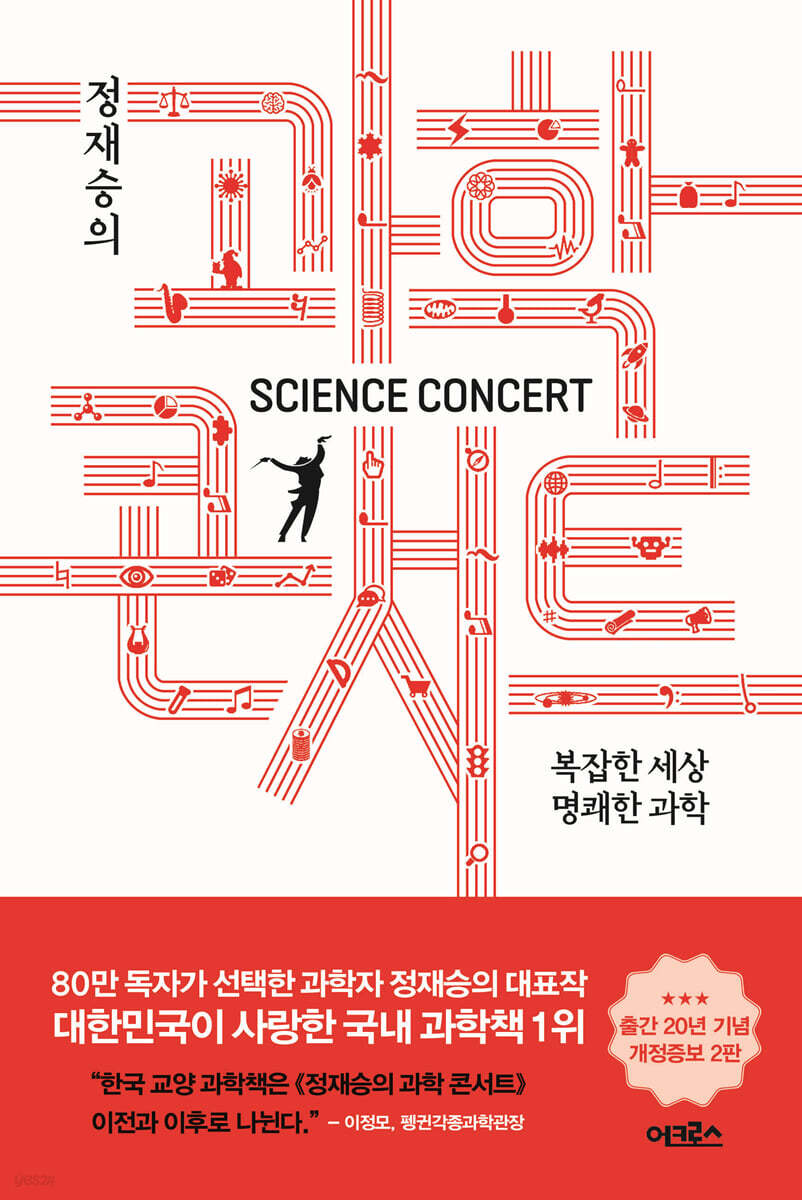
Jeong Jae-seung's Science Concert
 |
Description
Book Introduction
Korea's leading science textbook, loved by 800,000 readers. Revised and Expanded 2nd Edition of "Jeong Jae-seung's Science Concert" Yes24 exclusive re-cover release! "This one book is equivalent to summarizing the core content of dozens of top-tier scientific journals, including Nature." - JoongAng Ilbo "Jeong Jae-seung's Science Concert," a must-read for intellectuals, is now available to Yes24 readers in a limited edition hardcover edition. When first published in 2001, this book garnered enthusiastic responses from both the scientific community and the general public for its comprehensive knowledge and thinking across disciplines. This book, which introduces the latest complex science, such as network theory and fractal patterns, in an easy-to-understand and interesting way using everyday language, created the "Science Concert" syndrome and was selected for various recommended lists, including the "Ministry of Science and Technology-certified Excellent Science Book" and the "50 Science Classics Selected by the Asia-Pacific Center for Theoretical Physics (APCTP)." It was also included in middle and high school textbooks, establishing itself as a representative science textbook. Published to mark the 20th anniversary of its publication, the revised and expanded second edition reinforces the content with vivid scientific experiment data and rich explanations, and includes a newly included 100-page "Second Curtain Call" that captures academic advancements and changes in the scientific community. |
- You can preview some of the book's contents.
Preview
index
Preface to the Revised and Expanded 2nd Edition
Preface to the Revised and Expanded Edition
Preface to the MBC Selected Book Commemorative Edition
Before the concert: How complex is the world?
1st movement.
Very fast and brisk Vivace molto
Kevin Bacon Games: Six Bridges Away and the World Will Know
Murphy's Law: The Law of Everyday Life, Proven by Science
Stupid Statistics: O.
Lessons from the J. J. Simpson Murder Case
The Sociology of Laughter: Why Are All Talk Show Audiences Women?
Einstein's Brain: Common Sense, or Lies, Called Science
2nd movement.
Slow Andante
Jackson Pollock: The Modern Artist Who Discovered Chaos on Canvas
African Culture: Fractals Live in Seo Taiji's Head
Fractal Music: From Bach to the Beatles, Hit Music Shares Common Patterns
Jeep's Law: What's the most used word in America?
Physiology of the Heart: A Requiem for the Heartbeat and Its Regular Rhythm
3rd movement.
Grave non tanto, slow and solemn but not too much
The Psychology of Capitalism: A Complex Maze Designed by Commercialism—The Department Store
Complexity Economics: Physicists Overturn Conventional Economics
Financial Engineering: NASA's Rocket Physicists Dive Into the Stock Market
Physics of Traffic: Don't Change Lanes on Busy Roads
The Brazil Nut Effect: Science Discovered in the Sand
4th movement.
Gradually faster Poco a poco Allegro
The Psychology of Noise: British Restaurants Are Too Noisy
Noise resonance: There must be noise to hear sound.
Cyborg Engineering: Creating a Brainwave-Controlled Gadget Detective
Christmas Physics: The Earth Is Too Big for Santa Claus to Circulate in a Day
The Physics of Applause: Science Discovered at a Firefly Concert
Closing the Concert: A Complex World and the Science Within It
A Curtain Call 10 Years Late: Flowers Bloom on Every Border in the World
Second Curtain Call: Complexity Science Now Reflects on Humanity
Further Reading
Preface to the Revised and Expanded Edition
Preface to the MBC Selected Book Commemorative Edition
Before the concert: How complex is the world?
1st movement.
Very fast and brisk Vivace molto
Kevin Bacon Games: Six Bridges Away and the World Will Know
Murphy's Law: The Law of Everyday Life, Proven by Science
Stupid Statistics: O.
Lessons from the J. J. Simpson Murder Case
The Sociology of Laughter: Why Are All Talk Show Audiences Women?
Einstein's Brain: Common Sense, or Lies, Called Science
2nd movement.
Slow Andante
Jackson Pollock: The Modern Artist Who Discovered Chaos on Canvas
African Culture: Fractals Live in Seo Taiji's Head
Fractal Music: From Bach to the Beatles, Hit Music Shares Common Patterns
Jeep's Law: What's the most used word in America?
Physiology of the Heart: A Requiem for the Heartbeat and Its Regular Rhythm
3rd movement.
Grave non tanto, slow and solemn but not too much
The Psychology of Capitalism: A Complex Maze Designed by Commercialism—The Department Store
Complexity Economics: Physicists Overturn Conventional Economics
Financial Engineering: NASA's Rocket Physicists Dive Into the Stock Market
Physics of Traffic: Don't Change Lanes on Busy Roads
The Brazil Nut Effect: Science Discovered in the Sand
4th movement.
Gradually faster Poco a poco Allegro
The Psychology of Noise: British Restaurants Are Too Noisy
Noise resonance: There must be noise to hear sound.
Cyborg Engineering: Creating a Brainwave-Controlled Gadget Detective
Christmas Physics: The Earth Is Too Big for Santa Claus to Circulate in a Day
The Physics of Applause: Science Discovered at a Firefly Concert
Closing the Concert: A Complex World and the Science Within It
A Curtain Call 10 Years Late: Flowers Bloom on Every Border in the World
Second Curtain Call: Complexity Science Now Reflects on Humanity
Further Reading
Detailed image

Into the book
This revised and expanded second edition examines the changes made since the original revised and expanded edition was published 10 years ago and corrects any changes that needed to be made.
The newly developed academic content was largely supplemented through the 'Second Curtain Call'.
The revised and expanded second edition, published 20 years later, is an academic milestone that demonstrates to readers the steady growth of complexity science, and an academic milestone that demonstrates that scientist Jeong Jae-seung is growing and maturing thanks to the love of his readers.
I would like to leave a record of how the book grows together with its readers through future revised editions.
As the pages accumulate and wrinkles increase, I want to show readers the book's maturity over a long period of time.
---From the preface to the revised and expanded 2nd edition
If there is one subject that schools should teach our youth, if there is one subject that humans should learn throughout their lives, it is undoubtedly 'understanding humanity.'
How can I navigate this harsh world without learning who I truly am and what kind of beings the others I must live with throughout my life are? What makes me even happier is that complexity science no longer simply seeks to explain social phenomena; it strives to understand the innermost thoughts and behaviors of human beings, opening up new horizons in this regard.
---Second Curtain Call: Complexity Science Now Reflects on Humanity
Let's say you have a wife who gets beaten.
What are the odds that this woman would be killed by her beating husband? On this point, Simpson's lawyers are right.
It will only be 0.1 percent.
But O.
In the case of J. Simpson, his wife was already dead.
So in this case, we need to calculate the probability that the husband who usually beats his wife is the culprit when she dies.
The probability of that happening is over 80 percent.
---Stupid Statistics: O.
Lessons from the J. J. Simpson Murder Case
Additionally, in the US---customers may not notice it---the floor at the checkout counter is designed to be slightly higher than the rest of the store.
Why? Pushing a cart laden with goods up a steep slope isn't easy.
As a housewife fills her cart with the necessary items and heads towards the checkout counter to pay, she begins to feel a little tired.
So, your walking speed will gradually slow down, and as you do so, you will be more likely to stop the cart and pick up an object that catches your eye.
---The Psychology of Capitalism: A Complex Maze Designed by Commercialism---Department Stores
In Cuernavaca, the capital of the Mexican state of Morelos, nicknamed the "City of Eternal Spring," buses are said to be rare.
There, the buses are privately owned and are in competition with each other.
So, they adjust their speed to maximize the gap between the cars in front and behind them to fit more passengers on their buses.
… … The two scientists showed that when the buses in Cuernavaca were treated as “particles moving along a one-dimensional road,” and a hypothetical force existed to maximize the gaps between buses to accommodate as many passengers as possible, the time intervals between buses had a distribution described by random matrix theory.
… … The secret to the smooth operation of Mexican buses has been uncovered using physics theories that describe the microscopic quantum system.
---Physics of Traffic: Don't Change Lanes on a Busy Road
When Robocop gives instructions from the brain, the contents are directly transmitted through the nerves to each part of the body (or machine) that has been replaced by a machine.
Gadgets, on the other hand, use brain waves.
When we think, the electrical signals that pass through the dendrites of hundreds of thousands of nerve cells exchange with each other combine to create a very unique electrical rhythm called a 'brain wave'.
… … Until the mid-1980s, many neurophysiologists made many attempts to find a correlation between the brain's information processing process and brain wave properties, but unfortunately, most of them ended in failure.
… … Our science has been short and insufficient to understand the meaning of brain waves created by the movement of at least tens of thousands and at most millions of nerve cells.
---Cyborg Engineering: Creating a Brainwave-Controlled Gadget Detective
Which is better at predicting lottery numbers: modern science or Chinese fortune cookies? Can modern science predict lottery numbers more reliably than Chinese superstitions and occult beliefs? I wanted to experience the power of modern science through the lottery.
---A Curtain Call 10 Years Late: Flowers Bloom on Every Boundary in the World
Like a child who takes apart a clock out of curiosity and then struggles to put it back together, 20th century modern science succeeded in breaking nature down into its components and listing them, but it could not provide an answer as to how to put it back together.
In that respect, network science is attracting attention as a breakthrough that will provide a clue to understanding how this world works by assembling the components developed by 20th-century modern science.
The newly developed academic content was largely supplemented through the 'Second Curtain Call'.
The revised and expanded second edition, published 20 years later, is an academic milestone that demonstrates to readers the steady growth of complexity science, and an academic milestone that demonstrates that scientist Jeong Jae-seung is growing and maturing thanks to the love of his readers.
I would like to leave a record of how the book grows together with its readers through future revised editions.
As the pages accumulate and wrinkles increase, I want to show readers the book's maturity over a long period of time.
---From the preface to the revised and expanded 2nd edition
If there is one subject that schools should teach our youth, if there is one subject that humans should learn throughout their lives, it is undoubtedly 'understanding humanity.'
How can I navigate this harsh world without learning who I truly am and what kind of beings the others I must live with throughout my life are? What makes me even happier is that complexity science no longer simply seeks to explain social phenomena; it strives to understand the innermost thoughts and behaviors of human beings, opening up new horizons in this regard.
---Second Curtain Call: Complexity Science Now Reflects on Humanity
Let's say you have a wife who gets beaten.
What are the odds that this woman would be killed by her beating husband? On this point, Simpson's lawyers are right.
It will only be 0.1 percent.
But O.
In the case of J. Simpson, his wife was already dead.
So in this case, we need to calculate the probability that the husband who usually beats his wife is the culprit when she dies.
The probability of that happening is over 80 percent.
---Stupid Statistics: O.
Lessons from the J. J. Simpson Murder Case
Additionally, in the US---customers may not notice it---the floor at the checkout counter is designed to be slightly higher than the rest of the store.
Why? Pushing a cart laden with goods up a steep slope isn't easy.
As a housewife fills her cart with the necessary items and heads towards the checkout counter to pay, she begins to feel a little tired.
So, your walking speed will gradually slow down, and as you do so, you will be more likely to stop the cart and pick up an object that catches your eye.
---The Psychology of Capitalism: A Complex Maze Designed by Commercialism---Department Stores
In Cuernavaca, the capital of the Mexican state of Morelos, nicknamed the "City of Eternal Spring," buses are said to be rare.
There, the buses are privately owned and are in competition with each other.
So, they adjust their speed to maximize the gap between the cars in front and behind them to fit more passengers on their buses.
… … The two scientists showed that when the buses in Cuernavaca were treated as “particles moving along a one-dimensional road,” and a hypothetical force existed to maximize the gaps between buses to accommodate as many passengers as possible, the time intervals between buses had a distribution described by random matrix theory.
… … The secret to the smooth operation of Mexican buses has been uncovered using physics theories that describe the microscopic quantum system.
---Physics of Traffic: Don't Change Lanes on a Busy Road
When Robocop gives instructions from the brain, the contents are directly transmitted through the nerves to each part of the body (or machine) that has been replaced by a machine.
Gadgets, on the other hand, use brain waves.
When we think, the electrical signals that pass through the dendrites of hundreds of thousands of nerve cells exchange with each other combine to create a very unique electrical rhythm called a 'brain wave'.
… … Until the mid-1980s, many neurophysiologists made many attempts to find a correlation between the brain's information processing process and brain wave properties, but unfortunately, most of them ended in failure.
… … Our science has been short and insufficient to understand the meaning of brain waves created by the movement of at least tens of thousands and at most millions of nerve cells.
---Cyborg Engineering: Creating a Brainwave-Controlled Gadget Detective
Which is better at predicting lottery numbers: modern science or Chinese fortune cookies? Can modern science predict lottery numbers more reliably than Chinese superstitions and occult beliefs? I wanted to experience the power of modern science through the lottery.
---A Curtain Call 10 Years Late: Flowers Bloom on Every Boundary in the World
Like a child who takes apart a clock out of curiosity and then struggles to put it back together, 20th century modern science succeeded in breaking nature down into its components and listing them, but it could not provide an answer as to how to put it back together.
In that respect, network science is attracting attention as a breakthrough that will provide a clue to understanding how this world works by assembling the components developed by 20th-century modern science.
---From the text
Publisher's Review
A reasonable choice for 800,000 readers
Representative best-selling Korean science books
The power of scientific world reading that penetrates the complex world
Revised and Expanded 2nd Edition of "Jeong Jae-seung's Science Concert" Released
“This book changed the standard of general science books in our country.
Korean popular science books are divided into the period before and after "Jeong Jae-seung's Science Concert." - Lee Jeong-mo (Director of the National Science Museum, Gwacheon)
"This one book is equivalent to summarizing the core content of dozens of top-tier scientific journals." - JoongAng Ilbo
"This book, which can be read as both a liberal arts book and a humanistic reflection, clearly presents the virtues that popular science books should possess." - The Hankyoreh
When "Jeong Jae-seung's Science Concert" was published in 2001, it demonstrated interdisciplinary knowledge and thinking, evoking an enthusiastic response from both the scientific community and the general public.
This book, which introduces the latest complex science, such as network theory and fractal patterns, in an easy-to-understand and interesting way using everyday language, created the "Science Concert" syndrome and was selected for various recommended lists, including the "Ministry of Science and Technology-certified Excellent Science Book" and the "50 Science Classics Selected by the Asia-Pacific Center for Theoretical Physics (APCTP)." It was also included in middle and high school textbooks, establishing itself as a representative science textbook.
Science should not be a secret conversation between scientists in a laboratory, but should remain with us as an interesting topic of discussion that anyone can enjoy, and has been consistently loved for a long time, just as scientist Jaeseung Jeong hoped.
Published to mark the 20th anniversary of its publication, this revised and expanded second edition reinforces the content with vivid scientific experiment data and rich explanations, and presents to readers the academic advancements and changes in the scientific community in a newly included 100-page "Second Curtain Call."
Science is difficult and rigid?
A monumental work that instantly shattered prejudice and fear of science.
From the sociology of laughter to the science of shopping
Reflecting on human society through the lens of science
《Jeong Jae-seung's Science Concert》 opens wide the world of science that has come closer to our world.
Physics, which has previously focused on the movement of the distant universe and the invisible microscopic world, is now turning its attention to behavioral patterns created by humans, or 'complex social phenomena.'
Professor Jeong Jae-seung travels across diverse settings, from department stores to Hollywood film studios, from talk show studios to the tense emergency room filled with heart attack patients, from elaborate and beautiful traditional African homes to noisy British restaurants, and shares fascinating new discoveries about humanity and society through the lens of physics.
It is a delightful symphony created by the intersection of science, psychology, sociology, economics, aesthetics, and medicine.
As we follow the explorations of scientists who have left the laboratory and discovered the agglomeration of cars on a congested road, fractal patterns in Jackson Pollock's paintings, granular dynamics in peanuts and grains of sand, and chaos theory in the movements of the stock market, we encounter new ways to approach our lives and the world that were once complex and incomprehensible.
"How complex is the world? The physicists featured in this book will give readers a heartfelt and compassionate answer to this question.
“The world is complex, but complex enough for us to understand.” - Excerpt from the text
The #1 Most Loved Domestic Science Book in South Korea
Revised and expanded 2nd edition to commemorate the 20th anniversary of publication
Includes a new 100-page manuscript titled "Second Curtain Call."
From the secrets of creative ideas to the future created by the Fourth Industrial Revolution.
The revised and expanded second edition of "Jeong Jae-seung's Science Concert" corrects parts that needed revision over time and supplements a large number of academically advanced contents through the newly included "Second Curtain Call," which consists of 100 pages of manuscript paper.
With vivid scientific illustrations and rich explanations, it has been designed to be an enjoyable read even for readers new to science. It now approaches readers with a new cover, format, and completely revised editorial system.
Since the publication of "Jeong Jae-seung's Science Concert," the most interesting development in the field of complex systems science has been the effort to explain the process of creative ideas emerging in the brain as a complex systems phenomenon.
The newly included second Curtain Call faithfully captures the core keywords and new scientific discoveries that are driving our era, from the process of creative ideas being born to the process of social achievement, to the changes being brought about by the Fourth Industrial Revolution.
The revised and expanded second edition of "Jeong Jae-seung's Science Concert" will help readers rediscover the joy of science they had forgotten.
The best educational book recommended by teachers to students, parents to children, and seniors to juniors.
Books selected for MBC's "Let's Read Books"
The most impressive book chosen by Seoul National University early admission applicants (2008)
This book dispels the stereotype that science books are boring and difficult, and is a representative educational book of our time that can be enjoyed by everyone from teenagers to teachers.
This book is a must-read, especially for college and high school students.
In a survey of applicants for Seoul National University's regular admissions in 2008, this book was selected as the most impressive book read across all fields including literature, humanities, and science. It was also selected as a book for the popular MBC program "Let's Read Books" in 2002, receiving favorable responses as a science textbook read by the entire nation.
The author's writing, which crosses between everyday life and specialized knowledge, science and other academic disciplines, is evaluated as a new form of 'integrated knowledge' and is recognized as a model for science essays in college entrance exams, and the so-called 'Science Concert-style essay writing' has become a hot topic.
The 21st century talent is said to be someone who has the ability to ask questions and organically combine diverse knowledge to derive new perspectives and problem-solving methods.
The reason this book has become one of the best liberal arts bestsellers of the 21st century is likely due to its crossover approach that encompasses science and various academic disciplines, and the power of its novel questions that question social phenomena that are taken for granted from a completely different perspective.
Representative best-selling Korean science books
The power of scientific world reading that penetrates the complex world
Revised and Expanded 2nd Edition of "Jeong Jae-seung's Science Concert" Released
“This book changed the standard of general science books in our country.
Korean popular science books are divided into the period before and after "Jeong Jae-seung's Science Concert." - Lee Jeong-mo (Director of the National Science Museum, Gwacheon)
"This one book is equivalent to summarizing the core content of dozens of top-tier scientific journals." - JoongAng Ilbo
"This book, which can be read as both a liberal arts book and a humanistic reflection, clearly presents the virtues that popular science books should possess." - The Hankyoreh
When "Jeong Jae-seung's Science Concert" was published in 2001, it demonstrated interdisciplinary knowledge and thinking, evoking an enthusiastic response from both the scientific community and the general public.
This book, which introduces the latest complex science, such as network theory and fractal patterns, in an easy-to-understand and interesting way using everyday language, created the "Science Concert" syndrome and was selected for various recommended lists, including the "Ministry of Science and Technology-certified Excellent Science Book" and the "50 Science Classics Selected by the Asia-Pacific Center for Theoretical Physics (APCTP)." It was also included in middle and high school textbooks, establishing itself as a representative science textbook.
Science should not be a secret conversation between scientists in a laboratory, but should remain with us as an interesting topic of discussion that anyone can enjoy, and has been consistently loved for a long time, just as scientist Jaeseung Jeong hoped.
Published to mark the 20th anniversary of its publication, this revised and expanded second edition reinforces the content with vivid scientific experiment data and rich explanations, and presents to readers the academic advancements and changes in the scientific community in a newly included 100-page "Second Curtain Call."
Science is difficult and rigid?
A monumental work that instantly shattered prejudice and fear of science.
From the sociology of laughter to the science of shopping
Reflecting on human society through the lens of science
《Jeong Jae-seung's Science Concert》 opens wide the world of science that has come closer to our world.
Physics, which has previously focused on the movement of the distant universe and the invisible microscopic world, is now turning its attention to behavioral patterns created by humans, or 'complex social phenomena.'
Professor Jeong Jae-seung travels across diverse settings, from department stores to Hollywood film studios, from talk show studios to the tense emergency room filled with heart attack patients, from elaborate and beautiful traditional African homes to noisy British restaurants, and shares fascinating new discoveries about humanity and society through the lens of physics.
It is a delightful symphony created by the intersection of science, psychology, sociology, economics, aesthetics, and medicine.
As we follow the explorations of scientists who have left the laboratory and discovered the agglomeration of cars on a congested road, fractal patterns in Jackson Pollock's paintings, granular dynamics in peanuts and grains of sand, and chaos theory in the movements of the stock market, we encounter new ways to approach our lives and the world that were once complex and incomprehensible.
"How complex is the world? The physicists featured in this book will give readers a heartfelt and compassionate answer to this question.
“The world is complex, but complex enough for us to understand.” - Excerpt from the text
The #1 Most Loved Domestic Science Book in South Korea
Revised and expanded 2nd edition to commemorate the 20th anniversary of publication
Includes a new 100-page manuscript titled "Second Curtain Call."
From the secrets of creative ideas to the future created by the Fourth Industrial Revolution.
The revised and expanded second edition of "Jeong Jae-seung's Science Concert" corrects parts that needed revision over time and supplements a large number of academically advanced contents through the newly included "Second Curtain Call," which consists of 100 pages of manuscript paper.
With vivid scientific illustrations and rich explanations, it has been designed to be an enjoyable read even for readers new to science. It now approaches readers with a new cover, format, and completely revised editorial system.
Since the publication of "Jeong Jae-seung's Science Concert," the most interesting development in the field of complex systems science has been the effort to explain the process of creative ideas emerging in the brain as a complex systems phenomenon.
The newly included second Curtain Call faithfully captures the core keywords and new scientific discoveries that are driving our era, from the process of creative ideas being born to the process of social achievement, to the changes being brought about by the Fourth Industrial Revolution.
The revised and expanded second edition of "Jeong Jae-seung's Science Concert" will help readers rediscover the joy of science they had forgotten.
The best educational book recommended by teachers to students, parents to children, and seniors to juniors.
Books selected for MBC's "Let's Read Books"
The most impressive book chosen by Seoul National University early admission applicants (2008)
This book dispels the stereotype that science books are boring and difficult, and is a representative educational book of our time that can be enjoyed by everyone from teenagers to teachers.
This book is a must-read, especially for college and high school students.
In a survey of applicants for Seoul National University's regular admissions in 2008, this book was selected as the most impressive book read across all fields including literature, humanities, and science. It was also selected as a book for the popular MBC program "Let's Read Books" in 2002, receiving favorable responses as a science textbook read by the entire nation.
The author's writing, which crosses between everyday life and specialized knowledge, science and other academic disciplines, is evaluated as a new form of 'integrated knowledge' and is recognized as a model for science essays in college entrance exams, and the so-called 'Science Concert-style essay writing' has become a hot topic.
The 21st century talent is said to be someone who has the ability to ask questions and organically combine diverse knowledge to derive new perspectives and problem-solving methods.
The reason this book has become one of the best liberal arts bestsellers of the 21st century is likely due to its crossover approach that encompasses science and various academic disciplines, and the power of its novel questions that question social phenomena that are taken for granted from a completely different perspective.
GOODS SPECIFICS
- Date of issue: July 7, 2020
- Page count, weight, size: 388 pages | 716g | 145*217*30mm
- ISBN13: 9791190030540
- ISBN10: 1190030543
You may also like
카테고리
korean


korean

![GQ KOREA Mark (Monthly): December [2025]](http://librairie.coreenne.fr/cdn/shop/files/8ef265dbbfbf186523ed75ba7319009d.jpg?v=1765340328&width=3840)


