

What is death
 |
Description
Book Introduction
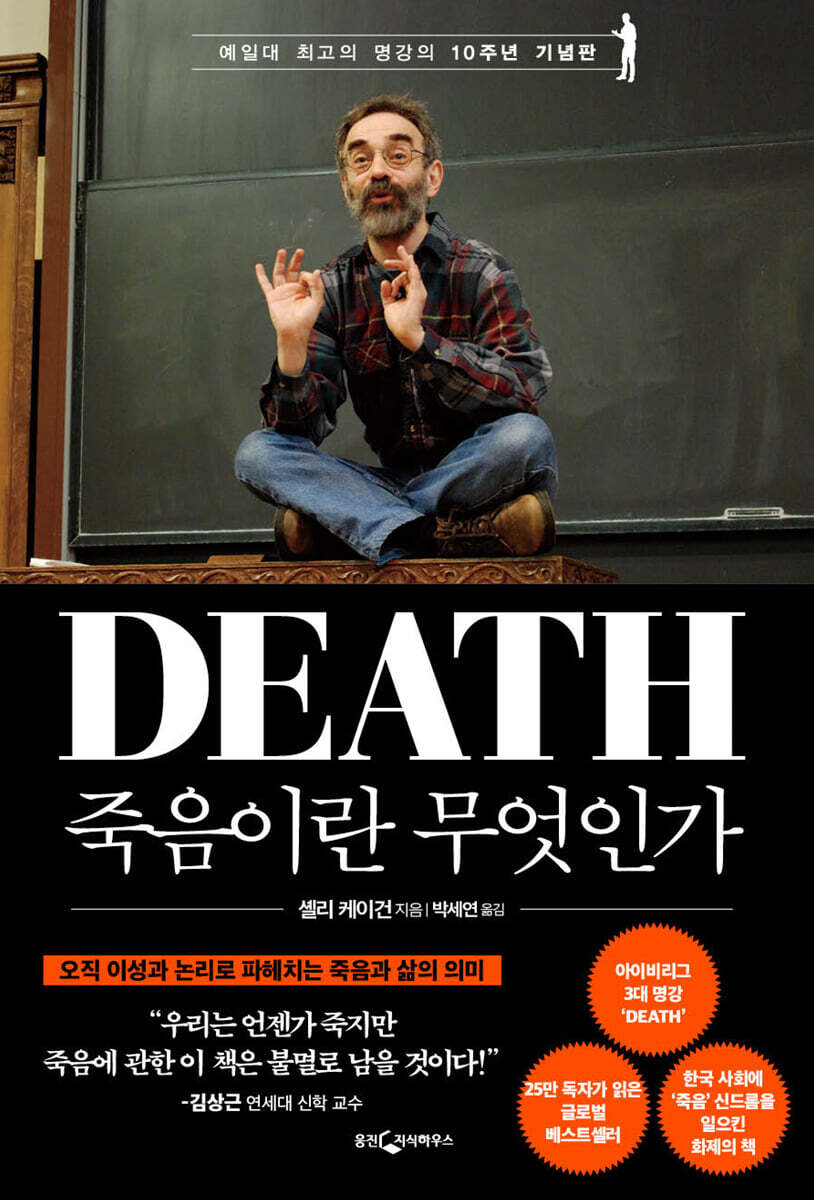
DEATH: The Three Ivy League Schools You Must See at Least Once in Your Life
A global bestseller, acclaimed by 250,000 readers
“We will all die someday, but this book about death will remain immortal!”
- Professor Kim Sang-geun, Yonsei University College of Theology
The meaning of life and death, unraveled only through reason and logic.
A life lecture of our time for those seeking a clearer reason to live!
The global bestseller "What is Death?" (2013), which created a "death syndrome" in Korean society and was loved by 250,000 readers, is meeting new readers with its 10th anniversary edition.
This is a book version of Shelly Kagan's 'Death' lecture, which is considered one of the top three lectures in the Ivy League and is considered a representative work of Shelly Kagan, a modern philosopher representing the United States along with Michael Sandel of Harvard University.
"What is death?" This book contains a philosophical reflection on this question, which is both the fate of humanity and an eternally unsolvable one. It completely excludes psychological and religious interpretations and explores everything about death solely through reason and logic.
Through endless questions and persistent conversations that overturn familiar thinking, and thorough thinking that crosses the vast history of philosophy from Plato, Epicurus, and Descartes to modern philosophy, the essence of death and the meaning of life are woven together.
A global bestseller, acclaimed by 250,000 readers
“We will all die someday, but this book about death will remain immortal!”
- Professor Kim Sang-geun, Yonsei University College of Theology
The meaning of life and death, unraveled only through reason and logic.
A life lecture of our time for those seeking a clearer reason to live!
The global bestseller "What is Death?" (2013), which created a "death syndrome" in Korean society and was loved by 250,000 readers, is meeting new readers with its 10th anniversary edition.
This is a book version of Shelly Kagan's 'Death' lecture, which is considered one of the top three lectures in the Ivy League and is considered a representative work of Shelly Kagan, a modern philosopher representing the United States along with Michael Sandel of Harvard University.
"What is death?" This book contains a philosophical reflection on this question, which is both the fate of humanity and an eternally unsolvable one. It completely excludes psychological and religious interpretations and explores everything about death solely through reason and logic.
Through endless questions and persistent conversations that overturn familiar thinking, and thorough thinking that crosses the vast history of philosophy from Plato, Epicurus, and Descartes to modern philosophy, the essence of death and the meaning of life are woven together.
- You can preview some of the book's contents.
Preview
index
Prologue: On Life, Death, and Eternity
Chapter 1: Does Life Continue After It Ends?
Questions to Ask Before Talking About Death · Two Perspectives on Humanity · Dualism: Humans Composed of Body and Soul · Physicalism: Humans Composed of Body Only
Chapter 2: Does the Soul Exist?
Can the soul be proven? · Inference to the best explanation · Who controls the body? · Can the soul have experiences?
Chapter 3: Can the mind exist without the body?
Body and mind are different - Descartes · The Star and the Morning Star
Chapter 4: Does the soul never die?
The Death of Socrates · Plato's Perfect Kingdom · The Immortal Soul - The Nature of Forms · Immortal Being - The Simplicity of the Soul · The Harmony of Mind and Body
Chapter 5: Why I Can Be Who I Am
The existence of the questionable soul · Human identity and the space-time bug · Identity from the soul's perspective · Identity from the body's perspective · Identity from the personality's perspective
Chapter 6: Am I a soul, a body, or a person?
Same problem, different answers · Another Napoleon - the cloning problem · Can the soul be divided - the division problem · What values really matter?
Chapter 7: On the Nature of Death
What is death? · The basis for saying we are alive.
Chapter 8: Two Surprising Claims About Death
“I will never die.” · “All men die alone.”
Chapter 9: Is Death a Bad Thing?
What Death Takes Away - Theory of Deprivation · When is death bad? - Epicurus's perspective · The past when I 'did not exist', the future when I 'did not exist' - The case of Lucretius
Chapter 10: On Eternal Life
The punishment of eternal life. Do you want to live forever?
Chapter 11: Where Does the Value of Life Lie?
Essentially Good and Bad · Life Connected to the Experience Machine · Life as a Vessel - The Vessel Theory
Chapter 12: The Inescapable Weight of Death
We must die - the inevitability of death · We don't know how long we will live - the mutability of death · We don't know when we will die - the unpredictability of death · We don't know where or how we will die - the ubiquity of death · The mutual influence of life and death
Chapter 13: Living in the Face of Death
Attitudes toward death - denial, acceptance, and ignorance · Is death something to be feared? · You only live once · How should we live - life strategies
Chapter 14: Suicide: A Choice of Death or a Resignation to Life
Is suicide a rational choice? Is suicide morally justified?
Epilogue: Back to Life
main
More to read
Search
Recommendation: Every book about death speaks of life (Kim Sang-geun, Professor of Theology, Yonsei University)
Chapter 1: Does Life Continue After It Ends?
Questions to Ask Before Talking About Death · Two Perspectives on Humanity · Dualism: Humans Composed of Body and Soul · Physicalism: Humans Composed of Body Only
Chapter 2: Does the Soul Exist?
Can the soul be proven? · Inference to the best explanation · Who controls the body? · Can the soul have experiences?
Chapter 3: Can the mind exist without the body?
Body and mind are different - Descartes · The Star and the Morning Star
Chapter 4: Does the soul never die?
The Death of Socrates · Plato's Perfect Kingdom · The Immortal Soul - The Nature of Forms · Immortal Being - The Simplicity of the Soul · The Harmony of Mind and Body
Chapter 5: Why I Can Be Who I Am
The existence of the questionable soul · Human identity and the space-time bug · Identity from the soul's perspective · Identity from the body's perspective · Identity from the personality's perspective
Chapter 6: Am I a soul, a body, or a person?
Same problem, different answers · Another Napoleon - the cloning problem · Can the soul be divided - the division problem · What values really matter?
Chapter 7: On the Nature of Death
What is death? · The basis for saying we are alive.
Chapter 8: Two Surprising Claims About Death
“I will never die.” · “All men die alone.”
Chapter 9: Is Death a Bad Thing?
What Death Takes Away - Theory of Deprivation · When is death bad? - Epicurus's perspective · The past when I 'did not exist', the future when I 'did not exist' - The case of Lucretius
Chapter 10: On Eternal Life
The punishment of eternal life. Do you want to live forever?
Chapter 11: Where Does the Value of Life Lie?
Essentially Good and Bad · Life Connected to the Experience Machine · Life as a Vessel - The Vessel Theory
Chapter 12: The Inescapable Weight of Death
We must die - the inevitability of death · We don't know how long we will live - the mutability of death · We don't know when we will die - the unpredictability of death · We don't know where or how we will die - the ubiquity of death · The mutual influence of life and death
Chapter 13: Living in the Face of Death
Attitudes toward death - denial, acceptance, and ignorance · Is death something to be feared? · You only live once · How should we live - life strategies
Chapter 14: Suicide: A Choice of Death or a Resignation to Life
Is suicide a rational choice? Is suicide morally justified?
Epilogue: Back to Life
main
More to read
Search
Recommendation: Every book about death speaks of life (Kim Sang-geun, Professor of Theology, Yonsei University)
Detailed image
Into the book
What does this book tell us about death? First, we'll address the philosophical questions that arise when considering the nature of death.
For example, we might consider questions like, “What happens after we die?”
And to answer these questions, we will first ask the following questions:
“What kind of beings are we?”, “What is the essence of human existence?”, and going a step further, “Does the soul really exist?”
---From "Prologue"
I want you to think about this philosophical discussion for yourself.
Imagine that after death, the existence of a country completely disappears.
If this is true, then death cannot be said to be a bad thing.
Because once I'm dead, death can never be bad for me.
How can death be bad for me when I don't even exist? How can death be bad when it can't harm me in any way? Furthermore, while I'm alive, death isn't necessarily bad for me.
---From "Prologue"
We keep asking ourselves these questions:
"Is there life after death?" But what exactly does this question mean? What does it mean to die? Let's begin our discussion with these questions.
Generally, 'death' refers to 'the end of life'.
From this perspective, the question “Is there life after death?” means “Is there life after death?”
If so, the answer is self-evident.
Of course, the answer is “no.”
Asking whether there is life after death is a 'self-contradictory' question, asking whether life continues after death.
So the answer is clearly “no.”
It's like asking if there's still food left on your plate after you've finished eating.
It's also like asking after the movie is over if there's more to come.
That's a stupid question.
Because the answer is already contained in the question.
It's so obvious
---From Chapter 1, “Does Life Continue After Life Ends?”
To continue the discussion in a free and diverse way, on a neutral level, I will primarily use the term 'spirit'.
And I think you would agree that humans have minds, in the sense that they are spaces where thoughts and personality reside.
But tricky questions still remain.
“What is the mind?” Dualists say that the mind is the soul, and that the soul is an immaterial entity.
Therefore, I will use the term soul only when discussing it from a specific metaphysical perspective that accepts the soul as an immaterial entity.
Physicalists, on the other hand, take the opposite view.
Of course, these people do not deny the existence of the mind.
But in physicalism, the mind is just a concept used to guide discussions about physical functions.
Physicalists do not accept the existence of an immaterial soul, as dualists believe.
It is precisely for this reason that we can say that “physicalists do not believe in the soul.”
Physicalists acknowledge the existence of the mind, but do not believe in the existence of the soul.
---From Chapter 1, “Does Life Continue After Life Ends?”
We often use this method.
How can we be sure that X-rays, which we have never seen with our naked eyes, exist? Because X-ray pictures, which show the inside of the body, such as the bones inside my chest, explain it.
How can we believe in the existence of planets so far from Earth that they cannot be seen even with a telescope? It's because they explain the flickering of light arriving from the distant universe.
When a phenomenon can be explained in a particular way and not in any other way, we can prove its existence by the process of inference.
In fact, this is a fairly common approach.
Philosophers call this approach 'inference to the best explanation'.
---From Chapter 2, “Does the Soul Exist?”
One thing that can be said is that when people are diagnosed with a fatal illness, the thought that they will die one day comes as a real shock to them.
In this regard, we can find a suitable example in Tolstoy's novel The Death of Ivan Ilyich.
Ivan Ilyich falls and is seriously injured.
And the wound continues to worsen and eventually leads to death.
The surprising scene here is the moment when Ivan Ilyich is shocked to realize that he is destined to die.
What Tolstoy wanted to tell his readers through this story is that most people don't think much differently from Ivan Ilyich.
It's easy to say that we're all going to die someday, but in some ways, we're actually reluctant to believe it.
---From Chapter 8, “Two Surprising Claims About Death”
Again, what I want to ask you now is whether you want to spend your 'life' hooked up to an experience machine.
I'm not asking if you want to have an exciting and interesting experience for a week, a month, or a year.
More precisely, we are asking whether life in the experience machine would be better than your life now.
Of course, it's heartbreaking, but for people who are living a terribly bad life, living in an experience machine is definitely a better choice.
Let's think about it this way.
Can you really get everything worthwhile from life in the experience machine? Can you really get everything? Could it be the best possible form of human existence? A hedonist would say yes.
---From Chapter 11, “Where Does the Value of Life Lie?”
He knew full well that he was going to die soon.
The student was already diagnosed with cancer when he was in his first year.
The doctor in charge said that the chances of recovery were extremely slim and that he would only live for a few years at best.
Then the student asked himself:
“What should I do with the time I have left?” he asked himself, and decided that what he really wanted to do was graduate from school.
I set a goal to graduate from school before I die.
So, the student ended up taking my lecture on death in the second semester of his senior year.
It was sobering to see students in that situation come to my classes, keep me awake, and talk with me about the soul, the existence of life after death, and whether it's really a bad thing that we're all going to die.
---From Chapter 12, “The Inevitable Fear of Death”
“How should we live when faced with the fact that we will die someday?” Then we can answer like this.
“Since we don’t have much time, we must fill our lives with as many things as possible.
“You should enjoy as many blessings as you can while you can.” That’s a very ordinary answer.
I think there are at least two macro-level strategies for putting this idea into practice.
First, always remember that if your goals are too high, the risk of failure increases accordingly.
For example, we might consider questions like, “What happens after we die?”
And to answer these questions, we will first ask the following questions:
“What kind of beings are we?”, “What is the essence of human existence?”, and going a step further, “Does the soul really exist?”
---From "Prologue"
I want you to think about this philosophical discussion for yourself.
Imagine that after death, the existence of a country completely disappears.
If this is true, then death cannot be said to be a bad thing.
Because once I'm dead, death can never be bad for me.
How can death be bad for me when I don't even exist? How can death be bad when it can't harm me in any way? Furthermore, while I'm alive, death isn't necessarily bad for me.
---From "Prologue"
We keep asking ourselves these questions:
"Is there life after death?" But what exactly does this question mean? What does it mean to die? Let's begin our discussion with these questions.
Generally, 'death' refers to 'the end of life'.
From this perspective, the question “Is there life after death?” means “Is there life after death?”
If so, the answer is self-evident.
Of course, the answer is “no.”
Asking whether there is life after death is a 'self-contradictory' question, asking whether life continues after death.
So the answer is clearly “no.”
It's like asking if there's still food left on your plate after you've finished eating.
It's also like asking after the movie is over if there's more to come.
That's a stupid question.
Because the answer is already contained in the question.
It's so obvious
---From Chapter 1, “Does Life Continue After Life Ends?”
To continue the discussion in a free and diverse way, on a neutral level, I will primarily use the term 'spirit'.
And I think you would agree that humans have minds, in the sense that they are spaces where thoughts and personality reside.
But tricky questions still remain.
“What is the mind?” Dualists say that the mind is the soul, and that the soul is an immaterial entity.
Therefore, I will use the term soul only when discussing it from a specific metaphysical perspective that accepts the soul as an immaterial entity.
Physicalists, on the other hand, take the opposite view.
Of course, these people do not deny the existence of the mind.
But in physicalism, the mind is just a concept used to guide discussions about physical functions.
Physicalists do not accept the existence of an immaterial soul, as dualists believe.
It is precisely for this reason that we can say that “physicalists do not believe in the soul.”
Physicalists acknowledge the existence of the mind, but do not believe in the existence of the soul.
---From Chapter 1, “Does Life Continue After Life Ends?”
We often use this method.
How can we be sure that X-rays, which we have never seen with our naked eyes, exist? Because X-ray pictures, which show the inside of the body, such as the bones inside my chest, explain it.
How can we believe in the existence of planets so far from Earth that they cannot be seen even with a telescope? It's because they explain the flickering of light arriving from the distant universe.
When a phenomenon can be explained in a particular way and not in any other way, we can prove its existence by the process of inference.
In fact, this is a fairly common approach.
Philosophers call this approach 'inference to the best explanation'.
---From Chapter 2, “Does the Soul Exist?”
One thing that can be said is that when people are diagnosed with a fatal illness, the thought that they will die one day comes as a real shock to them.
In this regard, we can find a suitable example in Tolstoy's novel The Death of Ivan Ilyich.
Ivan Ilyich falls and is seriously injured.
And the wound continues to worsen and eventually leads to death.
The surprising scene here is the moment when Ivan Ilyich is shocked to realize that he is destined to die.
What Tolstoy wanted to tell his readers through this story is that most people don't think much differently from Ivan Ilyich.
It's easy to say that we're all going to die someday, but in some ways, we're actually reluctant to believe it.
---From Chapter 8, “Two Surprising Claims About Death”
Again, what I want to ask you now is whether you want to spend your 'life' hooked up to an experience machine.
I'm not asking if you want to have an exciting and interesting experience for a week, a month, or a year.
More precisely, we are asking whether life in the experience machine would be better than your life now.
Of course, it's heartbreaking, but for people who are living a terribly bad life, living in an experience machine is definitely a better choice.
Let's think about it this way.
Can you really get everything worthwhile from life in the experience machine? Can you really get everything? Could it be the best possible form of human existence? A hedonist would say yes.
---From Chapter 11, “Where Does the Value of Life Lie?”
He knew full well that he was going to die soon.
The student was already diagnosed with cancer when he was in his first year.
The doctor in charge said that the chances of recovery were extremely slim and that he would only live for a few years at best.
Then the student asked himself:
“What should I do with the time I have left?” he asked himself, and decided that what he really wanted to do was graduate from school.
I set a goal to graduate from school before I die.
So, the student ended up taking my lecture on death in the second semester of his senior year.
It was sobering to see students in that situation come to my classes, keep me awake, and talk with me about the soul, the existence of life after death, and whether it's really a bad thing that we're all going to die.
---From Chapter 12, “The Inevitable Fear of Death”
“How should we live when faced with the fact that we will die someday?” Then we can answer like this.
“Since we don’t have much time, we must fill our lives with as many things as possible.
“You should enjoy as many blessings as you can while you can.” That’s a very ordinary answer.
I think there are at least two macro-level strategies for putting this idea into practice.
First, always remember that if your goals are too high, the risk of failure increases accordingly.
---From Chapter 13, “Living in the Face of Death”
Publisher's Review
Yale University's "DEATH," the best life lecture among the top three Ivy League universities
“All humans are running towards death.
We call it life”
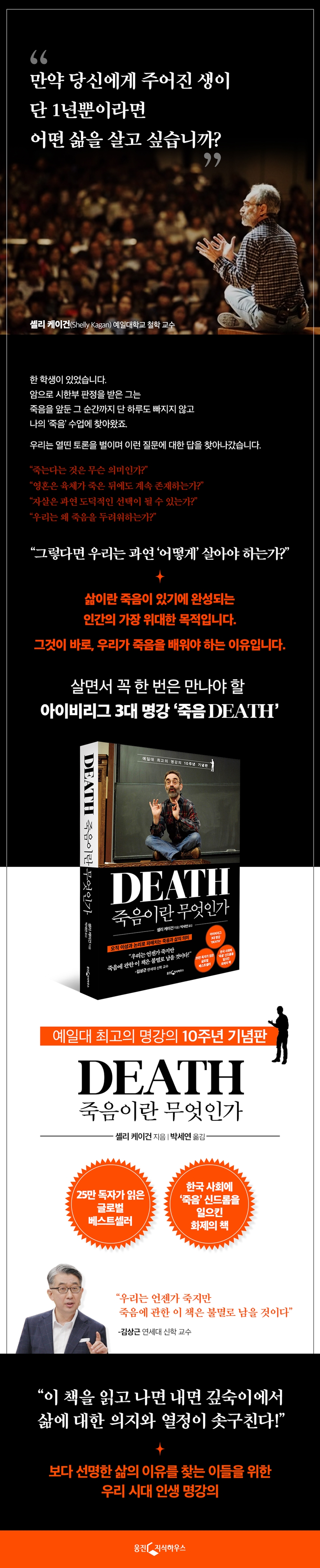
A man dressed simply in a checkered shirt and jeans sits down on a desk in the middle of the podium.
He unravels the vast history of philosophy with a wit and humor worthy of a TV talk show, asking questions like, “What is death?”, “What happens after death?”, and “Does the soul really exist?”
This is the scene from the 'DEATH' lecture room of Shelly Kagan, a professor of philosophy at Yale University and a representative contemporary philosopher of the United States, along with Michael Sandel of Harvard University.
He is well known by the nickname 'Desk Professor' due to his habit of climbing on the desk during every lecture, and has been giving 'Death' lectures since 1995.
This lecture, which is part of Yale University's knowledge sharing project 'Open Yale Courses', is considered one of the three most prestigious lectures in the Ivy League, following Justice and Happiness.
A new book, "What is Death?", which reinterprets this lecture, which was praised by Yale students, examines the nature of death, the meaning of life, and the dignity of life through philosophical considerations.
This book caused a huge stir immediately after its publication, selling 180,000 copies in Korea and Japan alone, and becoming a bestseller in China, Russia, Europe, and other countries.
Professor Kagan, who has visited Korea three times since the book was first published in Korea in 2013, has become a hot topic, with lines of readers stretching hundreds of meters and 3,000-seat lecture halls sold out at each lecture. The media has highlighted the book's explosive popularity as a "death syndrome" and evaluated that it has brought "death" into the forum of social discussion.
"What is Death?", which has been loved by 250,000 readers in Korea and established itself as a representative classic on death of our time, has been refurbished and returned to readers in a 10th anniversary edition.
A terminally ill student listened to the last lecture, discussing death through reason and logic.
“After reading this book, a will and passion for life wells up deep within me.”
If you had only a short time left, what would you choose? Professor Kagan, the author of this book, shares the story of a student who has been the most memorable to him in his ongoing lectures on "death."
A student who had already been diagnosed with terminal cancer visited the 'death' classroom without missing a single day.
He used to sit across from Professor Shelly Kagan, the "desk professor," and have heated discussions about things like the existence of a soul, life after death, and whether death is a bad thing.
Why did he, who was nearing the end of his life, desperately want to listen to this lecture?
This book completely excludes topics that should be covered in a book about death, such as the 'process of reaching death', criticism of the medical and funeral industries, awareness of death, psychological comfort, or religious interpretation.
The only means the author has chosen to approach the essence of death are logic, reason, and philosophical questions.
Starting with conceptual questions like “What does it mean to die?”, “What kind of being am I that cannot help but die?”, “Is eternal life possible?”, “Does the soul continue to exist after the body dies?”, it makes us reflect on our attitude toward death with questions like “Is death a bad thing?”, “Is eternal life a good thing?”, “Is suicide a rational choice?”, and “Why are we afraid of death we have not even experienced?”
And all these questions come back to one question:
“Then, how should I live?”
The author endlessly poses these philosophical questions, tenaciously leads the conversation, and, using only everyday terms, addresses the vast debate on death in the history of philosophy, gradually deepening the thought.
And it makes you realize.
This means that the question about 'death' soon demands an answer about 'life'.
The author emphasizes that “life is the greatest purpose of human beings, and it is only fulfilled because there is death,” and that “if we understand the essence of death, we can live a valuable life.”
A terminally ill student taking a class on 'death' had to return home without completing his studies due to his illness worsening during the semester.
He received an early graduation from Yale University, but passed away shortly thereafter.
By achieving the value he had strived to achieve until the end of his life, which was his dream of completing his studies, he finally came to understand the meaning of lectures.
Life and death, woven from a vast range of thought, from Plato to Descartes to modern philosophy.
“Death of soul and body, and eternal life.
“The paradox of life and death that no one can escape”
Is there life after death? The fear of death has given rise to the expectation and belief in eternal life or life after death.
The author asserts that this is a self-contradictory question, similar to asking, "Can the body survive even when the body dies?" and introduces two major perspectives on the reality of human existence: "dualism," which states that humans are composed of "body and soul," and "physicalism," which states that humans are composed only of "body."
He explains the logical errors in Phaidon, which deals with the death of Socrates and the immortality of the soul, and criticizes the phenomenon of easily choosing psychological beliefs in the face of something that is very difficult to prove with reason, such as refuting Descartes' claim that "body and mind are separate entities because one can 'think' that the mind (soul) can exist without the body."
Furthermore, we examine three arguments regarding human identity: the "soul perspective," the "body perspective," and the "personality perspective," and unravel metaphysical puzzles through a variety of everyday examples, from the concept of the "space-time worm" to the analogy of the watch repairman and the movie Star Wars.
Using Tolstoy's "The Death of Ivan Ilyich" as an example, we examine the duality of human psychology that seeks to deny death even when facing it, and we also examine Charles Dickens' "A Tale of Two Cities" while analyzing the proposition that "all men die alone."
In response to the question, “Is death scary and bad?”, the author presents the “deprivation account” that “it is bad because it takes away the good things that life brings.” He compares this with the position of Epicurus, who said, “Death is not bad because I do not exist after death,” and Lucretius, who said, “If death is bad, then the state before birth, which is a state of non-existence, must also be bad.” He also introduces the core views of modern philosophers such as Thomas Nagle, Fred Feldman, and Derek Parfit.
Is eternal life, the opposite of death, a good thing? Professor Kagan questions whether we truly understand the meaning of "eternal." He emphasizes that any form of life that lasts forever would lose its appeal, that infinite life would be a harsher punishment than any suffering, and reminds us that all good things are finite in nature.
The Ultimate Death Lecture for Those Seeking a Clearer Reason to Live
If death is truly the end, we must devise a strategy for living our best life.
In philosophy, death has four characteristics.
Humans are 'inevitable to die (inevitability),' 'don't know how long they will live (variability),' 'don't know when they will die (unpredictability),' and 'don't know where or how they will die (ubiquity).' When we understand these characteristics and accept the finiteness of life, only then can we free ourselves from the fear of death and talk about the essence of happiness.
The author poses the grand question, "What makes life worth living?" and answers that the value of life is not life itself, but the "contents" that fill life, that is, the sum total of the good and bad that fill life (container theory).
Ultimately, “what we should pay attention to is not life itself or death itself, but the process from birth to death.”
It explains how to develop strategies for a life with a high happiness index, that is, to fill our lives with as many things as possible in the limited time given to us.
And the author concludes his 14-lecture series by seeking an answer to the question of whether suicide can be a moral and rational choice.
Every book about death speaks of life.
“We die.
That is why we must live well.” In a way, the author mobilized all of his knowledge and reasoning to reach this simple and clear conclusion, leading us into a philosophical play.
The author speaks to readers who want to find a clearer reason to live than yesterday.
“To be free from the fear and illusion of death, to face death directly, and to live again.”
“All humans are running towards death.
We call it life”
A man dressed simply in a checkered shirt and jeans sits down on a desk in the middle of the podium.
He unravels the vast history of philosophy with a wit and humor worthy of a TV talk show, asking questions like, “What is death?”, “What happens after death?”, and “Does the soul really exist?”
This is the scene from the 'DEATH' lecture room of Shelly Kagan, a professor of philosophy at Yale University and a representative contemporary philosopher of the United States, along with Michael Sandel of Harvard University.
He is well known by the nickname 'Desk Professor' due to his habit of climbing on the desk during every lecture, and has been giving 'Death' lectures since 1995.
This lecture, which is part of Yale University's knowledge sharing project 'Open Yale Courses', is considered one of the three most prestigious lectures in the Ivy League, following Justice and Happiness.
A new book, "What is Death?", which reinterprets this lecture, which was praised by Yale students, examines the nature of death, the meaning of life, and the dignity of life through philosophical considerations.
This book caused a huge stir immediately after its publication, selling 180,000 copies in Korea and Japan alone, and becoming a bestseller in China, Russia, Europe, and other countries.
Professor Kagan, who has visited Korea three times since the book was first published in Korea in 2013, has become a hot topic, with lines of readers stretching hundreds of meters and 3,000-seat lecture halls sold out at each lecture. The media has highlighted the book's explosive popularity as a "death syndrome" and evaluated that it has brought "death" into the forum of social discussion.
"What is Death?", which has been loved by 250,000 readers in Korea and established itself as a representative classic on death of our time, has been refurbished and returned to readers in a 10th anniversary edition.
A terminally ill student listened to the last lecture, discussing death through reason and logic.
“After reading this book, a will and passion for life wells up deep within me.”
If you had only a short time left, what would you choose? Professor Kagan, the author of this book, shares the story of a student who has been the most memorable to him in his ongoing lectures on "death."
A student who had already been diagnosed with terminal cancer visited the 'death' classroom without missing a single day.
He used to sit across from Professor Shelly Kagan, the "desk professor," and have heated discussions about things like the existence of a soul, life after death, and whether death is a bad thing.
Why did he, who was nearing the end of his life, desperately want to listen to this lecture?
This book completely excludes topics that should be covered in a book about death, such as the 'process of reaching death', criticism of the medical and funeral industries, awareness of death, psychological comfort, or religious interpretation.
The only means the author has chosen to approach the essence of death are logic, reason, and philosophical questions.
Starting with conceptual questions like “What does it mean to die?”, “What kind of being am I that cannot help but die?”, “Is eternal life possible?”, “Does the soul continue to exist after the body dies?”, it makes us reflect on our attitude toward death with questions like “Is death a bad thing?”, “Is eternal life a good thing?”, “Is suicide a rational choice?”, and “Why are we afraid of death we have not even experienced?”
And all these questions come back to one question:
“Then, how should I live?”
The author endlessly poses these philosophical questions, tenaciously leads the conversation, and, using only everyday terms, addresses the vast debate on death in the history of philosophy, gradually deepening the thought.
And it makes you realize.
This means that the question about 'death' soon demands an answer about 'life'.
The author emphasizes that “life is the greatest purpose of human beings, and it is only fulfilled because there is death,” and that “if we understand the essence of death, we can live a valuable life.”
A terminally ill student taking a class on 'death' had to return home without completing his studies due to his illness worsening during the semester.
He received an early graduation from Yale University, but passed away shortly thereafter.
By achieving the value he had strived to achieve until the end of his life, which was his dream of completing his studies, he finally came to understand the meaning of lectures.
Life and death, woven from a vast range of thought, from Plato to Descartes to modern philosophy.
“Death of soul and body, and eternal life.
“The paradox of life and death that no one can escape”
Is there life after death? The fear of death has given rise to the expectation and belief in eternal life or life after death.
The author asserts that this is a self-contradictory question, similar to asking, "Can the body survive even when the body dies?" and introduces two major perspectives on the reality of human existence: "dualism," which states that humans are composed of "body and soul," and "physicalism," which states that humans are composed only of "body."
He explains the logical errors in Phaidon, which deals with the death of Socrates and the immortality of the soul, and criticizes the phenomenon of easily choosing psychological beliefs in the face of something that is very difficult to prove with reason, such as refuting Descartes' claim that "body and mind are separate entities because one can 'think' that the mind (soul) can exist without the body."
Furthermore, we examine three arguments regarding human identity: the "soul perspective," the "body perspective," and the "personality perspective," and unravel metaphysical puzzles through a variety of everyday examples, from the concept of the "space-time worm" to the analogy of the watch repairman and the movie Star Wars.
Using Tolstoy's "The Death of Ivan Ilyich" as an example, we examine the duality of human psychology that seeks to deny death even when facing it, and we also examine Charles Dickens' "A Tale of Two Cities" while analyzing the proposition that "all men die alone."
In response to the question, “Is death scary and bad?”, the author presents the “deprivation account” that “it is bad because it takes away the good things that life brings.” He compares this with the position of Epicurus, who said, “Death is not bad because I do not exist after death,” and Lucretius, who said, “If death is bad, then the state before birth, which is a state of non-existence, must also be bad.” He also introduces the core views of modern philosophers such as Thomas Nagle, Fred Feldman, and Derek Parfit.
Is eternal life, the opposite of death, a good thing? Professor Kagan questions whether we truly understand the meaning of "eternal." He emphasizes that any form of life that lasts forever would lose its appeal, that infinite life would be a harsher punishment than any suffering, and reminds us that all good things are finite in nature.
The Ultimate Death Lecture for Those Seeking a Clearer Reason to Live
If death is truly the end, we must devise a strategy for living our best life.
In philosophy, death has four characteristics.
Humans are 'inevitable to die (inevitability),' 'don't know how long they will live (variability),' 'don't know when they will die (unpredictability),' and 'don't know where or how they will die (ubiquity).' When we understand these characteristics and accept the finiteness of life, only then can we free ourselves from the fear of death and talk about the essence of happiness.
The author poses the grand question, "What makes life worth living?" and answers that the value of life is not life itself, but the "contents" that fill life, that is, the sum total of the good and bad that fill life (container theory).
Ultimately, “what we should pay attention to is not life itself or death itself, but the process from birth to death.”
It explains how to develop strategies for a life with a high happiness index, that is, to fill our lives with as many things as possible in the limited time given to us.
And the author concludes his 14-lecture series by seeking an answer to the question of whether suicide can be a moral and rational choice.
Every book about death speaks of life.
“We die.
That is why we must live well.” In a way, the author mobilized all of his knowledge and reasoning to reach this simple and clear conclusion, leading us into a philosophical play.
The author speaks to readers who want to find a clearer reason to live than yesterday.
“To be free from the fear and illusion of death, to face death directly, and to live again.”
GOODS SPECIFICS
- Date of issue: February 24, 2023
- Page count, weight, size: 512 pages | 738g | 152*224*25mm
- ISBN13: 9788901269092
- ISBN10: 8901269090
You may also like
카테고리
korean


korean

![GQ KOREA Mark (Monthly): December [2025]](http://librairie.coreenne.fr/cdn/shop/files/8ef265dbbfbf186523ed75ba7319009d.jpg?v=1765340328&width=3840)


