

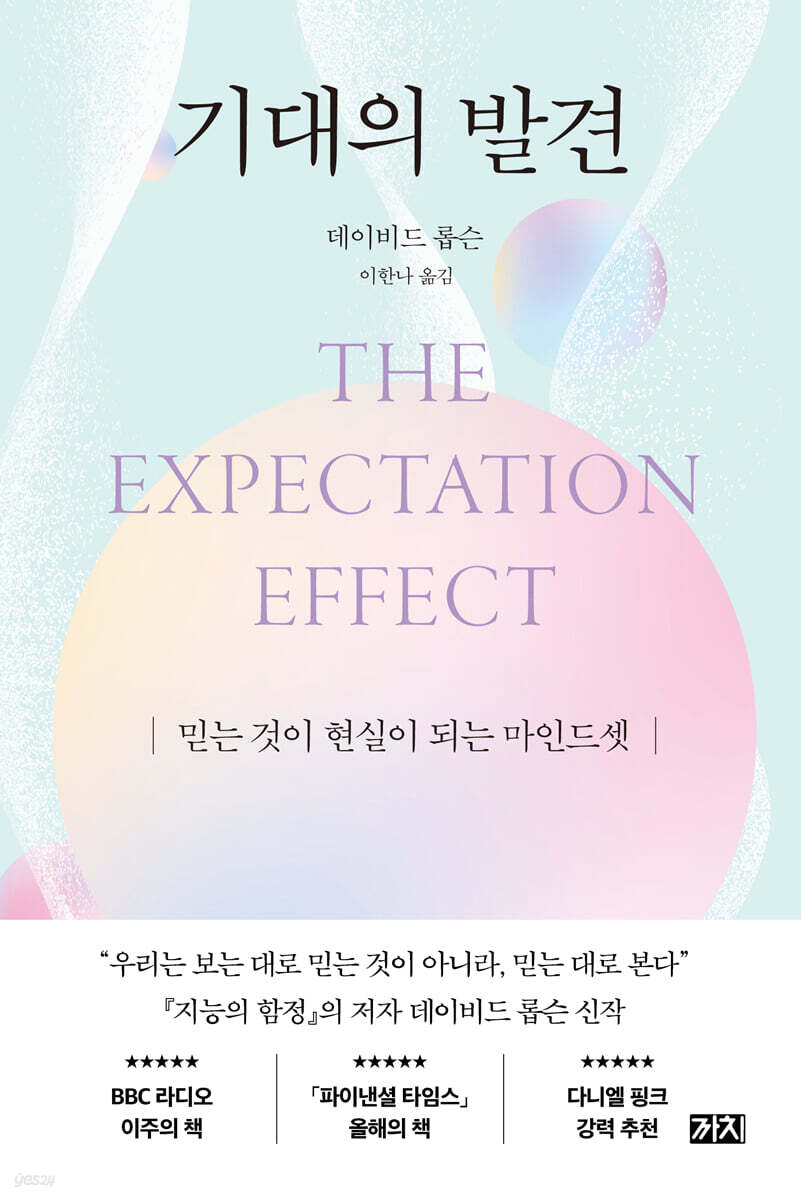
The discovery of expectations
 |
Description
Book Introduction
- A word from MD
-
Beliefs change hearts and actionsThe brain perceives information received through various sensory organs.
However, human cognition is not neutral.
The content accepted varies depending on the individual's beliefs and values.
Beliefs change actions.
This book on the anticipation effect explores the brain, mind, and behavior to create a better tomorrow than today.
January 13, 2023. Humanities PD Son Min-gyu
For you to live healthier, happier, and more productively
One amazing power, expected effect
A new book by David Robson, author of "The Intelligence Trap"
Highly recommended by BBC Radio, the Financial Times, and Daniel Pink
You've probably heard stories about the placebo effect or fake medicine helping you recover from an illness.
But did you know that sham heart surgery is just as effective as real stent placement? And that people who believe they are particularly vulnerable to cardiovascular disease are four times more likely to die from a heart attack? In his book, "The Intelligence Trap," science journalist David Robson draws on cutting-edge psychological research to compellingly demonstrate the profound power and critical importance of the expectancy effect, which can make something happen when you expect it to happen.
Our brains are prediction machines, and if we understand this brain trait and learn to apply it effectively to our lives, our expectations can become the reality we desire.
This book does not preach pseudoscience, which says that what you think about becomes what you get.
Rather, the author explains in the book the tremendous power of expectation, making it clear that expectations alone do not guarantee the fulfillment of wishes.
But if we recognize the power of expectation and apply it appropriately to our lives, the effects can be tremendously transformative.
For many readers who dream of change and growth, this book will be the best guide to help them achieve that dream.
One amazing power, expected effect
A new book by David Robson, author of "The Intelligence Trap"
Highly recommended by BBC Radio, the Financial Times, and Daniel Pink
You've probably heard stories about the placebo effect or fake medicine helping you recover from an illness.
But did you know that sham heart surgery is just as effective as real stent placement? And that people who believe they are particularly vulnerable to cardiovascular disease are four times more likely to die from a heart attack? In his book, "The Intelligence Trap," science journalist David Robson draws on cutting-edge psychological research to compellingly demonstrate the profound power and critical importance of the expectancy effect, which can make something happen when you expect it to happen.
Our brains are prediction machines, and if we understand this brain trait and learn to apply it effectively to our lives, our expectations can become the reality we desire.
This book does not preach pseudoscience, which says that what you think about becomes what you get.
Rather, the author explains in the book the tremendous power of expectation, making it clear that expectations alone do not guarantee the fulfillment of wishes.
But if we recognize the power of expectation and apply it appropriately to our lives, the effects can be tremendously transformative.
For many readers who dream of change and growth, this book will be the best guide to help them achieve that dream.
- You can preview some of the book's contents.
Preview
index
Entering
1.
prediction machine
2.
white lies
3.
Medicine is not a sin
4.
The Source of Mass Hysteria
5.
Faster, stronger, healthier
6.
The Paradox of Food
7.
Stress reliever stress reliever
8.
Infinite willpower
9.
undeveloped genius
10.
Super old man
Epilogue
Acknowledgements
main
Translator's Note
Biographical Index
1.
prediction machine
2.
white lies
3.
Medicine is not a sin
4.
The Source of Mass Hysteria
5.
Faster, stronger, healthier
6.
The Paradox of Food
7.
Stress reliever stress reliever
8.
Infinite willpower
9.
undeveloped genius
10.
Super old man
Epilogue
Acknowledgements
main
Translator's Note
Biographical Index
Detailed image

Publisher's Review
We do not believe what we see, but we see what we believe.
What you believe becomes reality.
How does our brain process the vast amount of information coming in through our senses? It interprets reality by amplifying some information and ignoring others through prior information and predictions.
In other words, we do not see reality as it is, but rather see reality as interpreted by our brain.
In short, our minds can change reality.
By viewing the brain as a prediction machine and understanding how it works, we can harness the expectation effect to bring about profound changes in our reality.
Perhaps the most well-known example of the power of expectancy is the placebo effect.
The placebo effect, which has long been used in clinical trials as a means of verifying the efficacy of real drugs, has a surprising secret hidden within it.
The point is that you can see results even if you take the drug knowing that it is a placebo.
Moreover, in countries where people were more exposed to what a placebo was through mass media, the placebo drug was more effective in clinical trials, to the point of threatening the effectiveness of the real drug.
Additionally, some of the subjects who took the placebo drug experienced side effects expected from the real drug.
This negative expectation, known as nocebo, was found to be four times more likely to die from a heart attack 20 years later in participants who believed they were more likely to develop heart disease than their peers.
These negative expectations can be contagious within groups.
In 2006, teenagers in Portugal began showing symptoms such as dizziness, shortness of breath, and skin rashes, and around 300 people nationwide developed the disease.
Many experts had conflicting opinions on the diagnosis and cause of the disease, but ultimately a popular Portuguese drama was identified as the cause.
This is because the symptoms of the disease suffered by the main character in the drama were identical to those exhibited by the teenagers.
Teenagers who are immersed in the drama are infected with the fictional disease in the drama.
This ability to be infected by the emotions of others is due to the operation of our brain's mirror system, which allows us to consider the physical and mental states of others in an integrated manner.
When we see others smile or frown as if in pain, we unconsciously mimic their facial expressions.
Let's look at an experiment that demonstrates how surprising the contagious nature of the expectation effect is.
The research center, located in the Italian Alps at an altitude of 3,500 meters, was an environment that could cause altitude headaches.
The research team invited about 120 students to this alpine research institute.
And I made it a point to think that maybe just one student might get altitude sickness, and asked them to ask if they should bring medication before coming to the lab.
Ultimately, 35 students contacted the lab about the drug, and 86 percent of them experienced altitude headaches (only 53 percent of students who had not been informed about altitude headaches experienced headaches).
We are easily influenced by the physical and mental states of others, and these symptoms can be exacerbated by negative expectations.
Why is exercise so hard?
Why do I feel hungry so quickly after eating healthy food?
You start exercising for your health, but it's not easy to maintain a consistent exercise habit.
This is because exercise uses up the energy in your body and lactic acid builds up in your muscles, causing you to feel tired.
And at some point, your muscles start to feel like they can't move anymore.
But is it really true that we've exhausted ourselves and run out of energy? A study conducted on cyclists in the late 2000s found that we feel fatigue not from muscle fatigue, but from the brain's perceived limit to the amount of exercise it can do.
The limits of our body are also determined by the brain.
In one experiment, participants were asked to vividly visualize exercises that strengthened their forearm muscles, such as lifting an object, and their strength actually improved! Of course, this kind of mental training alone cannot replace physical training.
However, if you accept the muscle soreness you feel after exercise as evidence that your body is being trained rather than pain, and pay attention to reframing your daily activities as exercise, you will see much greater results.
The expected effect also exerts tremendous power in the food we eat for our health.
In one experiment, participants were given soup in bowls with a label on them, and the amount they ate was controlled by a secret device on the bowl.
As a result, participants who ate a smaller amount of soup from a larger bowl felt fuller for significantly longer than those who actually ate a larger amount of soup from a smaller bowl.
We feel full not because our stomach feels full, but because our brain thinks we are full.
Even the healthy diet we eat for our health cannot escape the power of the expectancy effect.
We associate healthy eating with words that make us feel hungry, like tasteless, hungry, and starving.
As a result, even if we eat the same amount of calories as other foods, if we eat foods labeled as healthy, we quickly feel hungry and look for other snacks.
So, by focusing on eating delicious food and enjoying the pleasure of eating, you can actually live a healthy life.
Accumulating stress, releasing stress
Mental energy that changes as you believe
We think of stress as the root of all evil and try to avoid it as much as possible.
But is stress really all that bad? Jeremy Jamieson, a psychologist at the University of Rochester in New York, observed that his athletic friends would be hyperactive and excited before competitions, but then underperform due to nervousness before exams. He studied why, despite the pressures both pose, the outcomes were different.
He showed through experiments that when people changed the way they interpreted stress, pre-test anxiety actually resulted in improved cognitive abilities.
In other words, by re-evaluating the tension we feel, we can effectively deal with the situation.
After a hard day at work or school, we feel drained of mental energy, making it difficult to resist the temptations of late-night snacks or shopping lists.
But this too is only true if we believe it to be so.
People who believe their psychic energy is limitless have been able to perform challenging tasks without losing focus and control, even in subsequent tasks.
Also, if you have your own routine or good luck charm like world-class athletes, it can be a huge help in exercising your willpower.
The “Pygmalion effect” is now a familiar concept to many people.
The concept that teachers' expectations have a profound impact on students' academic achievement is now being applied in a variety of ways beyond the educational field to improve organizational productivity.
Additionally, individuals can reduce the negative expectations effect by reframing the importance of the task and focusing on their own characteristics and values, rather than feeling frustrated and anxious about the challenge.
An active Latin dancer in her 80s
The Secret of a 90-Year-Old Ultramarathoner
In an experiment conducted in the 1970s, Harvard University psychologist Ellen Langer had participants in their 70s and 80s go back 20 years and live as if they were in their 50s or 60s.
And the results were amazing.
In just one week, the Rangers had the effect of turning back their clocks by 20 years.
Many subsequent studies have shown that our age can have dramatically different outcomes depending on how we view old age.
People who began to age around 60 and had a negative view of aging were actually more affected by aging and had a higher incidence of dementia.
Paddy Jones, who is now a Latin dancer in his 80s, and Albert Stricker, who has shown superhuman endurance by completing ultramarathons, both started exercising later in life.
And at a time when many people are pessimistic about their age, they are countering this attitude with their own abilities.
In their stories, we will learn how influential our expectations about aging are.
“This book explains in an easy-to-understand way that our health and happiness are determined not by what actually happens, but by what we expect to happen.”
―The Guardian
“A very fascinating book.
“An amazing story about the power of the brain to control our brain and body.”
―The Sunday Times
“According to this captivating book, the human brain has a mind of its own. … A powerful blend of cutting-edge research and compelling storytelling, this insightful book explores a constantly evolving field.”
―Kirkus Review
“In contrast to many other ‘pseudoscience’ self-help books about the power of expectation and belief, Robson’s book explores the ‘expectation effect’ through academically validated experiments and research.
“It will be an excellent starting point for readers interested in the power of the mind.”
―Publisher's Weekly
What you believe becomes reality.
How does our brain process the vast amount of information coming in through our senses? It interprets reality by amplifying some information and ignoring others through prior information and predictions.
In other words, we do not see reality as it is, but rather see reality as interpreted by our brain.
In short, our minds can change reality.
By viewing the brain as a prediction machine and understanding how it works, we can harness the expectation effect to bring about profound changes in our reality.
Perhaps the most well-known example of the power of expectancy is the placebo effect.
The placebo effect, which has long been used in clinical trials as a means of verifying the efficacy of real drugs, has a surprising secret hidden within it.
The point is that you can see results even if you take the drug knowing that it is a placebo.
Moreover, in countries where people were more exposed to what a placebo was through mass media, the placebo drug was more effective in clinical trials, to the point of threatening the effectiveness of the real drug.
Additionally, some of the subjects who took the placebo drug experienced side effects expected from the real drug.
This negative expectation, known as nocebo, was found to be four times more likely to die from a heart attack 20 years later in participants who believed they were more likely to develop heart disease than their peers.
These negative expectations can be contagious within groups.
In 2006, teenagers in Portugal began showing symptoms such as dizziness, shortness of breath, and skin rashes, and around 300 people nationwide developed the disease.
Many experts had conflicting opinions on the diagnosis and cause of the disease, but ultimately a popular Portuguese drama was identified as the cause.
This is because the symptoms of the disease suffered by the main character in the drama were identical to those exhibited by the teenagers.
Teenagers who are immersed in the drama are infected with the fictional disease in the drama.
This ability to be infected by the emotions of others is due to the operation of our brain's mirror system, which allows us to consider the physical and mental states of others in an integrated manner.
When we see others smile or frown as if in pain, we unconsciously mimic their facial expressions.
Let's look at an experiment that demonstrates how surprising the contagious nature of the expectation effect is.
The research center, located in the Italian Alps at an altitude of 3,500 meters, was an environment that could cause altitude headaches.
The research team invited about 120 students to this alpine research institute.
And I made it a point to think that maybe just one student might get altitude sickness, and asked them to ask if they should bring medication before coming to the lab.
Ultimately, 35 students contacted the lab about the drug, and 86 percent of them experienced altitude headaches (only 53 percent of students who had not been informed about altitude headaches experienced headaches).
We are easily influenced by the physical and mental states of others, and these symptoms can be exacerbated by negative expectations.
Why is exercise so hard?
Why do I feel hungry so quickly after eating healthy food?
You start exercising for your health, but it's not easy to maintain a consistent exercise habit.
This is because exercise uses up the energy in your body and lactic acid builds up in your muscles, causing you to feel tired.
And at some point, your muscles start to feel like they can't move anymore.
But is it really true that we've exhausted ourselves and run out of energy? A study conducted on cyclists in the late 2000s found that we feel fatigue not from muscle fatigue, but from the brain's perceived limit to the amount of exercise it can do.
The limits of our body are also determined by the brain.
In one experiment, participants were asked to vividly visualize exercises that strengthened their forearm muscles, such as lifting an object, and their strength actually improved! Of course, this kind of mental training alone cannot replace physical training.
However, if you accept the muscle soreness you feel after exercise as evidence that your body is being trained rather than pain, and pay attention to reframing your daily activities as exercise, you will see much greater results.
The expected effect also exerts tremendous power in the food we eat for our health.
In one experiment, participants were given soup in bowls with a label on them, and the amount they ate was controlled by a secret device on the bowl.
As a result, participants who ate a smaller amount of soup from a larger bowl felt fuller for significantly longer than those who actually ate a larger amount of soup from a smaller bowl.
We feel full not because our stomach feels full, but because our brain thinks we are full.
Even the healthy diet we eat for our health cannot escape the power of the expectancy effect.
We associate healthy eating with words that make us feel hungry, like tasteless, hungry, and starving.
As a result, even if we eat the same amount of calories as other foods, if we eat foods labeled as healthy, we quickly feel hungry and look for other snacks.
So, by focusing on eating delicious food and enjoying the pleasure of eating, you can actually live a healthy life.
Accumulating stress, releasing stress
Mental energy that changes as you believe
We think of stress as the root of all evil and try to avoid it as much as possible.
But is stress really all that bad? Jeremy Jamieson, a psychologist at the University of Rochester in New York, observed that his athletic friends would be hyperactive and excited before competitions, but then underperform due to nervousness before exams. He studied why, despite the pressures both pose, the outcomes were different.
He showed through experiments that when people changed the way they interpreted stress, pre-test anxiety actually resulted in improved cognitive abilities.
In other words, by re-evaluating the tension we feel, we can effectively deal with the situation.
After a hard day at work or school, we feel drained of mental energy, making it difficult to resist the temptations of late-night snacks or shopping lists.
But this too is only true if we believe it to be so.
People who believe their psychic energy is limitless have been able to perform challenging tasks without losing focus and control, even in subsequent tasks.
Also, if you have your own routine or good luck charm like world-class athletes, it can be a huge help in exercising your willpower.
The “Pygmalion effect” is now a familiar concept to many people.
The concept that teachers' expectations have a profound impact on students' academic achievement is now being applied in a variety of ways beyond the educational field to improve organizational productivity.
Additionally, individuals can reduce the negative expectations effect by reframing the importance of the task and focusing on their own characteristics and values, rather than feeling frustrated and anxious about the challenge.
An active Latin dancer in her 80s
The Secret of a 90-Year-Old Ultramarathoner
In an experiment conducted in the 1970s, Harvard University psychologist Ellen Langer had participants in their 70s and 80s go back 20 years and live as if they were in their 50s or 60s.
And the results were amazing.
In just one week, the Rangers had the effect of turning back their clocks by 20 years.
Many subsequent studies have shown that our age can have dramatically different outcomes depending on how we view old age.
People who began to age around 60 and had a negative view of aging were actually more affected by aging and had a higher incidence of dementia.
Paddy Jones, who is now a Latin dancer in his 80s, and Albert Stricker, who has shown superhuman endurance by completing ultramarathons, both started exercising later in life.
And at a time when many people are pessimistic about their age, they are countering this attitude with their own abilities.
In their stories, we will learn how influential our expectations about aging are.
“This book explains in an easy-to-understand way that our health and happiness are determined not by what actually happens, but by what we expect to happen.”
―The Guardian
“A very fascinating book.
“An amazing story about the power of the brain to control our brain and body.”
―The Sunday Times
“According to this captivating book, the human brain has a mind of its own. … A powerful blend of cutting-edge research and compelling storytelling, this insightful book explores a constantly evolving field.”
―Kirkus Review
“In contrast to many other ‘pseudoscience’ self-help books about the power of expectation and belief, Robson’s book explores the ‘expectation effect’ through academically validated experiments and research.
“It will be an excellent starting point for readers interested in the power of the mind.”
―Publisher's Weekly
GOODS SPECIFICS
- Date of issue: January 5, 2023
- Page count, weight, size: 422 pages | 600g | 145*215*26mm
- ISBN13: 9788972917915
- ISBN10: 8972917915
You may also like
카테고리
korean


korean

![GQ KOREA Mark (Monthly): December [2025]](http://librairie.coreenne.fr/cdn/shop/files/8ef265dbbfbf186523ed75ba7319009d.jpg?v=1765340328&width=3840)


