

Easy science book for science students
 |
Description
Book Introduction
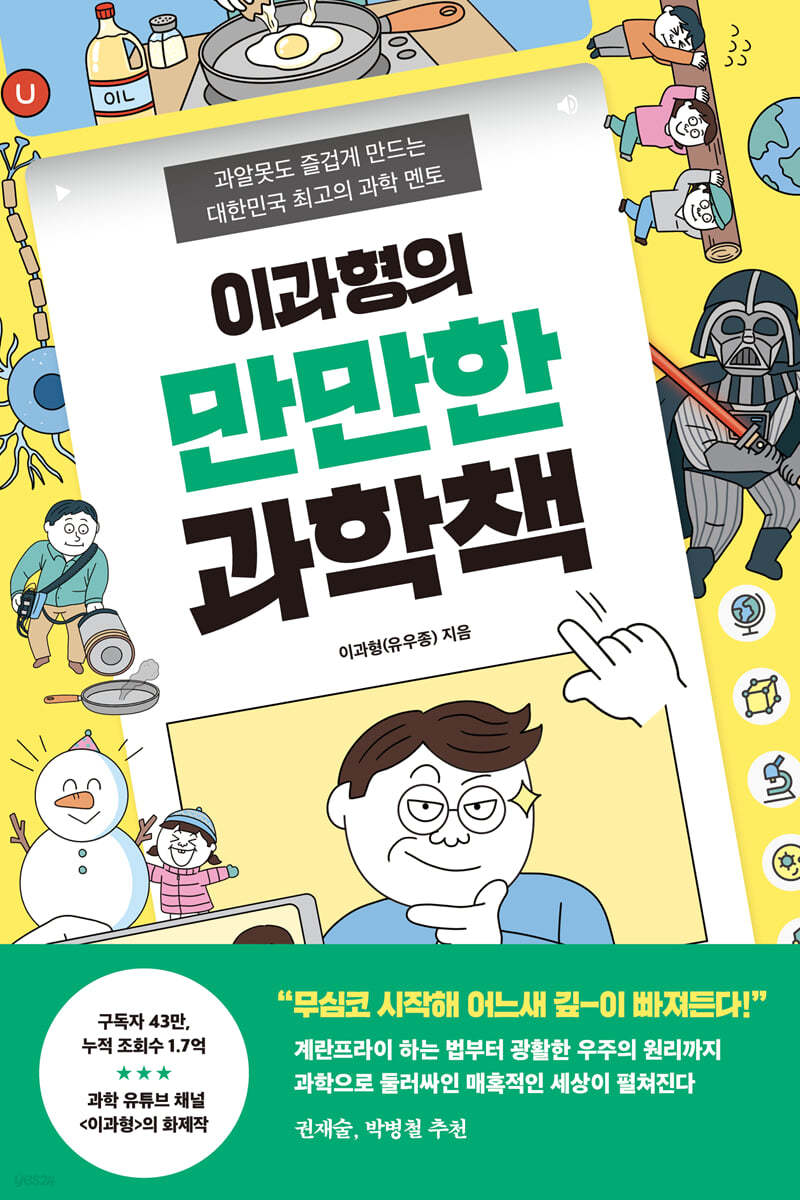
430,000 subscribers, 170 million cumulative views The hottest science channel in Korea, [Science and Technology] From how to fry an egg to the principles of the vast universe. A fascinating world surrounded by science unfolds! Recommended by science writers Kwon Jae-sul and Park Byeong-cheol There is a popular YouTube channel that has amassed 430,000 subscribers and 170 million cumulative views in less than two years. This is the science channel [Science Type] that you will keep coming back to once you start watching the videos. The science type guides various scientific knowledge with questions that stimulate curiosity and solves them with a fun twist, helping even science novice who gave up on science early to take a step back into science and fall in love with its charm. The science teacher, who has taught science to middle school students, uses engaging storytelling, excellent communication skills, and a variety of visual aids to convey scientific principles in an easy and fun way, leading science from being rigid to being familiar and enjoyable. It scientifically explains the know-how of making a beautiful fried egg or the winning strategy of tug-of-war, and it also explains the principles of heat energy while building a snowman and the properties of sound waves in the absurd story of putting out a forest fire with a curse. It also reveals scientific stories we didn't know about, such as Newton, who dreamed of becoming an alchemist, and Edison, who created a device to communicate with ghosts, and examines the development and current state of science, and even guides us into a world that seems beyond the realm of the principle of relativity and quantum mechanics. Even if you don't know the exact formulas or understand the exact concepts, if you follow the stories explained by the science major in this book, you will soon find yourself immersed in a fascinating world surrounded by science. |
- You can preview some of the book's contents.
Preview
index
Prologue | Science is inherently fun.
Part 1: Easy-to-understand science stories for Earthlings
We all dream of being alchemists
What is the most powerful weapon in the world?
There's a separate reason why we, who were so passionate, broke up.
Would a snowman want to wear a thick padded jumper?
The Secret of the Man Who Survived a 10km Fall
Is there a wildfire expert who can put out a forest fire by shouting?
How much does your soul weigh?
Why do my fried eggs keep burning?
Is Everest really the highest mountain?
It's so hard, and I've done zero.
What makes a fortune teller different?
The Uses of the Anal You Didn't Know About
Is Kamila Valieva's doping truly unfair?
Will they be able to join forces and cross the river?
Should Hawkeye be punished?
The Scientific Way to Win at Tug-of-War
Part 2: A Spectacular Science Story That Will Keep You Engaged Once You Hear It
Why is the night sky, filled with countless stars, dark?
Ghosts exist vs.
Ghosts do not exist
The solar system you imagined does not exist.
Pluto was wronged that day
What You, the Earth, and Ramen Soup Have in Common
The Origins of the Theory of Relativity, Understood by Everyone
Our time doesn't flow together
Beyond time and space, into space and time
Can we now unlock the secrets of the universe?
Towards another world
References
Part 1: Easy-to-understand science stories for Earthlings
We all dream of being alchemists
What is the most powerful weapon in the world?
There's a separate reason why we, who were so passionate, broke up.
Would a snowman want to wear a thick padded jumper?
The Secret of the Man Who Survived a 10km Fall
Is there a wildfire expert who can put out a forest fire by shouting?
How much does your soul weigh?
Why do my fried eggs keep burning?
Is Everest really the highest mountain?
It's so hard, and I've done zero.
What makes a fortune teller different?
The Uses of the Anal You Didn't Know About
Is Kamila Valieva's doping truly unfair?
Will they be able to join forces and cross the river?
Should Hawkeye be punished?
The Scientific Way to Win at Tug-of-War
Part 2: A Spectacular Science Story That Will Keep You Engaged Once You Hear It
Why is the night sky, filled with countless stars, dark?
Ghosts exist vs.
Ghosts do not exist
The solar system you imagined does not exist.
Pluto was wronged that day
What You, the Earth, and Ramen Soup Have in Common
The Origins of the Theory of Relativity, Understood by Everyone
Our time doesn't flow together
Beyond time and space, into space and time
Can we now unlock the secrets of the universe?
Towards another world
References
Detailed image
.jpg)
Into the book
Isn't it ironic that Newton, who created calculus and established the laws that govern the movement of all things, ushering in an era of science, was also fascinated by alchemy? Indeed, a 1979 chemical analysis of Newton's hair detected large quantities of mercury, a widely used alchemical reagent.
This further solidified Keynes's statement that Newton was the last magician.
At this point, it is necessary to find out what alchemy is, which even Newton was fascinated by.
Alchemy, simply put, is the secret art of turning cheap substances like iron and lead into expensive substances like gold and silver.
Since anyone can become rich overnight if they succeed, mankind has been desperately trying to discover this secret technique for about 2,000 years from ancient times to the Middle Ages.
People who once became immersed in alchemy often spent their entire lives melting, mixing, and separating substances day and night.
---From "We All Dream of Being Alchemists"
So how did she really survive? The air pressure in the air above the plane is extremely low.
So the airplane maintains a pressure control device inside the cabin.
However, if the plane is destroyed and the air pressure drops rapidly, the human body suddenly swells, and most people's hearts burst and they die instantly.
But Vesna Vulovic's heart was saved from bursting thanks to her chronic low blood pressure.
He was also trapped in the meal cart and crashed down a snowy slope with pieces of the broken aircraft.
The wide fuselage fragments increased air resistance.
It is not known exactly what angle of the slope she fell from, but even a 60-degree slope would have reduced the impact by half.
Also, if the snow had reduced the impact by more than half, survival would not have been impossible.
---From "The Secret of the Man Who Survived a 10km Fall"
In 1988, a patient came to Dr. Pesmia at the University of Tennessee Medical School.
This patient had been hiccups at a rate of 30 times per minute for a whopping 72 hours.
It's impossible to hiccup for that long.
But there are people who have had hiccups for even longer than this person.
Charles Osborne, an American, is listed in the Guinness Book of World Records as the person who hiccups the most in the world.
He had hiccups for 68 years, starting in 1922.
This happens once every 1.5 seconds, a total of 430 million times.
Then, in 1990, when he was 96 years old, the hiccups suddenly stopped.
And he died the following year.
Dr. Pesmia tried every treatment available to the patient who came to him, but the hiccups did not stop.
In the end, the doctor used the last resort.
It's just putting your hand into the patient's anus.
But then, as if by magic, the hiccups stopped.
How could he stop hiccups?
---From "The Uses of the Anal You Didn't Know About"
Our body is made up of 7×1027 atoms.
American physicist Paul Ebersold says that 98% of this is converted into atoms from the air and food we consume within a year.
Also, according to researchers at the Weizmann Institute of Science in Israel, the total number of cells in our body is around 30 trillion, and we replace an average of 330 billion cells per day.
Every day, 1% of all cells change.
Epithelial cells renew themselves every 5 days, skin every 2 weeks, red blood cells every 120 days, liver every 2 years, bones every 10 years, and muscles every 15 years.
The only things that don't change throughout life are brain neurons and eye lens cells.
These two account for only 0.5% of all cells.
Therefore, whether from an atomic or cellular perspective, it is correct to view my body as a completely new body after 15 years.
This is no different from quantum copying, the only difference is whether it changes instantly or slowly.
Are you the same person you were 15 years ago and are you the same person now? What exactly am I? Is the self I perceive now an illusion? Does free will exist?
---From "Should Hawkeye Be Punished?"
Contrary to Harry Houdini, there are people who believed in the existence of ghosts and tried to show that ghosts exist.
Thomas Edison, the inventor we all know so well.
Edison had over a thousand patents by the time he died.
But among the countless inventions he tried to make, there was one strange thing.
Before he died, he wrote a memoir called Reminiscences and Observations, and the story of this invention appears in the last chapter.
Edison thought it was very unscientific for mediums to sit at a table, place strange objects on it, and communicate with ghosts.
Edison decides to invent a scientific device to communicate with ghosts.
It is a ghost communication device that uses electromagnetic waves.
But there was a problem.
There was no way to verify that this was working correctly.
Edison made a solemn promise with his assistant, William Dinwiddie, that whoever died first would send a message from the afterlife.
---“Ghosts exist vs.
From "Ghosts do not exist"
As Carl Sagan pointed out, it was a huge mistake to think we had any presence in the solar system.
Wouldn't the solar system seen by aliens be nothing more than the sun? We're just a mere 0.14% impurity.
But this is wrong.
The various shapes and colors of diamonds, which are 99.95% carbon, are determined by the 0.05% impurities.
Electrons account for less than 0.03% of the mass of an atom.
However, all phenomena in the world that we experience, such as seeing, touching, and tasting matter, are caused by a few electrons located at the outermost part of atoms.
---From "What You, the Earth, and Ramen Soup Have in Common"
In 1971, Richard Keating and Joseph Hafel flew around the world twice, carrying four cesium atomic clocks on airplanes.
After the trip, a comparison with the four cesium atomic clocks kept on the ground showed that the clock on board was 59 billionths of a second slow.
This result was consistent with the predictions of the theory of relativity within a 10% error.
This also included time dilation in general relativity.
A few years later, physicists at the University of Maryland conducted a similar, more precise experiment.
They verified time dilation with an error of less than 1%.
Time dilation is also very essential for us today.
Your smartphone or car navigation system transmits signals to GPS satellites to tell you your current location.
This further solidified Keynes's statement that Newton was the last magician.
At this point, it is necessary to find out what alchemy is, which even Newton was fascinated by.
Alchemy, simply put, is the secret art of turning cheap substances like iron and lead into expensive substances like gold and silver.
Since anyone can become rich overnight if they succeed, mankind has been desperately trying to discover this secret technique for about 2,000 years from ancient times to the Middle Ages.
People who once became immersed in alchemy often spent their entire lives melting, mixing, and separating substances day and night.
---From "We All Dream of Being Alchemists"
So how did she really survive? The air pressure in the air above the plane is extremely low.
So the airplane maintains a pressure control device inside the cabin.
However, if the plane is destroyed and the air pressure drops rapidly, the human body suddenly swells, and most people's hearts burst and they die instantly.
But Vesna Vulovic's heart was saved from bursting thanks to her chronic low blood pressure.
He was also trapped in the meal cart and crashed down a snowy slope with pieces of the broken aircraft.
The wide fuselage fragments increased air resistance.
It is not known exactly what angle of the slope she fell from, but even a 60-degree slope would have reduced the impact by half.
Also, if the snow had reduced the impact by more than half, survival would not have been impossible.
---From "The Secret of the Man Who Survived a 10km Fall"
In 1988, a patient came to Dr. Pesmia at the University of Tennessee Medical School.
This patient had been hiccups at a rate of 30 times per minute for a whopping 72 hours.
It's impossible to hiccup for that long.
But there are people who have had hiccups for even longer than this person.
Charles Osborne, an American, is listed in the Guinness Book of World Records as the person who hiccups the most in the world.
He had hiccups for 68 years, starting in 1922.
This happens once every 1.5 seconds, a total of 430 million times.
Then, in 1990, when he was 96 years old, the hiccups suddenly stopped.
And he died the following year.
Dr. Pesmia tried every treatment available to the patient who came to him, but the hiccups did not stop.
In the end, the doctor used the last resort.
It's just putting your hand into the patient's anus.
But then, as if by magic, the hiccups stopped.
How could he stop hiccups?
---From "The Uses of the Anal You Didn't Know About"
Our body is made up of 7×1027 atoms.
American physicist Paul Ebersold says that 98% of this is converted into atoms from the air and food we consume within a year.
Also, according to researchers at the Weizmann Institute of Science in Israel, the total number of cells in our body is around 30 trillion, and we replace an average of 330 billion cells per day.
Every day, 1% of all cells change.
Epithelial cells renew themselves every 5 days, skin every 2 weeks, red blood cells every 120 days, liver every 2 years, bones every 10 years, and muscles every 15 years.
The only things that don't change throughout life are brain neurons and eye lens cells.
These two account for only 0.5% of all cells.
Therefore, whether from an atomic or cellular perspective, it is correct to view my body as a completely new body after 15 years.
This is no different from quantum copying, the only difference is whether it changes instantly or slowly.
Are you the same person you were 15 years ago and are you the same person now? What exactly am I? Is the self I perceive now an illusion? Does free will exist?
---From "Should Hawkeye Be Punished?"
Contrary to Harry Houdini, there are people who believed in the existence of ghosts and tried to show that ghosts exist.
Thomas Edison, the inventor we all know so well.
Edison had over a thousand patents by the time he died.
But among the countless inventions he tried to make, there was one strange thing.
Before he died, he wrote a memoir called Reminiscences and Observations, and the story of this invention appears in the last chapter.
Edison thought it was very unscientific for mediums to sit at a table, place strange objects on it, and communicate with ghosts.
Edison decides to invent a scientific device to communicate with ghosts.
It is a ghost communication device that uses electromagnetic waves.
But there was a problem.
There was no way to verify that this was working correctly.
Edison made a solemn promise with his assistant, William Dinwiddie, that whoever died first would send a message from the afterlife.
---“Ghosts exist vs.
From "Ghosts do not exist"
As Carl Sagan pointed out, it was a huge mistake to think we had any presence in the solar system.
Wouldn't the solar system seen by aliens be nothing more than the sun? We're just a mere 0.14% impurity.
But this is wrong.
The various shapes and colors of diamonds, which are 99.95% carbon, are determined by the 0.05% impurities.
Electrons account for less than 0.03% of the mass of an atom.
However, all phenomena in the world that we experience, such as seeing, touching, and tasting matter, are caused by a few electrons located at the outermost part of atoms.
---From "What You, the Earth, and Ramen Soup Have in Common"
In 1971, Richard Keating and Joseph Hafel flew around the world twice, carrying four cesium atomic clocks on airplanes.
After the trip, a comparison with the four cesium atomic clocks kept on the ground showed that the clock on board was 59 billionths of a second slow.
This result was consistent with the predictions of the theory of relativity within a 10% error.
This also included time dilation in general relativity.
A few years later, physicists at the University of Maryland conducted a similar, more precise experiment.
They verified time dilation with an error of less than 1%.
Time dilation is also very essential for us today.
Your smartphone or car navigation system transmits signals to GPS satellites to tell you your current location.
---From "Our Time Does Not Flow Together"
Publisher's Review
From the most outrageous scientific stories I've ever heard
Even modern scientific theories that make even liberal arts students nod along
Your sleeping scientific mind is finally awakening!
Has anyone survived a 10-kilometer fall? What's the scientific reason we, the long-time friends, broke up? What's the most reliable way to stop hiccups? Is there a master at putting out fires by screaming? Do snowmen like long padding? The science channel "Science Brothers," which guides many people into the world of science with fascinating topics and stories, is finally coming to book form.
With 430,000 subscribers and 170 million cumulative views in just two years, “Science Type” is a channel that is popular not only among science enthusiasts but also among typical liberal arts students who don’t know much about science.
The reason for this is probably because of the unique communication skills of the science instructor who introduces science in an easy and fun way.
《Science Book for Science Students》 reconstructs and contains the most loved and well-received content from science students' science stories, while adding theoretical explanations that could not be conveyed through video, and also contains the wit and sensibility unique to science students.
Additionally, new episodes are added to provide readers with a richer story.
From exciting science stories you've never heard before to entertaining interpretations of the most popular modern scientific theories, this book will upgrade your scientific acumen.
“Science is originally fun!”
A guide by self-proclaimed science storyteller, Lee Gwa-hyung
The amazing fun and usefulness of science you never knew about!
The science stories of this science teacher, who graduated from the Department of Physics Education at Korea National University of Education and has been teaching science in middle school, are interesting.
That's because the author's motto is "science is fun."
The author believes that the reason science is so rigid and dry is not because science is inherently rigid, but because the medium or those who convey it have neglected the "fun" aspect of science. He strives to convey any scientific principle or explanation as an interesting story to the listener.
So he wants people to call him a "science storyteller" rather than a science mentor, teacher, or science creator.
This book is full of fascinating and engaging science stories he tells.
The science type claims that Everest is not the highest mountain or questions the weight of the soul.
He explains atoms while talking about the world's most powerful weapon, explains the principles of force while explaining the winning strategy for tug-of-war, and teaches the principles of heat energy while building a snowman with his daughter.
It also reveals scientific stories we didn't know about, such as Newton, who dreamed of becoming an alchemist, and Edison, who created a device to communicate with ghosts, and examines the development and current state of science. It also guides us into a world that seems to lie beyond, such as the principle of relativity and quantum mechanics.
This book, which starts from atoms and moves to gravity, then thermodynamics and earth science, then genetics and brain science, and then moves out into the vast universe before settling on Einstein's theory of relativity, is introduced as follows by science writer Park Byeong-cheol.
“It’s as exciting as a roller coaster ride, yet it’s packed with the essence of modern science.
“This is a truly easy and informative science book that you can read with the mindset of going to an amusement park.”
The delightful interpretation of science and the unique illustrations of the artist Ppom.
The moment you open the book, science becomes easy!
“I just realized something I was wondering about in class 20 years ago!”
"Thanks to my science major, I've heard on blind dates that I'm knowledgeable."
A popular science book enjoyed by everyone from science nerds to science nerds alike.
This book, consisting of a total of 26 stories, adds illustrations by the beloved artist Ppom, who is known for his unique illustrations, to the solid storytelling of the science type, making science more accessible and fun to read.
Even those who haven't read a single science book since their school days will be able to confidently pick up this book and read it thoroughly.
However, this does not mean that this book is light.
Even if you start off easy, as you continue reading, you will be drawn into the breadth and depth of science guided by the science teacher, and you will encounter a new world of scientific knowledge and stories you were not aware of before.
Some people may have finally realized what they were curious about in middle school science class 20 years ago, others may have truly understood the scientific principles in their favorite science fiction movies, and others may have newly discovered modern scientific theories such as neuroscience and quantum mechanics.
You see as much as you know.
I hope that through this book, both science novice and science enthusiast will experience a broader world.
Even modern scientific theories that make even liberal arts students nod along
Your sleeping scientific mind is finally awakening!
Has anyone survived a 10-kilometer fall? What's the scientific reason we, the long-time friends, broke up? What's the most reliable way to stop hiccups? Is there a master at putting out fires by screaming? Do snowmen like long padding? The science channel "Science Brothers," which guides many people into the world of science with fascinating topics and stories, is finally coming to book form.
With 430,000 subscribers and 170 million cumulative views in just two years, “Science Type” is a channel that is popular not only among science enthusiasts but also among typical liberal arts students who don’t know much about science.
The reason for this is probably because of the unique communication skills of the science instructor who introduces science in an easy and fun way.
《Science Book for Science Students》 reconstructs and contains the most loved and well-received content from science students' science stories, while adding theoretical explanations that could not be conveyed through video, and also contains the wit and sensibility unique to science students.
Additionally, new episodes are added to provide readers with a richer story.
From exciting science stories you've never heard before to entertaining interpretations of the most popular modern scientific theories, this book will upgrade your scientific acumen.
“Science is originally fun!”
A guide by self-proclaimed science storyteller, Lee Gwa-hyung
The amazing fun and usefulness of science you never knew about!
The science stories of this science teacher, who graduated from the Department of Physics Education at Korea National University of Education and has been teaching science in middle school, are interesting.
That's because the author's motto is "science is fun."
The author believes that the reason science is so rigid and dry is not because science is inherently rigid, but because the medium or those who convey it have neglected the "fun" aspect of science. He strives to convey any scientific principle or explanation as an interesting story to the listener.
So he wants people to call him a "science storyteller" rather than a science mentor, teacher, or science creator.
This book is full of fascinating and engaging science stories he tells.
The science type claims that Everest is not the highest mountain or questions the weight of the soul.
He explains atoms while talking about the world's most powerful weapon, explains the principles of force while explaining the winning strategy for tug-of-war, and teaches the principles of heat energy while building a snowman with his daughter.
It also reveals scientific stories we didn't know about, such as Newton, who dreamed of becoming an alchemist, and Edison, who created a device to communicate with ghosts, and examines the development and current state of science. It also guides us into a world that seems to lie beyond, such as the principle of relativity and quantum mechanics.
This book, which starts from atoms and moves to gravity, then thermodynamics and earth science, then genetics and brain science, and then moves out into the vast universe before settling on Einstein's theory of relativity, is introduced as follows by science writer Park Byeong-cheol.
“It’s as exciting as a roller coaster ride, yet it’s packed with the essence of modern science.
“This is a truly easy and informative science book that you can read with the mindset of going to an amusement park.”
The delightful interpretation of science and the unique illustrations of the artist Ppom.
The moment you open the book, science becomes easy!
“I just realized something I was wondering about in class 20 years ago!”
"Thanks to my science major, I've heard on blind dates that I'm knowledgeable."
A popular science book enjoyed by everyone from science nerds to science nerds alike.
This book, consisting of a total of 26 stories, adds illustrations by the beloved artist Ppom, who is known for his unique illustrations, to the solid storytelling of the science type, making science more accessible and fun to read.
Even those who haven't read a single science book since their school days will be able to confidently pick up this book and read it thoroughly.
However, this does not mean that this book is light.
Even if you start off easy, as you continue reading, you will be drawn into the breadth and depth of science guided by the science teacher, and you will encounter a new world of scientific knowledge and stories you were not aware of before.
Some people may have finally realized what they were curious about in middle school science class 20 years ago, others may have truly understood the scientific principles in their favorite science fiction movies, and others may have newly discovered modern scientific theories such as neuroscience and quantum mechanics.
You see as much as you know.
I hope that through this book, both science novice and science enthusiast will experience a broader world.
GOODS SPECIFICS
- Date of issue: January 16, 2023
- Page count, weight, size: 296 pages | 456g | 140*210*20mm
- ISBN13: 9791158512569
- ISBN10: 1158512562
You may also like
카테고리
korean


korean

![GQ KOREA Mark (Monthly): December [2025]](http://librairie.coreenne.fr/cdn/shop/files/8ef265dbbfbf186523ed75ba7319009d.jpg?v=1765340328&width=3840)


