

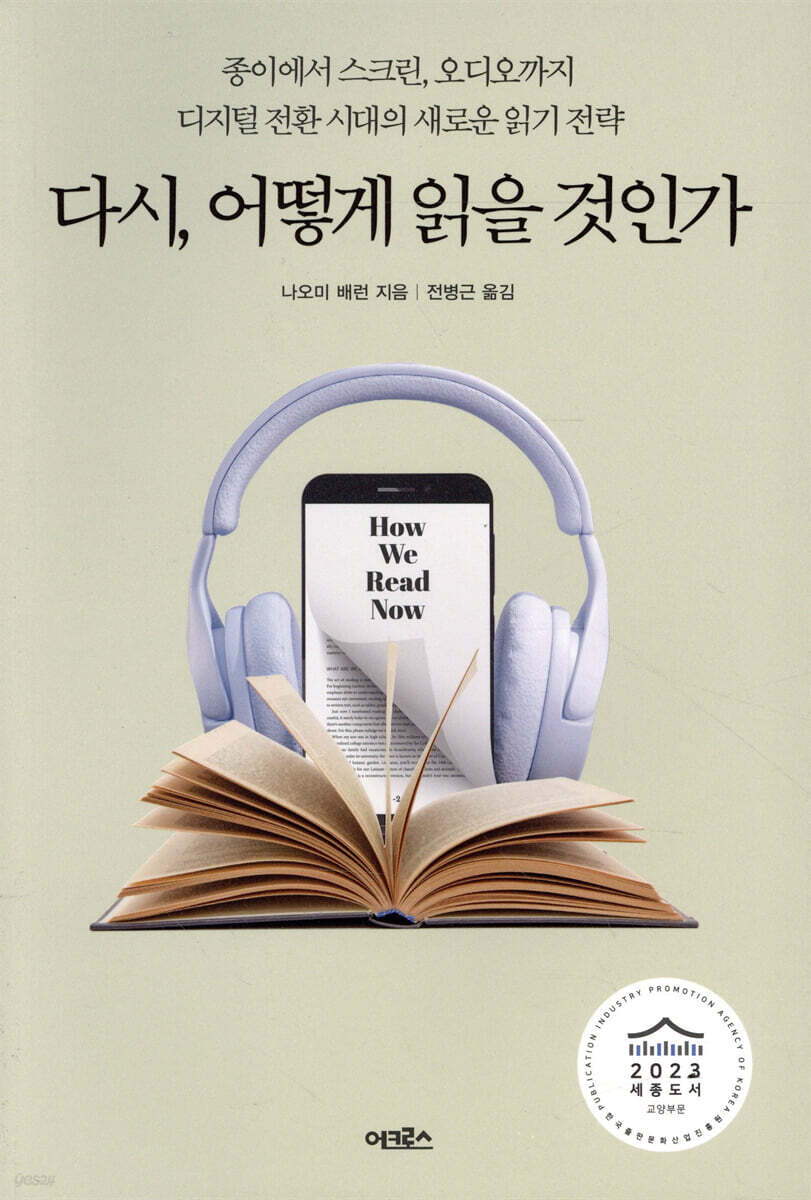
Again, how to read
 |
Description
Book Introduction
- A word from MD
-
Paper book or digital?Reading is changing.
The digital transformation has accelerated during COVID-19.
There is a story about the uselessness of paper books and their extinction.
Will e-books, audio, and video replace paper books? This book transcends the dichotomy between paper and digital, examining reading methods across age groups and topics to explore effective strategies.
January 6, 2023. Humanities PD Son Min-gyu
Marion Woolf recommends "Back to the Book"
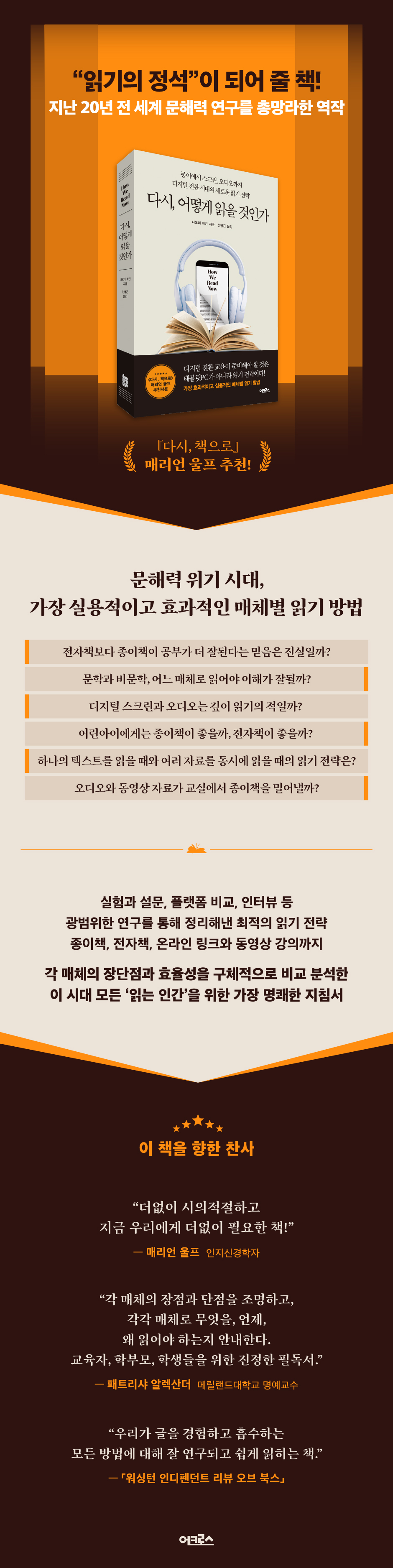
What digital transformation education needs to prepare for is not tablet PCs, but reading strategies!
Beyond the debate over vocabulary and literacy: paper books vs. e-books
The most effective and practical reading methods for each medium
· Is deep reading impossible on screen and audio?
· Should I give a paper book or an e-book as a birthday gift for a six-year-old child?
· Is it just my imagination that I feel like I learn more from paper books than e-books?
· Is it okay to view the research materials on the website on a computer screen? Would it be more effective to print them out and read them?
· Will audio and video push out paper books in the classroom?
“A book so timely and so much needed now.” -Marion Woolf
Which media is best for learning? What are the pros and cons of reading on paper versus on a screen? Are audio and video media effective for learning? Can students learn to read deeply and wisely in a digital culture? What role can digital media play in fostering critical thinking, the most important goal of education?
Linguist Naomi Barron, a leading expert in reading studies, has been deeply interested in the impact of digital devices on our language and reading since before smartphones became commonplace.
Professor Barron's research, conducted over the past two decades with students from around the world, including the United States, Norway, and Italy, addresses some of the most pressing questions among parents, educators, and policymakers today.
This book aims to provide the best answers to these questions, presenting in detail various cutting-edge research findings on reading and literacy, as well as media utilization methods according to age and purpose.
Our reading is becoming more and more diverse.
Beyond traditional paper books, digital learning media—from e-books and subscription services to video lectures and audiobooks—beckons us to a new era of reading unlike anything we've experienced before.
Meanwhile, COVID-19 has accelerated the shift of students from single-volume books to fragmented texts.
In changing times, both the tools and concepts of reading are expanding.
But more importantly, you need to know what value you want to gain from reading.
In this multimedia age, where one method can no longer be the standard for reading, this book will serve as a solid stepping stone for all readers of this era, striving to advance into the realm of knowledge and wisdom through countless reading platforms.
What digital transformation education needs to prepare for is not tablet PCs, but reading strategies!
Beyond the debate over vocabulary and literacy: paper books vs. e-books
The most effective and practical reading methods for each medium
· Is deep reading impossible on screen and audio?
· Should I give a paper book or an e-book as a birthday gift for a six-year-old child?
· Is it just my imagination that I feel like I learn more from paper books than e-books?
· Is it okay to view the research materials on the website on a computer screen? Would it be more effective to print them out and read them?
· Will audio and video push out paper books in the classroom?
“A book so timely and so much needed now.” -Marion Woolf
Which media is best for learning? What are the pros and cons of reading on paper versus on a screen? Are audio and video media effective for learning? Can students learn to read deeply and wisely in a digital culture? What role can digital media play in fostering critical thinking, the most important goal of education?
Linguist Naomi Barron, a leading expert in reading studies, has been deeply interested in the impact of digital devices on our language and reading since before smartphones became commonplace.
Professor Barron's research, conducted over the past two decades with students from around the world, including the United States, Norway, and Italy, addresses some of the most pressing questions among parents, educators, and policymakers today.
This book aims to provide the best answers to these questions, presenting in detail various cutting-edge research findings on reading and literacy, as well as media utilization methods according to age and purpose.
Our reading is becoming more and more diverse.
Beyond traditional paper books, digital learning media—from e-books and subscription services to video lectures and audiobooks—beckons us to a new era of reading unlike anything we've experienced before.
Meanwhile, COVID-19 has accelerated the shift of students from single-volume books to fragmented texts.
In changing times, both the tools and concepts of reading are expanding.
But more importantly, you need to know what value you want to gain from reading.
In this multimedia age, where one method can no longer be the standard for reading, this book will serve as a solid stepping stone for all readers of this era, striving to advance into the realm of knowledge and wisdom through countless reading platforms.
- You can preview some of the book's contents.
Preview
index
Recommendation: A Solid Foundation for Wise Reading (Marion Woolf)
Translator's Note: Rethinking and Transforming Reading in the Digital Age
Introduction: The New Debate Surrounding Reading
Part 1: The Reality of Our Reading
Chapter 1: Reflecting on 'Reading' and 'Readers'
The various types of 'reading' we didn't know about / The concept of literacy is changing / The roles of touch, smell, and hearing in reading / Looking into the reading eye: Eye tracking / Measuring reading / Factors to consider when talking about 'readers'
Chapter 2: What are we reading and with what?
The impact of a text's 'genre' on reading / Digital reading is sweeping the educational landscape / Why reading research yields unexpected results / How we interact with digital texts / Is technology the problem or is it our mindset?
Chapter 3: The Illusion of Reading a Paper Book Properly
The Bewildering Shift in Leisure Reading / Are Students Doing Their Reading Assignments Sincerely? / The Reality of Education: Interviews with Teachers in the U.S. and Norway / Proven Reading Strategies
Part 2: The Most Difficult Question: Paper Reading vs. Digital Reading
Chapter 4: When Reading Only One Text _ Reading Study 1
Should We Give Young Children Digital Books? / A Reading Study of School-Age Readers / Key Takeaways
Chapter 5: Searching and Reading Various Materials on the Internet _ Reading Research 2
The Unintended Consequences of the Internet / Digital Transformation in Schools / Online Exploration: Changing the Learning Landscape / Reading Multiple Materials Online / The Neverending Debate: Content or Container? / How Online Reading Has Changed Education / Key Summary
Chapter 6: Optimal Digital Reading Strategies for Learning
Things to remember / Digital reading strategies for young children / Digital reading strategies for students 1: When it's a single text / Digital reading strategies for students 2: When it's multiple texts / The impact of digital reading on citizenship / For better choices
Part 3: The Age of Reading by Ear: Audio and Video Reading
Chapter 7: Can Audiobooks and Video Lectures Replace Textbooks?
From an oral culture to a written culture / The era of reading by ear has arrived / When using audio for learning
When to Use Audio and Text Together / Some Issues Surrounding Video Learning / Key Summary
Chapter 8: Optimal Audio and Video Reading Strategies for Learning
Will Audio and Video Create a Wordless Classroom? / Things to Remember / Audio and Video Reading Strategies for Young Children / Audio and Video Reading Strategies for Students
Part 4: The Future of Reading
Chapter 9: Developing Reading Strategies in a Digital World
People Who Can't Focus on Reading / How the 'Instant Access' Culture Has Changed Us / The Digital Mindset That Permeates Paper Reading / Reading Strategies in a Digital World: Ambidextrous Literacy
Chapter 10: How to Create an Era of Abundant Reading
The paradoxical situation of paper books in schools
The purpose of education today
How to Raise Students to Be Readers
Recommended Reading Diet for Everyone
Acknowledgements
main
References
Translator's Note: Rethinking and Transforming Reading in the Digital Age
Introduction: The New Debate Surrounding Reading
Part 1: The Reality of Our Reading
Chapter 1: Reflecting on 'Reading' and 'Readers'
The various types of 'reading' we didn't know about / The concept of literacy is changing / The roles of touch, smell, and hearing in reading / Looking into the reading eye: Eye tracking / Measuring reading / Factors to consider when talking about 'readers'
Chapter 2: What are we reading and with what?
The impact of a text's 'genre' on reading / Digital reading is sweeping the educational landscape / Why reading research yields unexpected results / How we interact with digital texts / Is technology the problem or is it our mindset?
Chapter 3: The Illusion of Reading a Paper Book Properly
The Bewildering Shift in Leisure Reading / Are Students Doing Their Reading Assignments Sincerely? / The Reality of Education: Interviews with Teachers in the U.S. and Norway / Proven Reading Strategies
Part 2: The Most Difficult Question: Paper Reading vs. Digital Reading
Chapter 4: When Reading Only One Text _ Reading Study 1
Should We Give Young Children Digital Books? / A Reading Study of School-Age Readers / Key Takeaways
Chapter 5: Searching and Reading Various Materials on the Internet _ Reading Research 2
The Unintended Consequences of the Internet / Digital Transformation in Schools / Online Exploration: Changing the Learning Landscape / Reading Multiple Materials Online / The Neverending Debate: Content or Container? / How Online Reading Has Changed Education / Key Summary
Chapter 6: Optimal Digital Reading Strategies for Learning
Things to remember / Digital reading strategies for young children / Digital reading strategies for students 1: When it's a single text / Digital reading strategies for students 2: When it's multiple texts / The impact of digital reading on citizenship / For better choices
Part 3: The Age of Reading by Ear: Audio and Video Reading
Chapter 7: Can Audiobooks and Video Lectures Replace Textbooks?
From an oral culture to a written culture / The era of reading by ear has arrived / When using audio for learning
When to Use Audio and Text Together / Some Issues Surrounding Video Learning / Key Summary
Chapter 8: Optimal Audio and Video Reading Strategies for Learning
Will Audio and Video Create a Wordless Classroom? / Things to Remember / Audio and Video Reading Strategies for Young Children / Audio and Video Reading Strategies for Students
Part 4: The Future of Reading
Chapter 9: Developing Reading Strategies in a Digital World
People Who Can't Focus on Reading / How the 'Instant Access' Culture Has Changed Us / The Digital Mindset That Permeates Paper Reading / Reading Strategies in a Digital World: Ambidextrous Literacy
Chapter 10: How to Create an Era of Abundant Reading
The paradoxical situation of paper books in schools
The purpose of education today
How to Raise Students to Be Readers
Recommended Reading Diet for Everyone
Acknowledgements
main
References
Detailed image
Into the book
A new debate is raging in the reading world right now.
The battlefield changed and the range of participants expanded.
In today's digitally saturated world, the question on people's minds is: "Does the medium you use to read matter?"
With the explosive growth of digital texts (whether freely available online or sold as e-books), we now have to choose when to read on paper and when to read on a digital screen.
Moreover, a third option has emerged.
There has been a huge increase in audio media, such as podcasts and audiobooks, as well as audio and video available on YouTube and TED Talks.
Now we can 'read' with our ears too.
--- p.25
Does people's preferred reading medium also influence their level of learnability? Perhaps.
The answer is complex.
One reason is that people's attitudes have changed over the past decade or so.
Previous research has shown that even though paper and digital reading scores are virtually identical, many college students prefer paper.
On the other hand, students of all ages are preferring digital reading even though paper reading scores are higher on questions that assess deeper understanding.
--- p.66
Seeing these things unfold reminded me of the 'warm-up' we did back in 2009.
It was a time when school closures were feared as the H1N1 virus showed signs of becoming a pandemic.
My university (and I think many others) has asked faculty to upload as much course material as possible to the school's digital learning management system.
This was a measure taken in case face-to-face classes had to be canceled.
We adjusted our syllabus by discarding paper books that we had set aside in the library reserve or that we expected students to purchase or check out from the library shelves during the semester.
Instead of using the entire book, we replaced it with single chapters that could be converted to digital format and put them online.
We also found papers in journals to which our library has a digital subscription.
In short, the threat of disease has helped shift from a complete paper book to fragmented digital texts.
COVID-19 has accelerated this movement.
--- p.84
As digital screens and audio increasingly replace paper reading, it seems reasonable to expect that tools that have long been used to guide students' paper reading will also be helpful.
As we will see, annotating, identifying keywords, and summarizing are reading skills that researchers recommend.
But are these strategies even effective for reading on paper? You might ask, "What kind of question is that?"
Of course, there is evidence that these strategies can be helpful.
This technique is especially helpful when slowing down the reading pace and allowing students to revisit their own annotations.
However, educational psychologists have questioned whether some of the proven reading strategies really work.
--- p.133
Innovative projects are also underway to foster collaborative digital annotation.
In Taiwan, a project targeting fifth-grade students reported that using such digital tools improved both explicit and inferential reading comprehension.
At the university level, there is a sophisticated system called Peruzzoall, designed by Eric Mazur and colleagues and developed at Harvard.
Mazur, a physicist, is also a pioneer in using techniques that promote active learning to help students remember what they've learned long after final exams.
--- p.272
Benjamin Hollis and Christopher Woese measured how much undergraduates' minds wandered while they watched a video.
Researchers asked students enrolled in online classes to watch two online lectures from their own digital devices, wherever they were.
Each lecture was about 13 minutes long.
While students watched each lecture, they were interrupted four times and asked, “What were you thinking about in the last five seconds?”
The choices were: ① a video, ② thoughts about how well I understood the video, ③ memories of past events, ④ something in the future, ⑤ my current state (e.g., hunger), ⑥ thinking about or using another technology (e.g., texting or Facebook), and ⑦ other.
In total, students reported thinking about something unrelated to the video a whopping 43 percent of the time.
--- p.348
What do these facts tell us about our attitudes toward digital reading? Screen reading is often incredibly convenient.
But despite all this convenience, don't we also tend to undervalue digital texts? "Value," here, is something we translate into the amount of time and effort we're willing to expend reading them.
If so, the challenge associated with serious reading on digital platforms isn't simply that we can "multitask" (remember the hypothesis that this leads to shallow reading).
Perhaps part of the problem has to do with the fact that, fundamentally, we feel that text, when virtual, is not as valuable as literal words printed on paper.
The battlefield changed and the range of participants expanded.
In today's digitally saturated world, the question on people's minds is: "Does the medium you use to read matter?"
With the explosive growth of digital texts (whether freely available online or sold as e-books), we now have to choose when to read on paper and when to read on a digital screen.
Moreover, a third option has emerged.
There has been a huge increase in audio media, such as podcasts and audiobooks, as well as audio and video available on YouTube and TED Talks.
Now we can 'read' with our ears too.
--- p.25
Does people's preferred reading medium also influence their level of learnability? Perhaps.
The answer is complex.
One reason is that people's attitudes have changed over the past decade or so.
Previous research has shown that even though paper and digital reading scores are virtually identical, many college students prefer paper.
On the other hand, students of all ages are preferring digital reading even though paper reading scores are higher on questions that assess deeper understanding.
--- p.66
Seeing these things unfold reminded me of the 'warm-up' we did back in 2009.
It was a time when school closures were feared as the H1N1 virus showed signs of becoming a pandemic.
My university (and I think many others) has asked faculty to upload as much course material as possible to the school's digital learning management system.
This was a measure taken in case face-to-face classes had to be canceled.
We adjusted our syllabus by discarding paper books that we had set aside in the library reserve or that we expected students to purchase or check out from the library shelves during the semester.
Instead of using the entire book, we replaced it with single chapters that could be converted to digital format and put them online.
We also found papers in journals to which our library has a digital subscription.
In short, the threat of disease has helped shift from a complete paper book to fragmented digital texts.
COVID-19 has accelerated this movement.
--- p.84
As digital screens and audio increasingly replace paper reading, it seems reasonable to expect that tools that have long been used to guide students' paper reading will also be helpful.
As we will see, annotating, identifying keywords, and summarizing are reading skills that researchers recommend.
But are these strategies even effective for reading on paper? You might ask, "What kind of question is that?"
Of course, there is evidence that these strategies can be helpful.
This technique is especially helpful when slowing down the reading pace and allowing students to revisit their own annotations.
However, educational psychologists have questioned whether some of the proven reading strategies really work.
--- p.133
Innovative projects are also underway to foster collaborative digital annotation.
In Taiwan, a project targeting fifth-grade students reported that using such digital tools improved both explicit and inferential reading comprehension.
At the university level, there is a sophisticated system called Peruzzoall, designed by Eric Mazur and colleagues and developed at Harvard.
Mazur, a physicist, is also a pioneer in using techniques that promote active learning to help students remember what they've learned long after final exams.
--- p.272
Benjamin Hollis and Christopher Woese measured how much undergraduates' minds wandered while they watched a video.
Researchers asked students enrolled in online classes to watch two online lectures from their own digital devices, wherever they were.
Each lecture was about 13 minutes long.
While students watched each lecture, they were interrupted four times and asked, “What were you thinking about in the last five seconds?”
The choices were: ① a video, ② thoughts about how well I understood the video, ③ memories of past events, ④ something in the future, ⑤ my current state (e.g., hunger), ⑥ thinking about or using another technology (e.g., texting or Facebook), and ⑦ other.
In total, students reported thinking about something unrelated to the video a whopping 43 percent of the time.
--- p.348
What do these facts tell us about our attitudes toward digital reading? Screen reading is often incredibly convenient.
But despite all this convenience, don't we also tend to undervalue digital texts? "Value," here, is something we translate into the amount of time and effort we're willing to expend reading them.
If so, the challenge associated with serious reading on digital platforms isn't simply that we can "multitask" (remember the hypothesis that this leads to shallow reading).
Perhaps part of the problem has to do with the fact that, fundamentally, we feel that text, when virtual, is not as valuable as literal words printed on paper.
--- p.389
Publisher's Review
★★★Recommended by Marion Woolf: "Back to the Book"★★★
What digital transformation education needs to prepare for is not tablet PCs, but reading strategies!
Beyond the debate over vocabulary and literacy: paper books vs. e-books
The most effective and practical reading methods for each medium
* A masterpiece that comprehensively covers reading research conducted around the world over the past 20 years.
Which media is best for learning? What are the pros and cons of reading on paper versus on a screen? Are audio and video media effective for learning? Can students learn to read deeply and wisely in a digital culture? What role can digital media play in fostering critical thinking, the most important goal of education? Naomi Barron, a linguist recognized as a leading expert in reading research, has been deeply interested in the impact of digital devices on language and reading even before smartphones became commonplace.
Professor Barron's research, conducted over the past two decades with students from around the world, including the United States, Norway, and Italy, addresses some of the most pressing questions among parents, educators, and policymakers today.
This book aims to provide the best answers to these questions, presenting in detail various cutting-edge research findings on reading and literacy, as well as media utilization methods according to age and purpose.
Our reading is becoming more and more diverse.
Beyond traditional paper books, digital learning media—from e-books and subscription services to video lectures and audiobooks—beckons us to a new era of reading unlike anything we've experienced before.
Meanwhile, COVID-19 has accelerated the shift of students from single-volume books to fragmented texts.
In changing times, both the tools and concepts of reading are expanding.
But more importantly, you need to know what value you want to gain from reading.
In this multimedia age, where one method can no longer be the standard for reading, this book will serve as a solid stepping stone for all "readers" of this era, striving to advance into the realm of knowledge and wisdom through countless reading platforms.
Literacy of the Past vs. Literacy of the Future
― A Great Turning Point in Reading: How Should We Read?
We live in an age where we receive more information through digital screens and video content on social media than through printed materials on paper.
With the emergence of new media, our reading methods and habits have changed significantly.
In the past, literacy referred to the ability to read and write, but with the widespread spread of digital technology, literacy in the new digital environment has become a concept that includes the skills needed to access and communicate digital information, as well as an understanding of its social context.
Pointing out the limitations and problems of online reading by comparing it to reading paper books is not enough to keep up with the changing reality.
Students need to learn new literacies that allow them to access, synthesize, and critically interpret a vast array of resources, both online and in print.
Why do people who spend more time on social media score lower on reading comprehension? Is a paper book or an e-book better for a six-year-old's birthday? Is it better to read research materials on a computer screen or print them out? How can we critically review Google search results online? How can we synthesize the information we obtain by following hyperlinks? Drawing on 20 years of global research on reading and literacy, this book examines how the way we read has drastically changed during the digital transition. It then proposes effective and practical reading strategies tailored to the literacy and media demands of this new era.
Beyond the black-and-white logic of reading, paper books and digital
― What content should be read best through which medium? What is the optimal reading method for each medium?
Everyone knows that we live in an age where we can no longer read only the letters printed on paper.
But the shift to digital has brought a lot of confusion about reading.
Is it okay to teach preschoolers to read using digital devices? Wouldn't utilizing a variety of multimedia e-books be more effective for effective learning? The long-held belief that reading on paper is the only way to truly read, and that digital content should be avoided as much as possible, is confusing us in today's world, where the amount of digital information has increased dramatically.
In this book, the author explains the differences in how we focus on text, understand its content, and remember it across different reading media, and argues that we must move beyond the dichotomy between paper and digital books and adopt new reading strategies suited to each medium.
Rather than arguing that one medium is better than another, the authors explain how we read and learn in each context we find ourselves in, synthesize current research, and offer specific recommendations for the best reading strategies to adopt when reading print, reading on screen, and listening to video and audio.
"For toddlers and preschoolers, if the goal of reading is to improve communication skills, it's better to use a paper book. If the goal is to make reading fun, it's better to use a multimedia e-book." "When reading digital media, focus is better on a fixed page than scrolling, so use the page-turning function." "When reading digital materials, consciously slow down your reading speed."
Paper books (and reading) will never die.
At the same time, digital text (and audio and video) are now part of our classrooms.
At least for the foreseeable future, it will be an unavoidable reality.
And it's a blessing for us, given that it can enrich education even more.
The secret to making it a blessing, as we have argued so far, is to identify which medium suits which type of learning.
- From Chapter 10, “How to Create an Era of Abundant Reading”
Digital transformation education requires more than just tablets.
― How to develop reflective skills, critical thinking skills, and the ability to use information appropriately.
As the digital revolution accelerates in the wake of the pandemic, the educational landscape is rapidly being reorganized around screen reading, centered on digital textbooks, and reading (listening) to audiobooks, including videos.
As classes moved online, reading materials and assignments became digital, and some schools began providing tablets to students.
It's been a while since news broke that all textbooks were planned to be published digitally first.
The problem is that this entire process is being conducted with only an emphasis on the aspects of 'cost' and 'convenience' without sufficient research and review from an educational and learning perspective.
And above all, there is a great risk that the essential reflection on ‘what humans pursue through reading’ will be omitted in this process.
The author expresses serious concerns about the important values that are being lost in this rapid digitalization of educational processes.
From paper to audio, reading instruction methods appropriate for each medium must be sufficiently researched and prepared, and reading education, as a foundation for long-term, lifelong learning, must be able to cultivate the reflective ability of an active human being, the critical thinking ability of a democratic citizen, and the ability to use information correctly in the digital age.
In this context, the author emphasizes the importance of 'reading long texts,' which is often overlooked in recent digital trends, and suggests reading novels as an alternative.
It is a matter of great concern that recent school education emphasizes only reading short passages for exams and increasingly neglects the importance of reading longer texts.
To get to the heart of an issue, you need to be able to wrestle with long-form writing.
Higher human cognitive abilities, such as critical thinking and reflection, are developed through the process of reading, and long-term reading is essential for this.
What needs to be discussed urgently in the educational field now is not the spread of tablet PCs, but a curriculum centered on reading long texts, including narratives, and the development of the reading habits necessary for this.
Whether we read on paper, digitally, or through video, our priority should be finding the best reading methods that preserve and cultivate our capacity to think for ourselves.
It's not entirely wrong for students to value visually appealing text and consider hyperlinks worth following.
This trend is also confirmed through related research.
Our job is to teach students that things aren't always like that.
- From Chapter 6, “The Optimal Digital Reading Strategy for Learning”
What are the best reading strategies for learning?
― A reading education guidebook tailored to each age and situation.
"How to Read Again" is a timely guide for anyone concerned about proper reading in the digital age.
It systematically organizes the latest research findings from scholars around the world on reading and literacy, and provides detailed guidance on how to utilize media for different reading purposes, from preschoolers to college-aged readers and beyond.
The questions, which are appropriately organized to fit the 'reading situation', the author's answers, and the chapter summaries are very helpful in understanding and utilizing this book.
This book will serve as a reading education guide that provides profound insight to teachers and other professionals working in the education field, and it is also a useful guide that provides much food for thought and practical guidance to students, parents, and others interested in reading.
I am confident that this will be a useful guide for those struggling with how to read and teach in this era of digital transformation and the deluge of various media and platforms.
What digital transformation education needs to prepare for is not tablet PCs, but reading strategies!
Beyond the debate over vocabulary and literacy: paper books vs. e-books
The most effective and practical reading methods for each medium
* A masterpiece that comprehensively covers reading research conducted around the world over the past 20 years.
Which media is best for learning? What are the pros and cons of reading on paper versus on a screen? Are audio and video media effective for learning? Can students learn to read deeply and wisely in a digital culture? What role can digital media play in fostering critical thinking, the most important goal of education? Naomi Barron, a linguist recognized as a leading expert in reading research, has been deeply interested in the impact of digital devices on language and reading even before smartphones became commonplace.
Professor Barron's research, conducted over the past two decades with students from around the world, including the United States, Norway, and Italy, addresses some of the most pressing questions among parents, educators, and policymakers today.
This book aims to provide the best answers to these questions, presenting in detail various cutting-edge research findings on reading and literacy, as well as media utilization methods according to age and purpose.
Our reading is becoming more and more diverse.
Beyond traditional paper books, digital learning media—from e-books and subscription services to video lectures and audiobooks—beckons us to a new era of reading unlike anything we've experienced before.
Meanwhile, COVID-19 has accelerated the shift of students from single-volume books to fragmented texts.
In changing times, both the tools and concepts of reading are expanding.
But more importantly, you need to know what value you want to gain from reading.
In this multimedia age, where one method can no longer be the standard for reading, this book will serve as a solid stepping stone for all "readers" of this era, striving to advance into the realm of knowledge and wisdom through countless reading platforms.
Literacy of the Past vs. Literacy of the Future
― A Great Turning Point in Reading: How Should We Read?
We live in an age where we receive more information through digital screens and video content on social media than through printed materials on paper.
With the emergence of new media, our reading methods and habits have changed significantly.
In the past, literacy referred to the ability to read and write, but with the widespread spread of digital technology, literacy in the new digital environment has become a concept that includes the skills needed to access and communicate digital information, as well as an understanding of its social context.
Pointing out the limitations and problems of online reading by comparing it to reading paper books is not enough to keep up with the changing reality.
Students need to learn new literacies that allow them to access, synthesize, and critically interpret a vast array of resources, both online and in print.
Why do people who spend more time on social media score lower on reading comprehension? Is a paper book or an e-book better for a six-year-old's birthday? Is it better to read research materials on a computer screen or print them out? How can we critically review Google search results online? How can we synthesize the information we obtain by following hyperlinks? Drawing on 20 years of global research on reading and literacy, this book examines how the way we read has drastically changed during the digital transition. It then proposes effective and practical reading strategies tailored to the literacy and media demands of this new era.
Beyond the black-and-white logic of reading, paper books and digital
― What content should be read best through which medium? What is the optimal reading method for each medium?
Everyone knows that we live in an age where we can no longer read only the letters printed on paper.
But the shift to digital has brought a lot of confusion about reading.
Is it okay to teach preschoolers to read using digital devices? Wouldn't utilizing a variety of multimedia e-books be more effective for effective learning? The long-held belief that reading on paper is the only way to truly read, and that digital content should be avoided as much as possible, is confusing us in today's world, where the amount of digital information has increased dramatically.
In this book, the author explains the differences in how we focus on text, understand its content, and remember it across different reading media, and argues that we must move beyond the dichotomy between paper and digital books and adopt new reading strategies suited to each medium.
Rather than arguing that one medium is better than another, the authors explain how we read and learn in each context we find ourselves in, synthesize current research, and offer specific recommendations for the best reading strategies to adopt when reading print, reading on screen, and listening to video and audio.
"For toddlers and preschoolers, if the goal of reading is to improve communication skills, it's better to use a paper book. If the goal is to make reading fun, it's better to use a multimedia e-book." "When reading digital media, focus is better on a fixed page than scrolling, so use the page-turning function." "When reading digital materials, consciously slow down your reading speed."
Paper books (and reading) will never die.
At the same time, digital text (and audio and video) are now part of our classrooms.
At least for the foreseeable future, it will be an unavoidable reality.
And it's a blessing for us, given that it can enrich education even more.
The secret to making it a blessing, as we have argued so far, is to identify which medium suits which type of learning.
- From Chapter 10, “How to Create an Era of Abundant Reading”
Digital transformation education requires more than just tablets.
― How to develop reflective skills, critical thinking skills, and the ability to use information appropriately.
As the digital revolution accelerates in the wake of the pandemic, the educational landscape is rapidly being reorganized around screen reading, centered on digital textbooks, and reading (listening) to audiobooks, including videos.
As classes moved online, reading materials and assignments became digital, and some schools began providing tablets to students.
It's been a while since news broke that all textbooks were planned to be published digitally first.
The problem is that this entire process is being conducted with only an emphasis on the aspects of 'cost' and 'convenience' without sufficient research and review from an educational and learning perspective.
And above all, there is a great risk that the essential reflection on ‘what humans pursue through reading’ will be omitted in this process.
The author expresses serious concerns about the important values that are being lost in this rapid digitalization of educational processes.
From paper to audio, reading instruction methods appropriate for each medium must be sufficiently researched and prepared, and reading education, as a foundation for long-term, lifelong learning, must be able to cultivate the reflective ability of an active human being, the critical thinking ability of a democratic citizen, and the ability to use information correctly in the digital age.
In this context, the author emphasizes the importance of 'reading long texts,' which is often overlooked in recent digital trends, and suggests reading novels as an alternative.
It is a matter of great concern that recent school education emphasizes only reading short passages for exams and increasingly neglects the importance of reading longer texts.
To get to the heart of an issue, you need to be able to wrestle with long-form writing.
Higher human cognitive abilities, such as critical thinking and reflection, are developed through the process of reading, and long-term reading is essential for this.
What needs to be discussed urgently in the educational field now is not the spread of tablet PCs, but a curriculum centered on reading long texts, including narratives, and the development of the reading habits necessary for this.
Whether we read on paper, digitally, or through video, our priority should be finding the best reading methods that preserve and cultivate our capacity to think for ourselves.
It's not entirely wrong for students to value visually appealing text and consider hyperlinks worth following.
This trend is also confirmed through related research.
Our job is to teach students that things aren't always like that.
- From Chapter 6, “The Optimal Digital Reading Strategy for Learning”
What are the best reading strategies for learning?
― A reading education guidebook tailored to each age and situation.
"How to Read Again" is a timely guide for anyone concerned about proper reading in the digital age.
It systematically organizes the latest research findings from scholars around the world on reading and literacy, and provides detailed guidance on how to utilize media for different reading purposes, from preschoolers to college-aged readers and beyond.
The questions, which are appropriately organized to fit the 'reading situation', the author's answers, and the chapter summaries are very helpful in understanding and utilizing this book.
This book will serve as a reading education guide that provides profound insight to teachers and other professionals working in the education field, and it is also a useful guide that provides much food for thought and practical guidance to students, parents, and others interested in reading.
I am confident that this will be a useful guide for those struggling with how to read and teach in this era of digital transformation and the deluge of various media and platforms.
GOODS SPECIFICS
- Date of issue: January 5, 2023
- Page count, weight, size: 488 pages | 648g | 147*215*30mm
- ISBN13: 9791167740847
- ISBN10: 116774084X
You may also like
카테고리
korean


korean

![ELLE 엘르 스페셜 에디션 A형 : 12월 [2025]](http://librairie.coreenne.fr/cdn/shop/files/b8e27a3de6c9538896439686c6b0e8fb.jpg?v=1766436872&width=3840)


