

immunity
 |
Description
Book Introduction
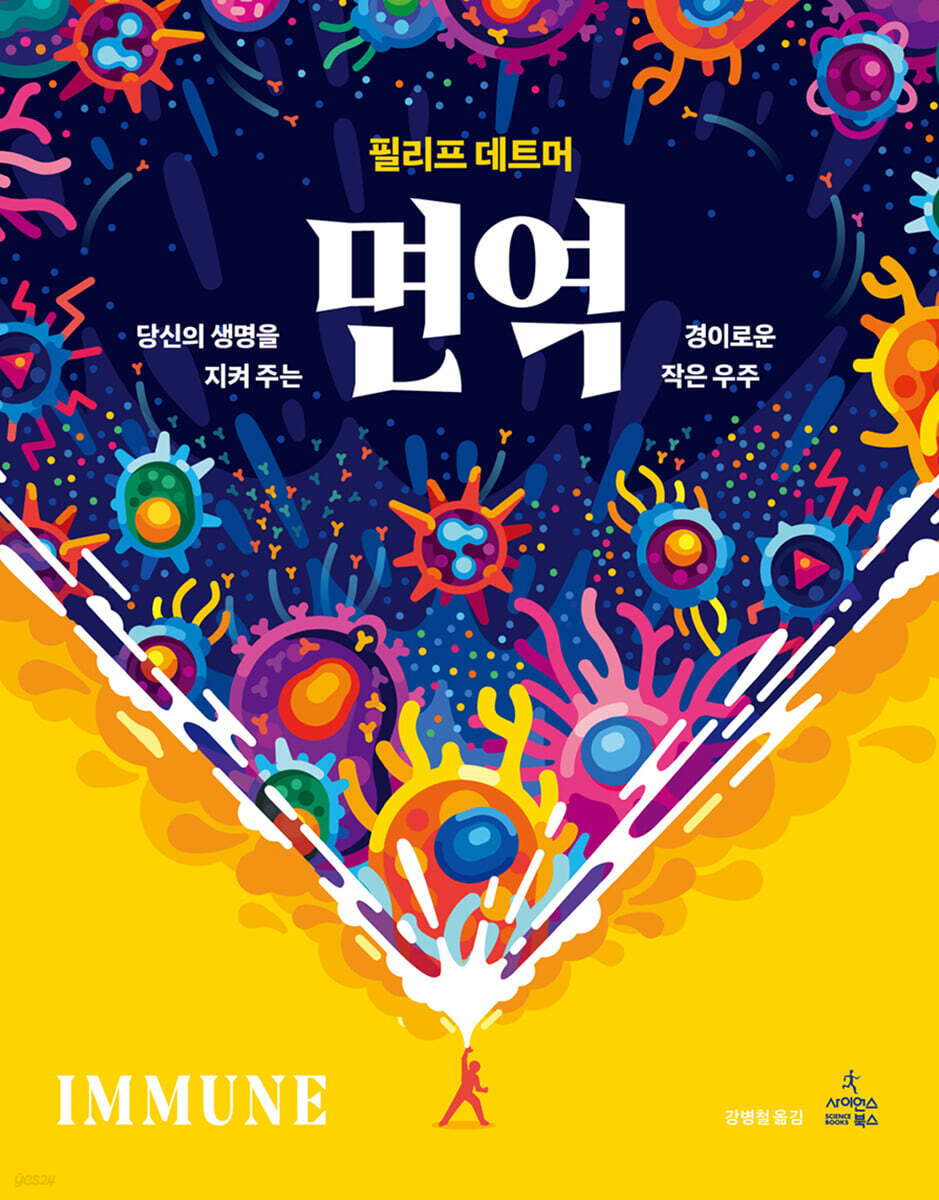
Change your mind about your body forever Immune System Pictorial Journey Philipp Detmer is the founder, CEO, and lead writer of Kurzgesagt, a science YouTube channel with over 19 million subscribers and over 2 billion cumulative views. Kurzgesagt is an animation and design studio based in Munich, Germany. Since its founding in 2013, Kurzgesagt has published over 170 motion graphic animation videos on YouTube that unravel the complexities of our world through science, aiming to inspire a passion for learning about science, nature, humanity, and life itself. Following Spanish, French, Portuguese, Japanese, Arabic, and Hindi, the Korean channel, which was launched in June 2022, also surpassed 100,000 subscribers in just three months and is currently cruising with 160,000 subscribers. "Immunity" is his debut work in the popular science genre, expanding beyond video to include book content. It was simultaneously published in major countries around the world, including the UK and Germany, in October 2021, creating a huge buzz. In this book, he fills the 300-page book with his interest and love for the immune system, a subject that has captivated him since his student days, something he still felt was lacking even when dealing with it on film in Kurzgesagt, and which became even more intense after being diagnosed with cancer at the age of thirty-two. |
- You can preview some of the book's contents.
Preview
index
Introduction 7
Part 1: Fundamentals of the Immune System
1 What is the immune system? 21
2 What to defend? 28
3 What is a cell? 35
4 Empires and Kingdoms of the Immune System 46
Part 2: Catastrophic damage
5 Let's meet the enemies 53
6 Desert Kingdom of Skin 59
7 Wounds 66
8 Warriors of the Innate Immune System: Large Phagocytes and Neutrophils 73
9 Inflammation: Playing with Fire 80
10 Naked, Blind, and Terrified: How Do Cells Know Where to Go? 86
11 Smell the Components of Life 93
12 Invisible Assassin Units: Complementary System 98
Special Agent of the 13th Cell Lineage: Branch Cell 107
14 Superhighways and Megacities 112
Facts in a Nutshell! Jira and Tonsils: The Lymph Node's Best Friends 115
15 Special Weapons Appearance 119
16 The Largest Library in the Universe 123
17 Delicious Receptor Recipes to Make 126
18 Heart Gland Killer University 131
19 Presenting Information on a Golden Porch: Antigen Presentation 137
20 Awakening the Adaptive Immune System: T Cells 145
21 Weapons Factories and Sniper Rifles: B Cells and Antibodies 152
22 The Dance of T Cells and B Cells 163
23 Antibodies 167
Fact Sheet! The Four Types of Antibodies 170
Part 3 Hostile Takeover
24 Swamp Kingdom, Mucus 179
25 The Strange and Special Gastrointestinal Immune System 185
26 What is a virus? 191
27 The Immune System of the Lungs 197
28 Flu - A 'Harmless' Virus You Shouldn't Ignore 201
29 Chemical Warfare: Interferon, Hold Your Enemies Back! 209
Facts! The Difference Between the Flu and a Cold 218
30 Window to the Soul of Cell 221
31 Killer Experts - Killer T Cells 227
32 Natural killer cells 234
33 How does our body fight off viral infections? 239
Fact Sheet! Why Aren't There Better Virus Treatments? 242
34 Calm Your Immune System 245
35 Immunity - How Does the Immune System Remember Enemies for Life? 248
Fact Fact! What Doesn't Kill Us Makes Us Stronger: Measles and Memory Cells 253
36 Vaccines and Artificial Immunity 255
Part 4: Rebellion and Civil War
37 When the immune system is too weak: HIV and AIDS 267
38 When the immune system becomes too aggressive: Allergies 274
39 Does the immune system miss parasites? 281
40 Autoimmune Diseases 285
Anecdotal facts! Anergy 291
41 Hygiene Hypothesis and Old Friends 293
42 How can I strengthen my immune system? 301
43 Stress and the Immune System 308
44 Cancer and the Immune System 312
Facts! Smoking and the Immune System 323
45 Coronavirus Pandemic 326
Closing remarks 334
Reference 337
Acknowledgments 338
Translator's Note 340
Search 342
Part 1: Fundamentals of the Immune System
1 What is the immune system? 21
2 What to defend? 28
3 What is a cell? 35
4 Empires and Kingdoms of the Immune System 46
Part 2: Catastrophic damage
5 Let's meet the enemies 53
6 Desert Kingdom of Skin 59
7 Wounds 66
8 Warriors of the Innate Immune System: Large Phagocytes and Neutrophils 73
9 Inflammation: Playing with Fire 80
10 Naked, Blind, and Terrified: How Do Cells Know Where to Go? 86
11 Smell the Components of Life 93
12 Invisible Assassin Units: Complementary System 98
Special Agent of the 13th Cell Lineage: Branch Cell 107
14 Superhighways and Megacities 112
Facts in a Nutshell! Jira and Tonsils: The Lymph Node's Best Friends 115
15 Special Weapons Appearance 119
16 The Largest Library in the Universe 123
17 Delicious Receptor Recipes to Make 126
18 Heart Gland Killer University 131
19 Presenting Information on a Golden Porch: Antigen Presentation 137
20 Awakening the Adaptive Immune System: T Cells 145
21 Weapons Factories and Sniper Rifles: B Cells and Antibodies 152
22 The Dance of T Cells and B Cells 163
23 Antibodies 167
Fact Sheet! The Four Types of Antibodies 170
Part 3 Hostile Takeover
24 Swamp Kingdom, Mucus 179
25 The Strange and Special Gastrointestinal Immune System 185
26 What is a virus? 191
27 The Immune System of the Lungs 197
28 Flu - A 'Harmless' Virus You Shouldn't Ignore 201
29 Chemical Warfare: Interferon, Hold Your Enemies Back! 209
Facts! The Difference Between the Flu and a Cold 218
30 Window to the Soul of Cell 221
31 Killer Experts - Killer T Cells 227
32 Natural killer cells 234
33 How does our body fight off viral infections? 239
Fact Sheet! Why Aren't There Better Virus Treatments? 242
34 Calm Your Immune System 245
35 Immunity - How Does the Immune System Remember Enemies for Life? 248
Fact Fact! What Doesn't Kill Us Makes Us Stronger: Measles and Memory Cells 253
36 Vaccines and Artificial Immunity 255
Part 4: Rebellion and Civil War
37 When the immune system is too weak: HIV and AIDS 267
38 When the immune system becomes too aggressive: Allergies 274
39 Does the immune system miss parasites? 281
40 Autoimmune Diseases 285
Anecdotal facts! Anergy 291
41 Hygiene Hypothesis and Old Friends 293
42 How can I strengthen my immune system? 301
43 Stress and the Immune System 308
44 Cancer and the Immune System 312
Facts! Smoking and the Immune System 323
45 Coronavirus Pandemic 326
Closing remarks 334
Reference 337
Acknowledgments 338
Translator's Note 340
Search 342
Detailed image
.jpg)
Into the book
Now let's get an idea of the scale of a human body made using people instead of cells.
Cells - People hold hands, link arms, climb on top of each other, and create living, breathing structures.
This giant is about 100 kilometers tall.
The head pierces the sky and towers over space.
Their nostrils and ear holes are as wide as a small country, their bones are as big and hard as mountains, and are dotted with delicate caves and tunnels.
Blood flows like a sea within the arteries, and countless people swim in it, transporting food and oxygen to every corner.
If you were a red blood cell, or a "red-blooded person" as we speak, you would travel back and forth between Paris and Rome in just one minute, riding the powerful current of blood pumped by a heart as big as a metropolis.
Isn't it wonderful to think about? Everyone working together as one, united in spirit and purpose, to sustain the life of a colossal giant, and in so doing, to sustain their own.
---From "Chapter 2: What to Defend?"
There are only 20,000 to 25,000 genes in the human genome.
What? How can such a small genetic code produce such a diverse array of receptors? Moreover, the 20,000 to 25,000 protein-coding genes perform functions unrelated to immunity, such as making proteins essential for cell survival.
During evolution, the immune system was allocated only a very small number of genes to create the largest library in the universe.
It's not the whole gene, it's just a part of it.
How is this possible? The answer lies in the careful combination of a small number of genes, resulting in tremendous diversity.
Let's delve a little deeper.
---From "Chapter 17: Making Delicious Receptor Recipes"
Let's think about it from a slightly different angle.
Let's say you send your child to a dojo to teach self-defense.
There are two dojos in the neighborhood.
Like a good parent, you decide to visit both sides and see how they practice.
The first is 'natural stamp'.
The teacher's philosophy is to train with real weapons - real swords and spears - to better deal with the dangers of the harsh world.
Of course it is risky, but it is true that it is more natural and closer to the real situation.
Trainees sometimes suffer deep wounds and are taken to the hospital for stitches.
There are even rumors that some children have lost an eye or even died.
But it's definitely a natural way! The second is the "vaccine stamp."
The training process and methods are the same as those of the 'Natural Dojo', but there is one major difference.
The vaccine seal uses weapons made of sponge and paper.
But do children get hurt? It's rare, but it does happen.
However, they are much less common and most are only light bruises, so crying babies are rarely noticed.
Which dojo would you like to send your child to?
---From "Chapter 36: Vaccines and Artificial Immunity Formation"
Let's think about it this way.
There is a car that has been driven on dirt roads for decades and is rusty and worn out.
The axle was broken, the tire was flat, and one of the headlights was broken.
Will pouring special gasoline into this car and repainting it solve all its problems? Will it magically erase all the damage caused by years of rough use? To maintain your car's performance for a long time, you need to take good care of it on a regular basis.
Our bodies are the same.
If you want to 'strengthen' your immune system for health, you must first and foremost take good care of your body by maintaining healthy lifestyle habits.
Doing so will allow the complex balance and billions of different parts of the immune system to function properly for a longer period of time.
However, it cannot maintain its function forever.
The impossible is impossible, whether it's a car or a person.
But you can keep it longer and in better condition.
This is the limit of what science can say.
If it were sound science, it would say something like this:
At least for now.
---From Chapter 42, “How can we strengthen our immune system?”
There are many topics in science that are completely immersive.
It often emerges as one of the most beloved topics or fields in popular culture.
For example, space science, which involves vast spaces, black holes, and incredibly cool stars, is made into documentaries and popular science books and sells like hotcakes.
Sure, space is breathtakingly wonderful and beautiful, but it pales in comparison to biology.
A star is nothing more than a swarm of blazing plasma, a dead entity, and even the most complex and interesting stars pale in wonder and complexity to the simplest bacteria struggling to escape the clutches of large predatory cells.
But the immune system isn't as easy or enjoyable to understand as other areas of popular science.
Asking questions without even understanding the basics.
To truly understand the beauty and mystery of the immune system requires a significant investment of time and effort.
In an age where information is expected to be understandable and enjoyable, this may sound like an excessive demand.
Despite these challenges, the immune system is a fascinating subject to study. It's incredibly complex, composed of countless components that interact and work in intricately interlocked ways.
Indeed, it is a window into the universe itself.
It is a window into the complexity that surrounds us, a complexity of which we ourselves are a part.
It's an incredible fortune to be alive at this moment and to have a body I can call my own.
At least that's how I feel.
---From "Concluding Remarks"
As a wise man once said, there is nothing more important than understanding yourself as a human being.
But when it comes to the topic of 'what is a human being', there is too much talk about nothing.
Fortunately, as science advances, more and more objective facts about us are being revealed.
Problems that have plagued us for thousands of years can often be solved by understanding human biology.
To understand humans as thinking beings, we must first understand the brain.
But to understand a more fundamental dimension, our most fundamental experience as creatures, we must understand immunity.
Because immunity is what distinguishes the self from others, and defines who I am and what the world around me is like.
So, if you want to understand yourself, the first thing you need to do is understand and look at your immunity.
But studying immunity is not easy.
Because it is a very complex field that is developing at an incredible pace.
Even when people around me asked me to recommend books, there was nothing I could recommend.
Most of the books I read were difficult even for a specialist like me, covered only very basic knowledge, were unsystematic and difficult to understand, failed to reflect the latest developments, or only covered narrow areas such as cancer immunity and the history of immunity.
There are more than one or two books that the author himself has lost track of.
(All these books flash through my mind.) There's no need to overthink things anymore.
Want to understand immunity? Read this book!
Cells - People hold hands, link arms, climb on top of each other, and create living, breathing structures.
This giant is about 100 kilometers tall.
The head pierces the sky and towers over space.
Their nostrils and ear holes are as wide as a small country, their bones are as big and hard as mountains, and are dotted with delicate caves and tunnels.
Blood flows like a sea within the arteries, and countless people swim in it, transporting food and oxygen to every corner.
If you were a red blood cell, or a "red-blooded person" as we speak, you would travel back and forth between Paris and Rome in just one minute, riding the powerful current of blood pumped by a heart as big as a metropolis.
Isn't it wonderful to think about? Everyone working together as one, united in spirit and purpose, to sustain the life of a colossal giant, and in so doing, to sustain their own.
---From "Chapter 2: What to Defend?"
There are only 20,000 to 25,000 genes in the human genome.
What? How can such a small genetic code produce such a diverse array of receptors? Moreover, the 20,000 to 25,000 protein-coding genes perform functions unrelated to immunity, such as making proteins essential for cell survival.
During evolution, the immune system was allocated only a very small number of genes to create the largest library in the universe.
It's not the whole gene, it's just a part of it.
How is this possible? The answer lies in the careful combination of a small number of genes, resulting in tremendous diversity.
Let's delve a little deeper.
---From "Chapter 17: Making Delicious Receptor Recipes"
Let's think about it from a slightly different angle.
Let's say you send your child to a dojo to teach self-defense.
There are two dojos in the neighborhood.
Like a good parent, you decide to visit both sides and see how they practice.
The first is 'natural stamp'.
The teacher's philosophy is to train with real weapons - real swords and spears - to better deal with the dangers of the harsh world.
Of course it is risky, but it is true that it is more natural and closer to the real situation.
Trainees sometimes suffer deep wounds and are taken to the hospital for stitches.
There are even rumors that some children have lost an eye or even died.
But it's definitely a natural way! The second is the "vaccine stamp."
The training process and methods are the same as those of the 'Natural Dojo', but there is one major difference.
The vaccine seal uses weapons made of sponge and paper.
But do children get hurt? It's rare, but it does happen.
However, they are much less common and most are only light bruises, so crying babies are rarely noticed.
Which dojo would you like to send your child to?
---From "Chapter 36: Vaccines and Artificial Immunity Formation"
Let's think about it this way.
There is a car that has been driven on dirt roads for decades and is rusty and worn out.
The axle was broken, the tire was flat, and one of the headlights was broken.
Will pouring special gasoline into this car and repainting it solve all its problems? Will it magically erase all the damage caused by years of rough use? To maintain your car's performance for a long time, you need to take good care of it on a regular basis.
Our bodies are the same.
If you want to 'strengthen' your immune system for health, you must first and foremost take good care of your body by maintaining healthy lifestyle habits.
Doing so will allow the complex balance and billions of different parts of the immune system to function properly for a longer period of time.
However, it cannot maintain its function forever.
The impossible is impossible, whether it's a car or a person.
But you can keep it longer and in better condition.
This is the limit of what science can say.
If it were sound science, it would say something like this:
At least for now.
---From Chapter 42, “How can we strengthen our immune system?”
There are many topics in science that are completely immersive.
It often emerges as one of the most beloved topics or fields in popular culture.
For example, space science, which involves vast spaces, black holes, and incredibly cool stars, is made into documentaries and popular science books and sells like hotcakes.
Sure, space is breathtakingly wonderful and beautiful, but it pales in comparison to biology.
A star is nothing more than a swarm of blazing plasma, a dead entity, and even the most complex and interesting stars pale in wonder and complexity to the simplest bacteria struggling to escape the clutches of large predatory cells.
But the immune system isn't as easy or enjoyable to understand as other areas of popular science.
Asking questions without even understanding the basics.
To truly understand the beauty and mystery of the immune system requires a significant investment of time and effort.
In an age where information is expected to be understandable and enjoyable, this may sound like an excessive demand.
Despite these challenges, the immune system is a fascinating subject to study. It's incredibly complex, composed of countless components that interact and work in intricately interlocked ways.
Indeed, it is a window into the universe itself.
It is a window into the complexity that surrounds us, a complexity of which we ourselves are a part.
It's an incredible fortune to be alive at this moment and to have a body I can call my own.
At least that's how I feel.
---From "Concluding Remarks"
As a wise man once said, there is nothing more important than understanding yourself as a human being.
But when it comes to the topic of 'what is a human being', there is too much talk about nothing.
Fortunately, as science advances, more and more objective facts about us are being revealed.
Problems that have plagued us for thousands of years can often be solved by understanding human biology.
To understand humans as thinking beings, we must first understand the brain.
But to understand a more fundamental dimension, our most fundamental experience as creatures, we must understand immunity.
Because immunity is what distinguishes the self from others, and defines who I am and what the world around me is like.
So, if you want to understand yourself, the first thing you need to do is understand and look at your immunity.
But studying immunity is not easy.
Because it is a very complex field that is developing at an incredible pace.
Even when people around me asked me to recommend books, there was nothing I could recommend.
Most of the books I read were difficult even for a specialist like me, covered only very basic knowledge, were unsystematic and difficult to understand, failed to reflect the latest developments, or only covered narrow areas such as cancer immunity and the history of immunity.
There are more than one or two books that the author himself has lost track of.
(All these books flash through my mind.) There's no need to overthink things anymore.
Want to understand immunity? Read this book!
---From the Translator's Note
Publisher's Review
Change your mind about your body forever
Immune System Pictorial Journey
Since its first report in Wuhan, Hubei Province, China in November 2019, the number of confirmed cases of coronavirus disease-19 (COVID-19) has surpassed 600 million worldwide.
Recently, we have heard news that 248 million people were confirmed to have contracted the virus in China in just 20 days, and that the reason for this is the failure to achieve "herd immunity," which is making us anxious.
Beyond these crucial life-or-death issues, we often hear phrases like, "Kimchi, pay attention as an immune-boosting food," "The solution to academic stress is to strengthen your immune system," and "If you want to grow taller, start by taking care of your immune system." This immunity, it seems, is an inseparable part of us.
So, what exactly is the immune system?
The immune system is second only to the human brain in complexity and is one of the oldest and most important life processes on Earth.
Without an immune system, we would die within days.
Conversely, it may be the immune system, not the pathogen, that threatens survival.
Even the incredibly scary Ebola virus takes about six days to kill a person, while immunity can kill a person in just 15 minutes.
The first book of Science Books in 2023, "Immunity: The Amazing Little Universe That Protects Your Life," is a book written by Philipp Dettmer, founder of YouTube's most powerful science channel, "Kurzgesagt - In a Nutshell," which turns the story of the immune system, the body's important defense system, into an epic with numerous heroes, and conveys it in the easiest-to-understand way possible with 45 infographic images that make it seem like watching a Kurzgesagt video.
A fierce battle, full of aggression, strategy, defeat, and noble self-sacrifice, is constantly raging within us.
Even as you read this, your immune system may have discovered and killed cancer cells that have begun to grow in your body.
Filled with full-color illustrations and witty language, this book transforms immunology, one of the most complex and confusing topics in our universe, into a captivating adventure on an alien planet.
"Immunity" is a fascinating special lecture that covers a system that has always been important to our bodies and is becoming increasingly important over time.
At a glance
The Principles of Immunity and Life
The central theme of "Immunity" is to convey to readers in an easily understandable way the stories of invasion, defense, strategy, defeat, and self-sacrifice that blossom from the small and large wars that unfold within our bodies every day without our even realizing it.
To do this, there must first be an introduction to the stage and characters of the war.
That is the role of Part 1, ‘The Foundations of the Immune System.’
Philipp Detmer explains how single-celled organisms began to cooperate and develop immune systems 500 million years ago, leading to an explosion of biodiversity, and how the benefits extend to us humans.
The place where the characters in this story live, made possible by immunity, is our body.
From the perspective of the cell, the smallest unit of life and a protein robot propelled by biochemical processes, the human body he describes is enough to awe the reader in a dimension different from the 'outer universe' made up of the sun, stars, and galaxies.
In Part 2, "Catastrophic Damage," Detmer uses the scenario of "a rusty nail piercing through your shoe and into the sole of your foot while you're walking in the woods" to simulate what would happen to our bodies.
From the cells' point of view, this catastrophe, which is like a metal asteroid blowing a hole in the sky and crashing into the middle of their world, is mainly caused by external bacteria. The main villains are the warriors of the innate immune system, including large phagocytic cells (macrophages), neutrophils, and dendritic cells, and the T cells and B cells of the adaptive immune system, which come to the rescue when the battle they wage, literally risking their lives, is not going well, as well as antibodies.
In Part 2, which is full of difficult-to-remember and complex names and content, he helps readers understand through metaphors such as “T cells that can only eat sausages on bread” and “chefs who try to serve different dishes to billions of customers.”
Particularly moving is the moment of biological emergence, where a limited number of proteins floating in body fluids, with no will or direction, come together to achieve the remarkable result of an immune system capable of responding to every infinite potential antigen that could possibly exist in the universe.
In Part 3, 'Hostile Takeover', a major change occurs as the main villain changes.
Now the enemy we have to fight is not alien bacteria, but viruses.
If bacteria are savages who invade our homes with their feet on the ground and howl, viruses are more like special forces that quietly invade, kill members without anyone noticing, and take over our homes to establish their bases.
In Part 3, we'll explore the true nature of viruses, arguably the most successful organisms on Earth, why they're harder to defeat than bacteria, and the special defense strategies the immune system employs to do so: interferons, killer T cells, and natural killer cells.
In addition, you will learn how our bodies store immunological memories that will protect us throughout our lives, the history and mechanisms of vaccines, which are disease-fighting methods that humanity has learned through hundreds of years of experience, and finally, the fiction of the so-called 'anti-vaccine movement' and the reasons why we must get vaccinated.
Part 4, "Rebellion and Civil War," is about the dark side of the immune system that protects us.
In other words, this great system has collapsed, and our immune system, not the external invaders, is now threatening our lives.
In Part 4, Philipp Detmer explains in an accessible way what happens when the immune system misbehaves, starting with diseases that attack the weak points of the immune system, such as acquired immunodeficiency syndrome (AIDS), and progressing to autoimmune diseases like allergies and even cancer, a disease he once suffered from.
In this process, readers can learn why the promotional claims of various health functional foods that claim to "boost immunity" are actually nothing more than empty talk, and what happens (and what doesn't happen!) when we pursue boosting our immunity, through real-life incidents and accident cases.
Chapter 45, the final chapter, "Coronavirus Pandemic," provides a brief overview of COVID-19, which was raging at the time of its publication in 2021.
While it's unclear how the fight against the coronavirus, which continues to threaten humanity as it mutates, will unfold, his vision that this pandemic will serve as a crucial reminder of why our immune system is incredibly important and why the more people understand it, the more helpful it will be remains valid.
Want to understand immunity?
Read this book!
As one of the most complex phenomena in biology and a crucial factor in our health and well-being, popular science books on the immune system have existed before.
The greatest advantage of "Immunity" that sets it apart from existing books is that it is the result of 10 years of effort by the author, who is the world's best at "communicating science in easy terms," receiving advice from numerous experts and even a final manuscript review from an immunologist, incorporating the achievements of cutting-edge immunology and the know-how of Kurzgesacht.
"Immunity" meticulously explains the immune system, which is made up of complex relationships between immune cells, the immune response, which is made up of even more complex relationships between the immune system and its enemies, and the world, which is made up of even more complex relationships between the immune response and the environment and society, through appropriate metaphors, examples, wit, and beautiful informational images.
I hope that with the help of this book and Kurzgesacht YouTube videos on the immune system, Korean readers will gain the knowledge and wisdom to understand themselves and the world in the new year of 2023.
Immune System Pictorial Journey
Since its first report in Wuhan, Hubei Province, China in November 2019, the number of confirmed cases of coronavirus disease-19 (COVID-19) has surpassed 600 million worldwide.
Recently, we have heard news that 248 million people were confirmed to have contracted the virus in China in just 20 days, and that the reason for this is the failure to achieve "herd immunity," which is making us anxious.
Beyond these crucial life-or-death issues, we often hear phrases like, "Kimchi, pay attention as an immune-boosting food," "The solution to academic stress is to strengthen your immune system," and "If you want to grow taller, start by taking care of your immune system." This immunity, it seems, is an inseparable part of us.
So, what exactly is the immune system?
The immune system is second only to the human brain in complexity and is one of the oldest and most important life processes on Earth.
Without an immune system, we would die within days.
Conversely, it may be the immune system, not the pathogen, that threatens survival.
Even the incredibly scary Ebola virus takes about six days to kill a person, while immunity can kill a person in just 15 minutes.
The first book of Science Books in 2023, "Immunity: The Amazing Little Universe That Protects Your Life," is a book written by Philipp Dettmer, founder of YouTube's most powerful science channel, "Kurzgesagt - In a Nutshell," which turns the story of the immune system, the body's important defense system, into an epic with numerous heroes, and conveys it in the easiest-to-understand way possible with 45 infographic images that make it seem like watching a Kurzgesagt video.
A fierce battle, full of aggression, strategy, defeat, and noble self-sacrifice, is constantly raging within us.
Even as you read this, your immune system may have discovered and killed cancer cells that have begun to grow in your body.
Filled with full-color illustrations and witty language, this book transforms immunology, one of the most complex and confusing topics in our universe, into a captivating adventure on an alien planet.
"Immunity" is a fascinating special lecture that covers a system that has always been important to our bodies and is becoming increasingly important over time.
At a glance
The Principles of Immunity and Life
The central theme of "Immunity" is to convey to readers in an easily understandable way the stories of invasion, defense, strategy, defeat, and self-sacrifice that blossom from the small and large wars that unfold within our bodies every day without our even realizing it.
To do this, there must first be an introduction to the stage and characters of the war.
That is the role of Part 1, ‘The Foundations of the Immune System.’
Philipp Detmer explains how single-celled organisms began to cooperate and develop immune systems 500 million years ago, leading to an explosion of biodiversity, and how the benefits extend to us humans.
The place where the characters in this story live, made possible by immunity, is our body.
From the perspective of the cell, the smallest unit of life and a protein robot propelled by biochemical processes, the human body he describes is enough to awe the reader in a dimension different from the 'outer universe' made up of the sun, stars, and galaxies.
In Part 2, "Catastrophic Damage," Detmer uses the scenario of "a rusty nail piercing through your shoe and into the sole of your foot while you're walking in the woods" to simulate what would happen to our bodies.
From the cells' point of view, this catastrophe, which is like a metal asteroid blowing a hole in the sky and crashing into the middle of their world, is mainly caused by external bacteria. The main villains are the warriors of the innate immune system, including large phagocytic cells (macrophages), neutrophils, and dendritic cells, and the T cells and B cells of the adaptive immune system, which come to the rescue when the battle they wage, literally risking their lives, is not going well, as well as antibodies.
In Part 2, which is full of difficult-to-remember and complex names and content, he helps readers understand through metaphors such as “T cells that can only eat sausages on bread” and “chefs who try to serve different dishes to billions of customers.”
Particularly moving is the moment of biological emergence, where a limited number of proteins floating in body fluids, with no will or direction, come together to achieve the remarkable result of an immune system capable of responding to every infinite potential antigen that could possibly exist in the universe.
In Part 3, 'Hostile Takeover', a major change occurs as the main villain changes.
Now the enemy we have to fight is not alien bacteria, but viruses.
If bacteria are savages who invade our homes with their feet on the ground and howl, viruses are more like special forces that quietly invade, kill members without anyone noticing, and take over our homes to establish their bases.
In Part 3, we'll explore the true nature of viruses, arguably the most successful organisms on Earth, why they're harder to defeat than bacteria, and the special defense strategies the immune system employs to do so: interferons, killer T cells, and natural killer cells.
In addition, you will learn how our bodies store immunological memories that will protect us throughout our lives, the history and mechanisms of vaccines, which are disease-fighting methods that humanity has learned through hundreds of years of experience, and finally, the fiction of the so-called 'anti-vaccine movement' and the reasons why we must get vaccinated.
Part 4, "Rebellion and Civil War," is about the dark side of the immune system that protects us.
In other words, this great system has collapsed, and our immune system, not the external invaders, is now threatening our lives.
In Part 4, Philipp Detmer explains in an accessible way what happens when the immune system misbehaves, starting with diseases that attack the weak points of the immune system, such as acquired immunodeficiency syndrome (AIDS), and progressing to autoimmune diseases like allergies and even cancer, a disease he once suffered from.
In this process, readers can learn why the promotional claims of various health functional foods that claim to "boost immunity" are actually nothing more than empty talk, and what happens (and what doesn't happen!) when we pursue boosting our immunity, through real-life incidents and accident cases.
Chapter 45, the final chapter, "Coronavirus Pandemic," provides a brief overview of COVID-19, which was raging at the time of its publication in 2021.
While it's unclear how the fight against the coronavirus, which continues to threaten humanity as it mutates, will unfold, his vision that this pandemic will serve as a crucial reminder of why our immune system is incredibly important and why the more people understand it, the more helpful it will be remains valid.
Want to understand immunity?
Read this book!
As one of the most complex phenomena in biology and a crucial factor in our health and well-being, popular science books on the immune system have existed before.
The greatest advantage of "Immunity" that sets it apart from existing books is that it is the result of 10 years of effort by the author, who is the world's best at "communicating science in easy terms," receiving advice from numerous experts and even a final manuscript review from an immunologist, incorporating the achievements of cutting-edge immunology and the know-how of Kurzgesacht.
"Immunity" meticulously explains the immune system, which is made up of complex relationships between immune cells, the immune response, which is made up of even more complex relationships between the immune system and its enemies, and the world, which is made up of even more complex relationships between the immune response and the environment and society, through appropriate metaphors, examples, wit, and beautiful informational images.
I hope that with the help of this book and Kurzgesacht YouTube videos on the immune system, Korean readers will gain the knowledge and wisdom to understand themselves and the world in the new year of 2023.
GOODS SPECIFICS
- Publication date: November 24, 2022
- Format: Hardcover book binding method guide
- Page count, weight, size: 348 pages | 1,076g | 178*229*30mm
- ISBN13: 9791192107271
- ISBN10: 1192107276
You may also like
카테고리
korean


korean

![GQ KOREA Mark (Monthly): December [2025]](http://librairie.coreenne.fr/cdn/shop/files/8ef265dbbfbf186523ed75ba7319009d.jpg?v=1765340328&width=3840)


