

Lend Me Your Art Gallery: France
 |
Description
Book Introduction
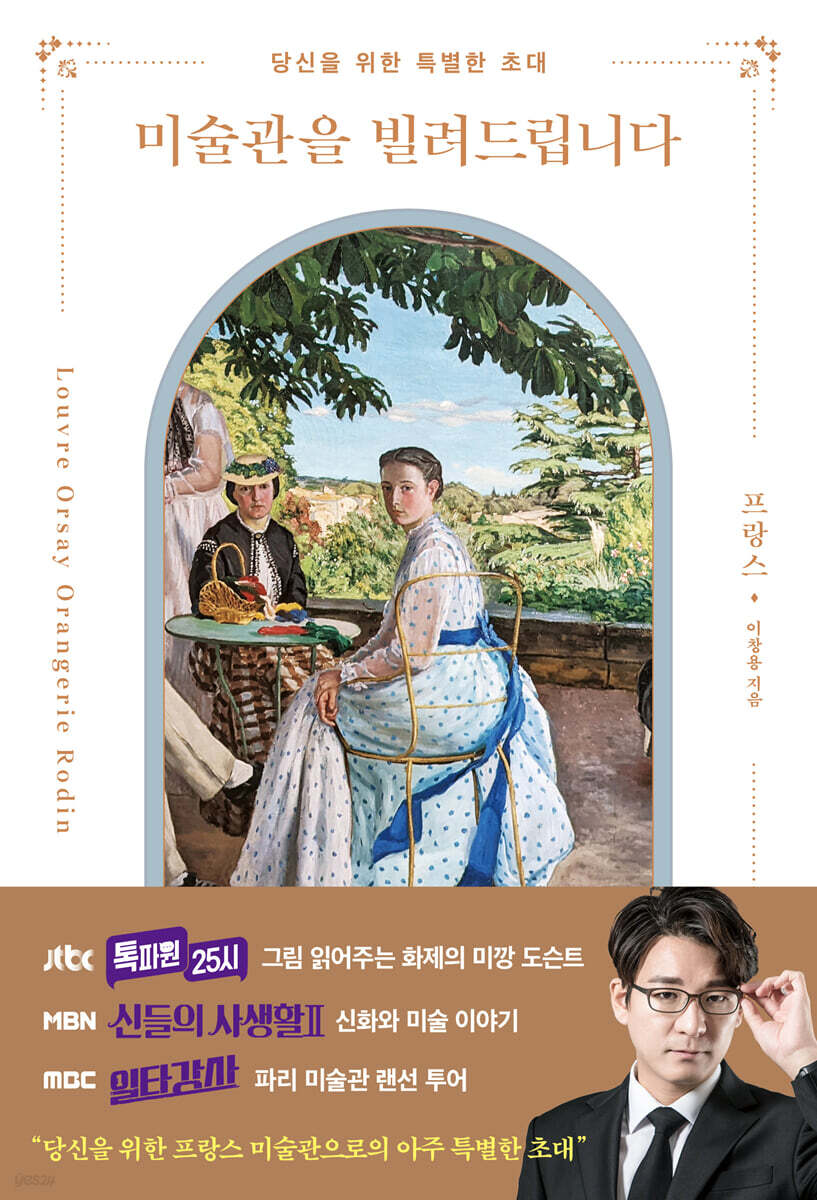
JTBC [TalkPawon 25 Hours] The hot topic docent! #1 in broadcasting and art history lectures! A Journey Through European Art with Docent Lee Chang-yong “What is the greatest French masterpiece that moves your heart?” This is an art travelogue that tours France's representative art museums, including the Louvre, the Orsay Museum, the Orangerie, and the Rodin Museum, and encounters masterpieces that span the major trends of Western art history, from ancient Greece to the Renaissance and Impressionism. In fact, the author Lee Chang-yong, who has worked as a docent at the Vatican Museum, the Louvre Museum, and the Musee d'Orsay in Rome, has expertise and a natural gift for conversation that allows readers to immerse themselves in the work. The author devotes considerable space to the Louvre's iconic Mona Lisa. After reading the secret stories behind her eyes, nose, mouth, and signature smile, you'll find yourself nodding along to understand why the Mona Lisa is a masterpiece. The story of how “Bonaparte Crossing the Pass of Saint-Bernard” and “The Coronation of Napoleon,” created by Jacques-Louis David, who was born with a genius talent for stealing people’s hearts, is also interesting. In Edouard Manet's "The Luncheon on the Grass" and "Olympia," which shook up the French art world, we can see Manet's courage to break away from the conventional beauty and create a new and innovative beauty. Nevertheless, the author says there is no set answer to the question, 'What makes a painting a good painting?' The work of art that is highly valued in the art world can change depending on the times, social atmosphere, and trends. Therefore, the author recommends that you visit famous French art museums and decide for yourself which piece of art is the best. The author's words, "A good work is not something that others determine, but something that I determine myself," deeply resonate with us about what we should truly gain from appreciating art. |
- You can preview some of the book's contents.
Preview
index
Prologue _ What makes a good work of art?
1.
The Louvre Museum, a treasure trove of humanity
The two most beautiful women in the world
The Beginning and End of Western Painting: The Grand Gallery
A New World Seen Through Human Eyes: The Renaissance
Painting that began to capture human emotions
The greatest name in history, Leonardo da Vinci
Two seemingly similar yet different "Madonna of the Rocks"
Da Vinci's most human work, "The Virgin and Child with Saint Anne"
The most beautiful smile in the world, "Mona Lisa"
Francis I, the father of the French Renaissance
The Louvre's largest painting, "The Wedding at Cana"
Jacques-Louis David, the man of neoclassicism
Two works that signal the beginning of the revolution
A message of peace to all French people
Praise the living heroes
I will be recorded in history in the shadow of my hero.
Romanticism, which sought to awaken the inner emotions of human beings
Beyond the Barricade of Corpses: "Freedom Leading the People"
The Endless Desire for Power: The "Marie de Medici" Series
Rubens completed a series of 24 works in two years and six months.
Meeting of Marie de Medici and Henry IV in Lyon
Marie's political achievements and conflict with her son, Louis XIII
2.
The beautiful train station of the Musee d'Orsay, a journey into Impressionism
Impressionism, the eternal flame of art
The Peasant Painter, Jean-François Millet
"The Gleaners," with its many interpretations
Theodore Rousseau, founder of the Barbizon School
Gustave Courbet, the painter who couldn't paint angels
The Prelude to Realism, "The Funeral at Ornans"
The Beginning of Modern Art, Edouard Manet
"Luncheon on the Grass," which marked the beginning of modern art
Yeah, I'm a whore.
So what do you want me to do? "Olympia"
A Season in Hell by Arthur Rimbaud
The Beginning and End of Impressionism, 5th Floor, Musee d'Orsay
The painters of Batignolles gathered at the Café Guerbois
The ill-fated painter, Jean-Frédéric Bazille
Painters leaving their studios and venturing outdoors
Claude Monet, Hunter of Light
The "Rouen Cathedral" series, in full bloom
The one and only model, Camille Dongsiou
Renoir, who sang only of joy and happiness
Another light effect of Impressionism
Parisian painter, Edgar Degas
A ballerina who dreams of being Cinderella in Paris
3.
Giverny Garden and Orangerie Museum, Monet's sanctuary
Monet's greatest masterpiece, "Water Lilies"
4.
Rodin Museum: The Sculptor Who Stole the Hand of God
A poet lost in thought at the miserable sight of hell
The Burghers of Calais, a symbol of noblesse oblige
His masterpiece, "The Gates of Hell," was left unfinished.
The Biron Mansion, Rodin's sanctuary
Rodin's works that changed the standards of value in sculpture
Camille Claudel, the eternal muse and sweet poison
Leaving the Rodin Museum
1.
The Louvre Museum, a treasure trove of humanity
The two most beautiful women in the world
The Beginning and End of Western Painting: The Grand Gallery
A New World Seen Through Human Eyes: The Renaissance
Painting that began to capture human emotions
The greatest name in history, Leonardo da Vinci
Two seemingly similar yet different "Madonna of the Rocks"
Da Vinci's most human work, "The Virgin and Child with Saint Anne"
The most beautiful smile in the world, "Mona Lisa"
Francis I, the father of the French Renaissance
The Louvre's largest painting, "The Wedding at Cana"
Jacques-Louis David, the man of neoclassicism
Two works that signal the beginning of the revolution
A message of peace to all French people
Praise the living heroes
I will be recorded in history in the shadow of my hero.
Romanticism, which sought to awaken the inner emotions of human beings
Beyond the Barricade of Corpses: "Freedom Leading the People"
The Endless Desire for Power: The "Marie de Medici" Series
Rubens completed a series of 24 works in two years and six months.
Meeting of Marie de Medici and Henry IV in Lyon
Marie's political achievements and conflict with her son, Louis XIII
2.
The beautiful train station of the Musee d'Orsay, a journey into Impressionism
Impressionism, the eternal flame of art
The Peasant Painter, Jean-François Millet
"The Gleaners," with its many interpretations
Theodore Rousseau, founder of the Barbizon School
Gustave Courbet, the painter who couldn't paint angels
The Prelude to Realism, "The Funeral at Ornans"
The Beginning of Modern Art, Edouard Manet
"Luncheon on the Grass," which marked the beginning of modern art
Yeah, I'm a whore.
So what do you want me to do? "Olympia"
A Season in Hell by Arthur Rimbaud
The Beginning and End of Impressionism, 5th Floor, Musee d'Orsay
The painters of Batignolles gathered at the Café Guerbois
The ill-fated painter, Jean-Frédéric Bazille
Painters leaving their studios and venturing outdoors
Claude Monet, Hunter of Light
The "Rouen Cathedral" series, in full bloom
The one and only model, Camille Dongsiou
Renoir, who sang only of joy and happiness
Another light effect of Impressionism
Parisian painter, Edgar Degas
A ballerina who dreams of being Cinderella in Paris
3.
Giverny Garden and Orangerie Museum, Monet's sanctuary
Monet's greatest masterpiece, "Water Lilies"
4.
Rodin Museum: The Sculptor Who Stole the Hand of God
A poet lost in thought at the miserable sight of hell
The Burghers of Calais, a symbol of noblesse oblige
His masterpiece, "The Gates of Hell," was left unfinished.
The Biron Mansion, Rodin's sanctuary
Rodin's works that changed the standards of value in sculpture
Camille Claudel, the eternal muse and sweet poison
Leaving the Rodin Museum
Detailed image

Into the book
There is a saying in the Louvre called the 'Mona Lisa Group'.
This saying comes from the phenomenon where about 25 percent of visitors to the Louvre simply look at the Mona Lisa and leave.
Additionally, according to a survey conducted by CNN in 2019 on the world's most famous artwork, a whopping 85.3 percent chose the Mona Lisa.
It is said that France currently earns trillions of won annually from the Mona Lisa alone, so it can be said that this work is truly the most famous work of art in history.
---From "The most beautiful smile in the world, "Mona Lisa"
This work, which had been beautifully decorating the dining room of the San Giorgio Maggiore Monastery in Venice for over 200 years, began to face numerous trials.
In 1797, Napoleon's army invaded Italy and plundered numerous works of art for the Louvre Museum's collection.
They were immediately captivated by this work, but because of its weight and size, weighing 1.5 tons, they were hesitant to take it back to France.
In the end, after much thought, they commit the atrocity of cutting the work in half and rolling up the canvas.
---From "The Wedding Feast at Cana," the largest painting in the Louvre
It's a wonderful portrait, but in fact, this scene was completely manipulated.
The Saint-Bernard Pass is a steep mountain range with an elevation of over 2,400 meters, and can only be safely crossed by mules, not Arabian racehorses.
Also, this was a snowy place with an average temperature close to freezing even in May when Napoleon passed through, so Napoleon must have wrapped himself in a thick overcoat and shivered from the cold as he passed through the pass with difficulty.
The scene David drew was, in fact, absolutely impossible to achieve.
---From "Praise the Living Hero"
Through this series, Rubens deifies the very life of Marie de Medici, leaving behind one of the most splendid biographical works in history.
He even confessed in a letter to an acquaintance that he had “poured out all my abilities and succeeded in completely distorting and deceiving the historical truth.”
And he may have hoped that the relationship between Marie and the hat would continue peacefully, as he expressed in his work.
But this wind did not last long.
---From “Marie’s Political Achievements and Conflict with Her Son, Louis XIII”
Art critic Louis Leroy said of Monet's work, "Impression, Sunrise.
It is a truly impressive painting.
“What a free painting! What a painting so easily drawn! The quality of the seascape in the painting is worse than that of wallpaper!” he mockingly disparaged the work and dubbed the exhibition “an exhibition of the Impressionists.”
This is how the word 'Impressionism' was first coined by Louis Leroy, and here the word "impressive" was an ironic expression meaning 'impressive because it is so poorly drawn, so absurd, or so ridiculous.'
Although it was initially a term close to a curse, from the third exhibition in 1877 onwards, he began to use the term 'Impressionism' himself, and Impressionism began to establish itself as a new mainstream in the art world.
---From "Impressionism, the Flame of Art That Never Goes Out"
Millet's words, "Even if everything in the world changes, the life of a farmer remains unchanged yesterday, today, and forever," seem to speak not so much of sanctifying labor as of the sorrows and joys of farmers, which remain unchanged no matter how much the world changes.
Some argue that Millet painted the painting in the hopes that a revolution would break out in the countryside, citing the colors of the hoods of the two women on the left and the sleeves of the woman in the center as resembling the French tricolor, a symbol of revolution.
Perhaps for this reason, after its publication, the work was criticized as a severely leftist painting that incited social chaos and conflict.
---From "The Gleaners," which has various interpretations
When the work was exhibited at the Salon, critics criticized it, saying, “This work is worth less than the stones those laborers break.”
However, Courbet wrote to a friend, “I do not want to paint to please anyone or to make easy money.
“I will never, even for a single moment, deviate from my principles and do anything that goes against my conscience,” he says, stating that this is the only truth and the true picture of the world he lives in.
---From "The Funeral at Ornans," the prelude to realism
Could it be that Manet didn't anticipate this outcome? Of course not.
Edouard Manet was born into a prominent bourgeois family, lived an aristocratic life, and received art education from the best academic painter of his time.
In other words, he was a person who knew exactly how to draw in a way that people would like and that would lead to his success.
But why on earth? Why did Manet paint such a controversial picture, knowing it would be controversial?
---From "Luncheon on the Grass," which marked the beginning of modern art
Those who did not understand the meaning and attempt of the work mostly commented, “It would be better to quit being a painter and become a train driver” or “Is Monet color-blind? Why did he use such ridiculous colors?”
But only Émile Zola gave the following praise:
“In Monet’s works, I can hear the sound of the train’s whistle, and the sight of the steam pouring out from the train slowly engulfing the huge train station seems to unfold before my eyes.
“His paintings contain our present, not the past.”
---From "The Hunter of Light, Claude Monet"
The lovely subjects and warm, bright colors in his works, which never change, are Renoir's unchanging characteristics.
So, when I introduce him to people when I visit the Musée d'Orsay, I tell them, "If you invest just 30 minutes to look closely at Renoir's works and become familiar with them, you will have the mysterious ability to distinguish Renoir's works in any museum in the world."
---From "Renoir, Who Singed Only Joy and Happiness"
Monet's various water lily series can be seen in art galleries around the world, but the most outstanding work is, of course, the large-scale water lily painting displayed at the Orangerie Museum.
This work is considered the greatest masterpiece of Monet's life, and it is said that it was the work he traded his later years for, as he devoted everything he had, both mentally and physically, to completing it.
---「From Monet's greatest masterpiece, "Water Lilies"」
Rodin did not want to falsely portray their figures as divine, heroic figures that transcend even death.
These were not heroes from myths who knew no fear, but ordinary people who felt the same emotions as we do, who were afraid of death, trembled, shed tears, and wanted to run away immediately.
So, what I wanted to say was that their choices and actions are greater and more valuable.
This saying comes from the phenomenon where about 25 percent of visitors to the Louvre simply look at the Mona Lisa and leave.
Additionally, according to a survey conducted by CNN in 2019 on the world's most famous artwork, a whopping 85.3 percent chose the Mona Lisa.
It is said that France currently earns trillions of won annually from the Mona Lisa alone, so it can be said that this work is truly the most famous work of art in history.
---From "The most beautiful smile in the world, "Mona Lisa"
This work, which had been beautifully decorating the dining room of the San Giorgio Maggiore Monastery in Venice for over 200 years, began to face numerous trials.
In 1797, Napoleon's army invaded Italy and plundered numerous works of art for the Louvre Museum's collection.
They were immediately captivated by this work, but because of its weight and size, weighing 1.5 tons, they were hesitant to take it back to France.
In the end, after much thought, they commit the atrocity of cutting the work in half and rolling up the canvas.
---From "The Wedding Feast at Cana," the largest painting in the Louvre
It's a wonderful portrait, but in fact, this scene was completely manipulated.
The Saint-Bernard Pass is a steep mountain range with an elevation of over 2,400 meters, and can only be safely crossed by mules, not Arabian racehorses.
Also, this was a snowy place with an average temperature close to freezing even in May when Napoleon passed through, so Napoleon must have wrapped himself in a thick overcoat and shivered from the cold as he passed through the pass with difficulty.
The scene David drew was, in fact, absolutely impossible to achieve.
---From "Praise the Living Hero"
Through this series, Rubens deifies the very life of Marie de Medici, leaving behind one of the most splendid biographical works in history.
He even confessed in a letter to an acquaintance that he had “poured out all my abilities and succeeded in completely distorting and deceiving the historical truth.”
And he may have hoped that the relationship between Marie and the hat would continue peacefully, as he expressed in his work.
But this wind did not last long.
---From “Marie’s Political Achievements and Conflict with Her Son, Louis XIII”
Art critic Louis Leroy said of Monet's work, "Impression, Sunrise.
It is a truly impressive painting.
“What a free painting! What a painting so easily drawn! The quality of the seascape in the painting is worse than that of wallpaper!” he mockingly disparaged the work and dubbed the exhibition “an exhibition of the Impressionists.”
This is how the word 'Impressionism' was first coined by Louis Leroy, and here the word "impressive" was an ironic expression meaning 'impressive because it is so poorly drawn, so absurd, or so ridiculous.'
Although it was initially a term close to a curse, from the third exhibition in 1877 onwards, he began to use the term 'Impressionism' himself, and Impressionism began to establish itself as a new mainstream in the art world.
---From "Impressionism, the Flame of Art That Never Goes Out"
Millet's words, "Even if everything in the world changes, the life of a farmer remains unchanged yesterday, today, and forever," seem to speak not so much of sanctifying labor as of the sorrows and joys of farmers, which remain unchanged no matter how much the world changes.
Some argue that Millet painted the painting in the hopes that a revolution would break out in the countryside, citing the colors of the hoods of the two women on the left and the sleeves of the woman in the center as resembling the French tricolor, a symbol of revolution.
Perhaps for this reason, after its publication, the work was criticized as a severely leftist painting that incited social chaos and conflict.
---From "The Gleaners," which has various interpretations
When the work was exhibited at the Salon, critics criticized it, saying, “This work is worth less than the stones those laborers break.”
However, Courbet wrote to a friend, “I do not want to paint to please anyone or to make easy money.
“I will never, even for a single moment, deviate from my principles and do anything that goes against my conscience,” he says, stating that this is the only truth and the true picture of the world he lives in.
---From "The Funeral at Ornans," the prelude to realism
Could it be that Manet didn't anticipate this outcome? Of course not.
Edouard Manet was born into a prominent bourgeois family, lived an aristocratic life, and received art education from the best academic painter of his time.
In other words, he was a person who knew exactly how to draw in a way that people would like and that would lead to his success.
But why on earth? Why did Manet paint such a controversial picture, knowing it would be controversial?
---From "Luncheon on the Grass," which marked the beginning of modern art
Those who did not understand the meaning and attempt of the work mostly commented, “It would be better to quit being a painter and become a train driver” or “Is Monet color-blind? Why did he use such ridiculous colors?”
But only Émile Zola gave the following praise:
“In Monet’s works, I can hear the sound of the train’s whistle, and the sight of the steam pouring out from the train slowly engulfing the huge train station seems to unfold before my eyes.
“His paintings contain our present, not the past.”
---From "The Hunter of Light, Claude Monet"
The lovely subjects and warm, bright colors in his works, which never change, are Renoir's unchanging characteristics.
So, when I introduce him to people when I visit the Musée d'Orsay, I tell them, "If you invest just 30 minutes to look closely at Renoir's works and become familiar with them, you will have the mysterious ability to distinguish Renoir's works in any museum in the world."
---From "Renoir, Who Singed Only Joy and Happiness"
Monet's various water lily series can be seen in art galleries around the world, but the most outstanding work is, of course, the large-scale water lily painting displayed at the Orangerie Museum.
This work is considered the greatest masterpiece of Monet's life, and it is said that it was the work he traded his later years for, as he devoted everything he had, both mentally and physically, to completing it.
---「From Monet's greatest masterpiece, "Water Lilies"」
Rodin did not want to falsely portray their figures as divine, heroic figures that transcend even death.
These were not heroes from myths who knew no fear, but ordinary people who felt the same emotions as we do, who were afraid of death, trembled, shed tears, and wanted to run away immediately.
So, what I wanted to say was that their choices and actions are greater and more valuable.
---From "The Burghers of Calais," a symbol of noblesse oblige
Publisher's Review
“I’m going to France to see Monet’s paintings.
“A very special and wonderful invitation to you!”
A French art tour that's worth taking with just a book
In this book, the author tells the story of the lives and masterpieces of outstanding painters such as Leonardo da Vinci, Jacques-Louis David, and Peter Paul Rubens, along with the Louvre Museum's representative works, "Venus de Milo" and "Winged Victory of Samothrace."
The Musée d'Orsay, which exhibits 19th-century modern art centered around Impressionism, introduces representative works by Jean-François Millet, Théodore Rousseau, and Gustave Courbet, as well as representative Impressionist artists Edouard Manet, Jean-Frédéric Bazille, Claude Monet, Pierre-Auguste Renoir, and Edgar Degas.
At the Giverny Gardens, the Orangerie Museum, and the Rodin Museum, you can immerse yourself in the artistic world of Claude Monet and Auguste Rodin, to which they dedicated their entire lives.
The author's unique expertise, cultivated as a docent at the Louvre and the Musée d'Orsay and as a specialist lecturer on Western art history, is evident throughout this book.
The author advises setting aside at least six hours to two days to tour the Louvre.
In addition, it provides helpful guidance on which route to take and which works you must see without missing.
The Musée d'Orsay is not as large as you might think, but I recommend setting aside at least four hours to see everything from Classicism to Post-Impressionism.
At the Giverny Garden and the Orangerie Museum, we also remember to offer advice to experience the leisure and comfort of life that Monet gave us in exchange for the last 12 years of his life.
The Rodin Museum is one of the most comfortable and leisurely museums in Paris, boasting a vast collection and expansive gardens.
The expert knowledge and wealth of information about French art travel contained in this book are so rich that you could easily leave for France right now with just this book in hand.
Yes, that's right.
This book is for you who wish to travel to France in search of the century's masterpieces by outstanding painters.
“The major art museums of France are now walking into my room!”
From da Vinci's "Mona Lisa" to Monet's "Water Lilies"
A feast of touching and secret stories that will be etched into your heart!
The author presents, with clarity and clarity, well-known, little-known, and misunderstood facts about the works of art displayed in the Louvre and other major French art museums.
First, the reason why the Mona Lisa is so famous is based on the painting's composition, sfumato technique, atmospheric perspective, and da Vinci's knowledge of anatomy.
He also explains in detail why Manet's masterpiece, "The Luncheon on the Grass," is a work that clearly exposes the corruption of French bourgeois men.
Hearing why Rodin agonized so deeply over how to stage "The Burghers of Calais," a symbol of noblesse oblige, is enough to make you clap your knee in awe. The Louvre's patriotic marketing in "Venus de Milo," and the perfectly staged scene in "Napoleon Crossing the Pass Saint-Bernard," are enough to make you revisit these problematic works.
Théodore Géricault, who exposed the incompetence and corruption of the government through "The Raft of the Medusa," and Bazille, who diligently supported the Impressionist painters we know well while never losing his humble attitude about his own work, convey the truth of life beyond the works they left behind.
Regarding the unfounded rumors surrounding Millet's "The Angelus," the author cites several specific examples and laments that, although the field of art is one in which various interpretations exist, rumors that cannot even be confirmed as fact must disappear.
The book also includes images of key works, along with helpful explanations surrounding the author's chosen works.
And that's not all.
It even includes reference works to support the explanation.
As I become immersed in the stories behind each piece, I find myself determined to go to France to see them.
But there's no need for that.
I hope that happens someday, but if not now, that's okay.
It doesn't matter where: in my room, on the subway, in a quiet cafe.
If you take your time and immerse yourself in the illustrations and text within the book, by the time you close the book, you'll find yourself saying these words, even though you've never actually booked a flight to Paris.
“Ah, I had a great time on my French art tour!”
“A very special and wonderful invitation to you!”
A French art tour that's worth taking with just a book
In this book, the author tells the story of the lives and masterpieces of outstanding painters such as Leonardo da Vinci, Jacques-Louis David, and Peter Paul Rubens, along with the Louvre Museum's representative works, "Venus de Milo" and "Winged Victory of Samothrace."
The Musée d'Orsay, which exhibits 19th-century modern art centered around Impressionism, introduces representative works by Jean-François Millet, Théodore Rousseau, and Gustave Courbet, as well as representative Impressionist artists Edouard Manet, Jean-Frédéric Bazille, Claude Monet, Pierre-Auguste Renoir, and Edgar Degas.
At the Giverny Gardens, the Orangerie Museum, and the Rodin Museum, you can immerse yourself in the artistic world of Claude Monet and Auguste Rodin, to which they dedicated their entire lives.
The author's unique expertise, cultivated as a docent at the Louvre and the Musée d'Orsay and as a specialist lecturer on Western art history, is evident throughout this book.
The author advises setting aside at least six hours to two days to tour the Louvre.
In addition, it provides helpful guidance on which route to take and which works you must see without missing.
The Musée d'Orsay is not as large as you might think, but I recommend setting aside at least four hours to see everything from Classicism to Post-Impressionism.
At the Giverny Garden and the Orangerie Museum, we also remember to offer advice to experience the leisure and comfort of life that Monet gave us in exchange for the last 12 years of his life.
The Rodin Museum is one of the most comfortable and leisurely museums in Paris, boasting a vast collection and expansive gardens.
The expert knowledge and wealth of information about French art travel contained in this book are so rich that you could easily leave for France right now with just this book in hand.
Yes, that's right.
This book is for you who wish to travel to France in search of the century's masterpieces by outstanding painters.
“The major art museums of France are now walking into my room!”
From da Vinci's "Mona Lisa" to Monet's "Water Lilies"
A feast of touching and secret stories that will be etched into your heart!
The author presents, with clarity and clarity, well-known, little-known, and misunderstood facts about the works of art displayed in the Louvre and other major French art museums.
First, the reason why the Mona Lisa is so famous is based on the painting's composition, sfumato technique, atmospheric perspective, and da Vinci's knowledge of anatomy.
He also explains in detail why Manet's masterpiece, "The Luncheon on the Grass," is a work that clearly exposes the corruption of French bourgeois men.
Hearing why Rodin agonized so deeply over how to stage "The Burghers of Calais," a symbol of noblesse oblige, is enough to make you clap your knee in awe. The Louvre's patriotic marketing in "Venus de Milo," and the perfectly staged scene in "Napoleon Crossing the Pass Saint-Bernard," are enough to make you revisit these problematic works.
Théodore Géricault, who exposed the incompetence and corruption of the government through "The Raft of the Medusa," and Bazille, who diligently supported the Impressionist painters we know well while never losing his humble attitude about his own work, convey the truth of life beyond the works they left behind.
Regarding the unfounded rumors surrounding Millet's "The Angelus," the author cites several specific examples and laments that, although the field of art is one in which various interpretations exist, rumors that cannot even be confirmed as fact must disappear.
The book also includes images of key works, along with helpful explanations surrounding the author's chosen works.
And that's not all.
It even includes reference works to support the explanation.
As I become immersed in the stories behind each piece, I find myself determined to go to France to see them.
But there's no need for that.
I hope that happens someday, but if not now, that's okay.
It doesn't matter where: in my room, on the subway, in a quiet cafe.
If you take your time and immerse yourself in the illustrations and text within the book, by the time you close the book, you'll find yourself saying these words, even though you've never actually booked a flight to Paris.
“Ah, I had a great time on my French art tour!”
GOODS SPECIFICS
- Publication date: October 5, 2022
- Page count, weight, size: 368 pages | 580g | 143*210*24mm
- ISBN13: 9791191194661
- ISBN10: 1191194663
You may also like
카테고리
korean


korean

![GQ KOREA Mark (Monthly): December [2025]](http://librairie.coreenne.fr/cdn/shop/files/8ef265dbbfbf186523ed75ba7319009d.jpg?v=1765340328&width=3840)


