

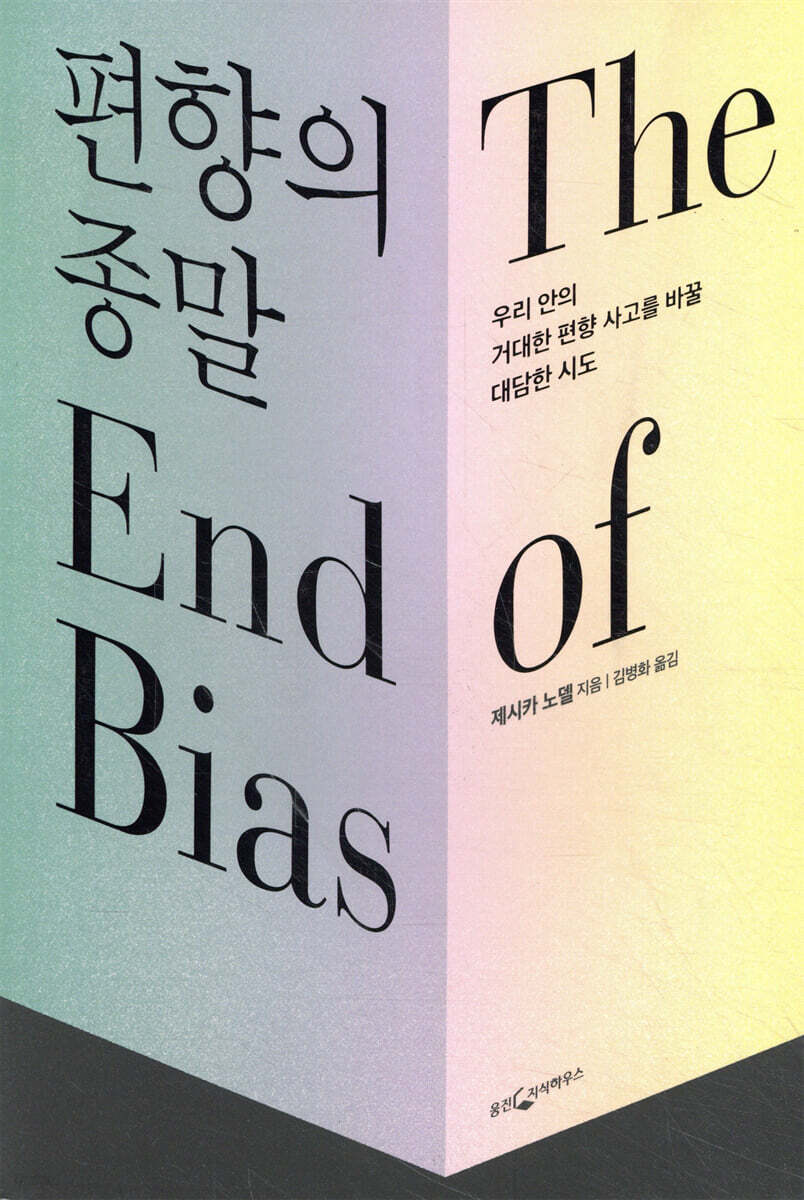
The End of Bias
 |
Description
Book Introduction
- A word from MD
-
A bold suggestion to overcome biasEven though we know that discrimination and hatred are baseless and bad, they do not disappear.
Why? Because the brain is designed that way.
The brain is excellent at distinguishing between me and you.
Bias is created in the brain and spreads throughout society.
This book analyzes how bias works and presents specific ways to break free from it.
December 13, 2022. Humanities PD Son Min-gyu
- Recommended by Adam Grant, Hong Seong-su, Kim Won-young, and Cheon Hyeon-woo
- World Economic Forum Book of the Year, Nautilus Book Award Silver Medalist, Royal Society Science Book Award Finalist
Going beyond the discovery of discrimination, we break the circuit of prejudice,
A great attempt to solve humanity's difficult problems!
Everyday prejudices such as “People from Jeolla Province are good at hitting the back of the head,” “Vegetarians are picky,” and “Women are bad at math” do not remain mere personal stereotypes; they threaten society.
How can we free ourselves from the biased thinking that has permeated our daily lives without us even realizing it? A new book, "The End of Bias," explores the empirical possibilities of answering this question.
In this book, Jessica Nordell, a next-generation American science journalist who is praised as a “reflective and capable thinker,” reveals to us the violence of bias and clues to its solution.
The author points out that human biased thinking, which operates instinctively, leads to prejudice and discrimination that run counter to our beliefs, and seeks a fundamental solution to the social conflicts that arise in almost all areas, including education, healthcare, labor, public safety, and religion.
Drawing on original computer simulations of the real-world impact of bias, as well as interdisciplinary research across cognitive science and psychology, and extensive case studies and interviews, this book offers ways to end biased thinking within us.
Beyond vague appeals and slogans, this book vividly exposes the true nature of how prejudice operates, offering hope that transcends an era of conflict and hatred.
- World Economic Forum Book of the Year, Nautilus Book Award Silver Medalist, Royal Society Science Book Award Finalist
Going beyond the discovery of discrimination, we break the circuit of prejudice,
A great attempt to solve humanity's difficult problems!
Everyday prejudices such as “People from Jeolla Province are good at hitting the back of the head,” “Vegetarians are picky,” and “Women are bad at math” do not remain mere personal stereotypes; they threaten society.
How can we free ourselves from the biased thinking that has permeated our daily lives without us even realizing it? A new book, "The End of Bias," explores the empirical possibilities of answering this question.
In this book, Jessica Nordell, a next-generation American science journalist who is praised as a “reflective and capable thinker,” reveals to us the violence of bias and clues to its solution.
The author points out that human biased thinking, which operates instinctively, leads to prejudice and discrimination that run counter to our beliefs, and seeks a fundamental solution to the social conflicts that arise in almost all areas, including education, healthcare, labor, public safety, and religion.
Drawing on original computer simulations of the real-world impact of bias, as well as interdisciplinary research across cognitive science and psychology, and extensive case studies and interviews, this book offers ways to end biased thinking within us.
Beyond vague appeals and slogans, this book vividly exposes the true nature of how prejudice operates, offering hope that transcends an era of conflict and hatred.
- You can preview some of the book's contents.
Preview
index
Recommendation 4
Introduction | The End of Bias Is the Beginning of Hope 12
Part 1: How Bias Leads to Discrimination and Hatred
: The instinct that separates us from them
Chapter 1: Tracing the Biased Thinking Within Us
The Birth of Racism | "I am a Girl" | Habits of the Mind, 'Implicit Bias' | Their Hatred is Innocent | When Prejudice, Beliefs, and Values Collide
Chapter 2: The Instinct That Classifies Us and Them
The human brain addicted to stereotypes | You turned your child into a monster | Categorization, essentialization, and stereotypes | “Good Morning, Boys and Girls” | Segmentation of racial groups | Cultural context and categorization | “White people are stupid, black people are weird” | What happened when a remote village got a TV | Images in the media and confirmation bias | The ‘implicit heuristic’ that justifies prejudice | Strategic deployment of stereotypes | Group identity, the double-edged sword
Chapter 3: Everyday Bias, Massive Discrimination
When 'micro-humiliations' persist | Simulating patterns of bias | 5 gender biases discovered in the Nomkov experiment | Homogeneity threatens the survival and evolution of organisms
Part 2: Breaking the Habits of the Mind
: A bold strategy to change the structure of biased thinking.
Chapter 4: Diversity Training to Break the Barriers of Habit
Unconscious Bias Training | Cognitive Behavioral Therapy: The Challenge of the Madison Workshop | 'Intervention' Training to Awareness of Bias | From Habitual to Selective Thinking | Are Your Behaviors Consistent with Your Beliefs?
Chapter 5: Discrimination Feeds on Fear
"I was afraid, and I had no choice" | The officer who feared a black man | Bias is imagined, but fear is real | Meditation for American police officers | Chronic stress triggers bias | Mindfulness for overcoming bias | The tragedy of the Hillsborough Police Department | 50 officers embark on enlightenment training | The beginning of change | Reading about the violence and ignorance within us
Chapter 6: Watts' Miracle Blooming from Contact
Laws Can't Change Fear | Is Contact the Best Answer? | From Arrests and Tactics to Conversations and Context | Community Safety Partnerships: Stripping Police of Their Bulletproof Vests | A Puzzle Approach to Recharging the Power of Giving | Neuronal Patterns and Intentional Intervention | The Miracle of Watts
How to change the three-tier system
: A New Design for the End of Bias
Chapter 7: Designing Choices Beyond Human Limitations
Do Black people feel less pain than white people? | A white, male-dominated healthcare system | Johns Hopkins' 'checklist' to eliminate healthcare disparities | Changing behavior is about design, not persuasion | Broward's gifted selection | The power of restructuring beyond good intentions
Chapter 8: Can Diversity Be Forced?
How Algorithms Learn to Hate | MIT's Strange Proposal | Is Affirmative Action Just Another Stigma? | The Consequences of MIT's Gender Quota | No Pioneers in Homogeneous Organizations | The Chains of Change
Chapter 9: The Science of Inclusion That Changes the World
Being a Complainer | It's Not Women's Fault, It's Just Circumstances | Inclusion and Equality: Taz Law Firm's Success Strategy | The Answer Lies with "Those Who Are Not Like You" | Female Mathematicians Changing the Language of Mathematics | The Philosophy of Recognizing Difference and Inclusion
Chapter 10: Overcoming Barriers of Group, Ethnicity, and Culture
Sesame Street's Challenge to Racial Integration | Media 'Manipulating' Racism and Hate | No 'Boys' or 'Girls' in Swedish Kindergartens | From Gender to Child Dignity: An Expanding World | Freedom from Bias
Going Out | A Great Challenge for You, Me, and All of Us
Acknowledgements
main
Search
Introduction | The End of Bias Is the Beginning of Hope 12
Part 1: How Bias Leads to Discrimination and Hatred
: The instinct that separates us from them
Chapter 1: Tracing the Biased Thinking Within Us
The Birth of Racism | "I am a Girl" | Habits of the Mind, 'Implicit Bias' | Their Hatred is Innocent | When Prejudice, Beliefs, and Values Collide
Chapter 2: The Instinct That Classifies Us and Them
The human brain addicted to stereotypes | You turned your child into a monster | Categorization, essentialization, and stereotypes | “Good Morning, Boys and Girls” | Segmentation of racial groups | Cultural context and categorization | “White people are stupid, black people are weird” | What happened when a remote village got a TV | Images in the media and confirmation bias | The ‘implicit heuristic’ that justifies prejudice | Strategic deployment of stereotypes | Group identity, the double-edged sword
Chapter 3: Everyday Bias, Massive Discrimination
When 'micro-humiliations' persist | Simulating patterns of bias | 5 gender biases discovered in the Nomkov experiment | Homogeneity threatens the survival and evolution of organisms
Part 2: Breaking the Habits of the Mind
: A bold strategy to change the structure of biased thinking.
Chapter 4: Diversity Training to Break the Barriers of Habit
Unconscious Bias Training | Cognitive Behavioral Therapy: The Challenge of the Madison Workshop | 'Intervention' Training to Awareness of Bias | From Habitual to Selective Thinking | Are Your Behaviors Consistent with Your Beliefs?
Chapter 5: Discrimination Feeds on Fear
"I was afraid, and I had no choice" | The officer who feared a black man | Bias is imagined, but fear is real | Meditation for American police officers | Chronic stress triggers bias | Mindfulness for overcoming bias | The tragedy of the Hillsborough Police Department | 50 officers embark on enlightenment training | The beginning of change | Reading about the violence and ignorance within us
Chapter 6: Watts' Miracle Blooming from Contact
Laws Can't Change Fear | Is Contact the Best Answer? | From Arrests and Tactics to Conversations and Context | Community Safety Partnerships: Stripping Police of Their Bulletproof Vests | A Puzzle Approach to Recharging the Power of Giving | Neuronal Patterns and Intentional Intervention | The Miracle of Watts
How to change the three-tier system
: A New Design for the End of Bias
Chapter 7: Designing Choices Beyond Human Limitations
Do Black people feel less pain than white people? | A white, male-dominated healthcare system | Johns Hopkins' 'checklist' to eliminate healthcare disparities | Changing behavior is about design, not persuasion | Broward's gifted selection | The power of restructuring beyond good intentions
Chapter 8: Can Diversity Be Forced?
How Algorithms Learn to Hate | MIT's Strange Proposal | Is Affirmative Action Just Another Stigma? | The Consequences of MIT's Gender Quota | No Pioneers in Homogeneous Organizations | The Chains of Change
Chapter 9: The Science of Inclusion That Changes the World
Being a Complainer | It's Not Women's Fault, It's Just Circumstances | Inclusion and Equality: Taz Law Firm's Success Strategy | The Answer Lies with "Those Who Are Not Like You" | Female Mathematicians Changing the Language of Mathematics | The Philosophy of Recognizing Difference and Inclusion
Chapter 10: Overcoming Barriers of Group, Ethnicity, and Culture
Sesame Street's Challenge to Racial Integration | Media 'Manipulating' Racism and Hate | No 'Boys' or 'Girls' in Swedish Kindergartens | From Gender to Child Dignity: An Expanding World | Freedom from Bias
Going Out | A Great Challenge for You, Me, and All of Us
Acknowledgements
main
Search
Detailed image

Into the book
The place where one human being meets another is also a kind of boundary.
That's where bias is evident and where harm is most likely to occur.
But it's also a place where we can substitute other ways of seeing, responding, and relating to one another if we interfere with our biases.
In the fermentation process that occurs bubbling at that boundary, something new can grow.
Things like insight, respect, and reciprocity that have been elusive for too long.
The risks are high and the repercussions are significant, but it is a solvable problem.
---From "Entering"
DeVine was not the first to suggest that people's behavior can be influenced by stereotypes that secretly arise in hidden chambers of the mind.
Lena Olive Smith, Minnesota's first Black female attorney, offered a sharp analysis of the phenomenon nearly a century ago.
As she wrote in 1928, “Some emotions may be so deeply embedded and subservient in a person’s unconscious that he or she may not even be aware of their existence.
It's common sense.
But with the right stimulus, it can come to the forefront.
People often believe that what they hear is the sound of justice, but they are deceived.
In fact, it is a prejudice that blinds him to all justice and fairness.”
---From "Chapter 1: Tracing the Biased Thinking Within Us"
In ancient times, skin color had different values and meanings than it does today, some of which we might not recognize today.
…according to Hippocrates' texts, the cold, damp climate of Northern Europe causes the skin to bleach, generate moisture, and make people lethargic.
Conversely, the hot sun of Egypt and Ethiopia darkens the skin and dries the body fluids, greatly enhancing the intelligence of Africans.
This worldview is also included in some Roman scientific guides.
Vitruvius, the Roman writer, architect, and engineer, wrote that 'the people of the southern countries are of a high understanding and act wisely in their councils.'
The Roman writer Vegetius lamented, “We are not as wealthy as the Africans, nor are we inferior to them in deception and strategy.”
---From "Chapter 2: The Instinct to Classify Us and Them"
To assess the true impact of bias, we need to look at the results of numerous interactions, not just one moment.
After setting out to explore this approach, I couldn't find any longitudinal studies in the real world—that is, studies that observed individuals and their biases over time.
To quantify the cumulative impact of one type of bias, I realized I needed to conduct my own hypothetical experiment.
The goal is to build a computer simulation that allows us to visualize a given environment as a complex system and observe changes over time.
Computer science professor Kenny Joseph agreed to collaborate on this project.
And we decided to design a simulation to quantify gender bias in the workplace.
---From "Chapter 3: Bias in Everyday Life, Massive Discrimination"
As mentioned earlier, perceived threat is the primary reason police officers use force.
As I wrote in this article, the belief that one's life is in imminent danger is precisely what legally justifies the action.
Yet, black men are disproportionately victims of force, even in situations where they are not actually in danger.
An analysis of nearly 1,000 fatal shootings by on-duty police officers found that Black victims were nearly twice as likely to be unarmed when shot compared to white victims.
---From "Chapter 5 Discrimination Feeds on Fear"
Women of color are at particularly high risk of receiving poor care.
A recent study analyzing the childbirth experiences of women of color found that they frequently experienced ridicule, ineffective communication, and contempt from medical professionals.
Some women even felt pressured into having a cesarean section.
Serena Williams' story of giving birth is famous.
The tennis star had a history of thrombosis, and when she noticed the signs, she immediately requested an X-ray and treatment, but the nurses and doctors didn't believe her.
Although Williams later received the care she needed, this attitude of medical professionals ignoring women's symptoms and discomfort is part of the reason why maternal mortality rates are higher among Black, Alaska Native, and American Indian women.
---From "Chapter 7: Designing Choices Beyond Human Limitations"
To create a less biased environment, simply increasing the diversity of the group is not enough.
We can't simply increase the number of women or other members of below-average-performing groups and hope things will work out.
Diversity is only half the battle if those who increase diversity in a group feel devalued and unwelcome.
If people from marginalized groups in an organization are frustrated by subtle or overt signs that they are not valued, then the organization has recruited talent, drained it, and discarded it.
That's where bias is evident and where harm is most likely to occur.
But it's also a place where we can substitute other ways of seeing, responding, and relating to one another if we interfere with our biases.
In the fermentation process that occurs bubbling at that boundary, something new can grow.
Things like insight, respect, and reciprocity that have been elusive for too long.
The risks are high and the repercussions are significant, but it is a solvable problem.
---From "Entering"
DeVine was not the first to suggest that people's behavior can be influenced by stereotypes that secretly arise in hidden chambers of the mind.
Lena Olive Smith, Minnesota's first Black female attorney, offered a sharp analysis of the phenomenon nearly a century ago.
As she wrote in 1928, “Some emotions may be so deeply embedded and subservient in a person’s unconscious that he or she may not even be aware of their existence.
It's common sense.
But with the right stimulus, it can come to the forefront.
People often believe that what they hear is the sound of justice, but they are deceived.
In fact, it is a prejudice that blinds him to all justice and fairness.”
---From "Chapter 1: Tracing the Biased Thinking Within Us"
In ancient times, skin color had different values and meanings than it does today, some of which we might not recognize today.
…according to Hippocrates' texts, the cold, damp climate of Northern Europe causes the skin to bleach, generate moisture, and make people lethargic.
Conversely, the hot sun of Egypt and Ethiopia darkens the skin and dries the body fluids, greatly enhancing the intelligence of Africans.
This worldview is also included in some Roman scientific guides.
Vitruvius, the Roman writer, architect, and engineer, wrote that 'the people of the southern countries are of a high understanding and act wisely in their councils.'
The Roman writer Vegetius lamented, “We are not as wealthy as the Africans, nor are we inferior to them in deception and strategy.”
---From "Chapter 2: The Instinct to Classify Us and Them"
To assess the true impact of bias, we need to look at the results of numerous interactions, not just one moment.
After setting out to explore this approach, I couldn't find any longitudinal studies in the real world—that is, studies that observed individuals and their biases over time.
To quantify the cumulative impact of one type of bias, I realized I needed to conduct my own hypothetical experiment.
The goal is to build a computer simulation that allows us to visualize a given environment as a complex system and observe changes over time.
Computer science professor Kenny Joseph agreed to collaborate on this project.
And we decided to design a simulation to quantify gender bias in the workplace.
---From "Chapter 3: Bias in Everyday Life, Massive Discrimination"
As mentioned earlier, perceived threat is the primary reason police officers use force.
As I wrote in this article, the belief that one's life is in imminent danger is precisely what legally justifies the action.
Yet, black men are disproportionately victims of force, even in situations where they are not actually in danger.
An analysis of nearly 1,000 fatal shootings by on-duty police officers found that Black victims were nearly twice as likely to be unarmed when shot compared to white victims.
---From "Chapter 5 Discrimination Feeds on Fear"
Women of color are at particularly high risk of receiving poor care.
A recent study analyzing the childbirth experiences of women of color found that they frequently experienced ridicule, ineffective communication, and contempt from medical professionals.
Some women even felt pressured into having a cesarean section.
Serena Williams' story of giving birth is famous.
The tennis star had a history of thrombosis, and when she noticed the signs, she immediately requested an X-ray and treatment, but the nurses and doctors didn't believe her.
Although Williams later received the care she needed, this attitude of medical professionals ignoring women's symptoms and discomfort is part of the reason why maternal mortality rates are higher among Black, Alaska Native, and American Indian women.
---From "Chapter 7: Designing Choices Beyond Human Limitations"
To create a less biased environment, simply increasing the diversity of the group is not enough.
We can't simply increase the number of women or other members of below-average-performing groups and hope things will work out.
Diversity is only half the battle if those who increase diversity in a group feel devalued and unwelcome.
If people from marginalized groups in an organization are frustrated by subtle or overt signs that they are not valued, then the organization has recruited talent, drained it, and discarded it.
---From "Chapter 9: The Science of Inclusion That Changes the World"
Publisher's Review
In the Age of Benevolent Discrimination, Why Can't Humans Be Free from Bias?
― Bias, a practical tool for the brain to perceive the world.
Our brains are addicted to stereotypes.
According to the conflict index calculated by the Federation of Korean Industries among 30 OECD countries, our country is a "republic of conflict," ranking third in the conflict index.
Beyond racial and gender bias, conflicts arising from discrimination and hatred in education, healthcare, labor, public safety, and religious settings are reaching dangerous levels.
In this situation, the easiest and fastest way to solve the problems of 'hate' and 'discrimination' is to regulate, prohibit, and punish them through law, but American science journalist Jessica Nodel points out that this symptomatic treatment is not a fundamental solution unless the root cause, 'biased thinking', is eliminated.
Here, bias refers to the attitude or tendency to have prejudice, and it appears very broadly, from human cognition and emotions to social systems and artificial intelligence.
Discrimination and hatred that occur throughout society stem from the human instinct of biased thinking, and the bias that is deeply rooted in individuals and society as a whole is eating away at future possibilities.
In her debut book, The End of Bias, which took 15 years to write, drawing on insights from cognitive science and social psychology, Nodell goes beyond recognizing and exposing the problem of bias to present systematic and practical solutions to overcome hate and discrimination in the workplace, disability, healthcare, and religious settings.
The author begins by understanding the true nature of bias, starting from human instinct.
It focuses on the fact that humans are born with an instinctive tendency to discriminate.
The human brain goes through three stages of ‘categorization’, ‘essentialization’, and ‘stereotype formation’ to efficiently understand information input in real time.
But in this process, a kind of compensatory effect occurs.
According to one experiment (Chapter 2), the human brain feels pleasure when it accurately predicts an uncertain outcome, and conversely, feels annoyance and threat when the prediction turns out to be wrong.
In an experiment conducted by psychologist Wendy Berry Mendez, white college students felt not only unfavorable but even threatened when interacting with Latino students (actually actors) who presented themselves as being of high socioeconomic status.
Because it didn't fit the stereotype that Latino students are poor.
In this reward system, the human brain is constantly 'addicted' to stereotypes, which leads to biased thinking.
“When white people feel threatened, they perceive black people as ‘blacker.’”
― Habitual thinking, discrimination, and hatred absorbed through culture feed on fear.
The problem is that these biased thoughts do not remain in the mind but lead to discrimination and hatred.
Surprisingly, humans are born without bias, but as we learn and socialize, we absorb the biases accumulated by the groups and cultures to which we belong.
This affects an individual's thoughts and actions, and acts as a bias against other cultural groups or others, such as gender, age, race, ethnicity, and religion.
Bias is a practical tool for humans to understand the world, but it is also a double-edged sword that can create fear of those different from ourselves.
Psychologist Amy Cross found that when white Americans feel threatened, they perceive black people's skin as "darker."
In 2016, Jeronimo Yanez, a traffic officer in the United States who shot a black man seven times after mistaking him for a criminal, said this during a police investigation.
“I was just scared.” Racial bias fueled fear and led to death.
This is just the tip of the iceberg.
As we've seen countless times, biased thinking creates differences in how we are treated across all areas of human life and across diverse groups, and the list of discrimination is endless.
If you are a woman, you may face limitations in your career advancement, and if you are a sexual minority, you may be rejected from the family, faith community, and health care sectors.
In a society where racism is rampant, you could lose your life because of the color of your skin.
“Why don’t you reply to women’s emails?”
― The reality of bias encountered while preparing to enter the media industry: Proving it with mathematical simulations.
After graduating from college, the author attempted to enter the media industry by submitting various feature articles to famous media outlets, but failed every time.
Then, when I sent an email with the same content to a fictional man named JD, the door that had been firmly closed opened in just a few hours.
The reason he didn't get a chance wasn't because he lacked skills, but because of his gender.
This experience led me to collaborate with computer scientists to understand the "dynamics of bias" that operate within social prejudice, simulating the real-world impact of bias.
Nodell, along with University of Buffalo computer science professor Kenny Joseph, designed a fictitious company called Nomcorp to assess how gender bias in the workplace affected women's advancement.
Here, we applied five gender biases that operate in the workplace: underestimation of ability, severity of punishment for mistakes, deprivation of merit, personality disadvantage, and opportunity bias.
This experiment mathematically proved that when there is a difference in the treatment of women and men, it ultimately 'disappears women from the upper echelons of the organization.'
This makes us realize that to bring about the end of bias, it is important to 'design' rather than persuade behavior.
Implicit bias can be more harmful than explicit bias.
The harm of implicit bias ranges from job loss to life-threatening consequences.
A striking point in this book is the author's argument that "implicit bias," which operates like a habit, can be more harmful than overt biases like racism or sexism.
Implicit bias refers to biased attitudes that are unconsciously displayed even though we believe we do not have such biases.
A typical example is when a white person who opposes racism actually acts in opposition to it.
Implicit bias operates like a circuit, starting when we absorb cultural knowledge.
This cultural knowledge influences how people react, behave, speak, and feel in the situations unfolding before them.
As a result, discrimination emerges and again feeds cultural knowledge.
So, to the question, “Can we really overcome implicit bias?” the author is confident that it is possible.
Because persuasion alone cannot change the mental habits and entrenched biased thinking structures, we must change our behavioral design from the beginning to break the biased circuit.
Although it may seem impossible, the author finds possibility in the midst of conflict.
Among the cases mentioned in this book, there are cases that support this, such as the value-neutral education of Swedish kindergartens that can be applied in educational settings, the behavioral design list of Johns Hopkins Hospital that enabled equal medical services, the mindfulness training based on meditation that reduced the frequency of gun use by US police officers, and the case of MIT that dramatically increased the proportion of female tenured professors to 66%.
"A new design that breaks the bias circuit"
― Immediately applicable solutions that go beyond the diagnosis of bias, such as behavioral design, mindfulness, and value-neutral education.
What makes this book different from existing books on bias is that it goes beyond simply diagnosing bias in our society, but instead presents systematic and practical solutions.
Among the numerous research cases, the following are three representative solutions that can be directly applied to our society.
1) Building a Brain Flexible Against Bias: Mindfulness Training
Based on research on the physical effects of mindfulness and meditation, mindfulness training was applied to 50 American police officers.
Police officers who underwent eight weeks of mindfulness training showed improvements in all aspects of their mental and physical health.
Stress levels were reduced, aggression was reduced, and physical fatigue was significantly improved.
2) Designing Behaviors to Prevent Discrimination: The Johns Hopkins Hospital Checklist
Johns Hopkins Hospital has introduced a "point list" into its clinical care to prevent blood clots in hospitalized patients.
Since then, the proportion of patients who were prescribed appropriate thrombolytics in a timely manner has increased, and the incidence of thrombosis has decreased.
The figures also show that gender inequality has disappeared from the medical process.
The correct treatment and care was provided to women and men in equal proportions.
3) Creating a Culture Beyond the Law: Value-Neutral Education in Swedish Kindergartens
When teachers at a Swedish kindergarten deliberately avoided classifying children as boys and girls, they found that the existing categories of 'gender' expanded.
As a result, children were less likely to predict "boy toys" and "girl toys," and when introduced to new friends, they were significantly less likely to choose friends of the same gender than in a typical kindergarten.
The way children see the world has changed.
*
The various approaches explored in this book are not definitive solutions to the problem of bias, but rather starting points.
In that respect, this book, "The End of Bias," will serve as a kind of guidebook for readers who wish to reduce their own biases.
It can also help organizations, managers, and policymakers design and build systems that prevent bias and discrimination, thereby driving organizational and societal change.
If we don't simply settle for vague appeals to eliminate prejudice, but instead work together to identify ways to overcome bias that are more accurately suited to our society, based on the countless examples discussed in this book, we will come one step closer to solving this complex problem.
― Bias, a practical tool for the brain to perceive the world.
Our brains are addicted to stereotypes.
According to the conflict index calculated by the Federation of Korean Industries among 30 OECD countries, our country is a "republic of conflict," ranking third in the conflict index.
Beyond racial and gender bias, conflicts arising from discrimination and hatred in education, healthcare, labor, public safety, and religious settings are reaching dangerous levels.
In this situation, the easiest and fastest way to solve the problems of 'hate' and 'discrimination' is to regulate, prohibit, and punish them through law, but American science journalist Jessica Nodel points out that this symptomatic treatment is not a fundamental solution unless the root cause, 'biased thinking', is eliminated.
Here, bias refers to the attitude or tendency to have prejudice, and it appears very broadly, from human cognition and emotions to social systems and artificial intelligence.
Discrimination and hatred that occur throughout society stem from the human instinct of biased thinking, and the bias that is deeply rooted in individuals and society as a whole is eating away at future possibilities.
In her debut book, The End of Bias, which took 15 years to write, drawing on insights from cognitive science and social psychology, Nodell goes beyond recognizing and exposing the problem of bias to present systematic and practical solutions to overcome hate and discrimination in the workplace, disability, healthcare, and religious settings.
The author begins by understanding the true nature of bias, starting from human instinct.
It focuses on the fact that humans are born with an instinctive tendency to discriminate.
The human brain goes through three stages of ‘categorization’, ‘essentialization’, and ‘stereotype formation’ to efficiently understand information input in real time.
But in this process, a kind of compensatory effect occurs.
According to one experiment (Chapter 2), the human brain feels pleasure when it accurately predicts an uncertain outcome, and conversely, feels annoyance and threat when the prediction turns out to be wrong.
In an experiment conducted by psychologist Wendy Berry Mendez, white college students felt not only unfavorable but even threatened when interacting with Latino students (actually actors) who presented themselves as being of high socioeconomic status.
Because it didn't fit the stereotype that Latino students are poor.
In this reward system, the human brain is constantly 'addicted' to stereotypes, which leads to biased thinking.
“When white people feel threatened, they perceive black people as ‘blacker.’”
― Habitual thinking, discrimination, and hatred absorbed through culture feed on fear.
The problem is that these biased thoughts do not remain in the mind but lead to discrimination and hatred.
Surprisingly, humans are born without bias, but as we learn and socialize, we absorb the biases accumulated by the groups and cultures to which we belong.
This affects an individual's thoughts and actions, and acts as a bias against other cultural groups or others, such as gender, age, race, ethnicity, and religion.
Bias is a practical tool for humans to understand the world, but it is also a double-edged sword that can create fear of those different from ourselves.
Psychologist Amy Cross found that when white Americans feel threatened, they perceive black people's skin as "darker."
In 2016, Jeronimo Yanez, a traffic officer in the United States who shot a black man seven times after mistaking him for a criminal, said this during a police investigation.
“I was just scared.” Racial bias fueled fear and led to death.
This is just the tip of the iceberg.
As we've seen countless times, biased thinking creates differences in how we are treated across all areas of human life and across diverse groups, and the list of discrimination is endless.
If you are a woman, you may face limitations in your career advancement, and if you are a sexual minority, you may be rejected from the family, faith community, and health care sectors.
In a society where racism is rampant, you could lose your life because of the color of your skin.
“Why don’t you reply to women’s emails?”
― The reality of bias encountered while preparing to enter the media industry: Proving it with mathematical simulations.
After graduating from college, the author attempted to enter the media industry by submitting various feature articles to famous media outlets, but failed every time.
Then, when I sent an email with the same content to a fictional man named JD, the door that had been firmly closed opened in just a few hours.
The reason he didn't get a chance wasn't because he lacked skills, but because of his gender.
This experience led me to collaborate with computer scientists to understand the "dynamics of bias" that operate within social prejudice, simulating the real-world impact of bias.
Nodell, along with University of Buffalo computer science professor Kenny Joseph, designed a fictitious company called Nomcorp to assess how gender bias in the workplace affected women's advancement.
Here, we applied five gender biases that operate in the workplace: underestimation of ability, severity of punishment for mistakes, deprivation of merit, personality disadvantage, and opportunity bias.
This experiment mathematically proved that when there is a difference in the treatment of women and men, it ultimately 'disappears women from the upper echelons of the organization.'
This makes us realize that to bring about the end of bias, it is important to 'design' rather than persuade behavior.
Implicit bias can be more harmful than explicit bias.
The harm of implicit bias ranges from job loss to life-threatening consequences.
A striking point in this book is the author's argument that "implicit bias," which operates like a habit, can be more harmful than overt biases like racism or sexism.
Implicit bias refers to biased attitudes that are unconsciously displayed even though we believe we do not have such biases.
A typical example is when a white person who opposes racism actually acts in opposition to it.
Implicit bias operates like a circuit, starting when we absorb cultural knowledge.
This cultural knowledge influences how people react, behave, speak, and feel in the situations unfolding before them.
As a result, discrimination emerges and again feeds cultural knowledge.
So, to the question, “Can we really overcome implicit bias?” the author is confident that it is possible.
Because persuasion alone cannot change the mental habits and entrenched biased thinking structures, we must change our behavioral design from the beginning to break the biased circuit.
Although it may seem impossible, the author finds possibility in the midst of conflict.
Among the cases mentioned in this book, there are cases that support this, such as the value-neutral education of Swedish kindergartens that can be applied in educational settings, the behavioral design list of Johns Hopkins Hospital that enabled equal medical services, the mindfulness training based on meditation that reduced the frequency of gun use by US police officers, and the case of MIT that dramatically increased the proportion of female tenured professors to 66%.
"A new design that breaks the bias circuit"
― Immediately applicable solutions that go beyond the diagnosis of bias, such as behavioral design, mindfulness, and value-neutral education.
What makes this book different from existing books on bias is that it goes beyond simply diagnosing bias in our society, but instead presents systematic and practical solutions.
Among the numerous research cases, the following are three representative solutions that can be directly applied to our society.
1) Building a Brain Flexible Against Bias: Mindfulness Training
Based on research on the physical effects of mindfulness and meditation, mindfulness training was applied to 50 American police officers.
Police officers who underwent eight weeks of mindfulness training showed improvements in all aspects of their mental and physical health.
Stress levels were reduced, aggression was reduced, and physical fatigue was significantly improved.
2) Designing Behaviors to Prevent Discrimination: The Johns Hopkins Hospital Checklist
Johns Hopkins Hospital has introduced a "point list" into its clinical care to prevent blood clots in hospitalized patients.
Since then, the proportion of patients who were prescribed appropriate thrombolytics in a timely manner has increased, and the incidence of thrombosis has decreased.
The figures also show that gender inequality has disappeared from the medical process.
The correct treatment and care was provided to women and men in equal proportions.
3) Creating a Culture Beyond the Law: Value-Neutral Education in Swedish Kindergartens
When teachers at a Swedish kindergarten deliberately avoided classifying children as boys and girls, they found that the existing categories of 'gender' expanded.
As a result, children were less likely to predict "boy toys" and "girl toys," and when introduced to new friends, they were significantly less likely to choose friends of the same gender than in a typical kindergarten.
The way children see the world has changed.
*
The various approaches explored in this book are not definitive solutions to the problem of bias, but rather starting points.
In that respect, this book, "The End of Bias," will serve as a kind of guidebook for readers who wish to reduce their own biases.
It can also help organizations, managers, and policymakers design and build systems that prevent bias and discrimination, thereby driving organizational and societal change.
If we don't simply settle for vague appeals to eliminate prejudice, but instead work together to identify ways to overcome bias that are more accurately suited to our society, based on the countless examples discussed in this book, we will come one step closer to solving this complex problem.
GOODS SPECIFICS
- Publication date: November 25, 2022
- Page count, weight, size: 500 pages | 682g | 145*217*25mm
- ISBN13: 9788901266817
- ISBN10: 8901266814
You may also like
카테고리
korean


korean

![ELLE 엘르 스페셜 에디션 A형 : 12월 [2025]](http://librairie.coreenne.fr/cdn/shop/files/b8e27a3de6c9538896439686c6b0e8fb.jpg?v=1766436872&width=3840)


