

Descriptive mind
 |
Description
Book Introduction
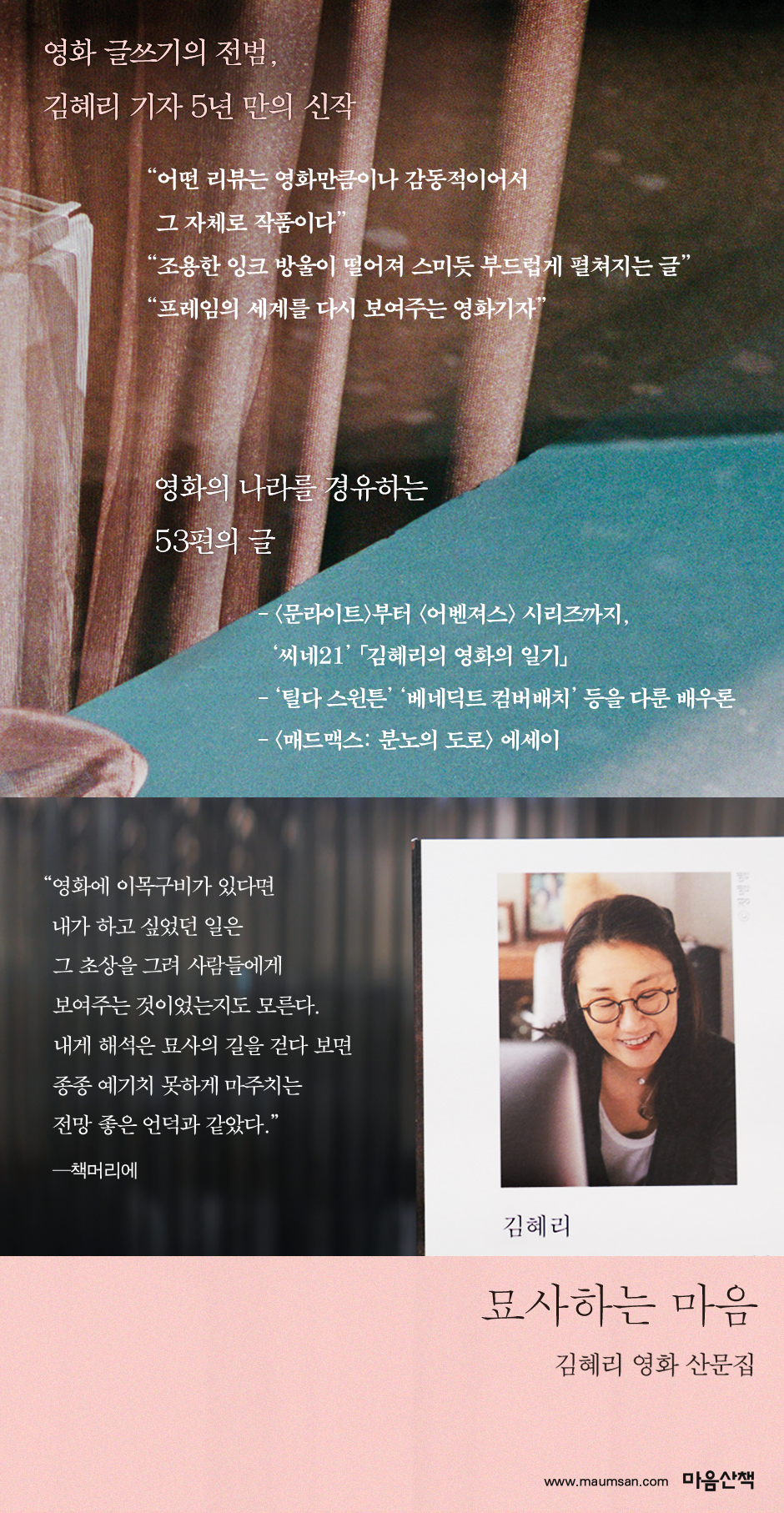
“There has always been a movie. I found myself figuring out 100 reasons to stop writing until yesterday. “The movies that got me excited and sat down at the keyboard, completely forgetting about it.” A model of film writing, Reporter Kim Hye-ri's new work after five years “Some reviews are as moving as a film, a work of art in themselves.” “Writing unfolds softly, like a quiet drop of ink falling and seeping through.” “A film journalist who rediscovers the world of frames.” Kim Hye-ri, a reporter for [Cine21], has been thoughtfully conveying the virtues of film for over 20 years. Online, you can often find reviews praising his writing for its clear reasoning and delicate sentences. Kim Hye-ri's writing is considered a model of film writing not only by general readers but also by professional writers such as literary critic Shin Hyeong-cheol, novelist Yoon Seong-hee, and film critic Heo Mun-yeong. With such a large fan base, the publication of his collection of essays, "Describing Heart," after five years will be welcome news to those who have only heard his stories about movies through his podcast since 2016. This book, which is a compilation of articles serialized in [Cine21]'s new release column "Kim Hye-ri's Film Diary" from 2017 to 2020, as well as several essays written before that, including a study on actress Tilda Swinton, shines with a humble attitude that still takes film as its subject and follows its shadow. In an age overflowing with presumptuous evaluations of what is spectacle, rather than displaying one's tastes, it is important to carefully ask oneself what the creative work of film means to oneself and to those who will read one's writing. And that attitude is also the driving force behind his ‘description’ of the film. He confesses that what he wanted to do was to look at the 'features' of the film and show people that portrait, and that walking along that path unexpectedly leads to an interpretation like 'a hill with a good view'. I look back and wonder what I did while following the movie. The word that can be used without hesitation is 'description'. When we see an attractive person, we want to take a picture, and when we hear a catchy song, we want to sing along. If there were facial features in the movie, what I wanted to do might have been to draw that portrait and show it to people. (…) For me, interpretation was like a hill with a nice view that I often unexpectedly encountered while walking the path of description. _Page 11, Preface 『The Descriptive Mind』 begins with the first part, "The Unsent Tribute," on actors, and moves on to parts that focus on themes of film (Part 2, "Awakening Films," Part 3, "Desiring Films," Part 4, "Worrying Films"), then delves into format (Part 5, "Action and Movement," Part 6, "The Sculpture of Time"), and concludes with "The Expanding Universe," which covers the landscape of Hollywood blockbusters since the 2010s. The 53 essays that travel through the land of cinema are closely arranged according to the author's intention, forming a tight link where thinking about one film leads to thinking about the next. Between the dense text, the metaphors and subtle humor placed at just the right places are commas that lead the reader to the book's conclusion. |
- You can preview some of the book's contents.
Preview
index
9 at the beginning of the book
1.
Unsent tribute
The Mystery of Isabelle Huppert | Isabelle Huppert
The Devilish Sociopath | Benedict Cumberbatch
Tom Cruise's Mission | Tom Cruise
Miss, choose that unassuming guy! | Paul Rudd
Tilda Swinton in Context | Tilda Swinton
2.
Awakening Movie
Moon Child | Moonlight
Revolution from the Self | Lady Bird
Parenting | Minors
Lifelong Education | Persepolis
Growth and Taboo | Stalker
First Love's Flair|Call Me By Your Name
The Keeper of the Magic Castle | The Florida Project
3.
Desire Movie
The Art of Breaking Up | Marriage Stories
Negotiation Called Love | My Love
A Morbid Match Made in Heaven|Phantom Thread
Selfishly, Cruelly|Lady Macbeth
Crazy Guys Are My Specialty|Elle
Little Women of the South | The Bewitched
Dedicated to a Like-minded Soul | Quiet Passion
Oh! My Queen | The Favourite: The Queen's Woman
4.
A worrying movie
Loving the Weakest of Capitalism | Okja
Save Me|First Reformed
Hand of God | Killing Deer
Broken Mirror|Midsommar
Peel off just one layer|Get Out
Even if they cry out, I will not listen.|Earth
Hidden Pain | Tully
Modern Saints|Help Them
5.
Action and movement
Wingardium Furiosa! | Mad Max: Fury Road
Not Kung Fu, but Gun Fu | John Wick 3 - Parabellum
The Usefulness of Technology, the Usefulness of Religion | Life of Pi
Michael Bay, the 'Auteur' | Transformers: Age of Extinction
The Ruins of the Killer | You Were Not Here
6.
The Sculpture of Time
Rediscovering Life|Right Now, Wrong Then
Rhyme of Everyday Life | Paterson
Beyond Death | Ghost Stories
2nd person past tense|Rome
Autobiography of a Villain | The Irishman
A Week, a Day, an Hour | Dunkirk
In Search of Lost Time | Turin's Horse
7.
Expanding Universe
A rare item called the Grand Finale | Harry Potter and the Deathly Hallows Part 2
The Threat of the Neverending Story | 2012 Hollywood Sequels
No Man's Land | Wonder Woman
The Laughing Man | Joker
The Unforgiven | Logan
Superhero Movies and Fascism | Captain America: The Winter Soldier
The Hero Alliance's Dilemma | Avengers: Age of Ultron
Black Beauty | Black Panther
Oh, My Captain | Captain Marvel
Season Finale | Avengers: Endgame
Iconoclasm | Star Wars: The Last Jedi
Backlash | Star Wars: The Rise of Skywalker
Disney's 21st Century Strategy | Aladdin (Live-Action)
1.
Unsent tribute
The Mystery of Isabelle Huppert | Isabelle Huppert
The Devilish Sociopath | Benedict Cumberbatch
Tom Cruise's Mission | Tom Cruise
Miss, choose that unassuming guy! | Paul Rudd
Tilda Swinton in Context | Tilda Swinton
2.
Awakening Movie
Moon Child | Moonlight
Revolution from the Self | Lady Bird
Parenting | Minors
Lifelong Education | Persepolis
Growth and Taboo | Stalker
First Love's Flair|Call Me By Your Name
The Keeper of the Magic Castle | The Florida Project
3.
Desire Movie
The Art of Breaking Up | Marriage Stories
Negotiation Called Love | My Love
A Morbid Match Made in Heaven|Phantom Thread
Selfishly, Cruelly|Lady Macbeth
Crazy Guys Are My Specialty|Elle
Little Women of the South | The Bewitched
Dedicated to a Like-minded Soul | Quiet Passion
Oh! My Queen | The Favourite: The Queen's Woman
4.
A worrying movie
Loving the Weakest of Capitalism | Okja
Save Me|First Reformed
Hand of God | Killing Deer
Broken Mirror|Midsommar
Peel off just one layer|Get Out
Even if they cry out, I will not listen.|Earth
Hidden Pain | Tully
Modern Saints|Help Them
5.
Action and movement
Wingardium Furiosa! | Mad Max: Fury Road
Not Kung Fu, but Gun Fu | John Wick 3 - Parabellum
The Usefulness of Technology, the Usefulness of Religion | Life of Pi
Michael Bay, the 'Auteur' | Transformers: Age of Extinction
The Ruins of the Killer | You Were Not Here
6.
The Sculpture of Time
Rediscovering Life|Right Now, Wrong Then
Rhyme of Everyday Life | Paterson
Beyond Death | Ghost Stories
2nd person past tense|Rome
Autobiography of a Villain | The Irishman
A Week, a Day, an Hour | Dunkirk
In Search of Lost Time | Turin's Horse
7.
Expanding Universe
A rare item called the Grand Finale | Harry Potter and the Deathly Hallows Part 2
The Threat of the Neverending Story | 2012 Hollywood Sequels
No Man's Land | Wonder Woman
The Laughing Man | Joker
The Unforgiven | Logan
Superhero Movies and Fascism | Captain America: The Winter Soldier
The Hero Alliance's Dilemma | Avengers: Age of Ultron
Black Beauty | Black Panther
Oh, My Captain | Captain Marvel
Season Finale | Avengers: Endgame
Iconoclasm | Star Wars: The Last Jedi
Backlash | Star Wars: The Rise of Skywalker
Disney's 21st Century Strategy | Aladdin (Live-Action)
Detailed image
Into the book
Benedict Cumberbatch's acting has that special quality that instantly electrifies the viewer.
Great acting can be either a touchy-feely performance or a permeating performance, but Cumberbatch's signature move is the one that instantly pierces the audience's heart.
When I suddenly turned around, his sword blade was already sticking out from behind my back.
--- p.29
The story of [Moonlight] breaks away from the standard narrative of misery and redemption, and formally, it does not adopt the naturalistic aesthetic automatically adopted by films depicting socially caused misfortune.
Barry Jenkins controls what to show and hear, what to hide and what to silence, with almost the rigor of a poet or architect.
The result, thus refined, is a near-perfect blend of sound and silence, image and omission.
--- p.71
As is always the case with Bong Joon-ho's films, there is no such thing as an all-out victory, and the world goes on as it always has.
Meanwhile, humans and animals do what they can and save what they can.
Like Clarice (Jodie Foster) in [The Silence of the Lambs], who pursued Buffalo Bill, a serial killer who was merely a fragment of the evil rampant in the world, to the death in order to stop the bleating of slaughter lambs heard in her dreams, Mija will sometimes fall asleep with her eyes closed.
And the memories of the fight will remain and flow through the world.
--- p.169
The women in [Mad Max: Fury Road] are not feminists because they beat up men, but because they refuse to be objectified and reified as vessels for fetuses or tools for sexual gratification by male power simply because they are women.
Bullet catcher Nux and 'blood bag' Max are both tooled humans and suffer the same pain, and the women fight in the same car as them.
They are feminists who believe in their own strength and dignity, who are willing to die for their beliefs, who do not wait for men to rescue them, and who save men in battle. Max and Nux, who fully respect them, are also feminists.
--- p.218
Frank never quite knows where his life went wrong or who or what he should apologize to.
No, they lose their physical strength and intelligence while being bewildered, not even being able to accurately recognize failure.
The old man, who has no one to protect him and yet keeps silent about the truth out of inertia, waits only for death to come through the slanted door and command the 'end'.
Scorsese leaves the man there.
--- p.286
What's needed at the end of a movie, especially one that's been a long series made over ten years, is not a happy ending, but justice.
Justice here does not simply mean that virtue is rewarded and evil is punished in the play.
This means that the characters that the audience loved and hated must be respected to the end, the plot and events that have been unfolded so far must be taken responsibility for, and the overall theme and style of the work must reach a desirable synthesis.
Director David Yates' [Harry Potter and the Deathly Hallows Part 2] (hereafter [Deathly Hallows Part 2]) is a 'righteous' finale that satisfies the above requirements.
The boy wizard Harry Potter ultimately won his seven-year battle with Voldemort, but he suffered numerous internal injuries and lost loved ones along the way.
And then… …I survived.
Yes, that's right.
It would be more appropriate to say that they survived rather than that they won.
And that's what we mean by justice.
--- p.307
The question of weighing individual freedom versus security is a point where Hollywood films have often connected with real society since 9/11.
(…) But fundamentally, the superheroes of American comics achieve their goals through physical force, and in most cases their goal is to protect and support the existing system.
--- p.348~349
In [The Dark Knight] and [The Dark Knight Rises], the friction that superheroes create with the public power that monopolizes violence and the impact that this has on the public psyche serve as the backbone of the entire narrative.
(…) There was no room for defense in the interpretation that the film reduced anti-capitalist resistance to a savage riot through a spectacle that precisely recalled the Wall Street protests, and then found a solution in the sacrifice of a noble elite lone star.
Great acting can be either a touchy-feely performance or a permeating performance, but Cumberbatch's signature move is the one that instantly pierces the audience's heart.
When I suddenly turned around, his sword blade was already sticking out from behind my back.
--- p.29
The story of [Moonlight] breaks away from the standard narrative of misery and redemption, and formally, it does not adopt the naturalistic aesthetic automatically adopted by films depicting socially caused misfortune.
Barry Jenkins controls what to show and hear, what to hide and what to silence, with almost the rigor of a poet or architect.
The result, thus refined, is a near-perfect blend of sound and silence, image and omission.
--- p.71
As is always the case with Bong Joon-ho's films, there is no such thing as an all-out victory, and the world goes on as it always has.
Meanwhile, humans and animals do what they can and save what they can.
Like Clarice (Jodie Foster) in [The Silence of the Lambs], who pursued Buffalo Bill, a serial killer who was merely a fragment of the evil rampant in the world, to the death in order to stop the bleating of slaughter lambs heard in her dreams, Mija will sometimes fall asleep with her eyes closed.
And the memories of the fight will remain and flow through the world.
--- p.169
The women in [Mad Max: Fury Road] are not feminists because they beat up men, but because they refuse to be objectified and reified as vessels for fetuses or tools for sexual gratification by male power simply because they are women.
Bullet catcher Nux and 'blood bag' Max are both tooled humans and suffer the same pain, and the women fight in the same car as them.
They are feminists who believe in their own strength and dignity, who are willing to die for their beliefs, who do not wait for men to rescue them, and who save men in battle. Max and Nux, who fully respect them, are also feminists.
--- p.218
Frank never quite knows where his life went wrong or who or what he should apologize to.
No, they lose their physical strength and intelligence while being bewildered, not even being able to accurately recognize failure.
The old man, who has no one to protect him and yet keeps silent about the truth out of inertia, waits only for death to come through the slanted door and command the 'end'.
Scorsese leaves the man there.
--- p.286
What's needed at the end of a movie, especially one that's been a long series made over ten years, is not a happy ending, but justice.
Justice here does not simply mean that virtue is rewarded and evil is punished in the play.
This means that the characters that the audience loved and hated must be respected to the end, the plot and events that have been unfolded so far must be taken responsibility for, and the overall theme and style of the work must reach a desirable synthesis.
Director David Yates' [Harry Potter and the Deathly Hallows Part 2] (hereafter [Deathly Hallows Part 2]) is a 'righteous' finale that satisfies the above requirements.
The boy wizard Harry Potter ultimately won his seven-year battle with Voldemort, but he suffered numerous internal injuries and lost loved ones along the way.
And then… …I survived.
Yes, that's right.
It would be more appropriate to say that they survived rather than that they won.
And that's what we mean by justice.
--- p.307
The question of weighing individual freedom versus security is a point where Hollywood films have often connected with real society since 9/11.
(…) But fundamentally, the superheroes of American comics achieve their goals through physical force, and in most cases their goal is to protect and support the existing system.
--- p.348~349
In [The Dark Knight] and [The Dark Knight Rises], the friction that superheroes create with the public power that monopolizes violence and the impact that this has on the public psyche serve as the backbone of the entire narrative.
(…) There was no room for defense in the interpretation that the film reduced anti-capitalist resistance to a savage riot through a spectacle that precisely recalled the Wall Street protests, and then found a solution in the sacrifice of a noble elite lone star.
--- p.350~351
Publisher's Review
Images, sound, editing… … each film has its own way of doing things.
Reflections on Film Ethics that Create a New Reality
『The Descriptive Mind』 covers a wide range of film genres, from arthouse films like Béla Turin's The Turin Horse to blockbusters like the Avengers series, but there is a common thread in his approach to viewing the works.
The point is that in the process of thinking about why and how a film is good, it illuminates both the film's narrative and form.
Films inevitably contain narrative elements, such as conflicts and events between characters, while also having their own unique format, such as images, sounds, and editing, that support the narrative.
Kim Hye-ri seeks to uncover the secrets of how these two aspects harmonize to make the magic of cinema work.
For example, while comparing Park Chan-wook's [Stoker] to Alfred Hitchcock's [Shadow of a Doubt] with a similar story, one can identify the unique framework of [Stoker]—eliminating the contemporary and regional aspects and putting a family of three in a mansion to focus on the girl's consciousness—or draw attention to the universality of the family story the director delved into.
Meanwhile, the use of low-angle shots using wide-angle lenses and the way the ceiling is hung above the frame in [The Favourite] (Yorgos Lanthimos) makes the powerful figures in the film look small and insignificant, and the aspect ratio (1.37:1) and the frame that resembles the photo paper of an old photograph in [A Ghost Story] (David Lowery) stimulate nostalgia for a house, all of which draw attention to the visual medium characteristics of films.
Among the works that allow us to experience a new cinematic time, [Dunkirk] is undoubtedly at the forefront.
Set against the backdrop of the Dunkirk evacuation during World War II, the film weaves together three perspectives: “The Pier: A Week,” “The Sea: A Day,” and “The Sky: An Hour,” and the very composition of the film “proves that film is the ultimate time machine and an art form that can ‘manipulate’ the quantity and quality of time experienced by humans.”
Above all, one of the virtues of Kim Hye-ri's writing is that, as Shin Hyeong-cheol puts it, she is "extremely sensitive to the 'ethical issues' latent in film narratives," and the writings in "The Descriptive Mind" also maintain this quality.
He gauges the progress (and sometimes regression) in how directors view issues of feminism, racism, and class through the way they deal with the identities of their characters in their films, including gender, race, and nationality. This attitude also leads to questions about the director's position and the way he represents reality.
His aesthetic judgment is not separate from his ethical judgment.
The lives and living spaces of extremely poor outsiders, rarely depicted in American films, and the underground economy where they earn their daily bread are subjects that have always drawn director Sean Baker.
The 2012 film [Starlet] was about a white porn star's friendship with an older woman in California's San Fernando Valley, and [Tangerine], the immediate predecessor to [The Florida Project], depicted the Christmas Eve of two transgender friends who make a living through prostitution.
In approaching this material, director Sean Baker avoids the outrage or sympathy that an outsider might easily adopt.
I want to stay by their side without looking down on them and grasp the beauty and darkness inherent in their lives.
Sean Baker's film believes that in 'a life of poverty', the emphasis should not be on 'poverty' but on 'a life that entails the condition of poverty'.
Page 107, "The Keeper of the Magic Castle: The Florida Project"
“Movies bring us to life.”
The hill of interpretation that follows delicate language
In an era where the rapid growth of OTT original films has created a flood of things to see, what does film mean to us?
In particular, what does it mean to go to the theater and watch a movie?
As director James Cameron put it, do people go to the theater to experience sharper, smoother, and more magnificent images and sound than they can experience on their living room TVs? Kim Hye-ri responds that audiences go to the theater not simply to enjoy "high-quality" images, but "in search of quality time."
Only film is the 'art that can invent time' and only through film can we understand the 'meaning of time'.
In reality, when we are cut off from our daily lives in the darkness, don't we gain autonomy over time and be able to fully accept 'time' as 'time'?
『The Descriptive Mind』 continues that special time a little longer.
When the film is depicted on the ground, readers will have to turn the projector on again in their minds.
Looking forward to the 'Hill of Interpretation' that we will reach with the author at the end of the movie.
The film makes the audience perceive time as time.
At the same time, unlike TV or other media that are barely inserted into the torrent of everyday life, films implicitly (in the dark) respect the audience's autonomy to control the quality, density, and speed of time.
While alive, humans do not know the meaning of time.
Only death gives meaning to the unfinished.
But while film preserves the time of life as the time of life, it produces meaning at every moment of the shot and sequence.
A cut is a small death.
So, as Virginia Woolf observed, movies are still more real than reality, and they can catch us when we are trying to get away from life and bring us back to life.
Page 303, "In Search of Lost Time: The Turin Horse"
Reflections on Film Ethics that Create a New Reality
『The Descriptive Mind』 covers a wide range of film genres, from arthouse films like Béla Turin's The Turin Horse to blockbusters like the Avengers series, but there is a common thread in his approach to viewing the works.
The point is that in the process of thinking about why and how a film is good, it illuminates both the film's narrative and form.
Films inevitably contain narrative elements, such as conflicts and events between characters, while also having their own unique format, such as images, sounds, and editing, that support the narrative.
Kim Hye-ri seeks to uncover the secrets of how these two aspects harmonize to make the magic of cinema work.
For example, while comparing Park Chan-wook's [Stoker] to Alfred Hitchcock's [Shadow of a Doubt] with a similar story, one can identify the unique framework of [Stoker]—eliminating the contemporary and regional aspects and putting a family of three in a mansion to focus on the girl's consciousness—or draw attention to the universality of the family story the director delved into.
Meanwhile, the use of low-angle shots using wide-angle lenses and the way the ceiling is hung above the frame in [The Favourite] (Yorgos Lanthimos) makes the powerful figures in the film look small and insignificant, and the aspect ratio (1.37:1) and the frame that resembles the photo paper of an old photograph in [A Ghost Story] (David Lowery) stimulate nostalgia for a house, all of which draw attention to the visual medium characteristics of films.
Among the works that allow us to experience a new cinematic time, [Dunkirk] is undoubtedly at the forefront.
Set against the backdrop of the Dunkirk evacuation during World War II, the film weaves together three perspectives: “The Pier: A Week,” “The Sea: A Day,” and “The Sky: An Hour,” and the very composition of the film “proves that film is the ultimate time machine and an art form that can ‘manipulate’ the quantity and quality of time experienced by humans.”
Above all, one of the virtues of Kim Hye-ri's writing is that, as Shin Hyeong-cheol puts it, she is "extremely sensitive to the 'ethical issues' latent in film narratives," and the writings in "The Descriptive Mind" also maintain this quality.
He gauges the progress (and sometimes regression) in how directors view issues of feminism, racism, and class through the way they deal with the identities of their characters in their films, including gender, race, and nationality. This attitude also leads to questions about the director's position and the way he represents reality.
His aesthetic judgment is not separate from his ethical judgment.
The lives and living spaces of extremely poor outsiders, rarely depicted in American films, and the underground economy where they earn their daily bread are subjects that have always drawn director Sean Baker.
The 2012 film [Starlet] was about a white porn star's friendship with an older woman in California's San Fernando Valley, and [Tangerine], the immediate predecessor to [The Florida Project], depicted the Christmas Eve of two transgender friends who make a living through prostitution.
In approaching this material, director Sean Baker avoids the outrage or sympathy that an outsider might easily adopt.
I want to stay by their side without looking down on them and grasp the beauty and darkness inherent in their lives.
Sean Baker's film believes that in 'a life of poverty', the emphasis should not be on 'poverty' but on 'a life that entails the condition of poverty'.
Page 107, "The Keeper of the Magic Castle: The Florida Project"
“Movies bring us to life.”
The hill of interpretation that follows delicate language
In an era where the rapid growth of OTT original films has created a flood of things to see, what does film mean to us?
In particular, what does it mean to go to the theater and watch a movie?
As director James Cameron put it, do people go to the theater to experience sharper, smoother, and more magnificent images and sound than they can experience on their living room TVs? Kim Hye-ri responds that audiences go to the theater not simply to enjoy "high-quality" images, but "in search of quality time."
Only film is the 'art that can invent time' and only through film can we understand the 'meaning of time'.
In reality, when we are cut off from our daily lives in the darkness, don't we gain autonomy over time and be able to fully accept 'time' as 'time'?
『The Descriptive Mind』 continues that special time a little longer.
When the film is depicted on the ground, readers will have to turn the projector on again in their minds.
Looking forward to the 'Hill of Interpretation' that we will reach with the author at the end of the movie.
The film makes the audience perceive time as time.
At the same time, unlike TV or other media that are barely inserted into the torrent of everyday life, films implicitly (in the dark) respect the audience's autonomy to control the quality, density, and speed of time.
While alive, humans do not know the meaning of time.
Only death gives meaning to the unfinished.
But while film preserves the time of life as the time of life, it produces meaning at every moment of the shot and sequence.
A cut is a small death.
So, as Virginia Woolf observed, movies are still more real than reality, and they can catch us when we are trying to get away from life and bring us back to life.
Page 303, "In Search of Lost Time: The Turin Horse"
GOODS SPECIFICS
- Date of issue: August 5, 2022
- Page count, weight, size: 404 pages | 614g | 145*225*28mm
- ISBN13: 9788960907515
- ISBN10: 8960907510
You may also like
카테고리
korean


korean

![GQ KOREA Mark (Monthly): December [2025]](http://librairie.coreenne.fr/cdn/shop/files/8ef265dbbfbf186523ed75ba7319009d.jpg?v=1765340328&width=3840)


