

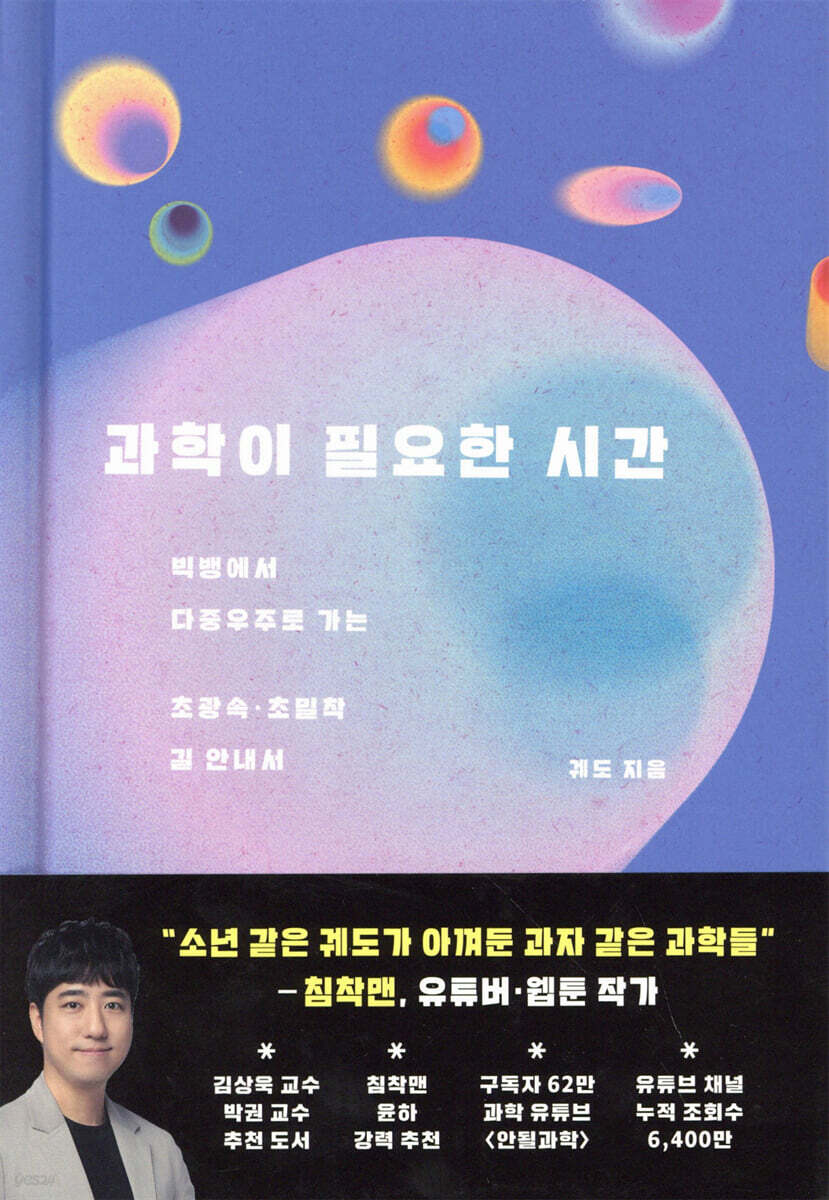
A time when science is needed
 |
Description
Book Introduction
- A word from MD
-
A Closer Look at the Science of OrbitA book on the orbit of a science communicator and YouTuber.
It conveys scientific knowledge in various fields, including artificial intelligence, dreams, time, and quantum mechanics, in an easy-to-understand and fun way unique to Orbit.
As you read this simple and informative science story, you'll find yourself seeing science everywhere.
October 18, 2022. Natural Science PD Ahn Hyeon-jae
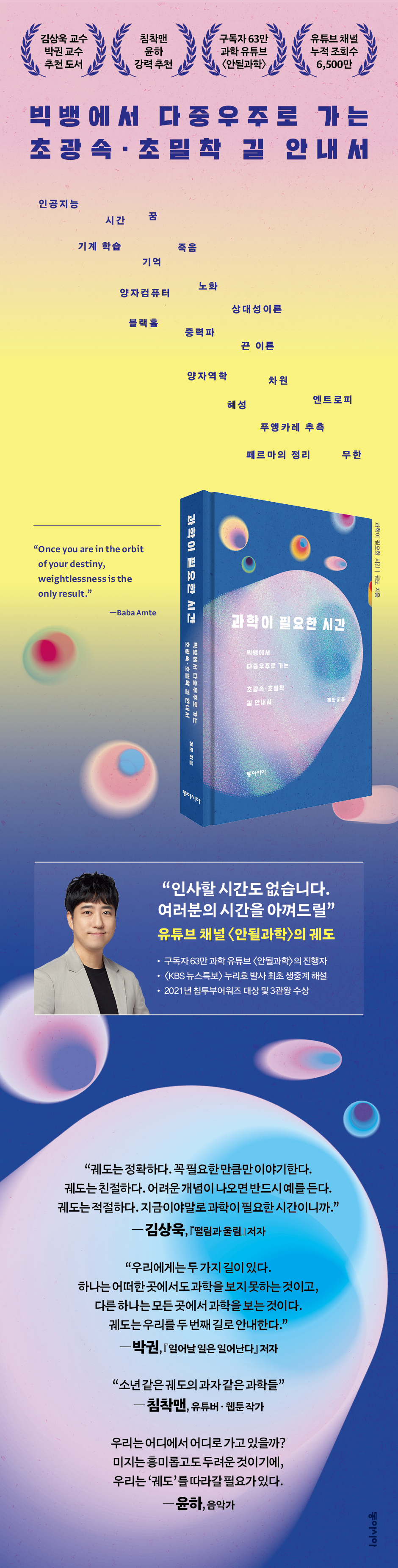
- Books recommended by Professor Kim Sang-wook and Professor Park Kwon
- Calm Man, strongly recommended by Yoon Ha
- Science YouTube channel "Science That Won't Work" with 630,000 subscribers
- YouTube channel cumulative views: 65 million
Artificial intelligence and human intelligence: are they ultimately the same?
Can humans overcome aging and read other people's brains?
Is our universe really a hologram recorded on a two-dimensional plane?
Could the universe, made of one-dimensional strings, be infinitely extended?
How and why did all this come into existence?
From artificial intelligence to quantum mechanics,
A Guide to Superluminal and Ultra-Close Science
It's a time when everyone needs science.
Especially with the rapid development of artificial intelligence, voices are growing louder that science should belong to all citizens, not just a few specialists or experts.
And above all, in the face of the climate crisis, science is becoming a vast arena and culture in which everyone must actively participate with creativity.
Yet, many still confess that they lack the "literacy" to understand science and that it requires too much patience to approach it.
For these people, the author, who is a science communicator and host of the YouTube channel "Science That Won't Work," has compiled 26 core topics in science, carefully selected over four years.
It is a time when science is needed.
Having gone through years of trial and error while communicating with professors and readers representing each field on various broadcasting and online platforms, the author finds the easiest, most accurate, and fastest 'optimal explanation' and explains not only the latest principles and concepts of science such as artificial intelligence, deep learning, and quantum computers, but also the core theories of 21st century science such as the theory of relativity, quantum mechanics, and the standard model in a friendly manner.
Furthermore, it helps us look at life's issues such as dreams, memory, aging, and death through the lens of science.
- Calm Man, strongly recommended by Yoon Ha
- Science YouTube channel "Science That Won't Work" with 630,000 subscribers
- YouTube channel cumulative views: 65 million
Artificial intelligence and human intelligence: are they ultimately the same?
Can humans overcome aging and read other people's brains?
Is our universe really a hologram recorded on a two-dimensional plane?
Could the universe, made of one-dimensional strings, be infinitely extended?
How and why did all this come into existence?
From artificial intelligence to quantum mechanics,
A Guide to Superluminal and Ultra-Close Science
It's a time when everyone needs science.
Especially with the rapid development of artificial intelligence, voices are growing louder that science should belong to all citizens, not just a few specialists or experts.
And above all, in the face of the climate crisis, science is becoming a vast arena and culture in which everyone must actively participate with creativity.
Yet, many still confess that they lack the "literacy" to understand science and that it requires too much patience to approach it.
For these people, the author, who is a science communicator and host of the YouTube channel "Science That Won't Work," has compiled 26 core topics in science, carefully selected over four years.
It is a time when science is needed.
Having gone through years of trial and error while communicating with professors and readers representing each field on various broadcasting and online platforms, the author finds the easiest, most accurate, and fastest 'optimal explanation' and explains not only the latest principles and concepts of science such as artificial intelligence, deep learning, and quantum computers, but also the core theories of 21st century science such as the theory of relativity, quantum mechanics, and the standard model in a friendly manner.
Furthermore, it helps us look at life's issues such as dreams, memory, aging, and death through the lens of science.
- You can preview some of the book's contents.
Preview
index
Introduction: What Matters
Part 1: When Machines Sing for Humans
[Artificial Intelligence] A World Where Humans and AI Are Indistinguishable
[Machine Learning] AlphaGo Doesn't Replay Past Games
[Virtual Human] AI Challenges God in Virtual Space
[Computer] A Turing machine that imitates thought with 0s and 1s
Quantum Computers: A Fantasy Becoming Reality
Part 2 The Story of Your Life
[Time] Where did all the boring times of my childhood go?
[Memory] The world's saddest time travel
[Dream] The blessing of dreams bestowed upon living beings
[Aging] Can Artificial Organs Overcome the Limits of Human Lifespan?
[Death] What does the brain see at the moment of death?
Part 3: The Most Elegant Way to Fall into a Black Hole
[Black Hole] Could There Be a Hole to Hell in Space?
[Gravitational Waves] If we listen to the signals sent by the universe
[Mars] Will we ever see a proper sunset on Mars?
[Comet] A scene from a movie that could happen in real life
[James Webb] Humanity Preparing a New Way to See the Universe
Part 4: The Beautiful Dream of the Final Theory
[Theory of Relativity] How would a girl who leapt through time view the world?
[Entropy] The devil wears entropy
[Information] If the world we live in were a hologram
[Quantum Mechanics] From the Smallest World to the Multiverse
[Standard Model] Where Does My Increasing Body Mass Come From?
[String Theory] Why I Wanted to Create a World Made of Strings
Part 5: A Language That Contains an Infinity Greater Than Infinity
[Fermat's Last Theorem] A Mathematical Puzzle That Made It into the Guinness Book of World Records
[Dimension] Why It's Not Surprising to Hear That It's Like the Fourth Dimension
[Poincaré Conjecture] Mathematics that seems useless but is beautiful, and therefore more useful.
[Pi] The most important and famous constant in human history
[Infinite] A journey to find a state of eternal, endless existence.
Outgoing Post: The Most Accurate Way to Fail
Part 1: When Machines Sing for Humans
[Artificial Intelligence] A World Where Humans and AI Are Indistinguishable
[Machine Learning] AlphaGo Doesn't Replay Past Games
[Virtual Human] AI Challenges God in Virtual Space
[Computer] A Turing machine that imitates thought with 0s and 1s
Quantum Computers: A Fantasy Becoming Reality
Part 2 The Story of Your Life
[Time] Where did all the boring times of my childhood go?
[Memory] The world's saddest time travel
[Dream] The blessing of dreams bestowed upon living beings
[Aging] Can Artificial Organs Overcome the Limits of Human Lifespan?
[Death] What does the brain see at the moment of death?
Part 3: The Most Elegant Way to Fall into a Black Hole
[Black Hole] Could There Be a Hole to Hell in Space?
[Gravitational Waves] If we listen to the signals sent by the universe
[Mars] Will we ever see a proper sunset on Mars?
[Comet] A scene from a movie that could happen in real life
[James Webb] Humanity Preparing a New Way to See the Universe
Part 4: The Beautiful Dream of the Final Theory
[Theory of Relativity] How would a girl who leapt through time view the world?
[Entropy] The devil wears entropy
[Information] If the world we live in were a hologram
[Quantum Mechanics] From the Smallest World to the Multiverse
[Standard Model] Where Does My Increasing Body Mass Come From?
[String Theory] Why I Wanted to Create a World Made of Strings
Part 5: A Language That Contains an Infinity Greater Than Infinity
[Fermat's Last Theorem] A Mathematical Puzzle That Made It into the Guinness Book of World Records
[Dimension] Why It's Not Surprising to Hear That It's Like the Fourth Dimension
[Poincaré Conjecture] Mathematics that seems useless but is beautiful, and therefore more useful.
[Pi] The most important and famous constant in human history
[Infinite] A journey to find a state of eternal, endless existence.
Outgoing Post: The Most Accurate Way to Fail
Detailed image
Into the book
Now it's time for algorithms to get confused with artificial intelligence.
Sometimes it seems like this guy is doing something on his own, and whenever he does, the word "artificial intelligence" is replaced with "algorithm."
To illustrate the difference between the two, let's take vending machines as an example.
The algorithm is that when you insert a coin, a drink comes out.
But artificial intelligence creates a vending machine by inserting coins and drinks.
A set of specific rules that define the output for various types of input information received by software is called a 'program', and artificial intelligence creates this based on the information received.
This way, it can autonomously build a rule system and solve tasks that were previously dependent on people.
--- pp.18~19
To satisfy his curiosity, Hassabis moved to University College London and began to study the human brain in earnest.
If even artificial intelligence, which seems to think almost like a human, ultimately thinks and acts within the boundaries established by its developers, isn't the creative act of coming up with entirely new ideas the last remaining greatness of humanity? In 2007, he published a short, six-page paper.
The conclusion was quite surprising.
Patients with amnesia are unable to imagine new experiences or situations.
--- pp.26~27
Is there another way to make things faster? While pondering this, a scientist returned to a fundamental question.
It was none other than British theoretical physicist David Deutsch.
He thought.
Are we really building computers correctly? Current computers calculate in 0s and 1s, but quantum mechanics shows that information isn't limited to just two states: 0 and 1.
Shouldn't we also consider the superposition state, which is both 0 and 1 at the same time?' This is how the qubit (quantum bit), the basic unit of a quantum computer, was born.
--- p.56
In particular, among the nuns who were the subjects of the study, there was one who was particularly noteworthy.
The research team had high expectations for her, as she had excelled on every cognitive test she had taken until just before she died of a heart attack at age 85, and her intellectual abilities were far superior to those of other, younger nuns.
When it finally came time to analyze her brain, Alzheimer's research reached a revolutionary turning point.
She was a dementia patient with advanced Alzheimer's disease.
--- pp.76~77
Comet NEOWISE's closest approach to Earth was on July 23, 2020.
However, as it gradually moves away from the sun and approaches the Earth, its brightness may have decreased and it may not have been visible.
But even if you can't see it, you must never forget it.
Even if a comet that comes once every 1,000 years doesn't cause us to change bodies or travel through time, we were already born and have lived thanks to the comet.
On a pitch-black night when you can't even see the person next to you, how about looking up at the comets getting closer to Earth and waving your hand to say thank you?
I will remember your name.
--- p.139
In the film The Devil Wears Prada, Andrea, who joins a top fashion magazine in New York, works as an assistant to the exceptionally picky editor-in-chief, Miranda.
She thinks it's just company work and does her best, but her devilish boss leads her into a deeper hell every day.
The phone rings all day, the overtime never ends, and the piles of chores make even your lover drift apart.
The movie ends smoothly, but even after 15 years, what I still remember is the cold and dignified charisma of the eccentric white-haired boss.
Meryl Streep's emotionless performance was so good that she dominated the screen throughout the film as a demon who only cared about personal success.
Even now, whenever the word 'devil' comes up, this comedy film that has nothing to do with necromancy comes to mind.
But such a terrifying demon exists in physics too.
This is Maxwell's demon.
--- p.162
As we all know, odd numbers starting with 1, 3, 5, and 7 are included in the natural numbers starting with 1.
If natural numbers are the whole, odd numbers are a part of it.
Naturally, there are likely to be more natural numbers than odd numbers.
Is that really so? Both numbers are infinite.
Now, let's use the same method to count candies.
It is counting by pairing natural numbers and odd numbers.
No matter how you pair them, there is no number that is too much or too little.
That is, the number of natural numbers and odd numbers is equal.
So Cantor concluded that in the infinite case the whole and its parts are the same.
Sometimes it seems like this guy is doing something on his own, and whenever he does, the word "artificial intelligence" is replaced with "algorithm."
To illustrate the difference between the two, let's take vending machines as an example.
The algorithm is that when you insert a coin, a drink comes out.
But artificial intelligence creates a vending machine by inserting coins and drinks.
A set of specific rules that define the output for various types of input information received by software is called a 'program', and artificial intelligence creates this based on the information received.
This way, it can autonomously build a rule system and solve tasks that were previously dependent on people.
--- pp.18~19
To satisfy his curiosity, Hassabis moved to University College London and began to study the human brain in earnest.
If even artificial intelligence, which seems to think almost like a human, ultimately thinks and acts within the boundaries established by its developers, isn't the creative act of coming up with entirely new ideas the last remaining greatness of humanity? In 2007, he published a short, six-page paper.
The conclusion was quite surprising.
Patients with amnesia are unable to imagine new experiences or situations.
--- pp.26~27
Is there another way to make things faster? While pondering this, a scientist returned to a fundamental question.
It was none other than British theoretical physicist David Deutsch.
He thought.
Are we really building computers correctly? Current computers calculate in 0s and 1s, but quantum mechanics shows that information isn't limited to just two states: 0 and 1.
Shouldn't we also consider the superposition state, which is both 0 and 1 at the same time?' This is how the qubit (quantum bit), the basic unit of a quantum computer, was born.
--- p.56
In particular, among the nuns who were the subjects of the study, there was one who was particularly noteworthy.
The research team had high expectations for her, as she had excelled on every cognitive test she had taken until just before she died of a heart attack at age 85, and her intellectual abilities were far superior to those of other, younger nuns.
When it finally came time to analyze her brain, Alzheimer's research reached a revolutionary turning point.
She was a dementia patient with advanced Alzheimer's disease.
--- pp.76~77
Comet NEOWISE's closest approach to Earth was on July 23, 2020.
However, as it gradually moves away from the sun and approaches the Earth, its brightness may have decreased and it may not have been visible.
But even if you can't see it, you must never forget it.
Even if a comet that comes once every 1,000 years doesn't cause us to change bodies or travel through time, we were already born and have lived thanks to the comet.
On a pitch-black night when you can't even see the person next to you, how about looking up at the comets getting closer to Earth and waving your hand to say thank you?
I will remember your name.
--- p.139
In the film The Devil Wears Prada, Andrea, who joins a top fashion magazine in New York, works as an assistant to the exceptionally picky editor-in-chief, Miranda.
She thinks it's just company work and does her best, but her devilish boss leads her into a deeper hell every day.
The phone rings all day, the overtime never ends, and the piles of chores make even your lover drift apart.
The movie ends smoothly, but even after 15 years, what I still remember is the cold and dignified charisma of the eccentric white-haired boss.
Meryl Streep's emotionless performance was so good that she dominated the screen throughout the film as a demon who only cared about personal success.
Even now, whenever the word 'devil' comes up, this comedy film that has nothing to do with necromancy comes to mind.
But such a terrifying demon exists in physics too.
This is Maxwell's demon.
--- p.162
As we all know, odd numbers starting with 1, 3, 5, and 7 are included in the natural numbers starting with 1.
If natural numbers are the whole, odd numbers are a part of it.
Naturally, there are likely to be more natural numbers than odd numbers.
Is that really so? Both numbers are infinite.
Now, let's use the same method to count candies.
It is counting by pairing natural numbers and odd numbers.
No matter how you pair them, there is no number that is too much or too little.
That is, the number of natural numbers and odd numbers is equal.
So Cantor concluded that in the infinite case the whole and its parts are the same.
--- pp.245~247
Publisher's Review
“The orbit is correct.
Speak only as much as is absolutely necessary.
The orbit is clever.
We only cover topics that people like.
The orbit is friendly.
When a difficult concept arises, always give an example.
The orbit is appropriate.
“Now is the time when science is needed.”
Kim Sang-wook, Professor of Physics at Kyung Hee University and author of "Trembling and Resonating"
Seeing the universe from a grain of sand
The way to find myself in the infinite universe
This book covers five major branches of science: computer science, biology, astronomy, physics, and mathematics. It is structured to provide a multi-layered view of science, progressing from the specific to increasingly general topics.
For example, it starts with artificial intelligence and machine learning, the biggest topics of the 21st century, exploring whether computers can truly achieve human-level intelligence (Part 1), then moves on to the brain involved in all our decision-making (Part 2), time and space distorted by the movement of monstrous celestial bodies (Part 3), relativity and quantum mechanics and the string that unites the two (Part 4), and finally to mathematics and set theory, which are the language of science and theories themselves (Part 5).
Even in detail, each chapter is structured to be organically connected to each other.
For example, after covering the properties of black holes, we talk about the Laser Interferometer Gravitational-Wave Observatory (LIGO), which detects gravitational waves using the collision of pairs of black holes, and we introduce entropy as a physical quantity that indicates the direction of time before defining information in physics.
In addition, we classify the fundamental particles predicted by quantum mechanics or the standard model, and then look back at their properties through string theory, introduce the concept of dimension, and explain the Poincaré conjecture based on this.
Above all, the content covered in this book complements and deepens the content of the YouTube channel "Anseol Science," while also being designed to enhance understanding when used in conjunction with the channel's videos.
“The Time We Need Science” brings this difficult science into our daily lives.
“This book is for anyone who wants to understand challenging topics like artificial intelligence and quantum computers, life and cognition, black holes and the universe, relativity and quantum mechanics, infinity and the millennium problem, and more, in a surprisingly fun and enjoyable everyday language.”
Park Kwon, Professor of Physics, Korea Advanced Institute of Science and Technology and author of "What's Worth Doing Will Happen"
“There is no time to say hello.
“I will save you time”
The orbit of the YouTube channel "Unsuccessful Science"
Computer science, neuroscience, astronomy, physics, mathematics.
Is it possible for one person to adequately explain such a vast scientific topic? If you're on the path of molecular biologist Professor Kim Eung-bin, who says he "knows too much," then you don't need to worry.
Even before he became the host of “Science That Won’t Work” under the pseudonym of “Science That Won’t Work”, which evokes the orbit of an artificial satellite, he was a leading science communicator in Korea who had been working for a long time to convey science “in the easiest, fastest, and most accurate way” on various broadcasting and online platforms, including the first science talk show on AfreecaTV and the podcast “Gwajangchang.”
In addition, the author was the first in Korea to provide a live commentary on the launch of the Nuri rocket on KBS News Special, and has been quickly conveying expert scientific knowledge by appearing on various TV and terrestrial radio programs such as JTBC's "National Science Representative," iHQ's "G-Sik's Night," and MBN's "Srasoni Academy."
In addition, we are leading the way in popularizing science by planning and operating 'Fame Lab' to discover new science communicators and consistently participating in 'Science Busking' to introduce science on the streets.
This book by the author, who won the grand prize and three awards at the 2021 Infiltration Awards hosted by the author's YouTube channel, "Calm Man," is a culmination of his experience introducing practical scientific knowledge across fields such as brain science, chemistry, and engineering.
“I find it exciting every time I see orbits that explain phenomena scientifically.
“Like a boy about to eat a sweet cookie.”
─Calm Man, YouTuber and webtoon artist
The language of the universe called science,
The power to understand that language
“The universe is written in the language of mathematics, and without mathematics we cannot understand a single word of it.” These words of the 16th-century Italian astronomer Galileo Galilei have never been more true than now.
Science, including mathematics, is literally everywhere.
Videos recommended by algorithms show simulations of soaring food prices and rising sea levels due to the climate crisis, ads for companies promoting new products based on brain science research feature virtual humans, and articles about DALL-E, an artificial intelligence that automatically generates realistic, painting-like images from text input, include protest comments translated by an AI translator.
If science is the language of the universe and the world, then now is the time for everyone to have that language.
“For us living in the 21st century, there are two paths.
One is to see science nowhere, and the other is to see science everywhere.
Just as the universe is a moving experience to those who believe that everything is a miracle, the universe reveals beautiful hidden secrets to those who see science in everything.
The orbit leads us to that second path.”
Park Kwon, Professor of Physics, Korea Advanced Institute of Science and Technology and author of "What's Worth Doing Will Happen"
If his previous book, 『Science in Orbit』, was more like a 'K-POP' book that dealt with science in everyday life, 『Time for Science』, published after 4 years, is a 'classic' book that faithfully conveys the basic grammar of science so that even readers who are unfamiliar with science will not be alienated in the modern society overflowing with science and technology.
The descriptions are elaborated, the wit refined, and the affection doubled.
"Where do we come from, and where are we going? As long as this question persists, new worlds will continue to open up.
“The unknown is both fascinating and frightening, so we need to follow the ‘orbit,’ and now is the ‘time for science.’”
─Yoon Ha, musician
Speak only as much as is absolutely necessary.
The orbit is clever.
We only cover topics that people like.
The orbit is friendly.
When a difficult concept arises, always give an example.
The orbit is appropriate.
“Now is the time when science is needed.”
Kim Sang-wook, Professor of Physics at Kyung Hee University and author of "Trembling and Resonating"
Seeing the universe from a grain of sand
The way to find myself in the infinite universe
This book covers five major branches of science: computer science, biology, astronomy, physics, and mathematics. It is structured to provide a multi-layered view of science, progressing from the specific to increasingly general topics.
For example, it starts with artificial intelligence and machine learning, the biggest topics of the 21st century, exploring whether computers can truly achieve human-level intelligence (Part 1), then moves on to the brain involved in all our decision-making (Part 2), time and space distorted by the movement of monstrous celestial bodies (Part 3), relativity and quantum mechanics and the string that unites the two (Part 4), and finally to mathematics and set theory, which are the language of science and theories themselves (Part 5).
Even in detail, each chapter is structured to be organically connected to each other.
For example, after covering the properties of black holes, we talk about the Laser Interferometer Gravitational-Wave Observatory (LIGO), which detects gravitational waves using the collision of pairs of black holes, and we introduce entropy as a physical quantity that indicates the direction of time before defining information in physics.
In addition, we classify the fundamental particles predicted by quantum mechanics or the standard model, and then look back at their properties through string theory, introduce the concept of dimension, and explain the Poincaré conjecture based on this.
Above all, the content covered in this book complements and deepens the content of the YouTube channel "Anseol Science," while also being designed to enhance understanding when used in conjunction with the channel's videos.
“The Time We Need Science” brings this difficult science into our daily lives.
“This book is for anyone who wants to understand challenging topics like artificial intelligence and quantum computers, life and cognition, black holes and the universe, relativity and quantum mechanics, infinity and the millennium problem, and more, in a surprisingly fun and enjoyable everyday language.”
Park Kwon, Professor of Physics, Korea Advanced Institute of Science and Technology and author of "What's Worth Doing Will Happen"
“There is no time to say hello.
“I will save you time”
The orbit of the YouTube channel "Unsuccessful Science"
Computer science, neuroscience, astronomy, physics, mathematics.
Is it possible for one person to adequately explain such a vast scientific topic? If you're on the path of molecular biologist Professor Kim Eung-bin, who says he "knows too much," then you don't need to worry.
Even before he became the host of “Science That Won’t Work” under the pseudonym of “Science That Won’t Work”, which evokes the orbit of an artificial satellite, he was a leading science communicator in Korea who had been working for a long time to convey science “in the easiest, fastest, and most accurate way” on various broadcasting and online platforms, including the first science talk show on AfreecaTV and the podcast “Gwajangchang.”
In addition, the author was the first in Korea to provide a live commentary on the launch of the Nuri rocket on KBS News Special, and has been quickly conveying expert scientific knowledge by appearing on various TV and terrestrial radio programs such as JTBC's "National Science Representative," iHQ's "G-Sik's Night," and MBN's "Srasoni Academy."
In addition, we are leading the way in popularizing science by planning and operating 'Fame Lab' to discover new science communicators and consistently participating in 'Science Busking' to introduce science on the streets.
This book by the author, who won the grand prize and three awards at the 2021 Infiltration Awards hosted by the author's YouTube channel, "Calm Man," is a culmination of his experience introducing practical scientific knowledge across fields such as brain science, chemistry, and engineering.
“I find it exciting every time I see orbits that explain phenomena scientifically.
“Like a boy about to eat a sweet cookie.”
─Calm Man, YouTuber and webtoon artist
The language of the universe called science,
The power to understand that language
“The universe is written in the language of mathematics, and without mathematics we cannot understand a single word of it.” These words of the 16th-century Italian astronomer Galileo Galilei have never been more true than now.
Science, including mathematics, is literally everywhere.
Videos recommended by algorithms show simulations of soaring food prices and rising sea levels due to the climate crisis, ads for companies promoting new products based on brain science research feature virtual humans, and articles about DALL-E, an artificial intelligence that automatically generates realistic, painting-like images from text input, include protest comments translated by an AI translator.
If science is the language of the universe and the world, then now is the time for everyone to have that language.
“For us living in the 21st century, there are two paths.
One is to see science nowhere, and the other is to see science everywhere.
Just as the universe is a moving experience to those who believe that everything is a miracle, the universe reveals beautiful hidden secrets to those who see science in everything.
The orbit leads us to that second path.”
Park Kwon, Professor of Physics, Korea Advanced Institute of Science and Technology and author of "What's Worth Doing Will Happen"
If his previous book, 『Science in Orbit』, was more like a 'K-POP' book that dealt with science in everyday life, 『Time for Science』, published after 4 years, is a 'classic' book that faithfully conveys the basic grammar of science so that even readers who are unfamiliar with science will not be alienated in the modern society overflowing with science and technology.
The descriptions are elaborated, the wit refined, and the affection doubled.
"Where do we come from, and where are we going? As long as this question persists, new worlds will continue to open up.
“The unknown is both fascinating and frightening, so we need to follow the ‘orbit,’ and now is the ‘time for science.’”
─Yoon Ha, musician
GOODS SPECIFICS
- Publication date: October 17, 2022
- Format: Hardcover book binding method guide
- Page count, weight, size: 256 pages | 412g | 128*188*20mm
- ISBN13: 9788962624670
- ISBN10: 8962624672
You may also like
카테고리
korean


korean

![GQ KOREA Mark (Monthly): December [2025]](http://librairie.coreenne.fr/cdn/shop/files/8ef265dbbfbf186523ed75ba7319009d.jpg?v=1765340328&width=3840)


