

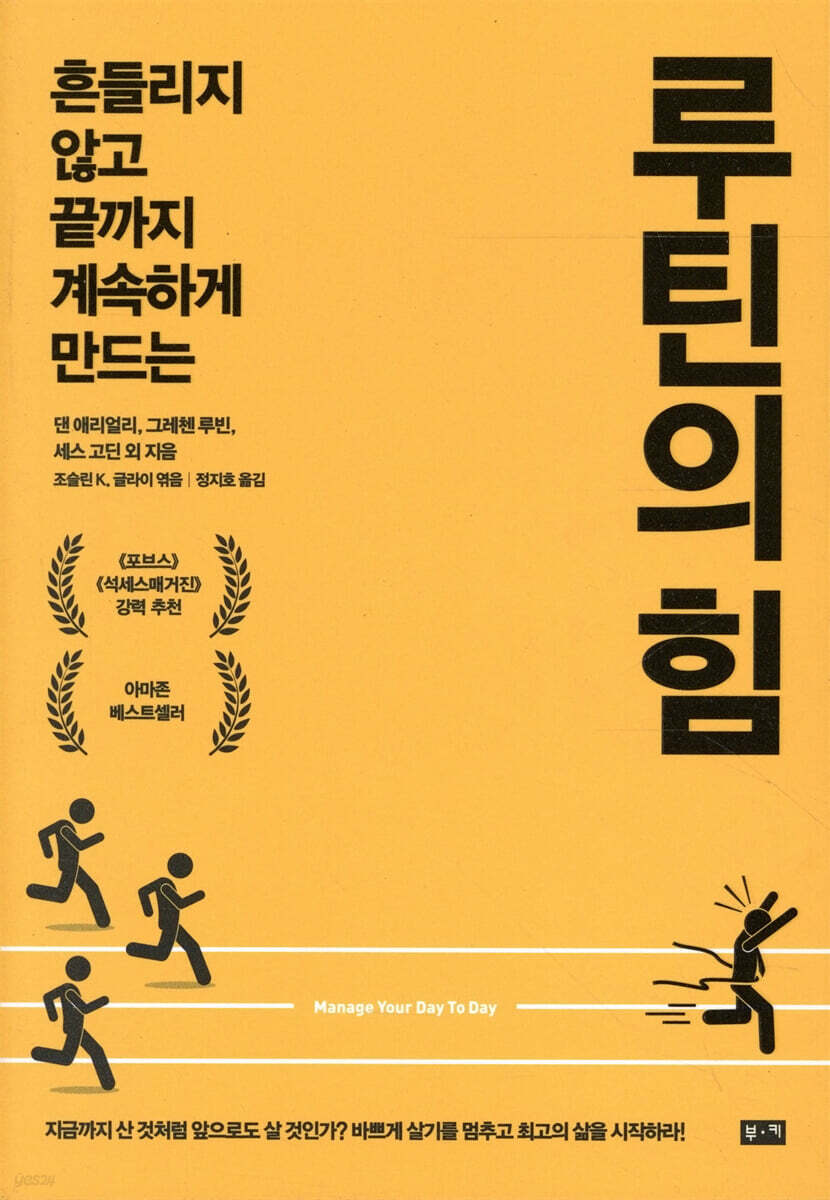
The power of routine
 |
Description
Book Introduction
Want to break free from the three-day trap and achieve success? Have a 'routine' that makes you start and finish even when you don't feel like doing it! I've tried tiny habits, I've tried turning off my nerves, I've tried simple things, I've tried doing them for 10,000 hours, and I've lived selfishly. I also looked into brain science, psychology, philosophy, and meditation. But what if you haven't achieved the results you want? What if your daily routine, work, and studies haven't changed, and you've quickly given up on exercising, dieting, and quitting smoking? What you need isn't just determination and hard work. It's a routine. A routine is a set of actions or procedures that you habitually do to maintain composure and perform at your best. One of the secrets to the success of Haruki Murakami and Stephen King, Yuna Kim and Hyun-jin Ryu, Warren Buffett and Oprah Winfrey is that they all have their own routines. Routines allow us to start even when we don't feel like it, to turn on our creative switch whenever we want, to resist the temptations of social media and distractions, and to ultimately see things through to the end. '99U', a creative project of global software company Adobe, brings together the success habits and routine philosophies of 20 global outliers, including Dan Ariely, Seth Godin, Gretchen Rubin, Cal Newport, and Scott Belsky, Vice President of Adobe's Community Division. The resulting book, The Power of Routine, will demonstrate to readers the power of pleasant repetition to bring about profound change. |
- You can preview some of the book's contents.
Preview
index
Introduction: About 99U, the Ultimate Idea Platform
Editor's Note: The Ultimate Guide to a Radiant Life _Jocelyn K.
Gly
Prologue: Will You Live As You Live Now? _Scott Belsky
Chapter 1: The Power of Routine to Strengthen the Roots of Life
The more you love something, the more often you do it. _Gretchen Rubin
Work for yourself first, not others _Mark McGinnis
(Q&A) Why I Work, Here, Now _Seth Godin
Your daily life needs a refresh, too _Tony Schwartz
Don't Lose Your Right to Loneliness _ Rio Babauta
Chapter 2: The Power of Routines to Help You Focus on What Really Matters
Success begins with a creative schedule _ Cal Newport
Don't Be Fooled by the Lie of Multitasking _Christian Jarrett
(Q&A) Breaking Free from the Obsession with Distraction _ Dan Ariely
Self-control requires strategy, too. _Erin Rooney Doland
The Secret to Unlocking Your Potential Through Blocking and Focus _Scott Belsky
Chapter 3: The Power of Routine to Sharpen Your Creative Edge
Become a Creator for Yourself _Todd Henry
How to Ignite Insight _Scott McDowell
(Q&A) How to Maintain a Creative Rhythm _ Stefan Sagmeister
Break Free from the Demand for Perfection _Elizabeth Grace Saunders
People Who Wisely Overcame Slumps _Mark McGinnis
Chapter 4: The Power of Routines to Optimize Your Skills and Tools
How to Spend 28% of Your Day Wisely _ Aaron Dignan
Does Your Social Media Have 'Meaning'? _Lori Deschenne
(Q&A) Why I Keep a Digital Sabbath _Tiffany Schlane
Escape from Screen Apnea _Linda Stone
To live as yourself, first believe in yourself. _James Victor
Epilogue: You Are the Expert on Your Life _Stephen Pressfield
Acknowledgements
main
Editor's Note: The Ultimate Guide to a Radiant Life _Jocelyn K.
Gly
Prologue: Will You Live As You Live Now? _Scott Belsky
Chapter 1: The Power of Routine to Strengthen the Roots of Life
The more you love something, the more often you do it. _Gretchen Rubin
Work for yourself first, not others _Mark McGinnis
(Q&A) Why I Work, Here, Now _Seth Godin
Your daily life needs a refresh, too _Tony Schwartz
Don't Lose Your Right to Loneliness _ Rio Babauta
Chapter 2: The Power of Routines to Help You Focus on What Really Matters
Success begins with a creative schedule _ Cal Newport
Don't Be Fooled by the Lie of Multitasking _Christian Jarrett
(Q&A) Breaking Free from the Obsession with Distraction _ Dan Ariely
Self-control requires strategy, too. _Erin Rooney Doland
The Secret to Unlocking Your Potential Through Blocking and Focus _Scott Belsky
Chapter 3: The Power of Routine to Sharpen Your Creative Edge
Become a Creator for Yourself _Todd Henry
How to Ignite Insight _Scott McDowell
(Q&A) How to Maintain a Creative Rhythm _ Stefan Sagmeister
Break Free from the Demand for Perfection _Elizabeth Grace Saunders
People Who Wisely Overcame Slumps _Mark McGinnis
Chapter 4: The Power of Routines to Optimize Your Skills and Tools
How to Spend 28% of Your Day Wisely _ Aaron Dignan
Does Your Social Media Have 'Meaning'? _Lori Deschenne
(Q&A) Why I Keep a Digital Sabbath _Tiffany Schlane
Escape from Screen Apnea _Linda Stone
To live as yourself, first believe in yourself. _James Victor
Epilogue: You Are the Expert on Your Life _Stephen Pressfield
Acknowledgements
main
Detailed image
Into the book
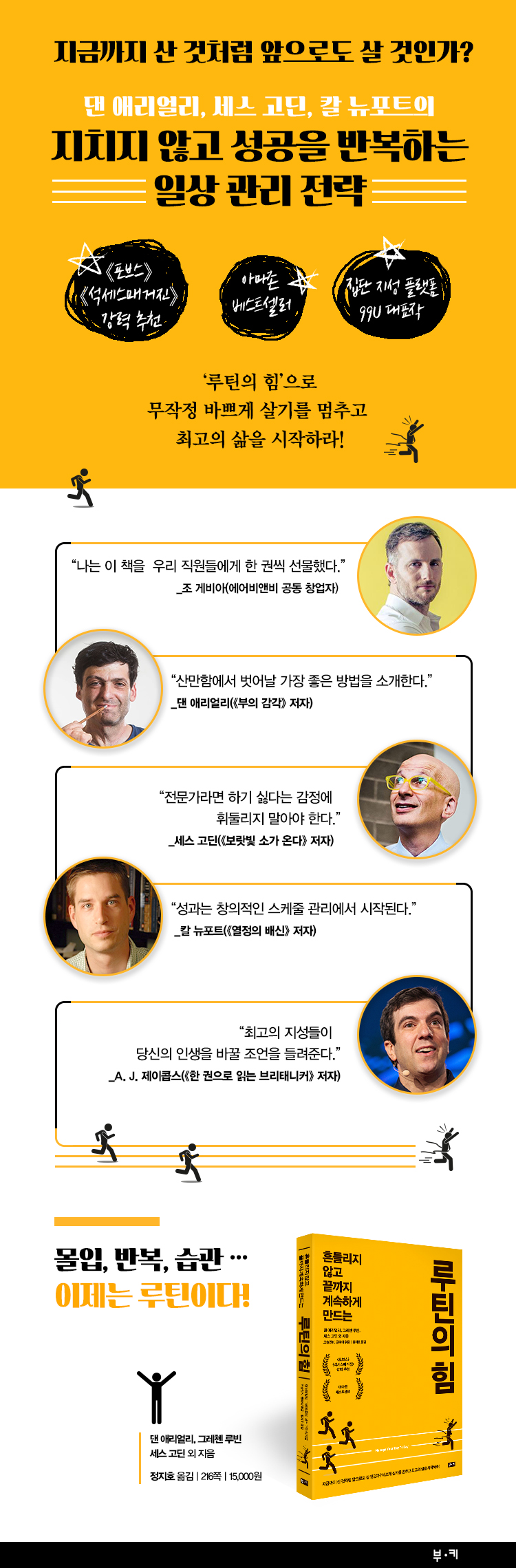
Will we live the way we have lived so far? _Scott Belsky, Vice President of Community, Adobe
In this rapidly changing work environment, I realized that I had neglected self-assessment regarding time management for too long.
A lot has changed in recent years.
My schedule and documents are now all stored in the cloud.
I use far more electronic devices, apps, alarms, and programs than ever before.
Moreover, thanks to the change in environment where one can work from anywhere, unexpected changes have occurred in the way work is done.
I was always so busy, rushing around, and working so hard that I never had time to stop and think for even a moment.
If you have to keep playing without any strategy time, it will be impossible to play the game as you want.
--- p.14
The more you love something, the more often you should do it. _Gretchen Rubin (habit expert and author of "Be Happy Unconditionally")
If all you can produce in a week is one page, one blog post, and one sketch, you'll naturally feel like you have to do exceptionally well and start to feel anxious about the quality of your work.
(Omitted) Since I didn't do much work, I thought the results had to be excellent.
On the other hand, I write every day, so a day's worth isn't that important to me.
Some days go well and some days don't.
Some days end without me getting much done.
That's okay though.
Because it's clearly something you're doing consistently.
As a result of my anxiety disappearing, I enjoy my work more and am more willing to experiment and take risks.
Even if you don't get a good result, you have plenty of time to try another method.
--- p.24~25
Why I Work, Here, Now _Seth Godin (author of "Purple Cow")
There are countless people who fail to develop their talents as they wish due to failed strategies and ultimately fail to achieve success.
This strategy is simple.
Practice is strategy.
Practice is doing something regularly and reliably in a habitual way.
There are many ways to remind yourself that you are developing a practice habit.
For example, wearing a white lab coat, wearing special glasses, or working in a specific location.
This is how you specialize your skills through habits.
(syncopation)
The idea that you start here, now, like this, even when you don't feel like it, and especially when you don't feel like it, is incredibly important.
There are plenty of people who are creative when they want to work, but you have to be able to get things done even when you don't want to to join the ranks of professionals.
--- p.39~40
Your daily life needs a refresh, too. _Tony Schwartz, CEO of consulting firm The Energy Project
Unlike computers, humans cannot operate continuously at high speeds for long periods of time.
Rather, we humans are designed to move rhythmically, expending and recovering energy.
Our brain alternates between high-frequency and low-frequency movements.
The heart rate is also irregular.
Our lungs also expand and contract as needed.
It's not just about breathing well.
In fact, the deeper you exhale, the calmer and more confident you will feel.
But we run in a straight line all day long, burning off our energy reserves.
It's like constantly withdrawing money from your bank account without saving any money.
At some point we all end up bankrupt.
The good news is that we can change the way we manage our energy.
Skillfully managing your energy allows you to accomplish more consistently, at a higher level, and in a shorter amount of time. --- p.47-48
Don't Be Fooled by the Multitasking Lie _Christian Jarrett (Psychologist)
To combat the temptation of multitasking, renowned novelist Jonathan Franzen practically locked himself in an unfurnished office while writing his bestselling novel, Freedom.
As he revealed in an interview with Time, he even took the wireless card out of his old laptop and disabled the Ethernet port with superglue and a saw.
As if that wasn't enough, we created an environment like a cocoon by wearing earplugs and noise-canceling headphones.
Although a bit extreme, Franzen's case poignantly illustrates how imperfect humans are.
The creative mind is easily distracted, and the allure of new connectivity is so powerful that it's easy to lose focus.
--- p.72~73
Become a creator for yourself _Todd Henry, founder of Accidental Creative
Of course you say, “Wait a minute.
I completely understand if you protest, “I barely have time to breathe, and you want me to cram another task into my already tight schedule just to have fun?”
Wherever we spend our time, there's always an opportunity cost, and spending time on unnecessary creative activities can feel like a truly inefficient choice.
In fact, it is actually quite inefficient.
But also consider the opportunity cost of investing your life solely in practical pursuits.
You spend so much time pleasing others and meeting their expectations, yet you never even attempt to discover your own inner aptitudes and creative potential, even though there's nothing more valuable than that.
--- p.116
How to Maintain a Creative Rhythm _ Stefan Sagmeister (Graphic Designer)
There is a wonderful anecdote about a Nobel Prize winner.
He was asked by a company to give a lecture on time planning.
He stood there holding a glass bottle and said, “It only takes two minutes to show you what I have to say about time planning.”
Then he took some large stones and filled the jar up to the top, then he put some smaller stones in the jar, then he poured sand in again, and finally he poured water in.
Finally, the glass bottle was full.
The message of this story is pretty clear.
The point is that you have to put the big stones in first.
That way, you can fill in the smaller things too.
--- p.132~133
People Who Wisely Overcame Slumps _Mark McGinnis (Creative Consultant)
The Adventures of Tom Sawyer is considered a great novel, but even Mark Twain had a moment when he fell into despair because he couldn't finish the novel.
In his autobiography, he described the moment when he could no longer advance the story as “my fuel tank was empty.”
Eventually, he stopped writing for two years and devoted himself to other things.
When he picked up the manuscript again, Mark Twain made the “great discovery” that his imaginative “storehouse” had been refilled, and he was finally able to finish the novel.
This discovery marked a major turning point in Twain's writing career.
From then on, whenever he wrote a book, he would carefully consider the point at which his reserves were running low, and when that point came, he would take a break and then finish the work.
--- p.148~149
How to Spend 28% of Your Day Wisely _Aaron Dignan (CEO of Undercurrent, a digital strategy firm)
According to research from the McKinsey Global Institute, knowledge workers spend an average of 28 percent of their workweek writing, reading, and responding to emails.
No matter what field you work in, there's a good chance you're spending too much energy managing your email.
As a result, many people are trying to reduce their email-related workload, leading to the so-called "email efficiency craze."
This craze has been fueled by the emergence of hundreds of tools, technologies, services, and plugins that help you manage your email.
Just following these 'best email management tips' one by one is exhausting.
--- p.160~161
Escape Screen Apnea _Linda Stone (Consultant and Author)
Deep, regular breathing, or diaphragmatic breathing, calms the sympathetic nervous system and allows the parasympathetic nervous system, which controls organ functions such as hunger, satiety, and relaxation responses, to take over a more dominant role.
Conversely, shallow breathing, temporary breath holding, and hyperventilation stimulate the sympathetic nervous system into a fight-or-flight state.
In this state, our heart rate increases, our sense of fullness decreases, and our bodies are fully prepared to engage in the physical activity that accompanies the fight-or-flight response as they always have.
(syncopation)
Our bodies react impulsively and compulsively when we are in a state of fight or flight.
It is also easy to fall into the tendency to consume excessive energy.
In this state, it is difficult to distinguish between hunger and fullness.
Whether it's food or information, we reach for every resource around us as if it were our last chance to get it, which leads us to constantly pull out our smartphones to check emails and text messages.
In this rapidly changing work environment, I realized that I had neglected self-assessment regarding time management for too long.
A lot has changed in recent years.
My schedule and documents are now all stored in the cloud.
I use far more electronic devices, apps, alarms, and programs than ever before.
Moreover, thanks to the change in environment where one can work from anywhere, unexpected changes have occurred in the way work is done.
I was always so busy, rushing around, and working so hard that I never had time to stop and think for even a moment.
If you have to keep playing without any strategy time, it will be impossible to play the game as you want.
--- p.14
The more you love something, the more often you should do it. _Gretchen Rubin (habit expert and author of "Be Happy Unconditionally")
If all you can produce in a week is one page, one blog post, and one sketch, you'll naturally feel like you have to do exceptionally well and start to feel anxious about the quality of your work.
(Omitted) Since I didn't do much work, I thought the results had to be excellent.
On the other hand, I write every day, so a day's worth isn't that important to me.
Some days go well and some days don't.
Some days end without me getting much done.
That's okay though.
Because it's clearly something you're doing consistently.
As a result of my anxiety disappearing, I enjoy my work more and am more willing to experiment and take risks.
Even if you don't get a good result, you have plenty of time to try another method.
--- p.24~25
Why I Work, Here, Now _Seth Godin (author of "Purple Cow")
There are countless people who fail to develop their talents as they wish due to failed strategies and ultimately fail to achieve success.
This strategy is simple.
Practice is strategy.
Practice is doing something regularly and reliably in a habitual way.
There are many ways to remind yourself that you are developing a practice habit.
For example, wearing a white lab coat, wearing special glasses, or working in a specific location.
This is how you specialize your skills through habits.
(syncopation)
The idea that you start here, now, like this, even when you don't feel like it, and especially when you don't feel like it, is incredibly important.
There are plenty of people who are creative when they want to work, but you have to be able to get things done even when you don't want to to join the ranks of professionals.
--- p.39~40
Your daily life needs a refresh, too. _Tony Schwartz, CEO of consulting firm The Energy Project
Unlike computers, humans cannot operate continuously at high speeds for long periods of time.
Rather, we humans are designed to move rhythmically, expending and recovering energy.
Our brain alternates between high-frequency and low-frequency movements.
The heart rate is also irregular.
Our lungs also expand and contract as needed.
It's not just about breathing well.
In fact, the deeper you exhale, the calmer and more confident you will feel.
But we run in a straight line all day long, burning off our energy reserves.
It's like constantly withdrawing money from your bank account without saving any money.
At some point we all end up bankrupt.
The good news is that we can change the way we manage our energy.
Skillfully managing your energy allows you to accomplish more consistently, at a higher level, and in a shorter amount of time. --- p.47-48
Don't Be Fooled by the Multitasking Lie _Christian Jarrett (Psychologist)
To combat the temptation of multitasking, renowned novelist Jonathan Franzen practically locked himself in an unfurnished office while writing his bestselling novel, Freedom.
As he revealed in an interview with Time, he even took the wireless card out of his old laptop and disabled the Ethernet port with superglue and a saw.
As if that wasn't enough, we created an environment like a cocoon by wearing earplugs and noise-canceling headphones.
Although a bit extreme, Franzen's case poignantly illustrates how imperfect humans are.
The creative mind is easily distracted, and the allure of new connectivity is so powerful that it's easy to lose focus.
--- p.72~73
Become a creator for yourself _Todd Henry, founder of Accidental Creative
Of course you say, “Wait a minute.
I completely understand if you protest, “I barely have time to breathe, and you want me to cram another task into my already tight schedule just to have fun?”
Wherever we spend our time, there's always an opportunity cost, and spending time on unnecessary creative activities can feel like a truly inefficient choice.
In fact, it is actually quite inefficient.
But also consider the opportunity cost of investing your life solely in practical pursuits.
You spend so much time pleasing others and meeting their expectations, yet you never even attempt to discover your own inner aptitudes and creative potential, even though there's nothing more valuable than that.
--- p.116
How to Maintain a Creative Rhythm _ Stefan Sagmeister (Graphic Designer)
There is a wonderful anecdote about a Nobel Prize winner.
He was asked by a company to give a lecture on time planning.
He stood there holding a glass bottle and said, “It only takes two minutes to show you what I have to say about time planning.”
Then he took some large stones and filled the jar up to the top, then he put some smaller stones in the jar, then he poured sand in again, and finally he poured water in.
Finally, the glass bottle was full.
The message of this story is pretty clear.
The point is that you have to put the big stones in first.
That way, you can fill in the smaller things too.
--- p.132~133
People Who Wisely Overcame Slumps _Mark McGinnis (Creative Consultant)
The Adventures of Tom Sawyer is considered a great novel, but even Mark Twain had a moment when he fell into despair because he couldn't finish the novel.
In his autobiography, he described the moment when he could no longer advance the story as “my fuel tank was empty.”
Eventually, he stopped writing for two years and devoted himself to other things.
When he picked up the manuscript again, Mark Twain made the “great discovery” that his imaginative “storehouse” had been refilled, and he was finally able to finish the novel.
This discovery marked a major turning point in Twain's writing career.
From then on, whenever he wrote a book, he would carefully consider the point at which his reserves were running low, and when that point came, he would take a break and then finish the work.
--- p.148~149
How to Spend 28% of Your Day Wisely _Aaron Dignan (CEO of Undercurrent, a digital strategy firm)
According to research from the McKinsey Global Institute, knowledge workers spend an average of 28 percent of their workweek writing, reading, and responding to emails.
No matter what field you work in, there's a good chance you're spending too much energy managing your email.
As a result, many people are trying to reduce their email-related workload, leading to the so-called "email efficiency craze."
This craze has been fueled by the emergence of hundreds of tools, technologies, services, and plugins that help you manage your email.
Just following these 'best email management tips' one by one is exhausting.
--- p.160~161
Escape Screen Apnea _Linda Stone (Consultant and Author)
Deep, regular breathing, or diaphragmatic breathing, calms the sympathetic nervous system and allows the parasympathetic nervous system, which controls organ functions such as hunger, satiety, and relaxation responses, to take over a more dominant role.
Conversely, shallow breathing, temporary breath holding, and hyperventilation stimulate the sympathetic nervous system into a fight-or-flight state.
In this state, our heart rate increases, our sense of fullness decreases, and our bodies are fully prepared to engage in the physical activity that accompanies the fight-or-flight response as they always have.
(syncopation)
Our bodies react impulsively and compulsively when we are in a state of fight or flight.
It is also easy to fall into the tendency to consume excessive energy.
In this state, it is difficult to distinguish between hunger and fullness.
Whether it's food or information, we reach for every resource around us as if it were our last chance to get it, which leads us to constantly pull out our smartphones to check emails and text messages.
--- p.188~189
Publisher's Review
The world's greatest writers each had their own creative habits.
Victor Hugo took ice-cold showers and had haircuts every day to concentrate on his writing.
Leo Tolstoy kept a diary for 60 years, and Ernest Hemingway, no matter what, wrote 500 words a day (p. 21). Haruki Murakami woke up at 4 a.m. and repeated a routine of writing, running, swimming, reading, and listening to music, then going to bed at 9 p.m. Stephen King always sat at the same desk at 8 a.m., playing the same music, and getting ready to write (p. 34).
These repetitive and regular habits are also important for athletes.
Tennis star Nadal touches his buttocks, shoulders, nose, and ears before serving.
When figure skating queen Yuna Kim warms up, she always circles the stadium counterclockwise, then stands back and glides in an S-shape.
Major League Baseball player Ryu Hyun-jin is famous for enjoying a high-temperature sauna for more than 30 minutes before a game.
Many artists and athletes use routines to achieve their best performance, a set of actions and procedures they repeat over and over again.
A proper routine can help us relieve anxiety, maintain composure, and improve focus, whether we're writing, playing sports, or even working or studying.
Above all, it allows you to start even when you don't feel like doing it, and it makes you see it through to the end without giving up.
Thanks to routines, you can easily achieve everyday resolutions that would otherwise only last three days, such as exercising, dieting, quitting smoking, or reading.
This book is a collection of success habits and routine philosophies from 20 world-class outliers representing the fields of economics, management, art, business and creative consulting, education, and lifestyle, including Duke University professor and author of 『Unconventional Economics』 and 『The Sense of Wealth』, Seth Godin, author of 『Purple Cow』, habit expert Gretchen Rubin, Georgetown University professor and author of 『The Passion Betrayal』 and 『Deep Work』, Scott Belsky, Adobe's vice president of community, and graphic designer Stefan Sagmeister.
Through the routine insights and practical 'how tos' they introduce, readers will gain a weapon more powerful than habits to bring about the greatest change in their work and daily lives.
The world's greatest leaders and creators
Create exceptional focus and performance with routines
According to a survey of 200 CEOs of domestic companies conducted by the Korea Chamber of Commerce and Industry, 6 out of 10 responded that they wake up at 5 or 6 a.m. and start their day with their own routine, such as hiking, meditating, reading the newspaper, or reading a book.
Executives at global companies also strictly adhere to their own routines.
Warren Buffett and his investment partner Charlie Munger start their day by reading three or four newspapers, while Facebook's Mark Zuckerberg and Starbucks' Howard Schultz start their day with exercise.
Twitter's Jack Dorsey walks about five miles to work every day, and Amazon's Jeff Bezos has plenty of free time, including eating with his kids until 10 a.m.
In this way, the best leaders use routines as tools to improve work efficiency and focus.
So, what kind of routines are the outliers who participated in "The Power of Routine" using?
· "Create a rhythmic work routine." - Tony Schwartz, CEO of productivity consulting firm 'The Energy Project'
Our bodies reach their maximum capacity to handle tasks in cycles of about 90 minutes.
In other words, if you work or study hard for 90 minutes, you definitely need time for physiological rest and recovery.
So, I figured out exactly how long I could focus, and then I created a rhythmic cycle of energy consumption and recovery by repeating the pattern of work and rest. (Page 48)
· “Set your own focus time zone.” _Cal Newport, Professor, Georgetown University · Author of “Betrayal of Passion” and “Deep Work”
It's important to set aside a "focus time" every day, whether it's an hour or two, when you can focus on your work without interruption, and be mindful not to do anything else during this time.
By repeating this process and establishing it as a routine, you'll find yourself becoming more immersed day by day, and you'll be able to easily extend your focus time. (Page 66)
· "Get 28 percent more out of your day with an email management routine." _Aaron Dignan, CEO of digital strategy firm Undercurrent
According to a study by the McKinsey Global Institute, modern knowledge workers spend 28 percent of their working hours dealing with email-related tasks.
So, just managing your email systematically can save you a lot of time and energy, right? That's why I established an email management routine: "Clearly define my tasks and goals, filter out emails necessary for achieving them, and boldly discard the rest." (Page 163)
· “Overcoming Distraction with Visible Routines” _Dan Ariely, Professor at Duke University · Author of “The Sense of Wealth” and “Unconventional Economics”
I record my daily workload in a diary or save my work results step by step.
Through this process, I can see with my own eyes how much and how much progress has been made, and I can feel that I am developing myself.
This will help you focus more on your goals and less on distractions that can eat away at your concentration (p. 86).
Even if you don't want to do it, you start and eventually finish it.
A Success Strategy More Powerful Than Habits
Everyone has probably made resolutions at least once during the New Year, only to have them fizzle out after a few days.
In January 2020, a domestic job portal site conducted a survey of office workers, and six out of ten respondents said they were unsure whether they would be able to keep their New Year's resolutions.
Another 32 percent actually only lasted three days, and 20 percent of respondents didn't even last a day.
Only 2.5 percent of those who completed the course and achieved their goals.
To complete a project, raise your grades to a certain level, lose weight or gain muscle, or reach your reading goal, you need to work hard and consistently over a long period of time.
What is absolutely necessary at this time is the ability to execute, like a starting stone, even if you don't want to do it, and the perseverance to see it through to the end even if you want to give up in the middle.
Here we introduce the special know-how of the authors of "The Power of Routine."
· "The best routine is the one you do often, no matter what." _Gretchen Rubin, habit expert · Author of "Be Happy Unconditionally"
I write every single day, 365 days a year.
There are days when I only finish the work in 15 minutes, but I never skip a day.
Because if you do it every day, no matter how little time or amount, the burden of the daily performance or workload will be reduced.
It's much easier to get started if you think, "Let's do it anyway," rather than "I have to do it well." (Page 23)
· “A true expert is one who doesn’t let the feeling of not wanting to do something get the best of him.” _Seth Godin, author of “Purple Cow”
Creative people are only as good as they want to be when they want to work.
However, experts must perform unconditionally without being swayed by feelings of not wanting to do something.
The same goes for the sales aspect, which involves communicating and selling your ideas and achievements to others.
It would be foolish to neglect this aspect when planning your performance and expect things to go well. (Page 40)
· "Start whenever you want with a stimulation routine." _Mark McGinnis, creative consultant
A 'stimulus routine' is a kind of ritualistic preparation process that you do when you start work, such as always wearing the same clothes, listening to the same music, or organizing your desk in the same way.
I have my own stimulation routine too.
By starting this stimulating routine, you can remind yourself that "right now" is the time to get down to business. (Page 34)
"To last, you need a special performance strategy." _Erin Rooney Doland, productivity consultant, author of "The One-Week Revolution"
When we encounter a simple task that we can handle unconsciously after performing a complex and difficult task, our brain relaxes and recharges with leisure and energy.
So, when I plan my work, I alternate between complex and simple tasks to ensure that productivity and efficiency don't suffer. (Page 94)
Victor Hugo took ice-cold showers and had haircuts every day to concentrate on his writing.
Leo Tolstoy kept a diary for 60 years, and Ernest Hemingway, no matter what, wrote 500 words a day (p. 21). Haruki Murakami woke up at 4 a.m. and repeated a routine of writing, running, swimming, reading, and listening to music, then going to bed at 9 p.m. Stephen King always sat at the same desk at 8 a.m., playing the same music, and getting ready to write (p. 34).
These repetitive and regular habits are also important for athletes.
Tennis star Nadal touches his buttocks, shoulders, nose, and ears before serving.
When figure skating queen Yuna Kim warms up, she always circles the stadium counterclockwise, then stands back and glides in an S-shape.
Major League Baseball player Ryu Hyun-jin is famous for enjoying a high-temperature sauna for more than 30 minutes before a game.
Many artists and athletes use routines to achieve their best performance, a set of actions and procedures they repeat over and over again.
A proper routine can help us relieve anxiety, maintain composure, and improve focus, whether we're writing, playing sports, or even working or studying.
Above all, it allows you to start even when you don't feel like doing it, and it makes you see it through to the end without giving up.
Thanks to routines, you can easily achieve everyday resolutions that would otherwise only last three days, such as exercising, dieting, quitting smoking, or reading.
This book is a collection of success habits and routine philosophies from 20 world-class outliers representing the fields of economics, management, art, business and creative consulting, education, and lifestyle, including Duke University professor and author of 『Unconventional Economics』 and 『The Sense of Wealth』, Seth Godin, author of 『Purple Cow』, habit expert Gretchen Rubin, Georgetown University professor and author of 『The Passion Betrayal』 and 『Deep Work』, Scott Belsky, Adobe's vice president of community, and graphic designer Stefan Sagmeister.
Through the routine insights and practical 'how tos' they introduce, readers will gain a weapon more powerful than habits to bring about the greatest change in their work and daily lives.
The world's greatest leaders and creators
Create exceptional focus and performance with routines
According to a survey of 200 CEOs of domestic companies conducted by the Korea Chamber of Commerce and Industry, 6 out of 10 responded that they wake up at 5 or 6 a.m. and start their day with their own routine, such as hiking, meditating, reading the newspaper, or reading a book.
Executives at global companies also strictly adhere to their own routines.
Warren Buffett and his investment partner Charlie Munger start their day by reading three or four newspapers, while Facebook's Mark Zuckerberg and Starbucks' Howard Schultz start their day with exercise.
Twitter's Jack Dorsey walks about five miles to work every day, and Amazon's Jeff Bezos has plenty of free time, including eating with his kids until 10 a.m.
In this way, the best leaders use routines as tools to improve work efficiency and focus.
So, what kind of routines are the outliers who participated in "The Power of Routine" using?
· "Create a rhythmic work routine." - Tony Schwartz, CEO of productivity consulting firm 'The Energy Project'
Our bodies reach their maximum capacity to handle tasks in cycles of about 90 minutes.
In other words, if you work or study hard for 90 minutes, you definitely need time for physiological rest and recovery.
So, I figured out exactly how long I could focus, and then I created a rhythmic cycle of energy consumption and recovery by repeating the pattern of work and rest. (Page 48)
· “Set your own focus time zone.” _Cal Newport, Professor, Georgetown University · Author of “Betrayal of Passion” and “Deep Work”
It's important to set aside a "focus time" every day, whether it's an hour or two, when you can focus on your work without interruption, and be mindful not to do anything else during this time.
By repeating this process and establishing it as a routine, you'll find yourself becoming more immersed day by day, and you'll be able to easily extend your focus time. (Page 66)
· "Get 28 percent more out of your day with an email management routine." _Aaron Dignan, CEO of digital strategy firm Undercurrent
According to a study by the McKinsey Global Institute, modern knowledge workers spend 28 percent of their working hours dealing with email-related tasks.
So, just managing your email systematically can save you a lot of time and energy, right? That's why I established an email management routine: "Clearly define my tasks and goals, filter out emails necessary for achieving them, and boldly discard the rest." (Page 163)
· “Overcoming Distraction with Visible Routines” _Dan Ariely, Professor at Duke University · Author of “The Sense of Wealth” and “Unconventional Economics”
I record my daily workload in a diary or save my work results step by step.
Through this process, I can see with my own eyes how much and how much progress has been made, and I can feel that I am developing myself.
This will help you focus more on your goals and less on distractions that can eat away at your concentration (p. 86).
Even if you don't want to do it, you start and eventually finish it.
A Success Strategy More Powerful Than Habits
Everyone has probably made resolutions at least once during the New Year, only to have them fizzle out after a few days.
In January 2020, a domestic job portal site conducted a survey of office workers, and six out of ten respondents said they were unsure whether they would be able to keep their New Year's resolutions.
Another 32 percent actually only lasted three days, and 20 percent of respondents didn't even last a day.
Only 2.5 percent of those who completed the course and achieved their goals.
To complete a project, raise your grades to a certain level, lose weight or gain muscle, or reach your reading goal, you need to work hard and consistently over a long period of time.
What is absolutely necessary at this time is the ability to execute, like a starting stone, even if you don't want to do it, and the perseverance to see it through to the end even if you want to give up in the middle.
Here we introduce the special know-how of the authors of "The Power of Routine."
· "The best routine is the one you do often, no matter what." _Gretchen Rubin, habit expert · Author of "Be Happy Unconditionally"
I write every single day, 365 days a year.
There are days when I only finish the work in 15 minutes, but I never skip a day.
Because if you do it every day, no matter how little time or amount, the burden of the daily performance or workload will be reduced.
It's much easier to get started if you think, "Let's do it anyway," rather than "I have to do it well." (Page 23)
· “A true expert is one who doesn’t let the feeling of not wanting to do something get the best of him.” _Seth Godin, author of “Purple Cow”
Creative people are only as good as they want to be when they want to work.
However, experts must perform unconditionally without being swayed by feelings of not wanting to do something.
The same goes for the sales aspect, which involves communicating and selling your ideas and achievements to others.
It would be foolish to neglect this aspect when planning your performance and expect things to go well. (Page 40)
· "Start whenever you want with a stimulation routine." _Mark McGinnis, creative consultant
A 'stimulus routine' is a kind of ritualistic preparation process that you do when you start work, such as always wearing the same clothes, listening to the same music, or organizing your desk in the same way.
I have my own stimulation routine too.
By starting this stimulating routine, you can remind yourself that "right now" is the time to get down to business. (Page 34)
"To last, you need a special performance strategy." _Erin Rooney Doland, productivity consultant, author of "The One-Week Revolution"
When we encounter a simple task that we can handle unconsciously after performing a complex and difficult task, our brain relaxes and recharges with leisure and energy.
So, when I plan my work, I alternate between complex and simple tasks to ensure that productivity and efficiency don't suffer. (Page 94)
GOODS SPECIFICS
- Date of issue: February 10, 2020
- Page count, weight, size: 216 pages | 288g | 128*185*14mm
- ISBN13: 9788960517721
- ISBN10: 8960517720
You may also like
카테고리
korean


korean

![GQ KOREA Mark (Monthly): December [2025]](http://librairie.coreenne.fr/cdn/shop/files/8ef265dbbfbf186523ed75ba7319009d.jpg?v=1765340328&width=3840)


