

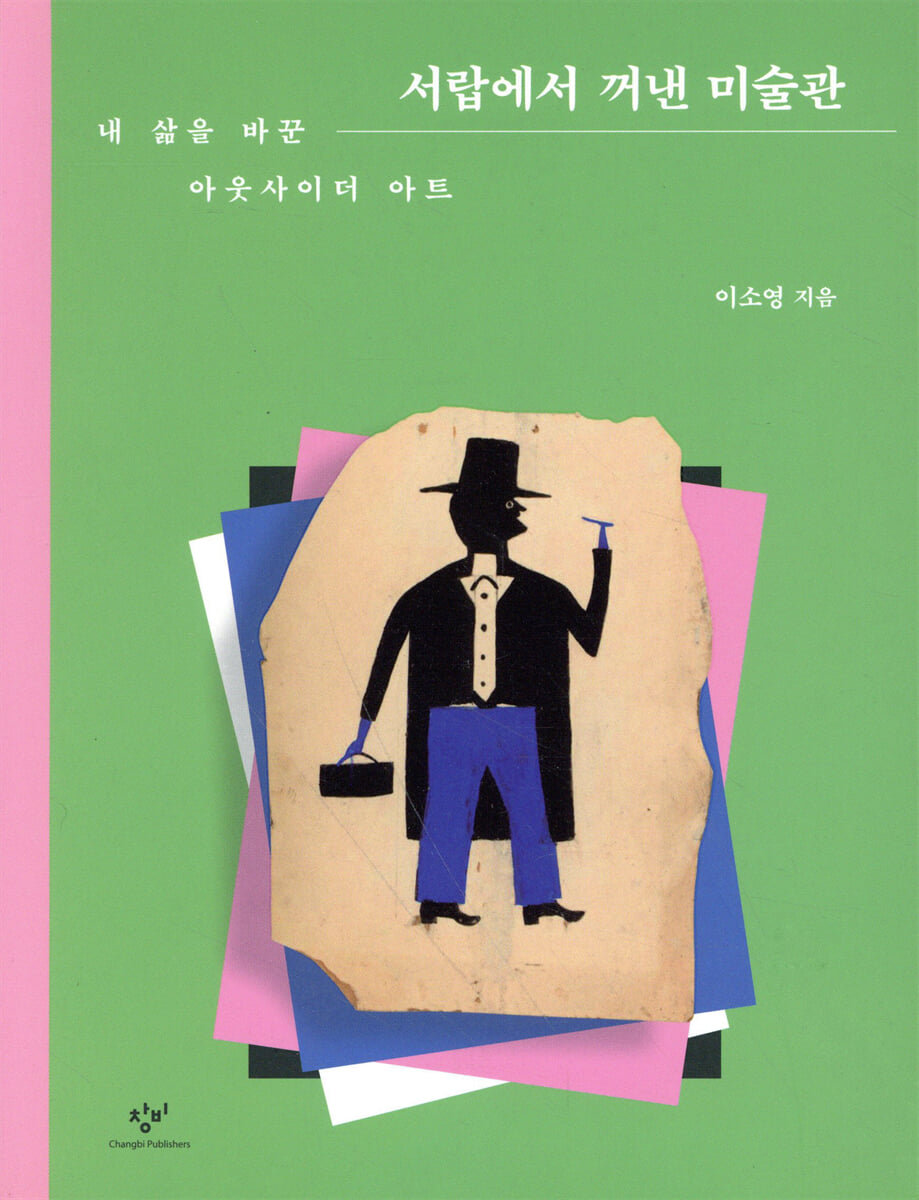
Art gallery taken out of the drawer
 |
Description
Book Introduction
- A word from MD
-
May your world never disappearArt essayist Soyoung Lee returns this time with a story about ‘outsider art.’
The story of artists who were losing attention and disappearing due to the monopolization of the powerful.
The worlds pulled out of the writer's drawer each exude a unique charm.
I hope their world will grow bigger with support now.
August 5, 2022. Art PD Lee Na-young
A masterpiece not found in textbooks, a warm look at life.
The power of affectionate healing conveyed through paintings
The painters who have finally come into the world!
A magical story told with a fervent heart
Art essayist Lee So-young, who has garnered attention through various broadcast activities, including her appearance on tvN's 'You Quiz on the Block', has returned to readers with a wealth of hidden art history secrets.
"The Art Museum Taken Out of the Drawer" is a book that records the author's journey of the mind in search of "outsider art," a long-standing interest.
Outsider art is a term that refers to the works of artists who have not received formal education, and it is already one of the most notable areas in the art world in recent years.
Lee So-young brings out the stories of artists who were destined to disappear from the art history centered on white men and powerful nations, along with her own intimate confessions, from dusty drawers.
Each of these stories is not only full of new and readable anecdotes, but also touches the hearts of weary and weary modern people with its own unique depth of emotion.
That is why this book is “a record of bright eyes and a complete heart for lonely beings” (recommendation, poet Park Jun).
The author, who has always received love from readers for his new and innovative themes rather than the usual art stories that everyone knows, refuses to follow the path taken by others this time as well.
To this end, I traveled the world for a long time, searching for works of lost artists.
Outsider art is a legitimate 'mainstream' genre, being introduced at leading museums around the world, such as the Centre Pompidou in Paris, the Museum of Modern Art in New York, and the Tate in London.
But the fact that they were not properly highlighted in the country, and some were not known at all, made the author even more passionate.
This book serves as a gallery where you can appreciate outstanding works with friendly explanations, and it also serves as a 'rewriting of art history' that means rehabilitating those who have been discriminated against due to race, gender, disability, and class.
By reading their stories, readers will gain hope and courage, and will have the amazing experience of broadening their aesthetic sense by seeing at a glance the diverse world of their works, something they have never encountered before.
The power of affectionate healing conveyed through paintings
The painters who have finally come into the world!
A magical story told with a fervent heart
Art essayist Lee So-young, who has garnered attention through various broadcast activities, including her appearance on tvN's 'You Quiz on the Block', has returned to readers with a wealth of hidden art history secrets.
"The Art Museum Taken Out of the Drawer" is a book that records the author's journey of the mind in search of "outsider art," a long-standing interest.
Outsider art is a term that refers to the works of artists who have not received formal education, and it is already one of the most notable areas in the art world in recent years.
Lee So-young brings out the stories of artists who were destined to disappear from the art history centered on white men and powerful nations, along with her own intimate confessions, from dusty drawers.
Each of these stories is not only full of new and readable anecdotes, but also touches the hearts of weary and weary modern people with its own unique depth of emotion.
That is why this book is “a record of bright eyes and a complete heart for lonely beings” (recommendation, poet Park Jun).
The author, who has always received love from readers for his new and innovative themes rather than the usual art stories that everyone knows, refuses to follow the path taken by others this time as well.
To this end, I traveled the world for a long time, searching for works of lost artists.
Outsider art is a legitimate 'mainstream' genre, being introduced at leading museums around the world, such as the Centre Pompidou in Paris, the Museum of Modern Art in New York, and the Tate in London.
But the fact that they were not properly highlighted in the country, and some were not known at all, made the author even more passionate.
This book serves as a gallery where you can appreciate outstanding works with friendly explanations, and it also serves as a 'rewriting of art history' that means rehabilitating those who have been discriminated against due to race, gender, disability, and class.
By reading their stories, readers will gain hope and courage, and will have the amazing experience of broadening their aesthetic sense by seeing at a glance the diverse world of their works, something they have never encountered before.
- You can preview some of the book's contents.
Preview
index
Entering
Part 1: Outsider Artists Who Changed My Life
Borders and Challenges: Henri Rousseau
Children Who Painted Freedom: The Camp Painters and Friedl Dickerbrandeis
Don't Forget Me: Sylvain Fusco
Be Happy, Be Happy: Aloise Corbas
The Man of Many Hearts: August Natterer
The Janitor Creates the World: Henry Darger
Part 2 Unique, bizarre, incomprehensible, and therefore attractive
To You Who Can't Meet: Georgiana Houghton
A Story Drawn with a Frozen Voice: Hendrik Averkamp
I was sick for a long time before writing this: Richard Dadd
The Postman's Dream Shelter: Ferdinand Cheval
Requiem for Paula: Paula Modersonbecker
The Sorrow of Life, Brilliantly: Seraphine Louis
Part 3: The Path Led by New 'Eyes' and 'Hands'
The World's Most Beautiful Funeral: Ana Anker
Bad Picture: Kaim Soutine
The Genomics of Tearing: Anne Ryan
A Life of Neither Good nor Bad: Florin Mitroi
The Brothers Who Built Robots: Josef and Karel Capek
Part 4 And They Came Back to Me
Picking Up Pieces of Heaven: William Edmondson
The Best Made on the Street: Bill Traylor
Parisian Postman Becomes Painter: Louis Vivin
When War Makes Art: Horace Pippin
Finding Her Name: Winifred Knight
Garcia Style: Joaquin Torres Garcia
Author's Note
References
Part 1: Outsider Artists Who Changed My Life
Borders and Challenges: Henri Rousseau
Children Who Painted Freedom: The Camp Painters and Friedl Dickerbrandeis
Don't Forget Me: Sylvain Fusco
Be Happy, Be Happy: Aloise Corbas
The Man of Many Hearts: August Natterer
The Janitor Creates the World: Henry Darger
Part 2 Unique, bizarre, incomprehensible, and therefore attractive
To You Who Can't Meet: Georgiana Houghton
A Story Drawn with a Frozen Voice: Hendrik Averkamp
I was sick for a long time before writing this: Richard Dadd
The Postman's Dream Shelter: Ferdinand Cheval
Requiem for Paula: Paula Modersonbecker
The Sorrow of Life, Brilliantly: Seraphine Louis
Part 3: The Path Led by New 'Eyes' and 'Hands'
The World's Most Beautiful Funeral: Ana Anker
Bad Picture: Kaim Soutine
The Genomics of Tearing: Anne Ryan
A Life of Neither Good nor Bad: Florin Mitroi
The Brothers Who Built Robots: Josef and Karel Capek
Part 4 And They Came Back to Me
Picking Up Pieces of Heaven: William Edmondson
The Best Made on the Street: Bill Traylor
Parisian Postman Becomes Painter: Louis Vivin
When War Makes Art: Horace Pippin
Finding Her Name: Winifred Knight
Garcia Style: Joaquin Torres Garcia
Author's Note
References
Detailed image
.jpg)
Into the book
Did these paintings relieve the overwhelming longing for my deceased sister? When everyone tells me to forget someone who's gone, but I can't, when I'm forced to say goodbye to someone precious, burdened by the funeral rites and rituals dictated by the world, I think of her paintings.
When I give lectures, surprisingly many people ask, “What kind of person can become an artist?”
When I was trying to answer this question in various ways, I often thought of the works of Georgiana Howton.
The conditions of an artist are diverse.
But now I can say one thing.
The more people you miss, the better artist you can become.
---From "To You Who Cannot Be Met: Georgiana Houghton"
Here's a painting that Freddie Mercury loved.
A large number of people can be seen through the long grass that divides the screen.
There are countless chestnuts scattered here and there in the forest.
Have we come to the world of the Lilliputians? A man about to strike something with an axe.
The old man crouched down as if he was afraid to watch the sight.
Women standing there, dressed up as if nothing had happened.
Freddie Mercury, the lead singer of the band Queen, who was loved by many, was a fan of Richard Dadd's work and often visited Tate Britain, where his paintings are stored.
And inspired by this painting, a song of the same name was included in the second album.
---From "I was sick for a long time before writing this: Richard Dadd"
As modern people's lives become more demanding, programs like 'art therapy' and 'picture book therapy' are becoming more popular.
In this day and age, where it is so easy to label things as art therapy or art therapy, it seems like there are more people seeking treatment than people seeking treatment.
Every time, I learn the true power of art therapy from the life of Friedl Deckerbrandeis.
The true power of art is to bring freedom even in the most difficult moments.
---From "Children Who Embrace Freedom: Children of the Camps and Friedl Dickerbrandeis"
I'm often drawn to bad pictures like this.
Because the protagonist collapses and becomes distorted, it provides the audience with both the tragedy and humor of life.
It is important for everyone to be able to find humor in tragic situations and to not be intoxicated by humor but rather become serious or cynical.
Because we eventually leave our festive life behind, leaving behind only silence.
Leaving behind the reality of a lump of meat with blood flowing out of it.
---From "Bad Pictures: Kaim Soutine"
Life is filled with countless coincidences every day.
Some days, these coincidences come to me in an orderly manner, but other days, they seem to keep rushing towards me.
On days like that, even if you want to spend the day with a gentle disposition, you keep wanting to tear and destroy something.
Every time that happens, I take out Anne Ryan's collage work and look at it on the monitor for a long time.
And I tear, tear, scatter and throw away whatever I want to tear.
And after a while, take a deep breath and put the pieces back together.
I'm glad I found a work that read my mind without having to tear up the paper myself, like I did when I was nineteen and twenty, in those dark and anxious times preparing to enter art school.
When I give lectures, surprisingly many people ask, “What kind of person can become an artist?”
When I was trying to answer this question in various ways, I often thought of the works of Georgiana Howton.
The conditions of an artist are diverse.
But now I can say one thing.
The more people you miss, the better artist you can become.
---From "To You Who Cannot Be Met: Georgiana Houghton"
Here's a painting that Freddie Mercury loved.
A large number of people can be seen through the long grass that divides the screen.
There are countless chestnuts scattered here and there in the forest.
Have we come to the world of the Lilliputians? A man about to strike something with an axe.
The old man crouched down as if he was afraid to watch the sight.
Women standing there, dressed up as if nothing had happened.
Freddie Mercury, the lead singer of the band Queen, who was loved by many, was a fan of Richard Dadd's work and often visited Tate Britain, where his paintings are stored.
And inspired by this painting, a song of the same name was included in the second album.
---From "I was sick for a long time before writing this: Richard Dadd"
As modern people's lives become more demanding, programs like 'art therapy' and 'picture book therapy' are becoming more popular.
In this day and age, where it is so easy to label things as art therapy or art therapy, it seems like there are more people seeking treatment than people seeking treatment.
Every time, I learn the true power of art therapy from the life of Friedl Deckerbrandeis.
The true power of art is to bring freedom even in the most difficult moments.
---From "Children Who Embrace Freedom: Children of the Camps and Friedl Dickerbrandeis"
I'm often drawn to bad pictures like this.
Because the protagonist collapses and becomes distorted, it provides the audience with both the tragedy and humor of life.
It is important for everyone to be able to find humor in tragic situations and to not be intoxicated by humor but rather become serious or cynical.
Because we eventually leave our festive life behind, leaving behind only silence.
Leaving behind the reality of a lump of meat with blood flowing out of it.
---From "Bad Pictures: Kaim Soutine"
Life is filled with countless coincidences every day.
Some days, these coincidences come to me in an orderly manner, but other days, they seem to keep rushing towards me.
On days like that, even if you want to spend the day with a gentle disposition, you keep wanting to tear and destroy something.
Every time that happens, I take out Anne Ryan's collage work and look at it on the monitor for a long time.
And I tear, tear, scatter and throw away whatever I want to tear.
And after a while, take a deep breath and put the pieces back together.
I'm glad I found a work that read my mind without having to tear up the paper myself, like I did when I was nineteen and twenty, in those dark and anxious times preparing to enter art school.
---From "The Generativity of Tearing: Anne Ryan"
Publisher's Review
A charm you've never experienced before
The heartfelt art that life itself exudes
This book consists of 21 chapters in 4 parts.
Part 1, 'Outsider Artists Who Changed My Life,' is a record of the moments when I became immersed in forgotten artists.
These include Henri Rousseau, who was considered a world-class master but received recognition after his death; Friedl Dicker-Brandeis, who taught drawing to children in a Nazi concentration camp and ended up in a gas chamber; Sylvain Fusco, who continued to create art despite being imprisoned as a political prisoner; Aloise Corbaz, who expressed his love through fantasy even amid the devastation of World War I; August Natterer, who sublimated schizophrenia into art; and Henry Darger, who was just a janitor while he was alive but left behind an enormous world of art.
In particular, Decker Brandeis, who taught children according to his beliefs in a concentration camp, is also a role model for the author, an art educator.
The book also features artwork drawn by children in the camp, and their innocent paintings make the tragedy of history all the more painful.
The world of work of Henry Darger, a representative artist of outsider art, is also worth noting.
He goes beyond reflecting reality and recording the times to creating a world in a small room. This boundless imagination is also the power of outsider art, which was difficult to achieve within the framework of formal education.
Part 2, 'Unique, Strange, Incomprehensible, and Therefore Attractive', is where you can best experience the charm of outsider art that you have never experienced before.
It includes the stories of Georgiana Houghton, who created works using the popular 'planchette', a device that was said to record the soul; Hendrick Avercamp, a silent writer who never uttered a word since his birth; Richard Dadd, a painter loved by Queen's lead singer Freddie Mercury; Ferdinand Cheval, who spent his life completing his own palace; Paula Modersohn-Becker, who left behind one of the most meaningful self-portraits in history; and Seraphine Louis, an author whose life was also highlighted in a movie.
Richard Dadd, who made it especially difficult for the author to write until the end, is a murderer.
Looking at the painting that Freddie Mercury created through song (page 94), the author asks, "Can this painting be called beautiful?" and readers also find themselves caught up in that question in front of the beautiful and precise description.
Georgiana Howton, who created 'With Soul' to express her longing for the departed, will understand the feelings and works of those who have lost a loved one.
It has already begun and is approaching quickly
The Sparkling Return of Vanished Painters
Part 3, ‘The Path Led by New ‘Eyes’ and ‘Hands’’, is the story of pioneering writers who pioneered new paths.
Anna Ancher, who was born where two seas of different colors meet and interacted with numerous artists; Chaim Soutine, who violently painted animal corpses; Anne Ryan, who raised three children and left behind an enormous collection of collages; Florin Mitroi, the 'father of Romanian modern art', whose extensive work of over 8,000 pieces was discovered after his death; and Josef and Karel Čapek, brothers who first coined the word 'robot'.
The book is worth the price just for getting to know this work, as it arouses admiration in the viewer in terms of expression and technique.
In particular, the stories of Chaim Soutine and the Capek brothers, who suffered political oppression, are as captivating as reading a novel, and when you encounter the works along with their stories, you experience the birth of a new artistic aesthetic.
Part 4, 'And They Came Back to Me', introduces aspects of outsider art that have already become a trend.
William Edmondson, the first black artist to hold a solo exhibition at the Museum of Modern Art in New York; Bill Traylor, the 'master' of outsider artists; Louis Vivin, who went from being a street artist to the dream of art collectors; Horace Pippin, who sparked his artistic spirit even in the midst of the horrors of slavery and war; Winifred Knights, who held a solo exhibition 70 years after her death; and Joaquin Torres Garcia, the founder of a new type of abstract art, are artists who are already acclaimed around the world and have been gradually introduced to Korea.
The stories of Edmondson, who found art in nature with minimal effort, and Bill Traylor, who found happiness even in street life, still provide us with abundant warmth.
And it is also a pleasure not to be missed to read the small anecdotes related to artists who have already become classics, such as Piet Mondrian and Marcel Duchamp, who appear in this chapter.
There is no such thing as trivial art or trivial life.
About the greatness we all possess
"The Art Museum Taken Out of the Drawer" is a book that "seems to talk about the anxiety of disappearing, but ultimately makes you hopeful for a beginning" (recommendation, actress So Yoo-jin).
This is partly due to the splendid return of the artists featured in this book, but more importantly, it gives us hope that even ordinary people like us possess greatness.
The author states in the introduction that he wrote this book “for all those who are afraid of their lives being destroyed.”
The author can say this because he himself has experienced comfort and healing through 'outsiders' and has had his self-esteem raised.
This is probably the same reason why readers who read the stories of the twenty-one people listed here each experience healing from their loneliness.
With so many art-related books being published, the existence of this book shines even brighter.
This is because it is not just a simple list of knowledge, but also has a deep-seated insight into life and a warm heart that seeks to restore those who have disappeared.
Therefore, this book holds great significance as an art textbook containing new and emerging knowledge, as a high-quality essay containing the author's honest experiences, and as a source of encouragement for all those in need of comfort.
The author says he kept the following phrase in mind throughout the book's writing.
“There is no such thing as trivial art.” And by publishing this book, I am able to say with even greater force, “There is no such thing as trivial art, and there is no such thing as trivial life.”
Everyone feels pathetic at times.
That is precisely when the comforting power of this book will shine the brightest.
Because this book has the power to instantly transform our lives into something not so trivial.
Author's Note
Every time I wrote an article in this book, I thought about 'diversity.'
I also thought about the history of people being excluded because of their race, gender, disability, or age.
I dreamed of a time when people who always stay in the same place no matter how hard they try to make a firm start can run properly, a time when those who have always lost can finally win.
I hope the artists featured in this book can join me in dreaming such dreams.
I must confess that I hope to be the last person to use the term "outsider art."
I hope and pray that they will spread their wings, become widely known, and shake off the label of "outsider" that has been attached to them, and take their place as one of the many diverse things.
They changed every corner of my life.
When I felt defeated in life, when I lacked confidence, when inexplicable fears consumed my heart, it saved me in various ways.
I believe that good art always protects our lives, which are diverse and different.
They give me valuable advice in different ways every time.
That is why I will continue to explore the lives and works of unknown painters.
For over three years while I was writing this book, this sentence was printed in bold letters on my computer:
'There is no such thing as trivial art.'
Now that I have finished writing this book, I can speak with a more solid stance.
There is no such thing as trivial art, and no such thing as trivial life.
Summer 2022, in the study
Lee So-young
The heartfelt art that life itself exudes
This book consists of 21 chapters in 4 parts.
Part 1, 'Outsider Artists Who Changed My Life,' is a record of the moments when I became immersed in forgotten artists.
These include Henri Rousseau, who was considered a world-class master but received recognition after his death; Friedl Dicker-Brandeis, who taught drawing to children in a Nazi concentration camp and ended up in a gas chamber; Sylvain Fusco, who continued to create art despite being imprisoned as a political prisoner; Aloise Corbaz, who expressed his love through fantasy even amid the devastation of World War I; August Natterer, who sublimated schizophrenia into art; and Henry Darger, who was just a janitor while he was alive but left behind an enormous world of art.
In particular, Decker Brandeis, who taught children according to his beliefs in a concentration camp, is also a role model for the author, an art educator.
The book also features artwork drawn by children in the camp, and their innocent paintings make the tragedy of history all the more painful.
The world of work of Henry Darger, a representative artist of outsider art, is also worth noting.
He goes beyond reflecting reality and recording the times to creating a world in a small room. This boundless imagination is also the power of outsider art, which was difficult to achieve within the framework of formal education.
Part 2, 'Unique, Strange, Incomprehensible, and Therefore Attractive', is where you can best experience the charm of outsider art that you have never experienced before.
It includes the stories of Georgiana Houghton, who created works using the popular 'planchette', a device that was said to record the soul; Hendrick Avercamp, a silent writer who never uttered a word since his birth; Richard Dadd, a painter loved by Queen's lead singer Freddie Mercury; Ferdinand Cheval, who spent his life completing his own palace; Paula Modersohn-Becker, who left behind one of the most meaningful self-portraits in history; and Seraphine Louis, an author whose life was also highlighted in a movie.
Richard Dadd, who made it especially difficult for the author to write until the end, is a murderer.
Looking at the painting that Freddie Mercury created through song (page 94), the author asks, "Can this painting be called beautiful?" and readers also find themselves caught up in that question in front of the beautiful and precise description.
Georgiana Howton, who created 'With Soul' to express her longing for the departed, will understand the feelings and works of those who have lost a loved one.
It has already begun and is approaching quickly
The Sparkling Return of Vanished Painters
Part 3, ‘The Path Led by New ‘Eyes’ and ‘Hands’’, is the story of pioneering writers who pioneered new paths.
Anna Ancher, who was born where two seas of different colors meet and interacted with numerous artists; Chaim Soutine, who violently painted animal corpses; Anne Ryan, who raised three children and left behind an enormous collection of collages; Florin Mitroi, the 'father of Romanian modern art', whose extensive work of over 8,000 pieces was discovered after his death; and Josef and Karel Čapek, brothers who first coined the word 'robot'.
The book is worth the price just for getting to know this work, as it arouses admiration in the viewer in terms of expression and technique.
In particular, the stories of Chaim Soutine and the Capek brothers, who suffered political oppression, are as captivating as reading a novel, and when you encounter the works along with their stories, you experience the birth of a new artistic aesthetic.
Part 4, 'And They Came Back to Me', introduces aspects of outsider art that have already become a trend.
William Edmondson, the first black artist to hold a solo exhibition at the Museum of Modern Art in New York; Bill Traylor, the 'master' of outsider artists; Louis Vivin, who went from being a street artist to the dream of art collectors; Horace Pippin, who sparked his artistic spirit even in the midst of the horrors of slavery and war; Winifred Knights, who held a solo exhibition 70 years after her death; and Joaquin Torres Garcia, the founder of a new type of abstract art, are artists who are already acclaimed around the world and have been gradually introduced to Korea.
The stories of Edmondson, who found art in nature with minimal effort, and Bill Traylor, who found happiness even in street life, still provide us with abundant warmth.
And it is also a pleasure not to be missed to read the small anecdotes related to artists who have already become classics, such as Piet Mondrian and Marcel Duchamp, who appear in this chapter.
There is no such thing as trivial art or trivial life.
About the greatness we all possess
"The Art Museum Taken Out of the Drawer" is a book that "seems to talk about the anxiety of disappearing, but ultimately makes you hopeful for a beginning" (recommendation, actress So Yoo-jin).
This is partly due to the splendid return of the artists featured in this book, but more importantly, it gives us hope that even ordinary people like us possess greatness.
The author states in the introduction that he wrote this book “for all those who are afraid of their lives being destroyed.”
The author can say this because he himself has experienced comfort and healing through 'outsiders' and has had his self-esteem raised.
This is probably the same reason why readers who read the stories of the twenty-one people listed here each experience healing from their loneliness.
With so many art-related books being published, the existence of this book shines even brighter.
This is because it is not just a simple list of knowledge, but also has a deep-seated insight into life and a warm heart that seeks to restore those who have disappeared.
Therefore, this book holds great significance as an art textbook containing new and emerging knowledge, as a high-quality essay containing the author's honest experiences, and as a source of encouragement for all those in need of comfort.
The author says he kept the following phrase in mind throughout the book's writing.
“There is no such thing as trivial art.” And by publishing this book, I am able to say with even greater force, “There is no such thing as trivial art, and there is no such thing as trivial life.”
Everyone feels pathetic at times.
That is precisely when the comforting power of this book will shine the brightest.
Because this book has the power to instantly transform our lives into something not so trivial.
Author's Note
Every time I wrote an article in this book, I thought about 'diversity.'
I also thought about the history of people being excluded because of their race, gender, disability, or age.
I dreamed of a time when people who always stay in the same place no matter how hard they try to make a firm start can run properly, a time when those who have always lost can finally win.
I hope the artists featured in this book can join me in dreaming such dreams.
I must confess that I hope to be the last person to use the term "outsider art."
I hope and pray that they will spread their wings, become widely known, and shake off the label of "outsider" that has been attached to them, and take their place as one of the many diverse things.
They changed every corner of my life.
When I felt defeated in life, when I lacked confidence, when inexplicable fears consumed my heart, it saved me in various ways.
I believe that good art always protects our lives, which are diverse and different.
They give me valuable advice in different ways every time.
That is why I will continue to explore the lives and works of unknown painters.
For over three years while I was writing this book, this sentence was printed in bold letters on my computer:
'There is no such thing as trivial art.'
Now that I have finished writing this book, I can speak with a more solid stance.
There is no such thing as trivial art, and no such thing as trivial life.
Summer 2022, in the study
Lee So-young
GOODS SPECIFICS
- Publication date: July 29, 2022
- Page count, weight, size: 256 pages | 416g | 150*195*15mm
- ISBN13: 9788936479145
- ISBN10: 8936479148
You may also like
카테고리
korean


korean

![GQ KOREA Mark (Monthly): December [2025]](http://librairie.coreenne.fr/cdn/shop/files/8ef265dbbfbf186523ed75ba7319009d.jpg?v=1765340328&width=3840)


