

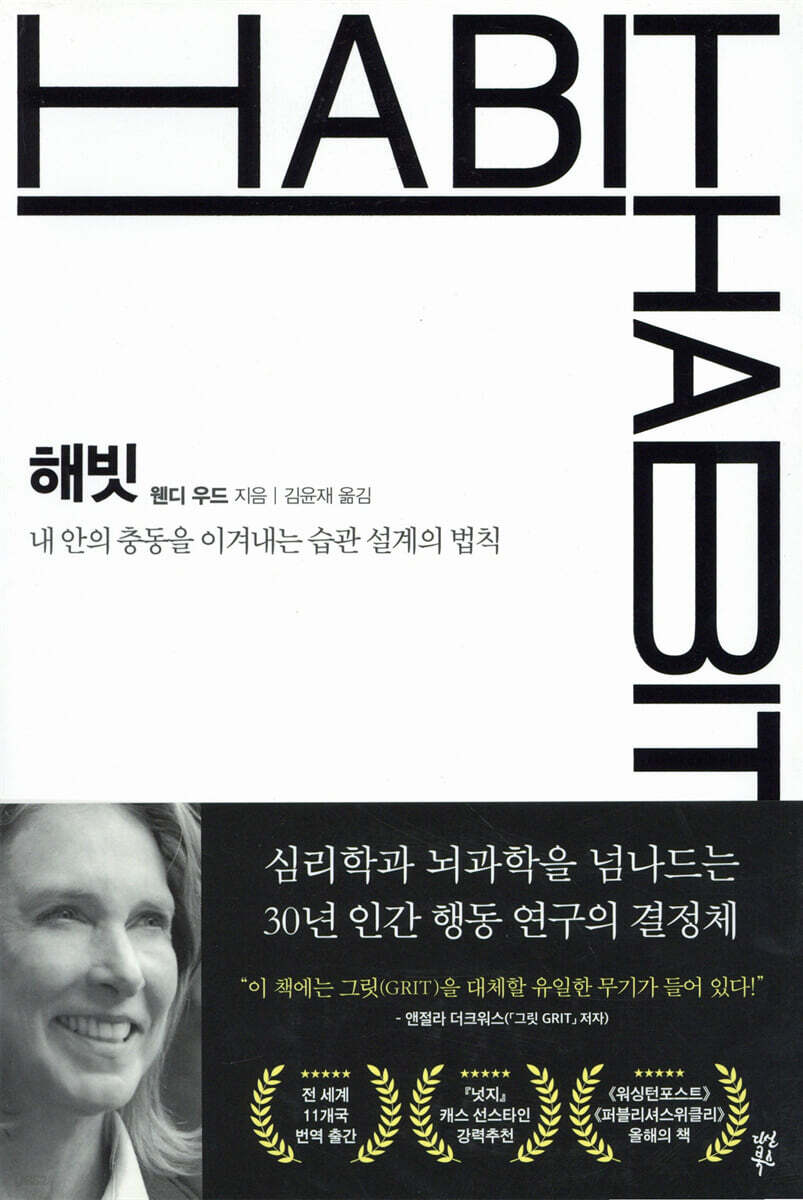
Habit HABIT
 |
Description
Book Introduction
- A word from MD
-
You can form habits without even trying.Creating good habits isn't easy.
What is the reason?
Is it a lack of willpower? To create habits that make your body move automatically without conscious thought, something more important than time and effort is crucial.
We reveal the secrets of behavior discovered through psychology and brain science, and the 'Law of Habit Design' that emphasizes the importance of situation and environment.
December 29, 2019. Self-Development PD Park Jeong-yoon
Nudge: The Only Book Cass Sunstein Approves
The culmination of 30 years of human behavior research spanning neuroscience and psychology.
“Before solving a problem, first rearrange the ‘situation’!”
Goal Obsessed vs.
People who focus on the environment
There are two groups of college students facing an assignment.
One group completed the task solely with their own 'willpower', while the other group began by organizing their surroundings to create a favorable environment for studying before starting the actual task.
When the two groups' scores were checked a week later, the group that had properly controlled the environment and situation beforehand scored significantly higher than the group that relied solely on willpower.
All they did was block Facebook, carry their smartphones in their bags, and study at the library instead of at home. Yet, the students who studied less far outperformed the students who used willpower to complete their assignments.
According to the results of this experiment conducted on actual University of Pennsylvania students, students who put in less effort and got high grades were said to have identified and eliminated the "friction" that was interfering with their study habits, and then "just" continued studying without struggling or fighting.
Wendy Wood, who has spent her life studying the "power of context" on human behavior, says that by intentionally manipulating the smallest conditions of everyday life, we can design a completely new life.
He asserts that the reason we always try our best but quickly become frustrated and return to the same place is because we are overly obsessed with 'goals' and 'motivations'.
There are interesting experimental results that prove this.
After giving the same task of 'morning running' to the general public, we analyzed the differences between those who formed a regular running habit of more than three times a week and those who did not run even once a month.
The group in front reacted sensitively to the environment, that is, the place where they ran, such as a 'playground' or a 'park'.
On the other hand, people who had never run before were overly obsessed with the reasons they had to run, such as 'lose weight', 'participate in a marathon', and 'take care of their body'.
It's as if you need motivation to go out and run, and you're obsessed with goals and rewards.
The culmination of 30 years of human behavior research spanning neuroscience and psychology.
“Before solving a problem, first rearrange the ‘situation’!”
Goal Obsessed vs.
People who focus on the environment
There are two groups of college students facing an assignment.
One group completed the task solely with their own 'willpower', while the other group began by organizing their surroundings to create a favorable environment for studying before starting the actual task.
When the two groups' scores were checked a week later, the group that had properly controlled the environment and situation beforehand scored significantly higher than the group that relied solely on willpower.
All they did was block Facebook, carry their smartphones in their bags, and study at the library instead of at home. Yet, the students who studied less far outperformed the students who used willpower to complete their assignments.
According to the results of this experiment conducted on actual University of Pennsylvania students, students who put in less effort and got high grades were said to have identified and eliminated the "friction" that was interfering with their study habits, and then "just" continued studying without struggling or fighting.
Wendy Wood, who has spent her life studying the "power of context" on human behavior, says that by intentionally manipulating the smallest conditions of everyday life, we can design a completely new life.
He asserts that the reason we always try our best but quickly become frustrated and return to the same place is because we are overly obsessed with 'goals' and 'motivations'.
There are interesting experimental results that prove this.
After giving the same task of 'morning running' to the general public, we analyzed the differences between those who formed a regular running habit of more than three times a week and those who did not run even once a month.
The group in front reacted sensitively to the environment, that is, the place where they ran, such as a 'playground' or a 'park'.
On the other hand, people who had never run before were overly obsessed with the reasons they had to run, such as 'lose weight', 'participate in a marathon', and 'take care of their body'.
It's as if you need motivation to go out and run, and you're obsessed with goals and rewards.
- You can preview some of the book's contents.
Preview
index
To Korean Readers: Awaken the 43 Percent of Your Subconscious
Recommendation_ Introducing the best experts in the field of habit science
Part 1: What Keeps Us Going
Chapter 1: The Unconscious Self: Habits are Permanent
The psychology of posting New Year's resolutions on Facebook
Well begun is half the battle? A beginning is just a beginning.
Will alone cannot sustain it.
We are in such a harsh environment.
Chapter 2: The Introversion Illusion: Habits Are Unseen
Where does a habit begin and end?
Why Habits Go Unnoticed
Why do some people risk their lives to vote, while others give up so easily?
Why you can answer the phone while driving a two-ton killing machine
Chapter 3: Remembering Habits: Habits Don't Stick to Goals
What is the source of human behavior?
The revival of habits
People who are obsessed with their goals and focus on the situation
Great people only focus on great things.
Chapter 4: The Repetitive Brain: Habits Don't Effort
Why I Can't Quit Meat
The brain is constantly being redesigned
You can't call in the cavalry every time
Chapter 5: Controlling the Situation: Habits Don't Fight
If you have strong self-control, will you be successful as an adult?
They didn't create a situation that could collapse.
How to Create Powerful Habits
Part 2: How Habits Take Root in Daily Life
Chapter 6: Habit Design Rule 1: Rearrange Things Around Yourself
[Habit Breaker] The War on Tobacco
[Force Field Theory] Our environment is our force.
[Rearrange] Before solving a problem, first organize the situation.
Chapter 7 Habit Design Rule 2: Place Friction Where It Matters
[Low Friction Strategy] “Would you like some fries too?”
[Distance Friction] Location is the strongest friction force.
[Barricade Strategy] Adding or Removing Friction
Chapter 8: Habit Design Rule 3: Discover Your Own Cue
[Situational Signals] Habits always respond to the same signals.
[Attention Focus Effect] Don't look at the forest, look at the trees.
[Signal Strategy] Use Everyday Signals
Chapter 9: Habit Design Rule 4: Tightly Link Actions to Rewards
[Reward Prediction Error] Rewards should always be greater than expected.
[Intrinsic reward] The faster the reward, the better.
[Uncertain Reward] “It was almost a daughter!”
[The Dullness of Habit] If something works without a reward, it's a habit.
Chapter 10 Habit Design Rule 5: Repeat Until the Magic Begins
[Automated Repeat] When Does the Magic Begin?
[Simplifying Decision Making] Actions Beget Actions
[Final Choice] Seek More Than Repetition
Part 3: How Habits Change Your Life
Chapter 11: Habit Breaking: On the Massive Changes in Your Life
When life floods, only what's truly important remains.
Habits do not discriminate
If bad habits are eating away at your life,
Chapter 12: Habit Promotion: On the Pain That's Hard to Handle
Life doesn't always go according to plan.
Resisting inertia is always painful.
The world is becoming more and more dangerous and our consciousness is weakening.
Chapter 13: Addiction and Habit: On the Self-Exploiting Life
What Drug Addiction and Habits Have in Common
How Soldiers Returning from Vietnam Kicked Out of Drug Addiction in Just One Year
Individuals belonging to a group are not easily contaminated.
Chapter 14: Consciousness and Habit: On the Greatness of Familiarity
Repetition also changes human desires.
Ritual, faith itself becomes power.
Sometimes, your attitude toward habits sustains your life.
Chapter 15: Society and Habits: You Are Not Alone
Failure is not your fault
Why are people in some cities healthier than those in others?
People who can't even decide how much they eat
Appendix_ Breaking Free from Smartphone Addiction
Epilogue: What Controls Human Inner Impulses?
Recommendation_ Introducing the best experts in the field of habit science
Part 1: What Keeps Us Going
Chapter 1: The Unconscious Self: Habits are Permanent
The psychology of posting New Year's resolutions on Facebook
Well begun is half the battle? A beginning is just a beginning.
Will alone cannot sustain it.
We are in such a harsh environment.
Chapter 2: The Introversion Illusion: Habits Are Unseen
Where does a habit begin and end?
Why Habits Go Unnoticed
Why do some people risk their lives to vote, while others give up so easily?
Why you can answer the phone while driving a two-ton killing machine
Chapter 3: Remembering Habits: Habits Don't Stick to Goals
What is the source of human behavior?
The revival of habits
People who are obsessed with their goals and focus on the situation
Great people only focus on great things.
Chapter 4: The Repetitive Brain: Habits Don't Effort
Why I Can't Quit Meat
The brain is constantly being redesigned
You can't call in the cavalry every time
Chapter 5: Controlling the Situation: Habits Don't Fight
If you have strong self-control, will you be successful as an adult?
They didn't create a situation that could collapse.
How to Create Powerful Habits
Part 2: How Habits Take Root in Daily Life
Chapter 6: Habit Design Rule 1: Rearrange Things Around Yourself
[Habit Breaker] The War on Tobacco
[Force Field Theory] Our environment is our force.
[Rearrange] Before solving a problem, first organize the situation.
Chapter 7 Habit Design Rule 2: Place Friction Where It Matters
[Low Friction Strategy] “Would you like some fries too?”
[Distance Friction] Location is the strongest friction force.
[Barricade Strategy] Adding or Removing Friction
Chapter 8: Habit Design Rule 3: Discover Your Own Cue
[Situational Signals] Habits always respond to the same signals.
[Attention Focus Effect] Don't look at the forest, look at the trees.
[Signal Strategy] Use Everyday Signals
Chapter 9: Habit Design Rule 4: Tightly Link Actions to Rewards
[Reward Prediction Error] Rewards should always be greater than expected.
[Intrinsic reward] The faster the reward, the better.
[Uncertain Reward] “It was almost a daughter!”
[The Dullness of Habit] If something works without a reward, it's a habit.
Chapter 10 Habit Design Rule 5: Repeat Until the Magic Begins
[Automated Repeat] When Does the Magic Begin?
[Simplifying Decision Making] Actions Beget Actions
[Final Choice] Seek More Than Repetition
Part 3: How Habits Change Your Life
Chapter 11: Habit Breaking: On the Massive Changes in Your Life
When life floods, only what's truly important remains.
Habits do not discriminate
If bad habits are eating away at your life,
Chapter 12: Habit Promotion: On the Pain That's Hard to Handle
Life doesn't always go according to plan.
Resisting inertia is always painful.
The world is becoming more and more dangerous and our consciousness is weakening.
Chapter 13: Addiction and Habit: On the Self-Exploiting Life
What Drug Addiction and Habits Have in Common
How Soldiers Returning from Vietnam Kicked Out of Drug Addiction in Just One Year
Individuals belonging to a group are not easily contaminated.
Chapter 14: Consciousness and Habit: On the Greatness of Familiarity
Repetition also changes human desires.
Ritual, faith itself becomes power.
Sometimes, your attitude toward habits sustains your life.
Chapter 15: Society and Habits: You Are Not Alone
Failure is not your fault
Why are people in some cities healthier than those in others?
People who can't even decide how much they eat
Appendix_ Breaking Free from Smartphone Addiction
Epilogue: What Controls Human Inner Impulses?
Detailed image
Into the book
Life can be better if you understand the simple, powerful laws of when, how, and why habits work.
You can break bad habits and form better ones that align with your goals.
At this point, there is no need to rely on willpower anymore.
To help you understand how to develop good habits even amidst the traps of everyday life.
This is the only goal I want to achieve in this book.
--- p.51
They don't necessarily bite their lips to achieve their goals.
They always repeat certain actions at the same time and place.
They act without thinking, and once they start, they don't hesitate.
They achieve small successes every day without putting in much effort.
They don't struggle.
--- p.126
Between February and March 2017, a data analytics firm collected records from 7.5 million smartphones.
The company analyzed how far people with smartphones travel to the gym.
People who went to a gym about 6 kilometers away visited more than 5 times a month.
In contrast, people who went to a gym about 8.2 kilometers away only visited once a month.
A difference of just over two kilometers made a fivefold difference.
--- p.164
Circumstances and friction pave the way for habits to form, and signals start the engine.
And rewards fuel the habit train to keep moving forward.
Without even a small reward for the initial effort, our habits will not last.
--- p.195
We must consistently practice new behaviors, believing that good habits can be formed through repetition.
Up to this point, it is correct.
But we must not stop there and push ourselves into the mindset that repetition is the only answer.
You need to free up some of the conscious parts of your life to habits built through repetition, and then use that free time to focus on what really matters (things that shouldn't be repetitive like a machine).
It's up to you to figure out what's more important.
Don't forget.
We must always strive for more than repetition.
--- p.229
There are two wolves living inside us: good habits and bad habits, and which one we feed more often determines the direction of our lives.
Once you start tasting the food, your inner bad habits will grow bigger and bigger in response to the various impulses in life.
Then, when you are in a certain situation, such as when you are under extreme stress or your mental strength drops sharply and you become distracted, this wolf of a bad habit suddenly pops out and invades your mind.
At that time, no one can stop this wolf.
Human impulsive nature cannot be controlled by patience or self-control alone.
It can only be controlled by the power of carefully designed habits.
--- p.275
How miserable and useless would life be if we had to endure this world, full of splendid scenery and peaceful silence.
Can you accept a life where you constantly push yourself, depleting and squandering something within yourself, rather than one where your mind becomes stronger and you accumulate something tangible over time? If your dream life and reality are slowly drifting apart, you need to examine the way you've been living so far.
I wrote this book in the hope that more people will use the power of science to design new, healthy habits, rather than walking the painful and thorny path, and create their own habit system that will solidify their lives.
You can break bad habits and form better ones that align with your goals.
At this point, there is no need to rely on willpower anymore.
To help you understand how to develop good habits even amidst the traps of everyday life.
This is the only goal I want to achieve in this book.
--- p.51
They don't necessarily bite their lips to achieve their goals.
They always repeat certain actions at the same time and place.
They act without thinking, and once they start, they don't hesitate.
They achieve small successes every day without putting in much effort.
They don't struggle.
--- p.126
Between February and March 2017, a data analytics firm collected records from 7.5 million smartphones.
The company analyzed how far people with smartphones travel to the gym.
People who went to a gym about 6 kilometers away visited more than 5 times a month.
In contrast, people who went to a gym about 8.2 kilometers away only visited once a month.
A difference of just over two kilometers made a fivefold difference.
--- p.164
Circumstances and friction pave the way for habits to form, and signals start the engine.
And rewards fuel the habit train to keep moving forward.
Without even a small reward for the initial effort, our habits will not last.
--- p.195
We must consistently practice new behaviors, believing that good habits can be formed through repetition.
Up to this point, it is correct.
But we must not stop there and push ourselves into the mindset that repetition is the only answer.
You need to free up some of the conscious parts of your life to habits built through repetition, and then use that free time to focus on what really matters (things that shouldn't be repetitive like a machine).
It's up to you to figure out what's more important.
Don't forget.
We must always strive for more than repetition.
--- p.229
There are two wolves living inside us: good habits and bad habits, and which one we feed more often determines the direction of our lives.
Once you start tasting the food, your inner bad habits will grow bigger and bigger in response to the various impulses in life.
Then, when you are in a certain situation, such as when you are under extreme stress or your mental strength drops sharply and you become distracted, this wolf of a bad habit suddenly pops out and invades your mind.
At that time, no one can stop this wolf.
Human impulsive nature cannot be controlled by patience or self-control alone.
It can only be controlled by the power of carefully designed habits.
--- p.275
How miserable and useless would life be if we had to endure this world, full of splendid scenery and peaceful silence.
Can you accept a life where you constantly push yourself, depleting and squandering something within yourself, rather than one where your mind becomes stronger and you accumulate something tangible over time? If your dream life and reality are slowly drifting apart, you need to examine the way you've been living so far.
I wrote this book in the hope that more people will use the power of science to design new, healthy habits, rather than walking the painful and thorny path, and create their own habit system that will solidify their lives.
--- p.341
Publisher's Review
“Before solving a problem, first rearrange the ‘situation’!”
Goal Obsessed vs.
People who focus on the environment
There are two groups of college students facing an assignment.
One group completed the task solely with their own 'willpower', while the other group began by organizing their surroundings to create a favorable environment for studying before starting the actual task.
When the two groups' scores were checked a week later, the group that had properly controlled the environment and situation beforehand scored significantly higher than the group that relied solely on willpower.
All they did was block Facebook, carry their smartphones in their bags, and study at the library instead of at home. Yet, the students who studied less far outperformed the students who used willpower to complete their assignments.
According to the results of this experiment conducted on actual University of Pennsylvania students, students who put in less effort and got high grades were said to have identified and eliminated the "friction" that was interfering with their study habits, and then "just" continued studying without struggling or fighting.
Wendy Wood, who has spent her life studying the "power of context" on human behavior, says that by intentionally manipulating the smallest conditions of everyday life, we can design a completely new life.
He asserts that the reason we always try our best but quickly become frustrated and return to the same place is because we are overly obsessed with 'goals' and 'motivations'.
There are interesting experimental results that prove this.
After giving the same task of 'morning running' to the general public, we analyzed the differences between those who formed a regular running habit of more than three times a week and those who did not run even once a month.
The group in front reacted sensitively to the environment, that is, the place where they ran, such as a 'playground' or a 'park'.
On the other hand, people who had never run before were overly obsessed with the reasons they had to run, such as 'lose weight', 'participate in a marathon', and 'take care of their body'.
It's as if you need motivation to go out and run, and you're obsessed with goals and rewards.
“Your willpower cools faster than freshly brewed coffee!”
The miraculous life transformation created by the 43% of your unconscious mind.
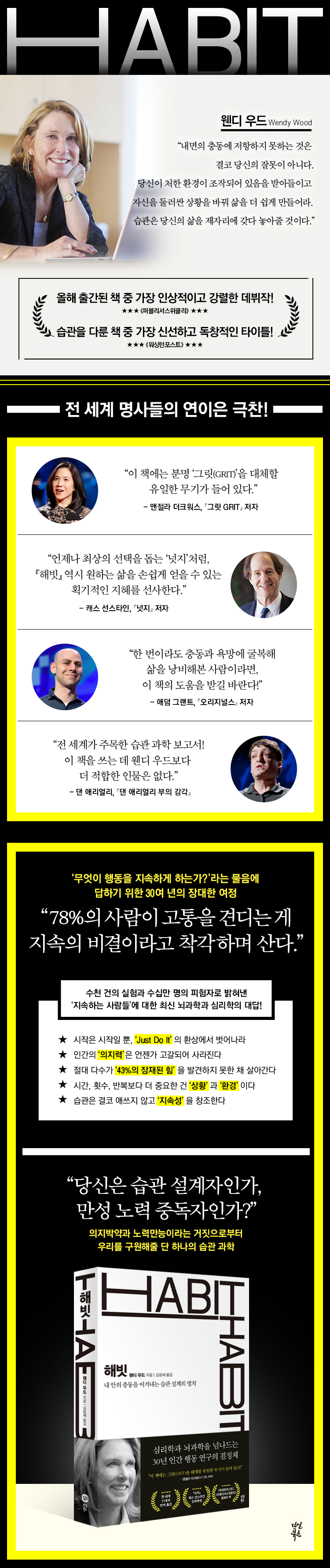
Wendy Wood's research team has discovered, for the first time in the academic world, that a whopping '43%' of our daily lives are operated by the power of habit, that is, by the power of the unconscious.
If I could channel this boundless potential, which accounts for nearly half of my life, in the direction I desire, if I could channel this vast current toward a more beneficial direction, wouldn't I be able to rebuild my past life, which had been swayed by impulses and repeated cycles of self-exploitation and apathy?
The common thread among the "effortless, persistent people" Wendy Wood has encountered over the past 30 years is that they aren't obsessed with motivation, rewards, resolutions, or goals, but simply lay the groundwork for "good habits" to flourish.
Once the circumstances are rearranged and the environment is set, willpower and effort become meaningless.
They blended into life with grace and style, achieving their goals without struggle, as if temptation or impulse itself never existed in the first place.
In Part 1, Wendy Wood debunks the misconceptions about habits that have been distorted by all the superstitious self-help discourse and unconventional advice from motivational gurus, and analyzes the true force that sustains our behaviors, drawing on the latest brain science and extensive psychological research.
And based on this, we will explain in detail, step by step, the 'Habit Design Law' that fully draws out the 43% of power latent in the subconscious.
First, keep the same situation centered around yourself, second, remove the friction that gets in the way of good habits, third, find your own cue that automatically triggers the behavior, fourth, design the behavior itself to be a reward, and fifth, repeat all of this until the magic begins.
With the help of the science of habits, you can maintain good behavior 100 years from now without having to push yourself to the point of exhaustion.
Writing a diary as soon as you open your eyes in the morning, taking a 30-minute walk during lunch, reading a book or meditating instead of using your smartphone before going to bed, etc. All of these are examples of the 'habit design law' that rearranges the surrounding circumstances around 'me' so that certain behaviors become naturally ingrained in daily life.
“Will I waste my life on meaningless repetition next year too?”
The Science of Habits: Saving Us from the Myth of "Effort Is Everything"
Of course, habits don't always work in a good way.
In Part 3, which analyzes the influence of society on habit formation using keywords such as “change,” “addiction,” and “stress,” the author mentions that modern people’s food intake has more than doubled over the past 20 years, exposing how cleverly and secretly modern society is designed to slowly erode our self-control and willpower.
Since 1950, French fries have tripled in size, hamburgers have quadrupled in size, and soda has more than sixfold in size.
Despite this, people eat up all the food given to them.
This is also the 43% of potential unconscious power.
Multinational food companies are constantly working to develop more stimulating and addictive foods, while YouTube and Netflix constantly bombard us with videos to watch next.
There are always sweet snacks and candies on the supermarket checkout counter, and the smell of all kinds of food fills the air on the way to the gym.
How can we safeguard our lives against the increasingly cunning temptations of a world? Will we allow our lives to drift along at will, neglecting the power of the unconscious and the power of circumstances? Or will we surrender the reins to the power of habit, bid farewell to pain and apathy, and embrace a completely new life?
A life lived day by day through effort and willpower alone is difficult.
For these 'chronic effort addicts,' every area of life—dieting, saving, exercising, quitting smoking, studying—is nothing but a series of hardships.
As time passes, the pain increases and patience and self-control quickly wear thin.
How long will we endure this pain, go against our desires, and live in such difficulty?
“We can all be better people and deserve a better life.
And habits will put our lives in order.” As the author says, our inability to properly resist our inner impulses and the temptations of the world is not our fault, but rather the clever manipulation of the environment that surrounds us.
If you are someone who succumbs to addictive media such as smartphones, TV, and YouTube and ends each day with regret and lethargy, or if you are someone who struggles with painful abstinence every day and then cannot suppress your impulses at night and repeats binge drinking and regret, you can read this book and apply the scientific rules of habit design to your daily life by utilizing the power of circumstances to break away from a life of 'enduring, enduring, and fighting' and reach your goals easily and elegantly.
Goal Obsessed vs.
People who focus on the environment
There are two groups of college students facing an assignment.
One group completed the task solely with their own 'willpower', while the other group began by organizing their surroundings to create a favorable environment for studying before starting the actual task.
When the two groups' scores were checked a week later, the group that had properly controlled the environment and situation beforehand scored significantly higher than the group that relied solely on willpower.
All they did was block Facebook, carry their smartphones in their bags, and study at the library instead of at home. Yet, the students who studied less far outperformed the students who used willpower to complete their assignments.
According to the results of this experiment conducted on actual University of Pennsylvania students, students who put in less effort and got high grades were said to have identified and eliminated the "friction" that was interfering with their study habits, and then "just" continued studying without struggling or fighting.
Wendy Wood, who has spent her life studying the "power of context" on human behavior, says that by intentionally manipulating the smallest conditions of everyday life, we can design a completely new life.
He asserts that the reason we always try our best but quickly become frustrated and return to the same place is because we are overly obsessed with 'goals' and 'motivations'.
There are interesting experimental results that prove this.
After giving the same task of 'morning running' to the general public, we analyzed the differences between those who formed a regular running habit of more than three times a week and those who did not run even once a month.
The group in front reacted sensitively to the environment, that is, the place where they ran, such as a 'playground' or a 'park'.
On the other hand, people who had never run before were overly obsessed with the reasons they had to run, such as 'lose weight', 'participate in a marathon', and 'take care of their body'.
It's as if you need motivation to go out and run, and you're obsessed with goals and rewards.
“Your willpower cools faster than freshly brewed coffee!”
The miraculous life transformation created by the 43% of your unconscious mind.
Wendy Wood's research team has discovered, for the first time in the academic world, that a whopping '43%' of our daily lives are operated by the power of habit, that is, by the power of the unconscious.
If I could channel this boundless potential, which accounts for nearly half of my life, in the direction I desire, if I could channel this vast current toward a more beneficial direction, wouldn't I be able to rebuild my past life, which had been swayed by impulses and repeated cycles of self-exploitation and apathy?
The common thread among the "effortless, persistent people" Wendy Wood has encountered over the past 30 years is that they aren't obsessed with motivation, rewards, resolutions, or goals, but simply lay the groundwork for "good habits" to flourish.
Once the circumstances are rearranged and the environment is set, willpower and effort become meaningless.
They blended into life with grace and style, achieving their goals without struggle, as if temptation or impulse itself never existed in the first place.
In Part 1, Wendy Wood debunks the misconceptions about habits that have been distorted by all the superstitious self-help discourse and unconventional advice from motivational gurus, and analyzes the true force that sustains our behaviors, drawing on the latest brain science and extensive psychological research.
And based on this, we will explain in detail, step by step, the 'Habit Design Law' that fully draws out the 43% of power latent in the subconscious.
First, keep the same situation centered around yourself, second, remove the friction that gets in the way of good habits, third, find your own cue that automatically triggers the behavior, fourth, design the behavior itself to be a reward, and fifth, repeat all of this until the magic begins.
With the help of the science of habits, you can maintain good behavior 100 years from now without having to push yourself to the point of exhaustion.
Writing a diary as soon as you open your eyes in the morning, taking a 30-minute walk during lunch, reading a book or meditating instead of using your smartphone before going to bed, etc. All of these are examples of the 'habit design law' that rearranges the surrounding circumstances around 'me' so that certain behaviors become naturally ingrained in daily life.
“Will I waste my life on meaningless repetition next year too?”
The Science of Habits: Saving Us from the Myth of "Effort Is Everything"
Of course, habits don't always work in a good way.
In Part 3, which analyzes the influence of society on habit formation using keywords such as “change,” “addiction,” and “stress,” the author mentions that modern people’s food intake has more than doubled over the past 20 years, exposing how cleverly and secretly modern society is designed to slowly erode our self-control and willpower.
Since 1950, French fries have tripled in size, hamburgers have quadrupled in size, and soda has more than sixfold in size.
Despite this, people eat up all the food given to them.
This is also the 43% of potential unconscious power.
Multinational food companies are constantly working to develop more stimulating and addictive foods, while YouTube and Netflix constantly bombard us with videos to watch next.
There are always sweet snacks and candies on the supermarket checkout counter, and the smell of all kinds of food fills the air on the way to the gym.
How can we safeguard our lives against the increasingly cunning temptations of a world? Will we allow our lives to drift along at will, neglecting the power of the unconscious and the power of circumstances? Or will we surrender the reins to the power of habit, bid farewell to pain and apathy, and embrace a completely new life?
A life lived day by day through effort and willpower alone is difficult.
For these 'chronic effort addicts,' every area of life—dieting, saving, exercising, quitting smoking, studying—is nothing but a series of hardships.
As time passes, the pain increases and patience and self-control quickly wear thin.
How long will we endure this pain, go against our desires, and live in such difficulty?
“We can all be better people and deserve a better life.
And habits will put our lives in order.” As the author says, our inability to properly resist our inner impulses and the temptations of the world is not our fault, but rather the clever manipulation of the environment that surrounds us.
If you are someone who succumbs to addictive media such as smartphones, TV, and YouTube and ends each day with regret and lethargy, or if you are someone who struggles with painful abstinence every day and then cannot suppress your impulses at night and repeats binge drinking and regret, you can read this book and apply the scientific rules of habit design to your daily life by utilizing the power of circumstances to break away from a life of 'enduring, enduring, and fighting' and reach your goals easily and elegantly.
GOODS SPECIFICS
- Publication date: December 17, 2019
- Format: Hardcover book binding method guide
- Page count, weight, size: 388 pages | 762g | 146*219*30mm
- ISBN13: 9791130627595
- ISBN10: 1130627594
You may also like
카테고리
korean


korean

![GQ KOREA Mark (Monthly): December [2025]](http://librairie.coreenne.fr/cdn/shop/files/8ef265dbbfbf186523ed75ba7319009d.jpg?v=1765340328&width=3840)


