

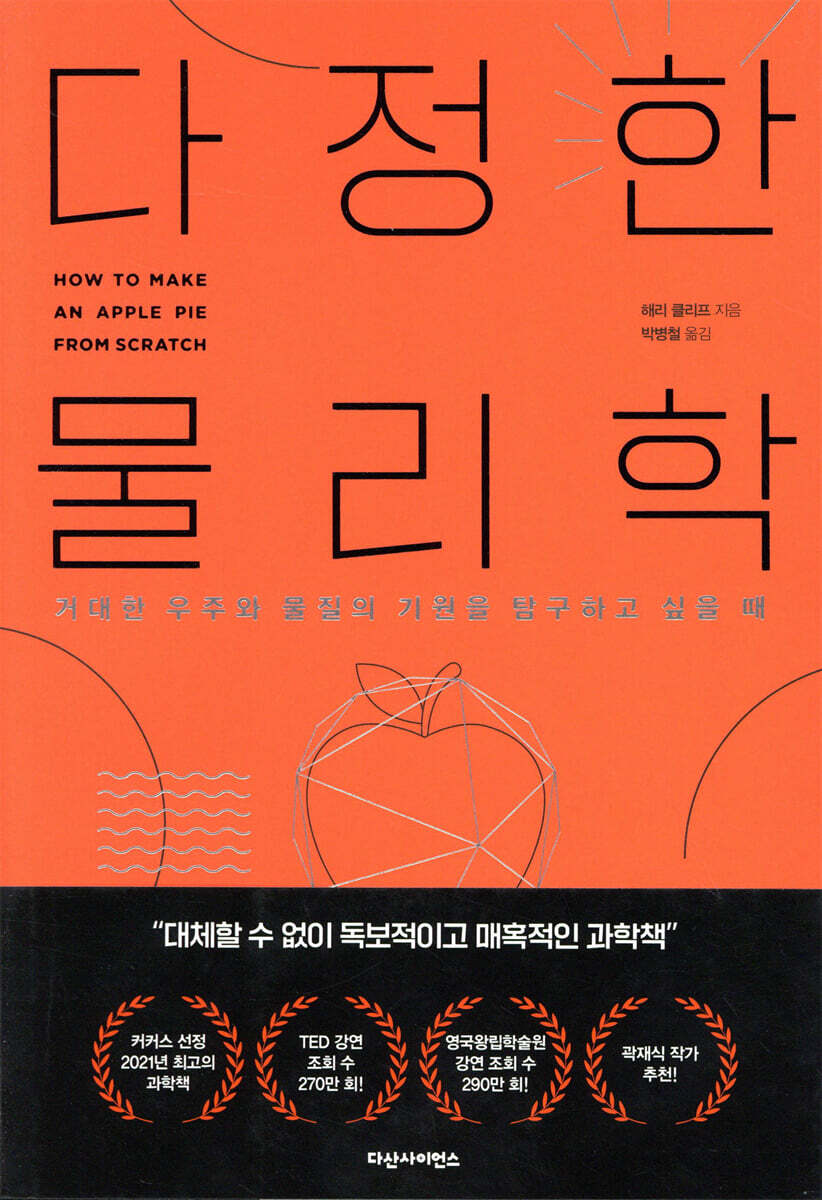
Affectionate Physics
 |
Description
Book Introduction
“Going back to one trillionth of a second after the Big Bang “An intellectual journey to uncover the origins of the universe and matter.” CERN particle physicist who discovered the Higgs boson, A contemporary science communicator, following in the footsteps of Richard Dawkins and Carl Sagan. How the world was created: Harry Cliff reveals cutting-edge modern physics For those living in the age of science A popular science textbook that anyone can read from start to finish. This book is a popular science textbook that covers a vast and in-depth range of advanced scientific knowledge, yet can be easily read from beginning to end by anyone interested in science. The author has incorporated unique features into this book that set it apart from other science books for the general reader. First, by leveraging his expertise as an experimental scientist, he demonstrates potentially difficult scientific knowledge through direct experiments and discoveries, rather than focusing solely on theoretical explanations. Also, like Michio Kaku, who wrote “A Single Equation,” he visits actual laboratories and shows scientists working with machines, making you feel as if you were there. There are also humorous touches scattered throughout the book that will make you laugh out loud even amidst serious scientific discussions. For example, there's the anecdote about how too many meetings were disrupting work, so they created a meeting team to reduce them, only to end up having more meetings, or the author's mischievous remark that he enjoys proving theoretical physicists wrong. You'll find yourself chuckling and laughing while understanding cutting-edge modern science without even realizing it. For us who live in the age of science, science is not simply technology; it is knowledge and thought that constitutes a major axis of our thoughts and judgments. In a world that is changing in ways we could never have imagined before, science is no longer something we can only observe from afar. If you're interested in science, take the time to become familiar with science by reading "Affectionate Physics," a friendly science book that anyone can enjoy reading from beginning to end. |
- You can preview some of the book's contents.
Preview
index
prolog
Chapter 1 · Basic Recipe
Chapter 2 · The Smallest Piece
Chapter 3 · The Composition of Atoms
Chapter 4: Splitting Nuclei
Chapter 5: Thermonuclear Oven
Chapter 6 · Star
Chapter 7: The Ultimate Space Chef
Chapter 8 · Proton Recipe
Chapter 9: What Really Are Particles?
Chapter 10: The Final Ingredient
Chapter 11: The Recipe for All Things
Chapter 12 · Missing Components
Chapter 13: Creating the Universe
Chapter 14: Is This the End?
Appendix / Acknowledgments / Translator's Note / Postscript / References / Index
Chapter 1 · Basic Recipe
Chapter 2 · The Smallest Piece
Chapter 3 · The Composition of Atoms
Chapter 4: Splitting Nuclei
Chapter 5: Thermonuclear Oven
Chapter 6 · Star
Chapter 7: The Ultimate Space Chef
Chapter 8 · Proton Recipe
Chapter 9: What Really Are Particles?
Chapter 10: The Final Ingredient
Chapter 11: The Recipe for All Things
Chapter 12 · Missing Components
Chapter 13: Creating the Universe
Chapter 14: Is This the End?
Appendix / Acknowledgments / Translator's Note / Postscript / References / Index
Detailed image
.jpg)
Into the book
The ninth episode of the Cosmos series begins with a scene showing a small green dot appearing on a pitch-black background.
At first it looks like a wandering planet drifting through space, but as you zoom in, something seems strange.
Then, just as the viewers realize, "Aha, it wasn't a planet, it was an apple!", a kitchen knife suddenly appears and mercilessly cuts the apple in two, followed by a scene where a chef rolls out dough with a rolling pin, shapes it into something, and puts it in the oven.
After a while, the setting changes to the banqueting hall of Trinity College, Cambridge, famous for its oak decorations.
There are several long tables there, and at the end of one of them sits Carl Sagan, wearing a red turtleneck sweater.
When the waiter offers Sagan a freshly baked apple pie, he turns to the camera and utters the following opening line: “If you want to make an apple pie from nothing, you have to first make the universe.”
--- p.022
Curious about the nature of the smoke, I tried a chemical analysis method that has been used since ancient times: “sniffing.”
Humphry Davy, a renowned chemist of the Romantic era, used to inhale various gases himself to determine their effects on the human body.
(…) Of course, this is not a recommended method.
One day, during an experiment, Davey collapsed after inhaling too much carbon monoxide. When the researchers dragged him outside to breathe the sacred air, he muttered in a faint voice, “It’s okay.
“I don’t think I’m going to die today.”
--- pp.
027~028
I decided that the charcoal wasn't ground fine enough and was trying to remove the slide when I noticed a much smaller black particle at the bottom left of the screen.
I was aiming the microscope lens at it, roughly estimating its size, when suddenly the particle began to move! It wasn't flowing smoothly along with the liquid, but rather, it was trembling violently, as if something was bothering it.
It was at this moment that I realized why Brown had once thought he had “discovered a living molecule.”
The excitement and joy I felt at that moment cannot be expressed in words.
I had a similar feeling when I first discovered Saturn and its moons through a telescope as a child.
Even now, when I think about it, what I blurted out back then seems so stupid—“Oh my god… Saturn really exists!” I had seen Saturn many times before, in books and on TV, but seeing it with my own eyes was a completely different experience.
--- p.064
If you look at it from a close enough distance, the discontinuity in matter disappears.
The particles we knew were not actually particles, but disturbances in the quantum fields that fill all of the universe.
All objects (apple pies, people, stars, etc.) are macroscopic aggregates of these vibrations, which move together to create the illusion of solidity and permanence.
Moreover, since there is only one electromagnetic field, one up-quark field, and one down-quark field in the world, you and I are connected to each other.
Since all the atoms that make up our bodies are ripples in the same cosmic ocean, we are one with all creation.
--- pp.
284~285
When ATLAS's Fabiola Zanotti appeared and showed a graph showing a "hill" formed at the same location as CMS, the audience erupted in an uproar, screaming and stamping their feet.
How much was it? It was almost exactly like when your own team scored the winning goal in the World Cup final.
The physicists gathered there celebrated their shared success, and Peter Higgs, now in his eighties, shed tears of joy.
(…) When the Director General of CERN declared the event closed, Matt finally realized what he had done—“Now it makes sense.
“I’m not an expert yet, but I’ve definitely discovered something great.”
Yes, they discovered the Higgs particle.
--- p.324
No matter how hard we try, we will never be able to reach the moment when the universe was born (the moment when gravity, time, space, quantum fields, and everything else were unified).
Disappointed? No need to be.
Because in fact, the opposite is true.
We have come a long way in understanding the origins of matter and the universe, but we are still a long way from reaching the Planck scale.
This is not the time to discuss ultimate theories.
There are still unsolved mysteries everywhere.
What is dark matter? Why did matter outnumber antimatter during the Big Bang, allowing it to survive to this day? Why does the Higgs field have such miraculous values? Fortunately, science thrives when its mysteries are abundant.
What's even more hopeful is that the mysteries just listed may be solved in the coming years.
At first it looks like a wandering planet drifting through space, but as you zoom in, something seems strange.
Then, just as the viewers realize, "Aha, it wasn't a planet, it was an apple!", a kitchen knife suddenly appears and mercilessly cuts the apple in two, followed by a scene where a chef rolls out dough with a rolling pin, shapes it into something, and puts it in the oven.
After a while, the setting changes to the banqueting hall of Trinity College, Cambridge, famous for its oak decorations.
There are several long tables there, and at the end of one of them sits Carl Sagan, wearing a red turtleneck sweater.
When the waiter offers Sagan a freshly baked apple pie, he turns to the camera and utters the following opening line: “If you want to make an apple pie from nothing, you have to first make the universe.”
--- p.022
Curious about the nature of the smoke, I tried a chemical analysis method that has been used since ancient times: “sniffing.”
Humphry Davy, a renowned chemist of the Romantic era, used to inhale various gases himself to determine their effects on the human body.
(…) Of course, this is not a recommended method.
One day, during an experiment, Davey collapsed after inhaling too much carbon monoxide. When the researchers dragged him outside to breathe the sacred air, he muttered in a faint voice, “It’s okay.
“I don’t think I’m going to die today.”
--- pp.
027~028
I decided that the charcoal wasn't ground fine enough and was trying to remove the slide when I noticed a much smaller black particle at the bottom left of the screen.
I was aiming the microscope lens at it, roughly estimating its size, when suddenly the particle began to move! It wasn't flowing smoothly along with the liquid, but rather, it was trembling violently, as if something was bothering it.
It was at this moment that I realized why Brown had once thought he had “discovered a living molecule.”
The excitement and joy I felt at that moment cannot be expressed in words.
I had a similar feeling when I first discovered Saturn and its moons through a telescope as a child.
Even now, when I think about it, what I blurted out back then seems so stupid—“Oh my god… Saturn really exists!” I had seen Saturn many times before, in books and on TV, but seeing it with my own eyes was a completely different experience.
--- p.064
If you look at it from a close enough distance, the discontinuity in matter disappears.
The particles we knew were not actually particles, but disturbances in the quantum fields that fill all of the universe.
All objects (apple pies, people, stars, etc.) are macroscopic aggregates of these vibrations, which move together to create the illusion of solidity and permanence.
Moreover, since there is only one electromagnetic field, one up-quark field, and one down-quark field in the world, you and I are connected to each other.
Since all the atoms that make up our bodies are ripples in the same cosmic ocean, we are one with all creation.
--- pp.
284~285
When ATLAS's Fabiola Zanotti appeared and showed a graph showing a "hill" formed at the same location as CMS, the audience erupted in an uproar, screaming and stamping their feet.
How much was it? It was almost exactly like when your own team scored the winning goal in the World Cup final.
The physicists gathered there celebrated their shared success, and Peter Higgs, now in his eighties, shed tears of joy.
(…) When the Director General of CERN declared the event closed, Matt finally realized what he had done—“Now it makes sense.
“I’m not an expert yet, but I’ve definitely discovered something great.”
Yes, they discovered the Higgs particle.
--- p.324
No matter how hard we try, we will never be able to reach the moment when the universe was born (the moment when gravity, time, space, quantum fields, and everything else were unified).
Disappointed? No need to be.
Because in fact, the opposite is true.
We have come a long way in understanding the origins of matter and the universe, but we are still a long way from reaching the Planck scale.
This is not the time to discuss ultimate theories.
There are still unsolved mysteries everywhere.
What is dark matter? Why did matter outnumber antimatter during the Big Bang, allowing it to survive to this day? Why does the Higgs field have such miraculous values? Fortunately, science thrives when its mysteries are abundant.
What's even more hopeful is that the mysteries just listed may be solved in the coming years.
--- p.451
Publisher's Review
★ Kirkus Reviews' Best Science Books of 2021
★ A renowned lecture in the scientific community with an astonishing record of 2.7 million TED talks and 2.9 million Royal Academy talks
★ Popular science books recommended by scientists such as Kwak Jae-sik, Jim Al-Khalili, and Sean Carroll
A very small science that explores the secrets of the vast world.
Over the past 100 years, Einstein's brilliant research on relativity and the even more groundbreaking quantum mechanics have completely changed our view of the world.
Thanks to these two theories, humanity was able to figure out what the universe is made of and how it has changed.
But now, after a time that felt like a blessing, physics has reached another turning point.
This led humanity to undertake an unprecedented and unique attempt: to discover the origins of the immeasurably vast universe through tiny particles.
A super-coalition experimental project was established with the cooperation of 22 countries and the participation of over 2,500 scientists. After overcoming numerous problems and difficulties, in 2012, an experiment was finally launched to recreate the Big Bang, which created the universe, using protons, the first elementary particle discovered by mankind.
Two protons were accelerated to 99.999996% of the speed of light and collided in a gigantic particle accelerator 100 meters underground, 27 kilometers long and weighing 6,000 tons.
A tremendous amount of energy burst out, countless numbers were printed on the measuring instrument, and soon the Higgs boson, known as the God particle that had only been imagined, appeared.
When the next page of modern science was opened by the incredibly tiny 0.833 femtometer-sized proton, humanity, which emerged about 4 million years ago, traveled back in time, an uncountable 13.8 billion years, to understand the world up to one trillionth of a second after the Big Bang, and came one step closer to answering the biggest and most fundamental question in science: how did we and the world come to be?
This book details the challenges and efforts of countless scientists who have expanded humanity's horizons at the forefront of modern science.
It also contains the miraculous principles that allowed our universe and matter to be created, revealed through their tireless passion.
Through this story of human intelligence pioneering the next frontier at the forefront of modern science, readers will be able to expand their horizons of knowledge and satisfy their boundless intellectual appetite.
The world's emotions that only science can tell
When we enter the world of extremely small particles that can no longer be cut by cutting countless objects, the world appears different from what we knew.
The world seen through the microscopic world is not a world of individuality and distinction, but a world of interconnected continuity within a single movement called the quantum field.
All objects are a collection of enormous vibrations, and therefore you and I are not separate and distinct beings, but rather one interconnected being.
In a modern society increasingly moving toward selfish individualism, the stories of the microscopic world revealed by science carry a meaningful message.
Science is often thought of as a distant discipline that has no direct connection to our lives, but even in the smallest particles, there are hidden teachings that can enlighten our lives.
Science expands the limits of our unilateral perception and teaches us about the values we must not lose.
Science says:
Since all atoms are born from vibrations that occur in the same cosmic ocean, we are one with all creation.
Through this, readers will be able to experience the profound emotions and messages that only science can convey to marginalized modern people.
For those living in the age of science
A popular science textbook that anyone can read from start to finish.
This book is a popular science textbook that covers a vast and in-depth range of advanced scientific knowledge, yet can be easily read from beginning to end by anyone interested in science.
The author has incorporated unique features into this book that set it apart from other science books for the general reader. First, by leveraging his expertise as an experimental scientist, he demonstrates potentially difficult scientific knowledge through direct experiments and discoveries, rather than focusing solely on theoretical explanations.
Also, like Michio Kaku, who wrote “A Single Equation,” he visits actual laboratories and shows scientists working with machines, making you feel as if you were there.
There are also humorous touches scattered throughout the book that will make you laugh out loud even amidst serious scientific discussions. For example, there's the anecdote about how too many meetings were disrupting work, so they created a meeting team to reduce them, only to end up having more meetings, or the author's mischievous remark that he enjoys proving theoretical physicists wrong. You'll find yourself chuckling and laughing while understanding cutting-edge modern science without even realizing it.
For us who live in the age of science, science is not simply technology; it is knowledge and thought that constitutes a major axis of our thoughts and judgments.
In a world that is changing in ways we could never have imagined before, science is no longer something we can only observe from afar.
If you're interested in science, take the time to become familiar with science by reading "Affectionate Physics," a friendly science book that anyone can enjoy reading from beginning to end.
★ A renowned lecture in the scientific community with an astonishing record of 2.7 million TED talks and 2.9 million Royal Academy talks
★ Popular science books recommended by scientists such as Kwak Jae-sik, Jim Al-Khalili, and Sean Carroll
A very small science that explores the secrets of the vast world.
Over the past 100 years, Einstein's brilliant research on relativity and the even more groundbreaking quantum mechanics have completely changed our view of the world.
Thanks to these two theories, humanity was able to figure out what the universe is made of and how it has changed.
But now, after a time that felt like a blessing, physics has reached another turning point.
This led humanity to undertake an unprecedented and unique attempt: to discover the origins of the immeasurably vast universe through tiny particles.
A super-coalition experimental project was established with the cooperation of 22 countries and the participation of over 2,500 scientists. After overcoming numerous problems and difficulties, in 2012, an experiment was finally launched to recreate the Big Bang, which created the universe, using protons, the first elementary particle discovered by mankind.
Two protons were accelerated to 99.999996% of the speed of light and collided in a gigantic particle accelerator 100 meters underground, 27 kilometers long and weighing 6,000 tons.
A tremendous amount of energy burst out, countless numbers were printed on the measuring instrument, and soon the Higgs boson, known as the God particle that had only been imagined, appeared.
When the next page of modern science was opened by the incredibly tiny 0.833 femtometer-sized proton, humanity, which emerged about 4 million years ago, traveled back in time, an uncountable 13.8 billion years, to understand the world up to one trillionth of a second after the Big Bang, and came one step closer to answering the biggest and most fundamental question in science: how did we and the world come to be?
This book details the challenges and efforts of countless scientists who have expanded humanity's horizons at the forefront of modern science.
It also contains the miraculous principles that allowed our universe and matter to be created, revealed through their tireless passion.
Through this story of human intelligence pioneering the next frontier at the forefront of modern science, readers will be able to expand their horizons of knowledge and satisfy their boundless intellectual appetite.
The world's emotions that only science can tell
When we enter the world of extremely small particles that can no longer be cut by cutting countless objects, the world appears different from what we knew.
The world seen through the microscopic world is not a world of individuality and distinction, but a world of interconnected continuity within a single movement called the quantum field.
All objects are a collection of enormous vibrations, and therefore you and I are not separate and distinct beings, but rather one interconnected being.
In a modern society increasingly moving toward selfish individualism, the stories of the microscopic world revealed by science carry a meaningful message.
Science is often thought of as a distant discipline that has no direct connection to our lives, but even in the smallest particles, there are hidden teachings that can enlighten our lives.
Science expands the limits of our unilateral perception and teaches us about the values we must not lose.
Science says:
Since all atoms are born from vibrations that occur in the same cosmic ocean, we are one with all creation.
Through this, readers will be able to experience the profound emotions and messages that only science can convey to marginalized modern people.
For those living in the age of science
A popular science textbook that anyone can read from start to finish.
This book is a popular science textbook that covers a vast and in-depth range of advanced scientific knowledge, yet can be easily read from beginning to end by anyone interested in science.
The author has incorporated unique features into this book that set it apart from other science books for the general reader. First, by leveraging his expertise as an experimental scientist, he demonstrates potentially difficult scientific knowledge through direct experiments and discoveries, rather than focusing solely on theoretical explanations.
Also, like Michio Kaku, who wrote “A Single Equation,” he visits actual laboratories and shows scientists working with machines, making you feel as if you were there.
There are also humorous touches scattered throughout the book that will make you laugh out loud even amidst serious scientific discussions. For example, there's the anecdote about how too many meetings were disrupting work, so they created a meeting team to reduce them, only to end up having more meetings, or the author's mischievous remark that he enjoys proving theoretical physicists wrong. You'll find yourself chuckling and laughing while understanding cutting-edge modern science without even realizing it.
For us who live in the age of science, science is not simply technology; it is knowledge and thought that constitutes a major axis of our thoughts and judgments.
In a world that is changing in ways we could never have imagined before, science is no longer something we can only observe from afar.
If you're interested in science, take the time to become familiar with science by reading "Affectionate Physics," a friendly science book that anyone can enjoy reading from beginning to end.
GOODS SPECIFICS
- Publication date: August 26, 2022
- Page count, weight, size: 488 pages | 660g | 145*210*30mm
- ISBN13: 9791130693057
- ISBN10: 1130693058
You may also like
카테고리
korean


korean

![GQ KOREA Mark (Monthly): December [2025]](http://librairie.coreenne.fr/cdn/shop/files/8ef265dbbfbf186523ed75ba7319009d.jpg?v=1765340328&width=3840)


