

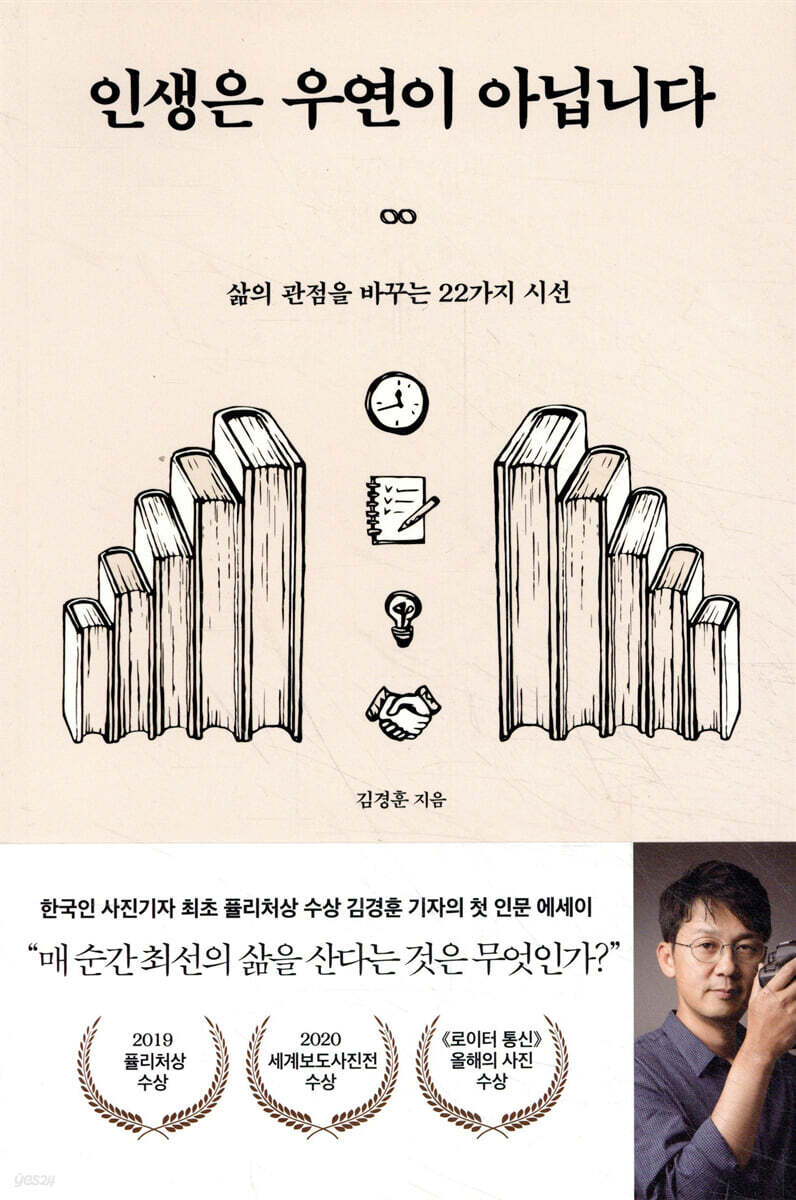
Life is not a coincidence
 |
Description
Book Introduction
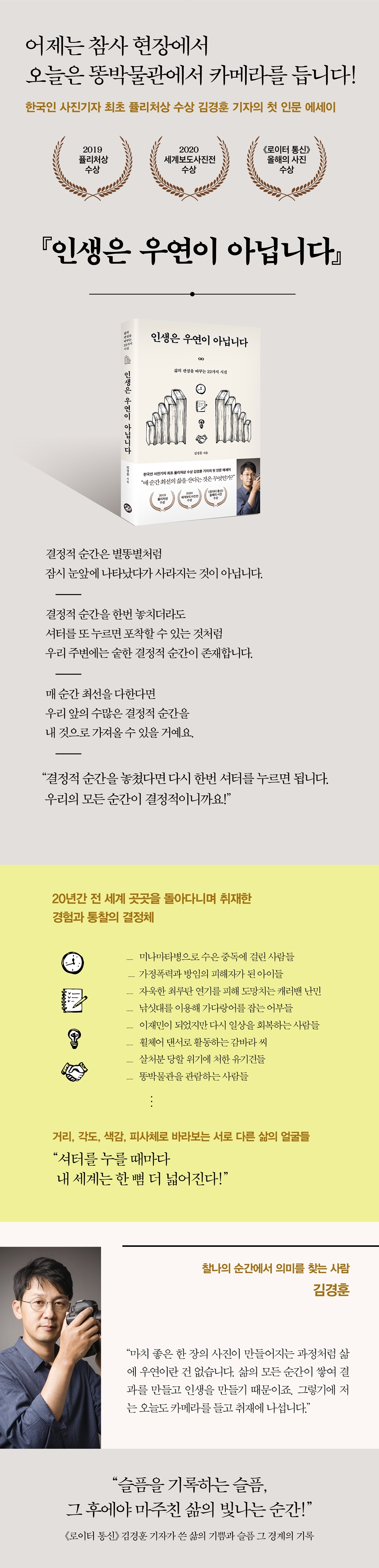
“What does it mean to live your best life every moment?”
The first humanities essay by Kim Kyung-hoon, the first Korean photojournalist to win the Pulitzer Prize.
- 2019 Pulitzer Prize Winner
- 2020 World Press Photo Awards Winner
- Reuters Photo of the Year Award
People suffering from mercury poisoning due to Minamata disease, children who are victims of domestic violence and neglect, Gambara, a wheelchair dancer, people visiting the Poop Museum…
A humanities essay by Reuters photojournalist Kim Kyung-hoon, who has encountered various events, people, and stories around the world for 20 years.
The author says that just as a good photograph is made from countless choices, there are no coincidences in life, and every moment accumulates to create a result and make up life.
Winning major awards, including the 2019 Pulitzer Prize, the 2020 World Press Photo, the Reuters Photo of the Year, and the 9th Seo Jae-pil Journalism and Culture Award, was not a coincidence that he covered major events.
His attitude of always trying to treat his reporters with sincerity, striving to view cases from various perspectives, and never giving up, even when the results aren't immediate, in the hope that another opportunity will come, is what has led to all the results.
This book guides us through various stories related to photography and the author's working attitude to see life from a certain perspective.
In addition, it discusses in depth human relationships (Chapter 1), attitude toward life (Chapter 2), emotions (Chapter 3), and the purpose of life (Chapter 4).
As readers turn each page of this book, which contains vivid photographs taken by the author himself and those by photography masters, they will be able to examine their own framework for viewing life.
The first humanities essay by Kim Kyung-hoon, the first Korean photojournalist to win the Pulitzer Prize.
- 2019 Pulitzer Prize Winner
- 2020 World Press Photo Awards Winner
- Reuters Photo of the Year Award
People suffering from mercury poisoning due to Minamata disease, children who are victims of domestic violence and neglect, Gambara, a wheelchair dancer, people visiting the Poop Museum…
A humanities essay by Reuters photojournalist Kim Kyung-hoon, who has encountered various events, people, and stories around the world for 20 years.
The author says that just as a good photograph is made from countless choices, there are no coincidences in life, and every moment accumulates to create a result and make up life.
Winning major awards, including the 2019 Pulitzer Prize, the 2020 World Press Photo, the Reuters Photo of the Year, and the 9th Seo Jae-pil Journalism and Culture Award, was not a coincidence that he covered major events.
His attitude of always trying to treat his reporters with sincerity, striving to view cases from various perspectives, and never giving up, even when the results aren't immediate, in the hope that another opportunity will come, is what has led to all the results.
This book guides us through various stories related to photography and the author's working attitude to see life from a certain perspective.
In addition, it discusses in depth human relationships (Chapter 1), attitude toward life (Chapter 2), emotions (Chapter 3), and the purpose of life (Chapter 4).
As readers turn each page of this book, which contains vivid photographs taken by the author himself and those by photography masters, they will be able to examine their own framework for viewing life.
- You can preview some of the book's contents.
Preview
index
Introduction If you can't live every moment perfectly,
Chapter 1.
Distance: On Human Relationships
The most appropriate distance for sincerity to be conveyed
Ambiguity of the photograph, ambiguity of the relationship
People who lie with pictures
Two ways I deal with sources
Please give me just one photo.
Chapter 2.
Angle: On Attitude to Life
How to Survive the Fourth Industrial Revolution
Breaking through stereotypes
Goebbels' Shadow
A photojournalist takes pictures with both eyes open.
The subjective world outside the frame
A life of comparison, a creative life
Chapter 3.
Color: About the Emotions of the Moment
Why I Can't Have a Dog
Timing of a photo, timing of life
Mother's photo album
Moments when you want to stay without a camera
Scoops don't come by accident.
The countless choices before you click
Chapter 4.
Subject: On the purpose of life
Our lives as seen through the rise and fall of Kodak
I went to the poop museum today
A photojournalist's life photos
Despair never comes alone
Adrenaline is my strength
References
Chapter 1.
Distance: On Human Relationships
The most appropriate distance for sincerity to be conveyed
Ambiguity of the photograph, ambiguity of the relationship
People who lie with pictures
Two ways I deal with sources
Please give me just one photo.
Chapter 2.
Angle: On Attitude to Life
How to Survive the Fourth Industrial Revolution
Breaking through stereotypes
Goebbels' Shadow
A photojournalist takes pictures with both eyes open.
The subjective world outside the frame
A life of comparison, a creative life
Chapter 3.
Color: About the Emotions of the Moment
Why I Can't Have a Dog
Timing of a photo, timing of life
Mother's photo album
Moments when you want to stay without a camera
Scoops don't come by accident.
The countless choices before you click
Chapter 4.
Subject: On the purpose of life
Our lives as seen through the rise and fall of Kodak
I went to the poop museum today
A photojournalist's life photos
Despair never comes alone
Adrenaline is my strength
References
Detailed image
Into the book
What has been the driving force behind my continued work as a photojournalist for so long? It's my unwavering commitment to the essence of my work.
Making fleeting moments eternal through the camera lens.
And it's about conveying the stories of the people in the photos to others.
Sometimes, I record and show the public the stories of someone experiencing a moment of happiness and glory, sometimes a moment in life that makes you burst into laughter just by looking at it, and sometimes a sad story so sad that the eyes looking through the camera's viewfinder are filled with tears.
In doing so, I learned to communicate sincerely with the people I was covering, and to remain steadfast even when I missed an important moment, and to wait for another opportunity.
I also developed the habit of checking carefully to avoid reporting incorrect information.
Instead of being obsessed with scoops, I started to focus on the subject, the incident, and the emotions of the moment.
The photos and experiences I accumulated through consistent daily reporting have broadened my world by a few inches.
Sometimes, I even received a wonderful award that made others envious.
And I realized that life is not made up of coincidences, but rather, it is made up of the accumulation of doing your best at every moment.
---From "Introduction_If You Can't Live Every Moment Perfectly"
We often hide our true feelings from others, as if we were covering our faces with a veil.
Therefore, the emotions I see in others may be just the emotions I see and feel, and not the emotions that others are really expressing.
In this ambiguity, misunderstandings sometimes arise and disputes arise.
The wrong emotions that settle in a moment can become lodged in our hearts like an eternity, creating an unbridgeable distance between us and others.
Just as photographers and their subjects, we see each other through different eyes in many relationships.
In these relationships, there are often other people involved, like the viewer looking at the photograph.
The gazes of the subject, the photographer, and the viewer are more likely to be inconsistent than to coincide.
The same goes for human relationships.
What should we do in human relationships rife with misunderstandings? Rather than hastily giving up for fear of being misunderstood or hurt, perhaps the right answer is to maintain constant eye contact and communication.
If you respect each other and share your feelings, your sincerity will eventually come through.
---From "Ambiguity of Photography, Ambiguity of Relationships"
Even before I met him, I had a few images naturally forming in my head.
One was a close-up of his lower body, bent and twisted as it grew, showing the extent of his disability, while the other showed him struggling to get to and from work in a wheelchair among able-bodied people.
My intention was to show the world's third-largest economy, but its infrastructure for people with disabilities is somewhat weaker than in the US and Europe. This idea was born from mixing it with the stereotypical images of people with disabilities I'd seen in the media.
In this image formed in my head, the image I wanted to capture in my photographs, Mr. Gambara was portrayed as a thoroughly socially disadvantaged person.
But from the first day of reporting, these stereotypes were pleasantly shattered.
Mr. Gambara lived his life with such a bright attitude.
He treats his wheelchair like his alter ego. When he takes the subway, instead of taking a long detour to take the elevator or calling the station attendant for help, he skillfully navigates the steep escalator and then jumps into his wheelchair before reaching the floor, landing gracefully.
---From "Overcoming Stereotypes"
One easy way to tell the difference between a photojournalist and a non-photojournalist is to look into the person's eyes when they take a picture by looking into the viewfinder of their camera.
Most photographers hold the camera up to their eye and take pictures with their right eye.
And when you look through the viewfinder, instead of squeezing one eye shut, open both eyes.
While looking through the viewfinder with your right eye, you observe the world outside the viewfinder with your left eye. Even when taking a picture, you are constantly checking what is happening outside the frame to make sure you are not missing anything.
Before I became a photojournalist, I always took pictures with my left eye, with one eye closed.
Then, the right eye was covered by the camera body, which was designed to be relatively longer than the left side, so even if I opened my eye, I couldn't see anything.
The first thing I learned from my seniors when I joined a Korean newspaper company was how to take pictures with both eyes open.
It is the fate of a photojournalist to have to keep both eyes wide open and constantly look not only at the narrow world inside the viewfinder but also at what is happening outside it.
---From "Photojournalists take pictures with both eyes open"
“Owning a dog requires responsibility.
The cute puppy looks like it's only been a few months.
Raising a dog can be more of a hassle and cause more problems than it is cute and lovable.
Dogs are different from people in that they cannot be independent and it becomes more difficult to raise them as they get older.
“If you don’t have the confidence to raise a dog until it gets old and dies, you should reconsider raising a dog.” I shed tears of regret for Jinsun, whom I couldn’t be with until the end and who I once pushed aside.
Jinsun must have had a hard time adapting to the sudden change in environment.
Perhaps he resented his old master who never came to see him no matter how long he waited.
Since that interview that day, I have not been able to raise a dog.
I probably won't be able to have a dog for a while.
Because of the nature of my job, I move around a lot, and I may suddenly have to move my base to another country, so I am not prepared or able to take responsibility for the dog's life.
---From "Why I Can't Raise a Dog"
As we live, we are often so consumed by fear that we cannot do anything and cannot take a single step forward.
We give up before we even start, thinking, “I can’t do it,” or “No matter how hard I try, the results won’t change.”
But just as I covered a disaster that I thought I couldn't do, and just as the survivors of the ruined Bandiache were grateful to be alive, opened a new market, and built a new village to continue their lives, the future depends on how you decide and act.
It is up to you whether you continue to wallow in despair or move forward with hope.
So, when you feel like you're standing in front of a dark road where you can't see even an inch ahead, squint your eyes as if you were closing the aperture of a lens, and focus your eyes sharply forward.
And remember that there is no such thing as an eternal end in our lives.
Then, a better future, opportunities with infinite possibilities, will be right there with us.
Making fleeting moments eternal through the camera lens.
And it's about conveying the stories of the people in the photos to others.
Sometimes, I record and show the public the stories of someone experiencing a moment of happiness and glory, sometimes a moment in life that makes you burst into laughter just by looking at it, and sometimes a sad story so sad that the eyes looking through the camera's viewfinder are filled with tears.
In doing so, I learned to communicate sincerely with the people I was covering, and to remain steadfast even when I missed an important moment, and to wait for another opportunity.
I also developed the habit of checking carefully to avoid reporting incorrect information.
Instead of being obsessed with scoops, I started to focus on the subject, the incident, and the emotions of the moment.
The photos and experiences I accumulated through consistent daily reporting have broadened my world by a few inches.
Sometimes, I even received a wonderful award that made others envious.
And I realized that life is not made up of coincidences, but rather, it is made up of the accumulation of doing your best at every moment.
---From "Introduction_If You Can't Live Every Moment Perfectly"
We often hide our true feelings from others, as if we were covering our faces with a veil.
Therefore, the emotions I see in others may be just the emotions I see and feel, and not the emotions that others are really expressing.
In this ambiguity, misunderstandings sometimes arise and disputes arise.
The wrong emotions that settle in a moment can become lodged in our hearts like an eternity, creating an unbridgeable distance between us and others.
Just as photographers and their subjects, we see each other through different eyes in many relationships.
In these relationships, there are often other people involved, like the viewer looking at the photograph.
The gazes of the subject, the photographer, and the viewer are more likely to be inconsistent than to coincide.
The same goes for human relationships.
What should we do in human relationships rife with misunderstandings? Rather than hastily giving up for fear of being misunderstood or hurt, perhaps the right answer is to maintain constant eye contact and communication.
If you respect each other and share your feelings, your sincerity will eventually come through.
---From "Ambiguity of Photography, Ambiguity of Relationships"
Even before I met him, I had a few images naturally forming in my head.
One was a close-up of his lower body, bent and twisted as it grew, showing the extent of his disability, while the other showed him struggling to get to and from work in a wheelchair among able-bodied people.
My intention was to show the world's third-largest economy, but its infrastructure for people with disabilities is somewhat weaker than in the US and Europe. This idea was born from mixing it with the stereotypical images of people with disabilities I'd seen in the media.
In this image formed in my head, the image I wanted to capture in my photographs, Mr. Gambara was portrayed as a thoroughly socially disadvantaged person.
But from the first day of reporting, these stereotypes were pleasantly shattered.
Mr. Gambara lived his life with such a bright attitude.
He treats his wheelchair like his alter ego. When he takes the subway, instead of taking a long detour to take the elevator or calling the station attendant for help, he skillfully navigates the steep escalator and then jumps into his wheelchair before reaching the floor, landing gracefully.
---From "Overcoming Stereotypes"
One easy way to tell the difference between a photojournalist and a non-photojournalist is to look into the person's eyes when they take a picture by looking into the viewfinder of their camera.
Most photographers hold the camera up to their eye and take pictures with their right eye.
And when you look through the viewfinder, instead of squeezing one eye shut, open both eyes.
While looking through the viewfinder with your right eye, you observe the world outside the viewfinder with your left eye. Even when taking a picture, you are constantly checking what is happening outside the frame to make sure you are not missing anything.
Before I became a photojournalist, I always took pictures with my left eye, with one eye closed.
Then, the right eye was covered by the camera body, which was designed to be relatively longer than the left side, so even if I opened my eye, I couldn't see anything.
The first thing I learned from my seniors when I joined a Korean newspaper company was how to take pictures with both eyes open.
It is the fate of a photojournalist to have to keep both eyes wide open and constantly look not only at the narrow world inside the viewfinder but also at what is happening outside it.
---From "Photojournalists take pictures with both eyes open"
“Owning a dog requires responsibility.
The cute puppy looks like it's only been a few months.
Raising a dog can be more of a hassle and cause more problems than it is cute and lovable.
Dogs are different from people in that they cannot be independent and it becomes more difficult to raise them as they get older.
“If you don’t have the confidence to raise a dog until it gets old and dies, you should reconsider raising a dog.” I shed tears of regret for Jinsun, whom I couldn’t be with until the end and who I once pushed aside.
Jinsun must have had a hard time adapting to the sudden change in environment.
Perhaps he resented his old master who never came to see him no matter how long he waited.
Since that interview that day, I have not been able to raise a dog.
I probably won't be able to have a dog for a while.
Because of the nature of my job, I move around a lot, and I may suddenly have to move my base to another country, so I am not prepared or able to take responsibility for the dog's life.
---From "Why I Can't Raise a Dog"
As we live, we are often so consumed by fear that we cannot do anything and cannot take a single step forward.
We give up before we even start, thinking, “I can’t do it,” or “No matter how hard I try, the results won’t change.”
But just as I covered a disaster that I thought I couldn't do, and just as the survivors of the ruined Bandiache were grateful to be alive, opened a new market, and built a new village to continue their lives, the future depends on how you decide and act.
It is up to you whether you continue to wallow in despair or move forward with hope.
So, when you feel like you're standing in front of a dark road where you can't see even an inch ahead, squint your eyes as if you were closing the aperture of a lens, and focus your eyes sharply forward.
And remember that there is no such thing as an eternal end in our lives.
Then, a better future, opportunities with infinite possibilities, will be right there with us.
---From "Despair Never Comes Alone"
Publisher's Review
“Life is not an accident.”
A Humanities Essay by the First Korean Photojournalist to Win a Pulitzer Prize
Quite a few people, when they see someone successful, easily say, “They were lucky” or “They were born in an environment that made them successful.”
At first glance, it's easy to resign yourself to the fact that the world is just that way and that you have to accept it.
But when we look at the life of Kim Kyung-hoon, the first Korean photojournalist to win the Pulitzer Prize, we see that there is little in life that comes from luck.
Reporter Kim Kyung-hoon, author of "Life is Not a Coincidence," says that just as a good photograph is created through countless choices, so too is life.
There are no coincidences in life, so every moment accumulates to create results and make life.
Normally, like any other salaried worker, he sometimes has to do things he doesn't want to do, and when he returns from a rough business trip to a disaster area, he's always busy with a pile of receipts on his desk, writing down his expenses, and submitting them for approval.
Nevertheless, he never neglects to cultivate the habit of communicating sincerely with the people he's covering, waiting for another opportunity without wavering even if he misses a crucial moment, and meticulously checking to ensure that no incorrect information is reported.
The Pulitzer Prize is an honorable award, but I think it's just the result of the work I've done every day, accumulating to create something quite significant one day.
This book, filled with my passion and experience as a photojournalist over the past 20 years, will serve as a guide for those who feel they are out of luck and cannot even try anything.
“Yesterday I was at the disaster site, today I’m holding a camera at the poop museum.”
A sincere attitude toward various events, people, and stories
In November 2018, Reuters photographer Kim Kyung-hoon captured the desperate scene of families fleeing tear gas in front of the U.S. border fence as they made their way from a caravan of migrants heading to the United States from Central and South America.
The photo attracted worldwide media attention and won a Pulitzer Prize.
On the day you received the award, a Korean reporter said, “You must be busy receiving congratulations from all over the place today.
I asked, “Did you go out on a mission today? If so, what kind of mission was it?” and he gave an unexpected answer: “I went to the Poop Museum today.”
He says that not only the heavy, serious news that matters globally, but also the everyday, entertaining news that reflects the times are valuable sources of information.
This kind of thinking of his is also revealed throughout his new work, “Life is not a coincidence.”
While covering people suffering from mercury poisoning due to Minamata disease, I ponder the appropriate distance to connect with their hearts. While observing people who have become refugees but are regaining their daily lives, I see hope after frustration. And while watching Mr. Gambara, a wheelchair dancer, I reflect on my own prejudices.
Through his sincere attitude toward various events, people, and stories, we can see from what perspective we should look at life.
Readers will be able to glimpse the various shapes, colors, and frames of life through this book, which contains vivid photographs taken by the author himself and those of photography masters.
“The sadness that records sadness, and the shining moments of life that we encounter only afterward!”
A record of the joys and sorrows of life, the boundaries between them.
As we live, we are often so consumed by fear that we cannot do anything and cannot take a single step forward.
We give up before we even start, thinking, “I can’t do it” or “No matter how hard I try, the results won’t change.”
However, the author of 'Life is not a coincidence' emphasizes that the future changes depending on how you decide and act.
“You’ve covered many cases so far.
“Wasn’t it emotionally difficult to endure such a situation as a human being?” He is often asked this question, and he confesses that the horrific images he encountered on the scene are etched in his mind for a long time, and that he sometimes despairs at the fact that he can do nothing when looking at the people in sorrow.
But, realizing that recording the tragedy so that we can laugh together again is a necessary task, I endure the sadness of recording the sadness and silently continue to report for the days ahead.
Just as the survivors of Bandiace, Indonesia, devastated by the tsunami, were grateful to be alive, opened new markets, and built new villages to continue their lives, it is up to each of us to decide whether to continue wallowing in despair or to move forward with hope.
This book will help you avoid getting lost in sorrow and walk towards joy.
A Humanities Essay by the First Korean Photojournalist to Win a Pulitzer Prize
Quite a few people, when they see someone successful, easily say, “They were lucky” or “They were born in an environment that made them successful.”
At first glance, it's easy to resign yourself to the fact that the world is just that way and that you have to accept it.
But when we look at the life of Kim Kyung-hoon, the first Korean photojournalist to win the Pulitzer Prize, we see that there is little in life that comes from luck.
Reporter Kim Kyung-hoon, author of "Life is Not a Coincidence," says that just as a good photograph is created through countless choices, so too is life.
There are no coincidences in life, so every moment accumulates to create results and make life.
Normally, like any other salaried worker, he sometimes has to do things he doesn't want to do, and when he returns from a rough business trip to a disaster area, he's always busy with a pile of receipts on his desk, writing down his expenses, and submitting them for approval.
Nevertheless, he never neglects to cultivate the habit of communicating sincerely with the people he's covering, waiting for another opportunity without wavering even if he misses a crucial moment, and meticulously checking to ensure that no incorrect information is reported.
The Pulitzer Prize is an honorable award, but I think it's just the result of the work I've done every day, accumulating to create something quite significant one day.
This book, filled with my passion and experience as a photojournalist over the past 20 years, will serve as a guide for those who feel they are out of luck and cannot even try anything.
“Yesterday I was at the disaster site, today I’m holding a camera at the poop museum.”
A sincere attitude toward various events, people, and stories
In November 2018, Reuters photographer Kim Kyung-hoon captured the desperate scene of families fleeing tear gas in front of the U.S. border fence as they made their way from a caravan of migrants heading to the United States from Central and South America.
The photo attracted worldwide media attention and won a Pulitzer Prize.
On the day you received the award, a Korean reporter said, “You must be busy receiving congratulations from all over the place today.
I asked, “Did you go out on a mission today? If so, what kind of mission was it?” and he gave an unexpected answer: “I went to the Poop Museum today.”
He says that not only the heavy, serious news that matters globally, but also the everyday, entertaining news that reflects the times are valuable sources of information.
This kind of thinking of his is also revealed throughout his new work, “Life is not a coincidence.”
While covering people suffering from mercury poisoning due to Minamata disease, I ponder the appropriate distance to connect with their hearts. While observing people who have become refugees but are regaining their daily lives, I see hope after frustration. And while watching Mr. Gambara, a wheelchair dancer, I reflect on my own prejudices.
Through his sincere attitude toward various events, people, and stories, we can see from what perspective we should look at life.
Readers will be able to glimpse the various shapes, colors, and frames of life through this book, which contains vivid photographs taken by the author himself and those of photography masters.
“The sadness that records sadness, and the shining moments of life that we encounter only afterward!”
A record of the joys and sorrows of life, the boundaries between them.
As we live, we are often so consumed by fear that we cannot do anything and cannot take a single step forward.
We give up before we even start, thinking, “I can’t do it” or “No matter how hard I try, the results won’t change.”
However, the author of 'Life is not a coincidence' emphasizes that the future changes depending on how you decide and act.
“You’ve covered many cases so far.
“Wasn’t it emotionally difficult to endure such a situation as a human being?” He is often asked this question, and he confesses that the horrific images he encountered on the scene are etched in his mind for a long time, and that he sometimes despairs at the fact that he can do nothing when looking at the people in sorrow.
But, realizing that recording the tragedy so that we can laugh together again is a necessary task, I endure the sadness of recording the sadness and silently continue to report for the days ahead.
Just as the survivors of Bandiace, Indonesia, devastated by the tsunami, were grateful to be alive, opened new markets, and built new villages to continue their lives, it is up to each of us to decide whether to continue wallowing in despair or to move forward with hope.
This book will help you avoid getting lost in sorrow and walk towards joy.
GOODS SPECIFICS
- Publication date: October 21, 2022
- Page count, weight, size: 296 pages | 494g | 145*217*18mm
- ISBN13: 9791130694108
- ISBN10: 1130694100
You may also like
카테고리
korean


korean

![GQ KOREA Mark (Monthly): December [2025]](http://librairie.coreenne.fr/cdn/shop/files/8ef265dbbfbf186523ed75ba7319009d.jpg?v=1765340328&width=3840)


