

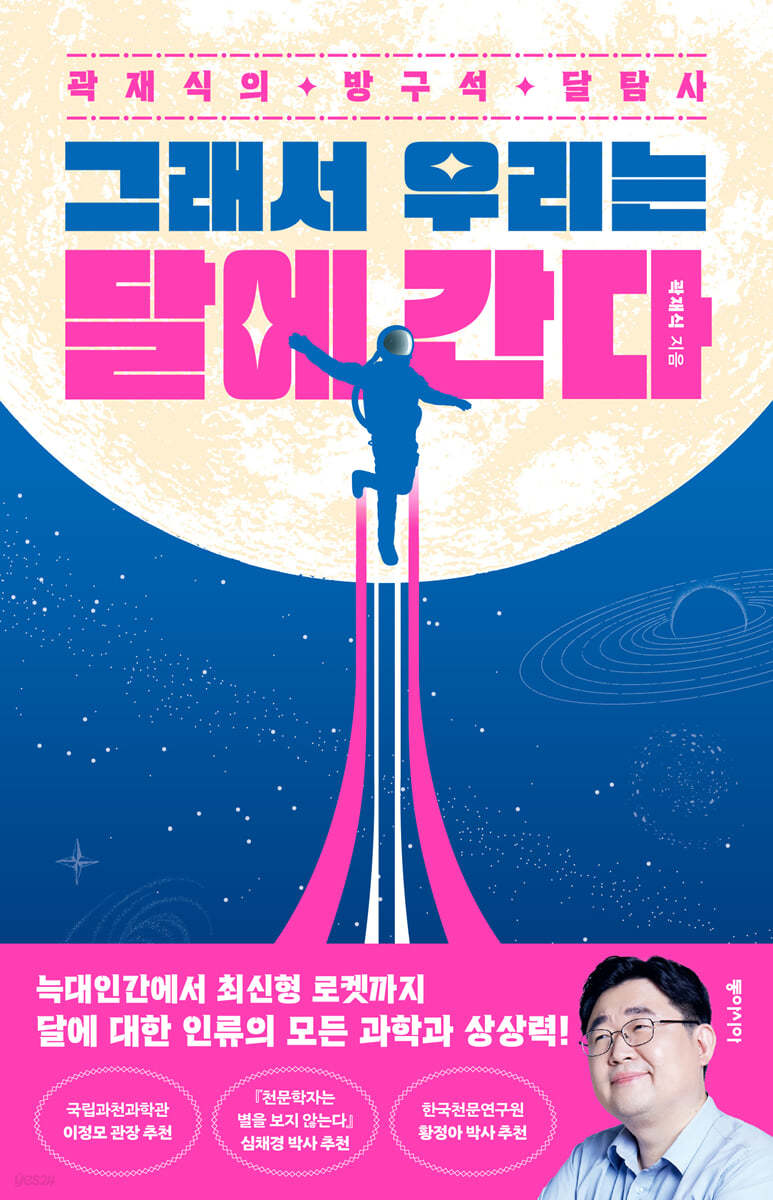
So we go to the moon
 |
Description
Book Introduction
Now we're going to the moon? Why on earth? 14 Reasons Why We Should Go to the Moon Now Freely crossing between fiction and non-fiction, science and imagination Kwak Jae-sik, a lively and cheerful storyteller of our time Let's talk about the moon as the Age of Exploration and Space Exploration returns! Science writer Kwak, this time it's the moon! A guide to a lunar journey aboard Korea's first lunar probe, Danuri. “Why are we spending so much money? “Should we do research that involves going into space?” This question is posed to the readers who open this book, and it is also a question that the author himself has been pondering for a long time. The author, who is known as a chemist, professor, and science fiction writer, is already well-known for his active and diverse activities. At the root of this amazing energy is a curiosity that always seeks new learning. And the 'moon' could not escape from such curiosity either. Because the moon is the closest object to Earth that can affect it on a cosmic scale. So, the moon has been historically and culturally inseparable from people's lives, and has left its mark on every aspect of human life. Although it has only been a little over 50 years since humans first set foot on the moon on July 20, 1969, the history of the moon leaving footprints on Earth is truly age-old. And in August 2022, Korea's first lunar probe, Danuri, will head to the moon. The author collected various stories about the moon and Danuri to satisfy his own curiosity, and wove them into a single story by mixing new stories with existing experiences. "So We Go to the Moon" is the answer the author obtained and a clear guide to lunar exploration that he presents to readers. In this new era of space exploration, where private companies are launching rockets by the dozens and hundreds, and emerging powers like India and China are rushing into space exploration, why are we spending enormous sums of money to reach the moon? The author, a scientist, intellectual, and science fiction writer, combines his knowledge, curiosity, and imagination to offer the answer. So we go to the moon. So we have to go to the moon! |
- You can preview some of the book's contents.
Preview
index
Entering
1.
Where did the moon come from?
2.
The secret to dinosaur extinction is found on the moon.
3.
Why do werewolves transform when they see the full moon?
4.
Does the moon determine a person's fate?
5.
Why do tides occur?
6.
Silla, the Kingdom of the Moon
7.
Joseon's dream of traveling to the moon
8.
Soviet Union shoots at the far side of the moon
9.
Small steps, giant leaps
10.
So Apollo really went to the moon?
11.
Earthlings who launched astronauts to the moon
12.
People who followed the moon in the night sky
13.
From Earth to the Moon, from the Moon to the Alpaca
14.
Now Danuri is going to the moon
References
1.
Where did the moon come from?
2.
The secret to dinosaur extinction is found on the moon.
3.
Why do werewolves transform when they see the full moon?
4.
Does the moon determine a person's fate?
5.
Why do tides occur?
6.
Silla, the Kingdom of the Moon
7.
Joseon's dream of traveling to the moon
8.
Soviet Union shoots at the far side of the moon
9.
Small steps, giant leaps
10.
So Apollo really went to the moon?
11.
Earthlings who launched astronauts to the moon
12.
People who followed the moon in the night sky
13.
From Earth to the Moon, from the Moon to the Alpaca
14.
Now Danuri is going to the moon
References
Detailed image

Into the book
In the past, people thought that when a phenomenon like an earthquake occurred, it was just a disaster sent from the heavens and there was nothing they could do about it.
But we cannot stand still in such an era.
The Korean Peninsula is adjacent to Japan, one of the most earthquake-prone regions in the world, and has experienced significant earthquake damage in Gyeongju, Pohang, and other areas in the 21st century.
Research into understanding the structure of the Earth and the principles of geological phenomena cannot be left to other powerful nations forever.
In a country where the entire nation is so interested in real estate, it seems unreasonable to lack research into the root causes of geological phenomena that destroy buildings and split the land.
--- p.30
The moon is a great place to study the impact marks of asteroids and comets.
First of all, because there is no air on the moon, the phenomenon of small rocks falling from space and burning up due to friction with the air does not occur.
So, whether big or small, when a rock hits the moon, it falls and leaves a mark.
Even a small grain of sand, let alone a large rock, can fall to the moon from space and cause an impact.
So the Moon has far more meteorite impact scars than the Earth.
This phenomenon is also a concern for people going to the moon to work or building a base and living there.
--- p.39
Researchers at Princeton University announced in 2017 that animals in the Serengeti plains of Africa have a special habit of responding to the moon.
Many mammals are nocturnal, meaning they are active at night.
Some scholars have speculated that this may have been a skill developed during the time when dinosaurs existed to survive and avoid the eyes of dinosaurs.
For the herbivores of the Serengeti plains, they still need to hide from carnivores.
However, on bright moonlit days, they become more visible to predators at night.
So, it is said that when the full moon rises, herbivores tend to become more sensitive and more alert.
Moonlight may not have the power to change people's hearts, but it does seem to have the power to at least slightly alter the behavior of a herd of buffalo on the prairie.
--- p.66
Furthermore, it will help you see the world in a more concrete and realistic way, freeing you from the vague, old imaginations about the sun, moon, sky, and time.
And that world is not a place where our future is determined by some intangible celestial magic, but a place where the future can be created through the efforts of workers who build rockets and calculate their orbits.
The moon will become a space where we can go, touch, and enjoy ourselves to our heart's content, free from the deity that bestows upon us the fate of the unlucky moon.
--- p.90
One of the most famous pieces of evidence supporting the moon landing hoax theory is the appearance of the flag planted on the moon fluttering in promotional photos.
When I first heard about the moon landing hoax theory from a friend in the 1990s, this was the first thing I heard.
If it's a photo of a national flag, shouldn't it be fluttering? What's wrong with that? It's a cool photo. If you pretend not to understand why the photo is problematic, the conspiracy theorist will proudly reveal some incredible secret.
--- p.203
He is worried.
You have to decide whether to ignore them and tell them to go away, or give up and tell them to come back.
Fortunately, Margaret Hamilton and her colleagues had already created a feature that could solve this problem.
It was later revealed that the incident was caused by radar being activated when it was not supposed to be activated for some reason.
Apollo 11's computer was not large enough to handle landing calculations and radar calculations simultaneously.
However, as unnecessary radar control commands continued to come into the computer, the computer could not handle the excessive calculations and caused errors.
If you do something wrong, you could lose the ability to use your computer or pilot your spaceship.
--- p.203
Some time later, Roberts was caught by the authorities while trying to secretly sell the moon rock, and was arrested.
He was found to have stolen over 100 grams of moonstone and was also found to be guilty of other thefts.
It is not known how much 100g would have actually sold for at the time, but that amount would be incomparably larger than the Soviet moon rocks sold at Sotheby's auctions.
Roberts served eight years in prison.
While in prison, with nothing else to do, he became absorbed in the study of science and is said to have reached a considerable level of knowledge in physics and theories of the universe.
So later he wrote a book introducing the laws of the universe, the theory of relativity, quantum theory, and 11-dimensional space, and later went on to become a scholar, but I have no idea what kind of person he is.
--- p.254
Water is the most precious resource in space.
No matter how important helium-3 or rare earth elements are, those resources are merely resources for making money, whereas water is a substance for survival.
Water is even more valuable when separated into hydrogen and oxygen, as it can be used as fuel for spacecraft.
If you can see exactly where the water is, there is no more precious discovery than that.
If you were an explorer who went into the jungle to find rare animals, finding helium-3 on the moon would be like finding a tiger or a leopard, and finding water would be like finding a living dinosaur.
But we cannot stand still in such an era.
The Korean Peninsula is adjacent to Japan, one of the most earthquake-prone regions in the world, and has experienced significant earthquake damage in Gyeongju, Pohang, and other areas in the 21st century.
Research into understanding the structure of the Earth and the principles of geological phenomena cannot be left to other powerful nations forever.
In a country where the entire nation is so interested in real estate, it seems unreasonable to lack research into the root causes of geological phenomena that destroy buildings and split the land.
--- p.30
The moon is a great place to study the impact marks of asteroids and comets.
First of all, because there is no air on the moon, the phenomenon of small rocks falling from space and burning up due to friction with the air does not occur.
So, whether big or small, when a rock hits the moon, it falls and leaves a mark.
Even a small grain of sand, let alone a large rock, can fall to the moon from space and cause an impact.
So the Moon has far more meteorite impact scars than the Earth.
This phenomenon is also a concern for people going to the moon to work or building a base and living there.
--- p.39
Researchers at Princeton University announced in 2017 that animals in the Serengeti plains of Africa have a special habit of responding to the moon.
Many mammals are nocturnal, meaning they are active at night.
Some scholars have speculated that this may have been a skill developed during the time when dinosaurs existed to survive and avoid the eyes of dinosaurs.
For the herbivores of the Serengeti plains, they still need to hide from carnivores.
However, on bright moonlit days, they become more visible to predators at night.
So, it is said that when the full moon rises, herbivores tend to become more sensitive and more alert.
Moonlight may not have the power to change people's hearts, but it does seem to have the power to at least slightly alter the behavior of a herd of buffalo on the prairie.
--- p.66
Furthermore, it will help you see the world in a more concrete and realistic way, freeing you from the vague, old imaginations about the sun, moon, sky, and time.
And that world is not a place where our future is determined by some intangible celestial magic, but a place where the future can be created through the efforts of workers who build rockets and calculate their orbits.
The moon will become a space where we can go, touch, and enjoy ourselves to our heart's content, free from the deity that bestows upon us the fate of the unlucky moon.
--- p.90
One of the most famous pieces of evidence supporting the moon landing hoax theory is the appearance of the flag planted on the moon fluttering in promotional photos.
When I first heard about the moon landing hoax theory from a friend in the 1990s, this was the first thing I heard.
If it's a photo of a national flag, shouldn't it be fluttering? What's wrong with that? It's a cool photo. If you pretend not to understand why the photo is problematic, the conspiracy theorist will proudly reveal some incredible secret.
--- p.203
He is worried.
You have to decide whether to ignore them and tell them to go away, or give up and tell them to come back.
Fortunately, Margaret Hamilton and her colleagues had already created a feature that could solve this problem.
It was later revealed that the incident was caused by radar being activated when it was not supposed to be activated for some reason.
Apollo 11's computer was not large enough to handle landing calculations and radar calculations simultaneously.
However, as unnecessary radar control commands continued to come into the computer, the computer could not handle the excessive calculations and caused errors.
If you do something wrong, you could lose the ability to use your computer or pilot your spaceship.
--- p.203
Some time later, Roberts was caught by the authorities while trying to secretly sell the moon rock, and was arrested.
He was found to have stolen over 100 grams of moonstone and was also found to be guilty of other thefts.
It is not known how much 100g would have actually sold for at the time, but that amount would be incomparably larger than the Soviet moon rocks sold at Sotheby's auctions.
Roberts served eight years in prison.
While in prison, with nothing else to do, he became absorbed in the study of science and is said to have reached a considerable level of knowledge in physics and theories of the universe.
So later he wrote a book introducing the laws of the universe, the theory of relativity, quantum theory, and 11-dimensional space, and later went on to become a scholar, but I have no idea what kind of person he is.
--- p.254
Water is the most precious resource in space.
No matter how important helium-3 or rare earth elements are, those resources are merely resources for making money, whereas water is a substance for survival.
Water is even more valuable when separated into hydrogen and oxygen, as it can be used as fuel for spacecraft.
If you can see exactly where the water is, there is no more precious discovery than that.
If you were an explorer who went into the jungle to find rare animals, finding helium-3 on the moon would be like finding a tiger or a leopard, and finding water would be like finding a living dinosaur.
--- p.291
Publisher's Review
From lunar probes, the moon landing hoax, werewolves, druids, and the Samguk Sagi (History of the Three Kingdoms)
Fourteen stories about the moon, covering all sorts of TMI about the moon.
“I earnestly ask you, parents.
Please don't deny your precious child the chance to see the 'Yonggary' he or she wants.
“Because scientific knowledge gained through enjoyable and healthy imagination creates beautiful dreams.”
This is the promotional slogan that appeared in a newspaper advertisement when the movie “Yonggary: The Monster from the Deep” was released in 1967.
Perhaps no one embodies this phrase better than the author. He's well-versed in science fiction, ghost stories, and monster tales, and he fully displays his expertise in "So We Go to the Moon."
“Yonggary, the Giant Monster” is one of them.
The author freely draws on a variety of sources, including science fiction films, science fiction dramas, European and Korean ghost stories and folktales, to develop a story about the moon.
It's quite a spectacle to see a lunar exploration book written by a scientist that features stories of werewolves, witches, and aliens.
As you follow the way in which seemingly unrelated materials naturally blend together in his hands and weave together into a single piece of writing, you will find yourself exclaiming in admiration.
It is literally a sight of ‘scientific knowledge gained in imagination’ blossoming into a beautiful dream.
But if there's one point that the publicity team for "Yonggary, the Monster, the Giant" failed to consider, it's that science, born from fantasy, can sometimes go far beyond imagination.
The size of the dragonfly in the movie is roughly less than twice the size of the old Seoul City Hall building.
It is estimated to be about 50 to 60 meters tall.
The monsters that appear in other science fiction movies and novels are not much different.
It varies from a few dozen meters to several hundred meters, but is generally not beyond the 'scope of imagination'.
But what if a rocket were to launch? A look at the specifications of the Saturn V rocket, the historic vehicle that led humanity to the moon landing, is intriguing.
It is 111m high and weighs 2,950t.
It's bigger than the mountain behind an average neighborhood.
What's even more astonishing is that this massive, monstrous beast, weighing as much as 300 blue whales, can fly at a staggering 9,920 km/h.
The author is amazed by this sight, where reality surpasses imagination, and wants to share that experience with his readers.
Such novel and innovative approaches are pouring in from all over, captivating readers.
"So We Go to the Moon" does not simply explain the scientific composition of the moon, the principles of lunar exploration rockets, or the justifiable purpose of lunar exploration.
The author uses his own interests and abilities to connect the moon and people's lives from a new perspective, touching on points that readers had never considered.
The scientific knowledge, cultural knowledge, and lifestyles accumulated by mankind over the years combine to create a surprisingly exciting story.
As you delve into this fascinating tale of the moon, blending cutting-edge scientific research, centuries-old historical records, science fiction, and rigorous scientific knowledge, you'll find yourself becoming a "moon expert" without even realizing it.
As humanity looks beyond the distant reaches of space, this is essential reading.
150 days to lunar orbit, faster than a rocket at 11.2 km/s
Kwak Jae-sik's Speed: Guiding Us to the Moon
In August 2022, Korea's first lunar probe, Danuri, will leave Earth carrying BTS's "Dynamite."
It is for space internet file transfer experiments.
In addition, Danuri carries six payloads developed in Korea and the United States.
So to speak, they are robot explorers who replace humans.
A variety of equipment is used to explore the lunar surface soil, water and ice that may be hidden in shaded areas, the magnetic field, and resources underground.
In particular, the Shadow Cam sent by NASA is the main culprit that significantly increased the weight of Danuri, and is also a key piece of equipment for searching for water and ice that may exist on the moon.
If Danuri succeeds in finding water this time, it will become the number one contributor to the 'Artemis Project', a manned lunar exploration mission.
Korea is now emerging as a new power in the era of space development.
However, Danuri will settle into the lunar orbit on December 31st or January 1st of the following year, approximately five months later.
This is because a fairly circular orbit must be chosen to reach the moon while using minimal fuel.
It will take several more months or even a year for the lunar exploration survey results to be sent back from there.
But there is no need to be impatient here.
Because there is an author who will guide us to the moon faster than Danuri can reach the moon.
"So We Go to the Moon" is a lunar exploration guidebook for all readers.
Faster than a man can send a spaceship to the moon, Kwak Jae-sik sends readers to the moon.
The story of the moon that he paints with a single stroke of his hand is filled with all kinds of stories about the moon, including myths, science, history, and culture, so there is never a dull moment.
Above all, the author's story never ends in the present.
What Kwak Jae-sik is looking at is not just the moon, but the future of humanity beyond lunar exploration.
And through the moon, we will be able to know more about the Earth itself and live better.
Readers of "So We Go to the Moon" will feel a sense of satisfaction from learning all about the moon, and their hearts will be filled with anticipation for the future that Danuri, lunar exploration, and space development will bring us.
With Kwak Jae-sik by my side, the months of waiting for news from Danuri will never be boring and will be a joyful wait.
Fourteen stories about the moon, covering all sorts of TMI about the moon.
“I earnestly ask you, parents.
Please don't deny your precious child the chance to see the 'Yonggary' he or she wants.
“Because scientific knowledge gained through enjoyable and healthy imagination creates beautiful dreams.”
This is the promotional slogan that appeared in a newspaper advertisement when the movie “Yonggary: The Monster from the Deep” was released in 1967.
Perhaps no one embodies this phrase better than the author. He's well-versed in science fiction, ghost stories, and monster tales, and he fully displays his expertise in "So We Go to the Moon."
“Yonggary, the Giant Monster” is one of them.
The author freely draws on a variety of sources, including science fiction films, science fiction dramas, European and Korean ghost stories and folktales, to develop a story about the moon.
It's quite a spectacle to see a lunar exploration book written by a scientist that features stories of werewolves, witches, and aliens.
As you follow the way in which seemingly unrelated materials naturally blend together in his hands and weave together into a single piece of writing, you will find yourself exclaiming in admiration.
It is literally a sight of ‘scientific knowledge gained in imagination’ blossoming into a beautiful dream.
But if there's one point that the publicity team for "Yonggary, the Monster, the Giant" failed to consider, it's that science, born from fantasy, can sometimes go far beyond imagination.
The size of the dragonfly in the movie is roughly less than twice the size of the old Seoul City Hall building.
It is estimated to be about 50 to 60 meters tall.
The monsters that appear in other science fiction movies and novels are not much different.
It varies from a few dozen meters to several hundred meters, but is generally not beyond the 'scope of imagination'.
But what if a rocket were to launch? A look at the specifications of the Saturn V rocket, the historic vehicle that led humanity to the moon landing, is intriguing.
It is 111m high and weighs 2,950t.
It's bigger than the mountain behind an average neighborhood.
What's even more astonishing is that this massive, monstrous beast, weighing as much as 300 blue whales, can fly at a staggering 9,920 km/h.
The author is amazed by this sight, where reality surpasses imagination, and wants to share that experience with his readers.
Such novel and innovative approaches are pouring in from all over, captivating readers.
"So We Go to the Moon" does not simply explain the scientific composition of the moon, the principles of lunar exploration rockets, or the justifiable purpose of lunar exploration.
The author uses his own interests and abilities to connect the moon and people's lives from a new perspective, touching on points that readers had never considered.
The scientific knowledge, cultural knowledge, and lifestyles accumulated by mankind over the years combine to create a surprisingly exciting story.
As you delve into this fascinating tale of the moon, blending cutting-edge scientific research, centuries-old historical records, science fiction, and rigorous scientific knowledge, you'll find yourself becoming a "moon expert" without even realizing it.
As humanity looks beyond the distant reaches of space, this is essential reading.
150 days to lunar orbit, faster than a rocket at 11.2 km/s
Kwak Jae-sik's Speed: Guiding Us to the Moon
In August 2022, Korea's first lunar probe, Danuri, will leave Earth carrying BTS's "Dynamite."
It is for space internet file transfer experiments.
In addition, Danuri carries six payloads developed in Korea and the United States.
So to speak, they are robot explorers who replace humans.
A variety of equipment is used to explore the lunar surface soil, water and ice that may be hidden in shaded areas, the magnetic field, and resources underground.
In particular, the Shadow Cam sent by NASA is the main culprit that significantly increased the weight of Danuri, and is also a key piece of equipment for searching for water and ice that may exist on the moon.
If Danuri succeeds in finding water this time, it will become the number one contributor to the 'Artemis Project', a manned lunar exploration mission.
Korea is now emerging as a new power in the era of space development.
However, Danuri will settle into the lunar orbit on December 31st or January 1st of the following year, approximately five months later.
This is because a fairly circular orbit must be chosen to reach the moon while using minimal fuel.
It will take several more months or even a year for the lunar exploration survey results to be sent back from there.
But there is no need to be impatient here.
Because there is an author who will guide us to the moon faster than Danuri can reach the moon.
"So We Go to the Moon" is a lunar exploration guidebook for all readers.
Faster than a man can send a spaceship to the moon, Kwak Jae-sik sends readers to the moon.
The story of the moon that he paints with a single stroke of his hand is filled with all kinds of stories about the moon, including myths, science, history, and culture, so there is never a dull moment.
Above all, the author's story never ends in the present.
What Kwak Jae-sik is looking at is not just the moon, but the future of humanity beyond lunar exploration.
And through the moon, we will be able to know more about the Earth itself and live better.
Readers of "So We Go to the Moon" will feel a sense of satisfaction from learning all about the moon, and their hearts will be filled with anticipation for the future that Danuri, lunar exploration, and space development will bring us.
With Kwak Jae-sik by my side, the months of waiting for news from Danuri will never be boring and will be a joyful wait.
GOODS SPECIFICS
- Date of issue: August 3, 2022
- Page count, weight, size: 320 pages | 396g | 135*210*16mm
- ISBN13: 9788962624427
- ISBN10: 8962624427
You may also like
카테고리
korean


korean

![GQ KOREA Mark (Monthly): December [2025]](http://librairie.coreenne.fr/cdn/shop/files/8ef265dbbfbf186523ed75ba7319009d.jpg?v=1765340328&width=3840)


