

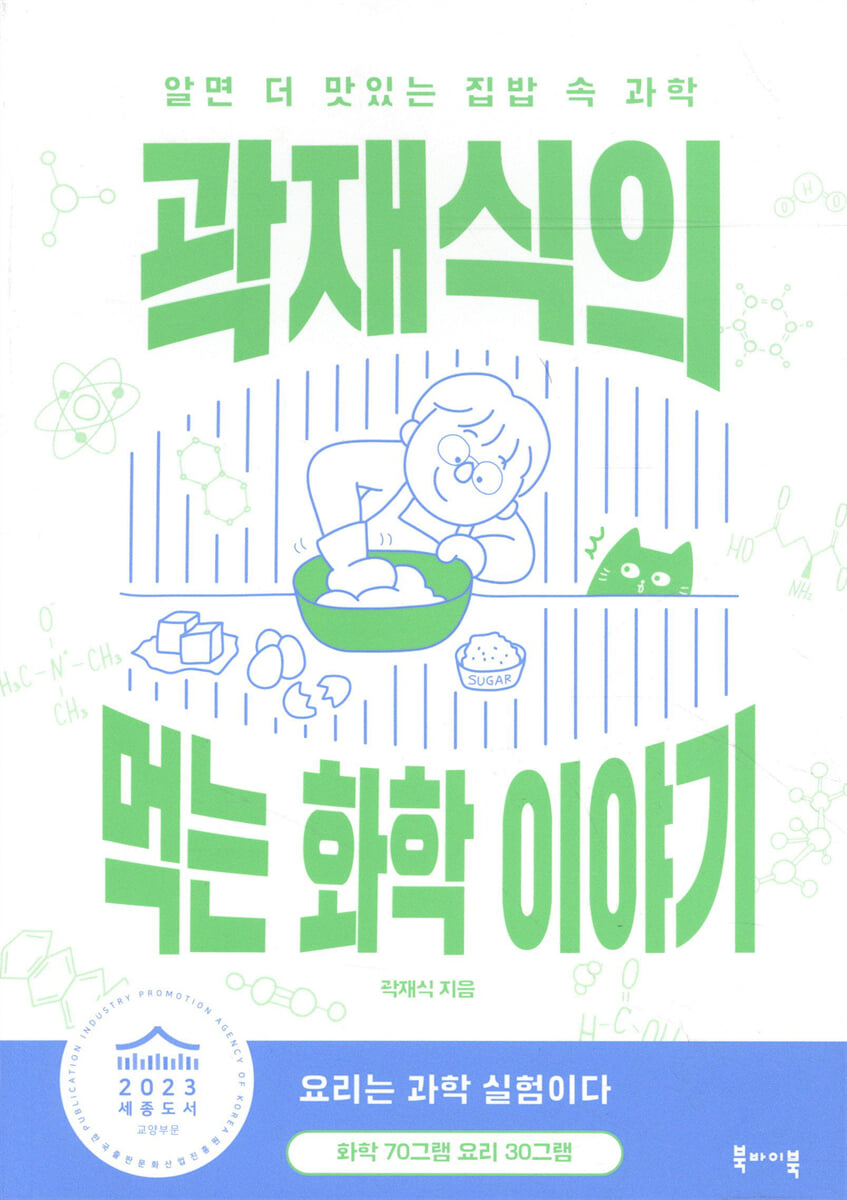
Kwak Jae-sik's Food Chemistry Story
 |
Description
Book Introduction
Home cooking chemistry essay by chemist and novelist Kwak Jae-sik.
The author, who has survived the COVID-19 pandemic by cooking with her family every weekend, has selected sixteen menus and weaved together a variety of stories, including the history of ingredients, the chemical principles behind cooking, and precious memories.
From familiar dishes like tteokbokki, naengmyeon, and kimbap to more difficult-to-make dishes like cake, carbonara, and pizza, we introduce recipes that anyone can easily make using simple tools and ingredients.
It examines food ingredients from an evolutionary perspective, explains the historical events behind them, and explains the key chemical principles that arise during the cooking process in a way that anyone can understand.
As you read along, you will experience the thrill of learning about scientific terms you have heard of but not really understood, such as omega-3, unsaturated fatty acids, and gluten.
The author, who has survived the COVID-19 pandemic by cooking with her family every weekend, has selected sixteen menus and weaved together a variety of stories, including the history of ingredients, the chemical principles behind cooking, and precious memories.
From familiar dishes like tteokbokki, naengmyeon, and kimbap to more difficult-to-make dishes like cake, carbonara, and pizza, we introduce recipes that anyone can easily make using simple tools and ingredients.
It examines food ingredients from an evolutionary perspective, explains the historical events behind them, and explains the key chemical principles that arise during the cooking process in a way that anyone can understand.
As you read along, you will experience the thrill of learning about scientific terms you have heard of but not really understood, such as omega-3, unsaturated fatty acids, and gluten.
- You can preview some of the book's contents.
Preview
index
1.
Tteokbokki: The Secret of Evolution Hidden in Spicy Flavor
The Spicy Flavor of Nostalgia│The moment when Koreans truly began to enjoy spicy food│The birth of modern tteokbokki│Why do people cry while eating tteokbokki?
2.
Perilla Leaf Salad: Traces of Evolution Rising from the Fragrance of Perilla Leaves
Pierre Magnole's Fruit│Sesame Fruit and Perilla Fruit│That Good Perilla Leaf Fragrance│It's Perfect When You Sprinkle Sesame Seeds at the End
3.
Onion Fries: The Dawn of the Fried Era in 1971
The Beauty of Soybean Oil│The Birth of Fried Food and Oil│The Secret to Squeezing Soybean Oil│The Crispy Flavor of Fried Onions
4.
Cake: The Sugar Revolution
The Biggest Problem with Pound Cake│Lavoisier and the 1 Meter│The Flames of Revolution Spread to the Caribbean│The Sugar Revolution Returns to Korea│Baekgram Cake Instead of Pound Cake
5.
Kimbap: The Taste of Neutron Stars
Living Transformation Jewel│The Legend of Kim│How to Confidently Roll Kimbap│Cobalt, the Element of Life
6.
Butter Cookie: Fire a super-powerful microwave.
How to Make Simple Cookies│Chief Spencer Bakes Popcorn with Radar Components│How Microwaves Cook Food
7.
Ramen: A scientist who devises his own ramen recipe.
The Meaning of Matching in Cheese Ramen│My Ramen Recipe│Ramen and Phase Change
8.
Bread: A creature resembling a person raised in the kitchen
Yeast: The Baker's Fairy | The Life of Yeast | Bread and Quantum Theory | Is There Anything Better Than Yeast?
9.
Fried Rice: Studying 5,000-Year-Old Rice with an Electron Gun
Kawaji's Discovery│Studying 5,000-Year-Old Rice Grains│The Advent of Particle Accelerators│What Did Old-Time Fried Rice Taste Like?
10.
Carbonara: The Secret of Life
Encounter with Carbonara | Carbonara and Carbon | Why Do Eggs Harden When Cooked? | Artificial Intelligence Solving the Protein Folding Problem
11.
Naengmyeon: A Miracle of Modern Culinary Science
Treasures of Hwangdeungsan │ The Mystery of Savory Flavor │ Cold Noodles and Seasoning │ The Treasure of Flavor │ The War of Seasonings
12.
Pizza: With the heart of making rhinoceros horn
The Difference Between Rice Cakes and Bread│The Tradition of Korean Pizza│Concerns About Sweet Potato Pizza│Why Europeans Eat Bread and East Asians Eat Rice│The Value of Gluten-Free
13.
Grilled Mackerel: The Alpha and Omega of Savory Flavors
What are Omega-3s? │Why are unsaturated fats better? │How to grill mackerel. │Mackerel of Light.
14.
Acorn Jelly: The Relationship Between the Symbol of the Knights of Malta and Acorn Jelly
The Knights of Malta's Coat of Arms│Why Acorn Powder Becomes Jelly│Eating Acorn Jelly│Where Do Acorns Come From?
15.
Bulgogi: What Roasted Coffee Beans and Bulgogi Have in Common
Proteins and Amino Acids: The Ingredients of Life│The Emergence of the Maillard Reaction│Theory of Grilling Meat│The Birth of Bulgogi
16.
Burgers: The Road to the Best Burger
Making Hamburger Meat│The Miracle Sword in Your Kitchen│The Order of Stacking Hamburger Ingredients
Tteokbokki: The Secret of Evolution Hidden in Spicy Flavor
The Spicy Flavor of Nostalgia│The moment when Koreans truly began to enjoy spicy food│The birth of modern tteokbokki│Why do people cry while eating tteokbokki?
2.
Perilla Leaf Salad: Traces of Evolution Rising from the Fragrance of Perilla Leaves
Pierre Magnole's Fruit│Sesame Fruit and Perilla Fruit│That Good Perilla Leaf Fragrance│It's Perfect When You Sprinkle Sesame Seeds at the End
3.
Onion Fries: The Dawn of the Fried Era in 1971
The Beauty of Soybean Oil│The Birth of Fried Food and Oil│The Secret to Squeezing Soybean Oil│The Crispy Flavor of Fried Onions
4.
Cake: The Sugar Revolution
The Biggest Problem with Pound Cake│Lavoisier and the 1 Meter│The Flames of Revolution Spread to the Caribbean│The Sugar Revolution Returns to Korea│Baekgram Cake Instead of Pound Cake
5.
Kimbap: The Taste of Neutron Stars
Living Transformation Jewel│The Legend of Kim│How to Confidently Roll Kimbap│Cobalt, the Element of Life
6.
Butter Cookie: Fire a super-powerful microwave.
How to Make Simple Cookies│Chief Spencer Bakes Popcorn with Radar Components│How Microwaves Cook Food
7.
Ramen: A scientist who devises his own ramen recipe.
The Meaning of Matching in Cheese Ramen│My Ramen Recipe│Ramen and Phase Change
8.
Bread: A creature resembling a person raised in the kitchen
Yeast: The Baker's Fairy | The Life of Yeast | Bread and Quantum Theory | Is There Anything Better Than Yeast?
9.
Fried Rice: Studying 5,000-Year-Old Rice with an Electron Gun
Kawaji's Discovery│Studying 5,000-Year-Old Rice Grains│The Advent of Particle Accelerators│What Did Old-Time Fried Rice Taste Like?
10.
Carbonara: The Secret of Life
Encounter with Carbonara | Carbonara and Carbon | Why Do Eggs Harden When Cooked? | Artificial Intelligence Solving the Protein Folding Problem
11.
Naengmyeon: A Miracle of Modern Culinary Science
Treasures of Hwangdeungsan │ The Mystery of Savory Flavor │ Cold Noodles and Seasoning │ The Treasure of Flavor │ The War of Seasonings
12.
Pizza: With the heart of making rhinoceros horn
The Difference Between Rice Cakes and Bread│The Tradition of Korean Pizza│Concerns About Sweet Potato Pizza│Why Europeans Eat Bread and East Asians Eat Rice│The Value of Gluten-Free
13.
Grilled Mackerel: The Alpha and Omega of Savory Flavors
What are Omega-3s? │Why are unsaturated fats better? │How to grill mackerel. │Mackerel of Light.
14.
Acorn Jelly: The Relationship Between the Symbol of the Knights of Malta and Acorn Jelly
The Knights of Malta's Coat of Arms│Why Acorn Powder Becomes Jelly│Eating Acorn Jelly│Where Do Acorns Come From?
15.
Bulgogi: What Roasted Coffee Beans and Bulgogi Have in Common
Proteins and Amino Acids: The Ingredients of Life│The Emergence of the Maillard Reaction│Theory of Grilling Meat│The Birth of Bulgogi
16.
Burgers: The Road to the Best Burger
Making Hamburger Meat│The Miracle Sword in Your Kitchen│The Order of Stacking Hamburger Ingredients
Detailed image
.jpg)
Into the book
Rather than focusing on explaining overly difficult chemical reactions, the overall content of this book is more like a compilation of various knowledge that can be directly or indirectly related to cooking, centered around chemistry, in an easy-to-read format.
I thought that by weaving together stories from such diverse perspectives, it would be more clearly revealed that knowledge from various fields is gathered in every moment of ordinary, everyday life, and that the principles of science and technology and the research process are also implicit.
--- p.7
I believe that the establishment of the SI unit culture in Korea has clearly contributed to Korea's development.
If there's one thing Korea can boast about compared to other countries, it's that its people are good at using SI units.
Even when ordering beer at a pub, they ask for 3000 or 1700.
Here, the word 3000 means 3000 si, that is, 3000 milliliters, and milliliters is a word derived from the SI unit, which is the international standard.
Non-standard units like ounces, pints, and gallons are not used even when drunk and drunk. This is the spirit of the Korean people who have been steadily developing technology, science, economy, and culture since the mid-20th century.
--- pp.89-91
Instead of making pound cake, I'm thinking about using the metric system, which was born with the revolution and has become the world's standard.
Starting with 100 grams of sugar, 100 grams of butter, 100 grams of egg, and 100 grams of flour, mix 100 grams of each of the four ingredients to make the dough and make a cake. It won't be a large cake, but it's enough to make two or three muffin- or cupcake-sized cakes.
This is the perfect amount to prepare as a simple dessert for a 21st century dinner.
The name Baekgram Cake is perfect.
--- p.102
On the other hand, when using a microwave, I think it would be good to think about what the ladder of opportunity is like.
Percy Spencer was a factory worker who had to give up his studies due to poverty and get a job first, but he was interested in new technologies and had the opportunity to explore them further.
Capitalizing on that interest, I further developed my skills in the military, and based on those skills, I was able to work for a high-tech company, where I also had the opportunity to demonstrate my research achievements and creativity.
Stories like these make it seem like the world isn't just about the geniuses who were called prodigies from a young age, or the people who succeeded in passing major exams and building successful careers in their 20s and 30s.
The world, at least occasionally, changes because a 50-year-old man wonders why his snack melted in a factory machine.
--- p.142
If you look at old cartoons, there are scenes where people curse at the other person by saying things like, "You idiot, you idiot, you snail, you euglena," meaning that the other person's way of thinking is too simple.
Sometimes, among those curses, there are also curses like “This guy is worse than bacteria” and “He’s like a virus in the world.”
If you look closely, bacteria is the English and Latin name for germs.
Therefore, compared to insults like bacteria or viruses, insults like "parasite bug" or "euglena" are so good that they are on a whole other level.
Although paramecium and euglena are also microorganisms, they have a nucleus in their bodies and are not very different in structure from human cells.
It resembles humans to a similar degree to yeast.
--- p.177
Glutamic acid was a bit inconvenient to use as a seasoning, and its effect was weaker than expected.
So Ikeda devised a way to turn glutamic acid into a powder that would be more soluble in water and easier to use by adding sodium, which is derived from salt.
Thus, monosodium glutamate, a glutamic acid with one sodium atom, was born, and the abbreviation for this substance became very famous.
It's MSG.
I thought that by weaving together stories from such diverse perspectives, it would be more clearly revealed that knowledge from various fields is gathered in every moment of ordinary, everyday life, and that the principles of science and technology and the research process are also implicit.
--- p.7
I believe that the establishment of the SI unit culture in Korea has clearly contributed to Korea's development.
If there's one thing Korea can boast about compared to other countries, it's that its people are good at using SI units.
Even when ordering beer at a pub, they ask for 3000 or 1700.
Here, the word 3000 means 3000 si, that is, 3000 milliliters, and milliliters is a word derived from the SI unit, which is the international standard.
Non-standard units like ounces, pints, and gallons are not used even when drunk and drunk. This is the spirit of the Korean people who have been steadily developing technology, science, economy, and culture since the mid-20th century.
--- pp.89-91
Instead of making pound cake, I'm thinking about using the metric system, which was born with the revolution and has become the world's standard.
Starting with 100 grams of sugar, 100 grams of butter, 100 grams of egg, and 100 grams of flour, mix 100 grams of each of the four ingredients to make the dough and make a cake. It won't be a large cake, but it's enough to make two or three muffin- or cupcake-sized cakes.
This is the perfect amount to prepare as a simple dessert for a 21st century dinner.
The name Baekgram Cake is perfect.
--- p.102
On the other hand, when using a microwave, I think it would be good to think about what the ladder of opportunity is like.
Percy Spencer was a factory worker who had to give up his studies due to poverty and get a job first, but he was interested in new technologies and had the opportunity to explore them further.
Capitalizing on that interest, I further developed my skills in the military, and based on those skills, I was able to work for a high-tech company, where I also had the opportunity to demonstrate my research achievements and creativity.
Stories like these make it seem like the world isn't just about the geniuses who were called prodigies from a young age, or the people who succeeded in passing major exams and building successful careers in their 20s and 30s.
The world, at least occasionally, changes because a 50-year-old man wonders why his snack melted in a factory machine.
--- p.142
If you look at old cartoons, there are scenes where people curse at the other person by saying things like, "You idiot, you idiot, you snail, you euglena," meaning that the other person's way of thinking is too simple.
Sometimes, among those curses, there are also curses like “This guy is worse than bacteria” and “He’s like a virus in the world.”
If you look closely, bacteria is the English and Latin name for germs.
Therefore, compared to insults like bacteria or viruses, insults like "parasite bug" or "euglena" are so good that they are on a whole other level.
Although paramecium and euglena are also microorganisms, they have a nucleus in their bodies and are not very different in structure from human cells.
It resembles humans to a similar degree to yeast.
--- p.177
Glutamic acid was a bit inconvenient to use as a seasoning, and its effect was weaker than expected.
So Ikeda devised a way to turn glutamic acid into a powder that would be more soluble in water and easier to use by adding sodium, which is derived from salt.
Thus, monosodium glutamate, a glutamic acid with one sodium atom, was born, and the abbreviation for this substance became very famous.
It's MSG.
--- p.243
Publisher's Review
▶ The science behind home cooking that makes it even more delicious when you know how to cook it
▶ A combination of cooking, science, history, illustrations, and essays
▶ Explains the history of food ingredients and the chemical principles of cooking processes with unique wit and knowledge!
“Cooking is a process that involves using fire to cook, cutting with a knife, and adding seasonings containing various ingredients to change the properties of the ingredients in various ways. Therefore, the core of cooking cannot help but be about the chemical reaction that changes one ingredient into another.
So, it is no exaggeration to say that cooking is ‘edible chemistry.’ (From ‘Introduction’)
Since the pandemic began in the spring of 2020, everyone has been searching for their own way out.
Since the escape route had to be 'inside the house', it mainly consisted of interior design, games, OTT services, and online video meetings.
The author cooked with his family every weekend during the COVID-19 pandemic.
Under the title “Kwak Jae-sik’s Sunday Cooking!”, he has been consistently cooking at home, and with over 100 episodes to date, he has selected 16 menus and woven various stories, such as the history and scientific knowledge related to cooking, and the author’s precious memories, into each dish.
◈ What makes home cooking different from that of a chemist?
- A wonderful and hearty dish that can be made without an oven or expensive ingredients.
A home-cooked meal prepared by a chemist seems like it would be a different kind of cooking experience from that of a culinary researcher.
For example, should we say that the handling of nutrients, ingredients, and amounts will be done very chemically and physically precisely?
It's a mistake.
On the other hand, it is true.
Every weekend, Ji-eun cooks home-cooked meals using simple ingredients found in the refrigerator or at the supermarket near her house, and simple tools found in every home.
For example, even for a somewhat unreasonable request like “Monster Cupcakes,” I use my imagination to the fullest extent possible to create a shape that matches the title.
Although the early results were rather crude, I consistently combined common ingredients and cooked them “together.”
When I posted photos of dishes made with that principle on social media, many readers started showing interest.
Although this book starts out as a chemist's simple home cooking, it does not contain detailed recipes.
For kimbap, put in the ingredients you want, spread the seasoned rice, fold it in half, and roll it up. For pound cake, put in 100 grams of each ingredient, stir well, and microwave it.
The author also says, “If you want true cooking instruction, it is a hundred times better to follow the advice of a professional.”
Rather, thanks to these simple cooking instructions, readers feel like they can make it too, and they even laugh at the simple recipe.
You can bake cookies without an oven, and you can make pizza or bulgogi without fancy ingredients, so you'll feel motivated to cook.
On the other hand, no matter what anyone says, isn't he a chemist?
The scientific knowledge he shares before and after his simple and reasonable cooking instructions, the historical stories surrounding food ingredients, and his beliefs about the International System of Units, the standard weights and measures, make you nod in agreement with the expert, and this forms the true essence of this book.
◈ Why do I cry when I cut an onion?
- A very friendly scientific knowledge and historical story related to cooking.
The cooking process itself is similar to a typical scientific research process, where you use different ingredients, adjust the amounts, and change the way you use them, and you ponder and consider how and why the results change.
That is why this book contains a variety of scientific knowledge.
Although the main topic is chemistry, it also presents a feast of scientific knowledge surrounding cooking, from evolutionary approaches to physical knowledge.
Why do I cry when I cut an onion?
Why do people enjoy spicy food even if it makes them cry?
Is MSG really bad for you?
How does bread rise?
How does a microwave cook food?
What is Omega and what is 3?
Reading scientific and historical stories like these allows us to revisit the foods, ingredients, and cooking tools we often eat and use in our daily lives.
The good thing about learning this knowledge through this book is that the explanations are so easy that even elementary school students can understand them.
It provides step-by-step, friendly explanations of scientific terms that the public may have heard of but not yet fully understood, without any content that may be unfamiliar or difficult to understand.
It also raises questions about phenomena that we often encounter without much thought during the cooking process, such as why eggs harden in hot water, and provides step-by-step explanations of the chemical principles that arise there.
Thanks to this, even readers who are not very knowledgeable about science can feel proud of having read a very useful science textbook.
◈ The microwave oven was developed by an ordinary office worker in his 50s!
- A warm perspective on life and conviction as a chemist
It's a science textbook, but reading it strangely warms my heart and makes me feel cheerful.
The mere fact that she spent time cooking with her family during the pandemic brings a smile to the author's face when she reminisces about food.
The anecdote from my childhood about how I discovered that the spiciness of seasoned chicken didn't bother me while I was eating it, and the story from my college days about how I felt like a true adult when I found a favorite menu at my favorite pasta restaurant, reminds me of the place that the act of eating holds in human life.
The author's perspective on life also resonates with me.
The story of Percy Spencer, a man in his fifties with limited education due to difficult circumstances, developing the microwave oven through his persistent efforts in one corner of his life without giving up on his interests, and how it greatly influenced human eating habits, reminds us that human life can develop even through ordinary people.
Maybe that's why.
Ovens don't appear in this book, but microwaves do appear frequently.
The author's strong insistence on using SI units in the chapter on pound cake is noteworthy.
He laments how non-standard units like inches, pounds, ounces, yards, miles, barrels, gallons, and degrees Fahrenheit are hindering scientific and technological progress, and when he asks if K-pop is popular because “in America, there’s a band like Nine Inch Nails, but in Korea, there’s 10cm,” it makes you laugh out loud, but at the same time, you can feel his conviction as a scientist.
In this way, a new educational book was born that combines cooking, science, history, and essays.
The rich illustrations help you understand the content and add to the fun, and the simple tasting notes included for each menu item bring a smile to your face as they remind you of a peaceful time spent with a family.
▶ A combination of cooking, science, history, illustrations, and essays
▶ Explains the history of food ingredients and the chemical principles of cooking processes with unique wit and knowledge!
“Cooking is a process that involves using fire to cook, cutting with a knife, and adding seasonings containing various ingredients to change the properties of the ingredients in various ways. Therefore, the core of cooking cannot help but be about the chemical reaction that changes one ingredient into another.
So, it is no exaggeration to say that cooking is ‘edible chemistry.’ (From ‘Introduction’)
Since the pandemic began in the spring of 2020, everyone has been searching for their own way out.
Since the escape route had to be 'inside the house', it mainly consisted of interior design, games, OTT services, and online video meetings.
The author cooked with his family every weekend during the COVID-19 pandemic.
Under the title “Kwak Jae-sik’s Sunday Cooking!”, he has been consistently cooking at home, and with over 100 episodes to date, he has selected 16 menus and woven various stories, such as the history and scientific knowledge related to cooking, and the author’s precious memories, into each dish.
◈ What makes home cooking different from that of a chemist?
- A wonderful and hearty dish that can be made without an oven or expensive ingredients.
A home-cooked meal prepared by a chemist seems like it would be a different kind of cooking experience from that of a culinary researcher.
For example, should we say that the handling of nutrients, ingredients, and amounts will be done very chemically and physically precisely?
It's a mistake.
On the other hand, it is true.
Every weekend, Ji-eun cooks home-cooked meals using simple ingredients found in the refrigerator or at the supermarket near her house, and simple tools found in every home.
For example, even for a somewhat unreasonable request like “Monster Cupcakes,” I use my imagination to the fullest extent possible to create a shape that matches the title.
Although the early results were rather crude, I consistently combined common ingredients and cooked them “together.”
When I posted photos of dishes made with that principle on social media, many readers started showing interest.
Although this book starts out as a chemist's simple home cooking, it does not contain detailed recipes.
For kimbap, put in the ingredients you want, spread the seasoned rice, fold it in half, and roll it up. For pound cake, put in 100 grams of each ingredient, stir well, and microwave it.
The author also says, “If you want true cooking instruction, it is a hundred times better to follow the advice of a professional.”
Rather, thanks to these simple cooking instructions, readers feel like they can make it too, and they even laugh at the simple recipe.
You can bake cookies without an oven, and you can make pizza or bulgogi without fancy ingredients, so you'll feel motivated to cook.
On the other hand, no matter what anyone says, isn't he a chemist?
The scientific knowledge he shares before and after his simple and reasonable cooking instructions, the historical stories surrounding food ingredients, and his beliefs about the International System of Units, the standard weights and measures, make you nod in agreement with the expert, and this forms the true essence of this book.
◈ Why do I cry when I cut an onion?
- A very friendly scientific knowledge and historical story related to cooking.
The cooking process itself is similar to a typical scientific research process, where you use different ingredients, adjust the amounts, and change the way you use them, and you ponder and consider how and why the results change.
That is why this book contains a variety of scientific knowledge.
Although the main topic is chemistry, it also presents a feast of scientific knowledge surrounding cooking, from evolutionary approaches to physical knowledge.
Why do I cry when I cut an onion?
Why do people enjoy spicy food even if it makes them cry?
Is MSG really bad for you?
How does bread rise?
How does a microwave cook food?
What is Omega and what is 3?
Reading scientific and historical stories like these allows us to revisit the foods, ingredients, and cooking tools we often eat and use in our daily lives.
The good thing about learning this knowledge through this book is that the explanations are so easy that even elementary school students can understand them.
It provides step-by-step, friendly explanations of scientific terms that the public may have heard of but not yet fully understood, without any content that may be unfamiliar or difficult to understand.
It also raises questions about phenomena that we often encounter without much thought during the cooking process, such as why eggs harden in hot water, and provides step-by-step explanations of the chemical principles that arise there.
Thanks to this, even readers who are not very knowledgeable about science can feel proud of having read a very useful science textbook.
◈ The microwave oven was developed by an ordinary office worker in his 50s!
- A warm perspective on life and conviction as a chemist
It's a science textbook, but reading it strangely warms my heart and makes me feel cheerful.
The mere fact that she spent time cooking with her family during the pandemic brings a smile to the author's face when she reminisces about food.
The anecdote from my childhood about how I discovered that the spiciness of seasoned chicken didn't bother me while I was eating it, and the story from my college days about how I felt like a true adult when I found a favorite menu at my favorite pasta restaurant, reminds me of the place that the act of eating holds in human life.
The author's perspective on life also resonates with me.
The story of Percy Spencer, a man in his fifties with limited education due to difficult circumstances, developing the microwave oven through his persistent efforts in one corner of his life without giving up on his interests, and how it greatly influenced human eating habits, reminds us that human life can develop even through ordinary people.
Maybe that's why.
Ovens don't appear in this book, but microwaves do appear frequently.
The author's strong insistence on using SI units in the chapter on pound cake is noteworthy.
He laments how non-standard units like inches, pounds, ounces, yards, miles, barrels, gallons, and degrees Fahrenheit are hindering scientific and technological progress, and when he asks if K-pop is popular because “in America, there’s a band like Nine Inch Nails, but in Korea, there’s 10cm,” it makes you laugh out loud, but at the same time, you can feel his conviction as a scientist.
In this way, a new educational book was born that combines cooking, science, history, and essays.
The rich illustrations help you understand the content and add to the fun, and the simple tasting notes included for each menu item bring a smile to your face as they remind you of a peaceful time spent with a family.
GOODS SPECIFICS
- Date of issue: August 1, 2022
- Page count, weight, size: 380 pages | 528g | 140*200*22mm
- ISBN13: 9791190812436
- ISBN10: 1190812436
You may also like
카테고리
korean


korean

![GQ KOREA Mark (Monthly): December [2025]](http://librairie.coreenne.fr/cdn/shop/files/8ef265dbbfbf186523ed75ba7319009d.jpg?v=1765340328&width=3840)


